
2014新版PEP小学英语四年级下册第六单元教案
Unit6 Shopping第一课时主备人:王春燕副备人:李华伟一、教学目标:1、能够听、说、认读本课时的主要句型:Can I try them on. Let's try size 7.They're just right.2、能够跟录音朗读对话并进行表演。
二、教具准备:教学光盘、单词卡片。
三、教学重点:学习新句型:Can I try them on. Let's try size 7.They're just right.四、教学难点:在情景交际中正确使用本课时的新句型。
五、教学过程:复习引题1、日常口语训练。
教学新课1、教师出示Let’s learn部分的挂图,让孩子表演图中的情景,教师与学生共同表演对话。
教师挑出两双鞋,一双适合自己的脚,另一双或大或小,然后让学生猜哪一双是自己的鞋,引出新句型的教学。
2、教师指导学生做问答练习,然后调查同伴的鞋的号码,进行小组汇报。
3、待学生能够熟悉句型后,教师为学生放VCD,让学生感知对话内容。
4、学生跟录音朗读课文,教师指导学生朗读。
学生分角色朗读对话。
巩固练习1、教师播放一段购物的视频录像,孩子观看录像后用自己学过的句子和单词进行描述。
2、小组交流自己看到的内容。
布置作业1、听第58页的Let’s talk 部分的录音,读给同伴、朋友或家长听。
五、板书设计Can I try them on. Let's try size 7.They're just right.第二课时主备人:王春燕副备人:李华伟一、教学目标:1、学习四个名词sunglasses, gloves, umbrella, scarf。
2、在A部分对话的基础上,运用本课时及A部分学过内容进行实际的交际活动。
二、教具准备:教学光盘、单词卡片。
三、教学重点:本课时的四个单词。
四、教学难点:在实际情境中运用词汇。
五、教学过程:复习引题1、Let’s talk:学生读一读,并进行角色表演。
3、Guessing game:教师将各种标有价钱的衣服放到一个大储物袋中,让学生猜一猜里面有什么,学生猜对后,取出并描述一下大小、价钱等。
教学新课1、教师出示大挂图,让孩子结合图说一说What can you see? 引出新单词。
2、通过引入情景表演,描述图中的各种物品。
3、学生进行情景表演练习,并熟悉新的单词。
4、出示课件,让孩子观看课件(关掉声音),根据故事的内容给课件配音5、播放课件,孩子看课件理解含义。
6、孩子分角色跟读。
巩固练习1、做Complete and say的练习,先以两人一组完成表格填空,然后全班展示。
2、做作业本上配套的练习。
布置作业1、读课文第59页;2、用英语向家长介绍自己的衣物。
板书设计sunglasses, gloves, umbrella, scarf主备人:王春燕副备人:李华伟一、教学目标:1、复习本册的所有字母组合的发音。
2、能听、说、读、写本册的四会单词。
二、教具准备:教学光盘、单词卡片。
三、教学重点:能听、说、读、写本册的四会单词。
四、教学难点:正确书写本册的四会单词。
五、教学过程:复习引题1、师生做日常口语练习:A: Can I help you?B: Yes...A: Are they OK?B: ...2、请学生表演A部分Let’s talk的对话。
教学新课1、播放Read aloud的录音,让学生听歌谣。
2、让学生跟着动画学说歌谣,同时可用手打节奏。
3、播放Listen and chant的录音,让学生划出含有字母组合的单词。
巩固练习1、完成作业本上的配套练习。
布置作业1、抄本册四会单词4+1模式。
板书设计computer dinner girl wall homework nursecard little people world主备人:李华伟副备人:王春燕一、教学目标:1、听懂会说:“Can I help you? How much is this skirt? It's very pretty. That's expensive. It's too expensive.”2、能在实际的情景中运用进行实际交际。
3、培养孩子购物要节约的观念。
二、教具准备:教学光盘、单词卡片。
三、教学重点:句型:Can I help you? How much is this skirt? It's very pretty. That's expensive. It's too expensive.四、教学难点:对新词的读音的指导和规范,如:“eighty-nine yuan.”五、教学过程:复习引题1、日常口语训练。
2、用算术题复习数字,为价格的描述作好准备。
教学新课1、教师通过课件展示各种衣物。
2、教师和孩子们进行对话的交流T: Look at this shirt .It’s colourful.S: Yes, it’s pretty.T: How much is it?S (请一个孩子走到背面翻出价格)It’s one hundred yuan . It’s too expensive.3、教师播放课件,让孩子观看故事,理解内容。
4、再看一边,边看边模仿故事中人物的语气说一说。
5、分角色给课件配音,小组练习和表演。
巩固练习1、孩子运用自己手中的卡片,仿照Let’s talk部分中的对话,进行对话和描述,完成Let act。
布置作业1、听第61页的Let’s talk 部分的录音,读给同伴、朋友或家长听板书设计Can I help you? How much is this skirt?It's very pretty. That's expensive. It's too expensive.第五课时主备人:李华伟副备人:王春燕一、教学目标:1、能够听说认读本课主要单词:nice,pretty, cheap , expensive。
2、能运用句子:It's cheap/pretty/expensive/nice.来描述价格和颜色。
二、教具准备:教学光盘、单词卡片。
三、教学重点:单词:nice,pretty, cheap , expensive。
句子:It's cheap/pretty/expensive/nice.四、教学难点:单词expensive的读音;根据实际情景运用本课时的四个形容词。
五、教学过程:复习引题1、Talk about the weatherWhat’s the weather like toda y?What do you want to wear?2、Show us your clothes孩子们走到台前,介绍一下自己的衣服的颜色,样子。
教学新课1、教师出示几件衣服的实物,并标出价格,说:“Guess, how much is it?”引导学生回答价格,教师追问:“Is it cheap?/Is it pretty?” 引导学生自己表述:“It’s cheap/expensive/ nice /pretty.”教师根据学生的回答适时的出示相应的单词cheap/expensive/ nice /pretty.并进行带读,让孩子进行认读练习。
2、教师出示Let’s learn部分的挂图。
T: “Look at that dress. It’s pretty. I want to buy it.It’s …yuan.”Students try to say like this.3、观看课件展示,跟读练习。
4、小组活动:孩子两人一组。
每个孩子准备一些衣物单词的小卡片,在背面写出价格,两人进行购物的对话练习。
教师先和一个孩子进行示范(T: How much is that nice dress? S:Very expensive.It’s …yuan.T:I want to buy it.)巩固练习1、Guessing game:How much is it? 孩子两人一组,运用一些衣物小卡片,猜测价格。
A: Guess, How much is it?B: It’s twenty yuan .A: No , too cheap. Guess again.B: …2、完成Let's play的练习。
布置作业板书设计单词:nice,pretty, cheap , expensive。
句子:It's cheap/pretty/expensive/nice.第六课时主备人:李华伟副备人:王春燕一、教学目标:1、能让学生运用They are... 写句子。
2、能听懂录音。
3、会唱Let’s sing 的歌曲。
4、能听懂Story time 的内容。
二、教具准备:教学光盘、单词卡片。
三、教学重点:掌握重点句子:“They are...”的正确书写。
四、教学难点:在四线格中的正确书写They are...五、教学过程:复习引题1、日常口语交流。
A: Can I help you?B: ...A: How much ...?B: ...2、Review:A、B两部分的词语及对话。
教学新课1、让学生练习运用They are...练习说句子。
2、在学生能说的基础上在让学生书写这样的句子。
巩固练习1、读短文并填空。
2、听录音并判断对错。
3、看一看并连线。
4、唱Let’s sing 的歌曲。
5、听录音看动画理解Story time 的内容。
布置作业1、唱第60页的歌曲给家长听;2、听录音并跟读Story time。
板书设计Let’s check。
人教版四年级英语下册六单元教案3篇
人教版四年级英语下册六单元教案3篇人教版四年级英语下册六单元教案篇1一、教学目标:1.知识目标:掌握本课重点概念: jeans2.能力目标:使同学能够熟练地运用“What are you wearing I’mwearing ……”3.情感目标:感知英语的实用性,增强学习英语的兴趣。
二、教学重难点:1.重要概念trip2.同学能够熟练地运用“What are you wearing I’m wearing ……”三、教具、学具:1.衣服的图片.2.录音机和磁带3.单词卡片四、教学过程1.Greeting2. 复习a. Ask and answer用以复习clothes:T: What are you wearingS: I’m wearing ……b.做Spell It 游戏用以复习同学已经掌握的关于clothes词汇.3.教授重要概念:待复习一系列关于衣服的词汇后,出示jeans的图片并教授.T: Look! What is J enny wearing Let’s listen to the radio and think about this question.(part 2)Listen to part 2 once then discuss this question.Listen to part 2 again and students try to follow it.4.Practiceivide the class into small groups and ask the students to take turns describing what they are wearing to each other.they can say:This is a……I have a ……I’m wearing……5.Read after the tape.6. 完成活动手册第1题7. 作业: a. 完成活动手册剩余局部.b. 对话练习.板书设计:Lesson19: What Are You WearingWhat are you wearingI’m wearing ……jeans人教版四年级英语下册六单元教案篇2一. 教学目标:1.复习1-100的数字。
PEP小学英语四年级下册第六单元教材解读(教案设计)
Unit 6 Shopping A Let’s talk 教材解读教学目标:1、能够在图片和教师的帮助下理解对话大意,并回答读后问题。
2、能够按照正确的读音、语调及意群朗读对话,并能进行角色表演。
3、能够在情境中运用句型Can I help you? Can I try ...on? Size... please。
4、能够在情景中运用句型These ... are nice. They’re too... 描述某物品。
5、能够在语境中理解try on, size, of course, too, just right的意思,并能正确发音。
教学重点:1、学会运用句型: Can I help you? 以及回答方式。
2、在商店中购物时,能够根据具体的情景进行自主的问答教学难点:能够在语境中理解try on, size, of course, too, just的意思,并能正确发音。
教学方法指导:一、导入:1、话题交流,导入新课教师出示图片,T: Look,this is a shop. These are many shoes. I like the black shoes. What about you?S: I like the ______ shoes.T: Yes, these shoes are nice.2、利用衣服图片,突破单词:try on, size, of course, too, just right3、Show the main scene and ask some questions (利用对话教材板块插图,介绍对话背景,教师提问引导学生预测对话文本内容):T:Look at the picture. Who can you see ? Where are they? What do they want to buy?二、对话文本处理:1、Let Ss watch the cartoon and answer the question:Today Mum wants to buy shoes for John. How big are his feet?2、Read and answer the question:1).The shoes of size six are __________. A. too big B. too small2).The shoes of size seven are_________. A. too big B. just right2、Tips for pronunciation:3、Listen and imitate.4、Role play三、学生活动设计:活动1、(复习说)Talk about the clothes.T:What colour are the shoes?S: They’re white. What size?T: Size 7.S: They’re nice.T: Thank you.活动2、(新授说)情境: Suppose I have a clothes shop for girls/boys. Guess what’s in my shop语言支架:Can I help you?Can I try this/these/it/them on?It’s\They’re----- .备注:配pants hat dress skirt coat sweat sock shorts …图片提供形容词small big just right …活动2、(拓展听) Listen a song about clothes and answer: What clothes did you hear?活动3、(拓展读)语言材料:Read and tick and cross. (阅读短文,判断对错,打√或×号。
新人教版四年级下册第六单元教案
Unit 6 Shopping第一课时概述:PEP小学英语四年级下册Unit 6 shopping. 本单元共需六个课时,本单元围绕购物展开教学,主要学习询问衣物价格并作简略评价,同时简单描述衣物的大小、颜色款式等。
主要单词有:glove, scarf, umbrella, sunglasses, pretty, expensive, cheap, nice …等。
并能够运用句型:Can I help you? Can I try them on? 等。
本节课是第一课时。
在课堂教学中,教师要使教学内容生活化,结合学生的实际情境,使学生口语练习生活化,交际化,从而达到学以致用的目的。
教学目标:1.知识目标能够听、说、认读本课时的主要句型:Can I help you? Can I try them on? Let's try size 7. They're just right.2.能力目标能够在具体的语境中使用句型Can I help you? Can I try them on?教学重、难点:教学重点:句型Are these yours? No, they aren’t.Is this …? No, it isn’t.教学难点:指导学生正确使用名词所有格。
教具准备:1.教师自制PPT2.跨越式课题组提供的拓展资源。
教学过程:一、Warm-up/Revision (5minutes)1、Let’s sing教师播放歌曲《This the way》。
2.Free talk.(划线单词可以替换)A: Whose … are these?B: They are ×××’sA: What colour are they?B: They are …A: Do you like the …?B: Yes, I do./No, I don’t.Practice in pairs.One or two group show us.二、Presentation(15minutes)1.教师创设John 要去参加一场足球比赛的情景:John wants to play football. Can you guesswhat does John need for the match? 教师先让学生去猜,然后教师再在PPT上展示鞋子,短袖和短裤的图片,并做出回答He needs a T-shirt, shorts and a pair of shoes. 进一步创设去商店买鞋的情景。
人教PEP版四年级英语下册Unit6单元教案
•••••••••••••••••人教PEP版四年级英语下册Unit 6单元教案人教PEP版四年级英语下册Unit 6单元教案第一课时教学目标1.能听、说、认读单词和短语just,size,too,try on,of course。
2.会运用以下句型和同伴进行交流:—Can I help you?—Yes.Can I try them on?—OK, here you are.—They are just right/too big/too small.3.培养学生尊重他人、礼貌待人的良好品质。
教学重点1.掌握单词和短语just, size, too, try on, of course。
2.会用购物用语:—Can I help you?—Yes.Can I try them on?—OK, here you are.—They are just right/too big/too small.教学难点购物用语在实际生活中的应用。
教学准备教师准备:与本课时相关的录音和课件,本课所学的单词卡片。
学生准备:本课所需单词卡片。
教学方法1.角色表演教学法教师让学生分角色表演Let’s talk部分的对话,创设英语情景,让学生感受英语的语言氛围。
2.自由会话教学法学生两人一组根据图片进行问答练习:Can I help you? Yes. Can I try these on? OK, here you are. Oh,they’re too big.在会话练习中,不断提高学生的口语表达能力和运用英语的能力。
教学过程Step 1: Warm-up1.教师热情地和学生打招呼问好,做简单的Free talk。
2.两名学生到前面进行自由对话。
3.学生用英语讲故事,然后根据故事内容回答问题。
4.Main Scene(1)打开课本56,57页,看图回答下面的问题:They are in the clothing store, right?What do they want to buy?(2)猜一猜for sale的汉语意思。
pep四年级英语下册全英第六单元教案
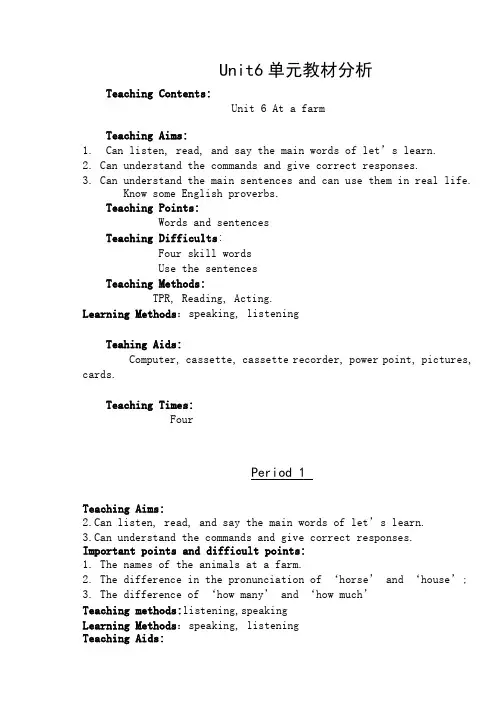
Unit6单元教材分析Teaching Contents:Unit 6 At a farmTeaching Aims:1. Can listen, read, and say the main words of let’s learn.2.Can understand the commands and give correct responses.3.Can understand the main sentences and can use them in real life.Know some English proverbs.Teaching Points:Words and sentencesTeaching Difficults:Four skill wordsUse the sentencesTeaching Methods:TPR, Reading, Acting.Learning Methods:speaking, listeningTeahing Aids:Computer, cassette, cassette recorder, power point, pictures, cards.Teaching Times:FourPeriod 1Teaching Aims:2.Can listen, read, and say the main words of let’s learn.3.Can understand the commands and give correct responses.Important points and difficult points:1.The names of the animals at a farm.2.The difference in the pronunciation of ‘horse’ and ‘house’;3.The difference of ‘how many’ and ‘how much’Teaching methods:listening,speakingLearning Methods:speaking, listeningTeaching Aids:Computer, cassette, cassette recorder, power point, pictures, cards. Teaching Steps:Step 1. Warm-up1.Daily English practice.What’s the weather like today? Is it warm? Oh, what a lovely day! Let’s go to the farm!Step 2. Preview1.Let’s do. Listen to the tape, t do actions to show the meaning ofthe phrases. Students listen and do actions after the teacher. 2.T draws some farm animals on the blackboard. Use the fast way or slowway of drawing and ask the students: Are they…?Step 3 presentationLet’s learn1.T shows some pictures of farm animals: look at these animals. Wheredo they live? They live on the farm.2.Show the main poster of this unit: this is a farm. There are manyanimals at the farm. Look, horses, hens, sheep, cows, goats and lambs.T repeats the names of the farm animals; students can make some sounds of that kind of animal.3.T uses the word cards to teach the farm animals.a.T gives out the sound of animal with actions; students followand say the words.b.Students practice in pairs in the same way.c.Ss work in pair. Draw and guess.4.T: what do you see in the picture? How many horses / hens /sheep/sows /goats /lambs do you see? Where are the hoses /hens /sheep / cows /goats / lambs? What are those? / What are they?5.Practice let's do.6.Ss ask and answer in pairs with the student’s card. What are they?They are….Board-writing:Unit 6 At a farmWhat are they? They are….Feed… Sheep-sheepRide… Horse-horsesMilk… Hen-hensShear... Cow-cowsHold… Goat-goatsPeriod 2Teaching Aims:1.Can understand the main sentences and can use them in real life.2.Know some English proverbs.3.can listen, say, read, and write the four skill words.4.can understand the dialogue and can act it out.Important points and difficult points:New words and sentencesTeaching methods:listening,speakingLearning Methods:speaking, listeningTeaching Aids:Computer, cassette, cassette recorder, power point, pictures, cards. Teaching Steps:Step 1.warm –up1.learn the song of this unit: Mary has a little lamb2.Guessing game: T or Ss make the sounds of animals. The others guesswhat animals are they.Step 2. revisione picture cards to review the words about farm animals.2.le t’s playT shows some parts of the picture, students guess what animals it is. See who can say out the words quickly. Then his group can get one point.3.review le t’s do with actions.Step 3. presentation1.Present the contents of A let’s talk. Ss watch the VCD about thedialogue and then answer the teacher’s questions:a.How many people are there in the dialogue?b.Who are they?c.Where are they? Are they at school?d.What can they see at the farm?e.How many cows are there at the farm?Step 4 practice1.Listen to the dialogue and repeat after it.2.practice the dialogue in groups.3.Some groups act out the dialogue.Homework: reside the dialogueBoard-writing:Unit 6 At a farmAre they…?Yes, they are. /No, they aren’t.How many…do you have?Period 3Teaching Aims:1.Can listen, say, and read the main words.2.Can read the new words after the tape.3.Can say the chant.Important points and difficult points:New words and sentencesTeaching methods:listening,speakingLearning Methods:speaking, listeningTeaching Aids:Computer, cassette, cassette recorder, power point, pictures, cards. Teaching Steps:Step 1. Warm –up/revisione pictures cards to review the words of farm animals.Practice in sentences: what are these/those? They are…. Are they….? Yes, they are. / No, they aren’t.e picture cards and word cards to teach the new words:tomato-tomatoes, potato-potatoes, cucumber-cucumbers, an onion- onions, carrot- carrots.e real objects to say: look at the …they are…. Or: The tomatoesare red. They are juicy. The potatoes are brown. They are tasty. The carrots are orange. They are yummy. The cucumbers are green. They are tender. The onions are white. They are smelly.4.Let’s chant.Ss listen to the tape, and repeat after it. Learn the chant by listening and repeating. T can explain some new words to them.Step 3 Homework1.Copy the new words.2.Reside the chant.Board-writing:Unit 6 At a farmTomato- tomatoes, juicy and red.Cucumber-cucumbers tender and green.Potato- potatoes, tasty and brown.Onion-onions, smelly and white.carrot-carrots, Yummy and orange.Period 4Teaching Aims:1.Can listen, say, read and write the words and sentences in this part.2.Can read the dialogue with the help of teacher and tape.3. Can listen, say and read the main sentences: What are these/ those?Are these/ those…? And can answer them.4.Can read the dialogue with the help of the teacher and tape. Important points and difficult points:New words and sentencesTeaching methods:listening,speakingLearning Methods:speaking, listeningTeaching Aids:Computer, cassette, cassette recorder, power point, pictures, cards. Teaching Steps:Step 1. Warm- up1.Review the words of farm animals and vegetables with the help ofpictures.2.Review the main sentence patterns.3.Review the dialogues and chants of Part A and B.Step 2 presentation1.Listen to the tape to learn the dialogue.2.Repeat after the tape.3.Practice spelling the words and sentences.Step 3 practice1.Have a spelling game to help them to memorize the four skilled wordsand sentences and tell them how to write them in the same way.2.Ss practice in pair to spell the words.Step 3 HomeworkCopy the dialogue and the four skilled words and sentences.Board-writing:Unit 6 At a farmAre these…?Yes, they are./ No, they aren’t.What are these/ those?They are….。
《PEP四年级英语下册第六单元教案,助力教学实效》

PEP英语教材一直以其简单清晰、内容恰当、针对性强的特点得到广大师生的认可。
尤其是《精编PEP四年级英语下册》这一教材,第六单元教案更是在丰富语言知识的同时,注重培养学生的听、说、读、写的能力,不仅如此,还能帮助学生更好的对英语文化进行理解与意识的转变。
今天,本篇文章将以《精编PEP四年级英语下册第六单元教案》为中心,探讨如何提高英语教学实效。
第一节:课堂导入针对下个主题——What can you do?,教师可通过展示一些关于动物的照片或短视频引导学生思考:Animals can do a lot of things. What can they do? Do you know any animals that can swim, run or jump?让学生在自由的环境中了解动物所具备的不同能力,锻炼学生的观察能力。
通过这种方式,学生会迅速进入学习状态,也能够在互动中对所学内容进行理解。
第二节:学习过程本单元的学习主题是"What can you do?",轻松有趣的学习方式可以提高学生的兴趣,涵盖听、说、读、写的多种知识技能。
课程内容的分析与拆分、教学技巧的灵活运用是增加教学实效性的关键。
1、听说训练PEP英语教材中有许多优秀的听说训练内容,例如课文的朗读、听力训练和句型模仿等。
在学习"What can you do?"这个话题时,教师可以使用一些学生熟悉的知识点,如表达动物的行为等,让学生在灵活的环境中练习口语表达能力。
同时,老师还可利用师生对话的形式,让学生在交流中提高听力技能。
这是一种非常有效的听说训练方法,能够帮助学生更好地进入学习状态,从中获得更多英语知识。
2、认知能力提升基于"What can you do?"一课,教师可使用海报或图片的形式来为学生展示不同的动物形象,鼓励学生用英语来表达它们的能力和特点。
这种形式的教育可以帮助学生扩大词汇量、提高表达能力和理解能力。
《教师必看:PEP四年级英语下册第六单元教案解读》
作为一名英语教师,无论是教授初学者还是高级课程,我们都需要认真准备每一堂课的教学内容,因为这关系到我们的教学质量和学生的学习成果。
PEP四年级英语下册第六单元是一节非常重要的课,因为它涵盖了多种知识点,而且涉及到听说读写等多个方面。
本文将从教案解读的角度出发,分析该单元教案的重点内容和教学方法。
一、教学目标教学目标是任何一节课的核心,它包括语言技能和认知技能两个方面。
PEP四年级英语下册第六单元的教学目标如下:1.能听懂有关家务的对话。
2.能用英语表达自己对家务的看法。
3.能够运用所学语言知识,表达家庭成员的职责。
4.培养学生合作交流意识,提高语言技能。
二、教学重点如何让学生更容易理解学习内容,就是我们需要解决的教学重点。
PEP四年级英语下册第六单元的教学重点如下:1.学生需要能够准确理解有关家务的对话。
2.学生需要能够使用所学语言知识,表达家庭成员的职责和看法。
3.学生需要能够加强语言技能的提高,提升英语听说能力。
三、教学难点在解决了教学重点之后,我们还需要面对教学难点。
PEP四年级英语下册第六单元的教学难点如下:1.掌握一些新的单词及短语,如cook,sweep,garbage等。
2.学生需要理解运用have to和should的差异。
3.接受家庭成员的不同看法和职责,发表自己的看法。
四、教学方法为了让学生更轻松愉快地学习PEP四年级英语下册第六单元,我们需要选择合适的教学方法。
以下是一些常用的教学方法:1.故事讲解法我们可以用小故事或者短片来解释课文内容,讲述家庭成员之间如何分配家务和互相帮助。
通过故事可以让学生更容易理解家务的概念。
2.多模式教学法多模式教学法是将不同的学习方式结合起来,通过听说读写等不同的方式帮助学生更好地理解学习内容。
我们可以通过让学生进行口语对话、阅读故事、写下自己的思考和感悟等方式,提高学生的英语技巧。
3.小组合作学习法在PEP四年级英语下册第六单元的教学中,我们可以将学生分成小组,让他们一起进行口语对话和互相讨论。
2014年新版pep四年级英语下册Unit 6 Shopping教案
Unit 6单元教材分析Teaching Contents: Unit 6 ShoppingTeaching Aims:1. Be able to describe the size of the shoes and the clothes, talk about the price, colour and style. ( It’s expensive/ pretty.)2. Be able to ask the price and make some suggestions.3. Try to do actions according to the commandsTeaching Points:Words and sentencesTeaching Difficulties:Four skill words Use the sentencesTeaching Methods:TPR, Reading, Acting.Learning Methods:speaking, listeningTeaching Aids:Computer, cassette, cassette recorder, power point, pictures, cards. Teaching Times: FourPeriod 1Teaching Aims:1. Be able to listen, speak, read the words: colourful, pretty, cheap, and expensive.2. Be able to talk about the colours, pri ce and style: It’s expensive/ colourful/ pretty/ cheap.3. Be able to chant the rhyme well.Important points and difficult points:New words and sentencesTeaching methods: listening, speakingLearning Methods:speaking, listeningTeaching Aids:Computer, cassette, cassette recorder, power point, pictures, cards.Teaching Steps:1. Warm –up.a. Free talkAsk some questions like the following:T: What’s the weather like today?Ss: It’s cloudy a nd warm.T: Can you wear your sweater?Ss: No, I can’t.b. Let’s chant. Mmm, It’s warm today.2. Preview.Let’s chant: My shirt is red. My jacket is blue…. Try to present the new words in anatural way.3. Presentation.Let’s learn.(1) Draw different clothes with nice colors on the blackboard. Ask:What’s this? It’s a dress/ jacket/skirt.Look at this skirt. What colour is it? Is it pretty? /colourful? How much is? Is it expensive/cheap/big/long/small/short?Help the Ss to answer them.Present the new words with the help of the real objects.(2) Show them the flash cards, to listen and repeat the new words: colourful, pretty, cheap, and expensive.(3) Play a game.a. I say cheap, Ss say expensive, or on the opposite.b. Cheap or expensive?Tell Ss that more than 80 is expensive, less than 79 is cheap. Put the price on the bag, pen, pencil, books, clothes, Ss see the price, then say It’s cheap/expensive. To see who can see the fastest.(4) Listen and repeat.Let Ss listen to tape recorder, repeat aloud.Then help Ss to say these following sentences: Look at that … It’s… I want to buy it. It’s…yuan.(5) Extension.Use the real objects to show Ss a dialogue like this:A: Can I help you?B: Yes, I ‘d like a pen.A: Look at that pen. Is it nice?B; Yes, i t’s pretty. I like itHow much is it?A: It’s 2 yuan.B: Oh, it’s cheap. I want buy it.A: Here you are.Get Ss to make more dialogues using the words and expressions.(5) Listen and chant in groups.4. Homework.a. Copy the key words.b. Listen and chant together.Board-writing:Unit 6 Shoppingpretty cheap expensive.It’s … It’s. …Yuan. I want to buy it.Period 2Teaching Aims:3. Be able to listen, speak, read the new words well: sixty seventy ninety-nine hundred as sistant help how much that’s= that is4. Be able to talk about the colours, price and style: That’s expensive/ colourful / pretty /cheap. How much is it? It’s …yuan.5. . Be able to use the language skillfully.Important points and difficult points:1. Listen, speak, read the key words well.2. Be able to communicate with the useful language points:Can I help you? How much is this dress/ shirt/jacket?Difficulty words: expensive pretty colourful ninety-nineTeaching methods: listening, speakingLearning Methods:speaking, listeningTeaching Aids:Computer, cassette, cassette recorder, power point, pictures, cards.Teaching Steps:5. Warm –up.a. Sing a song. My clothes.b. Listen and chant with the tape.c. Listen and do. (For Unit 5)6. Preview.Play the tape for Ss to listen to the song of Unit 5: The Coat in the Window.7. Presentation.Let’s talk(1) Make a dialogue with an individual student.T: Hello, How much is your shirt?S. It’s thirty yuan.T: Is it expensive?S: No, but it’s pretty.(2) Look, listen and imitate.a. Look at the picture. Ask some questions. Who can you see? What does Amy want to buy? How much is it? Is it cheap?b. Watch VCD tape. Try to understand the dialogue.c. Listen to the dialogue, repeat with the tape.d. Play a game; Higher or lower?Student holds a pen up: The others try to guess the price.S1: How much is this pen?S2: It’s two yuan.S1: Higher! Higher!S3: It’s Four yuan.S1: Lower! Lower!S4: It’s three yuan.S1: Yes.(3) Group talk.Try to ask the price of their own clothes or the stationeries. Then make a survey.(4) Practice the dialogue in the real situation.(5) Act out their dialogues.8. Homework.a. Read the dialogue aloud.b. Finish the exercise in activity book.Board-writing:Unit 6 ShoppingAssistant: Can I help you? Ninety-nineCustomer: Yes, I want … sixty seventyThat’s expensive/ cheap. It’s too …Period 3Teaching Aims:1.Be able to listen, speak, read the dialogue well.2.Be able to talk about the size, price and style of the things you want to buy.3. Group work: To make a survey. Ask the prices of your friends’ clothes.Important points and difficult points:1.Listen, speak, read the key words well.2.Be able to communicate with the useful expressions.3. Try to make a dialogue about the shopping by themselves.4. Difficult sentences: How about this pair? Are they all right? Yes, they are. / No, they aren’t. We’ll take them.Teaching methods: listening, speakingLearning Methods:speaking, listeningTeaching Aids:Computer, cassette, cassette recorder, power point, pictures, cards.Teaching Steps:9. Warm –up.a. Let’s do. (Listen and do actions)b. Greetings and everyday English.10. Preview.Play the tape for Ss to listen to the song of Unit 5: The Coat in the Window.11. Presentation.Let’s talk(1) Make a dialogue with an individual student.T: Hello, Are you wearing a pair of sandals?S. No, I’m wearing a pair of sneakers.T: Look at my sandals. They are old. I want to buy a new pair. Let’s go shopping together.S: Good idea.(2) Look, listen and imitate.a. Look at the picture. Ask some questions.b. Watch VCD tape. Try to understand the dialogue.c. Explain the difficulties: What size? Size 5. Are they all right? We’ll take them.d. Listen to the dialogue, repeat with the tape.e. Group talk. Make a survey.To know the size. Ask; What size do you wear? I wear size 37. How much are your sandals/ sneakers/ slippers?f. Practice the dialogue in groups.g. Act out the dialogue.h. Play a game.Guess the size of what they wear.What size do you wear? Guess.Size 5.Smaller. Size 4.i. If time permits, let Ss go to buy the things they have in groups.12. Homework.a. Read the dialogue aloud.b. Finish the exercise in activity book. Board-writing:Unit 5 How much is it?A pair of sneakers for my son.What size?How about this pair? How much are they? We’ll take them.Period 4Teaching Aims:1.Be able to listen, speak, read and write the key words well: apple, pear, orange, banana, and watermelon.2.Be able to say and write the main sentences: How much are they?They’re three Y uan.3.. Be able to use the language skillfully.Important points and difficult points:New words and sentencesTeaching methods: listening, speakingLearning Methods:speaking, listeningTeaching Aids:Computer, cassette, cassette recorder, power point, pictures, cards.Teaching Steps:13. Warm –up.a. Let’s do.b. Greetings and daily report.14. Preview.a. Make a survey: Ask Ss to think of what size of shoes and clothes their family members wear. Ask them some questions.3. Presentation.a. Show Ss the chart let them look at it carefully. Ask them questions.What does Zoom want to buy?What fruits do you know?Does Zoom want any lemons?How many apples does Zoom want?b. Ask the Ss to say something about the picture.c. Show them the cards, help Ss say: one apple, five apples, ten pears, ten oranges, and two big watermelons.d. Play a game: Show them pictures, let Ss quickly say the plural forms of the words: two ap ples, three bananas…e. Listen and watch the dialogue.a) Read and practice the dialogue.g. Act out the dialogue with headdresses.h. Let Ss make their own dialogue in groups.i. Do the exercises on the activity book.15. Homework.a. Read the dialogue aloud.b. Finish the exercise in activity book.c. Copy the key sentences and words one line each.Board-writing:Unit 6 ShoppingA fruit shop apples pearsPictures oranges bananasWatermelonsHow much are they? They’re three Yuan.。
小学四年级下册六单元英语教案5篇
小学四年级下册六单元英语教案5篇小学四年级下册六单元英语教案篇1Did you have a nice holidy教学目标;知识与技能:a.Key words and phrases: north, southb.Sentences: Beijing is the capital of China.c.Task aim:1. Go on learning the position words, Learn about China and America from this.2. Introduce some cities position and choose some cities to practice.过程与方法:课文、方向、对比情感、态度和价值观:对美国和中国两大国家进行对比德育目标:了解中国地理和国情重点:Key words and phrases: north, southSentences: Beijing is the capital of China.难点:Task aim:1. Go on learning the position words, Learn about China and America from this.2. Introduce some cities position and choose some cities to practice.教学方法:讲授、对比教学过程:(一)导入:1. Singing a song together.Choose your favorite country and describe it ( position capital nice city)Teacher shows the picture of Beijing, Sanya, Washington, and San Francisco on TV.(二)探究新知Q: Do you like Beijing And look at itS: Describe it (position…)Q: There is a famous city in China, What is it / It’s very hot.S: Sanya and describe it.And use the same way to show Washington (to teach north, south, east, and west) We can use a map to learn four words.Listen and match. Then point and say (consolidate to remember the four position words) Finish the part 1on Activity book.Give them 2’ to remember the new words and the meaning of it .Then finish the part 1 on Activity book. Check the answer in groupsPoint ,ask and answerShow some pictures on TV.( on the blackboard)(三)巩固新知A: Where is New York B: It’s in the east.( Look at pictures and describe the position of it )Show a map of China and deal with the part 3 on activity book.Do you have a friend If you have, please draw her / his house .And tell us where is his / her house(Practice “I live in Beijing. My friend lives in …)(四)作业布置(五)小结1. Practice to read and remember the new words .( look at the phonetic symbol and say them out)2. Important sentences ( make a simple translation)板书设计Unite 2 Did you have a nice holidy课后反思:小学四年级下册六单元英语教案篇2教学目标:1.能听懂、会说、会读交际用语:Welcome to … What arethese/thoseThey’re …Are these/those … Yes, they are./No, they aren’t2.能听懂、会说、会读词汇:they’r e=they are, pig, cow, chicken, duck3.能听懂、会说、会读、会写词汇:farm, they, pig, apple, those4.能熟练朗读对话或表演对话。
pep四年级英语下册第六单元教案
pep四年级英语下册第六单元教案pep四年级英语下册第六单元教案第六单元第一时教案题:Unit 6 At a far教学重点:单词:sheep,hen,,hrse,gat,lab及其复数形式的表达。
句型:hat are the?和Are the…?的问答。
教学难点:hrse,sheep,gat的复数形式表达。
教学准备:Let’s learn(A)部分挂图,录音及。
教师和学生共同准备所学动物单词卡。
(单、复数各一套)Let’s d部分,录音。
教学过程:(一)导入:1、教师提问:I lve anials ver uh D u lve anials?hat anials d u n?2、学生说说自己知道的动物单词,一旦学生说出本涉及到的单词,教师要及时拿出卡片,请这位同学教大家读。
(二)呈现新知:教师说:D u n a far?There are an anials at a far Let’s g and have a l教师出示Let’s learn(A)部分挂图,说:L,it is a far S an anialshat an u see?学生听懂后,教师可先试着让学生指图回答,能说出英的学生给与表扬,也可让学生用中回答。
告诉学生我们要学习有关far的内容,教读far。
让学生观看2遍,教师只点击有关单词部分,学生跟读。
教师出示单词卡:sheep,hen,,hrse,gat,lab,让学生进行认读,教师可以将一些发音规律,帮助学生记忆单词。
如:ee在sheep 中发[i:]在中发[aU],a在gat中发[EU]等等,也可以启发学生说说怎样记住每个单词。
(将卡片贴到黑板上)巩固单词:a、教师说单词,学生指图。
b、教师指图,学生说单词。
、一个学生说任意一个单词,其他学生举起相应的图片。
Let’s d部分:学生观看。
启发学生根据所看内容说说feed,ride,il,shear,hld的意思。
播放录音,学生根据所听内容做出相应的动作。