
考研真题1988年考研英语真题及解析
1988年全国硕士研究生入学统一考试英语试题Section I Close TestFor each numbered blank in the following passage there are four choices labeled [A], [B], [C], and [D]. Choose the best one and put your choice in the ANSWER SHEET. Read the whole passage before making your choice. (10 points)①In 1620, a small sailboat named the Mayflower left England for the New World. ②The Mayflower headed for the Jamestown colony on the warm shore of Virginia. ③Its one hundred passengers were the Pilgrims. ④They were looking for a place where they could worship God 1 . ⑤Because of strong winds and severe storms, the Mayflower lost its 2 . ⑥The brave group of colonists finally had to land at Plymouth on the rocky coast of Massachusetts in December 1620. ⑦It was the middle of the stern northern winter. ⑧ 3 months of starvation, disease, and death were ahead of them. ⑨Only the strongest of the pilgrims 4 that winter. ⑩Many women gave their own pitiful rations to their children and died for lack of food for themselves. ○11Living 5 began to improve in the spring of 1621. ○12There were wild vegetables. ○13There were berries and fruit. ○14Fish and game were plentiful. ○15Therefore, they were able to get enough fresh meat despite their lack of skill or experience in hunting and fishing. ○16The colonists’health 6 with the warm weather and their better diet.○17In the fall, they look back 7 the past year. ○18They were both regretful and thankful. ○19Only fifty of the original one hundred passengers remained. ○20The price in human life and tragedy had been great. ○21On the other hand, they saw new hope for the future. ○22A splendid harvest was8 them. ○23They were ready for the second winter with confidence. ○24They had eleven crude houses for protection against the severe winter. ○25Seven were for families, and four were for communal use. ○269 , they had established a treaty of friendship with their Indian neighbors under Chief Massasoit in the summer.○27The woods and forests became safe. ○28When the Mayflower returned to England that summer, there were no colonists 10 . ○29At the end of their first year in their new home, the Pilgrims wanted to celebrate with a real holiday. ○30It was their first Thanks giving Day. [328 words]1. [A]in their own style [B]in their own way[C]on their own [D]of their own2. [A]course [B]route [C]passage [D]channel3. [A]Uncomfortable [B]Bad [C]Unfavourable [D]Terrible4. [A]passed [B]sustained [C]survived [D]spent5. [A]situations [B]environments[C]conditions [D]circumstances6. [A]strengthened [B]regained [C]recovered [D]improved7. [A]in [B]of [C]over [D]at8. [A]on [B]behind [C]for [D]beyond9. [A]Best of all [B]For the best [C]To their best [D]All in all10.[A]ashore [B]around [C]about [D]aboardSection II Reading ComprehensionEach of the two passages below is followed by five questions. For each question there are four answers. Read the passages carefully and choose the best answer to each of the questions. Put your choice in the brackets on the left. (10 points)Text 1①It doesn’t come as a surprise to you to realize that it makes no difference what you read or study if you can’t remember it. ②You just waste your valuable time. ③Maybe you have already discovered some clever ways to keep yourself from forgetting.①One dependable aid that does help you remember what you study is to have a specific purpose or reason for reading. ②You remember better what you rea d when you know why you’re reading.①Why does a clerk in a store go away and leave you when your reply to her offer to help is, “No, thank you. I’m just looking”? ②Both you and she know that if you aren’t sure what you want, you are not likely to find it. ③But suppose you say instead, “Yes, thank you. I want a pair of sun glasses.” ④She says, “Right this way, please.”⑤And you and she are off -- both eager to look for exactly what you want.①It’s quite the same with your studying. ②If you chose a book at ra ndom, “just looking” for nothing in particular, you are likely to get just that -- nothing. ③But if you do know what you want, and if you have the right book, you are almost sure to get it. ④Your reasons will vary; they will include reading or studying “to find out more about”, “to understand the reasons for”, “to find out how”. ⑤A good student has a clear purpose or reason for what he is doing.①This is the way it works. ②Before you start to study, you say to yourself something like this, “I want to know w hy Stephen Vincent Benet happened to write about America. I’m reading this article to find out.” ③Or, “I’m going to skim this story to see what life was like in medieval England.” ④Because you know why you are reading or studying, you relate the information to your purpose and remember it better.①Reading is not one single activity. ②At least two important processes go on at the same time. ③As you read, you take in ideas rapidly and accurately. ④But at the same time you express your own ideas to yourself as you react to what you read. ⑤You have a kind of mental conversation with the author. ⑥If you expressed your ideas orally, they might sound like this: “Yes, I agree. That’s my opinion too.” or “Ummmm, I thought that record was broken much earlier. I’d better check those dates,” or “But there are some other facts to be considered!” ⑦You don’t just sit there taking in ideas -- you do something else, and that something else is very important.①This additional process of thinking about what you read includes evaluating it, relating it to what you already know, and using it for your own purposes. ②In other words, a good reader is a critical reader. ③One part of critical reading, as you have discovered, is distinguishing between facts and opinions. ④Facts can be checked by evidence. ⑤Opinions are one’s own personal reactions.①Another part of critical reading is judging sources. ②Still another part is drawing accurate inferences.Text 2①If you live in a large city, you are quite familiar with some of the problems of noise, but because of some of its harmful effects, you may not be aware of the extent of its influence on human behavior. ②Although everyone more or less knows what noise is, i.e., it is sounds that one would rather not hear, it is perhaps best to define it more precisely for scientific purposes. ③One such definition is that noise is sounds that are unrelated to the task at hand.④Thus stimuli that at one time might be considered relevant will at another time be considered noise, depending on what one is doing at the moment. ⑤In recent years there has been a great deal of interest in the effects of noise on human behavior, and concepts such as “noise pollution” have arisen, tog ether with movements to reduce noise.①Exposure to loud noises can definitely produce a partial or complete loss of hearing, depending on the intensity, duration, and frequency composition of the noise. ②Many jobs present noise hazards, such as working in factories and around jet aircraft, driving farm tractors, and working (or sitting) in music halls where rock bands are playing. ③In general, continuous exposure to sounds of over 80 decibels (a measure of the loudness of sound) can be considered dangerous. ④Decibel values correspond to various sounds. ⑤Sounds above about 85 decibels may, if exposure is for a sufficient period of time, produce significant hearing loss. ⑥Actual loss will depend upon the particular frequencies to which one is exposed, and whether the sound is continuous or intermittent.Noise can have unexpected harmful effects on performance of certain kinds of tasks, for instance, if one is performing a watch keeping task that requires vigilance, in which he is responsible for detecting weak signals of some kind (e.g., watching a radar screen for the appearance of aircraft).①Communicating with other people is unfavorably affected by noise. ②If you have ridden in the rear of a jet transport, you may have noticed that it was difficult to carry on a conversation at first, and that, eventually, you adjusted the loudness of your speech to compensate for the effect. ③The problem is noise.Text 3①The traditional belief that a woman’s place is in the home and that a woman ought not to go out to work can hardly be reasonably maintained in present conditions. ②It is said that it is a woma n’s task to care for the children, but families today tend to be small and with a year or two between children. ③Thus a woman’s whole period of childbearing may occur within five years. ④Furthermore, with compulsory education from the age of five or six her role as chief educator of her children soon ceases. ⑤Thus, even if we agree that a woman should stay at home to look after her children before they are of school age, for many women, this period would extend only for about ten years.①It might be argued that the house-proud woman would still find plenty to do about the home. ②That may be so, but it is certainly no longer necessary for a woman to spend her whole life cooking, cleaning, mending and sewing. ③Washing machines take the drudgery out of laundry, the latest models being entirely automatic and able to wash and dry a large quantity of clothes in a few minutes. ④Refrigerators have made it possible to store food for long periods and many pre-cooked foods are obtainable in tins. ⑤Shopping, instead of being a daily task, canbe completed in one day a week. ⑥The new man-made fibers are more hardwiring than natural fibers and greatly reduce mending, while good ready-made clothes are cheap and plentiful.①Apart from women’s own happiness, the needs of the c ommunity must be considered. ②Modern society cannot do well without the contribution that women can make in professions and other kinds of work. ③There is a serious shortage of nurses and teachers, to mention only two of the occupations followed by women. ④It is extremely wasteful to give years of training at public expense only to have the qualified teacher or nurse marry after a year or two and be lost forever to her profession. ⑤The training, it is true, will help her in duties as a mother, but if she continued to work, her service would be more widely useful. ⑥Many factories and shops, too, are largely staffed by women, many of them married. ⑦While here the question of training is not so important, industry and trade would be seriously short of staff if married women did not work.Section III English-Chinese TranslationTranslate the following passage into Chinese. Only the underlined sentences are to be translated. (20 points)Seated behind the front desk at a New York firm, the receptionist was efficient.Stylishly dressed, the firm’s newest employee had a pleasant telephone voice and a natural charm that put clients at ease. The company was pleased: (21) Clearly, this was a person who took considerable pride in personal appearance. David King, the receptionist, is unusual, but by no means unique. (22) Just as all truck drivers and construction workers are no longer necessarily men, all secretaries and receptionists are no longer automatically women. The number of men in women-dominated fields is still small and they haven’t attracted the attention that has often followed women advancing into male-dominated fields, but men are moving into more and more jobs that have traditionally been held by women.Strictly speaking, the phenomenon is not new. For the past several decades, men have been quietly entering fields such as nursing, social work and elementary education. But today no job seems off-limits. Men serve coffee in offices and meals on airplanes. (23) These changes are helping to influence some of the long-standing traditions about the types of work men and women can do -- but they also produce some undeniable problems for the men who are entering those fields formerly dominated by women.What kinds of men venture into these so-called “women’s fields”? All kinds. (24) “I don’t know of any definite answers I’d be comfortable with,” explains Joseph Pleck, Ph.D., of the Wellesley College Centre for Research on Women.Sam Ormont, for example, a thirty-year-old nurse at a Boston hospital, went into nursing because the army had trained him as a medical worker. (25) “I found that work very interesting.” he recalled, “and when I got out of the service it just seemed natural for me to go into something medical. I wasn’t really interested in becoming a doctor.” Thirty-five-year-old David King, an out-of-work actor, found a job as a receptionist because he was having trouble landing roles in Broadway plays and he needed to pay the rent.(26) In other words, men enter “female” jobs out of the same consideration for personal interest and economic necessity that motivates anyone looking for work. But similarities often end there. Men in female-dominated jobs are conspicuous. As a group, their work histories differ in most respects from those of their female colleagues, and they are frequently treated differently by the people with whom they are in professional contact.The question naturally arises: Why are there still approximately ninety-nine female secretaries for every one male? There is also a more serious issue. Most men don’t want to be receptionists, nurses, secretaries or sewing workers. Put simply, these are not generally considered very masculine jobs. (27) To choose such a line of work is to invite ridicule.“There was kidding in the beginning,” recalls Ormont. “Kids coming from school ask what I am, and when I say ‘A nurse,’ they laugh at me. I just smile and say, ‘You know, there are female doctors, too.’”Still, there are encouraging signs. Years ago, male grade school teachers were as rare as male nurses. Today more than one elementary school teacher in six is male.(28)Can we anticipate a day when secretaries will be an even mix of men and women —or when the mention of a male nurse will no longer raise eyebrows? It’s probably coming -- but not very soon.Section VII: English-Chinese TranslationDirections:Translate the following passage into Chinese. Only the underlined sentences are to be translated. (20 points) Seated behind the front desk at a New York firm, the receptionist was efficient.Stylishly dressed, the firm’s newest employee had a pleasant telephone voice and a natural charm that put clients at ease. The company was pleased: (61) Clearly, this was a person who took considerable pride in personal appearance. David King, the receptionist, is unusual, but by no means unique. (62) Just as all truck drivers and construction workers are no longer necessarily men, all secretaries and receptionists are no longer automatically women. The number of men in women-dominated fields is still small and they haven’t attracted the attention that has often followed women advancing into male-dominated fields, but men are moving into more and more jobs that have traditionally been held by women.Strictly speaking, the phenomenon is not new. For the past several decades, men have been quietly entering fields such as nursing, social work and elementary education. But today no job seems off-limits. Men serve coffee in offices and meals on airplanes. (63) These changes are helping to influence some of the long-standing traditions about the types of work men and women can do -- but they also produce some undeniable problems for the men who are entering those fields formerly dominated by women.What kinds of men venture into these so-called “women’s fields”? All kinds. (64) “I don’t know of any definite answers I’d be comfortable with,” explains Joseph Pleck, Ph.D., of the Wellesley College Centre for Research on Women.Sam Ormont, for example, a thirty-year-old nurse at a Boston hospital, went into nursing because the army had trained him as a medical worker. (65) “I found that work very interesting.” he recalled, “and when I got out of the service it just seemed natural for me to go into something medical. I wasn’t really interested in becoming a doctor.” Thirty-five-year-old David King, an out-of-work actor, found a job as a receptionist because he was having trouble landing roles in Broadway plays and he needed to pay the rent.(66) In other words, men enter “female” jobs out of the same consideration for personal interest and economic necessity that motivates anyone looking for work. But similarities often end there. Men in female-dominated jobs are conspicuous. As a group, their work histories differ in most respects from those of their female colleagues, and they are frequently treated differently by the people with whom they are in professional contact.The question naturally arises: Why are there still approximately ninety-nine female secretaries for every one male? There is also a more serious issue. Most men don’t want to be receptionists, nurses, secretaries or sewing workers. Put simply, these are not generally considered very masculine jobs. (67) To choose such a line of work is to invite ridicule.“There was kidding in the beginning,” recalls Ormont. “Kids coming from school ask what I am, and when I say‘A nurse,’ they laugh at me. I just smile and say, ‘You know, there are female doctors, too.’”Still, there are encouraging signs. Years ago, male grade school teachers were as rare as male nurses. Today more than one elementary school teacher in six is male.(68) Can we anticipate a day when secretaries will be an even mix of men and women -- or when the mention of a male nurse will no long er raise eyebrows? It’s probably coming -- but not very soon.61. 他显然,他是个对自己的仪表感到相当自豪的人。
1998年考研英语真题及答案(卷一)

考研资料1998年全国研究生入学考试试卷及参考答案(精校版)英语1998年全国攻读硕士学位研究生入学考试英语试题Section I Cloze TestDirections:For each numbered blank in the following passage, there are four choices marked [A], [B], [C], and [D]. Choose the best one and mark your answer on ANSWER SHEET 1by blackening the corresponding letter in the brackets with a pencil. (10 points)Until recent l y most historians spoke very critically of the Industrial Revolution. They1that in the long run industrialization greatly raised the standard of living for the 2 man. But they insisted that its 3 results during the period from 1750 to 1850 were widespread poverty and misery for the 4 of the English population. 5 contrast, they saw in the preceding hundred years from 1650 to 1750, when England was still a 6 agricultural country, a period of great abundance and prosperity.This view, 7 , is generally thought to be wrong. Specialists 8 history and economics, have 9 two things: that the period from 1650 to 1750 was 10 by great poverty, and that industrialization certainly did not worsen and may have actually improved the conditions for the majority of the populace.1. [A]admitted [B]believed [C]claimed [D]predicted2. [A]plain [B]average [C]mean [D]normal3. [A]momentary [B]prompt [C]instant [D]immediate4. [A]bulk [B]host [C]gross [D]magnitude5. [A]On [B]With [C]For [D]By6. [A]broadly [B]thoroughly [C]generally [D]completely7. [A]however [B]meanwhile [C]therefore [D]moreover8. [A]at [B]in [C]about [D]for9. [A]manifested [B]approved [C]shown [D]speculated10. [A]noted [B]impressed [C]labeled [D]markedSection ⅡReading ComprehensionDirections:Each of the passages below is followed by some questions. For each question there are four answers marked [A], [B], [C] and [D]. Read the passages carefully and choose the best answer to each of the questions. Then mark your answer on the ANSWER SHEET 1by blackening the corresponding letter in the brackets. (40 points)Text 1Few creations of big technology capture the imagination like giant dams. Perhaps it is humankind’s long suffering at the mercy of flood and drought that makes the idea of forcing the waters to do our bidding so fascinating. But to be fascinated is also, sometimes, to be blind. Several giant dam projects threaten to do more harm than good.The lesson from dams is that big is not always beautiful. It doesn’t help that building a big, powerful dam has become a symbol of achievement for nations and people striving to assertthemselves. Egypt’s leadership in the Arab world was cemented by the Aswan High Dam. Turkey’s bid for First World status includes the giant Ataturk Dam.But big dams tend not to work as intended. The Aswan Dam, for example, stopped the Nile flooding but deprived Egypt of the fertile silt that floods left -- all in return for a giant reservoir of disease which is now so full of silt that it barely generates electricity.And yet, the myth of controlling the waters persists. This week, in the heart of civilized Europe, Slovaks and Hungarians stopped just short of sending in the troops in their contention over a dam on the Danube. The huge complex will probably have all the usual problems of big dams. But Slovakia is bidding for independence from the Czechs, and now needs a dam to prove itself.Meanwhile, in India, the World Bank has given the go-ahead to the even more wrong-headed Narmada Dam. And the bank has done this even though its advisors say the dam will cause hardship for the powerless and environmental destruction. The benefits are for the powerful, but they are far from guaranteed.Proper, scientific study of the impacts of dams and of the cost and benefits of controlling water can help to resolve these conflicts. Hydroelectric power and flood control and irrigation are possible without building monster dams. But when you are dealing with myths, it is hard to be either proper, or scientific. It is time that the world learned the lessons of Aswan. You don’t need a dam to be saved.11. The third sentence of Paragraph 1 implies that ________.[A] people would be happy if they shut their eyes to reality[B] the blind could be happier than the sighted[C] over-excited people tend to neglect vital things[D] fascination makes people lose their eyesight12. In P aragraph 5, “the powerless” probably refers to ________.[A] areas short of electricity[B] dams without power stations[C] poor countries around India[D] common people in the Narmada Dam area13. What is the myth concerning giant dams?[A] They bring in more fertile soil.[B] They help defend the country.[C] They strengthen international ties.[D] They have universal control of the waters.14. What the author tries to suggest may best be interpreted as ________.[A] “It’s no use crying over spilt milk”[B] “More haste, less speed”[C] “Look before you leap”[D] “He who laughs last laughs best”Text 2Well, no gain without pain, they say. But what about pain without gain? Everywhere you go in America, you hear tales of corporate revival. What is harder to establish is whether the productivity revolution that businessmen assume they are presiding over is for real.The official statistics are mildly discouraging. They show that, if you lump manufacturing and services together, productivity has grown on average by 1.2% since 1987. That is somewhat faster than the average during the previous decade. And since 1991, productivity has increased by about 2% a year, which is more than twice the 1978-87 average. The trouble is that part of the recent acceleration is due to the usual rebound that occurs at this point in a business cycle, and so is not conclusive evidence of a revival in the underlying trend. There is, as Robert Rubin, the treasury secretary, says, a “disjunction” between the mass of business anecdote that points to a leap in productivity and the picture reflected by the statistics.Some of this can be easily explained. New ways of organizing the workplace -- all that re-engineering and downsizing -- are only one contribution to the overall productivity of an economy, which is driven by many other factors such as joint investment in equipment and machinery, new technology, and investment in education and training. Moreover, most of the changes that companies make are intended to keep them profitable, and this need not always mean increasing productivity: switching to new markets or improving quality can matter just as much.Two other explanations are more speculative. First, some of the business restructuring of recent years may have been ineptly done. Second, even if it was well done, it may have spread much less widely than people suppose.Leonard Schlesinger, a Harvard academic and former chief executive of Au Bong Pain, a rapidly growing chain of baker y cafes, says that much “re-engineering” has been crude. In many cases, he believes, the loss of revenue has been greater than the reductions in cost. His colleague, Michael Beer, says that far too many companies have applied re-engineering in a mechanistic fashion, chopping out costs without giving sufficient thought to long-term profitability. BBDO’s Al Rosenshine is blunter. He dismisses a lot of the work of re-engineering consultants as mere rubbish -- “the worst sort of ambulance c h asing.”15. According to the author, the American economic situation is ________.[A] not as good as it seems[B] at its turning point[C] much better than it seems[D] near to complete recovery16. The official statistics on productivity growth ________.[A] exclude the usual rebound in a business cycle[B] fall short of businessmen’s anticipation[C] meet the expectation of business people[D] fail to reflect the true state of economy17. The author raises the question “what about pain without gain?” because ________.[A] he questions the truth of “no gain without pain”[B] he does not think the productivity revolution works[C] he wonders if the official statistics are misleading[D] he has conclusive evidence for the revival of businesses18. Which of the following statements is NOT mentioned in the passage?[A] Radical reforms are essential for the increase of productivity.[B] New ways of organizing workplaces may help to increase productivity.[C] The reduction of costs is not a sure way to gain long-term profitability.[D] The consultants are a bunch of good-for-nothings.Text 3Science has long had an uneasy relationship with other aspects of culture. Think of Gallileo’s 17th-century trial for his rebelling belief before the Catholic Church or poet William Bl ake’s harsh remarks against the mechanistic worldview of Isaac Newton. The schism between science and the humanities has, if anything, deepened in this century.Until recently, the scientific community was so powerful that it could afford to ignore its critics -- but no longer. As funding for science has declined, scientists have attacked “anti-science” in several books, notably Higher Superstition, by Paul R. Gross, a biologist at the University of Virginia, and Norman Levitt, a mathematician at Rutgers University; and The Demon-Haunted World, by Carl Sagan of Cornell University.Defenders of science have also voiced their concerns at meetings such as “The Flight from Science and Reason,” held in New York City in 1995, and “Science in the Age of (Mis) information,” which assembled last June near Buffalo.Anti-science clearly means different things to different people. Gross and Levitt find fault primarily with sociologists, philosophers and other academics who have questioned science’s objectivity. Sagan is more concerned with those who believe in ghosts, creationism and other phenomena that contradict the scientific worldview.A survey of news stories in 1996 reveals that the anti-science tag has been attached to many other groups as well, from authorities who advocated the elimination of the last remaining stocks of smallpox virus to Republicans who advocated decreased funding for basic research.Few would dispute that the term applies to the Unabomber, whose manifesto, published in 1995, scorns science and longs for return to a pre-technological utopia. But surely that does not mean environmentalists concerned about uncontrolled industrial growth are anti-science, as an essay in US News & World Report last May seemed to suggest.The environmentalists, inevitably, respond to such critics. The true enemies of science, argues Paul Ehrlich of Stanford University, a pioneer of environmental studies, are those who question the evidence supporting global warming, the depletion of the ozone layer and other consequences of industrial growth.Indeed, some observers fear that the anti-science epithet is in danger of becoming meaningless. “The term ‘anti-science’ can lump together too many, quite different things,” notes Harvard University philosopher Gerald Holton in his 1993 work Science and Anti-Science. “They have in common only one thing that they tend to annoy or threaten those who regard themselves as more enlightened.”19. The word “schism” (Line 4, Paragraph 1) in the context probably means ________.[A] confrontation[B] dissatisfaction[C] separation[D] contempt20. Paragraphs 2 and 3 are written to ________.[A] discuss the cause of the decline of science’s power[B] show the author’s sympathy with scientists[C] explain the way in which science develops[D] exemplify the division of science and the humanities21. Which of the following is true according to the passage?[A] Environmentalists were blamed for anti-science in an essay.[B] Politicians are not subject to the labeling of anti-science.[C] The “more enlightened” tend to tag others as anti-science.[D] Tagging environmentalists as “anti-science” is justifiable.22. The author’s attitude toward the issue of “science vs. anti-science” is ________.[A] impartial[B] subjective[C] biased[D] puzzlingText 4Emerging from the 1980 census is the picture of a nation developing more and more regional competition, as population growth in the Northeast and Midwest reaches a near standstill.This development -- and its strong implications for US politics and economy in years ahead -- has enthroned the South as America’s most densely populated region for the first time in the historyof the nation’s head counting.Altogether, the US population rose in the 1970s by 23.2 million people -- numerically the third-largest growth ever recorded in a single decade. Even so, that gain adds up to only 11.4 percent, lowest in American annual records except for the Depression years.Americans have been migrating south and west in larger numbers since World War II, and the pattern still prevails.Three sun-belt states -- Florida, Texas and California -- together had nearly 10 million more people in 1980 than a decade earlier. Among large cities, San Diego moved from 14th to 8th and San Antonio from 15th to 10th -- with Cleveland and Washington. D. C., dropping out of the top 10.Not all that shift can be attributed to the movement out of the snow belt, census officials say. Nonstop waves of immigrants played a role, too -- and so did bigger crops of babies as yesterday’s “baby boom” generation reached its child bearing years.Moreover, demographers see the continuing shift south and west as joined by a related but newer phenomenon: More and more, Americans apparently are looking not just for places with more jobs but with fewer people, too. Some instances—■Regionally, the Rocky Mountain states reported the most rapid growth rate -- 37.1 percent since 1970 in a vast area with only 5 percent of the US population.■Among states, Nevada and Arizona grew fastest of all: 63.5 and 53.1 percent respectively. Except for Florida and Texas, the top 10 in rate of growth is composed of Western states with 7.5 million people -- about 9 per square mile.The flight from overcrowdedness affects the migration from snow belt to more bearable climates.Nowhere do 1980 census statistics dramatize more the American search for spacious living than in the Far West. There, California added 3.7 million to its population in the 1970s, more than any other state.In that decade, however, large numbers also migrated from California, mostly to other parts of the West. Often they chose -- and still are choosing -- somewhat colder climates such as Oregon, Idaho and Alaska in order to escape smog, crime and other plagues of urbanization in the Golden State.As a result, California’s growth rate dropped during the 1970s, to 18.5 percent -- little more than two thirds the 1960s’ growth figure and considerably below that of other Western states.23. Discerned from the perplexing picture of population growth the 1980 census provided, Americain 1970s ________.[A] enjoyed the lowest net growth of population in history[B] witnessed a southwestern shift of population[C] underwent an unparalleled period of population growth[D] brought to a standstill its pattern of migration since World War II24. The census distinguished itself from previous studies on population movement in that________.[A] it stresses the climatic influence on population distribution[B] it highlights the contribution of continuous waves of immigrants[C] it reveals the Americans’ new pursuit of spacious living[D] it elaborates the delayed effects of yesterday’s “baby boom”25. We can see from the available statistics that ________.[A] California was once the most thinly populated area in the whole US[B] the top 10 states in growth rate of population were all located in the West[C] cities with better climates benefited unanimously from migration[D] Arizona ranked second of all states in its growth rate of population26. The word “demographers” (Line 1, Paragraph 8) most probably means ________.[A] people in favor of the trend of democracy[B] advocates of migration between states[C] scientists engaged in the study of population[D] conservatives clinging to old patterns of lifeText 5Scattered around the globe are more than 100 small regions of isolated volcanic activity known to geologists as hot spots. Unlike most of the world’s volcanoes, they are not always found at the boundaries of the great drifting plates that make up t he earth’s surface; on the contrary, many of them lie deep in the interior of a plate. Most of the hot spots move only slowly, and in some cases the movement of the plates past them has left trails of dead volcanoes. The hot spots and their volcanic trails are milestones that mark the passage of the plates.That the plates are moving is now beyond dispute. Africa and South America, for example, are moving away from each other as new material is injected into the sea floor between them. The complementary coastlines and certain geological features that seem to span the ocean are reminders of where the two continents were once joined. The relative motion of the plates carrying these continents has been constructed in detail, but the motion of one plate with respect to another cannot readily be translated into motion with respect to the earth’s interior. It is not possible to determine whether both continents are moving in opposite directions or whether one continent is stationary and the other is drifting away from it. Hot spots, anchored in the deeper layers of the earth, provide the measuring instruments needed to resolve the question. From an analysis of the hot-spot population it appears that the African plate is stationary and that it has not moved during the past 30 million years.The significance of hot spots is not confined to their role as a frame of reference. It now appears that they also have an important influence on the geophysical processes that propel the plates across the globe. When a continental plate come to rest over a hot spot, the material rising from deeper layers creates a broad dome. As the dome grows, it develops deep fissures (cracks); in at least a few cases the continent may break entirely along some of these fissures, so that the hot spot initiates theformation of a new ocean. Thus just as earlier theories have explained the mobility of the continents, so hot spots may explain their mutability (inconstancy).27. The author believes that ________.[A] the motion of the plates correspon ds to that of the earth’s interior[B] the geological theory about drifting plates has been proved to be true[C] the hot spots and the plates move slowly in opposite directions[D] the movement of hot spots proves the continents are moving apart28. That Africa and South America were once joined can be deduced from the fact that ________.[A] the two continents are still moving in opposite directions[B] they have been found to share certain geological features[C] the African plate has been stable for 30 million years[D] over 100 hot spots are scattered all around the globe29. The hot spot theory may prove useful in explaining ________.[A] the structure of the African plates[B] the revival of dead volcanoes[C] the mobility of the continents[D] the formation of new oceans30. The passage is mainly about ________.[A] the features of volcanic activities[B] the importance of the theory about drifting plates[C] the significance of hot spots in geophysical studies[D] the process of the formation of volcanoesSection IV English-Chinese TranslationDirections:Read the following passage carefully and then translate the underlined sentences into Chinese. Your translation must be written clearly on the ANSWER SHEET 2. (15 points)They were, by far, the largest and most distant objects that scientists had ever detected: a strip of enormous cosmic clouds some 15 billion light-years from earth. 31) But even more important, it was the farthest that scientists had been able to look into the past, for what they were seeing were the patterns and structures that existed 15 billion years ago. That was just about the moment that the universe was born. What the researchers found was at once both amazing and expected: the US National Aeronautics and Space Admi nistration’s Cosmic Background Explorer satellite -- Cobe -- had discovered landmark evidence that the universe did in fact begin with the primeval explosionthat has become known as the Big Bang (the theory that the universe originated in an explosion froma single mass of energy).32) The existence of the giant clouds was virtually required for the Big Bang, first put forward in the 1920s, to maintain its reign as the dominant explanation of the cosmos. According to the theory, the universe burst into being as a submicroscopic, unimaginably dense knot of pure energy that flew outward in all directions, emitting radiation as it went, condensing into particles and then into atoms of gas. Over billions of years, the gas was compressed by gravity into galaxies, stars, plants and eventually, even humans.Cobe is designed to see just the biggest structures, but astronomers would like to see much smaller hot spots as well, the seeds of local objects like clusters and superclusters of galaxies. They shouldn’t have long to wait. 33) Astrophysicists working with ground-based detectors at the South Pole and balloon-borne instruments are closing in on such structures, and may report their findings soon.34) If the small hot spots look as expected, that will be a triumph for yet another scientific idea,a refinement of the Big Bang called the inflationary universe theory. Inflation says that very early on, the universe expanded in size by more than a trillion trillion trillion trillion fold in much less than a second, propelled by a sort of antigravity. 35) Odd though it sounds, cosmic inflation is a scientifically plausible consequence of some respected ideas in elementary particle physics, and many astrophysicists have been convinced for the better part of a decade that it is true.31. ________32. ________33. ________34. ________35. ________Section V WritingDirections:[A] Study the following cartoon carefully and write an essay in no less than 150 words.[B] Your essay must be written clearly on the ANSWER SHEET 2. (15 points)[C] Your essay should meet the requirements below:1. Write out the messages conveyed by the cartoon.2. Give your commentsn.注:图片上的文字是:本母鸡承诺:①本鸡下蛋不见棱不见角②保证有蛋皮,蛋黄和蛋清1998年答案及解析Part ⅠCloze Test1. A2. B3. D4. A5. D6. D7. A8.B9. C 10. DPart ⅡReading ComprehensionPart APassage 111. C 12. D 13.D 14. CPassage 215.A 16.B 17.B 18.APassage 319.C 20.D 21.A 22.APassage 423.B 24.C 25.D 26.CPassage 527.B 28.B 29.C 30.CPart ⅢEnglish-Chinese Translation31.更为重要的是,这是科学家们能够观测到的最遥远的过去的景象,因为他们看到的是150亿年前宇宙云的形状和结构。
2020 参考1998年考研英语真题答案及解析

1998 年全国硕士研究生入学统一考试英语试题答案与解析Part ⅠCloze Test1. A2. B3. D4. A5. D6. D7. A8.B9. C 10. DPart ⅡReading ComprehensionPart APassage 111. C 12. D 13.D 14. CPassage 215.A 16.B 17.B 18.APassage 319.C 20.D 21.A 22.APassage 423.B 24.C 25.D 26.CPassage 527.B 28.B 29.C 30.CPart Ⅲ English-Chinese Translation31.更为重要的是,这是科学家们能够观测到的最遥远的过去的景象,因为他们看到的是150 亿年前宇宙云的形状和结构。
32.巨大的宇宙云的存在,实际上是20 年代首创的大爆炸论得以保持其宇宙起源论的主导地位不可缺少的。
33.天体物理学家使用南极陆基探测器和球载仪器,正在越来越近地观测这些云系,也许不久会报告他们的观测结果。
34.假如这些小热点看上去同预计的一致,那就意味着又一种科学论说的胜利,这种论说即更完美的大爆炸论,亦称宇宙膨胀说。
35.宇宙膨胀说虽然听似奇特,但是它是基本粒子物理学中一些公认的理论产生的在科学上看来似乎可信的结论。
许多天体物理学家近十年来一直确信这一论说是正确的。
Section ⅣWriting(15 points)36.见分析试题精解Section I Cloze Test一、文章总体分析本文在关于工业革命对英国人民生活的影响问题上提出了两种对立的观点。
第一段讲述了第一种观点,是大部分历史学家的看法,即工业革命的直接结果是给英国大多数人民带来了普遍的贫穷和苦难。
第二段讲述的是另一种人普遍持有的观点,即工业革命不但没有加重这种贫困,反而使绝大多数人的生活得到了改善。
二、试题具体解析1.[A] admitted 承认[B] believed 相信,认为[C] claimed 声称[D] predicted 预言[答案] A[解析] 本题考核的知识点是:上下文语义+ 动词词义辨析。
1998年考研英语真题答案
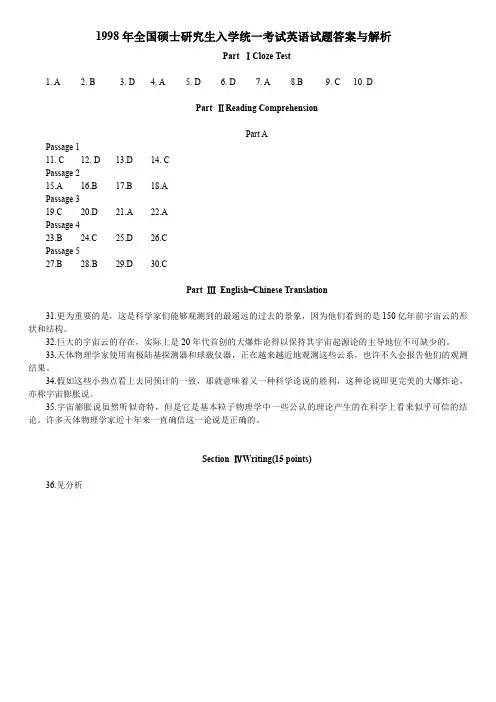
1998年全国硕士研究生入学统一考试英语试题答案与解析
PartⅠCloze Test
1.A
2.B
3.D
4.A
5.D
6.D
7.A
8.B
9.C10.D
PartⅡReading Comprehension
Part A
Passage1
11.C12.D13.D14.C
Passage2
15.A16.B17.B18.A
Passage3
19.C20.D21.A22.A
Passage4
23.B24.C25.D26.C
Passage5
27.B28.B29.D30.C
PartⅢEnglish-Chinese Translation
31.更为重要的是,这是科学家们能够观测到的最遥远的过去的景象,因为他们看到的是150亿年前宇宙云的形状和结构。
32.巨大的宇宙云的存在,实际上是20年代首创的大爆炸论得以保持其宇宙起源论的主导地位不可缺少的。
33.天体物理学家使用南极陆基探测器和球载仪器,正在越来越近地观测这些云系,也许不久会报告他们的观测结果。
34.假如这些小热点看上去同预计的一致,那就意味着又一种科学论说的胜利,这种论说即更完美的大爆炸论,亦称宇宙膨胀说。
35.宇宙膨胀说虽然听似奇特,但是它是基本粒子物理学中一些公认的理论产生的在科学上看来似乎可信的结论。
许多天体物理学家近十年来一直确信这一论说是正确的。
SectionⅣWriting(15points)
36.见分析。
【考研】1988年考研英语真题

1988年考研英语真题Section I Structure and VocabularyIn each question, decide which of the four choices given will most suitably complete the sentence if inserted at the place marked. Put your choices in the ANSWER SHEET. (15 points)EXAMPLE:I was caught ________ the rain yesterday.[A] in[B] by[C] with[D] atANSWER: [A]1. I didn’t buy the apples; she gave them to me ________ nothing.[A] with[B] as[C] for[D] by2. It’s ________ my power to make final decision on the matter.[A] off[B] outside[C] above[D] beyond3. I should say Henry is not ________ much a writer as a reporter.[A] that[B] so[C] this[D] as4. I won’t pay 20 for the coat; it’s not worth ________.[A] all that much[B] that much all[C] that all much[D] much all that5. He didn’t go into detail on the subject; he spoke ________.[A] in common[B] in general[C] in particular[D] in short6. It’s true that the old road is less direct and a bit longer. We won’ttake the new one, ________, because we don’t feel as safe on i t.[A] somehow[B] though[C] therefore[D] otherwise7. When you are about through the story ________, try to make a guess how theplot will develop.[A] half[B] midway[C] halfway[D] one-half8. Though already a teenager, Peter still finds it hard to ________ his favoritetoys.[A] part off[B] part with[C] part away[D] part from9. Strenuous efforts have been made to ________ government expenses to adesirable level.[A] cut down[B] cut short[C] cut out[D] cut off10. When at a party, be sure not to ________ from the person who tries to engageyou in conversation.[A] turn down[B] turn away[C] turn off[D] turn back11. The survival ________ of some wild animals is not very high as they areruthlessly hunted for their skins.[A] rate[B] degree[C] ratio[D] scale12. He was ________ admittance to the theatre for not being properly dressed.[A] denied[B] rejected[C] repelled[D] deprived13. When I ask you a question, I expect a ________ answer.[A] punctual[B] fast[C] rapid[D] prompt14. If a man is legally separated from his wife, is he still ________ for herdebts?[A] answerable[B] chargeable[C] recoverable[D] payable15. At the meeting, Roland argued ________ in favor of the proposal.[A] severely[B] heavily[C] forcefully[D] warmlySection II R eading ComprehensionEach of the three passages below is followed by some questions. For each question there are four answers. Read the passages carefully and chose the best answer to each of the questions. Put your choice in the ANSWER SHEET. (20 points)Text 1It doesn’t come as a surprise to you to realize that it makes no difference what you read or study if you can’t remember it. You just waste your valuable time. Maybe you have already discovered some clever ways to keep yourself from forgetting.One dependable aid that does help you remember what you study is to have a specific purpose or reason for reading. You remember better what you read when you know why you’re reading.Why does a clerk in a store go away and leave you when your reply to her offer to help is, “No, thank you. I’m just looking”? Both you and she know that if you aren’t sure what you want, you are not likely to find it. But suppose you say instead, “Yes, thank you. I want a pair of sun glasses.” She says, “Right this way, please.” And you and she are off -- both eager to look for exactly what you want.It’s quite the same with your studying. If you chose a book at random, “just looking” for nothing in particular, you are likely to get just tha t -- nothing. But if you do know what you want, and if you have the right book, you are almost sure to get it. Your reasons will vary; they will include reading or studying “to find out more about”, “to understand the reasons for”, “to find out how”. A goo d student has a clear purpose or reason for what he is doing.This is the way it works. Before you start to study, you say to yourself something like this, “I want to know why Stephen Vincent Benet happened to write about America. I’m reading this article to find out.” Or, “I’m going to skim this story to see what life was like in medieval England.” Because you know why you are reading or studying, you relate the information to your purpose and remember it better.Reading is not one single activity. At least two important processes go on at the same time. As you read, you take in ideas rapidly and accurately. But at the same time you express your own ideas to yourself as you react to what you read. You have a kind of mental conversation with the author. If you expressed your ideas orally, they might sound like this: “Yes, I agree. That’s my opinion too.” or “Ummmm, I thought that record was broken much earlier. I’d better check those dates,” or “But there are some other facts to be considered!” You don’t just sit there taking in ideas -- you do something else, and that something else is very important.This additional process of thinking about what you read includes evaluating it, relating it to what you already know, and using it for your own purposes. In other words, a good reader is a critical reader. One part of critical reading,as you have discovered, is distinguishing between facts and opinions. Facts can be checked by evidence. Opinions are one’s own personal reactions.Another part of critical reading is judging sources. Still another part is drawing accurate inferences.16. If you cannot remember what you read or study, ________.[A] it is no surprise[B] it means you have not really learned anything[C] it means you have not chosen the right book[D] you realize it is of no importance17. Before you start reading, it is important ________.[A] to make sure why you are reading[B] to relate the information to your purpose[C] to remember what you read[D] to choose an interesting book18. Reading activity involves ________.[A] only two simultaneous processes[B] primarily learning about ideas and evaluating them critically[C] merely distinguishing between facts and opinions[D] mainly drawing accurate inferences19. A good reader is one who ________.[A] relates what he reads to his own knowledge about the subject matter[B] does lots of thinking in his reading[C] takes a critical attitude in his reading[D] is able to check the facts presented against what he has already knownText 2If you live in a large city, you are quite familiar with some of the problems of noise, but because of some of its harmful effects, you may not be aware of the extent of its influence on human behavior. Although everyone more or less knows what noise is, i.e., it is sounds that one would rather not hear, it is perhaps best to define it more precisely for scientific purposes. One such definition is that noise is sounds that are unrelated to the task at hand. Thus stimuli that at one time might be considered relevant will at another time be considered noise, depending on what one is doing at the moment. In recent years there has been a great deal of interest in the effects of noise on human behavior, and concepts such as “noise pollution” have arisen, together with movements to reduce noise.Exposure to loud noises can definitely produce a partial or complete loss of hearing, depending on the intensity, duration, and frequency composition of the noise. Many jobs present noise hazards, such as working in factories and around jet aircraft, driving farm tractors, and working (or sitting) in music halls where rock bands are playing. In general, continuous exposure to sounds of over 80 decibels (a measure of the loudness of sound) can be considered dangerous. Decibel values correspond to various sounds. Sounds above about 85 decibels may, if exposure is for a sufficient period of time, produce significant hearing loss. Actual loss will depend upon the particular frequencies to which one is exposed, and whether the sound is continuous or intermittent.Noise can have unexpected harmful effects on performance of certain kindsof tasks, for instance, if one is performing a watch keeping task that requires vigilance, in which he is responsible for detecting weak signals of some kind (e.g., watching a radar screen for the appearance of aircraft).Communicating with other people is unfavorably affected by noise. If you have ridden in the rear of a jet transport, you may have noticed that it was difficult to carry on a conversation at first, and that, eventually, you adjusted the loudness of your speech to compensate for the effect. The problem is noise.20. Noise differs from sound in that ________.[A] it is sounds that interfere with the task being done[B] it is a special type of loud sound[C] it is usually unavoidable in big cities[D] it can be defined more precisely than the latter21. One of the harmful effects of noise on human performance is that ________.[A] it reduces one’s sensitivity[B] it renders the victim helpless[C] it deprives one of the enjoyment of music[D] it drowns out conversations at worksites22. The purpose of this passage is ________.[A] to define the effects of noise on human behavior[B] to warn people of the danger of noise pollution[C] to give advice as to how to prevent hearing loss[D] to tell the difference between noise and soundText 3The traditional belief that a woman’s place is in the home and that a woman ought not to go out to work can hardly be reasonably maintained in present conditions. It is said that it is a woman’s task to car e for the children, but families today tend to be small and with a year or two between children. Thus a woman’s whole period of childbearing may occur within five years. Furthermore, with compulsory education from the age of five or six her role as chief educator of her children soon ceases. Thus, even if we agree that a woman should stay at home to look after her children before they are of school age, for many women, this period would extend only for about ten years.It might be argued that the house-proud woman would still find plenty to do about the home. That may be so, but it is certainly no longer necessary for a woman to spend her whole life cooking, cleaning, mending and sewing. Washing machines take the drudgery out of laundry, the latest models being entirely automatic and able to wash and dry a large quantity of clothes in a few minutes. Refrigerators have made it possible to store food for long periods and many pre-cooked foods are obtainable in tins. Shopping, instead of being a daily task, can be completed in one day a week. The new man-made fibers are more hardwiring than natural fibers and greatly reduce mending, while good ready-made clothes are cheap and plentiful.Apart from women’s own happiness, the needs of the community must be considered. Modern society cannot do well without the contribution that women can make in professions and other kinds of work. There is a serious shortage of nurses and teachers, to mention only two of the occupations followed by women. It is extremely wasteful to give years of training at public expense only tohave the qualified teacher or nurse marry after a year or two and be lost forever to her profession. The training, it is true, will help her in duties as a mother, but if she continued to work, her service would be more widely useful. Many factories and shops, too, are largely staffed by women, many of them married. While here the question of training is not so important, industry and trade would be seriously short of staff if married women did not work.23. The author holds that ________.[A] the right place for all women, married or otherwise, is the home, not elsewhere[B] all married women should have some occupation outside the home[C] a married woman should give first priority to her duties as a mother[D] it is desirable for uneducated married women to stay at home and take careof the family24. A house-proud woman ________.[A] would devote her whole life to her family[B] would take her own happiness and that of her family as her chief concern[C] would still need some special training at public expense to help her inher duties as a housewife[D] would take full advantage of modern household appliances25. According to the author, modern society ________.[A] can operate just as well even without women participation[B] has been greatly hampered in its development by the shortage of women nursesand women teachers[C] cannot operate properly without the contribution of women[D] will be seriously affected by the continuing shortage of working women inheavy industries and international tradeSection III Cloze TestFor each numbered blank in the following passage there are four choices labeled [A], [B], [C], and [D]. Choose the best one and put your choice in the ANSWER SHEET. Read the whole passage before making your choice. (10 points) In 1620, a small sailboat named the Mayflower left England for the New World. The Mayflower headed for the Jamestown colony on the warm shore of Virginia. Its one hundred passengers were the Pilgrims. They were looking for a placewhere they could worship God 大26家. Because of strong winds and severe storms, the Mayflower lost its 大27家. The brave group of colonists finally had to land at Plymouth on the rocky coast of Massachusetts in December 1620. It was the middle of the stern northern winter. 大28家 months of starvation, disease, and death were ahead of them. Only the strongest of the pilgrims 大29家 that winter. Many women gave their own pitiful rations to their children and died for lack of food for themselves. Living 大30家 began to improve in the springof 1621. There were wild vegetables. There were berries and fruit. Fish and game were plentiful. Therefore, they were able to get enough fresh meat despite their lack of skill or experience in hunting and fishing. The colonists’ health大31家 with the warm weather and their better diet.In the fall, they look back 大32家 the past year. They were both regretfuland thankful. Only fifty of the original one hundred passengers remained. The price in human life and tragedy had been great. On the other hand, they sawnew hope for the future. A splendid harvest was 大33家 them. They were readyfor the second winter with confidence. They had eleven crude houses for protection against the severe winter. Seven were for families, and four werefor communal use. 大34家, they had established a treaty of friendship withtheir Indian neighbors under Chief Massasoit in the summer.The woods and forests became safe. When the Mayflower returned to Englandthat summer, there were no colonists 大35家. At the end of their first yearin their new home, the Pilgrims wanted to celebrate with a real holiday. It was their first Thanks giving Day.26. [A] in their own style[B] in their own way[C] on their own[D] of their own27. [A] course[B] route[C] passage[D] channel28. [A] Uncomfortable[B] Bad[C] Unfavourable[D] Terrible29. [A] passed[B] sustained[C] survived[D] spent30. [A] situations[B] environments[C] conditions[D] circumstances31. [A] strengthened[B] regained[C] recovered[D] improved32. [A] in[B] of[C] over[D] at33. [A] on[B] behind[C] for[D] beyond34. [A] Best of all[B] For the best[C] To their best[D] All in all35. [A] ashore[B] around[C] about[D] aboardSection IV E rror-detection and CorrectionEach of the following sentences has four underlined parts. These parts are labeled [A], [B], [C] and [D]. Identify the part of the sentence that is incorrect and put your choice in the ANSWER SHEET. Then, without altering the meaning of the sentence, write down your correction on the line in the ANSWER SHEET. (10 points)EXAMPLE:You’ve to hurry up if you want to buy something because A there’s Bhardly something C left D.ANSWER: [C] anything 36. The union and the management are having such a difficult A time agreeing Bon a contract for C the forthcoming year that the workers may go on strike D. 37. He got up, walked across A the room, and with B a sharp quick movement flung Cthe door widely open D. 38. His victory in the final A was no more B convinced C than I had expected D.39. Because there are less A members present tonight than B there were Clast night, we must wait until the next voting D.40. We’ve given him just A about everything he asked;B whatever else C can Dhewant? 41. In note-taking A , a strict discipline has to be kept Band all inessential details ignored C unnecessary words eliminated D.42. When the tank car carried A the poisonous gas ran off Bthe rails, the firemen tried to isolate the village from C all traffic D. 43. To be A frank, that B is a great relief to have the task fulfilled Cin so short a time D.44. At A a minimum, the negotiators are hoping of achieving Ban agreement in principle C with details to be worked out Dlater.45. It is encouraging A to note Bthat in recent years, cigarette smokers have been in the decline C , especially among older Dpeople.Section V Verb FormsFill in the blanks with the appropriate forms of the verbs given in the brackets. Put your answer in the ANSWER SHEET. (10 points)EXAMPLE:It is highly desirable that a new president ________ (appoint) for this college. ANSWER: (should) be appointed46. In the Middle Ages, in Rome, Venice and other Italian cities, there developedan intellectual movement ________ (call) humanism, which was the basis of the Renaissance.47. If law and order ________ (be) not preserved, neither the citizen nor hisproperty is safe.48. The colonel was decorated for bravery, ________ (fight) off the enemy.49. It’s quite obvious that Paul won’t sell his business now that he’s gotit ________ (run) so well.50. ________ (Not wish) to disturb his baby sister, he tiptoed into the room.51. I happened ________ (talk) with him when he was hit by a ball and collapsed.52. The applicants ________ (interview) are required to bring all the necessarypapers.53. Victor obviously doesn’t know what’s happened, otherwise he ________ (notmake) such a stupid remark.54. Such ________ (be) the case, there are no grounds to justify your complaints.55. The car shows no signs of ________ (repair); it looks like a new one.Section VI C hinese-English TranslationTranslate the following sentences into English. (15 points)56. 恶劣的天气使他无法按时动身去北京。
1988年考研英语真题及解析

1988年全国硕士研究生入学统一考试英语试题Section I Close TestFor each numbered blank in the following passage there are four choices labeled [A], [B], [C], and [D]. Choose the best one and put your choice in the ANSWER SHEET. Read the whole passage before making your choice. (10 points)①In 1620, a small sailboat named the Mayflower left England for the New World. ②The Mayflower headed for the Jamestown colony on the warm shore of Virginia. ③Its one hundred passengers were the Pilgrims. ④They were looking for a place where they could worship God 1 . ⑤Because of strong winds and severe storms, the Mayflower lost its 2 . ⑥The brave group of colonists finally had to land at Plymouth on the rocky coast of Massachusetts in December 1620. ⑦It was the middle of the stern northern winter. ⑧ 3 months of starvation, disease, and death were ahead of them. ⑨Only the strongest of the pilgrims 4 that winter. ⑩Many women gave their own pitiful rations to their children and died for lack of food for themselves. ○11Living 5 began to improve in the spring of 1621. ○12There were wild vegetables. ○13There were berries and fruit. ○14Fish and game were plentiful. ○15Therefore, they were able to get enough fresh meat despite their lack of skill or experience in hunting and fishing. ○16The colonists’ health 6 with the warm weather and their better diet.18They were both regretful and thankful. ○17In the fall, they look back 7 the past year. ○19Only fifty of the original one hundred passengers remained. ○20The price in human life and ○tragedy had been great. ○21On the other hand, they saw new hope for the future. ○22A splendid harvest was 8 them. ○23They were ready for the second winter with confidence. ○24They had eleven crude houses for protection against the severe winter. ○25Seven were for families, and four were for communal use. ○26 9 , they had established a treaty of friendship with their Indian neighbors under Chief Massasoit in the summer.○28When the Mayflower returned to England that 27The woods and forests became safe. ○summer, there were no colonists 10 . ○29At the end of their first year in their new home, the Pilgrims wanted to celebrate with a real holiday. ○30It was their first Thanks giving Day. [328 words]1. [A]in their own style [B]in their own way[C]on their own [D]of their own2. [A]course [B]route [C]passage [D]channel3. [A]Uncomfortable [B]Bad [C]Unfavourable [D]Terrible4. [A]passed [B]sustained [C]survived [D]spent5. [A]situations [B]environments[C]conditions [D]circumstances6. [A]strengthened [B]regained [C]recovered [D]improved7. [A]in [B]of [C]over [D]at8. [A]on [B]behind [C]for [D]beyond9. [A]Best of all [B]For the best [C]To their best [D]All in all10.[A]ashore [B]around [C]about [D]aboard 试题精解一、文章结构分析本文是一篇记叙文,讲述了“五月花号”抵达美洲新大陆的情况及感恩节的来历。
1998年考研英语真题答案及解析
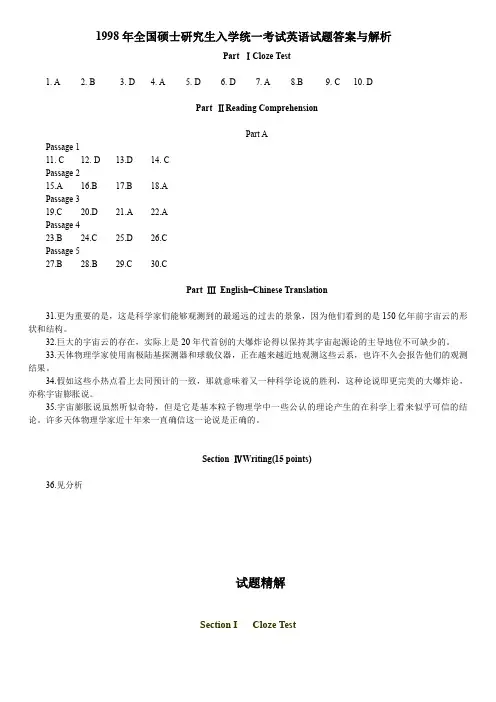
1998年全国硕士研究生入学统一考试英语试题答案与解析PartⅠCloze Test1.A2.B3.D4.A5.D6.D7.A8.B9.C10.DPartⅡReading ComprehensionPart APassage111.C12.D13.D14.CPassage215.A16.B17.B18.APassage319.C20.D21.A22.APassage423.B24.C25.D26.CPassage527.B28.B29.C30.CPartⅢEnglish-Chinese Translation31.更为重要的是,这是科学家们能够观测到的最遥远的过去的景象,因为他们看到的是150亿年前宇宙云的形状和结构。
32.巨大的宇宙云的存在,实际上是20年代首创的大爆炸论得以保持其宇宙起源论的主导地位不可缺少的。
33.天体物理学家使用南极陆基探测器和球载仪器,正在越来越近地观测这些云系,也许不久会报告他们的观测结果。
34.假如这些小热点看上去同预计的一致,那就意味着又一种科学论说的胜利,这种论说即更完美的大爆炸论,亦称宇宙膨胀说。
35.宇宙膨胀说虽然听似奇特,但是它是基本粒子物理学中一些公认的理论产生的在科学上看来似乎可信的结论。
许多天体物理学家近十年来一直确信这一论说是正确的。
SectionⅣWriting(15points)36.见分析试题精解Section I Cloze Test一、文章总体分析本文在关于工业革命对英国人民生活的影响问题上提出了两种对立的观点。
第一段讲述了第一种观点,是大部分历史学家的看法,即工业革命的直接结果是给英国大多数人民带来了普遍的贫穷和苦难。
第二段讲述的是另一种人普遍持有的观点,即工业革命不但没有加重这种贫困,反而使绝大多数人的生活得到了改善。
二、试题具体解析1.[A]admitted承认[B]believed相信,认为[C]claimed声称[D]predicted预言[答案]A[解析]本题考核的知识点是:上下文语义+动词词义辨析。
1998年全国硕士研究生入学统一考试英语试题试题精解
1998年全国硕士研究生入学统一考试英语试题试题精解Section I Cloze Test一、文章总体分析本文在关于工业革命对英国人民生活的影响问题上提出了两种对立的观点。
第一段讲述了第一种观点,是大部分历史学家的看法,即工业革命的直接结果是给英国大多数人民带来了普遍的贫穷和苦难。
第二段讲述的是另一种人普遍持有的观点,即工业革命不但没有加重这种贫困,反而使绝大多数人的生活得到了改善。
二、试题具体解析1.[A] admitted承认 [B] believed相信,认为相信,认为[C] claimed声称预言声称 [D] predicted预言[答案] A[解析] 本题考核的知识点是:上下文语义本题考核的知识点是:上下文语义 + 动词词义辨析。
难度:0.54文章开篇指出:Until recently most historians spoke very critically of the Industrial Revolution,接着第二句又谈到,in the long run industrialization greatly raised the standard of living。
显然,后一句是对前一句的让步。
第三句又以But开头,暗示与第二句有转折关系。
因此可以肯定,这里要表达的意思是历史学家不得不承认既成事实。
四个选项中,首先排除predicted,因为句子时态是过去时,表明"提高人们的生活水平"已经是事实,不存在"预测"了;其次believed和claimed都是表达人们肯定态度的词语,它们和首句所表达的含义自相矛盾;因此只有admitted可以承接上下文,表示一种让步,意为"直到最近,大多数的历史学家对工业革命仍持强烈的批评态度。
尽管他们承认从长远角度来看,工业革命已大大地提高了一般人的生活水平。
"2.[A] plain(man)衣着朴素或相貌平平的人)平民,普通人)衣着朴素或相貌平平的人 [B] average(man)平民,普通人[C] mean平均的,吝啬的,卑鄙的)正常人平均的,吝啬的,卑鄙的 [D] normal(man)正常人[答案] B[解析] 本题考核的知识点是:形容词词义辨析。
考研英语1998阅读真题解析
考研英语阅读真题解析(1998)Text 1核心词汇capture[5kAptFE]v./n.捕获,俘虏;夺得,攻占(capt+ure动词后缀→抓住毛病→逮捕)cement[si5ment]n.水泥;胶泥,胶接剂v.胶合;巩固,加强civilize[5sivilaiz]v.使文明,开化(civil市民→文明+ize动词后缀→文明化)complex[5kCmpleks]a.复杂的;综合的;联合体(com共同+plex重叠→全部重叠→复杂的)conflict[5kCnflikt9 kEn5flikt]n.战争;冲突(con共同+flict打击→共同打→冲突)deprive[di5praiv]vt.剥夺,夺去,使丧失(de去掉+prive→从个人身边拿走→剥夺),priv词根“个人的”(如private→priv+ate→私人的),使某物离开个人→剥夺drought[draut]n.旱灾,干旱go ahead n.批准,允许hydroelectric[5haidrEi5lektrik]a.水电的(hydro水+electric电→发电的)imagination[i9mAdVi5neiFEn]n.想象(力);空想,幻觉;想象出来的事物(imagin想象+ation→想象)irrigation[9iri5geiFEn]n.灌溉;冲洗;水利mercy[5mE:si]n.仁慈,怜悯,宽恕myth[miW]n.神话;神话(总称);想像的、虚构或不可能存在的事物、人persist[pE:5sist]v.(in)坚持,持续(per始终,完全+sist→始终站着→坚持到底)proper[5prCpE]a.适合的;合乎体统的;固有的;有礼貌的resolve[ri5zClv]v.决心;(使)分解,溶解;决议n.解决;决心(困难)(re再+solve→再松开→解决)。
同根词:dissolve(v.溶解;解散)←dis+solvespill[spil]v.溢出,溅出n.摔下,跌下symbol[5simbEl]n.(符号;象征)即sym+bol,sym bol看作ball,“共同喜欢球类运动”→这是现代人的“象征”wrong headed a. 执迷不悟的难句剖析难句1:Perhaps it is humankind’s long suffering at the mercy of flood and drought that makes the ideal of forcing the waters to do our bidding so fascinating.[分析]此句是一个强调句型,基本结构是“it is... that...”,强调部分的关键词是suffering,这个词就是后面that引导的从句的主语,句子的主干是“Suffering makes the ideal so fascinating”。
考研英语真题+解析word版本1998.pdf
1998年全国攻读硕士学位研究生入学考试英语试题Section I Cloze TestDirections:For each numbered blank in the following passage, there are four choices marked [A], [B], [C], and [D]. Choose the best one and mark your answer on ANSWER SHEET 1by blackening the corresponding letter in the brackets with a pencil. (10 points)Until recent l y most historians spoke very critically of the Industrial Revolution. They1that in the long run industrialization greatly raised the standard of living for the 2 man. But they insisted that its 3 results duringthe period from 1750 to 1850 were widespread poverty and misery for the 4 of the English population. 5 contrast, they saw in the preceding hundred years from 1650 to 1750, when England was still a 6 agricultural country, a period of great abundance and prosperity.This view, 7 , is generally thought to be wrong. Specialists 8 history and economics, have 9 two things: that the period from 1650 to 1750 was 10 by great poverty, and that industrialization certainly did not worsen and may have actually improved the conditions for the majority of the populace.1. [A]admitted [B]believed [C]claimed [D]predicted2. [A]plain [B]average [C]mean [D]normal3. [A]momentary [B]prompt [C]instant [D]immediate4. [A]bulk [B]host [C]gross [D]magnitude5. [A]On [B]With [C]For [D]By6. [A]broadly [B]thoroughly [C]generally [D]completely7. [A]however [B]meanwhile [C]therefore [D]moreover8. [A]at [B]in [C]about [D]for9. [A]manifested [B]approved [C]shown [D]speculated10. [A]noted [B]impressed [C]labeled [D]markedSection ⅡReading ComprehensionDirections:Each of the passages below is followed by some questions. For each question there are four answers marked [A], [B], [C] and [D]. Read the passages carefully and choose the best answer to each of the questions. Then mark your answer on the ANSWER SHEET 1by blackening the corresponding letter in the brackets. (40 points)Text 1Few creations of big technology capture the imagination like giant dams. Perhaps it is humankind’s long suffering at the mercy of flood and drought that makes the idea of forcing the waters to do our bidding so fascinating. But to be fascinated is also, sometimes, to be blind. Several giant dam projects threaten to do more harm than good.The lesson from dams is that big is not always beautiful. It doesn’t help that building a big, powerful dam has become a symbol of achievement for nations and people striving to assertthemselves. Egypt’s leadership in the Arab world was cemented by the Aswan High Dam. Turkey bid for First World status includes the giant Ataturk Dam.But big dams tend not to work as intended. The Aswan Dam, for example, stopped the Nile flooding but deprived Egypt of the fertile silt that floods left -- all in return for a giant reservoir of disease which is now so full of silt that it barely generates electricity.And yet, the myth of controlling the waters persists. This week, in the heart of civilized Europe, Slovaks and Hungarians stopped just short of sending in the troops in their contention over a dam on the Danube. The huge complex will probably have all the usual problems of big dams. But Slovakiais bidding for independence from the Czechs, and now needs a dam to prove itself.Meanwhile, in India, the World Bank has given the go-ahead to the even more wrong-headed Narmada Dam. And the bank has done this even though its advisors say the dam will cause hardship for the powerless and environmental destruction. The benefits are for the powerful, but they are far from guaranteed.Proper, scientific study of the impacts of dams and of the cost and benefits of controlling water can help to resolve these conflicts. Hydroelectric power and flood control and irrigation are possible without building monster dams. But when you are dealing with myths, it is hard to be either proper,or scientific. It is time that the world learned the lessons of Aswan. You don’t need a dam to be saved.11. The third sentence of Paragraph 1 implies that ________.[A] people would be happy if they shut their eyes to reality[B] the blind could be happier than the sighted[C] over-excited people tend to neglect vital things[D] fascination makes people lose their eyesight12. In Paragraph 5, “the powerless” probably refers to ________.[A] areas short of electricity[B] dams without power stations[C] poor countries around India[D] common people in the Narmada Dam area13. What is the myth concerning giant dams?[A] They bring in more fertile soil.[B] They help defend the country.[C] They strengthen international ties.[D] They have universal control of the waters.14. What the author tries to suggest may best be interpreted as ________.[A] “It’s no use crying over spilt milk”[B] “More haste, less speed”[C] “Look before you leap”[D] “He who laughs last laughs best”Text 2Well, no gain without pain, they say. But what about pain without gain? Everywhere you go in America, you hear tales of corporate revival. What is harder to establish is whether the productivity revolution that businessmen assume they are presiding over is for real.The official statistics are mildly discouraging. They show that, if you lump manufacturing and services together, productivity has grown on average by 1.2% since 1987. That is somewhat faster than the average during the previous decade. And since 1991, productivity has increased by about 2% a year, which is more than twice the 1978-87 average. The trouble is that part of the recent acceleration is due to the usual rebound that occurs at this point in a business cycle, and so is not conclusive evidence of a revival in the underlying trend. There is, as Robert Rubin, the treasurybetween the mass of business anecdote that points to a leap in secretary, says, a “disjunction” productivity and the picture reflected by the statistics.Some of this can be easily explained. New ways of organizing the workplace -- all thatre-engineering and downsizing -- are only one contribution to the overall productivity of an economy, which is driven by many other factors such as joint investment in equipment and machinery, new technology, and investment in education and training. Moreover, most of the changes that companies make are intended to keep them profitable, and this need not always mean increasing productivity: switching to new markets or improving quality can matter just as much.Two other explanations are more speculative. First, some of the business restructuring of recent years may have been ineptly done. Second, even if it was well done, it may have spread much less widely than people suppose.Leonard Schlesinger, a Harvard academic and former chief executive of Au Bong Pain, ahas been crude. In many rapidly growing chain of bakery cafes, says that much “re-engineering” cases, he believes, the loss of revenue has been greater than the reductions in cost. His colleague, Michael Beer, says that far too many companies have applied re-engineering in a mechanistic fashion, chopping out costs without giving sufficient thought to long-term profitability. BBDO’s Al Rosenshine is blunter. He dismisses a lot of the work of re-engineering consultants as mere rubbish -- “the worst sort of ambulance c hasing.”15. According to the author, the American economic situation is ________.[A] not as good as it seems[B] at its turning point[C] much better than it seems[D] near to complete recovery16. The official statistics on productivity growth ________.[A] exclude the usual rebound in a business cycle[B] fall short of businessmen’s anticipation[C] meet the expectation of business people[D] fail to reflect the true state of economy17. The author raises the question “what about pain without gain?” because ________.[A] he questions the truth of “no gain without pain”[B] he does not think the productivity revolution works[C] he wonders if the official statistics are misleading[D] he has conclusive evidence for the revival of businesses18. Which of the following statements is NOT mentioned in the passage?[A] Radical reforms are essential for the increase of productivity.[B] New ways of organizing workplaces may help to increase productivity.[C] The reduction of costs is not a sure way to gain long-term profitability.[D] The consultants are a bunch of good-for-nothings.Text 3s Science has long had an uneasy relationship with other aspects of culture. Think of Gallileo’17th-century trial for his rebelling belief before the Catholic Church or poet William Blakeremarks against the mechanistic worldview of Isaac Newton. The schism between science and the humanities has, if anything, deepened in this century.Until recently, the scientific community was so powerful that it could afford to ignore its critics-- but no longer. As funding for science has declined, scientists have attacked “anti-science” inseveral books, notably Higher Superstition, by Paul R. Gross, a biologist at the University of Virginia,and Norman Levitt, a mathematician at Rutgers University; and T he Demon-Haunted World, by CarlSagan of Cornell University.Defenders of science have also voiced their concerns at meetings such as “The Flight fromScience and Reason,” held in New York City in 1995, and “Science in the Age of (Mis) informa which assembled last June near Buffalo.Anti-science clearly means different things to different people. Gross and Levitt find faultprimarily with sociologists, philosophers and other academics who have questioned science’s objectivity. Sagan is more concerned with those who believe in ghosts, creationism and other phenomena that contradict the scientific worldview.A survey of news stories in 1996 reveals that the anti-science tag has been attached to m anyother groups as well, from authorities who advocated the elimination of the last remaining stocks ofsmallpox virus to Republicans who advocated decreased funding for basic research.Few would dispute that the term applies to the Unabomber, whose manifesto, published in 1995,scorns science and longs for return to a pre-technological utopia. But surely that does not meanUS environmentalists concerned about uncontrolled industrial growth are anti-science, as an essay inNews & World Report last May seemed to suggest.The environmentalists, inevitably, respond to such critics. The true enemies of science, arguesPaul Ehrlich of Stanford University, a pioneer of environmental studies, are those who question the evidence supporting global warming, the depletion of the ozone layer and other consequences of industrial growth.Indeed, some observers fear that the anti-science epithet is in danger of becoming meaningless.notes Harvardcan lump together too many, quite different things,” “The t erm ‘anti-science’ University philosopher Gerald Holton in his 1993 work Science and Anti-Science. “They have in common only one thing that they tend to annoy or threaten those who regard themselves as more enlightened.”19. The word “schism” (Line 4, Paragraph 1) in the context probably means ________.[A] confrontation[B] dissatisfaction[C] separation[D] contempt20. Paragraphs 2 and 3 are written to ________.[A] discuss the cause of the decline of science’s power[B] show the author’s sympathy with scientists[C] explain the way in which science develops[D] exemplify the division of science and the humanities21. Which of the following is true according to the passage?[A] Environmentalists were blamed for anti-science in an essay.[B] Politicians are not subject to the labeling of anti-science.-science.[C] The “more enlightened” tend to tag others as anti.-science” is justifiable[D] Tagging environmentalists as “antis. anti-science” is ________.22. The author’s attitude toward the issue of “science v[A] impartial[B] subjective[C] biased[D] puzzlingText 4Emerging from the 1980 census is the picture of a nation developing more and more regional competition, as population growth in the Northeast and Midwest reaches a near standstill.This development -- and its strong implications for US politics and economy in years ahead --has enthroned the South as America’s most densely populated region for the first time in the historyof the nation’s head counting.Altogether, the US population rose in the 1970s by 23.2 million people -- numerically the third-largest growth ever recorded in a single decade. Even so, that gain adds up to only 11.4 percent, lowest in American annual records except for the Depression years.Americans have been migrating south and west in larger numbers since World War II, and the pattern still prevails.Three sun-belt states -- Florida, Texas and California -- together had nearly 10 million more people in 1980 than a decade earlier. Among large cities, San Diego moved from 14th to 8th and San Antonio from 15th to 10th -- with Cleveland and Washington. D. C., dropping out of the top 10.Not all that shift can be attributed to the movement out of the snow belt, census officials say. Nonstop waves of immigrants played a role, too -- and so did bigger crops of babies as yesterday “baby boom” generation reached its child bearing years.Moreover, demographers see the continuing shift south and west as joined by a related but newer phenomenon: More and more, Americans apparently are looking not just for places with more jobs but with fewer people, too. Some instances—■Regionally, the Rocky Mountain states reported the most rapid growth rate -- 37.1 percent since 1970 in a vast area with only 5 percent of the US population.■Among states, Nevada and Arizona grew fastest of all: 63.5 and 53.1 percent respectively. Except for Florida and Texas, the top 10 in rate of growth is composed of Western states with 7.5 million people -- about 9 per square mile.The flight from overcrowdedness affects the migration from snow belt to more bearable climates.Nowhere do 1980 census statistics dramatize more the American search for spacious living than in the Far West. There, California added 3.7 million to its population in the 1970s, more than any other state.In that decade, however, large numbers also migrated from California, mostly to other parts of the West. Often they chose -- and still are choosing -- somewhat colder climates such as Oregon, Idaho and Alaska in order to escape smog, crime and other plagues of urbanization in the Golden State.e dropped during the 1970s, to 18.5 percent -- little more thanAs a result, California’s growth rattwo thirds the 1960s’ growth figure and considerably below that of other Western states.23. Discerned from the perplexing picture of population growth the 1980 census provided, Americain 1970s ________.[A] enjoyed the lowest net growth of population in history[B] witnessed a southwestern shift of population[C] underwent an unparalleled period of population growth[D] brought to a standstill its pattern of migration since World War II24. The census distinguished itself from previous studies on population movement in that________.[A] it stresses the climatic influence on population distribution[B] it highlights the contribution of continuous waves of immigrants[C] it reveals the Americans’ new pursuit of spacious living[D] it elaborates the delayed effects of yesterday’s “baby boom”25. We can see from the available statistics that ________.[A] California was once the most thinly populated area in the whole US[B] the top 10 states in growth rate of population were all located in the West[C] cities with better climates benefited unanimously from migration[D] Arizona ranked second of all states in its growth rate of population26. The word “demographers” (Line 1, Paragraph 8) most probably means ________.[A] people in favor of the trend of democracy[B] advocates of migration between states[C] scientists engaged in the study of population[D] conservatives clinging to old patterns of lifeText 5Scattered around the globe are more than 100 small regions of isolated volcanic activity knownto geologists as hot spots. Unlike most of the world’s volcanoes, they are not always found am boundaries of the great drifting plates that make up the earth’s surface; on the contrary, m lie deep in the interior of a plate. Most of the hot spots move only slowly, and in some cases t he movement of the plates past them has left trails of dead volcanoes. The hot spots and their volcanictrails are milestones that mark the passage of the plates.That the plates are moving is now beyond dispute. Africa and South America, for example, aremoving away from each other as new material is injected into the sea floor between them. The complementary coastlines and certain geological features that seem to span the ocean are remindersof where the two continents were once joined. The relative motion of the plates carrying these continents has been constructed in detail, but the motion of one plate with respect to another cannotreadily be translated into motion with respect to the earth’s interior. It is not possible to determine whether both continents are moving in opposite directions or whether one continent is stationary andthe other is drifting away from it. Hot spots, anchored in the deeper layers of the earth, provide the measuring instruments needed to resolve the question. From an analysis of the hot-spot population it appears that the African plate is stationary and that it has not moved during the past 30 million years.The significance of hot spots is not confined to their role as a frame of reference. It now appearsthat they also have an important influence on the geophysical processes that propel the plates acrossthe globe. When a continental plate come to rest over a hot spot, the material rising from deeperlayers creates a broad dome. As the dome grows, it develops deep fissures (cracks); in at least a fewcases the continent may break entirely along some of these fissures, so that the hot spot initiates theformation of a new ocean. Thus just as earlier theories have explained the mobility of the continents, so hot spots may explain their mutability (inconstancy).27. The author believes that ________.[A] the motion of the plates corresponds to that of the earth’s interior[B] the geological theory about drifting plates has been proved to be true[C] the hot spots and the plates move slowly in opposite directions[D] the movement of hot spots proves the continents are moving apart28. That Africa and South America were once joined can be deduced from the fact that ________.[A] the two continents are still moving in opposite directions[B] they have been found to share certain geological features[C] the African plate has been stable for 30 million years[D] over 100 hot spots are scattered all around the globe29. The hot spot theory may prove useful in explaining ________.[A] the structure of the African plates[B] the revival of dead volcanoes[C] the mobility of the continents[D] the formation of new oceans30. The passage is mainly about ________.[A] the features of volcanic activities[B] the importance of the theory about drifting plates[C] the significance of hot spots in geophysical studies[D] the process of the formation of volcanoesSection IV English-Chinese TranslationDirections:Read the following passage carefully and then translate the underlined sentences into Chinese. Your translation must be written clearly on the A NSWER SHEET 2. (15 points)They were, by far, the largest and most distant objects that scientists had ever detected: a strip of enormous cosmic clouds some 15 billion light-years from earth. 31) But even more important, it was the farthest that scientists had been able to look into the past, for what they were seeing were the patterns and structures that existed 15 billion years ago. That was just about the moment that the universe was born. What the researchers f ound was at once both amazing and expected: the US-- Cobe -- National Aeronautics and Space Administration’s Cosmic Background Explorer satellite had discovered landmark evidence that the universe did in fact begin with the primeval explosionthat has become known as the Big Bang (the theory that the universe originated in an explosion from a single mass of energy).32) The existence of the giant clouds was virtually required for the Big Bang, first put forwardin the 1920s, to maintain its reign as the dominant explanation of the cosmos. According to the theory, the universe burst into being as a submicroscopic, unimaginably dense knot of pure energy that flew outward in all directions, emitting radiation as it went, condensing into particles and then into atoms of gas. Over billions of years, the gas was compressed b y gravity into galaxies, stars, plants and eventually, even humans.Cobe is designed to see just the biggest structures, but astronomers would like to see much smaller hot spots as well, the seeds of local objects like clusters and superclusters of galaxies. They shouldn’t have long to wait. 33) Astrophysicists working with ground-based detectors at the South Pole and balloon-borne instruments are closing in on such structures, and may report their findings soon.34) If the small hot spots look as expected, that will be a triumph for yet another scientific idea,a refinement of the Big Bang called the inflationary universe theory. Inflation says that very early on, the universe expanded in size by more than a trillion trillion trillion trillion fold in much less than a second, propelled by a sort of antigravity. 35) Odd though it sounds, cosmic inflation is a scientifically plausible consequence o f some respected ideas in elementary particle physics, and many astrophysicists have been convinced for the better part of a decade that it is true.31. ________32. ________33. ________34. ________35. ________Section V WritingDirections:[A] Study the following cartoon carefully and write an essay in no less than 150 words.[B] Your essay must be written clearly on the ANSWER SHEET 2. (15 points)[C] Your essay should meet the requirements below:1. Write out the messages conveyed by the cartoon.2. Give your commentsn.注:图片上的文字是:本母鸡承诺:①本鸡下蛋不见棱不见角②保证有蛋皮,蛋黄和蛋清1998年答案及解析Part ⅠCloze Test1. A2. B3. D4. A5. D6. D7. A8.B9. C 10. DPart ⅡReading ComprehensionPart APassage 111. C 12. D 13.D 14. CPassage 215.A 16.B 17.B 18.APassage 319.C 20.D 21.A 22.APassage 423.B 24.C 25.D 26.CPassage 527.B 28.B 29.C 30.CPart ⅢEnglish-Chinese Translation31.更为重要的是,这是科学家们能够观测到的最遥远的过去的景象,因为他们看到的是150亿年前宇宙云的形状和结构。
1988年考研英语真题及解析
1988年全国硕士研究生入学统一考试英语试题年全国硕士研究生入学统一考试英语试题Section I Close TestFor each numbered blank in the following passage there are four choices labeled [A ], [B ], [C ], and [D ]. Choose the best one and put your choice in the ANSWER SHEET. Read the whole passage before making your choice. (10 points)①In 1620, a small sailboat named the Mayflower left England for the New World. ②The Mayflower headed for the Jamestown colony on the warm shore of Virginia. ③Its one hundred passengers were the Pilgrims. ④They were looking for a place where they could worship God 1 . ⑤Because of strong winds and severe storms, the Mayflower lost its2 . ⑥The brave group of colonists finally had to land at Plymouth on the rocky coast of Massachusetts in December 1620. ⑦It was the middle of the stern northern winter. ⑧ 3months of starvation, disease, and death were ahead of them. ⑨Only the strongest of the pilgrims 4 that winter. ⑩Many women gave their own pitiful rations to their children and died for lack of food for themselves. ○11Living 5 began to improve in the spring of 1621. ○12There were wild vegetables. ○13There were berries and fruit. ○14Fish and game were plentiful. ○15Therefore, they were able to get enough fresh meat despite their lack of skill or experience in hunting and fishing. ○16The colonists‟ health 6with the warm weather and their better diet. ○17In the fall, they look back 7the past year. ○18They were both regretful and thankful. ○19Only fifty of the original one hundred passengers remained. ○20The price in human life and tragedy had been great. ○21On the other hand, they saw new hope for the future. ○22A splendid harvest was 8 them. ○23They were ready for the second winter with confidence. ○24They had eleven crude houses for protection against the severe winter. ○25Seven were for families, and four were for communal use. ○26 9 , they had established a treaty of friendship with their Indian neighbors under Chief Massasoit in the summer.○27The woods and forests became safe. ○28When the Mayflower returned to England that summer, there were no colonists10 . ○29At the end of their first year in their new home, the Pilgrims wanted to celebrate with a real holiday. ○30It was their first Thanks giving Day. [328 words] 1. [A ] in their own style [B ] in their own way [C ] on their own[D ] of their own 2. [A ] course [B ] route[C ] passage [D ] channel 3. [A ] Uncomfortable [B ] Bad[C ] Unfavourable [D ] Terrible 4. [A ] passed [B ] sustained[C ] survived [D ] spent 5. [A ] situations[B ] environments [C ]conditions [D ] circumstances 6. [A ] strengthened[B ] regained [C ] recovered [D ] improved 7. [A ] in[B ] of [C ] over [D ] at 8. [A ] on[B ] behind [C ] for [D ] beyond 9. [A ] Best of all [B ]For the best [C ] To their best [D ] All in all 10.[A ] ashore [B ] around [C ] about [D ] aboard试题精解试题精解一、文章结构分析一、文章结构分析本文是一篇记叙文,讲述了“五月花号”抵达美洲新大陆的情况及感恩节的来历。