
江苏省常州市2016-2017学年高二上学期期末监测英语试题含答案
常州市教育学会学生学业水平监测高二英语试题2017年1月注意:本试卷分第一卷(选择题)和第二卷(非选择题)两部分。
答案全部做在答题纸上。
满分为120分。
考试时间120分钟。
书面表达部分分为A、B卷,其中B卷较难,请根据情况自行选择!第一卷(选择题,共80分)第一部分听力(共两节,满分20分)做题时,先将答案标在试卷上。
录音内容结束后,你将有两分钟的时间将试卷上的答案转涂到答题卡上。
第一节(共5小题;每小题1分,满分5分)听下面5段对话。
每段对话后有一个小题,从题中所给的A、B、C三个选项中选出最佳选项,并标在试卷的相应位置。
听完每段对话后,你都有10秒钟的时间来回答有关小题和阅读下一小题。
每段对话仅读一遍。
1. What is the woman doing now?A. Watching TV.B. Taking part in an activity.C. Preparing for an exam.2. Where does the conversation probably take place?A. In an office.B. In a store.C. In a hotel.3. When will the speakers meet?A. At 6:20.B. At 6:10.C. At 5:40.4. In which country does Jane want to spend her holiday?A. America.B. Korea.C. Japan.5. What do we know about the woman?A. She is fired.B. She didn‟t work hard.C. She can take a day off tomorrow.第二节(共15小题;每小题1分,满分15分)听下面5段对话或独白。
每段对话或独白后有几个小题,从题中所给的A、B、C三个项中选出最佳选项,并标在试卷的相应位置。
听每段对话或独白前,你将有时间阅读各个小题,每小题5秒钟;听完后,各小题给出5秒钟的作答时间。
每段对话或独白读两遍。
听下面一段对话,回答第6和第7两个小题。
6. What could the man be?A. A taxi driver.B. A policeman.C. A hotel clerk.7. Where does the woman think she lost her cell phone?A. In a park.B. In a supermarket.C. On her way to the hotel.听下面一段对话,回答第8和第9两个小题。
8. Where will The Magic Flute be on this weekend?A. At the Orpheum theatre.B. At the Caldonion theatre.C. At the Poseidon theatre.9. What will the man do tonight?A. Invite Joan to dinner.B. Give Joan a call.C. Buy tickets.听下面一段对话,回答第10至第12三个小题。
10. What is Isabel‟s?A. A restaurant.B. A toy shop.C. A clothing shop.11. Who bought an evening dress?A. Cindy .B. Wendy .C. Mrs. Miles.12. What will the speakers do first?A. Refuel the car .B. Go to a party.C. Have lunch.听下面一段对话,回答第13至第16四个小题。
13. What is the man?A. A salesman.B. A teacher.C. A stude nt.14. What is the second point being talked about?A. The man‟s education.B. The man‟s marriage.C. The man‟s demand.15. How does the man find the job?A. Challenging.B. Relaxing.C. Interesting.16. What will the man do?A. Have another interview.B. Wait for the reply.C. Think about the business trips.听下面一段独白,回答第17至第20四个小题。
17. What did the speaker like best?A. Big Ben.B. Tower Bridge.C. The Tower of London.18. Where did the speaker take a photo?A. At Trafalgar Square.B. At Madame Tussauds.C. At the Royal Shakespeare Theater.19. How old are the houses in Stratford?A. About 500 years old.B. About 1,000 years old.C. About 2,000 years old.20. Why does the speaker give the message?A. To introduce his blog.B. To tell about his trip in England.C. To recommend people to visit London.第二部分语言知识运用(共两小节,满分30分)第一节单项选择(共10小题,每小题1分,满分10分)21. A good teacher needs to be _____ to the development level of each student so as to help them better.A. committedB. sensitiveC. mercifulD. previous22. --- Tom, how was your exam?--- I had thought I _____, but actually I entered the top 10 out of 100.A. should have failedB. shouldn't have failedC. could have failedD. couldn't have failed23. It is reported that China‟s population living in poverty has fallen by forty percent _____ it was in 2014.A. thatB. whoC. whatD. which24. --- You look so tired this morning.--- I _____ with the difficult math paper the whole night.A. have been strugglingB. had struggledC. was strugglingD. would struggle25. MSF volunteers are working in areas _______ have dry climates, such as Kenya and Sudan.A. whereB. whichC. whoD. what26. --- How nice the dress looks on you! Where did you _____ it?--- I picked it up in the shop around the corner.A. come up withB. have power overC. get through toD. get hold of27. The car went on, _____ Peggoty away and _____ me under the tree _____ into the distance.A. taking, leaving, lookingB. took, leaving, to lookC. taking, left, lookD. took, left, looked28. --- Oh, it is still raining! I‟m afraid the sports meeting will have to be put off.--- _____ the weather would change.A. In caseB. If onlyC. Now thatD. As if29. How would you like _____ when he is addicted to his mobile phone, totally ignoring you?A. thoseB. themC. itD. that30. --- Would you mind my coming over and having a close look at the blackboard? You know,my eyesight is not so good.--- _______. You‟re welcome.A. Yes, I doB. Never mindC. Yes, pleaseD. Not at all第二节完形填空(共20小题,每小题1分,满分20分)We went for a walk in the fields, my mother, my wife, my son and I.Mother had been 31 to come out with us, for she was in poor health, and even a(n) 32 distance would make her feel tired. But I insisted that, just for this reason, walking was necessary. 33 her agreement, she went to fetch her overcoat.This year, spring came too late. Some old people found it hard to endure the long cold. But 34 spring was here now, and my mother had 35 another bitter winter.My mother and I walked in front, followed by my wife and son. Later, 36 occurred between us: my mother wanted to take the main road, for it was wide and 37 , while my son preferred the little path, where there might be more interesting things. It was 38 me to make the final decision. My mother had got used to listening to her strong son, and my son was in the habit of 39 his father, a big figure in his mind. I suddenly felt the weight of a heavy 40 . I tried to 41 a win-win choice, but failed. Finally, I decided 42 my son, because there would be long years 43 in which I could be with him.But my mother changed her 44 , and said, “We‟d better take the little path. You‟ll have to 45 me on your back in places I can‟t walk across,”Differences thus 46 ; we picked our way along the little path. When we came to a certain spot, I let my mother get on my back. My wife followed my 47 and carried our son.48 as my mother was, she was quite thin, and not heavy at all. My son was 49 , but a child could only be so heavy. Despite this, both my wife and I walked 50 , as steadily as possible, as if we bore the whole world on our backs.31. A. uncertain B. excited C. unwilling D. cautious32. A. short B. average C. long D. extra33. A. Reaching B. Nodding C. Having D. Getting34. A. above all B. after all C. in addition D. in fact35. A. enjoyed B. missed C. suffered D. survived36. A. alternatives B. barriers C. differences D. quarrels37. A. busy B. smooth C. empty D. long38. A. up to B. away from C. in for D. out of39. A. offending B. greeting C. loving D. obeying40. A. responsibility B. pressure C. guidance D. atmosphere41. A. work out B. give out C. turn out D. carry out42. A. upon B. against C. for D. about43. A. before B. around C. later D. ahead44. A. attitude B. direction C. mind D. route45. A. take B. bring C. carry D. fetch46. A. occurred B. settled C. remained D. split47. A. example B. path C. pattern D. instruction48. A. Ill B. Old C. Short D. Tall49. A. thin B. fat C. naughty D. small50. A. slowly B. quickly C. quietly D. easily第三部分阅读理解(共15小题,每小题2分,满分30分)ATwo people are walking towards each other along a narrow pavement --- who gives way?If it is you, you fall into the 25 percent of people who prefer to step aside. Another 25 percent like to pass first, making the other person stand to one side. The remaining 50 percent make up the third type of pedestrian and vary their strategy.The findings come from study in which researchers from the Technical University of Munich paired up 20 strangers and asked them to walk towards each other without colliding and without speaking.The volunteers also filled in personality questionnaires and were measured and weighed.Interestingly, physical factors such as age, height and gender seemed to have no bearing on pavement etiquette(礼仪). Nor did qualities such as extraversion or shyness, the Journal of Experimental Psychology reports. In other words, some of us seem to be simply born to push past.A second experiment revealed that the person who passes first isn‟t as rude as they may initially appear. It seems they do tend to adjust their path --- just not enough to avoid a collision. As a result, it is only when the second person moves out of the way that the problem is solved.Etiquette expert William Hanson said that the custom of men walking on the outside of the pavement to protect women from traffic and other dangers has fallen by the wayside.Mr Hanson said: …Traditionally, men let the woman they were accompanying walk closest to the building, away from the pavement edge.How to avoid that awkward 'pavement dance'The German study doesn‟t address what to do in the common but embarrassing situation, in which both pedestrians repeatedly dodge out of each other‟s way in the same direction, giving the impression of dancing together on the pavement.But Mr Hanson said: …I tend to pick a side of the pavement, stick to it, and politely gesture to the empty space for the stranger to use.‟51. The writer uses the question at the beginning to _____.A. test the readers‟ knowledge about pavement etiquetteB. draw the readers‟ attention to the topicC. show the importance of giving wayD. invite the readers to answer the question52. It can be learned from the two experiments that _____.A. about half of the people try to think of other waysB. pavement etiquette has much to do with personalitiesC. a quarter of people are too rude to give wayD. a collision is unavoidable when two walk to each other53. Which of following might Mr. Hanson agree with?A. Men tend to be more considerate to women than before.B. It‟s men‟s duty to protect women from traffic dangers.C. Sticking to one side can help avoid pavement dance.D. It is embarrassing to dance together on the pavement.BThe world-famous physicist has previously issued warnings to the world that robots could wipe out mankind and that leaving Earth is our only hope.“I believe that life on Earth is at an ever-increasing risk of being wiped out by a disaster, such as a sudden nuclear war, a genetically engineered virus, or catastrophic global warming,” he said. “I think the human race has no future if it doesn‟t go to space.”Hawking said that increasingly, most of the threats mankind faces come from progress in technology. “We are not going to stop making progress, or reverse it, so we must recognise the dangers and control them.”To get away from these threats, humankind will have to colonise other planets, which Hawking believes will take more than a c entury. “We will not establish self-sustaining colonies in space for at least the next hundred years, so we have to be very careful in this period,” Hawking said.Research regarding sending humans into space remains strong.In September the US Senate introduced a bill that authorizes a new $19.5 billion (£15 billion) budget for Nasa to send a crew to the red planet, but commanded it must happen within the next 25 years.Professor Hawking has also previously singled out the risk of artificial intelligence (AI) becoming powerful enough to cause the downfall of mankind.In July, Professor Hawking and Tesla founder Elon Musk led 1,000 robotics experts in an open letter warning that “Weapons entirely powered by AI will become the Kalashnikovs of tomorrow”.“The probable life span of human civilization is much greater if we‟re a multi-planet species as opposed to a single-planet species,” Elon Musk said last year.His company SpaceX is working to send humans to space. In September, the firm test fired one of its new Raptor “interplanetary transport engines” which the company will use to carry astronauts to Mars.54. Which of the following might Professor Hawking NOT agree with?A. The human race has no way out but to stop progress in technology.B. It will take at least one century to colonize a planet.C. Artificial intelligence will bring disasters to the human race.D. Mankind is facing many dangers caused by technological progress55. The underlined sentence “O ur days on Earth are numbered” implies _____.A. We are particular creatures living on earth.B. We can‟t live on earth for much longer.C. There are too many days for human existence.D. Each day has its particular meaning.56. The paragraphs following this passage would probably talk about _____.A. how to extend human life spanB. more threats the human race facesC. the risk of artificial intelligenceD. Space X‟s plan to colonize MarsCBonding with other guys may relieve stress in men, according to media reports of research published in the journal Neuropsychopharmacology last week. Men who are close with each other have higher levels of oxytocin, a kind of hormone which makes them better at handling stress.The research, however, comes from a rat study, and – while rats are often used as stand-ins for humans, because they similar biological and genetic characteristics –you‟d have to assume there are differences. The researchers put pairs of rats in cages together for a week and then put each one in a small space for three hours. When they were reunited, the rats were even friendlier to each other than before.Elizabeth Kirby, a postdoctoral fellow at Stanford University, says: “We can‟t speak rat, but we think the rats can‟t wait to tell their friend that some weird people shut them in a room.” They even touched each other more. But before they could have too much fun, the researchers measured the oxytocin levels in their brains. They found that the levels of oxytocin among rats with mates were higher.Kirby maintains that there is a takeho me message for men who aren‟t rats. Being social increases levels of oxytocin and protects you from being stressed. Men, she says, are sometimes accused of having superficial friendship, but her research suggests that a bromance(兄弟情) doesn‟t have to be deep to have health benefits. “Any sort of social bonding increases oxytocinlevels –it doesn‟t have to be a deep discussion,” she says. So is this the excuse you needed to have a pint with your mates?In the world of human-friend research, men are said to h ave “shoulder to shoulder” friendships while women have “face to face” ones. What this means, says Geoffrey L Greif, who has interviewed 400 men and 120 women about their friendships, is that men like to do things and women like to sit down and chat. “Women will say: …My boyfriend went out for dinner and didn‟t find out his friend was getting divorced,‟” says Grief. “Men don‟t need to express themselves as much as women in friendships.”Many studies show that friendships not only relieve stress but also reduce death from many causes, including heart disease. Also, men with friends are less likely to drink and smoke too much. Another good reason for encouraging bromances.57. It can be learnt from the rat study that _____.A. some rats are put together in cages and others in separate cagesB. rats are used for study because they have the same gene as humans.C. a short separation will make people friendlier than beforeD. Being together with friends will help stress reduction.58. Which of the following is a necessity to increase oxytocin levels?A. Deep bromanceB. Deep discussionC. Social interactionD. Close friendship59. What does the writer try to express in Paragraph 5?A. Men like to walk side by side with their friends.B. Women prefer to sit face to face to have a chat with friends.C. Men don‟t care about their friends‟ marriage as much as women.D. Men have less desire to communicate their emotions with friends.60. Bromances have the following benefits except _____.A. avoiding getting divorcedB. reducing stress levelsC. preventing heart diseaseD. smoking or drinking lessDFrom where I live on the coast of California‟s Monterey Peninsula, there is no easy way togo anywhere. We have roads with views that will take your breath away, but few fast lanes. To go north to San Francisco, you take the Old Coast Highway, and then go ahead to 101, a multilane freeway, which, depending on weather and traffic, will eventually get you where you‟re going or drive you crazy. But the part I feared most was a narrow two-lane stretch of a road that connected the two. In the south, where I grew up, such roads are called cow trails.Roads are like people; they have personalities --- colored by how we see and feel about them at particular times. My husband taught me this about roads. Randy was an athlete, body and soul.A high school basketball coach, he loved and worked out with his teams. He was a marathoner who could run miles and not be tired. In 25 years of teaching he rarely had a sick day. And then he had cancer.So we began another race down another road: a four-year-long marathon to Stanford University Medical Center for surgeries, radiation, chemo and more than a few emergencies. And to get to the hospital we had to travel those impossible roads --- 91 miles, two hours. I hated every minute and inch. I especially hated that traffic-crowded two-lane bottleneck. Then they started construction. Randy never complained. But as he grew weaker, I tried to avoid that cow trail to shorten our drive. I spent hours with maps but found that there was no getting around it. I had no choice but to drive it. Once, when we were running late for an appointment, I muttered, “I hate this stupid road.”“Four miles,” he said.I looked over. His eyes were closed.“What did you say?” I asked.“This part of the road,” he said in his calm voice. “It‟s only four miles long. That‟s easy. You can do anything for four miles.”I checked the odometer(里程表). He was right. Four miles exactly. I could have sworn it was20. Suddenly the drive got easier. Four miles was doable and comprehensible. It was the distance we walked in the evening from our house to the beach and back. It was half the length of a mountain trail he loved to hike in Yosemite, with a baby on his back. Four short trips to our local park to play catch with our kids. A part of the 26 miles he once ran in the Big Sur International Marathon. Four miles was nothing --- certainly not a space or time worth wasting in anger whenhe had only months to live. So I stopped complaining. I started really looking. And there appeared green acres of fields that shined in the sun. Strawberries and roses stand at the roadside. And there was an old white horse watching cars running down the open road.Those things had always been there, but I had never noticed. Randy taught me how to see them. Now when the road is long and hard, I break it into pieces in my soul. I divide it into four-mile stretches. You can endure anything for four miles --- even find beauty and acceptance along the way.61. It can be leant from Paragraph 1 that ______.A. you can drive crazily on 101 in a fine dayB. the roads are very dangerous and breathtakingC. the cow trail joined the Old Coast Highway and 101D. the roads to go north are narrow and rough62. Which of the following about Randy is NOT right?A. He had a strong love for playing sports.B. His poor health was due to 25 years‟ overwork.C. He was very ill and could only live for months.D. He had fought with cancer for about four years.63. It can be inferred from the last but one paragraph that _____.A. Four miles was nothing worth wasting in anger.B. The author didn‟t see the beautiful views on roads.C. Anything is acceptable if you see it differently.D. The author misread the odometer as 20 miles.64. What is the message conveyed in the passage?A. Complains makes no sense.B. Life is short and time is swift.C. A merry heart makes a long life.D. Situations are affected by our attitude.65. The best title for the passage would be _____A. Last four miles of roadsB. A stretch of hard roadC. Personalities of roadsD. Beauty along the way第二卷(非选择题,共40分)第四部分:任务型阅读(满分10分)请认真阅读下列短文,并根据所读内容在文章后表格中的空格里填入一个最恰当的单词。
成都市第七中学2016-2017学年高二上学期期末考试英语试题 含解析
成都七中2016-2017学年度上期高2018届期末考试英语本试卷分选择题和非选择题两部分。
第Ⅰ卷(选择题) 1页至9页,第Ⅱ卷(非选择题)9页至10页,满分150分,考试时间120分钟。
注意事项:1。
答卷前,考生务必将自己的姓名、考号填写在答题卷上。
2。
作答时,将答案写在答题卷上,写在本试卷上无效。
3。
考试结束后,只将答题卷交回。
第Ⅰ卷第一部分听力(共两节,满分30分)做题时,先将答案标在试卷上。
录音内容结束后,你将有两分钟的试卷将试卷上的答案转涂到答题卡上.第一节(共 5 小题;每小题1。
5 分,满分7。
5 分)听下面 5 段对话.每段对话后有一个小题,从题中所给的 A、B、C 三个选项中选出最佳选项,并标在试卷的相应位置。
听完每段对话后,你都有 10 秒钟的时间来回答有关小题和阅读下一小题。
每段对话仅读一遍。
1.What does the man want to do?A.Reserve a cheap hotel.B.Go to Mexico on business.C.Relax and enjoy himself。
2.What will the woman get?A.Carpet cleaner。
B。
A paper towel. C. A glass of wine.3.Who is the woman?A.A teacher.B. A student. C。
An assistant teacher.4.Where are the speakers headed?A.To a swimming pool。
B. To the beach. C。
To arestaurant.5.Why is the museum important?A.It’s a museum for old art.B.It will be built on a small island。
C.It’s the first of its kind in Indonesia。
大连二十中2016-2017学年高二英语期末试卷及答案
2016~2017 学年度上学期期末考试高二英语试卷考试时间120 分钟试题分数 150第一部分:听力第一节1.Whose wallet probably is it?A.the woman’sB. The man’sC. Gina’s2.What is the date today?A.May 1stB. May 2ndC. May 3rd3.Who made the woman’s personal web page?A.She herselfB. Her friend.C. The man4.What are the speakers mainly talking about?A. A townB. An accidentC. A murder5.What is the probable relationship between the speakers?A.Relatives.B. Colleagues.C. Neighbors.第二节(共15 小题;每小题1.5 分,满分22.5 分)6.What is the man doing?A.Watching TVB. Listening to the radio.C. Reading the newspaper7.Why are the rich and famous targets for being talked about according to the man?A.The public are interested in them.B. The public want to laugh at them.C. The public want to make them famous.听第7 段材料,回答第8-10 题。
8.Why does the man look sad? A. He had to stop his study. B. He failed his test again.C. He couldn’t understand the foreigners.9.How did the woman improve her French?A.By reading French newspapersB. By watching French films.C. By speaking to herself.10 . What does the woman suggest the man do?A.Be confident.B. Talk with foreignersC. Ask the teacher for advice.听第8 段材料,回答第11 至13 题。
2016-2017学年八年级上学期第一次学情调研考试英语试题(含答案)
2016-2017学年上学期第一次学情调研初二英语试卷(考试时间:100分钟考试形式:闭卷考试总分:100分)第Ⅰ卷(选择题,共45 分)一、单项选择(共15 小题,每小题 1 分,计15 分)从A 、B 、C、D 四个选项中选出一个可以填入句中空白处的最佳答案。
1. Tom is _______ honest boy, and he has ______ good sense of humour.A. a, aB. an, /C. a, /D. an, a2. My best friend Jack looks happy, and he always _____ a smile ________ his face.A. wears, onB. put, inC. wear, onD. wears, in3.I didn’t have breakfast this morning. Do you have _____________?A. anything eatB. something eatingC. anything to eatD. something eat4. They young man wears glasses because he spends too much time _____ the computer games.A. to playB. playingC. to workD. working5. — Health is money.— But I think it is money.A. as important asB. more important thanC. so important thanD. the same as6. There is a big cake. ____________ share it.A. May be we canB. We may beC. Maybe we canD. Maybe can we7.We all think he is one of the _____________ in our school.A. good teacherB. best teachersC. better teachersD. best teacher8. —Peter is _______ than you, right?—Yes, but he is ________ runner in our class.A. heavier, the bestB. heavier, bestC. heavyer, the bestD. heavy, better9. —What is your brother like? —_______________.A. He likes watching TV.B. He is a worker in a factory.C. He is very helpful and friendly.D. He works on a farm.10. “_________” is another way of saying “cookie”.A. BiscuitB. EraserC. HolidayD. Maths11.Times seems __________ when we are playing computer games.A. go fasterB. to go fasterC. to going fastD. go fast12.Why don’t you _________ an English Club to practice _________English?A. to join, speakingB. to join, to speakC. join, to speakD. join, speaking13. I have __________ money than you, but I have __________ friends than you.A. more, moreB. less, moreC. fewer, moreD. more, less14. The Changjiang River is ________ river in China.A. the longestB. the longerC. the second longerD. the second longest15. —Would you like some bread?—______________. I’m hungry now.A. Yes, I would.B. No, I don’tC. Yes, please.D.No, thanks.二、完形填空(共10 小题,每小题 1 分,计10 分)阅读下面短文,掌握其大意,然后从各题所给的四个选项中选出一个最佳答案。
江苏省常州市2016届高三上学期期末考试英语试卷(含答案)

常州市教育学会学生学业水平监测高三英语试题2016年1月第一卷(选择题,共85分)第一部分听力(共两节,满分20分)做题时,先将答案标在试卷上。
录音内容结束后,你将有两分钟的时间将试卷上的答案转涂到答题卡上。
第一节(共5小题;每小题1分,满分5分)听下面5段对话。
每段对话后有一个小题,从题中所给的A、B、C三个选项中选出最佳选项,并标在试卷的相应位置。
听完每段对话后,你都有10秒钟的时间来回答有关小题和阅读下一小题。
每段对话仅读一遍。
1. What will the woman do first?A. Give up the Mr. Fro case.B. Design a new brand.C. Have some coffee.2. What does the woman want?A. A dress.B. A pair of shoes.C. A pair of trousers.3. Where does the conversation probably take place?A. In a laundry.B. At the man’s.C. In a suit shop.4. What do people think of that piece of music?A. Beautiful.B. Unbearable.C. Complicated.5. What do we know about Alice's father?A. He always helps others.B. He doesn't live with Alice.C. He is too old to look after himself.第二节(共15小题;每小题1分,满分15分)听下面5段对话或独白。
每段对话或独白后有几个小题,从题中所给的A、B、C三个项中选出最佳选项,并标在试卷的相应位置。
2016-2017学年江苏省南京市高二(上)期末数学试卷(理科)
2016-2017学年江苏省南京市高二(上)期末数学试卷(理科)1.填空题:本大题共14小题,每小题5分,共70分。
请将答案填写在答题卡相应位置上。
1.(5分) 命题“若a=b,则|a|=|b|”的逆命题是“若|a|≠|b|,则a≠b”。
2.(5分) 双曲线的离心率大于1.3.(5分) 已知复数z=1的渐近线方程是y=x。
4.(5分) 在平面直角坐标系xOy中,点(4,3)到直线3x-4y+a=0的距离为1,则实数a的值是-5.5.(5分) 曲线y=x^4与直线y=4x+b相切,则实数b的值是4.6.(5分) 已知实数x,y满足条件x+y=1,则z=2x+y的最大值是2.7.(5分) 在平面直角坐标系xOy中,抛物线C:y^2=4x的焦点为F,P为抛物线C上一点,且PF=5,则点P的横坐标是9.8.(5分) 在平面直角坐标系xOy中,圆O:x^2+y^2=r^2(r>0)与圆M:(x-3)^2+(y+4)^2=4相交,则r的取值范围是1<r<3.9.(5分) 观察下列等式:sin^(-2)+sin^(-2)+sin^(-2)+。
+sin^(-2)=n(n+1)/2照此规律。
sin^(-2)+sin^(-2)+sin^(-2)+sin^(-2)+sin^(-2)+。
=110.(5分) 若“∃x∈R,x^2+ax+a=0”是真命题,则实数a的取值范围是a≤0.11.(5分) 已知函数f(x)=(x^2+x+m)ex(其中m∈R,e为自然对数的底数)。
若在x=-3处函数f(x)有极大值,则函数f(x)的极小值是f(-2)。
12.(5分) 有下列命题:①“m>0”是“方程x^2+my^2=1表示椭圆”的充要条件;②“a=1”是“直线l1:ax+y-1=0与直线l2:x+ay-2=0平行”的充分不必要条件;③“函数f(x)=x^3+mx单调递增”是“m>0”的充要条件;④已知p,q是两个不等价命题,则“p或q是真命题”是“p 且q是真命题”的必要不充分条件。
江苏省常州市2016-2017学年八年级上学期期中阶段性质量调研英语试题
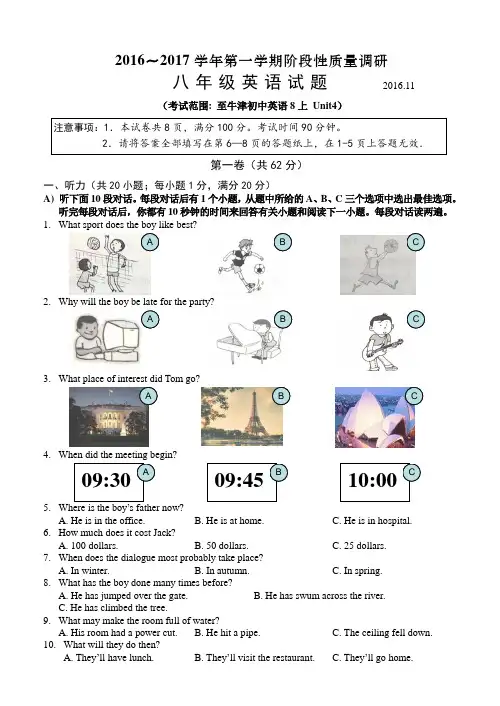
2016~2017学年第一学期阶段性质量调研八年级英语试题(考试范围: 至牛津初中英语8上Unit4)注意事项:1.本试卷共8页,满分100分。
考试时间90分钟。
2.请将答案全部填写在第6—8页的答题纸上,在1-5页上答题无效.第一卷(共62分)一、听力(共20小题;每小题1分,满分20分)A) 听下面10段对话。
每段对话后有1个小题,从题中所给的A、B、C三个选项中选出最佳选项。
听完每段对话后,你都有10秒钟的时间来回答有关小题和阅读下一小题。
每段对话读两遍。
1. What sport does the boy like best?2. Why will the boy be late for the party?3. What place of interest did Tom go?4. When did the meeting begin?5.A. He is in the office.B. He is at home.C. He is in hospital.6. How much does it cost Jack?A. 100 dollars.B. 50 dollars.C. 25 dollars.7. When does the dialogue most probably take place?A. In winter.B. In autumn.C. In spring.8. What has the boy done many times before?A. He has jumped over the gate.B. He has swum across the river.C. He has climbed the tree.9. What may make the room full of water?A. His room had a power cut.B. He hit a pipe.C. The ceiling fell down.10. What will they do then?A. They’ll have lunch.B. They’ll visit the restaurant.C. They’ll go home.2016.11B)听对话或独白。
江苏省常州市2024_2025学年高二英语下学期学业水平监测试题含解析
5. What does the woman mean?
A. She doesn’t agree.
B. She never goes fishing.
C. She agrees with the idea.
其次节(共15小题;每小题1.5分,满分22.5分)
听下面5段对话或独白.每段对话或独白后有几个小题,从题中所给的A,B,C三个选项中选出最佳选项,并标在试卷的相应位置.听每段对话或独白前,你将有时间阅读各个小题,每小题5秒钟;听完后,各小题将给出5秒钟的作答时间.每段对话或独白读两遍.
O’Connell is working in music full-time now, preparing Eilish s next album and his own full-length album while experimenting and learning more production ideas and sounds. But Finneas the actor will not turn down acting gigs(临时工作) if an ideal role is offered.
江苏省常州市2024-2025学年高二英语下学期学业水平监测试题(含解析)
留意:本试卷分第一卷(选择题)和其次卷(非选择题)两部分.答案全部做在答题纸上.
满分为150分.考试时间120分钟.
第一部分 听力(共两节,满分30分)
第一节(共5小题:每小题1.5分,满分7.5分)
听下面5段对话.每段对话后有一个小题,从题中所给的A,B,C三个选项中选出最佳选项,并标在试卷的相应位置.听完每段对话后,你都有10秒钟的时间来回答有关小题和阅读下一小题.每段对话仅读一遍.
江苏省淮安中学2016-2017学年高二第一学期期末考试英语试卷(解析版)
2016-2017学年度高二年级第一学期期末考试试卷试卷满分:120分完成时间:120分钟第I卷(选择题, 共85分)第一部分:听力(共两小节,满分20分)第一节(共5小题;每小题1分,满分5分)听下面5段对话。
每段对话后有一个小题,从题中所给的A、B、C三个选项中选出最佳选项,并标在试卷的相应位置。
听完每段对话后,你都有10秒钟的时间来回答有关小题和阅读下一小题。
每段对话仅读一遍。
1. What does Jim do?A. A teacher.B. An officer.C. A student.2. What time did Suzy leave home?A. 4:30.B. 5:00.C. 5:15.3. What is the man’s suggestion?A. Going to the concert.B. Going to see a show.C. Just walking around.4. How long has the rain lasted?A. 5 days.B. 6 days.C. 7 days.5. What opinion do they hold on their chemistry course?A. It’s well organized.B. It is satisfactory.C. It is unsatisfactory.第二节(共15小题)听下面5段对话或独白。
每段对话或独白后有几个小题,从题中所给的A、B、C三个选项中选出最佳选项,并标在试卷的相应位置。
听每段对话或独白前,你将有时间阅读各个小题,每小题5秒钟;听完后,各小题将给出5秒钟的作答时间。
每段对话或独白读两遍。
听第6段材料,回答第6至7题。
6. Where does this conversation take place?A. In a library.B. In a school.C. In a bookstore.7. Why is William Shakespeare mentioned in the conversation?A. He gave gifts to millions of people.B. He was a very wealthy man in his times.C. His signature is worth a lot of money....听第7段材料,回答第8至11题。
高二英语上学期期末考试试题(附答案)
海南中学2016-2017学年第一学期期末考试高二英语试题第一部分听力(共两节,满分30分)做题时,先将答案标在试卷上。
录音内容结束后,你将有两分钟的时间将试卷上的答案转涂到答题卡上。
第一节(共5小题;每小题1.5分,满分7.5分)听下面5段对话。
每段对话后有一个小题,从试题所给的A、B、C三个选项中选出最佳选项,并标在试卷的相应位置。
听完每段对话后,你都有10秒钟的时间来回答有关小题和阅读下一小题。
每段对话仅读一遍。
1. How does the man feel?A. Worried。
B. Satisfied。
C。
Regretful.2。
What was the regular price of one bag?A. 300 dollars.B. 600 dollars。
C. 450 dollars.3。
Why hasn’t the woman seen the man recently?A. He has changed his job。
B。
He has been too busy。
C. He has been out of town。
4. Who might be promoted to the president of the company?A. Alden。
B. Bruce. C。
Kevin.5. What does the woman want the man to do?A. Carry the box for her. B。
Hold the door open for her。
C. Open the box for her。
第二节(共15小题;每小题1。
5分,满分22.5分)听下面5段对话。
每段对话后有几个小题,从题中所给的A、B、C三个选项中选出最佳选项,并标在试卷的相应位置。
听每段对话前,你将有时间阅读各个小题,每小题5秒钟;听完后,各小题将给出5秒钟的作答时间。
江苏省扬州中学2016-2017学年高一上学期10月份测试英语试题 含答案
学必求其心得,业必贵于专精江苏省扬州中学高一年级十月质量检测英语试题2016.10。
6命题人王亚军审核张小兰(考试用时:120分钟满分:120分)第I卷(共80 分)第一部分听力(共两节,满分20分)第一节(共5小题;每小题1分,满分5分)听下面5段对话。
每段对话后有一个小题,从题中所给的A、B、C三个选项中选出最佳选项,并标在试题卷的相应位置。
听完每段对话后,你都有10秒钟的时间来回答有关小题和阅读下一小题。
每段对话仅读一遍。
1。
At what time will the speakers get to the sports meeting?A. 8:45. B。
8:30。
C。
8:15。
2. How will the woman get to New York?A。
By car。
B. By air。
C. By train。
3. What can we learn from the conversation?A. The man is handsome. B。
The man eats a lot every day.C. The man has been exercising recently。
4。
Why is the woman studying English?A. It will help her with her job.B. She wants to find a better job。
C. She will move to America.5. Who is the woman probably speaking to?A。
A shop manager. B. A policeman。
C. Her neighbor.第二节(共15小题;每小题1分,满分15分)听下面5段对话或独白。
每段对话或独白后有几个小题,从题中所给的A、B、C三个选项中选出最佳选项。
听每段对话或独白前,你将有时间阅读各个小题,每小题5秒钟;听完后,各小题给出5秒钟的作答时间。