
外研版英语(新标准)八年级上册Module 10 The weather Unit 2 教案
Unit 2 The weather is fine all year round.ⅠTeaching modelReading and writing.ⅡTeaching methodBottom-up approachⅢTeaching aims1. Listening and understanding familiar topics (weather).2. Giving weather forecast based on clues; predicting about future weather using probably.3. Reading and finding specific information.4. Writing a short passage about the best time to visit your town, using because, so and but.ⅣTeaching Objectives1. Key vocabulary: mile, northwest, umbrella, southeast, from time to time2. Keys sentences:1) When’s the best time to visit the US?2) The US is a very big country to visit.3) So choose carefully the places to see and the time to go.4) Bring a map because you may want to travel around.5) New York and Washington DC are good places to visit in May or October.6) The best time to visit New England is in September.7) The weather gets cooler and the green leaves start to go gold, then brown.8) It’s a good idea to bring your camera so you can take photos of autumn trees.9) Take your swimming clothes because you might want to go swimming inthe sea, even in December.10) So when’s the best time to visit the US?ⅤTeaching aidsRecorder, OHP, videoⅥTeaching StepsStep 1 RevisionTalk about the weather.1) Show a China weather map.2) Ask and answer:What will the weather be like in …?Step 2 Warming upWork in pairs.When’s the best time to visit your town or country? Why?Step 3 Reading1. Show some pictures about the weather of the cities and states in America.2. Talk about what you can see in the pictures.3. Talk something about the weather of the cities and states.4. Read the passage and fill in the blanks.5. Introduce the new words.6. Play the recording and listen to the tape carefully.7. Ask the students to read through the passage.Step 4 Complete the table.1. Read the passage again.2. Complete the table in Activity3.3. Check the answers .Keys:1. a lot of snow2. In May or October3. It gets cooler in September4. In September5. Fine all year round6. All year7. Warm day and cool night 8. very cold 9. In summerStep 5 Complete the sentences.1. Ask the students to read the words in the box in Activity 4.2. Complete the sentences with the correct form of the words from the box.1) In autumn the leaves turn gold and then _____________.2) It’s about 3,000 _____________ from the east coast to the west coast.3) You might need a(n) _____________ in the evening.4) Sometimes there are ____________ in summer and autumn on the southeastcoast.5) You will need a( n) ______________ in Seattle because it rains a lot.3. Check the answersKeys:1. brown2. miles3. sweater4. storm5. umbrellaStep 6 Language points1. The best time to visit New England is in September.九月是去新英格兰游览的最佳时间。
这里的New England (新英格兰) 指的是美国东北部的一个地区,他包括六个州:缅因州(Maine)、新罕布什尔州(New Hampshire)、佛蒙特州(Vermont )、马萨诸塞州(Massachusetts)、罗得岛州(Rhode Island) 和康涅狄格州(Connecticut) 。
这里的小镇非常美丽,每年秋天都会有大批游客来此游玩。
1614年英国探险家约翰•史密斯( John Smith ) 给这个地方起名为新英格兰。
2. Bring your camera so you can take photos of the autumn trees.带上你的照相机以便可以拍摄秋天的树木。
take photos of …的意思是“给……拍照”。
例如:I took a photo of Linda.我给琳达拍了一张照片。
She took a lot of photos of the kids.她给孩子们拍了许多照片。
3. In Texas and the southeast, it’s usually very hot and sunny co mpared to other places. 和其他地方对比,得克萨斯州和东南部地区通常天气很热,阳光灿烂。
compared to 意为“和……比较”,表示此意也可以用compared with。
例如:Compared to our small house, Bill’s house seemed like a palace.和我们的小房子相比,比尔的房子就像一座宫殿。
This road is quite busy compared to/ with ours.和我们(附近)的马路相比,这条马路(交通)非常繁忙。
4. There are storms from time to time in summer and autumn.但是夏秋季节时常有暴风雨。
from time to time 表示“时常,有时”。
例如:He has moved to another city, but we write to each other from time to time.他移居到了另外一座城市,但是我们会时不时通通信。
They are now living in different cities, but they still talk on the phone from time to time. 他们现在生活在不同的城市里,但是仍然偶尔通通电话。
Step 7 ExercisesI. 请根据句意及括号内所给汉语提示写出所缺单词。
1. My father bought a _______ (照相机) for me on my birthday.2. It’s raining and you should take an ________ (雨伞) with you.3. It will get cooler and cooler when ___________ (秋天) comes.4. Bring your _______________ (游泳衣) because you might go swimming in the sea.II. 请根据所给汉语及括号内的提示词语翻译下列句子。
1. 每天用英语写日记是个好主意。
(it’s a good idea to ...)______________________________________________________2. 与其他城市相比,海南的冬天很温暖。
(compared to ...)______________________________________________________3. 我昨天在动物园拍了几张猴子的照片。
(take photos of ...)_____________________________________________________4. 在昆明,一年到头都很温暖。
(all year)______________________________________________________5. 海上不时有风暴,所以你一定要小心。
新 外研版八上Module 10 The weather[Unit 2]练习含答案
![新 外研版八上Module 10 The weather[Unit 2]练习含答案](https://360docs-1393072327.cos.ap-beijing.myqcloud.com/c8aa398785868762caaedd3383c4bb4cf7ecb7b2.webp)
外研版八年级英语上册Module 10 The weather [Unit 2]练习Ⅰ.用所给单词的适当形式填空1.Don't forget ________ (take) a digital camera when you visit a place of interest.2.If you want to swim there, you should take your ________ (swim) clothes.3.Tom, you had better ________(finish) your homework before eight o'clock.4.It's ________ (snow) today. You should be careful when you drive.5.It's good ________ (hear) that our class won the football game.Ⅰ.连词成句根据括号内的中文提示,将所给的英文意群连接成正确的句子。
6.busy, my, is, all year round, very, father(我爸爸全年都很忙。
)________________________________________________________________________________________________________________________________________________7.I, compared with, have, other, more, students, stamps(与其他学生相比,我有更多的邮票。
)________________________________________________________________________________________________________________________________________________8.go, we, to, had better, this afternoon, Shanghai(我们最好今天下午去上海。
新 外研版英语八年级上册Module 10 Unit1 (2)配套练习(附答案)
Module 10The weatherUnit 1It might snow.[见学生用书A38]Ⅰ.根据句意及首字母或汉语提示完成单词1.The t__emperature__ in Beijing is between minus nine and two degrees today. 2.Don't play a j__oke__ on him.It's not polite.3.There are many c__louds__ in the sky.I think it will rain later on.4.It will be summer in February in Australia,so it'll p__robably__ be very sunny. 5.There was a heavy __storm__(暴风雨)last night.6.I like __rainy__(下雨的)days because the air is fresh.7.I have just had a __terrible__(可怕的)thought.Ⅱ.用括号中所给单词的适当形式填空1.—Is Jack busy packing luggage(行李)?—Yes.He __is__leaving__(leave)for America on vacation.2.—How is the weather?—It is raining __heavily__(heavy).3.It's __snowy/snowing__(snow).You should be careful on the road,or you may slip(滑倒).4.On __rainy__(rain)days,we'd better __stay__(stay)at home and do some reading. 5.I wish I __were__(be)in Hainan now.6.Don't forget __to__bring__(bring)your homework here.Ⅲ.完形填空The weather is closely related(联系)to our life.It is all around us all the time.It is a(n)__1__ part of our lives.We can't control(控制)it,but it often controls how and where we live,what we do,what we __2__ and what we eat.Read this passage and learn more about the __3__.What is the weather?The weather is just the state of the atmosphere(大气层)at any time,such as temperature,wind,__4__,sun,etc.What makes the weather __5__?As we know,not every place on the earth getsthe same amount of __6__.Some places get more sunlight.So it's __7__ in those places.Some places get little or no sunlight in __8__.Then those places have lower temperatures in winter.These __9__ in temperature make the air and water move around the __10__.The movement helps to __11__ the heat energy from the sun across the earth.So the weather changes.What's the difference between weather and climate(气候)?Climate is a place's weather over a __12__ time.The weather changes from day to day and __13__ from hour to hour.It can be sunny in the morning,__14__ cold and wet in the afternoon.As for the climate,it changes very __15__ over lots of years.(A)1.A.important B.interestingC.helpful D.useful(A)2.A.wear B.hearC.like D.read(D)3.A.seasons B.lifeC.customs D.weather(B)4.A.water B.rainC.plants D.animals(B)5.A.return B.changeC.rise D.drop(C)6.A.rain B.snowC.sunlight D.moonlight(B)7.A.nicer B.warmerC.heavier D.richer(A)8.A.winter B.autumnC.summer D.spring(D)9.A.advantages B.changesC.movements D.differences(A)10.A.earth B.mountainsC.sun D.oceans(D)11.A.reach B.fetchC.blow D.take(C)12.A.good B.hardC.long D.short(D)13.A.also B.almostC.just D.even(D)14.A.so B.becauseC.as D.but(B)15.A.differently B.slowlyC.carefully D.easilyⅣ.阅读理解Maybe you know floods,earthquakes,sandstorms and so on.But have you heard of typhoons(台风)?Typhoons are some of the worst storms,usually around the Pacific Ocean and the South China Sea.Most of them happen in July,August and September.How does a typhoon happen?When lots of sea water gets hot in the summer sun,it evaporates(蒸发)into the air.This makes the air hotter.When the air gets warm enough,it starts to move higher up into the sky.After the air gets warmer,it starts to move quickly,making wind.The wind goes in circles and it keeps moving higher in the sky.The warmer the air gets,the quicker the wind moves.And when the wind moves faster than 32.7 metres a second,a typhoon begins.A typhoon has two parts.One is called the “eye”.In the eye,the wind does not move so fast.The other part is the wall of clouds around the eye.Here are the strongest winds and hardest rain.Typhoons are very dangerous.In November,2013,Typhoon Haiyan killed more than 5,500 people in Philippines(菲律宾).Many people went missing.What to do when a typhoon hits?☆Stay inside.Close all the windows and stay away from them.☆Try to bring all of your things inside.Strong winds can even blow away your bikes.☆Listen to the radio or watch TV for important information.(D)1.This passage is most probably from________.A.an advertisementB.a travel recordC.a weather reportD.a science magazine(A)2.Typhoons often happen________.A.in the hot seasonB.in the cold seasonC.only in ChinaD.under the sea(D)3.In which order does a typhoon happen?①The wind moves fast enough and then a typhoon starts.②The air moves quickly,making wind.③The sun makes sea water hot.④The air gets warmer.A.②③①④B.③①④②C.①③④②D.③④②①(C)4.Which of the following is TRUE according to the passage?A.The warmer the air gets,the slower the wind moves.B.About 7,100 people died because of Typhoon Haiyan in Philippines. C.The strongest winds and hardest rain are in the wall of clouds.D.A typhoon will not happen before the wind goes faster than 40 km a second. Ⅴ.词汇运用A.用方框中所给单词的适当形式填空。
外研版八年级英语上册《Module 10 The Weather》教学设计
外研版八年级英语上册《Module 10 The Weather》教学设计一. 教材分析《Module 10 The Weather》主要讲述了关于天气的话题,包括不同国家的天气状况、天气词汇以及如何描述天气。
本模块的核心词汇有weather, climate, sunny, cloudy, rny, windy, hot, cold等。
本节课通过学习这些词汇和句型,让学生能够用英语描述不同国家的天气状况。
二. 学情分析八年级的学生已经具备了一定的英语基础,能够听、说、读、写一些简单的词汇和句子。
但是,对于一些天气词汇和描述天气的句型,学生可能还不太熟悉。
因此,在教学过程中,教师需要注重引导学生掌握这些核心词汇和句型,并能够运用到实际情境中。
三. 教学目标1.知识目标:–学生能够掌握关于天气的核心词汇,如weather, climate, sunny, cloudy, rny, windy, hot, cold等。
–学生能够运用所学的词汇和句型描述不同国家的天气状况。
2.能力目标:–学生能够听懂、会说、会读、会写关于天气的词汇和句型。
–学生能够在实际情境中运用所学的词汇和句型进行交流。
3.情感目标:–学生能够激发对天气话题的兴趣,提高学习英语的积极性。
四. 教学重难点•学生能够掌握关于天气的核心词汇。
•学生能够运用所学的词汇和句型描述不同国家的天气状况。
•学生能够正确运用所学的词汇和句型进行实际交流。
五. 教学方法1.任务型教学法:通过设定不同任务,让学生在实际情境中运用所学的词汇和句型。
2.交际法:引导学生进行小组讨论、角色扮演等交际活动,提高学生的口语表达能力。
3.情境教学法:创设不同国家的天气情境,让学生在情境中学习、运用所学的词汇和句型。
六. 教学准备1.教学课件:制作包含天气词汇和句型的课件,以便于学生学习和复习。
2.练习题:准备一些关于天气的练习题,用于巩固所学知识。
3.教学素材:准备一些关于不同国家天气的图片或视频,用于展示和引导学习。
外研版八年级英语上册《Module10TheWeather》说课稿
外研版八年级英语上册《Module 10 The Weather》说课稿一. 教材分析外研版八年级英语上册《Module 10 The Weather》主要介绍了天气和气候的相关知识。
通过本模块的学习,学生能够掌握描述天气和气候的词汇和句型,了解不同国家的气候特点,提高运用英语进行天气交流的能力。
本模块包括三个单元,分别是Unit 1 It’s rning! , Unit 2 The weather is cool in Siberia, and Unit 3 What’s the weather like in your city?。
二. 学情分析八年级的学生已经具备了一定的英语基础,能够听、说、读、写简单的英语句子。
但天气和气候的概念较为复杂,学生需要通过实例和实际操作来理解和掌握相关词汇和句型。
此外,学生的地区差异较大,对于不同地区的气候特点了解有限,需要在课堂上进行交流和分享。
三. 说教学目标1.知识目标:学生能够掌握描述天气和气候的词汇和句型,了解不同国家的气候特点。
2.能力目标:学生能够运用英语进行天气交流,提高听、说、读、写的能力。
3.情感目标:培养学生对天气和气候的兴趣,增强环保意识。
四. 说教学重难点1.重点:描述天气和气候的词汇和句型。
2.难点:不同国家的气候特点的理解和运用。
五. 说教学方法与手段1.情景教学法:通过设置天气和气候的情境,让学生在实际语境中学习和运用英语。
2.交际教学法:引导学生进行天气交流,提高实际运用英语的能力。
3.多媒体教学手段:利用图片、视频等资料,生动形象地展示不同国家的气候特点。
六. 说教学过程1.导入:通过谈论当天的天气,引出本节课的主题——天气和气候。
2.新课呈现:介绍描述天气和气候的词汇和句型,如“It’s sunny today.”、“The weather is cool in Siberia.”等。
3.课堂实践:分组进行角色扮演,模拟不同国家的气候特点,如在中国、美国、英国等。
Module10TheweatherUnit1课件八年级英语上册(5)
Chinese meaning 大明:在英国十二月份下雪吗?
托尼:通常不下,尽管今年雪下得相当多。绝大多数十二月份潮 湿多雨。 大明:贝蒂,在美国冬天天气怎么样? 贝蒂:我们冬季寒冷,夏季炎热。在纽约冬天会下雪。 托尼:听起来棒极了! 我喜欢晴朗的天气,我也喜欢雪。但我不 喜欢阵雨或有风的天气。
贝蒂:我也不喜欢。雨天令人烦恼!我希望我现在在澳大利亚。 那里可能晴朗而炎热。 玲玲:如果你喜欢晴朗的天气,你可以去海南岛。 贝蒂:总有一天我会去的。 玲玲:快点,走吧! 我们可以在公园滑冰,还能暖和起来。
云;云雾 阵雨 下雪 暴风雨 多云的
多雨的;下雨的 多雪的;下雪的 晴朗的
多风的;刮大风的
New words
skate /skeɪt/ thick /θɪk/ 滑冰
ice /aɪs/ joke /dʒəʊk/ 厚的
might /maɪt/
冰
temperature/'temprɪˌtʃə/ 说笑话;开玩笑
-8~-2 ℃
In Beijing, there will be clouds in the early morning, and the temperature will be between minus eight and minus two degrees.
What’s the weather like in Shanghai?
What’s the weather like in Hongkong?
17~20 ℃
Hongkong will be cloudy. There will be storms later, and the temperature will be between 17 and 20 degrees.
外研版英语八年级上册 Module 10 The weather
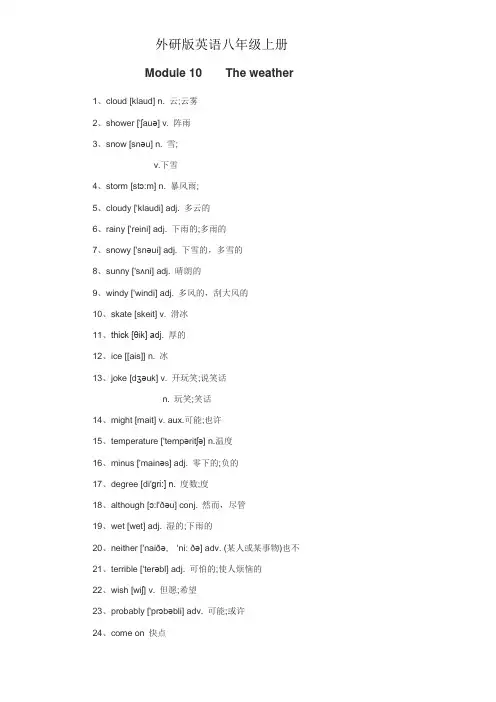
Module 10 The weather1、cloud [klaud] n. 云;云雾2、shower ['ʃauə] v. 阵雨3、snow [snəu] n. 雪;v.下雪4、storm [stɔ:m] n. 暴风雨;5、cloudy ['klaudi] adj. 多云的6、rainy ['reini] adj. 下雨的;多雨的7、snowy ['snəui] adj. 下雪的,多雪的8、sunny ['sʌni] adj. 晴朗的9、windy ['windi] adj. 多风的,刮大风的10、skate [skeit] v. 滑冰11、thick [θik] adj. 厚的12、ice [[ais]] n. 冰13、joke [dʒəuk] v. 开玩笑;说笑话n. 玩笑;笑话14、might [mait] v. aux.可能;也许15、temperature ['tempəritʃə] n.温度16、minus ['mainəs] adj. 零下的;负的17、degree [di'ɡri:] n. 度数;度18、although [ɔ:l'ðəu] conj. 然而,尽管19、wet [wet] adj. 湿的;下雨的20、neither ['naiðə, 'ni: ðə] adv. (某人或某事物)也不21、terrible ['terəbl] adj. 可怕的;使人烦恼的22、wish [wiʃ] v. 但愿;希望23、probably ['prɔbəbli] adv. 可能;或许24、come on 快点25、mile [mail] n. 英里26、round [raund] adv. 围绕地27、northwest [,nɔ:θ'west] n. 西北adj. 西北的;向西北的28、southeast [,sauθ'i:st]n. 东南adj. 东南的;朝东南的29、from time to time 有时;间或。
2023八年级英语上册Module10Unit1Itmightsnow知识点归纳新版外研版
Module 10 The weatherUnit 1Good evening, everyone! Here is the weather report in some cities around the world in twenty hours.In Moscow, the temperature is between minus ten and minus three degrees. You can skate on the thick ice. It will be snowy and windy tomorrow morning and it might snow heavily tomorrow afternoon.Beijing is sunny. It is neither too cold nor too hot. However, the weather will probably be terrible because a big storm is coming in ten hours.The temperature in New York is between 22 degrees and 28 degrees. There is much cloud this evening. There might be a shower. It will still be cloudy or rainy tomorrow morning. But it will be sunny in the afternoon.Sydney is rainy and wet tonight. Everyone wishes it could rain heavily because it is hot and dry for a long time.1. cloud n.云;云雾2. shower n.阵雨【新义:n.& v.淋浴】3. snow n.雪v.下雪4. storm n.暴风雨5. cloudy adj.多云的6. rainy adj.多雨的;下雨的7. snowy adj.多雪的;下雪的8. sunny adj.晴朗的9. windy adj.多风的;刮大风的10. skate v.滑冰11. thick adj.厚的【新义:adj.茂密的;浓密的;黏稠的】12. ice n.冰13. joke v.说笑话;开玩笑n.笑话;玩笑14. might v.aux.可能;也许15. temperature n.温度16. minus adj.负的;零下的【新义:prep. 减;减去】17. degree n.度;度数【新义:n.程度】18. although conj. 然而;尽管19. wet adj.下雨的;湿的20. neither adv.(某人或某事物)也不21. terrible adj.使人烦恼的;可怕的22. wish v.但愿;希望【新义:n.希望;祝愿】23. probably adv.或许;可能1. cloud n.云;云雾→cloudy adj.多云的2. snow n.雪v.下雪→snowy adj.多雪的; 下雪的3. rain n.雨;雨水v.下雨→rainy adj.多雨的;下雨的4. sun n.太阳→sunny adj.晴朗的5. wind n.风→windy adj.多风的;刮大风的6. probable adj.或许;可能→probably adv.或许;可能1. between… and… 在……和……之间2. quite a lot相当多3. as well也4. come on 快点儿5. at least至少1. 而且还是阴天,所以可能会下雪。
外研版英语八年级上册Module10《Theweather》(Unit2)教学设计
外研版英语八年级上册Module 10《The weather》(Unit 2)教学设计一. 教材分析本课选自外研版英语八年级上册Module 10《The weather》(Unit 2),主要介绍了天气的相关词汇和表达天气状况的句子。
通过本课的学习,学生能够掌握描述天气的词汇,如sunny, cloudy, rny, windy等,以及表达天气状况的句子,如It’s sunny today. How’s the weather today? 同时,本课还涉及到一般现在时的用法。
二. 学情分析八年级的学生已经具备了一定的英语基础,能够听懂并运用一些基本的英语句子进行交流。
但天气方面的词汇和表达可能对他们来说较为陌生,因此需要在教学中进行适当的引导和操练。
三. 教学目标1.知识目标:学生能够掌握描述天气的词汇,如sunny, cloudy, rny,windy等,以及表达天气状况的句子,如It’s sunny today. How’s the weather today?2.能力目标:学生能够在实际情景中运用所学词汇和句子进行 weather的简单交流。
3.情感目标:培养学生对天气变化的关注,增强学生的生活安全意识。
四. 教学重难点1.重点:描述天气的词汇和表达天气状况的句子。
2.难点:一般现在时的用法。
五. 教学方法采用情境教学法、交际法、任务型教学法和合作学习法等,通过图片、视频、对话等形式,激发学生的学习兴趣,提高学生的参与度和实践能力。
六. 教学准备1.教学课件:制作包含图片、视频、对话等的多媒体课件。
2.教学材料:天气预报视频、天气图片等。
3.教学设备:投影仪、计算机、音响等。
七. 教学过程1.导入(5分钟)利用天气预报视频或图片,引导学生关注天气,激发学生的学习兴趣。
教师提问:What’s the weather like today? 学生回答:It’s sunny/cloudy/rny/windy.2.呈现(10分钟)教师展示描述天气的词汇和表达天气状况的句子,如sunny, cloudy, rny, windy, It’s sunny today, How’s the weather today? 学生跟读并模仿。
八年级英语上册知识讲义-重点单词(Module 10 The weather)附练习及答案-外研版
初中英语重点单词(Module 10 The weather)知识梳理cloud n. 云minus a. 负的,零下的shower n. 阵雨degree n. 度snow n. & v . 雪;下雪although conj. 尽管storm n. 暴风雨wet a. 湿的cloudy a. 多云的neither adv. 也不rainy a. 多(下)雨的terrible a. 可怕的snowy a. 多(下)雪的wish v. 希望sunny a. 晴朗的probably adv. 或许windy a. 多(刮)风的come on 快点skate v. 滑冰mile n. 英里thick a. 厚的round adv. 围绕地ice n. 冰northwest n. & a. 西北(的)joke n. & v. (说)笑话southeast n. & a. 东南(的)might aux. & v. 可能from time to time 有时temperature n. 温度二、重点单词【单词学习】1. park ☆☆☆【用法】n. 公园【例句】We are going to the park to skate.我们要去公园滑冰。
【拓展】park的含义除了“公园”外,还可以解释成“停车”。
You can’t park your car here.park, drive, neutral, reverse还有就是可以翻译成韩国姓氏“朴”,如韩国总统朴槿惠的名字是:Park Geun-hye【考题链接】请判断下列park的含义:1. Can I park my car here?2. Is there a parking lot?3. I will park my car outside the park.答案:1. 停车 2. 停车场 3. 前者为停车,后者是公园思路分析:根据句子含义和结构来判断。
外研版初中英语初二上册Module 10 The weather知识讲解
Module 10 The weather词句精讲精练词汇精讲1. joke(1) joke可作动词,意为“开玩笑;说笑话”。
例如:Don’t get mad. I was only joking. 别生气,我只是在开玩笑。
You don’t joke with him. 你不要和他开玩笑。
(2) joke还可作名词,意为“笑话;玩笑”。
例如:She told us some very funny jokes. 她给我们讲了一些非常滑稽的笑话。
【拓展】(1) Are you joking? / You’re joking!是常用口语,常用来表示说话人对对方所说的话感到惊讶或者不相信。
例如:—Are you getting a new car this year? 你今年要买辆新车吗?—You’re joking! I can’t afford to buy a car at all. 你在开玩笑吧!我根本买不起车。
(2) play a joke on sb. 取笑某人make a joke讲笑话2. snowysnowy是形容词,意为“多雪的;下雪的”。
它的名词形式是snow,意为“雪”;动词形式是snow,意为“下雪”。
形容词用来作表语或定语,名词用来作主语或宾语,动词用来作谓语。
例如:If it’s snowy, you should stay indoors. 如果下雪,你应该待在室内。
We have a very snowy winter this year. 今年我们拥有一个多雪的冬天。
【拓展】在名词词尾加-y构成形容词,类似的词还有:rain—rainy 雨—下雨的sun—sunny 太阳—晴朗的luck—lucky 幸运—幸运的wind—windy 风—刮风的snow—snowy 雪—下雪的3. althoughalthough的意思相当于though,意为“尽管,虽然”,用来引导让步状语从句。