
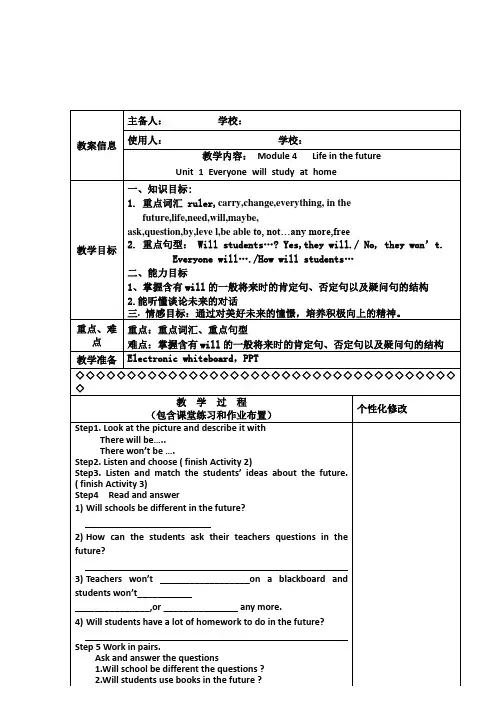
七年级上Module 4 Life in the future重难点解析
Module 4 Life in the future学案Unit 1 Everyone will study at home1.in the futureWho can tell what happen in the future?He hopes to be a scientists in the future.【相关链接】in future 和in the future 的区别in future指全部的将来,是“从今以后(from now on)”的意思,也可用for the future代替He promised to give me more help in future.in the future通常指将来的一段时间,“将来”What are you going to do in the future?【练习】I hope to visit USA sometime_______.A.in the futureB.in futureC.for futureD.of future2.In 20 years’ time“二十年后”,在一般将来时的句子中,“in+一段时间”表示“在一段时间以后”,常用于将来时,可以用how soon来提问。
I think I will be a reporter in five years. ——How will you be back? ——In a month. Maybe there won’t be any schools.【练习】——How far is your family from here? ——It’s about ten_________walk.A.minute’sB.minuteC.minutes’D.minutes3.……maybe there won’t be any schools!there will be的用法(1)there will be 是there be 句型的一般将来时态,表示“将会有某人/某物”There will be a strong wind in the north of China tomorrow.Will there be a big supermarket over there next year?(2)be going to也可以用在there be 句型中,即there is /are gong to be ,注意该句型有单复数的变化,可以与there will be 句型转换。
There is going to be an English party this weekend.(=There will be an English party this weekend.)【温馨提示】there与be连用表示存在关系,不能受汉语影响而误用have。
【练习】There _____-a football match tomorrow afternoon.A.is going to haveB.are going to beC.will beD.will have4.Everyone同义词everybody,everybody更口语化。
Everyone must work hard. Is everyone here today?Everyone与every one 的区别:(1)everyone“每人,人人”,只能指人,其后不能跟of短语。
(2)Every one“每人,每件东西”,即能用于之人,也能用于指物。
其后通常跟of短语。
Every one of them passed the exam.他们当中的每个人都通过了考试。
There are 16 students ans every one of them passes the exam.共有16个学生,每个人都通过了考试。
Every one of the cups is full of water.每个杯子都盛满了水。
(3)everyone和every one作主语时,后接动词的第三人称单数形式,与之对应的代词有时可用复数形式。
Every one buys their own lunch.(4)另外,everyone,every one 与not 连用时都表示部分否定,“并不是每个(人)”,表示全部否定式要用其对应的反义词:everyone——no one every one——none.【练习】——Is _______here? ——No,John and Bob have asked for leave.A.nobodyB.anybodyC.somebodyD.eveybody——The test is very easy,isn’t it? ——Yes,but I don’t think ______-can pass it.A.somebodyB.everybodyC.anybodyD.no one5.by Internetby作介词,表示方式、手段,“用,通过”Can I reach you by phone? I sent the letter by animal.【注意】by后面+v—ing,表示通过做某事达到目的。
You have tried to get Mrs Flower’s money by taking a false name.by作为介词还有一些其他常见用法:(1)表示地点,“在……旁边”I waited by the kitchen door.(2)表示路径,“经由……,通过……”Leave the hotel by the nearest exit.(3)表示工具,“用,乘(交通工具)”We traveled by bus.【练习】——______did you tell him about the news? ——By______an email.A.How, sendingB.How ,sendC.How,sentD.What ,sending6.Will students need computers at school?need 在此为实义动词,“需要”+n./pron/to do作宾语We need a lot of free time.We need to have a lot of free time.【拓展】need也可用作情态动词,多用于疑问句或否定句中,后跟动词原形。
其否定形式needn’t “不必”What need I carry to school? You needn’t carry lots of books to school.【练习】——_____I do the laundry first? ——No,you______.You can do your homework first.A.Must,mustn’tB.Can,mustn’tC.Must,needn’tD.May,needn’t7.carry的用法carry,动词,“拿,带”,carry sth to+某地,“把某物带到某地”Can students carry mobile phones to school?【辨析】bring,take carry,get的区别bring 表示从别处带到说话人处take 表示从说话人处带到别处carry 表示“携带”,没有方向性get 表示“去某地拿某物之后再回来”,表示一个双向、来回的动作Students carry books with the bag.Take the bag with you . Bring your bag to me. Can you get a cup of tea for me.【练习】My mother says that she will______us to the museum,,We are very excited.A.bringB.takeC.carryD.get8.be able tobe able to“能够,会,胜任”,=can,但是可以用于更多的时态之中。
I’m able to swim.= I can swim. They will be able to tell you the news soon,Mary was able to ride a bike when she was five.【练习】同义词转换They can sing in English.A.have toB.are able toC.wouldD.was able to9.not……any more“不再”=not……any longerWhy don’t you call me any more? He won’t stay with us any more.He is no longer/no more a child.=He is not a child any longer/more.=He is not any longer/more a child.【注意】表示某个动作和状态因为某种因素而突然不再延续时,应用no longer或not any longer,而不可用no more或not any more.【练习】——Excuse me,si this Mr Brown’s office?——I’m sorry,but Mr Brown_____--works here,He left about three weeks ago.A.not nowB.no moreC.not stillD.no longer10.free adj.空闲的free反义词busy Are you free tonight?【拓展】1)free形容词,“免费的”All the books are free.2)free“自由的”,名词时freedom You are free to so as you wish.【练习】根据汉语提示,写出正确的单词。
1.Look!Mike is ________(抱)a baby in his arms.2.Lucy has a high __________(水平)of English.3.I have something to do in my ________(空闲的)time.4.These___________-(问题)are very easy,so we all can answer them.5.——Can I help you,Mr Li? ——Yes,please get some________-(粉笔)for me.选择题1.Will computers ________us like our teachers?A.be able toB.can helpC.be able to helpD.be able to helping2.You can answer the question by_______others.A.to askB.askC.helpD.asking3.It is polite_______a gift when you visit somebody for the first time.A.takeB.to takeC.carryD.to carry4.Maybe nobody knows what _________happen in a hundred years.A.mustB.willC.needD.has to5.In a few years’ time, there ______hundreds of trees on the mountain.A.will haveB.are haveC.will beD.be arrive根据汉语意思完成英语句子。
初中英语_Module 4 Life in the future教学设计学情分析教材分析课后反思
M4u1 教学设计学情分析:对于遗传变异这种普遍现象,学生在生活中经常接触、感受到,通过报刊、杂志、电视、网络等媒体也接触到基因、DNA等名词术语,但要从理论上阐述、分析这些现象,牵涉到得名词术语较多,而且学生还没有相应的化学知识,对理解染色体、DNA、基因等有机大分子比较困难。
效果分析:1、本设计把语言技能听说读写作为主要目标,学生学会将来时will的用法,效果较好。
2、学生能掌握单词,学会话题联想,掌握理解文章大意的阅读策略。
教材分析:本节课是外研版初中英语新课标教材的内容,本课先联系前面知识点“be going to”将来时的用法。
引出“will”的表达法。
然后通过学生问答,自主学习,掌握这两种将来时的用法。
本节内容们对未来概念的认识表达方法,是进行探究式教学的极佳素材。
在教学中,通过发挥教师的主导作用,优化课堂结构,妙用情景模拟,把知识的传授变为让学生在探究中学习实践方法,从而渗透科学方法教育。
评测练习:※Exercises:.根据音标提示写出所缺的单词。
1. Answer my _______________ [‘kwestʃən], please.2. The old woman is _______________ ['kærɪɪŋ] a big bag to the airport.3. We will be _________ [‘eɪbl] to speak English well.4. ___________ [meɪbi] the book is hers..5. Will the city ____________ [tʃeɪndʒ] in twenty years?6. The ticket(票) is _____________ [fri:] .You needn’t pay money.7. _______________ [‘evriθɪŋ] is different in this city.8.Your ___________ [‘levl] is very high.句型转换。
Module4Lifeinthefuture学历案牛津译林版七年级英语下册
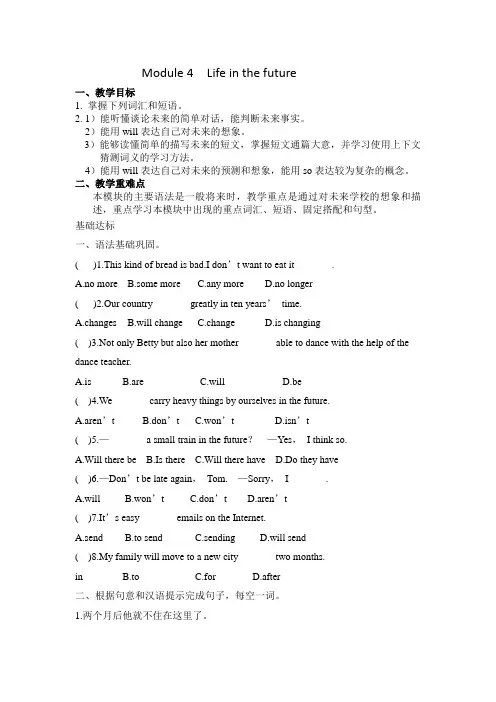
Module 4Life in the future一、教学目标1. 掌握下列词汇和短语。
2. 1)能听懂谈论未来的简单对话,能判断未来事实。
2)能用will表达自己对未来的想象。
3)能够读懂简单的描写未来的短文,掌握短文通篇大意,并学习使用上下文猜测词义的学习方法。
4)能用will表达自己对未来的预测和想象,能用so表达较为复杂的概念。
二、教学重难点本模块的主要语法是一般将来时,教学重点是通过对未来学校的想象和描述,重点学习本模块中出现的重点词汇、短语、固定搭配和句型。
基础达标一、语法基础巩固。
( )1.This kind of bread is bad.I don’t want to eat it _______.A.no moreB.some moreC.any moreD.no longer( )2.Our country _______greatly in ten years’time.A.changesB.will changeC.changeD.is changing( )3.Not only Betty but also her mother _______able to dance with the help of the dance teacher.A.isB.areC.willD.be( )4.We _______carry heavy things by ourselves in the future.A.aren’tB.don’tC.won’tD.isn’t( )5.—_______ a small train in the future?—Yes,I think so.A.Will there beB.Is thereC.Will there haveD.Do they have( )6.—Don’t be late again,Tom.—Sorry,I _______.A.willB.won’tC.don’tD.aren’t( )7.It’s easy_______ emails on the Internet.A.sendB.to sendC.sendingD.will send( )8.My family will move to a new city _______two months.in B.to C.for D.after二、根据句意和汉语提示完成句子,每空一词。
初中英语《Module4Lifeinthefuture》单元教学设计以及思维导图
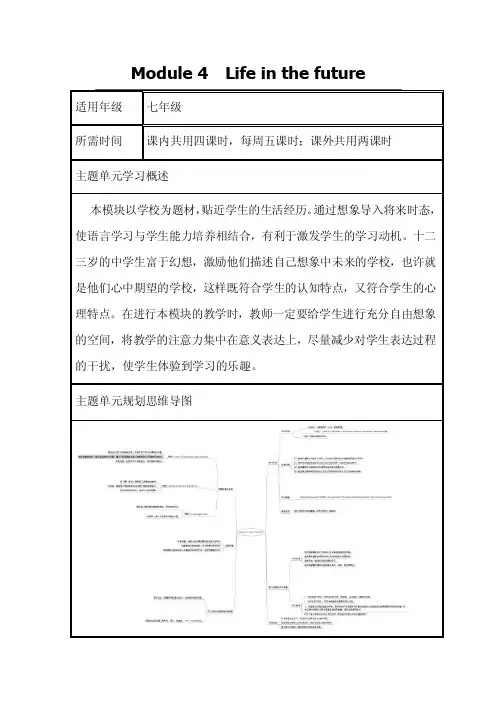
主题单元学习目标(说明:依据新课程标准要求描述学生在本主题单元 学习中所要达到的主要目标)
知识与技能:1.语法:一般将来时:will + 原形动词。 2.词汇:cable TV, calculator, cell phone, computer, education,
comfortable 等。 3.功能:预测与想象的表达。
Step 1. 创设情境导入 看图片,在小组内描述图片。
Step 2. 展示学习目标 Step 3. 出示提纲学生自学(讲评课出示学案、训练课出示练习题)
自主完成教材上的习题,巩固所学的知识。 Step 4. 师生互动合作探究(讲评课、训练课:自我纠错、合作合作探究)
1.We won’t travel by bus or bike any more.我们将不再乘公交车或自 行车旅行。
专题划分
(说明:除了说明主题单元将划分成几个专题以及每个专
题所用的课时外,还应说明哪一个专题或专题中的哪一个
活动将以研究性学习活动的形式来开展学习活动。)
专题一:Everyone will study at home. ( 一 课时)
专题二:Everyone will have a small car. ( 一 课时)
专题二
Everyone will have a small car.
所需课时 课内共用一课时,每周五课时;课外共用二课时
专题学习目标 (说明:描述学生在本专题学习中所要达到的学习目标, 注意与主题单元的学习目标呼应)
பைடு நூலகம்
To get necessary information from the reading material.
新外研版七年级下Module 4 Life in the future 导学案
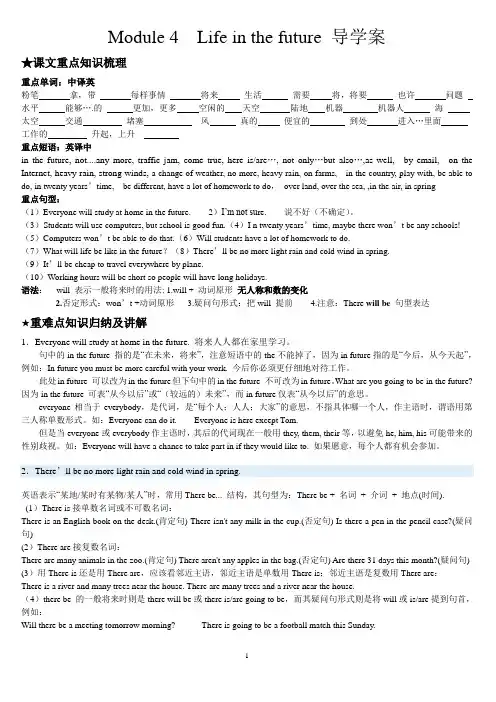
Module 4 Life in the future 导学案★课文重点知识梳理重点单词:中译英粉笔拿,带每样事情将来生活需要将,将要也许问题水平能够….的更加,更多空闲的天空陆地机器机器人海太空交通堵塞风真的便宜的到处进入…里面工作的升起,上升重点短语:英译中in the future, not....any more, traffic jam, come true, here is/are…, not only…but also…,as well, by email, on the Internet, heavy rain, strong winds, a change of weather, no more, heavy rain, on farms, in the country, play with, be able to do, in twenty years’time, be different, have a lot of homework to do,over land, over the sea, ,in the air, in spring重点句型:(1)Everyone will study at home in the future. 2)I’m not su re. 说不好(不确定)。
(3)Students will use computers, but school is good fun.(4)I n twenty years’time, maybe there won’t be any schools! (5)Computers won’t be able to do that.(6)Will students have a lot of homework to do.(7)What will life be like in the future?(8)There’ll be no more light rain and cold wind in spring.(9)It’ll be cheap to travel everywhere by plane.(10)Working hours will be short so people will have long holidays.语法:will 表示一般将来时的用法: 1.will + 动词原形无人称和数的变化2.否定形式:won’t +动词原形3.疑问句形式:把will 提前4.注意:There will be 句型表达★重难点知识归纳及讲解1.Everyone will study at home in the future. 将来人人都在家里学习。
Module 4 unit2

Module 4 Life in the futureUnit 2 Everyone will have a small car.课型:Reading and writing【学习目标】知识目标:1)掌握下列重点单词和词组的意思及用法car,farm,holiday,plane,sea,sun,expensive,rough,weather,wind,comfortable.2)重点句型will+动词原形2.能力目标:能用will表达自己对未来的想象。
3.情感目标:通过对未来的美好憧憬与想象,培养乐观向上的精神。
【教学重难点】:1.重点: 1).there will be , will do 句型2). 形容词反义词3). so 引导的并列句2.难点:there will be , will do 句型will/shall+动词原形与be going to do 的区别【教学过程】[课前朗读]:让学生大声朗读Unit2 Activity 1中出现的下列单词(一人领读)car,farm,holiday,plane,rain,sea,sun, weather, wind一.复习检查:Ⅰ. 旧知检测:没有人_____ 卫星电视________ 在将来_______将会有_________ 在家学习_________Ⅱ. 词汇预习情况检查1. 优秀学生朗读单词,教师注意其发音并及时纠正2.学生结对互查学生对词汇的预习情况二.情景导入:Can you image what life will be in the future?引出Activity 1 图片练习Read the pictures and say what you can see. You may use the words in the box.学生个体活动然后再核对答案。
三.多层阅读(自主完成,合作释疑,教师点拨)(一)泛读:Read the passage and match the pictures with paragraphs. (Activity 2)First, ask the students to read though the passage individually, and then match the paragraphs with the pictures.Last call back the answers from the whole class, asking the students to read the paragraphs.(二)快速阅读,概括段落大意I. First read the words in Activity 3Ⅱ.Ask them to read the passage again and match the pictures and paragraphs with these headings individually, then check with your partner.(三)Read again and check the true sentences.1. Planes will take a lot of people.Summer will be short and cool.2. It will be cheap to heat our homes.Machines will do interesting jobs.四.合作学习Ⅰ.弄清汉意(小组合作解决汉语意思不明白的地方。
2019-2020年七年级英语下册 Module 4 Life in the future全模块教案 外研版
2019-2020年七年级英语下册 Module 4 Life in the future全模块教案外研版一、教学内容分析本模块以未来的教室及学习为切入点,谈论将来我们生活的各个方面,学生较为有兴趣,便于展开活动。
Unit1的主要内容是涉及一些有关于教室和科学方面的名词,一篇出现了将来时的听力、一段有关未来教室的对话以及相关的几个训练活动,在这个过程中学习和掌握一般将来时WILL+动词原形的陈述,一般疑问句及问答,及否定句。
二、学生情况分析本模块以学生心目中的未来教室为话题,这与学生的现实生活密切相关,他们有话可说,乐于参与课堂活动,而涉及的语法项目是一般将来时will 的陈述句,否定句,一般疑问句及回答,动词不用任何的变化,学生应该较为容易掌握。
三、教学目标1.能够正确理解有关未来学校的对话。
2.能够听懂有关未来生活的简单对话。
3.能够用一般疑问句正确问答有关将来的信息。
四、教学重点和难点1.词汇的正确运用。
2.一般将来时will 的陈述句,否定句,一般疑问句及回答五、教学策略任务型教学、自主学习、合作学习六、教学手段磁带,图片七、教学过程Step 1 . Everyday EnglishWhat day is it today?What do you do today?What are you going to do tomorrow?……Step2.Warm-upT: What will you do at this weekend?S: I will do my homework at this weekend..T: Will you play the piano this afternoon?S: Yes, I will /No, I will not.………Like this, ask the students to work in pairs to review the future tense.Step2. PresentationT: What will you do at this weekend?Help the students answer: I will play games at this weekend.(用be going to+do引出will+do,使同学们在很自然的复习语境中导入到新课)Ask the students to work in pairs to practice will+do.Step3.Vocabulary(1) Use the pictures to teach the new words :cable, , cell phone, , paper, ruler, satellite TV.(2)guessing games :What do you use to learn math and science ? calculatorWhat do I use to teach English? chalk(3)Let students repeat the words loudly.(创设情景教单词,使学生自然地掌握了单词的读音和用法。
外研版新版七年级下Module-4-Life-in-the-future词汇语法课-
面孔二: will do 1. 根据计划或安排要做某事。
Will you see a film tomorrow evening? 明晚你打算看场电影吗? 2. 表示不以人的意志为转移的客观规 律,即注定要发生的事情。 Tomorrow will be my birthday. 明天是我的生日。
3. 表示不以人的意志为转移的客观规律, 也 可用一般现在时代替一般将来时。 Next Sunday is Women’s Day. 下周日是三八妇女节。
面孔四: 现在进行时代替一般将来时 come, go, leave, arrive, start 等动词 也可用现在进行时代替一般将来时。
He is coming here next Sunday. 下周日他将来这儿。 When are you leaving? 你什么时候动身?
3. Everyone will have a small car. (对划线部分提问) _W__h_o_w__il_l have a small car?
4. Flying in planes will be cheap. (用expensive改为选择疑问句) _W__il_l flying in planes be cheap _o_r_e_x_p_e_n_s_iv_e__?
面孔三: 一般现在时代替一般将来时 1. hope, wish, want等表“想要,希望”
的词汇无一般将来时,应用一般现 在时代替一般将来时。 I hope to see you again. 我希望再次见到你。 I want to get your help. 我想得到你的帮助。
2020-2021学年七年级英语外研版下册Module 4 Unit 1--unit3考点
Language points
• 2.Will our life be different in the future? 考点2:life/laif/n.生活;生命 考点批注:life泛指一般意义上的“生活”时,是不可数名词;若 表示某种生活方式,则是可数名词。 e.g. I think our life is colourful.我认为我们的生活是丰富多彩的。
Language points
<中考在线5>It was raining. My father asked me__D____ a raincoat. A.take B.takes C.took D.to take
点拔:用固定搭配法解题。句意:下雨了,我爸爸让我带上雨衣。ask sb.to do sth.要求某人做某事,其中的动词不定式作宾语补足语。
Language points
考点6: maybe/'meibi/adv.也许 e.g.Maybe his mother is a teacher.也许他的妈妈是一位老师。
辨析:maybe与may be maybe 副词,意为“也许,大概”,常位于句首作状语。 may be 为“情态动词+be”结构,在句中作谓语,意为“可能是”。
e.g.Maybe you'll have better luck next time.也许下次你的运气会好一 点。 It may be my mum's hat.它可能是我妈妈的帽子。 Δmay be 与maybe 可相互转换: She may be angry. Maybe she is angry. 她可能生气了。
Language points
3.Will students need computers at school?
外研版七年级英语下册 Module 4 Life in the+future专题讲解(有答案)
外研版英语七年级下册Module4 Life in the future专题讲解Name:__________________本单元提纲1. 主题功能:能够谈论未来的生活2. 重点单词:change, ask, traffic, cheap, heavy, hour 等。
3. 重点短语:in the future, not...any more, on the internet, come true, heavy rain 等。
4. 核心句型:Will school be different in the future?Everyone will study at home.等。
语法结构:will结构的一般将来时重难点精讲Will school be different in the future?将来学校会不一样吗?本句是一般将来时的一般疑问句,结构为“will+主语+动词原形+其它?”。
该句式的答语有两种形式:肯定回答Yes,主语+will否定回答No,主语+won’t一般将来时表示的是未来的事情或者是对将来的预测,will没有人称和数的变化。
如果表示将来不会,就要用will not或者缩写成won’t。
题一:翻译:那边将会有一个大型的公园。
将来每张桌子上都会有一台电脑。
我想人人都将用电脑学习。
他们将不用课本。
学校里会有电脑吗?In the future意为“将来,未来”。
in the future 意为“将来”in future 意为“今后,以后”,相当于from now onIn twenty years’ time, maybe there won’t be any schools.在20年后,也许将不会有任何学校。
in twenty years’ time意为“在20年后”,其中years’是名词所有格结构。
在一般将来时中,“in+时间段”表示“在一段时间之后”。
题二:翻译:谁知道将来会发生什么事情?今后多注意你的拼写。
外研版《英语》七年级下册Module 4 Life in the future
4、通过对美好未来的憧憬,培养乐观向上的精神。
三、教材分析
教学内容:外研版《英语》七年级下册Module 4Life in the future
Unit1 Everyone will study at home.
2、练习说:
T: What’s this?
S: It’s acell phone..
(设计意图:激发学生的学习兴趣,培养学生的开口说英语能力。)
(二)Presentation:
1、接着上一活动,=Unit1%20Everyone%20will%20study%20at%20home&in=14941&cl=2&lm=-1&st=&pn=6&rn=1&di=75913351740&ln=1974&fr=&fm=&fmq=1330412637078_R&ic=&s=&se=&sme=0&tab=&width=&height=&face=&is=&istype=#pn6&-1
内容分析通过本课学习,能运用will描述自己对未来的设想。
学情分析:七年级的学生大部分学生会做一些简单的指令,能做简单的角色扮演,鼓励学生多说,应答他人的话语是本课重点要突破的地方。
教学重难点:1、本课时重点掌握单词、。
2、难点是will法:交流法,讲读法、观察法等。
/i?ct=5033=%B7%DB%B1%CA&in=23543&cl=2&lm=-1&st=&pn=8&rn=1&di=57042862365&ln=1998&fr=&fm=&fmq=1330411579734_R&ic=&s=&se=&sme=0&tab=&width=&height=&face=&is=&istype=#pn8&-1&di57042862365&objURLhttp%3A%2F