
最全初中英语语法之-形容词和副词的比较级和最高级
形容词和副词的比较级和最高级一.形容词和副词的比较级和最高级的变化方法如下(1) 符合规则的:(2)几个不规则的形容词和副词的比较级和最高级如下表:二.形容词和副词比较级的用法注意:有些形容词,如 dead, empty, round, sure, woolen 等受本身含义的限制,没有比较级。
例题解析1. He is ________ friends than I.A. much moreB. many moreC. very moreD. too more解析:后面有可数名词复数时,many的比较级形式为many more 修饰。
应选B.2. Which is the _________ country, Japan or Australia?A. more developedB. more developingC. most developedD. most developing解析:两者比较用比较级,表示"发达"用developed, 而developing 是"发展中的" 意思3. There were _______ shops in the city in 1982 than in 1990.A. littleB. fewC. fewerD. less解析:little 不能修饰可数名词,两者比较需用比较级,所以应选C.4. If you are not free today, come another day __________.A. tooB. soC. insteadD. yet解析:instead 作副词用时意为"代替,顶替",表示前面的事情没做,而是做了后面的事。
Instead一般位于句首。
应选C.5.He can't tell us ________, I think.A. important anythingB. anything importantC. important somethingD. something important.解析:不定代词与形容词联用需后置,否定句中应该用anything而不是something. 因此应选B6. The Huang River is the second __________ river in our country.A. longB. longerC. longestD. the longest解析:"定冠词the+ 序数词+ 形容词最高级" 表示"第几大……" 应选C.7. The light in the office wasn't ________for him to read.A. enough brightB. bright enoughC. brightlyD. enough brightly解析:enough修饰名词时可前可后,修饰形容词或副词时,要后置。
应选B.8. There was an accident at the corner. ________, the girl wasn't _________hurt.A. luckily, badlyB. luck, hardlyC. Lucky, heavilyD. Lucky, strongly解析:第一空修饰全句需用副词,第二空修饰形容词hurt也要用副词,因此选A.9. You must keep your eyes _________ when you do eye exercises.A. closeB. openC. closedD., opened解析: 此处需用形容词做宾语补足语。
应选C.10. Five days has passed , but I haven't finished half of the work. ________,A. alreadyB. stillC. tooD. yet解析:already 与yet 都可用于现在完成时态。
Already常用于肯定句,而yet 常用与否定句。
应选D.三.形容词副词比较级最高级的其他用法(1)和冠词连用the +形容词原级+v(复),指一类人或物the +形容词比较级,指两者中“较…的”的那一个,eg. the younger of the twoa/ an +形容词比较级eg. The pen is expensive. I want a cheaper one.( a) +most+形容词最高级“非常…”eg. a most beautiful city( 2 ) 相关结构1)原级比较:肯定句as….as…., 否定句not so / as….as…..2)比较句:比较级+than….或more (less) ….than…..The furniture in this shop is less beautiful than that in that shop.(注意代词that的用法)3)比较级+and+比较级或more and more+比较级“越来越… ”richer and richer, more and more interesting4)The more….., the more…..“越…,越…”The more you look at the picture, the better you will like it.5) 比较级+than any other +n. (单)(适用于范围一致时)(all) other +n.(复)any +n.(单) (适用于范围不一致时)He is taller than any other student / all other students in his class.any student in my class.6) 倍数表达法。
A is three(four, etc.)times the size(height, length etc.)of B.A is three(four, etc.)times as big(high, long, etc.)as B.A is three (four, etc.)times bigger(higher, longer, etc.)than B.用times 表倍数通常用于三倍以上,两倍可以用twice或double.The new building is four times the size (the height)of the old one.这座新楼比那座旧楼大三倍(高三倍)。
Asia is four times as large as Europe.亚洲比欧洲大三倍。
Your school is three times bigger than ours.你们的学校比我们的学校大三倍。
7) more…than…结构,其意往往是…rather than…,可译为“是……而不是……”或颠倒词序译作“与其说是……,不如说是……”。
That little girl is more tired than hungry. 那个小姑娘是累了而不是饿了。
She is more a mother than a wife或She is more of a mother than a wife.她是贤妻,更是良母。
8) A is to B what C is to D A和B的关系就像C和D的关系Air is to man what water is to fish. 空气对于人类就像水和鱼的关系。
9) no more than= only “只不过”,言其少not more than=at most “不多于”,“至少”,指事实。
no more …than… 和…一样不… 如单音节使用比较级形式not more…than… 不比…更…no less than= as much as “多达”no fewer than= as many as例:I have no more than five yuan in my pocket. 我口袋里的钱只不过5元。
I have not more than five yuan in my pocket. 我口袋里的钱不多于5元。
He is no richer than I.他和我一样穷。
He is no less determined than you. 他的决心不亚于你。
(no less determined than等于“其决心不亚于你”,言其大)He is not less determined than you. 他的决心不比你小。
(not less determined than等于“其决心不小于”,无言其大或小的含义)10) 最高级+of/ in/ among….He is the tallest of the three/ among them/ in is class.四.相关词语辨析1.very 和muchA)very修饰形容词、副词的原级;much修饰比较级;修饰动词用much或very much , eg. I very like English.(×),因改为:I like English very much.B) 表示状态的过去分词前用very。
a very frightened boy, a very tired child .一般的情况下,以-ed结尾的分词多用much、very much / greatly等修饰。
如:We were greatly /much shocked by the news about Tom..C) 已转化为形容词的现在分词前用very。
如:very interesting / worrying / excitingD)too前用much/ far ,不用very。
You are much / far / a lot too nice.另外,在too many / much, too few / little前用far。
We’ve got far too many eggs and far too few egg cups.E)还有修饰词既不用very,也不用much.eg. be well worth doing, be well above the tree2. so和suchA)so … that … 与such … that … 的区别。
so + 形容词/ 副词+ that …so + 形容词+ a(n)+ 单数可数名词+ that …so + many / much / little / few + 名词+ that …such + a(n)+ 形容词+单数可数名词+ that …such + 形容词+ 不可数名词+ that …such + 形容词+ 复数名词+ that …注意:但当little表示“小”时用such。
形容词和副词的比较级和最高级全面解析

形容词和副词的比较级和最高级一. 形容词和副词的比较级和最高级的变化方法如下:(1) 规则变化表:(2)几个不规则的形容词和副词的比较级和最高级如下表:注:假如动词是及物或不及物动词,则后面用副词;假如后面是连系动词,则后面用形容词。
如:This car is the fastest of the four.(形容词)(这辆汽车是四辆之中最快的) This car runs (the) fastest of the four.(副词)(这辆汽车是四辆之中跑得最快的) 三.形容词副词比较级最高级的特殊用法(1)和冠词连用the +形容词原级+v(复),指一类人或物the + 形容词比较级,指两者中“较…的”的那一个,eg. the younger of the two a/ an +形容词比较级eg. The pen is expensive. I want a cheaper one. ( a) +most +形容词最高级 “非常…” eg. a most beautiful city (2)序数词与最高级连用,如:Flying is the fastest and the second cheapest way to travel. (3)比较级+than any other +n. (单) (适用于范围一致时)(all) other +n.(复)any +n.(单) (适用于范围不一致时) He is taller than any other student / all other students in his class. any student in my class. (4)倍数表达法。
A is three(four, etc.)times the size(height, length etc.)of B. A is three(four, etc.)times as big(high, long, etc.)as B. A is three (four, etc.)times bigger(higher, longer, etc.)than B.注:用times 表倍数通常用于三倍以上,两倍能够用twice 或double. The new building is four times the size (the height)of the old one.这座新楼比那座旧楼大三倍(高三倍)Asia is four times as large as Europe.亚洲比欧洲大三倍。
初中英语语法之形容词,副词
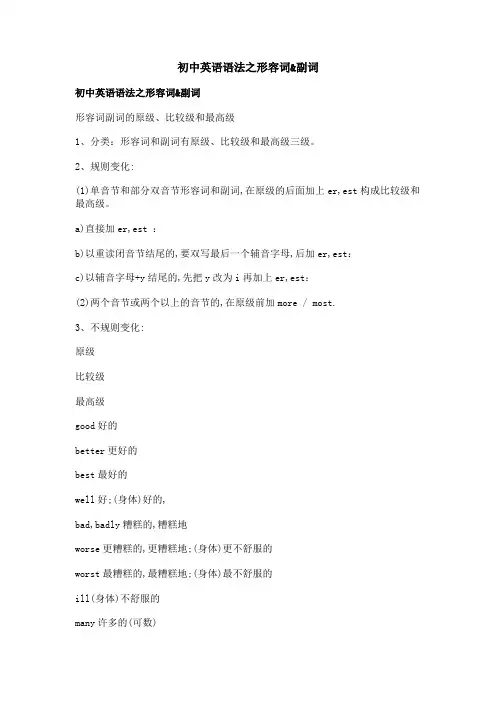
初中英语语法之形容词&副词初中英语语法之形容词&副词形容词副词的原级、比较级和最高级1、分类:形容词和副词有原级、比较级和最高级三级。
2、规则变化:(1)单音节和部分双音节形容词和副词,在原级的后面加上er,est构成比较级和最高级。
a)直接加er,est :b)以重读闭音节结尾的,要双写最后一个辅音字母,后加er,est:c)以辅音字母+y结尾的,先把y改为i再加上er,est:(2)两个音节或两个以上的音节的,在原级前加more / most.3、不规则变化:原级比较级最高级good好的better更好的best最好的well好;(身体)好的,bad,badly糟糕的,糟糕地worse更糟糕的,更糟糕地;(身体)更不舒服的worst最糟糕的,最糟糕地;(身体)最不舒服的ill(身体)不舒服的many许多的(可数)more更多的;更most最多的;最much许多的(不可数);非常little少的less更少的least最少的far远的;远地farther更远的;更远地farthest最远的;最远地further进一步的(地)furthest最深刻的(地)4、形容词和副词的原级、比较级和最高级的用法:(1) 讲述某人/物自身的情况时,用原级。
基本句型是:主语(sb./sth) + 谓语动词+(very/too/so/quite/rather…) + 形容词/副词原级+….如:He is very oldnow. 他现在很老了。
They ran quitefast. 它们跑得相当快。
The weatherlooks rather bad. 天气看上去相当糟。
I am sohappy! 我是如此的快乐!☆表示两者之间没有差别时,使用句型:主语(第一个人物) + 谓语动词 + as + 形容词/副词原级 + as + 第二个人物+….如He is as excited as his younger sister. 他和他妹妹一样兴奋。
初中英语语法课件-形容词和副词的比较级和最高级
a lot, much, far 这三个词意思相近,表示程度较高 a lot/much/far +better意为 (好)得多,(好)很多 The problem is a lot more difficult than that one. 这道题比那道题要难得多。
a little 表示程度较低 a little better (好)一点儿 I'm a little more outgoing than her. 我比她外向一点。
他出的错比你少。
I can run faster and farther than he.
我能跑得比他快 而且比他远。
we should help those who are less fortunate than us.
我们应该努力帮助那 些不如我们幸运的人
有些形容词说明形状、材质等,还有些形容词没有程
比较级
higher greater slower near
最高级
the highest the greatest the slowest
the nearest
规则 变化
以不发音的e结尾的单音节词和少数le结尾的 双音节词,只在词尾加-r或-st
原级
nice好的 large大的 able有能力的 late晚
形容词最高级用于同自身不同场合相比较时不带the。 I’m busiest on Mondays.
我星期一最忙。
形容词最高级在句中作宾语补足语时,常不带the。 I think grammar hardest in our English study. 我认为在我们的英语学习中语法最难。
形容词最高级前有物主代词、名词所有格时,不带 the。 Tom is the old woman’s youngest son. 汤姆是这位老人最小的儿子。
形容词和副词的比较级和最高级(完美版)
形容词和副词的比较级和最高级(完美版)1. 形容词的比较级和最高级形容词的比较级用于比较两个事物的性质或程度,最高级则表示一个事物在某一方面是最好的或最坏的。
- 比较级的构成:在形容词后加上 "-er" 或在前面加上 "more",例如:taller、more intelligent。
- 最高级的构成:在形容词后加上"-est" 或在前面加上"most",例如:tallest、most intelligent。
比较级和最高级的规则变化如下:- 以辅音字母+y结尾的形容词,变y为i,再加-er或-est,例如:happy -> happier -> happiest。
- 以短元音字母结尾的重读闭音节形容词,双写最后一个辅音字母,再加-er或-est,例如:big -> bigger -> biggest。
- 以一个辅音字母结尾的重读闭音节形容词,先辅音字母结尾,再加-er或-est,例如:thin -> thinner -> thinnest。
- 多音节和部分双音节形容词前加more或most,例如:beautiful -> more beautiful -> most beautiful。
2. 副词的比较级和最高级副词的比较级和最高级的构成方式与形容词类似,只是在形容词的基础上加上 "-ly" 构成副词。
- 比较级的构成:在副词后加上 "-er" 或在前面加上 "more",例如:faster、more quickly。
- 最高级的构成:在副词后加上 "-est" 或在前面加上 "most",例如:fastest、most quickly。
与形容词类似,副词的规则变化也遵循相同的规律。
(完整版)初中英语语法形容词和副词的比较级和最高级.doc
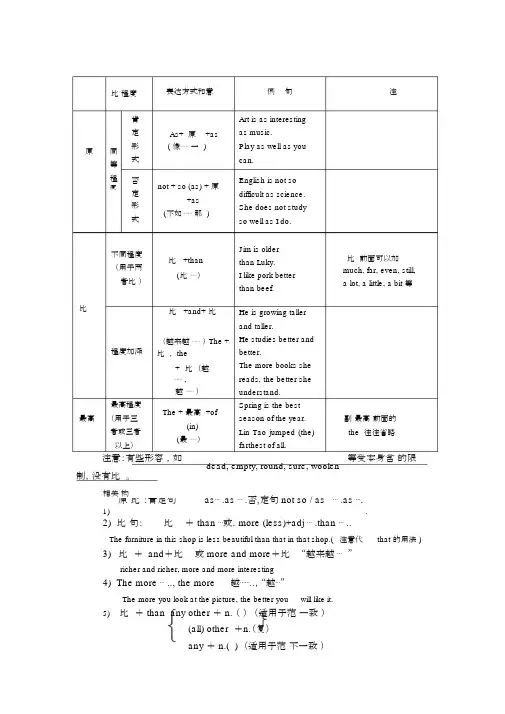
比 程度肯定 原同 形 式等程否度定 形 式不同程度 (用于两 者比 )比程度加深最高程度最高(用于三者或三者以上)表达方式和意As+ 原 +as( 像⋯⋯ 一 )not + so (as) + 原+as (不如 ⋯⋯ 那 )比 +than (比 ⋯⋯)比 +and+ 比(越来越 ⋯⋯ ) The + 比 , the+ 比 (越 ⋯⋯ ,越 ⋯⋯ )The + 最高 +of(in)(最 ⋯⋯)例 句Art is as interestingas music.Play as well as you can.English is not so difficult as science. She does not study so well as I do.Jim is olderthan Luky.I like pork better than beef.He is growing taller and taller.He studies better andbetter.The more books she reads, the better she understand.Spring is the best season of the year. Lin Tao jumped (the) farthest of all.注比 前面可以加 much, far, even, still, a lot, a little, a bit 等副 最高 前面的the 往往省略注意:有些形容 ,如 等受本身含 的限dead, empty, round, sure, woolen制,没有比 。
相关 构as ⋯ .as ⋯ .否,定句 not so / as ⋯ .as ⋯.1) 原 比 :肯定句.2) 比 句: 比 + than ⋯或. more (less)+adj ⋯ .than ⋯ ..The furniture in this shop is less beautiful than that in that shop.( 注意代that 的用法 )3) 比 + and +比 或 more and more +比 “越来越 ⋯ ”richer and richer, more and more interesting4) The more ⋯ .., the more越⋯⋯..,“越⋯”The more you look at the picture, the better youwill like it.5)比 + than any other + n. ( ) (适用于范 一致 )(all) other +n.(复)any + n.( ) (适用于范 不一致 )He is taller than any other student / all other students in his class.any student in my class.6)倍数表达法。
完整word版形容词和副词的比较级和最高级
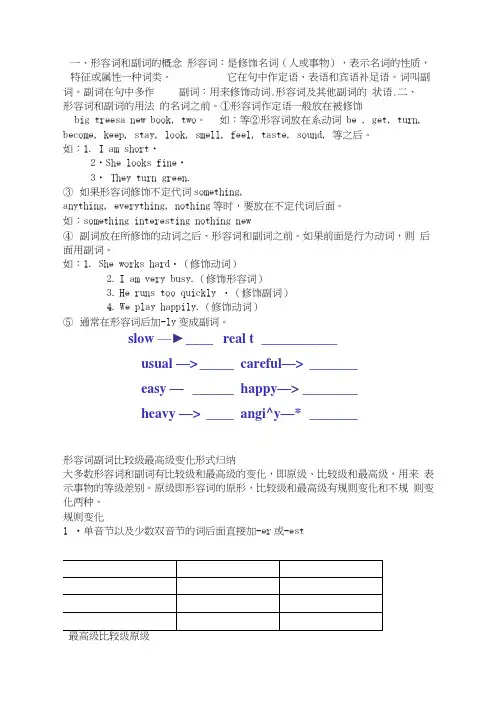
一、形容词和副词的概念形容词:是修饰名词(人或事物),表示名词的性质,特征或属性一种词类。
它在句中作定语、表语和宾语补足语。
词叫副词。
副词在句中多作副词:用来修饰动词.形容词及其他副词的状语.二、形容词和副词的用法的名词之前。
①形容词作定语一般放在被修饰big treesa new book, two。
如:等②形容词放在系动词be , get, turn, become, keep, stay, look, smell, feel, taste, sound, 等之后。
如:1. I am short・2・She looks fine・3・ They turn green.③如果形容词修饰不定代词something,anything, everything, nothing等时,要放在不定代词后面。
如:something interesting nothing new④副词放在所修饰的动词之后、形容词和副词之前。
如果前面是行为动词,则后面用副词。
如:1. She works hard・(修饰动词)2.I am very busy.(修饰形容词)3.He runs too quickly ・(修饰副词)4.We play happily.(修饰动词)⑤通常在形容词后加-ly变成副词。
slow —►____ real t ___________usual —> _____ careful—> _______easy —______ happy—> ________heavy —> ____ angi^y—* _______形容词副词比较级最高级变化形式归纳大多数形容词和副词有比较级和最高级的变化,即原级、比较级和最高级,用来表示事物的等级差别。
原级即形容词的原形,比较级和最高级有规则变化和不规则变化两种。
规则变化1 •单音节以及少数双音节的词后面直接加-er或-est最高级比较级原级tallest taller tallsmartest smarter smartshortestshorter shortesto结尾的双音节形容词末尾加特别提醒:以-y, -er, -ow, leer和healthy, funny, busy, hungry, easy, happy, early, pretty, lazy,如:heavy, dirty, clever, narrow o -stp或2.以不发音的e结尾只加最高级原级比较级nicest nice nicerfinest fine finerlargestlarge larger-est或i,再加-er3•“以辅音字母+y”结尾的词改y为最高比较原easiesteasiereasyprettiestprettierprettyhappiesthappierhappyfunniestfunnierfunnybusiestbusierbusy再加以一个元音加一个辅音字母结尾的重读闭音节词,双写后面的辅音字母,4 •一est最高级原级比较级thinnest thin thinner hottest hotter hotbiggestbigger big等词含有字母组合,且发的是长元音,不用new, few, slow, clean特别提醒: 双un构成的三音节形容词不适合上述情况,特别提醒:以形容前缀unhappy-一unhappier一一unhappiest, untidy一一untidier一一untidiest 如26.以形容词+ly构成的副词要在前面加more, most原级比较级最高级most slowly more slowly slowlymost quickly more quickly quicklymost angrily more angrily angrilymost softly more softly softlymost noisilymore noisilynoisily特另II提醒:early -- e arlier --- earliest7. ill ING分词和ED分词演变过来的形容词(包括不规则动词如know—known)只能加more或most来表示它们的比较级和最高级。
最全初中英语语法之-形容词和副词的比较级和最高级
形容词和副词的比较级和最高级一.形容词和副词的比较级和最高级的变化方法如下(1) 符合规则的:(2)几个不规则的形容词和副词的比较级和最高级如下表:二.形容词和副词比较级的用法注意:有些形容词,如 dead, empty, round, sure, woolen 等受本身含义的限制,没有比较级例题解析1. He is ________ friends than I.A. much moreB. many moreC. very moreD. too more解析:后面有可数名词复数时,many的比较级形式为many more 修饰。
应选B.2. Which is the _________ country, Japan or Australia?A. more developedB. more developingC. most developedD. most developing解析:两者比较用比较级,表示"发达"用developed, 而developing 是"发展中的" 意思3. There were _______ shops in the city in 1982 than in 1990.A. littleB. fewC. fewerD. less解析:little 不能修饰可数名词,两者比较需用比较级,所以应选C.4. If you are not free today, come another day __________.A. tooB. soC. insteadD. yet解析:instead 作副词用时意为"代替,顶替",表示前面的事情没做,而是做了后面的事。
Instead 一般位于句首。
应选C.5.He can't tell us ________, I think.A. important anythingB. anything importantC. important somethingD. something important. 解析:不定代词与形容词联用需后置,否定句中应该用anything 而不是something. 因此应选B6. The Huang River is the second __________ river in our country.A. longB. longerC. longestD. the longest 解析:"定冠词the+ 序数词 + 形容词最高级 " 表示"第几大……" 应选C.7. The light in the office wasn't ________for him to read. A. enough bright B. bright enough C. brightly D. enough brightly解析:enough 修饰名词时可前可后, 修饰形容词或副词时, 要后置。
形容词副词比较级最高级变化形式归纳(超全)
形容词/副词比较级最高级变化形式归纳大多数形容词和副词有比较级和最高级的变化,即原级、比较级和最高级,用来表示事物的等级差别原级即形容词的原形,比较级和最高级有规则变化和不规则变化两种。
规则变化:◇单音节以及少数双音节的词后面直接加-er , -est原级比较级最高级如:tall-taller-tallest◇以不发音的e结尾只加-r,-st◇“以辅音字母+y”结尾的词改y为i,再加-er, -est如:easy-easier-easiest pretty-prettier-prettiest◇以一个元音加一个辅音字母结尾的单音节词(即重读闭音节词),双写结尾的辅音字母er,-est 如:Thin-thinner-thinnest hot-hotter-hottest特别提醒:new, few, slow, clean等词含有字母组合,且发的是长元音,不用双写。
◇大部分双音节词和多音节的词(即音标中含有三个或三个以上元音音素的词),要在前面加more,most 如:beautiful -more beautiful-most beautiful特别提醒:以形容前缀un构成的三音节形容词不适合上述情况,如:unhappy-unhappier-unhappiest, untidy-untidier-untidiest◇以形容词+ly构成的副词要在前面加 more,most如:Slowly-more slowly-most slowly quickly-more quickly-most quickly特别提醒:early -earlier-earliest◇由ing分词和-ed分词演变过来的形容词(包括不规则动词如know→known)只能加more或most 来表示它们的比较级和最高级。
interesting-more interesting -most interesting excited-more excited -most excitingtired-more tired -most tired boring-more boring -most boring不规则变化原级比较级最高级good/well-better-best bad/badly/ill-worse-worstmany/much-more-most little-less-leastfar-farther/further -farthest/furthest old-older/elder-oldest/eldest特别提醒:◇further不仅可以指“距离更远”,还可指“程度更深”。
初中形容词比较级
形容词和副词的比较级和最高级一.形容词和副词的比较级和最高级的变化方法如下(1) 符合规则的:(2)几个不规则的形容词和副词的比较级和最高级如下表:二.形容词和副词比较级的用法注意:有些形容词,如 dead, empty, round, sure, woolen 等受本身含义的限制,没有比较级。
例题解析1. He is ________ friends than I.A. much moreB. many moreC. very moreD. too more解析:后面有可数名词复数时,many的比较级形式为many more 修饰。
应选B.2. Which is the _________ country, Japan or Australia?A. more developedB. more developingC. most developedD. most developing解析:两者比较用比较级,表示"发达"用developed, 而developing 是"发展中的" 意思3. There were _______ shops in the city in 1982 than in 1990.A. littleB. fewC. fewerD. less解析:little 不能修饰可数名词,两者比较需用比较级,所以应选C.4. If you are not free today, come another day __________.A. tooB. soC. insteadD. yet解析:instead 作副词用时意为"代替,顶替",表示前面的事情没做,而是做了后面的事。
Instead一般位于句首。
应选C.5.He can't tell us ________, I think.A. important anythingB. anything importantC. important somethingD. something important.解析:不定代词与形容词联用需后置,否定句中应该用anything而不是something. 因此应选B6. The Huang River is the second __________ river in our country.A. longB. longerC. longestD. the longest解析:"定冠词the+ 序数词+ 形容词最高级" 表示"第几大……" 应选C.7. The light in the office wasn't ________for him to read.A. enough brightB. bright enoughC. brightlyD. enough brightly解析:enough修饰名词时可前可后,修饰形容词或副词时,要后置。
初中英语必会形容词与副词的比较级和最高级
初中英语必会形容词与副词的比较级和最高级在初中英语学习中,形容词和副词是构建句子时不可或缺的一部分。
它们用来描述名词和动词,使语言更加生动和具体。
比较级和最高级是形容词和副词的两种特殊形式,用来比较事物之间的差异和程度。
让我们一起来深入了解初中英语中必须掌握的形容词与副词的比较级和最高级。
形容词的比较级和最高级形容词的比较级是用来比较两个事物的性质或程度。
一般情况下,在形容词后面加上”-er”构成比较级。
比如:big(大)-bigger(更大)fast(快)-faster(更快)smart(聪明)-smarter(更聪明)而形容词的最高级则是用来表示三个或三个以上事物之间的比较。
一般在形容词前面加上”themost”构成最高级。
例如:big(大)-thebiggest(最大的)fast(快)-thefastest(最快的)smart(聪明)-thesmartest(最聪明的)在比较级和最高级的构成中,需要注意一些特殊情况,比如在形容词末尾为“e”时,直接加上“r”和“st”;以辅音字母+y结尾时,变y为i再加er或est等。
副词的比较级和最高级副词也有比较级和最高级的形式,用来描述动词的程度或频率。
一般情况下,在副词前面加上”more”构成比较级。
例如:quickly(快速地)-morequickly(更快地)easily(容易地)-moreeasily(更容易地)happily(快乐地)-morehappily(更快乐地)副词最高级的构成则在副词前加上”themost”。
比如:quickly(快速地)-themostquickly(最快速地)easily(容易地)-themosteasily(最容易地)happily(快乐地)-themosthappily(最快乐地)掌握形容词和副词的比较级和最高级,能够帮助我们更准确地表达想法和观点,使语言更具有说服力和表现力。
形容词与副词的比较级和最高级是初中英语学习中的重要内容,掌握好这一部分知识,将有助于提升语言表达能力,希望大家能够在学习中多加练习,取得更好的成绩。