
2011年英语专业八级真题完整答案及详细解析word版1
TEST FOR ENGLISH MAJORS (2011)GRADE EIGHT TIME LIMIT: 195 MINPART I LISTENING COMPREHENSIONSECTION A MINI-LECTUREIn this section you will hear a mini-lecture. You will hear the lecture ONCE ONL Y. While listening, take notes on the important points. Your notes will not be marked, but you will need them to complete a gap-filling task after the mini-lecture. When the lecture is over, you will be given two minutes to check your notes, and another ten minutes to complete the gap-filling task on ANSWER SHEET ONE. Some of the gaps may require a maximum of THREE words. Make sure the word(s) you fill in is (are) both grammatically and semantically acceptable. You may refer to your notes while completing the task. Use the blank sheet for note-taking.Now, listen to the mini-lecture.Classifications of CulturesAccording to Edward Hall, different cultures result in different ideas about the world. Hall is an anthropologist. He is interested in relations between cultures.I. High-context cultureA. feature- context: more important than the message- meaning: (1)__________i.e. more attention paid to (2) ___________ than to the message itselfB. examples- personal space- preference for (3)__________- less respect for privacy / personal space- attention to (4)___________- concept of time- belief in (5)____________ interpretation of time- no concern for punctuality- no control over timeII. Low-context cultureA. feature- message: separate from context- meaning: (6)___________B. examples- personal space- desire / respect for individuality / privacy- less attention to body language- more concern for (7)___________- attitude toward time- concept of time: (8)____________- dislike of (9)_____________- time seen as commodityIII. ConclusionAwareness of different cultural assumptions- relevance in work and lifee.g. business, negotiation, etc.- (10)_____________ in successful communication参考答案:(1) context of message(2) what's happening / the context(3) closeness to people(4) body language(5) poly-chronic(6) message itself(7) the message(8) mono-chronic(9) lateness(10) great influence / significanceTIPS:(1) 根据原文中一句“A high-context culture is a culture in which the context of the message, or the action, or an event carries a large part of its meaning and significance.”可知答案。
(2) 根据原文“What this means is that in a high-context culture, more attention is paid to what's happening in and around the message than to the message itself.”可知答案。
(3) 根据原文“Generally speaking, in a high-context culture, because this greater dependency on group thinking, people lean towards heavier sense of involvement or closeness to people.”可得出答案。
(4) 根据原文“And also people from a high-context culture pay attention to body language.”可得出答案。
(5) 根据原文“People in high-context cultures, are considered to have, what is called a poly-chronic attitude toward time.”可得出答案。
(6) 根据原文“A low-context culture is one in which the message, the event or the action is a separate entity, hav ing meaning onto itself, regardless of the surroundings or the context.”可得出答案。
(7) 根据原文“And you'll also see that people might pay less attention to body language, because as I said, the message is, the message is everything.”可得出答案。
(8) 原文提到在low-context culture中,人们对时间的态度可称为mono-chronic。
(9) 根据原文“People in a low-context culture would be much more upset with lateness, because they feel that everyone should follow the same time.”可得出答案。
(10) 根据文章末尾部分“If you're in business, negotiations, interpersonal relations, if you'redealing with people from different cultures in any way, it's going to affect every part of your life. In any multi-cultural situation, these assumptions need to be taken into account for successful interactions.”可知,在商务活动、谈判、人际交往中,与来自不同文化的人打交道时,这些想法对成功的交际起着非常重要的作用。
script:Classifications of CulturesGood morning, everyone! Today, we'll look at culture or rather classifications of cultures. Usually, when we deal with different people, we deal with them as if we were all members of the same culture. However, it's possible that people from different cultures have different assumptions about the world. We got in such important and basic ideas as time, personal space. And this is the view of Edward Hall. And Edward Hall is an anthropologist who spent a large part of his life studying American Indians, their culture, their language. But he was different from a lot of other anthropologists who just study one culture. He was interested in the relations between cultures, how cultures interact. What Hall believes is that cultures can be classified by placing them on a continuum, ranging from what he called high-context to low-context.OK, what is a high-context culture? A high-context culture is a culture in which the context of the message, or the action, or an event carries a large part of its meaning and significance. What this means is that in a high-context culture, more attention is paid to what's happening in and around the message than to the message itself.Now, let me give you examples. First, in terms of personal space. Generally speaking, in a high-context culture, because this greater dependency on group thinking, people lean towards heavier sense of involvement or closeness to people. And they have less respect for privacy, for personal space. If you go into that culture, people might stand closer when they're talking to you. They might touch more. And if they're jostled in a crowd, they won't feel violated. And also people from a high-context culture pay attention to body language. Because remember what I said, the definition of a high-context culture is that more attention is paid to the context of the message than to the message itself. And part of the context is body language.Second, in terms of time. People in high-context cultures, are considered to have, what is called a poly-chronic attitude toward time. Here, "poly" means multiple and "chronic" means time. What this means is that they believe people, things, events have their own time. And there can't be a standard system of time for everything. What this leads them to believe is that you can't emphasize punctuality. Things happen when they are supposed to happen. So, there's a different attitude toward time; there's no set standard of time; you can't control time; everything has its own sense of time. So it's a culture that pays little attention to time, to clock time.Now, let's move on to low-context culture. A low-context culture is just the opposite. A low-context culture is one in which the message, the event or the action is a separate entity, having meaning onto itself, regardless of the surroundings or the context. That the message, the event, the action has meaning in itself. So what this means in a low-context culture, is that people pay more attention to the event itself rather than to the context which surrounds the event or the message. For example, in terms of personal space again, there's more emphasis on individuality. So the concept of privacy is very, very important. Whereas before, as I said, in a high-context culture, they might not even be concerned with privacy or personal space. But in a low-context culture,there's a feeling that we each have our own personal space. If you get too close, if you don't knock on doors before entering, that's an invasion of privacy. People feel violated. There's a respect and a desire for privacy. And you'll also see that people might pay less attention to body language, because as I said, the message is, the message is everything. They are not going to worry about all the details around it. What you say is the important thing, or what you do is the important thing.Another example of a low-context culture is people's attitude towards time. In terms of time, I said before, there was a poly-chronic sense of time in a high-context culture. What do you think there would be in a low-context culture? Mono-chronic? Right! A mono-chronic sense of time and by that we mean that there's one time. And that concept means that people in a low-context culture believe that there's one standard of time. And that should be for everything. And so I am not willing to hear "Oh, the traffic was heavy. That's why I'm late" or "Oh, I slept late". People in a low-context culture would be much more upset with lateness, because they feel that everyone should follow the same time. There shouldn't be all this flexibility with time and they expect punctuality. And they look at time as almost a commodity that they use expressions like "use time, to waste time, to spend time or time is money". All of these expressions reinforce the concept that time is actually something you can hold on to.So, what this is all about is that, Hall stresses that people need to be aware of these different assumptions or concepts about reality. And he thinks that this has all kinds of relevance no matter what you're doing. If you're in business, negotiations, interpersonal relations, if you're dealing with people from different cultures in any way, it's going to affect every part of your life. In any multi-cultural situation, these assumptions need to be taken into account for successful interactions.OK, today we've taken a brief look at Edward Hall's view of culture, mainly his classification of high- or low-context culture with some examples. Next week, we'll look at some more examples of cultures on a continuum between high-context and low-context cultures.SECTION B INTERVIEW/CONVERSATIONIn this section you will hear everything ONCE ONL Y. Listen carefully and then answer the questions that follow. Mark the best answer to each question on ANSWER SHEET TWO.Questions 1 to 5 are based on an interview. At the end of the interview you will be given 10 seconds to answer each of the following five questions.Now, listen to the interview.1. According to Dr. Harley, what makes language learning more difficult after a certain age?A. Differences between two languages.B. Declining capacity to learn syntax.C. Lack of time available.D. Absence of motivation.参考答案:BTIP:答案选B。
2011年专八试题
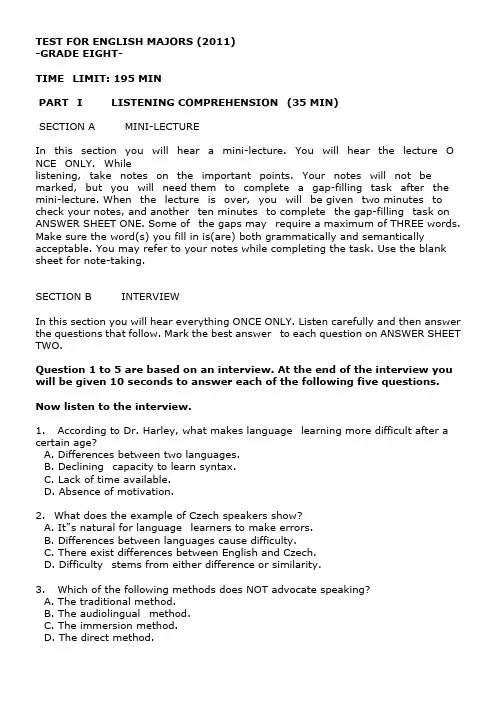
TEST FOR ENGLISH MAJORS (2011)-GRADE EIGHT-TIME LIMIT: 195 MINPART I LISTENING COMPREHENSION (35 MIN)SECTION A MINI-LECTUREIn this section you will hear a mini-lecture. You will hear the lecture O NCE ONLY. Whilelistening, take notes on the important points. Your notes will not be marked, but you will need them to complete a gap-filling task after the mini-lecture. When the lecture is over, you will be given two minutes to check your notes, and another ten minutes to complete the gap-filling task on ANSWER SHEET ONE. Some of the gaps may require a maximum of THREE words. Make sure the word(s) you fill in is(are) both grammatically and semantically acceptable. You may refer to your notes while completing the task. Use the blank sheet for note-taking.SECTION B INTERVIEWIn this section you will hear everything ONCE ONLY. Listen carefully and then answer the questions that follow. Mark the best answer to each question on ANSWER SHEET TWO.Question 1 to 5 are based on an interview. At the end of the interview you will be given 10 seconds to answer each of the following five questions. Now listen to the interview.1. According to Dr. Harley, what makes language learning more difficult after a certain age?A. Differences between two languages.B. Declining capacity to learn syntax.C. Lack of time available.D. Absence of motivation.2. What does the example of Czech speakers show?A. It‟s natural for language learners to make errors.B. Differences between languages cause difficulty.C. There exist differences between English and Czech.D. Difficulty stems from either difference or similarity.3. Which of the following methods does NOT advocate speaking?A. The traditional method.B. The audiolingual method.C. The immersion method.D. The direct method.4. Which hypothesis deals with the role of language knowledge in the learning process?A. The acquisition and learning distinction hypothesis.B. The comprehensible input hypothesis.C. The monitor hypothesis.D. The active filter hypothesis.5. Which of the following topics is NOT discussed during the interview?A. Causes of language learning difficulties.B. Differences between mother tongue and a second language.C. Theoretical conceptualization of second language learning.D. Pedagogical implementation of second language teaching.SECTION C NEWS BROADCASTIn this section you will hear everything ONCE ONLY. Listen carefully and then answer the questions that follow. Mark the best answer to each question on ANSWER SHEET TWO.Question 6 is based on the following news. At the end of the ne ws item, you will be given 10 seconds to answer the question.Now listen to the news.6. Which of the following statements is INCORRECT?A. Greyhound is Britain's largest bus and train operator.B. Currently Greyhound routes in Britain are limited.C. The coach starts from London every hour.D. Passengers are offered a variety of services.Questions 7 and 8 are based on the following news. At the end of the news item, you will be given 20 seconds to answer the questions.Now listen to the news.7. What does the news item say about the fires in Greece?A. Fires only occurred near the Greek capital.B. Fires near the capital caused casualties.C. Fires near the capital were the biggest.D. Fires near the capital were soon under control.8. According to the news, what measure did authorities take to fight the fires?A. Residents were asked to vacate their homes.B. Troops were brought in to help the firefighter.C. Air operations and water drops continued overnight.D. Another six fire engines joined the firefighting operation.Questions 9 and 10 are based on the following news. At the end of the news item, you will be given 20 seconds to answer the questions.Now listen to the news.9. Which of the following is NOT mentioned as a cause of thecurrent decline in the Mexicaneconomy?A. Fewer job opportunities in Mexico.B. Strong ties with the U.S. economy.C. Decline in tourism.D. Decline in tax revenues.10. Drop in remittances from abroad is mainly due toA. declining oil production.B. the outbreak of the H1N1 flu.C. the declining GDP in Mexico.D. the economic downturn in the U.S.PART II READING COMPREHENSION (30 MIN)In this section there are four reading passages followed by a total of 20 multiple-choice questions. Read the passages and then mark the best answer to each question on ANSWER SHEET TWO.TEXT AWhenever we could, Joan and I took refuge in the streets of Gibraltar. The Englishman's home is his castle because he has not much choice. There is nowhere to sit in the streets of England, not even, after twilight, in the public gardens. The climate, very often, odes not even permit him to walk outside. Naturally, he stays indoors and creates a cocoon of comfort. That was the way we lived in Leeds.These southern people, on the other hand, look outwards. The Gibraltar ian home is, typically, a small and crowded apartment up several flights of dark and dirty stairs. In it, one, two or even three old people share a few ill0lit rooms with the young family. Once he has eaten, changed his clothes, embraced his wife, kissed his children and his parents, there is nothing to keep the southern man at home. He hurries out, taking even his breakfast coffee at his local bar. He comes home late for his afternoon meal after an appetit ive hour at his café . He sleeps for an hour, dresses, goes out again and stays out until late at night. His wife does not miss him, for she is out, too –at the market in the morning and in the afternoon sitting with other mothers, baby-minding in the sun.The usualGibraltarian home has no sitting-room, living-room or lounge. The parlour of ourworking-class houses would be an intolerable waste of space. Easy-chairs , sofas and such-like furniture are unknown. There are no bookshelves, because there are no books. Talking and drinking , as well as eating, are done on hard chairs round the dining-table, between a sideboard decorated with the best glasses and an inevitable display cabinet full of family treasures, photographs and souvenirs. The elaborate chandelier over this table proclaims it as the hub of the household and of the family. "Hearth and home" makes very little sense in Gibraltar.One's home is one's town or village, and one's health is the sunshine.Our northern towns are dormitories with cubicles, by comparison. When we congregate –in the churches it used to be, now in the cinema, say, impersonally, or at public meetings, formally –we are scarcely ever man to man. Only in our pubs can you find the truly gregarious and communal spirit surviving, and in England even the pubs are divided along class lines.Along this Mediterranean coast, home is only a refuge and a retreat. The people live together in the open air–in the street, market-place. Down here, there is a far stronger feeling of communitythan we had ever known. In crowded and circumscribed Gibraltar, with it s complicated inter-marriages, its identity of interest, its surviving sense of siege, one can see and feel an integrated society.To live in a tiny town with all the organizat ion of a state,with Viceroy (总督), Premier, Parliament, Press and Pentagon, all in miniature, all within arm's reach, is an intensive course in civics. In suchan environment, nothing can be hidden, for better or for worse. One's successes are seen and recognized; one' failures are immediately exposed. Social consciousness is at its strongest,with the result that there is a constant and firm pressure towards good social behavior, towards courtesy and kindness.Gibraltar, with all its faults, is the friendliest andmost tolerant of places. Straight from the cynical anonymity of a big city,we luxuriated in its happy personalism. We lookback on it, like all its exiled sons and daughters, with true affection.11. Which of the following best explains the differences in ways of living between the English and the Gibraltarians?A. The family structure.B. Religious belief.C. The climateD. Eating habit.12. The italicized part in the third paragraph implies thatA. English working-class homes are similar to Gibraltarian ones.B. English working-class homes have spacious sitting-rooms.C. English working-class homes waste a lot of space.D. the English working-class parlour is intolerable in Gibraltar.13. We learn from the description of the Gibraltarian home that it isA. modern.B. luxurious.C. stark.D. simple.14. There is a much stronger sense of ________ among the Gibraltarians.A. togethernessB. survivalC. identityD. leisure15. According to the passage, people in Gibraltar tend to be will-behavedbecause of the followingEXCEPTA. the entirety of the state structure.B. constant pressure from the state.C. the small size of the town.D. transparency of occurrences.TEXT BFor office innovators, the unrealized dream of the “paperless”office i s a classic example of high-tech hubris (傲慢). Today's office drone is drowning in more paper than ever before.But after decades of hype, American offices may finally be losing the ir paper obsession. The demand for paper used to outstrip the growth of theUS economy, but the past two or three years have seen a marked slowdown in sales –despite a healthy economic scene.Analysts attribute the decline to such factors as advances in digital da tabases andcommunication systems. Escaping our craving for paper, however,will be anything but an easy affair.“Old habits are hard to break.”says Merilyn Dunn, a communications supplies director. “There are some functions that paper serves where a screen display doesn't work. Those functions are both its strength and its weakness.”In the early to mid-'90s, a booming economy and improved desktop printers helped boost papersales by 6 to 7 percent each year. The convenience of desktop printing allowed office workers to indulge in printing anything and everything at very little effort or cost.But now, the growth rate of paper sales in the United States is flattening by about half a percent each year. Between 2004 and 2005, Ms. Dunn says, plain white office paper will see less than a 4 percent growth rate, despite the strong overall economy. A primary reason for the change, says Dunn,is that for the first time ever, some 47 percent of the workforce entere d the job market after computers had already been introduced to offices.“We're finally seeing a reduction in the amount of paper being used per worker in the workplace.”says John Maine, vice president of a pulp and paper economic consulting firm. “More information is being transmitted electronically, and more and more people are comfortable with theinformation residing only in electronic form without printing multiple backups.”In addition, Mr. Maine points to the lackluster employment market forwhite-collar workers –the primary driver of office paper consumption –for the shift in paper usage.The real paradigm shift may be in the way paper is used.Since the advent of advanced and reliable office-network systems, data storage has moved away from paper archives. The secretarialart of “filing”is disappearing from job descriptions. Much of today's dat a may never leave its original digital format.The changing attitudes toward paper have finally caught the attention of paper companies, says Richard Harper, a researcher at Microsoft. “All of a sudden, thepaper industry has started thinking, "We need to learn more about the behavioural aspects of paper use, ”he says. “They had never asked, they'd just assumed that 70 million sheets would be bought per year as a literal function of economic growth.”To reduce paper use, some companies are working tocombine digital and paper capabilit ies. For example,Xerox Corp. is developing electronic paper: thin digital displays that respo nd to a stylus, like a pen on paper. Notations can be erased or saved digitally.Another idea, intelligent paper, comes from Anoto Group. It would allow notations made with a stylus on a page printed with a special magnetic ink to simultaneously appear on a computer screen.Even with such technological advances, the improved capabilit ies of digital storage continue toact against “paperlessness,”argues Paul Saffo, a technology forecaster. In his prophetic and metaphorical 1989 essay, “The Electronic Piñata (彩罐),”he suggests that the increasing amounts of electronic data necessarily require more paper.The information industry today is like a huge electronic piñata, composed of a thin paper crust surrounding an electronic core,”Mr. Saffo wrote. The growing paper crust “is most noticeable, but the hidden electronic core that produces the crust is far larger –and growing more rapidly. The result is that we are becoming paperless, but we hardly notice at all.”In the same way that digital innovations have increased paper consumption, Saffo says, so has video conferencing –with its promise of fewer in-person meetings –boosting business travel.“That's one of the great ironies of the information age,”Saffo says. “It' s just common sense that the more you talk to someone by phone or computer, it inevitably leads to a face-to-face meeting. The best thing for the aviation industry was the Internet.”16. What function does the second sentence in the first paragraph serve?A. It further explains high-tech hubris.B. It confirms the effect of high-tech hubris.C. It offers a cause for high-tech hubris.D. It offers a contrast to high-tech hubris.17. Which of the following is NOT a reason for the slowdown in paper sales?A. Workforce with better computer skills.B. Slow growth of the US economy.C. Changing patterns in paper use.D. Changing employment trends.18. The two innovations by Xerox Corp. and Anoto Group featureA. integrated use of paper and digital form.B. a shift from paper to digital form.C. the use of computer screen.D. a new style of writing.19. What does the author mean by “irony of the information age”?A. The dream of the “paperless”office will be realized.B. People usually prefer to have face-to-face meetings.C. More digital data use leads to greater paper use.D. Some people are opposed to video-conferencing.20. What is the author 's attitude towards “paperlessness”?A. He reviews the situation from different perspectives.B. He agrees with some of the people quoted in the passage.C. He has a preference for digital innovations.D. He thinks airlines benefit most from the digital age.TEXT CWhen George Orwell wrote in 1941 that England was “the most class-ridden country under the sun”, he was only partly right. Societies have always had their hierarchies, with some group perched at the top. In the Indian state ofBihar the Ranveer Sena, an upper-caste private army, even killed to stay there.By that measure class in Britain hardly seems entrenched (根深蒂固的). But in another way Orwell was right, and continues to be. As a new YouGov poll shows, Britons are surprisingly alert to class –both their own and that of others. And they still think class is sticky. According to the poll, 48%of people aged 30 or over say they expect to end up better off than t heir parents. But only 28% expect to end up in a different class.More than two-thirds think neither they nor their children will leave the class they were born into.What does this thing that people cannot escape consist of these days? And what do people look at when decoding which class someone belongs to? The mostuseful identifying markers, accordingto the poll, are occupation, address, accent and income, in that order. T he fact that income comes fourth is revealing: though some of the habits and attitudes that class used to define are more widely spread than they were, class still indicates something less blunt than mere wealth.Occupation is the most trusted guide to class, but changes in the labour market have made that harder to read than when Orwell was writing. Manual workers have shrunk along with farming and heavy industry as a proportion of the workforce, while the number of people in white-collar jobs has surged.Despite this striking change, when they were asked to place themselves in a class, Brits in 2006 huddled in much the same categories as they did when they were asked in 1949. So, jobs, which were once afairly reliable guide to class, have become misleading.A survey conducted earlier this year by Expertian shows how this convergence on similar types of work has blurred class boundaries. Expertian asked people in a number of different jobs to placethemselves in the working class or the middle class. Secretaries, waiters and journalists were signif icantly more likely to think themselvesmiddle-class than accountants, computer programmers or civil servants. Many new white-collar jobs offer no more autonomy or better prospects than old blue-collar ones. Yet despite the muddle over what the markers of class are these days, 71% of those polled by YouGov still said they found it very or fairly easy to figure out which class others belong to.In addition to changes in the labour market, two other thingshave smudged the borders on the class map. First, since 1945 Britainhas received large numbers of immigrants who do not fit easilyinto existing notions of class andmay have their own pyramids to scramble up. The flow of new arrivals has increased since the late 1990s, multiplying this effect.Second, barriers to fame have been lowered, Britain's fast-growing ranks of celebrit ies–like David Beckham and his wife Victoria –form a kind ofparallel aristocracy open to talent, or at least to those who are uninhibited enough to meet the requests of television producers. This too has made definitions more complicated.But many Br its, given the choice, still prefer to ident ifywith the class they were born into rather than that which their jobsor income would suggest. This often entails pretending to be morehumble than is actually the case: 22% ofwhite-collar workers told YouGov that they consider themselvesworking class. Likewise, the Expertian survey found that one in ten adult s who callthemselves working class are among the richest asset-owners, and that o ver half a million households which earnmore than $191,000 a year say they are working class. Pretending to be grander than income and occupation suggest is rarer, though it happens too.If class no longer describes a clear social, economic or evenpolitical status, is it worth paying any attention to? Possibly, yes. It is still in most cases closely correlated with educational attainment and career expectations.21. Why does the author say “…Orwell was right, and continues to be”(Paragraph Two)?A. Because there was stronger class consciousness in India.B. Because more people hoped to end up in a higher class.C. Because people expect to gain more wealth than their parents.D. Because Britons are still conscious of their class status.22. “…class still indicates something less blunt than mere wealth”(Paragraph Three) means thatA. class is still defined by its own habits and attitudes.B. class would refer to something more subtle than money.C. people from different classes may have the same habits or attitudes.D. income is unimportant in determining which class one belongs to.23. Which of the following statements is INCORRECT?A. White-collar workers would place themselves in a different class.B. People with different jobs may place themselves in the same class.C. Occupation and class are no longer related with each other.D. Changes in the workforce have made it difficult to define class.24. Which of the following is NOT a cause to blur class distinction?A. Notions of class by immigrants.B. Changing trends of employment.C. Fewer types of work.D. Easy access to fame.25. When some successful white-collar workers choose to stay in the working class, it implies that they areA. showing modesty.B. showing self-respect.C. expressing boastfulness.D. making an understatement.TEXT DThe train was whirling onward with such dignity ofmotion that a glance from the windowseemed simply to prove that plains of Texaswere pouring eastward. Vast flats of green grass, dull-hued spaces of mesquite and cactus, little groups of frame houses,woods of light and tender trees, all were sweeping into the east, sweeping over the horizon, a precipice.A newly married pair had boarded this coach at San Antonio. Theman's face was reddened from many days in thewind and sun, and a direct result of his new black clothes was that his brick-coloured hands were constantly performing in a most conscious fashion. From time to time he looked down respectfully at his attire. He satwith a hand on each knee, like a man waiting in a barber 's shop. The glances he devoted to other passengers were furtive and shy.The bride was not pretty, nor was she very young. Shewore a dress of blue cashmere, withsmall reservations of velvet here and there, and with steel buttons abou nding. She continually twisted her head to regard her puff sleeves, very stiff, and high. They embarrassed her. It was quite apparent that she had cooked, and that she expected to cook, dutifully. The blushes caused by the careless scrutiny of some passengers as she had entered the car were strange to see upon this plain, under-class countenance, which was drawn in placid, almost emotionless lines.They were evidently very happy. “Ever been in a parlor-car before?”he asked, smiling with delight.“No.”she answered: “I never was. It's fine, ain't it?”“Great! And then after a while we'll go forward to the dinner, and get a big lay-out. Fresh meal in the world. Charge a dollar.”“Oh, do they?”cried the bride. “Change a dollar? Why, that's too much –for us –ain't it, Jack?”“Nor this trip, anyhow.”he answered bravely. “We're going to go the whole thing.”Later he explained to her about the trains. “You see, it's a thousand miles from one end of Texasto the other' and this runs right across it, and never stops but four ti mes.”He had the pride of an owner. He pointed out to her the dazzling fitt ings of the coach; and in truth her eyes opened wider and she contemplated the sea-green figured velvet, the shining brass, silver, and glass, the wood that gleamed as darkly brilliant as the surface of a pool of oil. At one end a bronze figure sturdily held a support for a separated chamber, and at convenient places on the ceiling were frescos in olive and silver.To the minds of the pair, their surroundings reflected the glory of their marriage that morning in San Antonio; this was the environment of their new estate;and the man's face in particular beamed with an elation that made him appear ridiculous to the Negro porter. This individual at t imes surveyed them from afar with an amused and superior grin. On other occasions he bullied them withskill in ways that did not make it exactly plain to them that they were being bullied. He subtly usedall the manners of the most unconquerable kind of snobbery. He oppress ed them. But of thisoppression they had small knowledge, and they speedily forgot that infreq uently a number of travelers covered themwith stares of derisive enjoyment. Historically there was supposed to be something infinitely humorous in their situation.“We are due in Yellow Sky at 3:42.”he said, looking tenderly into her eyes.“Oh, are we?”she said, as if she had not been aware of it. To evince (表现出) surprise at her husband's statement was part of her wifely amiability.She took from a pocket a litt le silver watch; and as she held it before her, and stared at it with a frown of attention, the new husband's face shone.“I bought it in San Anton' from a friend of mine,”he told her gleefully.“It's seventeen minutes past twelve.”she said, looking up at him with a kind of shy and clumsy coquetry (调情;卖俏).A passenger, nothing this play, grew excessively sardonic, and winked at himself in one of the numerous mirrors.At last they went to the dining-car. Two rows of Negro waiters, in gl owing white suits, surveyed their entrancewith the interest, and also the equanimity (平静), of men who had been forewarned. The pair fell to the lot of a waiter who happened to feel pl easure in steering them through their meal. He viewed them with the manner of a fatherly pilot, his countenance radiant with benevolence. The patronage, entwined with the ordinary deference, was not plain to them. And yet, as they returned to their coach, they showed in their faces a sense of escape.26. The description of the couple's clothes and behaviour at the beginning of the passage seems to indicate that they had a sense ofA. secrecy.B. elation.C. superiority.D. awkwardness.27. Which of the following adjectives best depicts the interior of the coach?A. Modern.B. Luxurious.C. Practical.D. Complex.28. Which of the following best describes the attitude of other people on the train towards the couple?A. They regarded the couple as an object of fun.B. They expressed indifference towards the couple.C. They were very curious about the couple.D. They showed friendliness towards the couple.29. Which of the following contains a metaphor?A. …like a man waiting in a barber ‟s shop.B. …his countenance radiant with benevolence.C. …sweeping over the horizon, a precipice.D. …as darkly brilliant as the surface of a pool of oil.30. We can infer from the last paragraph that in the dining-carA. the waiters were snobbish.B. the couple felt ill at ease.C. the service was satisfactory.D. the couple enjoyed their dinner.PART III GENERAL KNOWLEDGE (10 MIN)There are ten multiple-choice questions in this section. Mark the best answer to each question onANSWER SHEET TWO.31. The northernmost part of Great Britain isA. Northern Ireland.B. Scotland.C. England.D. Wales.32. It is generally agreed that ________ were the first Europeans to reach Australia's shores.A. the FrenchB. the GermansC. the BritishD. the Dutch - 13 -33. Which country is known as the Land of Maple Leaf?A. Canada.B. New Zealand.C. Great Britain.D. The United States of America.34. Who wrote the famous pamphlet, The Common Sense, before the American Revolution?A. Thomas Jefferson.B. Thomas Paine.C. John Adams.D. Benjamin Franklin.35. Virginia Woolf was an important female ________ in the 20th-century England.A. poetB. biographerC. playwrightD. novelist36. ________ refers to a long narrative poem that records the adventures of a hero ina nation'shistory.A. Ballad.B. Romance.C. Epic.D. Elegy.37. Which of the following best explores American myth in the 20th century?A. The Great Gatsby.B. The Sun Also Rises.C. The Sound and the Fury.D. Beyond the Horizon.38. ________ is defined as the study of the relationship between language and mind.A. Semantics.B. Pragmatics.C. Cognitive linguisticsD. Sociolinguistics39. A vowel is different from a consonant in English because ofA. absence of obstruction.B. presence of obstruction.C. manner of articulation.D. Place of articulation. - 14 -40. The definition “the act of using, or promoting the use of, several l anguages, either by an individual speaker or by a community of speakers”refers toA. Pidgin.B. Creole.C. Multilingualism.D. Bilingualism.PART IV PROOFREADING & ERROR CORRECTION (15 MIN)The passage contains TEN errors. Each indicated line contains a maximum of ONE error. In each case, onlyONE word is involved. You should proof-read the passage and corr ect it in the following way:For a wrong word, underline the wrong word and write the correct onein the blank provided at the end of the line.For a missing word, mark the position of the missing word with a “^”sign andwrite the word you believe to be missing in the blank。
2011年专八真题 部分解析
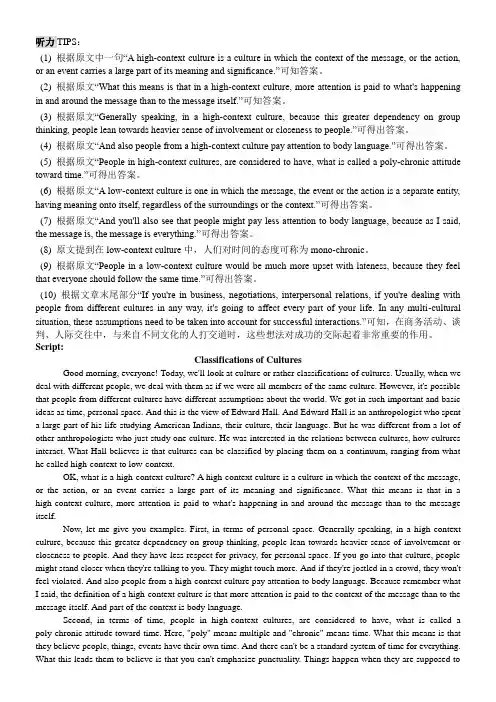
听力TIPS:(1) 根据原文中一句“A high-context culture is a culture in which the context of the message, or the action, or an event carries a large part of its meaning and significance.”可知答案。
(2) 根据原文“What this means is that in a high-context culture, more attention is paid to what's happening in and around the message than to the message itself.”可知答案。
(3) 根据原文“Generally speaking, in a high-context culture, because this greater dependency on group thinking, people lean towards heavier sense of involvement or closene ss to people.”可得出答案。
(4) 根据原文“And also people from a high-context culture pay attention to body language.”可得出答案。
(5) 根据原文“People in high-context cultures, are considered to have, what is called a poly-chronic attitude toward time.”可得出答案。
(6) 根据原文“A low-context culture is one in which the message, the event or the action is a separate entity, having meaning onto itself, regardless of the surroundings or the context.”可得出答案。
2011专八真题解析

英语专业八级2011年试题答案及解析第一部分听力理解SECTION A MINI-LECTURE1. outside the message【解析】细节题。
这篇讲座主要介绍不同文化之间的差异。
文中提到“What this means is that in a high-context culture more attention is paid to what's happening in and around the message than to the message itself.”可知人们更看重信息之外的含义。
2. the context【解析】细节题。
根据原文“What this means is that in a high-context culture, more attention is paid to what's happening in and around the message than to the message itself.”以及下文“the definition of a high-context culture is that more attention is paid to the context of the message than to the message itself. And part of the context is body language.”可知高语境文化中,人们更看重信息所处的语境,而不是信息本身。
3. involvement / closeness to people【解析】细节题。
由原文“in terms of personal space, generally speaking, in a high-context culture, because there's greater dependence on group thinking, people lean towards heavier sense of involvement or closeness to people.”可知,在高语境环境中,人们相互之间更加贴近,不太重视私人空间。
2011年英语专业八级考试真题及答案-中大网校

2011年英语专业八级考试真题及答案总分:100分及格:60分考试时间:190分PART I LISTENING COMPREHENSION (35 MIN) SECTION A MINI-LECTURE(1)SECTION A MINl LECTUREIn this section you will hear a mini-lecture.You will hear the lecture ONCE 0NL Y.While listening,take notes on the important points.Your notes will not be marked,but you will need them to complete a gap-filling task after the mini-lecture.When the lecture is over,you will be given two minutes to check your notes.and another ten minutes to complete the gal-filling task on ANSWER SHEET ONE.Some of the gaps may require a maximum of THREE words.Make sure the word(s)you fill in is(are)both grammatically and semantically acceptable.You may refer to your notes while completing the task.Use the blank sheet for note-taking.(2)根据材料,请在(2)处填上最佳答案。
(3)根据材料,请在(3)处填上最佳答案。
(4)根据材料,请在(4)处填上最佳答案。
2011年专业八级真题及答案详细
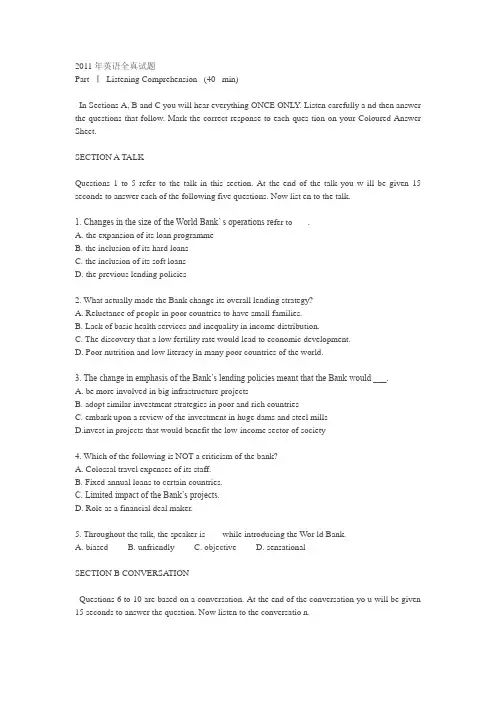
2011年英语全真试题Part ⅠListening Comprehension (40 min)In Sections A, B and C you will hear everything ONCE ONL Y. Listen carefully a nd then answer the questions that follow. Mark the correct response to each ques tion on your Coloured Answer Sheet.SECTION A TALKQuestions 1 to 5 refer to the talk in this section. At the end of the talk you w ill be given 15 seconds to answer each of the following five questions. Now list en to the talk.1. Changes in the size of the World Bank’ s operations re fer to ___.A. the expansion of its loan programmeB. the inclusion of its hard loansC. the inclusion of its soft loansD. the previous lending policies2. What actually made the Bank change its overall lending strategy?A. Reluctance of people in poor countries to have small families.B. Lack of basic health services and inequality in income distribution.C. The discovery that a low fertility rate would lead to economic development.D. Poor nutrition and low literacy in many poor countries of the world.3. The change in emphasis of the Bank’s lending policies meant that the Bank would ___.A. be more involved in big infrastructure projectsB. adopt similar investment strategies in poor and rich countriesC. embark upon a review of the investment in huge dams and steel millsD.invest in projects that would benefit the low-income sector of society4. Which of the following is NOT a criticism of the bank?A. Colossal travel expenses of its staff.B. Fixed annual loans to certain countries.C. Limited impact of the Bank’s projects.D. Role as a financial deal maker.5. Throughout the talk, the speaker is ___ while introducing the Wor ld Bank.A. biasedB. unfriendlyC. objectiveD. sensationalSECTION B CONVERSATIONQuestions 6 to 10 are based on a conversation. At the end of the conversation yo u will be given 15 seconds to answer the question. Now listen to the conversatio n.6. The man sounds surprised at the fact that ___.A. many Australians are taking time off to travelB. the woman worked for some time in New ZealandC. the woman raised enough money for travelD. Australians prefer to work in New Zealand7. We learn that the woman liked Singapore mainly because of its ___.A. cleannessB. multi-ethnicityC. modern characteristicsD. shopping opportunities8. From the conversation we can infer that Kaifeng and Yinchuan impressed the woman with their ___.A. respective locationsB. historic interestsC. ancient tombsD. Jewish descendants9. Which of the following words can best describe the woman’s feelings a bout Tibet?A. Amusement.B. Disbelief.C. Ecstasy.D. Delig ht10. According to the conversation, it was that made the woman ready to stop traveling.A. the unsettledness of travelB. the difficulties of trekkingC. the loneliness of travelD. the unfamiliar environmentSECTION C NEWS BROADCASTQuestions 11 and 12 are based on the following news. At the end of the news item , you will be given 30 seconds to answer the questions. Now listen to the news.11. Mike Tyson was put in prison last August because he ___.A. violated the traffic lawB. illegally attacked a boxerC. attacked sb. after a traffic accidentD. failed to finish his contract12. The license granted to Tyson to fight will be terminated ___.A. by the end of the yearB. in over a yearC. in AugustD. in a few weeksQuestion 13 is based on the following news. At the end of the news item, you wil l be given 15 seconds to answer the question. Now listen to the news.13. The Russian documents are expected to draw great attention because ___.A. they cover the whole story of the former US presidentB. the assassin used to live in the former Soviet UnionC. they are the only official documents released about KennedyD. they solved the mystery surrounding Kennedy’s assassinationQuestion 14 and 15 are based on the following news. At the end of the news item,you will be given 30 seconds to answer the questions. New listen to the news.14. In the recent three months, Hong Kong’s unemployment rate has ___.A. increased slowlyB. decreased graduallyC. st a yed steadyD. become unpredictable15. According to the news, which of the following statements is TRUE?A. Business conditions have worsened in the past three months.B. The past three months have seen a declining trend in job offers.C. The rise of unemployment rate in some sectors equals the fall in others.D. The unemployment rate in all sectors of the economy remains unchanged.SECTION D NOTE-TAKING AND GAP-FILLINGFill each of gaps with ONE word. You may refer to your notes. Make sure the word you fill in is both grammatically and semantically acceptable.The Press ConferenceThe press conference has certain advantages. The first advantage lies with the(1)___ nature of the event itself; public officials are supposed to 1.___submit to scrutiny by responding to various questions at a press conference.Secondly, statements previously made at a press conference can be used as a(2)___ in judging following statements or policies. Moreover, in case 2.___of important events, press conferences are an effective way to break the newsto groups of reporters.However, from the point of view of (3)___, the press conference 3.___possesses some disadvantages, mainly in its(4)___ and news source. 4.___The provider virtually determines the manner in which a press conferenceproceeds. This, sometimes, puts news reporters at a(n)(5)___ , as can 5.___be seen on live broadcasts of news conferences.Factors in getting valuable information preparation: a need to keep up to date on journalistic subject matter;—(6)___ of the news source: 6.___1 ) news source’ s (7)___ to7.___provide information;2)news-gathering methods.Conditions under which news reporters cannot trust the informationprovided by a news source— not knowing the required information;— knowing and willing to share the information, but without(8)___ skills; 8.___— knowing the information, but unwilling to share;— willing to share, but unable to recall.(9)___ of questions asked 9.___Ways of improving the questions:no words with double meanings;no long questions;— specific time, place, etc.;— (10) questions; 10.___— clear alternatives, or no alternatives in answers.改错Part ⅡProofreading and Error Correction (15 min)The following passage contains TEN errors. Each line contains a maximum of ONE error. In each case, only ONE word is involved. You should proofread the passage and correct it in thefollowing way. For a wrong word,underline the wrong word and wri te the correct one in the blank provided at the end of the line. For a missing word,mark the position of the missing word with a “∧” sign and write the word y ou believe to be missing in the blank provided at the end of the line. For an unnecessary word cross out the unnecessary word with a slash “/’ and put the word in the blank provided at the end of the line.ExampleWhen∧art museum wants a new exhibit, (1) an it never/buys things in finished form and hangs (2) never them on the wall. When a natural history museum wants an exhibition, it must often build it. (3) exhibitDuring the early years of this century, wheat was seen as thevery lifeblood of Western Canada. People on city streets watchedthe yields and the price of wheat in almost as much feeling as if 1.___they were growers. The marketing of wheat became an increasing 2.___favorite topic of conversation.War set the stage for the most dramatic events in marketingthe western crop. For years, farmers mistrusted speculative grainselling as carried on through the Winnipeg Grain Exchange.Wheat prices were generally low in the autumn, so farmers could 3.___not wait for markets to improve. It had happened too often thatthey sold their wheat soon shortly after harvest when farm debts 4.___were coming due, just to see prices rising and speculators getting rich. 5.___On various occasions, producer groups, asked firmer control, 6.___but the government had no wish to become involving, at 7.___least not until wartime when wheat prices threatened to runwild.Anxious to check inflation and rising life costs, the federal 8.___government appointed a board of grain supervisors to deal withdeliveries from the crops of 1917 and 1918. Grain Exchangetrading was suspended, and farmers sold at prices fixed by theboard. To handle with the crop of 1919, the government 9.___appointed the first Canadian Wheat Board, with total authority to 10.___buy, sell, and set prices.阅读理解APart ⅢReading Comprehension (40 min)SECTION A READING COMPREHENSION (30 min)In this section there are four reading passages followed by a total of fifteen multiple-choice questions. Read the passages and then mark answers on your Coloured Answer Sheet.TEXT A“Twenty years ago, Blackpool turned its back on the sea and tried to make i tself into anentertain ment centre. ” say Robin Wood, a local official. “Now t he thinki ng is that we should try, to refocus on the sea and make Blackpool a fami ly destination again.” To say that Blackpool neglected the sea is to put it mil d ly. In 1976 the European Community, as it then was called, instructed member nati ons to make their beaches conform to certain minimum standards of cleanliness wi thin ten years. Britain, rather than complying, took the novel strategy of conte nding that many of its most popular beaches were not swimming beaches at all. Be cause of Britain’s climate the sea-bathing season is short, and most people don ’ t go in above their knees anyway-and hence can’t really be said to be swimming. By averaging out the number of people actually swimming across 365 days of the y ear, the government was able to persuade itself, if no one else, that Britain ha d hardly any real swimming beaches.As one environmentalist put it to me: “You had the ludicrous situation in w hich Luxembourg had mere listed public bathing beaches than the whole of the Uni ted Kingdom. It was preposterous.”Meanwhile, Blackpool continued to discharge raw sewage straight into the se a. Finally after much pressure from both environmental groups and the European U nion, the local water authority built a new waste-treatment facility for the who le of Blackpool and neighbouring communities. The facility came online in June 1 996. For the first time since the industrial revolution Blackpool’s waters are safe to swim in.That done, the town is now turning its attention to making the sea-front me re visually attractive. The promenade, once a rather elegant place to stroll, ha d become increasingly tatty and neglected. “It was built in Victorian times and needed a thorough overhaul anyway, ”says Wood, “so we decided to make aestheti c imp rovements at the same time, to try to draw people back to it.” Blackpool rec e ntly spent about $1.4 million building new kiosks for vendors and improving seat ing around the Central Pier and plans to spend a further $ 15 million on various amenity projects.The most striking thing about Blackpool these days compared with 20 years a go is how empty its beaches are. When the tide is out, Blackpool’s beaches are a vast plain of beckoning sand. They look spacious enough to accommodate comforta bly the entire populace of northern England. Ken Welsby remembers days when, as he puts it,“ you couldn’t lay down a handkerchief on this beach, it was that c rowded.”Welsby comes from Preston, 20 miles down the road, and has been visiting Bl ackpool all his life. Now retired, he had come for the day with his wife, Kitty, and their three young grandchildren who were gravely absorbed in building a san dcastle. “Two hundred thousand people they’d have on this beach sometimes.” W elsby said. “You can’t imagine i t now, can you?”Indeed I could not. Though it was a bright sunny day in the middle of summe r. I counted just 13 people scattered along a half mile or so of open sand. Exce pt for those rare times when hot weather and a public holiday coincide, it is li ke this nearly always now.“You can’t imagine how exciting it was to come here for the day when we w er e young.” Kitty said. “Even from Preston, it was a big treat. Now children don ’t want the beach. They want arcade games and rides in helico pters and goodness kn ows what else.” She stared out over the glittery water. “We’ll never see thos e days again. It’s sad really.”“But your grandchildren seem to be enjoying it,” I po inted out.“For the moment, ”Ken said. “For the moment.”Afterward I went for a long walk along the empty beach, then went back to th e town centre and treated myself to a large portion of fish-and-chips wrapped in paper. The way they cook it in Blackpool, it isn’t so much a meal as an invita t ion to a hear t attack, but it was delicious. Far out over the sea the sun was se tting with such splendor that I would almost have sworn I could hear the water h iss where it touched.Behind me the lights of Blackpool Tower were just twinkling on, and the str eets were beginning to fill with happy evening throngs. In the purply light of d usk the town looked peaceful and happy — enchanting even — and there was an engaging air of expectancy, of fun about to happen. Somewhat to my surprise, I r ealized that this place was beginning to grow on me.16. At the beginning, the passage seems to suggest that Blackpool ___.A. will continue to remain as an entertainment centreB. complied with EC’s standar ds of clearlinessC. had no swimming beaches all alongD. is planning to revive its former attraction17. We can learn from the passage that Blackpool used to ___.A. have as many beaches as LuxumbourgB. have seriously polluted drinking waterC. boast some imposing seafront sightsD. attract few domestic holiday makers18. What Blackpool’s beaches strike visitors most is their ___.A. emptinessB. cleanlinessC. modernityD. monotonyTEXT BPundits who want to sound judicious are fond of warning against generalizin g. Each country is different, they say, and no one story fits all of Asia. This is, of course, silly: all of these economies plunged into economic crisis within a few months of each other, so they must have had something in common.In fact, the logic of catastrophe was pretty much the same in Thailand, Mal aysia, Indonesia and South Korea. (Japan is a very different story. ) In each ca se investors——mainly, but not entirely, foreign banks who had made short-term loans——all tried to pull their money out at the same time. The result was a co mbined banking and currency crisis: a banking crisis because no bank can convert all its assets into cash on short notice; a currency crisis because panicked in vestors were trying not only to convert long-term assets into cash, but to conve rt baht or rupiah into dollars. In the face of the stampede, governments had no good options. If they let their currencies plunge inflation would soar and compa nies that had borrowed in dollars would go bankrupt; if they tried to support th eir currencies by pushing up interest rates, the same firms would probably go bu st from the combination of debt burden and recession. In practice, countries’ s plit the difference—— and paid a heavy price regardless.Was the crisis a punishment for bad economic management? Like most cliches, the catchphrase“ crony capitalism” has prospered because it gets at something r eal: excessively cozy relationships between government and business really did l ead to a lot of bad investments. The still primitive financial structure of Asia n business also made the economies peculiarly vulnerable to a loss of confidence . But the punishment was surely disproportionate to the crime, and many investme nts that look foolish in retrospect seemed sensible at the time.Given that there were no good policy options, was the policy response mainl y on the fight track? There was frantic blame-shifting when everything in Asia s eemed to be going wrong: now there is a race to claim credit when some things ha ve started to go right. The international Monetary Fund points to Korea’s recov e ry——and more generally to the fact that the sky didn’t fall after all —— a s proof that its policy recommendations were right. Never mind that other IMF cli ents have done far worse, and that the economy of Malaysia —— which refused IM F help, and horrified respectable opinion by imposing capital controls ——also seems to be on the mend. Malaysia’s prime Minister, by contrast, claims full cr e dit for any good news——even though neighbouring economies also seem to have bo ttomed out.The truth is that an observer without any ax to grind would probably concl ude that none of the policies adopted either on or in defiance of t he IMF’s adv i ce made much difference either way. Budget policies, interest rate policies, ban king reform ——whatever countries tried, just about all the capital that could flee, did. And when there was no mere money to run, the natural recuperative po wers of the economies finally began to prevail. At best, the money doctors who p urported to offer cures provided a helpful bedside manner; at worst, they were l ike medieval physicians who prescribed bleeding as a remedy for all ills.Will the patients stage a full recovery? It depends on exactly what you me an by “full”. South Korea’s industrial production is already above its pre-cr isi s level; but in the spring of 1997 anyone who had predicted zero growth in Korea n industry over the next two years would have been regarded as a reckless doomsa yer. So if by recovery you mean not just a return to growth, but one that brings the region’s performance back to something like what people used to regard as the Asian norm, they have a long way to go.19. According to the passage, which of the following is NOT the w riter’s opinion?A. Countries paid a heavy price for whichever measure taken.B. Countries all found themselves in an economic dilemma.C. Withdrawal of foreign capital resulted in the crisis.D. Most governments chose one of the two options.20. The writer thinks that those Asian countries ___.A. well deserved the punishmentB. invested in a senseless way at the timeC. were unduly punished in the crisisD. had bad relationships between government and business21. It can be inferred from the passage that IMF policy recommendations ___.A. were far from a panacea in all casesB. were feasible in their recipient countriesC. failed to work in their recipient countriesD. were rejected unanimously by Asian countries22. At the end of the passage, the writer seems to think that a full reco very of the Asian economy is ___.A. dueB. remoteC. imaginativeD. unpredictableTEXT CHuman migration: the term is vague. What people usually think of is the per manent movement of people from one home to another. More broadly, though, migrat ion means all theways——from the seasonal drift of agricultural workers within a country to the relocation of refugees from one country to another.Migration is big, dangerous, compelling. It is 60 million Europeans leaving home from the 16th to the 20th centuries. It is some 15 million Hindus, Skihs, and Muslims swept up in a tumultuous shuffle of citizens between India and Pakis tan after the partition of the subcontinent in 1947.Migration is the dynamic undertow of population change: everyone’s solutio n , everyone’s conflict. As the century turns, migration, with its inevitable eco n omic and political turmoil, has been called“ one of the greatest challenges of the coming century.”But it is much more than that. It is, as has always been, the great adventu re of human life. Migration helped create humans, drove us to conquer the planet , shaped our societies, and promises to reshape them again.“You have a history book written in your genes, ”said Spencer Wells. The bo ok he’s trying to read goes back to long before even the first word was written , and it is a story of migration.Wells, a tall, blond geneticist at Stanford University, spent the summer of 1998 exploring remote parts of Transcaucasia and Central Asia with three collea gues in a Land Rover, looking for drops of blood. In the blood, donated by the p eople he met, he will search for the story that genetic markers can tell of the long paths human life has taken across the Earth. Genetic studies are the latest technique in a long effort of modern humans t o find out where they have come from. But however the paths are traced, the basi c story is simple: people have been moving since they were people. If early huma ns hadn’t moved and intermingled as much as they did, they probably would have c ontinued to evolve into different species. From beginnings in Africa, most resea rchers agree, groups of hunter-gatherers spread out, driven to the ends of the E arth.To demographer Kingsley Davis, two things made migration happen. First, hum an beings, with their tools and language, could adapt to different conditions wi thout having to wait for evolution to make them suitable for a new niche. Second , as populations grew, cultures began to differ, and inequalities developed betw een groups. The first factor gave us the keys to the door of any room on the pla net; the other gave us reasons to use them.Over the centuries, as agriculture spread across the planet, people moved t oward places where metal was found and worked and to centres of commerce that th en became cities. Those places were, in turn, invaded and overrun by people later generations called barbarians.In between these storm surges were steadier but similarly profound fides in which people moved out to colonize or were captured and brought in as slaves. F or a while the population of Athens, that city of legendary enlightenment was as much as 35 percent slaves.“What strikes me is how important migration is as a cause and effect in th e great world events. ”Mark Miller, co-author of The Age of Migration and a prof essor of political science at the University of Delaware, told me recently.It is difficult to think of any great events that did not involve migration . Religions spawned pilgrims or settlers; wars drove refugees before them and ma de new land available for the conquerors; political upheavals displaced thousand s or millions; economic innovations drew workers and entrepreneurs like magnets; environmental disasters like famine or disease pushed their bedraggled survivor s anywhere they could replant hope. “It’s part of our nature, this movement,” Miller said, “It’s just a fac t of the human condition.”23. Which of the following statements is INCORRECT?A. Migration exerts a great impact on population change.B. Migration contributes to Mankind’s progress.C. Migration brings about desirable and undesirable effects.D. Migration may not be accompanied by human conflicts.24. According to Kingsley Davis, migration occurs as a result of the foll owing reasons EXCEPF ___.A. human adaptabilityB. human evolutionC. cultural differencesD. inter-group inequalities25. Which of the following groups is NOT mentioned as migrants in the pas sage?A. Farmers.B. Workers.C. Settlers.D. Colon izers.26. There seems to be a(n) ___ relationship between great events an d migration.A. looseB. indefiniteC. causalD. rem oteTEXT DHow is communication actually achieved? It depends, of course, either on a common language or on known conventions, or at least on the beginnings of these. If the common language and the conventions exist, the contributor, for example, the creative artist, the performer, or the reporter, tries to use them as well as he can. But often, especially with original artists and thinkers, the problem is in one way that of creating a language, or creating a convention, or at leas t of developing the language and conventions to the point where they are capable of bearing his precise meaning. In literature, in music, in the visual arts, in the sciences, in social thinking, in philosophy, this kind of development has o ccurred again and again. It often takes a long time to get through, and for many people it will remain difficult. But we need never think that it is impossible; creative energy is much more powerful than we sometimes suppose. While a man is engaged in this struggle to say new things in new ways, he is usually more than ever concentrated on the actual work, and not on its possible audience. Many ar tists and scientists share this fundamental unconcern about the ways in which th eir work will be received. They may be glad if it is understood and appreciated, hurt if it is not, but while the work is being done there can be no argument. T he thing has to come out as the man himself sees it.In this sense it is true that it is the duty of society to create condition s in which such men can live. For whatever the value of any individual contribut ion, the general body of work is of immense value to everyone. But of course thi ngs are not so formal, in reality. There is not society on the one hand and thes e individuals on the other. In ordinary living, and in his work, the contributor shares in the life of his society, which often affects him both in minor ways a nd in ways sometimes so deep that he is not even aware of them. His ability to m ake his work public depends on the actual communication system: the language its elf, or certain visual or musical or scientific conventions, and the institution s through which the communication will be passed. The effect of these on his act ual work can be almost infinitely variable. For it is not only a communication s ystem outside him; it is also, however original he may be, a communication syste m which is in fact part of himself. Many contributors make active use of this ki nd of internal communication system. It is to themselves, in a way, that they fi rst show their conceptions, play their music, present their arguments. Not only as a way of getting these clear, in the process of almost endless testing that a ctive composition involves. But also, whether consciously or not, as a way of pu tting the experience into a communicable form. If one mind has grasped it, then it may be open to other minds.In this deep sense, the society is in some ways already present in the act of composition. Thisis always very difficult to understand, but often, when we have the advantage of looking back at a period, we can see, even if we cannot e xplain, how this was so. We can see how much even highly original individuals ha d in common, in their actual work, and in what is called their “structure of fe e ling”, with other individual workers of the time, and with the society of that t ime to which they belonged. The historian is also continually struck by the fact that men of this kind felt isolated at the very time when in reality they were beginning to get through. This can also be noticed in our own time, when some of the most deeply influential men feel isolated and even rejected. The society an d the communication are there, but it is difficult to recognize them, difficult to be sure.27. Creative artists and thinkers achieve communication by ___.A. depending on shared conventionsB. fashioning their own conventionsC. adjusting their personal feelingsD. elaborating a common language28. A common characteristic of artists and scientists involved in creativ e work is that ___.A. they cave about the possible reaction to their workB. public response is one of the primary conceitsC. they are keenly aware of public interest in their workD. they are indifferent toward response to their work29. According to the passage, which of the following statements is INCORR ECT?A. Individual contributions combined possess great significance to the publ ic.B. Good contributors don’t neglect the use of i nternal communication syste m.C. Everyone except those original people comes under the influence of socie ty.D. Knowing how to communicate is universal among human beings.30. It is implied at the end of the passage that highly original individu als feel isolated because they ___.A. fail to acknowledge and use an acceptable form of communicationB. actually differ from other individuals in the same periodC. have little in common with the society of the timeD. refuse to admit parallels between themselves and the society阅读理解BSECTION BTEXT EFirst read the question.31. The purpose of the passage is to ___.A. review some newly-published interior-design booksB. explore the potential market for interior-design booksC. persuade people to buy some good booksD. stress the importance of reading good booksNow go through TEXT E quickly to answer question 31.。
2011年英语专业八级考试语言学试题答案与解析.doc
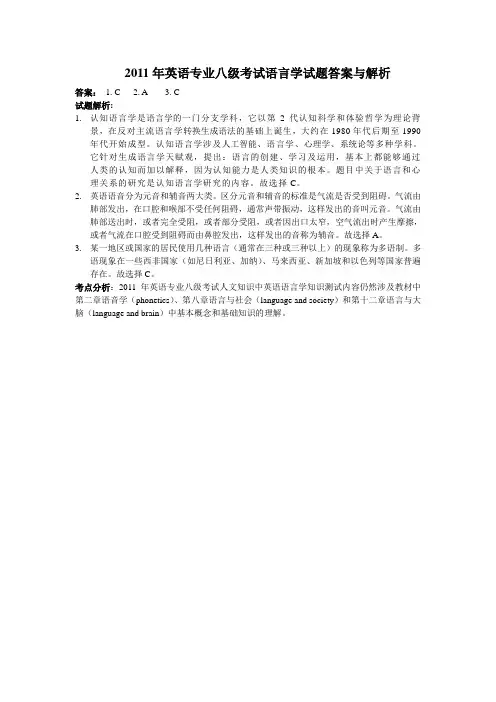
2011年英语专业八级考试语言学试题答案与解析
答案:1. C 2. A 3. C
试题解析:
1.认知语言学是语言学的一门分支学科,它以第2代认知科学和体验哲学为理论背
景,在反对主流语言学转换生成语法的基础上诞生,大约在1980年代后期至1990年代开始成型。
认知语言学涉及人工智能、语言学、心理学、系统论等多种学科。
它针对生成语言学天赋观,提出:语言的创建、学习及运用,基本上都能够通过人类的认知而加以解释,因为认知能力是人类知识的根本。
题目中关于语言和心理关系的研究是认知语言学研究的内容。
故选择C。
2.英语语音分为元音和辅音两大类。
区分元音和辅音的标准是气流是否受到阻碍。
气流由
肺部发出,在口腔和喉部不受任何阻碍,通常声带振动,这样发出的音叫元音。
气流由肺部送出时,或者完全受阻,或者部分受阻,或者因出口太窄,空气流出时产生摩擦,或者气流在口腔受到阻碍而由鼻腔发出,这样发出的音称为辅音。
故选择A。
3.某一地区或国家的居民使用几种语言(通常在三种或三种以上)的现象称为多语制。
多
语现象在一些西非国家(如尼日利亚、加纳)、马来西亚、新加坡和以色列等国家普遍存在。
故选择C。
考点分析:2011年英语专业八级考试人文知识中英语语言学知识测试内容仍然涉及教材中第二章语音学(phonetics)、第八章语言与社会(language and society)和第十二章语言与大脑(language and brain)中基本概念和基础知识的理解。
2011年3月5日专八 (TEM8) 真题+答案+听力材料[完整版]
TEST FOR ENGLISH MAJORS (2011)-GRADE EIGHT-TIME LIMIT: 195 MIN PART I LISTENING COMPREHENSION (35 MIN) SECTION A MINI-LECTUREIn this section you will hear a mini-lecture. You will hear the lecture ONCE ONLY While listening, take notes on the important points. Your notes will not be marked, but you will need them to complete a gap-filling task after the mini-lecture. When the lecture is over, you will be given two minutes to check your notes, and another ten minutes to complete the gap-filling task on ANSWER SHEET ONE. Use the blank sheet for note-taking.Complete the gap-filling task. Some of the gaps below may require maximum of THREE words. Make sure the word(s) you fill in is (are) both grammatically & semantically acceptable. You may refer to our notes.Classifications of CulturesAccording to Edward Hall, different cultures result in different ideas about the world. Hall is an anthropologist. He is interested in relations between cultures.I.High-context cultureA. feature—context: more important than the message—meaning (1) ________________i.e. more attention paid to (2) ________ than to the message itselfB. examples—personal spacepreference for (3) ___________less respect for privacy/personal spaceattention to (4) ________concept of time—belief in (5) _________ interpretation of time—no concern for punctuality—no control overtimeII.Low-context cultureA.feature—message: separate from context—meaning (6) __________B.examples—personal space—desire/respect for individuality/privacy—less attention to body language—more concern for (7) ________—attitude toward time—concept of time: (8) ___________—dislike of (9) _____________—time seen as commodityIII.ConclusionAwareness of different cultural assumptions—relevance in work and lifee.g. business, negotiation, etc.—(10) ___________ in successful communicationSECTION B INTERVIEWIn this section you will hear everything ONCE ONLY. Listen carefully and then answer the questions that follow. Mark the correct answer to each question on your coloured answer sheet.Questions 1 to 5 are based on an interview. At the end of the interview you will be given 10 seconds to answer each of the following five questions. Now listen to the interview.1. According to Dr. Harley, what makes language learning more difficult after a certain age?A.Differences between two languages.B.Dealing capacity to learn syntax.C. Lack of time available.D. Absence of motivation.2. What does the example of Czech speakers show?A. It‘s natural for language learners to make errors.B. Differences between languages cause difficulty.C. There exist differences between English and Czech.D. Difficulty stems from either differences or similarity.3. Which of the following methods does NOT advocate speaking?A. The traditional method.B. The audiolingual method.C. The immersion method.D. The direct method.4. Which hypothesis deals with the role of language knowledge in the learning process?A. The acquisition and learning distinction hypothesis.B. The comprehensible input hypothesis.C. The monitor hypothesis.D. The active filter hypothesis.5. Which of the following topics is NOT discussed during the interview?A. Causes of language learning difficulties.B. Differences between mother tongue and a second language.C. Theoretical conceptualization of second language learning.D. Pedagogical implementation of second language teaching.SECTION C NEWS BROADCASTIn this section you will hear everything ONCE ONLY. Listen carefully and then answer the questions that follow. Mark the best answer to each question on ANSWER SHEET TWO.Question 6 is based on the following news. At the end of the news item, you will be given 10 seconds to answer the question. Now listen to the news.6. Which of the following statements is INCORRECT?A. Greyhound is Britain's largest bus and train operator.B. Currently Greyhound routes in Britain are limited.C. The coach starts from London every hour.D. Passengers are offered a variety of services.Questions 7 and 8 are based on the following news. At the end of the news item, you will be given 20 seconds to answer the questions. Now listen to the news.7. What does the news item say about the fires in Greece?A. Fires only occurred near the Greek capital.B. Fires near the capital caused casualties.C. Fires near the capital were the biggest.D. Fires near the capital were soon under control.8. According to the news, what measure did authorities take to fight the fires?A. Residents were asked to vacate their homes.B. Troops were brought in to help the firefighter.C. Air operations and water drops continued overnight.D. Another six fire engines joined the firefighting operation.Questions 9 and 10 are based on the following news. At the end of the news item, you will be given 20 seconds to answer the questions. Now listen to the news.9. Which of the following is NOT mentioned as a cause of the current decline in the Mexican economy?A. Fewer job opportunities in Mexico.B. Strong ties with the U.S. economy.C. Decline in tourism.D. Decline in tax revenues.10. Drop in remittances from abroad is mainly due to _______A. declining oil production.B. the outbreak of the H1N1 flu.C. the declining GDP in Mexico.D. the economic downturn in the U.S.PART II READING COMPREHENSION (30 MIN) In this section there are four reading passages followed by a total of 20 multiple-choice questions. Read the passages and then mark your answers on your coloured answer sheet.TEXT AWhenever we could, Joan and I took refuge in the streets of Gibraltar. The Englishman's home is his castle because he has not much choice. There is nowhere to sit in the streets of England, not even,after twilight, in the public gardens. The climate, very often, odes not even permit him to walk outside. Naturally, he stays indoors and creates a cocoon of comfort. That was the way we lived in Leeds.These southern people, on the other hand, look outwards. The Gibraltarian home is, typically, a small and crowded apartment up several flights of dark and dirty stairs. In it, one, two or even three old people share a few ill0lit rooms with the young family. Once he has eaten, changed his clothes, embraced his wife, kissed his children and his parents, there is nothing to keep the southern man at home. He hurries out, taking even his breakfast coffee at his local bar. He comes home late for his afternoon meal after an appetitive hour at his café. He sleeps for an hour, dresses, goes out again and stays out until late at night. His wife does not miss him, for she is out, too – at the market in the morning and in the afternoon sitting with other mothers, baby-minding in the sun.The usual Gibraltarian home has no sitting-room, living-room or lounge. The parlour of our working-class houses would be an intolerable waste of space. Easy-chairs, sofas and such-like furniture are unknown. There are no bookshelves, because there are no books. Talking and drinking , as well as eating, are done on hard chairs round the dining-table, between a sideboard decorated with the best glasses and an inevitable display cabinet full of family treasures, photographs and souvenirs. The elaborate chandelier over this table proclaims it as the hub of the household and of the family. ,Hearth and home' makes very little sense in Gibraltar. One's home is one's town or village, and one's health is the sunshine.Our northern towns are dormitories with cubicles, by comparison. When we congregate – in the churches it used to be, now in the cinema, say, impersonally, or at public meetings, formally – we are scarcely ever man to man. Only in our pubs can you find the truly gregarious and communal spirit surviving, and in England even the pubs are divided along class lines.Along this Mediterranean coast, home is only a refuge and a retreat. The people live together in the open air – in the street, market-place. Down here, there is a far stronger feeling of community than we had ever known. In crowded and circumscribed Gibraltar, with its complicated inter-marriages, its identity of interest, its surviving sense of siege, one can see and feel an integrated society.To live in a tiny town with all the organization of a state, with Viceroy (总督), Premier, Parliament, Press and Pentagon, all in miniature, all within arm's reach, is an intensive course in civics. In such an environment, nothing can be hidden, for better or for worse. One's successes are seen and recognized; one' failures are immediately exposed. Social consciousness is at its strongest, with the result that there is a constant and firm pressure towards good social behavior, towards courtesy and kindness. Gibraltar, with all its faults, is the friendliest and most tolerant of places. Straight from the cynical anonymity of a big city, we luxuriated in its happy personalism. We look back on it, like all its exiled sons and daughters, with true affection.11. Which of the following best explains the differences in ways of living between the English and the Gibraltarians?A. The family structure.B. Religious belief.C. The climateD. Eating habit.12. The italicized part in the third paragraph implies that _______A. English working-class homes are similar to Gibraltarian ones.B. English working-class homes have spacious sitting-rooms.C. English working-class homes waste a lot of space.D. the English working-class parlour is intolerable in Gibraltar.13. We learn from the description of the Gibraltarian home that it is _______A. modern.B. luxurious.C. stark.D. simple.14. There is a much stronger sense of ________ among the Gibraltarians.A. togethernessB. survivalC. identityD. leisure15. According to the passage, people in Gibraltar tend to be will-behaved because of the following EXCEPT ________.A. the entirety of the state structure.B. constant pressure from the state.C. the small size of the town.D. transparency of occurrences.TEXT BFor office innovator s, the unrealized dream of the ―paperless‖ office is a classic example of high-tech hubris (傲慢). Today's office drone is drowning in more paper than ever before.But after decades of hype, American offices may finally be losing their paper obsession. The demand for paper used to outstrip the growth of the US economy, but the past two or three years have seen a marked slowdown in sales – despite a healthy economic scene.Analysts attribute the decline to such factors as advances in digital databases and communication systems. Escaping our craving for paper, however, will be anything but an easy affair.―Old habits are hard to break.‖ says Merilyn Dunn, a communications supplies director. ―There are some functions that paper serves where a screen display doesn't work. Those functions are both its strength and its weakness.‖In the early to mid-'90s, a booming economy and improved desktop printers helped boost paper sales by 6 to 7 percent each year. The convenience of desktop printing allowed office workers to indulge in printing anything and everything at very little effort or cost.But now, the growth rate of paper sales in the United States is flattening by about half a percent each year. Between 2004 and 2005, Ms. Dunn says, plain white office paper will see less than a 4 percent growth rate, despite the strong overall economy. A primary reason for the change, says Dunn, is that for the first time ever, some 47 percent of the workforce entered the job market after computers had already been introduced to offices.―We're finally seeing a reduction in the amount of paper being used per worker in the workplace.‖ says John Maine, vice president of a pulp and paper economic consulting firm. ―More information is being transmitted electronically, and more and more people are comfortable with the information residing only in electronic form without printing multiple backups.‖In addition, Mr. Maine points to the lackluster employment market for white-collar workers – the primary driver of office paper consumption – for the shift in paper usage.The real paradigm shift may be in the way paper is used. Since the advent of advanced and reliable office-network systems, data storage has moved away from paper archives. The secretarial art of ―filing‖ is disappearing from job descriptions. Much of today's data may never leave its original digital format.The changing attitudes toward paper have finally caught the attention of paper companies, says Richard Harper, a researcher at Microsoft. ―All of a sudden, the paper industry has started thinking,‗We need to learn more about the behavioural aspects of paper use,'― he says. ―They had never asked, they'd just assumed that 70 million sheets would be bought per year as a literal function of economic growth.‖To reduce paper use, some companies are working to combine digital and paper capabilities. For example, Xerox Corp. is developing electronic paper: thin digital displays that respond to a stylus, like a pen on paper. Notations can be erased or saved digitally.Another idea, intelligent paper, comes from Anoto Group. It would allow notations made with a stylus on a page printed with a special magnetic ink to simultaneously appear on a computer screen.Even with such technological advances, the improved capabilities of digital storage continue to act against ―paperlessness,‖ argues Paul Saffo, a technology forecaster. In his prophetic and metaphorical 1989 essay, ―The Electronic Pinata (彩罐),‖ he suggests that the increasing amounts of electronic data necessarily require more paper.The information industry today is like a huge electronic pinata, composed of a thin paper crust surrounding an electronic core,‖ Mr. Saffo wrote. The growing paper crust ―is most noticeable, but the hidden electronic core that produces the crust is far larger – and growing more rapidly. The result is that we are becoming paperless, but we hardly notice at all.‖In the same way that digital innovations have increased paper consumption, Saffo says, so has video conferencing – with its promise of fewer in-person meetings – boosting business travel.―That's one of the great ironies of the information age,‖ Saffo says. ―It's just common sense that the more you talk to someone by phone or computer, it inevitably leads to a face-to-face meeting. The best thing for the aviation industry was the Internet.‖16. What function does the second sentence in the first paragraph serve?A. It further explains high-tech hubris.B. It confirms the effect of high-tech hubris.C. It offers a cause for high-tech hubris.D. It offers a contrast to high-tech hubris.17. Which of the following is NOT a reason for the slowdown in paper sales?A. Workforce with better computer skills.B. Slow growth of the US economy.C. Changing patterns in paper use.D. Changing employment trends.18. The two innovations by Xerox Corp. and Anoto Group feature _______.A. integrated use of paper and digital form.B. a shift from paper to digital form.C. the use of computer screen.D. a new style of writing.19. What does the author mean by ―irony of the information age‖?A. The dream of the ―paperless‖ office will be realized.B. People usually prefer to have face-to-face meetings.C. More digital data use leads to greater paper use.D. Some people are opposed to video-conferencing.20. What is the author's attitude towards ―paperlessness‖?A. He reviews the situation from different perspectives.B. He agrees with some of the people quoted in the passage.C. He has a preference for digital innovations.D. He thinks airlines benefit most from the digital age.TEXT CWhen George Orwell wrote in 1941 that England was ―the most class-ridden country under the sun‖, he was only partly right. Societies have always had their hierarchie s, with some group perched at the top. In the Indian state of Bihar the Ranveer Sena, an upper-caste private army, even killed to stay there.By that measure class in Britain hardly seems entrenched (根深蒂固的). But in another way Orwell was right, and continues to be. As a new YouGov poll shows, Britons are surprisingly alert to class – both their own and that of others. And they still think class is sticky. According to the poll, 48% of people aged 30 or over say they expect to end up better off than their parents. But only 28% expect to end up in a different class. More than two-thirds think neither they nor their children will leave the class they were born into.What does this thing that people cannot escape consist of these days? And what do people look at when decoding which class someone belongs to? The most useful identifying markers, according to the poll, are occupation, address, accent and income, in that order. The fact that income comes fourth is revealing: though some of the habits and attitudes that class used to define are more widely spread than they were, class still indicates something less blunt than mere wealth.Occupation is the most trusted guide to class, but changes in the labour market have made that harder to read than when Orwell was writing. Manual workers have shrunk along with farming and heavy industry as a proportion of the workforce, while the number of people in white-collar jobs has surged. Despite this striking change, when they were asked to place themselves in a class, Brits in 2006 huddled in much the same categories as they did when they were asked in 1949. So, jobs, which were once a fairly reliable guide to class, have become misleading.A survey conducted earlier this year by Expertian shows how this convergence on similar types of work has blurred class boundaries. Expertian asked people in a number of different jobs to place themselves in the working class or the middle class. Secretaries, waiters and journalists were significantly more likely to think themselves middle-class than accountants, computer programmers or civil servants. Many new white-collar jobs offer no more autonomy or better prospects than old blue-collar ones. Yet despite the muddle over what the markers of class are these days, 71% of those polled by YouGov still said they found it very or fairly easy to figure out which class others belong to.In addition to changes in the labour market, two other things have smudged the borders on the class map. First, since 1945 Britain has received large numbers of immigrants who do not fit easily into existing notions of class and may have their own pyramids to scramble up. The flow of new arrivals has increased since the late 1990s, multiplying this effect.Second, barriers to fame have been lowered, Britain's fast-growing ranks of celebrities –like David Beckham and his wife Victoria – form a kind of parallel aristocracy open to talent, or at least to those who are uninhibited enough to meet the requests of television producers. This too has made definitions more complicated.But many Brits, given the choice, still prefer to identify with the class they were born into rather than that which their jobs or income would suggest. This often entails pretending to be more humble than is actually the case: 22% of white-collar workers told YouGov that they consider themselves working class. Likewise, the Expertian survey found that one in ten adults who call themselves working class are among the richest asset-owners, and that over half a million households which earn more than $191,000 a year say they are working class. Pretending to be grander than income and occupation suggest is rarer, though it happens too.If class no longer describes a clear social, economic or even political status, is it worth paying any attention to? Possibly, yes. It is still in most cases closely correlated with educational attainment and career expectations.21. Why does the author say ―…Orwell was right, and continues to be‖ (Paragr aph Two)?A. Because there was stronger class consciousness in India.B. Because more people hoped to end up in a higher class.C. Because people expect to gain more wealth than their parents.D. Because Britons are still conscious of their class status.22. ―…class still indicates something less blunt than mere wealth‖ (Paragraph Three) means that____.A. class is still defined by its own habits and attitudes.B. class would refer to something more subtle than money.C. people from different classes may have the same habits or attitudes.D. income is unimportant in determining which class one belongs to.23. Which of the following statements is INCORRECT?A. White-collar workers would place themselves in a different class.B. People with different jobs may place themselves in the same class.C. Occupation and class are no longer related with each other.D. Changes in the workforce have made it difficult to define class.24. Which of the following is NOT a cause to blur class distinction?A. Notions of class by immigrants.B. Changing trends of employment.C. Fewer types of work.D. Easy access to fame.25. When some successful white-collar workers choose to stay in the working class, it implies that they are _______.A. showing modesty.B. showing self-respect.C. expressing boastfulness.D. making an understatement.TEXT DThe train was whirling onward with such dignity of motion that a glance from the window seemed simply to prove that plains of Texas were pouring eastward. Vast flats of green grass, dull-hued spaces of mesquite and cactus, little groups of frame houses, woods of light and tender trees, all were sweeping into the east, sweeping over the horizon, a precipice.A newly married pair had boarded this coach at San Antonio. The man's face was reddened from many days in the wind and sun, and a direct result of his new black clothes was that his brick-coloured hands were constantly performing in a most conscious fashion. From time to time he looked down respectfully at his attire. He sat with a hand on each knee, like a man waiting in a barber's shop. The glances he devoted to other passengers were furtive and shy.The bride was not pretty, nor was she very young. She wore a dress of blue cashmere, with small reservations of velvet here and there, and with steel buttons abounding. She continually twisted her head to regard her puff sleeves, very stiff, and high. They embarrassed her. It was quite apparent that she had cooked, and that she expected to cook, dutifully. The blushes caused by the careless scrutiny of some passengers as she had entered the car were strange to see upon this plain, under-class countenance, which was drawn in placid, almost emotionless lines.They were e vidently very happy. ―Ever been in a parlor-car before?‖ he asked, smiling with delight.―No.‖ she answered: ―I never was. It's fine, ain't it?‖―Great! And then after a while we'll go forward to the dinner, and get a big lay-out. Fresh meal in the world. Charge a dollar.‖―Oh, do they?‖ cried the bride. ―Change a dollar? Why, that's too much – for us –ain't it, Jack?‖ ―Nor this trip, anyhow.‖ he answered bravely. ―We're going to go the whole thing.‖Later he explained to her about the trains. ―You se e, it's a thousand miles from one end of Texas to the other' and this runs right across it, and never stops but four times.‖ He had the pride of an owner. He pointed out to her the dazzling fittings of the coach; and in truth her eyes opened wider and she contemplated the sea-green figured velvet, the shining brass, silver, and glass, the wood that gleamed as darkly brilliant as the surface of a pool of oil. At one end a bronze figure sturdily held a support for a separated chamber, and at convenient places on the ceiling were frescos in olive and silver.To the minds of the pair, their surroundings reflected the glory of their marriage that morning in San Antonio; this was the environment of their new estate; and the man's face in particular beamed with an elation that made him appear ridiculous to the Negro porter. This individual at times surveyed them from afar with an amused and superior grin. On other occasions he bullied them with skill in ways that did not make it exactly plain to them that they were being bullied. He subtly used all the manners of the most unconquerable kind of snobbery. He oppressed them. But of this oppression they had small knowledge, and they speedily forgot that infrequently a number of travelers coveredthem with stares of derisive enjoyment. Historically there was supposed to be something infinitely humorous in their situation.―We are due in Yellow Sky at 3:42.‖ he said, looking tenderly into her eyes.―Oh, are we?‖ she said, as if she had not been aware of it. To evince (表现出) surprise at her husband's statement was part of her wifely amiability. She took from a pocket a little silver watch; and as she held it before her, and stared at it with a frown of attention, the new husband's face shone.―I bought it in San Anton' from a friend of mine,‖ he told her gleefully.―It's seventeen minutes past twelve.‖ she said, looking up at him with a kind of shy and clumsy coquetry (调情;卖俏). A passenger, nothing this play, grew excessively sardonic, and winked at himself in one of the numerous mirrors.At last they went to the dining-car. Two rows of Negro waiters, in glowing white suits, surveyed their entrance with the interest, and also the equanimity (平静), of men who had been forewarned. The pair fell to the lot of a waiter who happened to feel pleasure in steering them through their meal. He viewed them with the manner of a fatherly pilot, his countenance radiant with benevolence. The patronage, entwined with the ordinary deference, was not plain to them. And yet, as they returned to their coach, they showed in their faces a sense of escape.26. The description of the couple's clothes and behaviour at the beginning of the passage seems to indicate that they had a sense of _______.A. secrecy.B. elation.C. superiority.D. awkwardness.27. Which of the following adjectives best depicts the interior of the coach?A. Modern.B. Luxurious.C. Practical.D. Complex.28. Which of the following best describes the attitude of other people on the train to couple?A. They regarded the couple as an object of fun.B. They expressed indifference towards the couple.C. They were very curious about the couple.D. They showed friendliness towards the couple.29. Which of the following contains a metaphor?A. … li ke a man waiting in a barber's shop.B. … his countenance radiant with benevolence.C. … sweeping over the horizon, a precipice.D. … as darkly brilliant as the surface of a pool of oil.30. We can infer from the last paragraph that in the dining-carA. the waiters were snobbish.B. the couple felt ill at ease.C. the service was satisfactory.D. the couple enjoyed their dinner.PART ⅢGENERAL KNOWLEDGE (10 MIN) There are ten multiple-choice questions in this section. Choose the best answers to each question. Mark your answers on your colored answer sheet.31. The northernmost part of Great Britain is ________.A. Northern Ireland.B. Scotland.C. England.D. Wales.32. It is generally agreed that ________ were the first Europeans to reach Australia's shores.A. the FrenchB. the GermansC. the BritishD. the Dutch33. Which country is known as the Land of Maple Leaf?A. Canada.B. New Zealand.C. Great Britain.D. The United States of America.34. Who wrote the famous pamphlet, The Common Sense, before the American Revolution?A. Thomas Jefferson.B. Thomas Paine.C. John Adams.D. Benjamin Franklin.35. Virginia Woolf was an important female ________ in the 20 -century England.A. poetB. biographerC. playwrightD. novelist36. _____ refers to a long narrative poem that records the adventures of a hero in a nation's history.A. Ballad.B. Romance.C. Epic.D. Elegy.37. Which of the following best explores American myth in the 20 century?A. The Great Gatsby.B. The Sun Also Rises.C. The Sound and the Fury.D. Beyond the Horizon.38. ________ is defined as the study of the relationship between language and mind.A. Semantics.B. Pragmatics.C. Cognitive linguisticsD. Sociolinguistics39. A vowel is different from a consonant in English because of ________.A. absence of obstruction.B. presence of obstruction.C. manner of articulation.D. Place of articulation.。
年英语专业八级考试试题及答案.doc
2011年英语专业八级考试试题及答案TEST FOR ENGLISH MAJORS (2011)-GRADE EIGHTHTIME LIMIT: 19S MINPART 1 LISTENING COM PREH ENSION (35 MIN)SECTION A MINI-LECTUREIn this section you wilt hear a mini-lecture. You will hear the lecture ONCE ONL K HWi/e listenings take notes on the important points. Your notes will not be marked, but yuu H7//need them to complete a gap^/tlling task after the mini^lecture. When the lecture is over^ yuu will be gh^cn minutes to check your nates, and another ten minutes to complete the Kap^fUting task on ANSWER SHEET ONE. Some of the 密叩s may require a maximum of THREE ^onhi. Make jatre rhe wtfrd(s) you fill in isfare) b<9th grammatically and setnantically acceptable. You may refer to ytHtr notes while completing the task. Use the blank sheet for note-taking.SECTION B INTERVIEWIn this section you will hear everything ONCE CNLT Listen carefully and then answer the quest in/is that follow. Mark the best answer e each question an ANSWER SHEET T1UCQuestions 1 to 5 arc based on an interview. At the end of the inter\9id^ you will be JO seconds to answer each of the JbUowing Jive questions.Now listen to the interview.】. According to Dr, Harley, whai makes language learning more difliculr after a certainA.Differences between two languages.B.Declining capacity to learn syntax.ck of time available.D.Absence of motivation., What does the example of Czech speakers sliow*■ A.心natural for language learners to make gg.B. Dinercrwes between languages cause ditTiculty.C. There exist diftercnees between Engli sh and € zech.D Difnculty stems from cither dirTercnce or similarity.3. Which of the following methods does NOT adxocatc speaking?A. The traditional method. .B. The audiottngual method. 萄C. The immersion method.D. The direct method.4. Which hypothesis deals uith the role of language know ledge in the learning process?A. The acquisition and learning distinction hypothesis. :B. The comprehensible input hypothesis.C. The monitor hypothesis,D. The active filter hypothesis.5. Which of the following topics is NOT discussed during the interview?A. Causes of language learning difllcultics.B. Differences between mother tongue and a second language.C. Theoreiica! conceptualization of SCCOIK! language learning. #D. Pedagogical implementation of second language teaching.SECTION C NEWS BROADCASTln州•心:e 皿H7//hear zry断g ONCE ONLY. Lhlen carefulfy M then answer the 伽5g t I follow. Mark the best answer to each question on ANSWER SHEET EO.如”如 6 k based un the foUowini: new\ At th .,一 ,55 qgg. °f血5 5,冲win x州*〃10Now lixten to the心6 :坍°f USoHg ing dements is INCORRECT?甘加:"is Britain s Urgest bus and train operator C 清哂G勺Znd routes in Britain ;uc □广心Marts f rom l^ndon every hour。
2011年专八真题答案
2011年专八真题答案1. outside the message2. the context 或 what is happening3. closeness to people4. body language5. different6. in the message7. the action8. monochromic9. lateness10. importance2011年专八听力参考答案:1-5 BDACB 6-10 ACBAD2011年专八阅读参考答案:11-15 ABDAB 16-20 DBACA 21-25 DBCCA 26-30 DBACB2011年专八人文知识参考答案:31. B) 英国最北部:Scotland;32. D) 第一个到澳洲的人:Dutch;33. A) 枫叶之国:Canada;34. B) The Common Sense的作者:Thomas Paine35. D) Virginia Woolf:Novelist;36. C) 历史叙事诗:Epic37. A) 探讨20世纪American Myth的文学作品:The Great Gatsby38. C)探讨语言和思维的学科:Cognitive Linguistics39. A) 元音和辅音的区别:Obstruction of the air stream;40. C) 推动多种语言使用:Multilingualism2011年专八改错参考答案:1. grew 后加 up2. conscience 改成 consciousness3. soon 改成 sooner4. the child 中间加 middle5. disagreeing 改成 disagreeable6. imaginative 改成 imaginary7. literal 改成 literary8. in 去掉9. which 前加 in10. Therefore, 改成 Nevertheless2011年专八汉译英参考答案:Being hasty and at leisure are two quite distinct lifestyles. But in the real world, people have to frequently shuttle between these two lifestyles, sometimes not sure whether they are “at ease” or “in a rush”.For example, we are enjoying our holidays in the resort while suddenly we receive phone calls from the boss who tells us there are some troubles with our customers and work----so at this moment the modern, convenient and advanced device shows its vicious and gloomy features---and we lose all our interest. The subsequent leisure is the mere showy for we are in a restless and anxious state of mind.2011年专八英译汉参考答案:当飞机飞越尼泊尔的上空,你的想象力很容易开始翱翔,你很小,就像一只小蝴蝶,飞在一幅三维的建筑地形图上,那些环绕着每个高脊的梯田就像图中环形的等高线。
2011年英语专八考试真题及答案
2011年英语专八考试真题及答案IntroductionThe 2011 English Proficiency Test Level 8 (专八) is an important examination in China, designed to assess individuals' English language skills at an advanced level. In this article, we will explore the genuine questions from the 2011 exam and provide detailed answers for each question. With a focus on comprehension, grammar, and writing, this guide aims to help test-takers understand the structure and requirements of the exam better.Section 1: Reading ComprehensionPassage 1: The Importance of BilingualismIn this passage, the author discusses the benefits of being bilingual and provides examples of how bilingualism can positively impact various aspects of life, such as better job opportunities and enhanced cognitive abilities. The passage also addresses common misconceptions about bilingualism.Passage 2: The Impact of Climate ChangeThis passage explores the topic of climate change, focusing on its effects on the environment, ecosystems, and human health. It highlights the urgency of addressing climate change and the importance of global cooperation in mitigating its impacts.Section 2: Vocabulary and GrammarQuestion 1: Fill in the BlanksIn this question, candidates are required to fill in the blanks with the appropriate vocabulary words or phrases. The context of the passage provides clues to help determine the correct answers.Question 2: Sentence TransformationCandidates are given a sentence and are required to transform it according to the instructions given. This tests their ability to manipulate sentence structures and demonstrates their understanding of various grammar rules.Section 3: WritingQuestion 1: Essay WritingCandidates are asked to write an essay on a given topic within a specified word limit. The topic may require them to express their opinions, argue a particular viewpoint, or analyze a given situation. Test-takers are expected to demonstrate their ability to organize their thoughts, structure their essay coherently, and use appropriate vocabulary and grammar.Question 2: Letter WritingIn this section, candidates are asked to write a formal or informal letter based on a given scenario. The prompts may require them to express gratitude, make a complaint, or provide advice. Test-takers should demonstrate their ability to use appropriate language and format for the chosen type of letter.ConclusionIn this article, we have provided an overview of the 2011 English Proficiency Test Level 8, focusing on the reading comprehension, vocabulary and grammar, and writing sections. By understanding the structure and content of the exam, test-takers can better prepare themselves for success. However, it is essential to remember that studying and practicing consistently are the keys to achieving a high score in the exam.。