
上海版英语七年级上Unit 5 Visiting the Moon 教案 (1)
7A Unit5 Visiting the Moon知识点归纳重点单词: diary, space, spaceship, spacesuit, nervous, leave, gravity, able, float, tie, ourselves, without, weak, breathe, if, camera, work, garden, rock, postcard, machine, return.重点短语more than, be able to, have to, so that, take photos, as…as…, that is, such as.课文重点句子解析Reading1.How will Jerry travel?How may Jerry feel about the trip?travel, trip, journey的用法辨析: 三者区别如下1). travel 泛指一般意义的旅行如He is fond of travel (= travelling). 他喜欢旅行。
Travel is much cheaper than it used to be. 现在旅行比过去便宜多了。
注many 或数词连用。
如He’s gone off on his travels again. 他又外出旅行了。
另外travel 通常只是泛指旅行How was your travel?2). journey 通常指远距离的陆地旅行返回到出发地(即通常指单程)。
如I wish you a pleasant journey. 祝你一路顺风。
He made a journey to Beijing. 他去北京旅行了。
注journey 有时并不指真正意义的“旅行”如How long is your journey to work? 你上班要走多远?3). trip 通常指近距离的为了办事或消遣而进行旅行(即指双程)过有时trip 也可指远距离的长途旅行journey 换用journey 更通俗。
如A Where is John? 约翰在哪里? B He’s on a trip to Shanghai. 他去上海旅行了。
He’ll make a round-the-world trip. 他将周游世界。
2.There can be more than one answer. more than= over 超过3. Tomorrow I'll be one of the first students to travel into the space.①one of the first students ...的其中之一, 此机构中的中心名词要用可数名词的复数。
如He is one of the top students. 他是尖子生之一。
②space, place, room的用法区别三者均可表示“空地”、“空间”区别如下:1). 泛指一般意义的“空地”或“空间”space 和room 均可以用如The large table takes up too much space [room]. 这张大桌子太占地方了。
There isn’t enough space [room] for all our luggage. 没有足够的地方可以放我们的行李。
Here is an empty place, put the box here. 这里有个空地方把箱子放在这里吧。
注place 表示“太空”、“宇宙”room 表示“房间”He was staring into space. 他极目远眺。
This is one of the largest rooms here. 这是这里最大的房间之一。
2). place 表示“空地”seat 同义。
如We’ll try to get places (=seats) at the front of the hall. 我们要设法弄到大厅前面的座位。
There are only two places (=seats) left for tonight. 今晚只剩两个座位。
A Is there any room [space] in the boat? 船上有空处吗? B Yes, that place in the corner is empty. 在那边角落里还有个空位。
4.The spaceship will leave the Earth at 9 a.m.①“leave+地点”表示“离开某地”。
例如When did you leave Shanghai? --你什么时候离开上海的②“leave for+地点”表示“动身去某地”。
例如Next Friday, Alice is leaving for London. 下周五③“leave+地点+for+地点”表示“离开某地去某地”。
例如Why are you leaving Shanghai for Beijing? 你为什么要离开上海去北京5.It will take us to the Moon. take... to... 带...去...6.The Moon is around 380,000 kilometers from the Earth ,so it'll take us about four days to get there.①around = about 大约②it take sb. some time to do sth. =sb spend some time doing sth. / on sth. 某人花了多长时间做某事it 在此句型中作形式主语It will take him an hour to finish all his homework. = He will spend an hour finishing/on all his homework. 完成所有的家庭作业将花费他一个小时。
③get to , arrive , reach 的用法三者均可表示“到达”■arrive 和get 都是不及物动词但可接here, there, home 之类的表地点的副词作状语。
如What time does the train arrive?火车什么时候到? We got [arrived] here last night. 我们昨晚到这儿。
要表示“到达某地”1. arrive 之后通常接介词at (一般用于较小的地方)或in (一般用于较大的地方)。
如We arrived at the station five minutes late. 我们到车站晚了 5 分钟。
They will arrive in Paris next Monday. 他们将于下周星期一到达巴黎。
1.get 之后通常接介词to。
如When we got to the park, it began to rain. 我们到达公园时在谈到火车、汽车等或乘客等到站时get in。
如The bus gets in at five thirty. 汽车五点半到站。
■reach 通常是及物动词(较get 更正式)(不能用介词)。
如He reached Beijing yesterday. 他昨天到达北京。
注reach 之后也可接here, there, home 等词。
如When did he reach home yesterday? 昨天他什么时候到家? 顺便说一句reach 除可表示到达某地外Your letter reached me last week. 我是上周收到你的信的。
He has reached school age. 他已达到上学年龄。
You can guess it when you reach the end of the chapter. 当你读到这末尾时7.There is no gravity in space. There be 句型be动词的形式根据其后所跟名词的单复数遵循主谓一致的原则There is →可数名词单数或不可数名词There is an apple on the table. There is some water in the bottle. There are →可数名词的复数There are two apples on the chair.8. So we will all be able to float around in the spaceship. 比较: be able to与can1can表示能力(过去时用could), 只用于现在式和过去式(could)。
be able to 可以用于各种时态。
They will be able to tell you the news soon. 他很快就能告诉你消息了。
2be able to a. 位于助动词后, b. 情态动词后, c. 表示过去某时刻动作时, d. 用于句首表示条件,e. 表示成功地做了某事时was/were able to不能用could。
He was able toflee Europe before the war broke out. = He managed to flee Europe before the war broke out.9.---We'll have to tie ourselves to our beds so that we won't float away in our sleep!must和have to用法比较讲解:1must表示“必须”must not(mustn't)表示“不应该”在回答带有must的问句时need not(needn't)或don't have to 表示“不必”用must not (mustn't)。
The work must be finished as soon as possible.这件工作必须尽快完成。
You mustn't speak like that.你不能那样说话。
—Must I be home before eight o'clock? 8点之前我必须回家吗—Yes, you must./No, you needn't./No, you don't have to. 是的/不不必了。
2must表推测①一般只用于肯定句中There must be some mistakes.肯定有一些错误。
Unit 5 Visiting the Moon 第一课时 Reading I 教学设计 七上
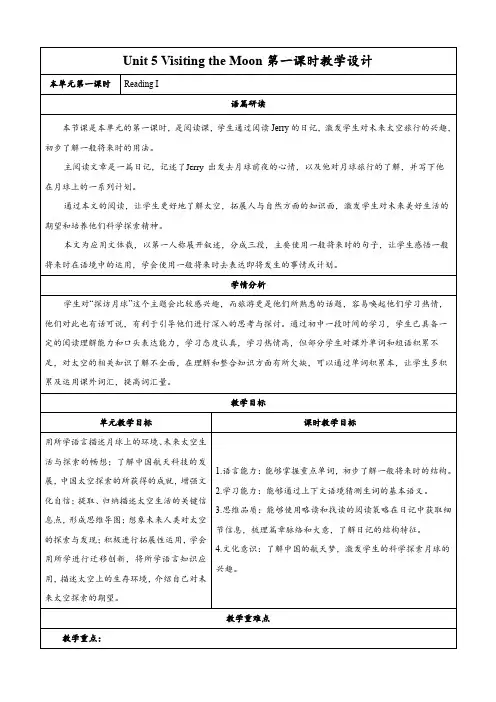
能够掌握重点单词,初步了解一般将来时的结构。
能够通过上下文语境猜测生词的基本语义。
教学难点:
能够使用略读和找读的阅读策略在日记中获取细节信息,梳理篇章脉络和大意,了解日记的结构特征。
了解中国的航天梦,激发学生的科学探索月球的兴趣。
教学方法
英语教学活动观,情境式教学
教学工具
PPT 课件,多功能白板,教案
教学流程图
教学过程
教学目标
教学活动及互动方式(时间)
设计意图
效果评价
第二部分
应用实践
第三部分
创新迁移
图片、音标、单词解释、例句等学习单词
A trip to space
标题和插图,预测篇章话题;理清段落大意,了解日记的写作特点
第一部分
学习理解
话题导入
视频,丰富“太空探索的发展”相关背景知识;
关于太空知识的小测试
问答 单项选择 完成表格 判断正误
绘制思维导图,复以第三人称转述Jerry 的日记。
单项选择 选词填空
阅读课评价量表。
英语七上《Unit 5 Visiting the Moon The simple future tense (will) 》_0
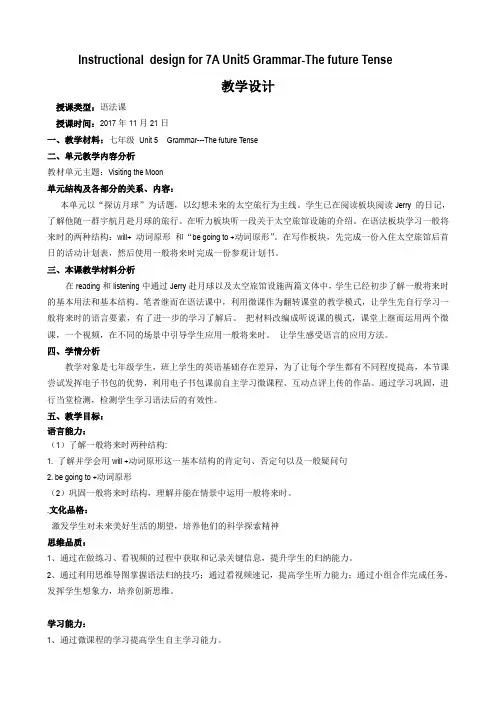
Instructional design for 7A Unit5 Grammar-The future Tense教学设计授课类型:语法课授课时间:2017年11月21日一、教学材料:七年级Unit 5 Grammar---The future Tense二、单元教学内容分析教材单元主题:Visiting the Moon单元结构及各部分的关系、内容:本单元以“探访月球”为话题,以幻想未来的太空旅行为主线。
学生已在阅读板块阅读Jerry 的日记,了解他随一群宇航月赴月球的旅行。
在听力板块听一段关于太空旅馆设施的介绍。
在语法板块学习一般将来时的两种结构:will+ 动词原形和“be going to +动词原形”。
在写作板块,先完成一份入住太空旅馆后首日的活动计划表,然后使用一般将来时完成一份参观计划书。
三、本课教学材料分析在reading和listening中通过Jerry赴月球以及太空旅馆设施两篇文体中,学生已经初步了解一般将来时的基本用法和基本结构。
笔者继而在语法课中,利用微课作为翻转课堂的教学模式,让学生先自行学习一般将来时的语言要素,有了进一步的学习了解后。
把材料改编成听说课的模式,课堂上继而运用两个微课,一个视频,在不同的场景中引导学生应用一般将来时。
让学生感受语言的应用方法。
四、学情分析教学对象是七年级学生,班上学生的英语基础存在差异,为了让每个学生都有不同程度提高,本节课尝试发挥电子书包的优势,利用电子书包课前自主学习微课程、互动点评上传的作品。
通过学习巩固,进行当堂检测,检测学生学习语法后的有效性。
五、教学目标:语言能力:(1)了解一般将来时两种结构:1. 了解并学会用will +动词原形这一基本结构的肯定句、否定句以及一般疑问句2. be going to +动词原形(2)巩固一般将来时结构,理解并能在情景中运用一般将来时。
.文化品格:激发学生对未来美好生活的期望,培养他们的科学探索精神思维品质:1、通过在做练习、看视频的过程中获取和记录关键信息,提升学生的归纳能力。
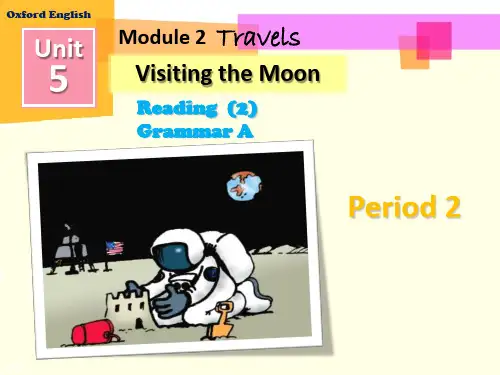
沪教版(牛津)七年级英语上册Unit 5 Visiting the Moon - Period 2 公开课PPT课件
(there/be) wonderful views of the Moon.
Mrs Green: How (6)__w__il_l_w__e_g_e_t_ (we/get) to the hotel? Mr Green: (7)__W__e__w__il_l/_W__e_’_ll_f_l_y__ (We/fly) up to the hotel in a spaceship. Mrs Green: (8)_W__i_ll_T__im__b__e_ (Tim/be) with us? Mr Green: Oh, yes, let’s take him too. (9)____H_e__w__il_l/_H__e_’l_l_e_n_j_o_y___(He/enjoy) it.
I will be able to swim underwater with fishes. How wonderful!
Homework
1. 流利地朗读Step 5中的短文。 2. 选择主阅读篇章中的单词、短语和句型,用
一般将来时续写短文。 3. 完成《综合练习册》第77页Grammar A和第84
初中七年级沪教版上册教案Unit5 Visiting the Moon
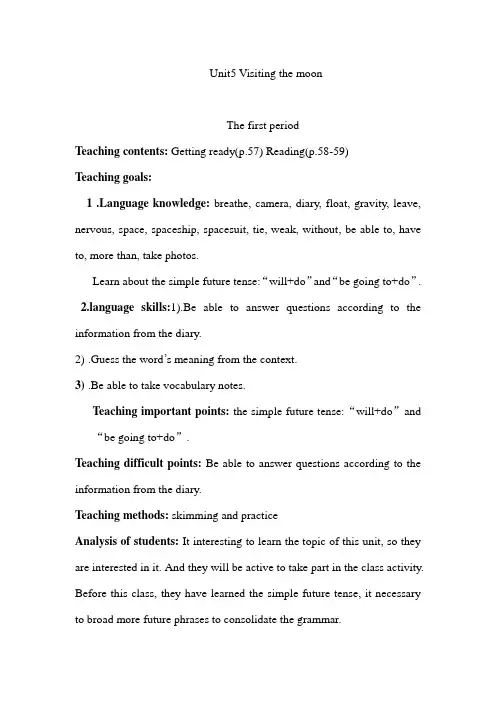
Unit5 Visiting the moonThe first periodTeaching contents: Getting ready(p.57) Reading(p.58-59)Teaching goals:1 .Language knowledge: breathe, camera, diary, float, gravity, leave, nervous, space, spaceship, spacesuit, tie, weak, without, be able to, have to, more than, take photos.Learn about the simple future tense:“will+do”and“be going to+do”.nguage skills:1).Be able to answer questions according to the information from the diary.2).Guess the word’s meaning from the context.3).Be able to take vocabulary notes.Teaching important points: the simple future tense:“will+do”and “be going to+do”.Teaching difficult points: Be able to answer questions according to the information from the diary.Teaching methods: skimming and practiceAnalysis of students: It interesting to learn the topic of this unit, so they are interested in it. And they will be active to take part in the class activity. Before this class, they have learned the simple future tense, it necessary to broad more future phrases to consolidate the grammar.Teaching procedures:Step1.Leading-in1)Free talkAsk Ss to look at the pictures on page 57 and talk with their partner.Ask Ss: Would you like to travel into space? How much do you know about space?a)After checking the answers, then ask Ss 5 questions:Q1: How do people travel into space? By spaceship.Q2: What do people wear in space? Spacesuits.Q3: Is there gravity in space? No.Q4: Where there is no gravity, can people stand in the spaceship? No, people will float.Q5: Can people breathe without wearing a spacesuit in space? Why or why not?No, because there is no air there.b)Get Ss to look at the picture and write the correct words in the boxes.(Exercise A on p58)Step2.Pre-readinga)Ask Ss to look at the photos ,the title and the first paragraph of the diary on page 59, then circle the correct answers.(finish exercise B on page 58) b) V ocabulary presentation: Get Ss to learn some new words by showing some pictures.c) V ocabulary exercise: Get Ss to finish exercise C1and C2 on page 60 to consolidate the new words.Step3. While- reading1) First reading: Tell Ss to read the text quickly and finish exercise.2) Second reading: Read the text again and complete exercise D1 and D2 on page 61.3)Check the answers.Step4.Post-readingDiscussion(group work)Get Ss to Discuss in groups:Q1: What do you think Jerry will do on the Moon?Q2: What do you think Jerry will bring back from the Moon?(finish exercise D3 on page61)Step5.Learning language pointsDeal with some useful phrases and expressions in the passage. Guide the Ss to learn and use them in their own speaking and writing.1)more than can’t wait to do sth.2)be able to do sth. wait for sb /sth. get weak3)have to do sth. so that do exercises4)tie... to... as many as that is5)so that(目的状语从句) 拓展:so… that……(结果状语从句)6)as+adj/adv… as…7)take photos8)that is(也就是说)9)if(如果)Step6.SummaryGet Ss to s ummarize what they’ve learned.Step7.HomeworkFinish the exercises the first period.Finish the reading exercises book.Blackboard designUnit5 Visiting the Moon.1)more than can’t wait to do sth.2)be able to do sth. wait for sb /sth. get weak3)have to do sth. so that do exercises4)tie... to... as many as that is5)so that(目的状语从句) 拓展:so… that……(结果状语从句)6)as+adj/adv… as…7)take photos教学反思:参观月球对学生来说是一个比较感兴趣的话题,所以反响不错,但是课文句子较长,复合句较多,所以理解起来不容易,而且生短语较多,所以还需要认真听课,好好巩固。
英语七年级上册《Unit 5 Visiting the Moon The simple future tense (will) 》_5
科目:英语七年级上册沪教版课题: Unit 5 Visiting the Moon Grammar A前置知识(本节课所用到学过和需补充的知识):Unit 5 Visiting the Moon Reading学习目标:1、知识与能力目标:1) 能掌握一般将来时的基本结构:所有人称+ will + do/be +其他。
2)能掌握一般将来时的各种句式:肯定句:所有人称+ will + do/be +其他。
否定句:主语+will not(won’t)+ do/be +其他。
一般疑问句:Will+主语+do/be +其他?Yes, 主语+will/No, 主语+won’t特殊疑问句:What/where/how/who…Will+主语+do/be ?3)一般将来时常用的时间状语:soon、tomorrow( evening) 、next week/month/year 、in the future 、in+段时间(……以后)、in+ 2020 (以后的年份)2、过程与方法目标教学过程设计:通过情景交际和任务型学习,熟练掌握一般将来时的结构和用法。
教师教学方法设计:情景交际法、讲授法、任务型语言教学法学生学习方法设计:练习法、情景交际法、任务学习法教学理念设计:通过情景交际法引入课堂教学,并采用多媒体课件进行教学。
通过给学生们介绍一位新朋友,来吸引学生的注意力。
而后一步步引导、培养学生们自主观察、探究、归纳的能力,从而进一步激发学生主动学习英语的兴趣,自主学习以及科学探索精神。
3、情感与价值目标:1. 学会使用多种句式描述自己现在和未来的设想。
2.引导学生阅读科普类文章,激发他们的阅读兴趣以及科学探索精神。
学习重点:1) 掌握一般将来时的基本结构及其运用。
2) 能够准确地用一般将来时表达将来可能发生的事情。
学习难点及突破方法:能够从学习中探究并归纳一般将来时的结构和句式;从而在做题过程中能够准确地辨认出一般将来时。
英语七年级上-Unit5教案(阅读)
二、阅读理解
David
I'm a Chinese boy. I love travelling a lot. Walking on the Moon is one of the wonders of our times. I hope that I can fly to the Moon one day. I know Chinese people are working hard to get ready to fly there. So I'm sure my dream will come true.
拓展
(1)序数词是指表示顺序的数词,如:first,second,third等。 基数词是指用来描述事物数量多少的数词,如:one,two,three等。 序数词前一般需加the。 (2)基数词变序数词的口诀如下: 一二三,特殊记;五和十二很容易,f来把ve替;八去t,九去e,
末尾都加th;遇到几十几,只变个位就可以;遇到整几十,改y为 ie,末尾仍加th。 (3)不定式(短语)作定语,一般都是作后置定语,修饰前面 的名词或代词。
Susan
I'm from New York. I think space is very interesting and amazing. People don't know much about it. I hope to visit the Mars (火星) if it is possible. But it's really hard to take a trip into space. So I'll exercise more to keep healthy and make more money for the trip.
Unit 5 Visting the Moon 单元整体教学设计 20232024学年牛津深圳七 上
单元整体教学设计
表二:单元大观念:
主题大观念
小观念1:了解月球一般知识 小观念2: 月球上的生活畅想
小观念3:太空的探索
单元大观念:探索太空,畅想未来;勇于创新与实践
输出:用将来时畅想未来的太空旅行
输出:以第三人称复述文本
输出:用一般将来时,介绍一次出行计划
输出:通过网络等查找更多关于中国航天的发展史 Reading: 日记“A trip to space”讲述了月球上的生活环境以及抵达月球后进行的活动。
Listening: 关于太空旅馆的介绍; Speak up:讨论关于参观太空博物馆的计划;Grammar:两篇对话,Mr Green 与妻子去太空旅馆度假以及关于他去太空旅馆的计划;Writing:入住太空旅馆后首日的活动计划表; More practice:关于月球上建立旅馆的
Culture corner 中国航天的探索与发展。
上教版七年级英语上册Unit 5 Visiting the Moon教案 1
Unit 5 Visiting the Moon教案 1一、教材分析本单元围绕着“探访月球”为话题来展开听、说、读、写的训练。
通过以男孩Jerry的一篇日记为载体,介绍了有关太空旅行和月球漫步的科学常识及相关表达,指导学生阅读科普类文章,激发他们的阅读兴趣以及科学探索精神。
对季节特征和天气状况的描述,同时在听说读写中引导学生掌握一般将来时的用法。
二、教学对象分析1.学生对于“月球旅行”比较熟悉,有利于开展本单元的各项听说读写任务。
2.学生对于一般将来时的用法其实并不陌生,在小学已经接触过,只是没有进行专项的归纳性学习。
在本单元,教师可以系统地帮助学生温故而知新,引导学生在一定的语境中熟练运用一般将来时。
三、单元教学目标1.认知目标2.能力发展目标:1)能够在听、说、读、写等语言综合实践活动中运用本单元的重点词汇、句型与语法。
2)在学习中提高交流和传递信息的能力,在写作中句型使文章更连贯和流畅。
3)通过指导学生在模拟交际中运用所学的知识,培养学生探究学习、合作学习、自主学习的能力。
四、单元教学难点1.学生熟练掌握重点词汇22个,短语8个。
2.指导学生利用所学句型正确表达思想、进行交际活动。
3.指导学生归纳一般将来时用法并在实践中熟练运用它们。
五、单元教学重点1. 通过形式多样的课堂活动与任务,帮助学生完成阅读理解、听力理解等学习任务。
2. 引导学生积极主动地探究学习,从教材以外的渠道去了解与本单元主题相关的文化背息、资料等,并且与同学进行相互交流,顺利开展包括口头汇报、写作展示等拓展活动,培养学生探究学习、自主学习、合作学习的能力。
六、教学策略1.在教学中,教师应积极设情景引入,配合媒体、表情、动作、进行视听说演示,激发学生兴趣。
2.教师应采用有利于学生学习的教学方法,善于引导学生通过阅读或观察、比较对比知识进行归纳总结。
增加学习内容的复现和巩固练习、及时反馈学习情况。
3.教师应该根据自己学生的具体情况对教材进行整合,精讲精练,调动学生的学习兴趣,使他们积极参加参与课堂各种学习活动。
沪教版英语七年级上册精品教案Unit 5Period 3
Reciting all the key sentences.
6.Repeat and recite.
6.Check their activities.
6.To check the situation of words learning.
5
第五环节 课后作业
1.Whrite 10 sentences you learned in this period.
Period 3
课题
Unit 5 Visiting the Moon
课型
Reading 2
备课时间
1 period
教
材
分
析
教学目标
1.The Ss can master some basic sentence structures.
2. Learn to cooperate and self-study.
as…as
so…that
5.Think of the relative sentences as many as they can.
5.Walk around to help nd correct the mistakes.
5.To strengthen the learning fruit.
5’
第四环节 课时小结
1.Lead them to ge to the key points of this period.
5’
第二环节 观察操作、探索归纳平移的作法
Step Ⅱ:Language learning
2.Learn the structure.
﹙Group work﹚
StepⅢ: Show and develop the points.
沪教版英语七年级上册精品教案Unit 5Period 6
I want to_____________________and then I’d like to________________________
5
第四环节 课时小结
效
果
评
价
与
反
思
a
4.Provide a calendar progress chart for them to finish.
2.To train their ability to express as well as improve their speaking ability.
3.To get ready for the writing and train their ability to cooperate.
2.Help them to describe like this:
I am going to… on Monday.
I’ll…on+time
3.Give them some usefull items to help them to express.
I want to… in the morning.
教学重点
Teach them the ways to make a plan.
教学难点
Using the right tense.
教学关键
Using a calendar progress chart.
教法与学法指导
Self-study, Cooperation, Group work.
教学环节