
最新外研版九年级上册英语Module7被动语态 课件
3、They make computers in the USA. Computers are made (by them) in the USA.
4、They grow rice in South China.
Rice is grown (by them) in South China.
2019/9/1
• 第五级
3.Dalian produces big ships. Big ships are produced in Dalian.
4.Farmers grow rice in summer . Rice is grown (by farmers ) in summer.
5.We clean our classroom every day. Ou20r19c/l9a/1ssroom is cleaned (by us) every 1d9 ay.
• 第四级 • 第五级
The People’s Republic of China was founded
on 1st October 1949.
2019/9/1
2
单击此处编母版标题样式
• 单击此处编辑母版文本样式
• 第二级
• 第三级
• 第四级 • 第五级
The Great Wall was built in the Qin Dynasty.
students eve• r第y四•d级第a五y级.
4. Many books _a_r_e__w__r_it_t_e_n_______(write) by that
famous writer.
5. Most of the famous pop songs _a_r_e_s_u_n__g_ (sing) by
2019/9/1
3
单击此处编母版标题样式
• 单击此处编辑母版文本样式
• 第二级
• 第三级
• 第四级 • 第五级
The boy is called Tony.
2019/9/1
4
单击此处编母版标题样式
1.
定义:表示主语和谓语之间是被动关系,主语 • 单击此处编辑母版文本样式
被。。• 第。二级
• 第三级
The classroo• m第四i级s cleaned by us every day.
• 第五级
2. 谓语结构是:be+动词的过去分词
3. 强调动作发出者:by +宾语代词或名词
4. be有各种时态变化。
主动语态:表示主语和谓语之间是主动关系。
W20e19c/9l/e1an the classroom every day.
单击此处编母版标题样式
• 单击此处编辑母版文本样式
• 第二级
• 第三级
• 第四级 • 第五级
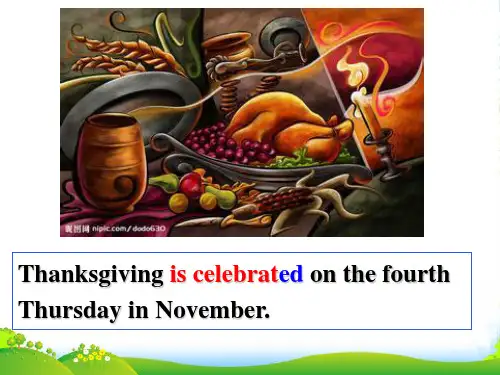
Thanksgiving is celebrated on the fourth Thursday in November.
2019/9/1
1
单击此处编母版标题样式
• 单击此处编辑母版文本样式
• 第二级
• 第三级
5
单击此处编母版标题样式
• 单击此处编辑母版文本样式
• 第二级
• 第三级
• 第四级 • 第五级nt trees every year.
树每年都被我们种。
Trees are planted by us every year.
2019/9/1
6
单击此处编母版标题样式
• 单击此处编辑母版文本样式
1、• 单Th击ey此处sp编ea辑k 母E版ng文li本sh样in式 Canada . E• n第g二lis级h is spoken (by them)in Canada.
• 第三级
2、People• u第四s• 级e第五w级 ood for making tables. Wood is used (by people) for making tables.
15
单击此处编母版标题样式
1. 2.
•_HI_单as_l•_f击第(ob此f二et)h处级bea编aspk辑petl母be a_版l_l__文pi__sl__本a_e_y_a_样e_t_de__式_n(p__la_y_)_a(reoaut)nbdythheiswsoisrtledr?.
3. The flo• w第e三rs级a_r_e__n_o_t__w_a__te_r_e_d( not water) by the
The G• r第ea二t级Wall was built in Qin Dinasty.
•
一般将来时• 第的三被级动语态:
• 第四级
will+be
done
• 第五级
A football playground will be built in our school.
• 现在完成时的被动语态: have/has+been done
单击此处编母版标题样式
• 单击此处编辑母版文本样式
• 第二级
• 第三级
• 第四级 • 第五级
am/is/are
单击此处编母版标题样式
• 单击此处编辑母版文本样式
• 第二级
• 第三级
• 第四级 • 第五级
am/is/are
单击此处编母版标题样式
拓展延伸:动脑筋,想一下
• 一•般单过击去时此的处被编动语辑态母结版构:文w本as样/w式ere+done
3.Children read books in the classroom.
Books __a_r_e_r_e_ad___ by children in the classroom.
4.I love cartoons.
Cartoons __a_re_l_o_v_ed____ by me.
2019/9/1
• 第二级
• 第三级
• 第四级 • 第五级
2019/9/1
7
单击此处编母版标题样式
• 单击is此处sp编o辑ke母n 版文本样式 • 第二级are read
• 第三级
• 第四级
are p•la第n五t级ed
is grown
2019/9/1
8
单击此处编母版标题样式
• 单击此处编辑母版文本样式
• 第二级
2019/9/1
12
单击此处编母版标题样式
is
by
• 单击此处编辑母版文本样式
• 第二级
• 第三级
• 第四级 • 第五级
cleaned
2019/9/1
is used
13
单击此处编母版标题样式
• 单击此处编辑母版文本样式
• 第二级
• 第三级
• 第四级 • 第五级
2019/9/1
14
单击此处编母版标题样式
18
单击此处编母版标题样式
1.More and more people speak English. En•g单lis击h 此is 处spo编ke辑n母(b版y m文o本re样an式d more people). 2. We •p第la•二n第t级三m级ore trees every year here. More trees• a第r四e级planted (by us)every year here.
一、把主动语态的句子变为被动语态
1.We clean the classroom after school. Th•e单c•l击a第s此二sr处级oo编m辑_母_i_s版_c_文le_a本_n_e样_d_式_ by us after school.
2.The •te第a三ch级ers use the computers everyday. The comput• e第r四•s级a第_r五_e级_u_s_ed_ by the teachers everyday.
Two new buildings have been built in our school.
单击此处编母版标题样式
主• 单动击此语处编态辑母变版文被本样动式 语态口诀:
• 第二级
宾语提前主语变, • 第三级 • 第四级 • 第五级
原主变宾by后见,
时态人称be关键。
• 第三级
• 第四级 • 第五级
2019/9/1
9
单一般击现此在处时编被母动语版态标的题构样成 式
• 单击此处编辑母版文本样式
• 第二级am 主语•+第•三i第s级四级
+过去分词
are• 第五级
+(by + 动作执行者)
动作 承受者
动作
动作 执行者
2019/9/1
10
单击此处编Pra母tic版e 标题样式
• 单击此处编op辑en母版文本样式
• 第二级
• 第三级
• 第四级 • 第五级
is opened
collect
are collected
2019/9/1
11
单击此处编母版标题样式
Write • 单•击第此二处级 编辑母版文M本a样rk式twain
• 第三级
• 第四级 • 第五级
is written by
him.
单击此处编母版标题样式
6. An accident _h_a_p_p__en__ed___ (happen) here last nig•h单t. 击此处编辑母版文本样式
• 第二级
7. Some•p第r三es级ents _a_re__b_o_u_g_h_t_ (buy) by my sister • 第四级
for me every •b第ir五t级hday. 8. The computer __is_u__se_d______(use) in teaching.
合集下载
外研版英语九年级上册 Module 7 Unit 3 Language in usePPT

外研版英语九年级上册 Module 7 Unit 3 Language in use【公开课课件】
外研版英语九年级上册 Module 7 Unit 3 Language in use【公开课课件】
外研版英语九年级上册 Module 7 Unit 3 Language in use【公开课课件】
Complete the conversation with the correct form of the words in brackets.
Jack: Because films and books are different. Some people in the book are not included in the film, but others are more important than they are in the book.
the world.
外研版英语九年级上册 Module 7 Unit 3 Language in use【公开课课件】
mmar
被动语态 (1)
如果想要表达“孩子们喜爱这本书”,“我们 每天使用电脑”,我们会说:
Children love this book. We use computers every day. 如果想要说“这本书为孩子们所喜爱”,“电 脑天天都要使用到”,则可以这样表达:
❖
1.榜样示范与言传身教并重。现代教 育理念 认为, 家庭是 子女的 第一所 学校。 这与古 人在教 育方面 讲求以 身示范 、身体 力行来 达到教 育晚辈 的目的 是较为 一致的 。他们 都是通 过言传 身教, 营造正 面而健 康的家 庭氛围 ,以期 对晚辈 的人格 塑造产 生潜移 默化的 影响。
❖
5. 进一步注重家庭所发挥的积极作用 ,从而 形成施 教导民 、上下 和合的 良好局 面,是 使精神 文明建 设适应 于现代 化建设 的需要 的前提 。
外研版九年级英语上册语法复习课件 Module7
单项选择
( A ) 1. ----Why not buy a radio and learn English on the radio?
----______________
A. Sounds like a good idea!
B. It doesn't matter.
C. Thanks for your help.
-----Wonderful. We were all_________with the __________trip.
A. pleased;pleasant
B. pleasant;pleased
C. pleasing;pleased
D. pleasant;pleasing
( B ) 5. Now people's __________life is becoming better and better.
have/has +been done
主动语态和被动语态的比较
时态 主动语态
被动语态
过去将来 时
过去完成 时 情态动词
Was/were + going to do
Would + do
had+ done
can/must...+do
Was/were + going to be done Would +be +done had+ been +done
❖ 2.Linda’s parents make her practice the piano every Sunday. Linda is made to practice the piano every Sunday.
九年级英语上册 Module 7 Unit 3 Language in use上课课件(新版)外研版
Tom says that he enjoys painting the gate white, and his friends want to try. He asks each friend to give him something valuable, and in return they (5)_a_r_e__a_ll_o_w_e_d_(allow) to do some of Tom’s work!
Host: Is that a problem?
James: Yes, I think so. Although it’s good that everyone can be a writer and write what they like on the Internet, they also sometimes write
Module 7 Great books
Unit 3 Language in use
外研·九年级上册
Language practice
Their works are still read by many people today. We’re still influenced by Confucius’s ideas. It is still read and loved by people all over the world .
give influence read write
1. Millions of peoplere_a_d______ Mark Twain’s
stories every year. are read Mark Twain’s stories _________ by
2. Confucius stillin_f_lu_e_n_c_e_s___ people around
外研版九年级英语上册Module7被动语态 课件

Work harder!
1、They speak English in Canada . English is spoken (by them)in Canada.
2、People use wood for making tables. Wood is used (by people) for making tables.
5.We clean our classroom every day. Our classroom is cleaned (by us) every day.
am/is/are
am/is/are
拓展延伸:动脑筋,想一下
• 一般过去时的被动语态结构:was/were+done The Great Wall was built in Qin Dinasty. • 一般将来时的被动语态: will+be done A football playground will be built in our school. • 现在完成时的被动语态: have/has+been done
is used
一、把主动语态的句子变为被动语态 1.We clean the classroom after school. The classroom __i_s_c_le_a_n_e_d__ by us after school.
2.The teachers use the computers everyday. The computersa_r_e_u_s_ed_ by the teachers everyday.
主动语态:表示主语和谓语之间是主动关系。 We clean the classroom every day.
我们每年都种树。 We plant trees every year. 树每年都被我们种。 Trees are planted by us every year.
外研九年级英语上册Module7 被动语态 (共23张PPT)
一、把主动语态的句子变为被动语态
1.We clean the classroom after school. The classroom __i_s_c_le_a_n_e_d__ by us after school.
2.The teachers use the computers everyday. The computersa_r_e_u_s_ed_ by the teachers everyday.
More trees are planted (by us)every year here.
3.Dalian produces big ships. Big ships are produced in Dalian.
4.Farmers grow rice in summer . Rice is grown (by farmers ) in summer.
Thanksgiving is celebrated on the fourth Thursday in November.
The People’s Republic of China was founded on 1st October 1949.
The Great Wall was built in the Qin Dynasty.
3. The windows aren't opened by Lingling. 一般现在时的被动语态否定句的结构为: 在_a_m__/i_s_/a_r_e__后+not.
1.Is English spoken by many people? 2. Are many trees planted in North China? 3.Is he punished for his bad behaviour?
外研版英语九年级上册 Module 7 Unit 3 Language in use.(共18页ppt)PPT
外 研 版 英 语 九年级 上册 M o dule 7 U n it 3 L an guage i n u se .(共18 页ppt) 【公开 课课件 】
外 研 版 英 语 九年级 上册 M o dule 7 U n it 3 L an guage i n u se .(共18 页ppt) 【公开 课课件 】
give influence read write
1. Millions of people ___re_a_d___ Mark Twain’s stories every year. Mark Twain’s stories __a_r_e_r_e_a_d_ by millions of people every year.
love it.
主动语态和被动语态
这两组句子表达的重点有所不同。第一组句子 侧重动作的承受者,强调某事/某物被如何;第 二组句子侧重动作的发出者,强调某人做了什 么。因此,当我们要突出某个行为的执行者时 ,应使用主动语态(第二组句子)来表达,而要 强调动作的承受者时,就要使用被动语态(第一 组句子)来表达。
give influence read write
4. The teacher usually __g_iv_e_s_ the students a lot of ideas. The students _a_r_e__ usually _g_iv_e_n_ a lot of ideas by the teacher.
Tom: But why (3) a_r_e___ the stories sometimes __ch__a_n_g_e_d_ (change) in films?
外 研 版 英 语 九年级 上册 M o dule 7 U n it 3 L an guage i n u se .(共18 页ppt) 【公开 课课件 】
外研版九年级英语上册 Module 7 模块语法写作课件【精品课件】
14.You should pay more attention to your pronunciation.(改为 被动语态)
More attention _s_h_o_u_l_d __b_e_ __p_a_i_d__ __t_o_your pronunciation by you. 15.My father buys me school things every term.(改为被动语态) ①__I___ __a_m__ _b_o_u__g_h_t_school things by my father every term. ②_S_c_h_o_o_l _t_h_in_g_s_ __a_r_e_ _b_o_u_g_h_t_ __f_o_r_ _m__e__by my father
三、句型转换 11.(上海)Sometimes we use smart phones to take
pictures instead of cameras.(改为被动语态) Sometimes smart phones_a_r_e_ _u__se_d_ to take pictures instead of cameras. 12.She takes good care of children in the village.(改为被动语态) __C_h_i_ld_r_e_n__ __a_r_e__ _t_a_k_e_n_ _g_o_o_d__ __c_a_r_e_ ___o_f __ by her in the village. 13.People serve tea with milk and sugar in England.(改为被动语态) _T_e_a_ _i_s__ _s_e_r_v_e_d_with milk and sugar by people in England.
新外研版九年年级英语上册Module 7 Great books一般现在时被动语态讲解
主语 +
be+过去分词
+
by+宾语
具体应用
一般现在时的被动语态具体用法见下表 用 法 例 句
表达“被……,受…… 强调动作的承受者 不知道或没必要指出动 作的执行者。
Teachers are well respected. 老师很受尊敬。 He is known far and wide.他远近闻名。 My shirt is made of silk.我的衬衫是丝绸制成 的。
Module 7 Great books
被动语态讲解
教材原句
1. Their works are still read by many people today. 2. We’re still influenced by his ideas. 3. It is still read and loved by people all over the world.
当动作执行者不是“人” I am stopped from leaving home by the 时,常用被动语态 heavy rain.大雨阻止我离家。 用于it is said that…句 型中 It is said that a fire broke out during the night.据说夜间发生了一场火灾。
以上各句均是 一般现在时 被害人动语态。表示形 式是: Am/is/are+过去分词英语的语态共有两种:主动 语态和被动语态。主动语态表示评语是动作的执行者 , 被动语态表示主语是动作的承受者。被动语态是动 作的一种特殊形式,一般来说,只有需要动作对象 的及物动词才有被动语态。汉语往往用“被”、 “受”、“给”等词来表示被动意义。
外研英语九年级上册Module 7unit3(共26张PPT)
承受者
执行者
被动语态构成
be + vt. p. p.
一般现在时的被动语态:
一般现在时的被动语态
肯定句: 主语+am/is/are + done + by+动作的执行者。
否定句: 主语+am/is/are + not + done + by+动作的执 行者。
一般疑问句: Am/Is/Are +主语+done + by+动作的执行者?
3. ---水稻是种植在中国南方吗? ---是的,它是。
--- Is rice grown in the south of
China? --- Yes, it is.
1. 不同时态的被动语态
表格:被动态基本结构
时态
被动语态结构
一般现在时
am/is/are + p.p
一般过去时
was/were + p.p
people every year.
2. They read a book every month.
-﹥A book is read by them every
month.
3. We water the flowers every year.
-﹥ The flowers are watered by us
3. 被动语态是动词的一种特殊形式,一般说来, 只有需要动作对象的及物动词才有被动语态。
被动语态的用法
4. 用法: (1) 表示“受…/被…”时; (2) 强调动作的接受者; (3) 不知道或者没必要知道动作的执行者时。
5. Ex. 指出句中的执行者和承受者。
外研版九年级英语上册课件:Module 7 Unit 3 (共17张PPT)
So why not follow me to enjoy reading now?
Information Card
The kind of the real books for the 1. The books made of
writer of the passage
paper and can be
Tom. 萨姆没被汤姆杀。
Am / Is / Are + 主语+done (+ Is Sam killed by Tom?
by sb.) ?
萨姆被汤姆杀了吗?
特殊疑问词+am / is / are + Who is killed by Tom?
主语+done (+ by sb.) ?
谁被汤姆杀了?
三、被动语态常见的用法 1.用于表达“被……;受……;遭……;让……”之 类的含义。如: Teachers are well respected. 老师们很受尊敬。 2.用于不知道或没有必要说明动作的执行者是谁。如: He is known far and wide. 他远近闻名。 3.用于强调动作的承受者,而不强调动作的执行者。 如: My shirt is made of silk. 我的衬衫是丝绸制成的。
But we can still fall in love with books easily. We all have this thing called imagination. It is more powerful than any computer. In fact, any online game is written in words as a story by its writer at first. It’s all about his or her imagination.
Information Card
The kind of the real books for the 1. The books made of
writer of the passage
paper and can be
Tom. 萨姆没被汤姆杀。
Am / Is / Are + 主语+done (+ Is Sam killed by Tom?
by sb.) ?
萨姆被汤姆杀了吗?
特殊疑问词+am / is / are + Who is killed by Tom?
主语+done (+ by sb.) ?
谁被汤姆杀了?
三、被动语态常见的用法 1.用于表达“被……;受……;遭……;让……”之 类的含义。如: Teachers are well respected. 老师们很受尊敬。 2.用于不知道或没有必要说明动作的执行者是谁。如: He is known far and wide. 他远近闻名。 3.用于强调动作的承受者,而不强调动作的执行者。 如: My shirt is made of silk. 我的衬衫是丝绸制成的。
But we can still fall in love with books easily. We all have this thing called imagination. It is more powerful than any computer. In fact, any online game is written in words as a story by its writer at first. It’s all about his or her imagination.