
托福阅读算分方法评分标准.doc
托福阅读算分方法评分标准
托福阅读算分方法
从OG中我们可以看出托福阅读的算分方法,是这样的:
The Reading Section score is based on your performance on multiple-choice items. Except for the last question of each set,you received one point for each of the questions you answered correctly. The total points that you received were than converted to a score on a scale from 0-30. The reported score for the Reading Section will always be on this scale of 0-30.
The last question in each set is worth 2 points. These questions were scored as follows:
If you had:You received
1 correct answers 0 points
2 correct answers 1 point
3 correct answers 2 points
关于托福阅读评分标准的解读:
1. 这里所说的转换(convert),不同版本的试卷因难度不同有不同的转换标准,所以新托福阅读是没有固定的评分表的。
2. 所以,计算新托福阅读的分数,不要计算对多少题,而是算拿到多少原始分Raw Point Total(0-45) ,然后再参照评分表,计算最后的分数(0-30)。
下面解释下新托福阅读怎么算分。
并公布下新托福阅读算分表,希望对托福备考有帮助。
托福阅读算分表:
新托福考试都是进行机考的,由于托福阅读考试界面决定了我们不能从美观上来标注,这样对于我们把握文章来说是很不利的,所以考生在考试的时候可以通过做阅读笔记的方式来组织文章思路。
做阅读笔记的目的就是为了做题时可以更加的迅速,定位更加的准确。
托福阅读笔记记的内容是阅读文章要点及总结,从而将整个文章的框架组织起来。
考生如果掌握了托福阅读笔记这一个技巧可以帮助大家快速的把握文章。
记录阅读笔记我们要记的内容有:主题段和主题句的关键词、时间和数字、专
有名词、举例主体、新的概念和局部核心概念及重要的逻辑关系。
这些内容可以更好的帮助我们做题。
技巧二:学会猜词
托福阅读考试的文章篇幅比较长,其中词汇也是非常多的,考生很容易就可以看到不明白的词汇,但是我们阅读托福阅读文章的目的是获得整个句子、整个段落、乃至于整个篇章的思想,而不仅仅是孤立于一两个词汇的意义。
其实在阅读考试中,不能因为难词的存在而影响考生答题,故而我们在考试中,对于我们不认识的词汇我们可以靠猜,这个技巧在托福阅读考试中也是很实用的。
猜词的依据有很多种形式:
1.可以根据文章中的定义和解释猜测词义。
ETS在设计托福阅读文章的时候就考虑到有一些难词考生是没有必要要掌握的,但是为了不影响答题,所以这些难词的周围就会给出相关的解释内容。
2.也可以根据同位语等复述性质的内容进行猜词。
在托福阅读考试中同位语是非常常见的,同位语本质就是对前面内容的复述的。
3.还可以根据举例来猜词。
文章中的例子和主体部分是包含关系还是被包含关系,所以在属性上也有相关性的。
4.利用同义词也是可在托福阅读中进行猜词的。
托福阅读文章中的用词还是比较讲究的,不会出现某个单词是重复的,这种情况下,一般都会利用同义词替换来使表达更加的丰富。
5.可以利用构词法来猜词。
这种猜词方法是从单词本身的角度出发来猜词的,当然这种猜词技巧是需要考生有构词法基础知识才能办得到的。
技巧三:利用排除法判断答案
在托福阅读考试中,答对阅读题才是我们最终的目标,考生在答题时最实用的技巧就是排除法了。
排除法可以大大节省考生答题时间,甚至在对托福阅读题目选项特点有深刻理解基础上的排除法就可以直接解答某些题目。
排除法的使用的基本要求就是为了了解题目选项的设置。
比如在托福阅读文章的总结题中有很多的选项也是可以直接进行排除的,像是细节信息,原文中没有信息,这种总结题中的错误选择一般多为细节信息,这里使用排除法也是屡试不爽的。
托福阅读提速方法
转折句理解很重要
既然已经说要在每段的首句、末句读懂大意,那么又为什么要那么关注于文章中的转折句呢?一般首句说了什么,后面没有明显转折的话,通常就是两种情况:要么解释一下第一句的意思,要么就是顺着第一句往下说,最后再总结一下。
这两种情况都是只读首末句就可以概括出段落大意。
可是如果中间出现了转折句,那么转折句后面的部分很可能和第一句说的不是一回事儿了,转折句就把文章一段分成了前后两层,转折句本身呢,通常就是第二层的首句了,也就是第二层意思的概括。
阅读时学会做笔记
一般我们会在托福口语和托福听力时候强调笔记的重要,在阅读时候为什么又要注重于笔记呢?原因很简单,托福文章是比较长的,内容文章比较丰富。
只有做了笔记才能节省做题的时候回去看文章的时间。
尤其是让找的又是主要内容,如果没有关键内容的笔记,又是没法定位的,要读的内容太多,将要花费上很多时间。
:
1.托福听力到底怎么算分的方法
2.2017年托福考试考几分算合格
3.托福成绩差2分怎么办:考几分才算好
4.怎样能够删除托福成绩的方法
5.托福成绩多少算高分几分及格。
托福阅读评分标准
托福阅读评分标准托福阅读评分标准!你的阅读分数是这么算出来哒!给大家带来了托福阅读评分标准,希望能够帮助到大家,下面就和大家分享,来欣赏一下吧。
托福阅读评分标准!你的阅读分数是这么算出来哒!看看想看听力和口语请点击阅读语文查看想要了解托福阅读评分标准那么就需要先对托福阅读部分进行全面的了解,托福阅读总共有3篇*如遇到加试,则随机3篇*算分,另1篇*不算分。
每篇*700个字,对应14道题目。
其中,13道题是基础信息和推断题,每道题1分。
最后一道题是小结题,俗称大题,满分2分。
大题一般情况下是6选3,3个选项错一个扣一分,扣完为止,即在答题中错2或3个选项,这个题目不得分。
因此,每篇*对应14个题目,共15分。
托福阅读部分整体42道题,对应原始分数满分45分。
将会给出原始分数与最终分数的对应。
托福阅读满分为42至45分不等,转换为标准分后满分为30分。
对于托福阅读评分标准我们展现给大家一个表格进行详细的了解下吧。
有图有真相看的更清晰么。
在此分数对应表格中,需要特别注意的是25分和20分的最终分数。
托福阅读评分标准大家还需要注意的是0分的最终分数,对应的9分以下的原始分数。
在传统考试中,如果不看题目,直接“蒙”,可能会得到一定的分数。
托福阅读评分标准而在托福阅读中,如果用“蒙”的方法,可能会得到9分的原始分数,但最终分数就是0分。
如果得到20分以上,那就意味着总分有可能到80分以上,这个分数是申请美国前100名学校时比较基本的分数。
如果得到25分以上,那就等于总分有可能上100分,而100分是申请美国名校的比较有竞争力的分数。
托福阅读高难度*长难句实例解析:在和谐及意识平等的社区中交流托福阅读100个长难句实例分析原句案例:In the multiplicity of small-scale local egalitarian orquasi-egalitarian organizations for fellowship, worship, and production that flourished in this laissez-faire environment, individuals could interact with one another within acommunity of harmony and ideological equality, following their own popularlyelected leaders and governing themselves by shared consensus while minimizing distinct ions of wealth and power.词汇讲解:multiplicity /?m?lt?pl?s?t?/ n. 多,多样性egalitarian /?g?l?t?r??n/ adj. 平等主义的fellowship n. 友谊,交情;团体,协会;会员资格quasi /kwesai/ adj. 准...,半...laissez-faire /?lese??f e?/ adj. 放任自由的ideological /?a?d???l?d??k?l/ adj. 意识的consensus /k?nsens?s/ n. 意见一致结构划分:(In the multiplicity of small-scale local egalitarian orquasi-egalitarian organizations)(for fellowship, worship, and production) (that flourished in this laissez-faire environment), individuals could interact with one another (within a community of harmony and ideological equality), (following their own popularly elected leaders)and (governing themselves by shared consensus) (while minimizing distinctions of wealth andpower.)深度分析:这个句子的主干是:individuals could interact with one another修饰一:(In the multiplicity of small-scale local egalitarian or quasi-egalitarian organizations) ,介词短语,中文:在小规模的当地的平等或半平等的组织的多样性中修饰二:(for fellowship, worship, and production) ,介词短语,修饰organizations中文:目的是关于协会、崇拜和生产修饰三:(that flourished in this laissez-faire environment) ,从句,修饰organizations中文:这些组织在这种放任自由的环境中繁荣发展修饰四:(within a community of harmony and ideological equality) ,介词短语中文:在一个和谐以及意识平等的社区中修饰五:(following their own popularly elected leaders),非谓语动词中文:追随他们自己选出的领导修饰六:(governing themselves by shared consensus) ,非谓语动词中文:通过共识而实现自我管理修饰七:(while minimizing distinctions of wealth and power.) ,非谓语动词中文:在最小化财富和权利差异的同时参考翻译:当地有很多有关协会、崇拜和生产的小规模平等或半平等的组织(这些组织在这种放任自由的环境中繁荣发展),在这些组织的多样性中,大家能在一个和谐以及意识平等的社区中互相交流,追随他们自己选出的领导,并且在最小化财富和权利差异的同时,通过共识而实现自我管理。
托福算分
托福阅读算分:托福考试记分方式及标准托福考试的记分方式TOEFL考试的成绩分两步计算(最高分为667分):(1)算出听力、结构与表面表达部分、词汇与阅读等三个部分的基本分,每个部分的基本分等于该部分所选择正确的答案数。
(2)按照TOEFL分数转换表将各部分的基本分转化为标准分,然后TOEFL总分=(Listening + Structure + Reading)x10/3即:(听力部分得分+语法和结构部分得分+阅读部分得分)x10/3大学对托福分数的要求?外国大多数院校都是以TOEFL考试成绩的好坏来决定录取外国学生的。
并且相当多数的院校规定了申请者的最低TOEFL录取分数线,把它作为录取外国学生的一个重要依据。
考生的TOEFL成绩越好,争取奖学金的成功率自然也就越大。
一般来说,如果中国考生的TOEFL 成绩能达到570分,则很有可能被普通大学的研究生院录取;如果能考到620分左右,则申请奖学金的机会就更大了。
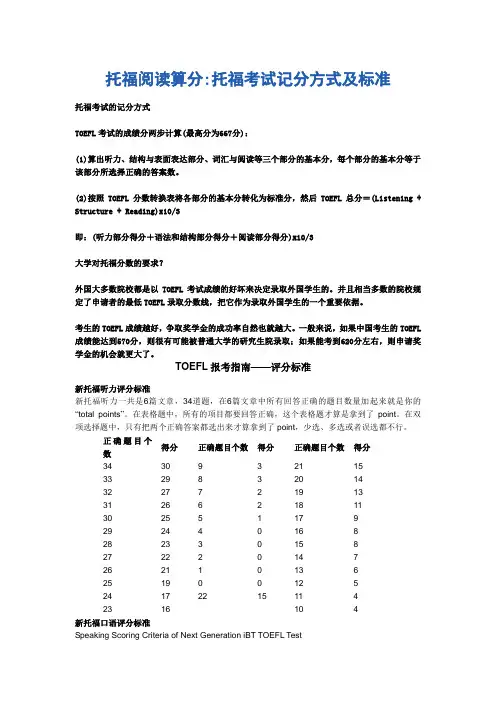
TOEFL报考指南——评分标准新托福听力评分标准新托福听力一共是6篇文章,34道题,在6篇文章中所有回答正确的题目数量加起来就是你的“total points”。
在表格题中,所有的项目都要回答正确,这个表格题才算是拿到了point。
在双项选择题中,只有把两个正确答案都选出来才算拿到了point,少选、多选或者误选都不行。
正确题目个得分正确题目个数得分正确题目个数得分数3430932115332983201432277219133126621811302551179292440168282330158272220147262110136251900125241722151142316104新托福口语评分标准Speaking Scoring Criteria of Next Generation iBT TOEFL TestIn the Speaking section, you will receive a score of 0 through 5; this score of 0 through then be converted to a scaled score out of 30. The criteria for Speaking scores of 0 through 4 are listed below.4 ANSWER TOQUESTIONThe student answers the question thoroughly. COMPREHENSIBILITY The student can be understood completely. ORGANIZATIONThe student's response is well organized anddeveloped.FLUENCY The student's speech is generally fluent. PRONUNCIATION The student has generally good pronunciation. GRAMMARThe student uses advanced grammaticalstructure with a high degree of accuracy. VOCABULARYThe student uses advanced vocabulary with ahigh degree of accuracy.3 ANSWER TOQUESTIONThe student answers the questions adequatelybut not thoroughly.COMPREHENSIBILITY The student can generally be understood. ORGANIZATIONThe student's response is organized basicallyand is not thoroughly developed.FLUENCYThe student's speech is generally fluent, withminor problems.PRONUNCIATIONThe student has generally good pronunciation,with minor problems.GRAMMARThe student uses either accurate easiergrammatical structures or more advancedgrammatical structures with some errors. VOCABULARYThe student uses either accurate easiervocabulary or more advanced vocabulary withsome errors.2 ANSWER TOQUESTIONThe student discusses information from the taskbut does not answer the question directly. COMPREHENSIBILITYThe student is not always intelligible inaccuratepoints.ORGANIZATIONThe students response is not clearly organizedam is incomplete or contains some inaccuratepoints.FLUENCYThe student's speech is not very fluent and hasa number of problems.PRONUNCIATIONThe students pronunciation is not very clear,with a number of problems.GRAMMARThe student has a number of errors in grammaror uses only very basic grammar fairlyaccurately.VOCABULARY The student has a number of errors in vocabulary or uses only very basic vocabulary fairly accurately.1 ANSWER TOQUESTIONThe student's response is only slightly related tothe topic.COMPREHENSIBILITY The student is only occasionally intelligible. ORGANIZATIONThe student's response is not clearly organizedand is only minimally on the topic.FLUENCYThe student has problems with fluency thatmake the response difficult to understand. PRONUNCIATIONThe student has problems with pronunciationthat make the response difficult to understand GRAMMARThe student has numerous errors in grammarthat interfere with meaning.VOCABULARYThe student has numerous errors in vocabularythat interfere with meaning.0 The student either says nothing or fails to answer the question 新托福阅读评分标准正确题目个数得分正确题目个数得分正确题目个数得分正确题目个数得分10321832184530922083117442982197301613297118729164228611762815412750166271440264015526133925301452512382420134241137231012423103622331911322935213420新托福作文评分标准六分:文章切题,阐说充分,文章有说服力;段落组织有序,衔接紧密,过渡自然,有很强的逻辑性;段落内句与句连接顺畅,句式使用恰当,灵活,娴熟;用词确切,得体。
托福阅读分数换算表及阅读常考题型总结

托福阅读分数换算表及阅读常考题型总结托福小白可能对于托福考试的评分有很多疑问,比如阅读的题量和分数是如何换算的?阅读每篇14道题,一共考3篇,如果遇到加试,可能会考4-5篇阅读,加试题目不计入总分。
跟小编一起来看看托福阅读分数换算表和托福阅读常考的题型托福阅读分数换算表及阅读常考题型总结一.托福阅读分数换算表除重要观点题和归类题以外,每道题的分值都是1分,重要观点题的分值可能是2分,归类题为3或4分,考试所得分数范围:0-30分。
大家在算出原始分数以后,将被转化为0-30分的最终分数。
以下是托福阅读评分标准中原始分数与最终分数的对照表:二.托福阅读常考题型托福阅读题型共分为10种:1. Factual Information questions(事实信息题)2. Negative Factual Information questions(否定事实信息题)3. Inference questions(推论题)4. Rhetorical Purpose questions(修辞目的题)5. Vocabulary questions(词汇题)6. Reference questions(指代题)7. Sentence Simplification questions(句子简化题)8. Insert Text question(句子插入题)9. Prose Summary(文章总结题)10. Fill in a Table(表格填写题)托福阅读TPO30第3篇:The Invention of the Mechanical Clock 【1】In Europe, before the introduction of the mechanical clock, people told time by sun (using, for example, shadow sticks or sun dials) and water clocks. Sun clocks worked, of course, only on clear days; water clocks misbehaved when the temperature fell toward freezing, to say nothing of long-run drift as the result of sedimentation and clogging. Both these devices worked well in sunny climates; but in northern Europe the sun may be hidden by clouds for weeks at a time, while temperatures vary not only seasonally but from day to night.【2】Medieval Europe gave new importance to reliable time. The Catholic Church had its seven daily prayers, one of which was at night, requiring an alarm arrangement to waken monks before dawn. And then the new cities and towns, squeezed by their walls, had to know and order time in order to organize collective activity and ration space. They set a time to go to sleep. All this was compatible with older devices so long as there was only one authoritative timekeeper; but with urban growth and the multiplication of time signals, discrepancy brought discord and strife. Society needed a more dependable instrument of time measurement and found it in the mechanical clock.【3】We do not know who invented this machine, or where.It seems to have appeared in Italy and England (perhaps simultaneous invention) between 1275 and 1300. Once known, it spread rapidly, driving out water clocks but not solar dials, which were needed to check the new machines against the timekeeper of last resort. These early versions were rudimentary, inaccurate, and prone to breakdown.【4】Ironically, the new machine tended to undermine Catholic Church authority. Although church ritual had sustained an interest in timekeeping throughout the centuries of urban collapse that followed the fall of Rome, church time was nature’s time. Day and night were divided into the same number of parts, so that except at the equinoxes, days and night hours were unequal; and then of course the length of these hours varied with the seasons. But the mechanical clock kept equal hours, and this implied a new time reckoning. The Catholic Church resisted, not coming over to the new hours for about a century. From the start, however, the towns and cities took equal hours as their standard, and the public clocks installed in town halls and market squares became the very symbol of a new, secular municipal authority. Every town wanted one; conquerors seized them as especially precious spoils of war; tourists came to see and hear these machines the way they made pilgrimages to sacred relics.【5】The clock was the greatest achievement of medieval mechanical ingenuity. Its general accuracy could be checked against easily observed phenomena, like the rising and setting of the sun. The result was relentless pressure to improve technique and design. At every stage, clockmakers led the way to accuracy and precision; they became masters of miniaturization, detectors and correctors of error, searchers for new and better. They werethus the pioneers of mechanical engineering and served as examples and teachers to other branches of engineering.【6】The clock brought order and control, both collective and personal. Its public display and private possession laid the basis for temporal autonomy: people could now coordinate comings and goings without dictation from above. The clock provided the punctuation marks for group activity, while enabling individuals to order their own work (and that of others) so as to enhance productivity. Indeed, the very notion of productivity is a by-product of the clock: once one can relate performance to uniform time units, work is never the same. One moves from the task-oriented time consciousness of the peasant (working on job after another, as time and light permit) and the time-filling busyness of the domestic servant (who always had something to do) to an effort to maximize product per unit of time.托福阅读TPO30试题第3篇:The Invention of the Mechanical Clock1.Why does the author provide the information that "in northern Europe the sun may be hidden by clouds for weeks at a time, while temperatures vary not only seasonally but from day to night"?A.To emphasize the variety of environments in which people used sun and water clocks to tell time.B.To illustrate the disadvantage of sun and water clocks.C.To provide an example of an area where water clocks have an advantage over sun clocks.D.To counter the claim that sun and water clocks were used all over Europe.2.According to paragraph 2, all of the following are examplesof the importance of timekeeping to medieval European society EXCEPTA.the need of different towns to coordinate timekeeping with each other.B.the setting of specific times for the opening and closing of markets.C.the setting of specific time for the start and finish of the working day.D.the regulation of the performance of daily church rituals.3.According to paragraph 2, why did the medieval church need an alarm arrangement?A.The alarm warned the monks of discord or strife in the town.B.The church was responsible for regulating working hours and market hours.C.The alarm was needed in case fires were not put out each night.D.One of the church's daily rituals occurred during the night.4.The word "authoritative" in the passage(paragraph 2)is closest in meaning toA.actual.B.important.C.official.D.effective.5.The author uses the phrase "the timekeeper of last resort" to refer toA.water clocks.B.the sun.C.mechanical clocks.D.the church.6.The word "rudimentary" in the passage(paragraph 3)is closest in meaning toA.rare.B.small.C.impractical.D.basic.7.According to paragraph 4, how did the Catholic Church react to the introduction of mechanical clocks?A.Its used mechanical clocks through the period of urban collapse.B.It used clocks to better understand natural phenomena, like equinoxes.C.It tried to preserve its own method of keeping time, which was different from mechanical-clock time.D.It used mechanical clocks to challenge secular, town authorities.8.The word "installed" in the passage(paragraph 4)is closest in meaning toA.required.B.expected by the majority of people.C.standardized.D.put in place.9.It can be inferred from paragraph 5 that medieval clockmakersA.were able to continually make improvements in the accuracy of mechanical clocks.B.were sometimes not well respected by other engineers.C.sometimes made claims about the accuracy of mechanical clocks that were not true.D.rarely shared their expertise with other engineers.10.Paragraph 5 answers which of the following questions about mechanical clocks.A.How did early mechanical clocks work?B.Why did the design of mechanical clocks affect engineering in general?C.How were mechanical clocks made?D.What influenced the design of the first mechanical clock?11.The word "pioneers" in the passage isclosest in meaning toA.leaders.B.opponents.C.employers.D.guardians.12.According to paragraph 6, how did the mechanical clock affect labor?A.It encouraged workers to do more time-filling busywork.B.It enabled workers to be more task oriented.C.It pushed workers to work more hours every day.D.It led to a focus on productivity.13. Look at the four squares[■] that indicate where the following sentence can be added to the passage. Where would the sentence best fit? The division of time no longer reflected the organization of religious ritual.Ironically, the new machine tended to undermine Catholic Church authority. Although church ritual had sustained an interest in timekeeping throughout the centuries of urban collapse that followed the fall of Rome,church time was nature's time.■【A】Day and night were divided into the same number of parts, so that except at the equinoxes, days and night hours were unequal;and then of course the length of these hours varied withthe seasons.■【B】But the mechanical clock kept equal hours, and this implied a new time reckoning.■【C】The Catholic Church resisted, not coming over to the new hours for about acentury.■【D】From the start, however, the towns and cities took equal hours as their standard, and the public clocks installed in town halls and market squares became the very symbol of a new, secular municipal authority. Every town wanted one; conquerors seized them as especially precious spoils of war;tourists came to see and hear these machines the way they made pilgrimages to sacred relics.14. Directions: An introductory sentence for a brief summary of the passage is provided below. Complete the summary by selecting the THREE answer choices that express the most important ideas in the passage. Some sentences do not belong in the summary because they express ideas that are not presented in the passage or are minor ideas in the passage. This question is worth 2 points.The introduction of the mechanical clock caused important changes to the society of medieval Europe.A.The increasing complexity of social and economic activity in medieval Europe led to the need for a more dependable means of keeping time than sun and water clocks provided.B.Because they were unreliable even in sunny climates, sun clocks and water clocks were rarely used in Europe, even before the invention of the mechanical clock.C.Before the mechanical clock, every city wanted a large number of timekeepers because more timekeepers allowed for better organization of collective activities.D.Soon after the invention of mechanical clocks, sun and water clocks became obsolete because mechanical clocks werefar more accurate.E.Predators help maintain biological diversity by limiting populations of a dominant competitor species, thereby preventing that species from excluding others.F.The removal of sea stars reduces the diversity of the community in which they are predators, and is therefore a bad idea.托福阅读TPO30答案第3篇:The Invention of the Mechanical Clock1.从第一段的第二句开始,原文列举了这两种device各种的缺点,最后一句前半句说它们work,后面but表转折,证明要说有些情况它们不能用。
托福阅读题怎么算分

托福阅读题怎么算分文章总结题满分为2分。
这道题会给出6个选项,要求考生从中选出3个最能概括文章内容的选项。
在评分方面,文章总结题每道题2分。
如果这道题没有选对答案或只选对1个选项,不得分;如果这道题选对2个选项,得1分;如果这道题选对了3个选项,得2分。
表格填写题满分为3分。
这道题会有2或3栏/行表格,包括5个正确答案选项。
考生必须要在备选答案中挑出正确选项,并将正确选项拖入表格中的相应位置。
表格填写题满分为3分。
没有答对或只答对1或2个答案不得分;答对3个答案得1分;答对4个答案得2分;5个全对得满分3分。
在计算出原始分数以后,将被转化为0-30分的最终分数。
2托福阅读考试之五个必须词汇必须扎实托福阅读考试可是有专门视察词汇的题型的,考生必须要选择与原文单词词义为接近的一项,而这些词汇可没有大纲来让我们系统的背诵的,所以我们必须要做好日常的积存,尤其是一些常见的学科词汇。
如果断定了要参加IBT考试,就一定要大量地去背单词,按话题或按学科背都要比从A背到Z要有效的多。
语法必须熟悉阅读部分还是比较全面的而视察同学们的英文综合能力,除了文章及词汇题对考生词汇量的视察之外,想要深入的理解句子含义,只知道词汇含义是远远不够的,所以接下来要提醒各位,必须要有足够的语法知识去将词汇连成句子。
长难句在阅读部分还是很常见的,大家必须要学会去快速的分析和理解长难句,找到句子的主谓宾核心成分。
关系词必须铭记英文句子的理解更多是去理解句子中逻辑关系,句与句、段落与段落之间也都是用一些逻辑关系词连贯到一起的。
所以常见的一些逻辑衔接词一定要铭记,常见的有并列(and, as well),比较(than, as.as),因果(because, so, therefore, thus, result from),递进(also, furthermore),转折(but, however, yet)等。
找到这些逻辑关系,让我们更快的理顺文章脉络,明确文章主旨。
托福阅读评分标准

托福阅读评分标准
托福阅读评分标准包括以下几个方面:
1. 主旨理解能力:考察考生对文章主题、中心思想和目的的理解程度。
2. 细节理解能力:考察考生对文章细节信息的理解和捕捉能力。
3. 推理能力:考察考生通过已有信息进行推理和推断的能力。
4. 词汇理解能力:考察考生对文章中词汇意义的理解和运用能力。
5. 结构理解能力:考察考生对文章结构和段落组织的理解和把握能力。
6. 总结概括能力:考察考生对文章内容的总结和概括能力。
7. 连贯性和逻辑性:考察考生文章段落之间和句子之间的连贯性和逻辑性。
8. 综合理解能力:考察考生综合运用各种阅读技巧和策略的能力。
托福阅读的评分标准是基于上述方面综合考察考生的阅读能力,并根据答题情况给出综合得分。
评分标准是根据正确答题数量和答题准确性来评价考生的阅读能力水平。
得分标准主要分为
0-30分的六个等级,其中30分为最高分。
托福阅读分数怎样算计分标准
托福阅读分数怎样算计分标准托福阅读考试是托福提分的一个很重要的部分,托福阅读部分的分数是怎么计算的呢?下面就是店铺给大家整理的托福阅读分数计算方法,希望对你有用!托福阅读分数计算方法托福阅读部分,总共有3篇文章(如遇到加试,则随机3篇文章算分,另1篇文章不算分)。
每篇文章700个字,对应14道题目。
其中,13道题是基础信息和推断题,每道题1分。
最后一道题是小结题,俗称大题,满分2分。
大题一般情况下是6选3,3个选项错一个扣一分,扣完为止,即在答题中错2或3个选项,这个题目不得分。
因此,每篇文章对应14个题目,共15分。
阅读部分整体42道题,对应原始分数满分45分。
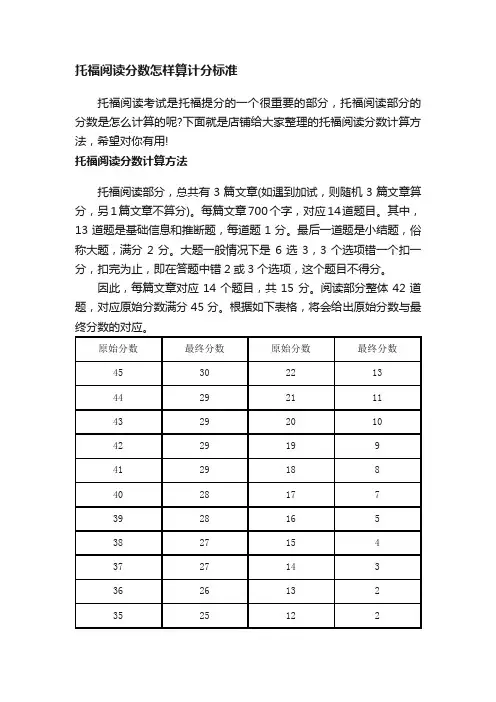
根据如下表格,将会给出原始分数与最终分数的对应。
比如,某位学生阅读部分,错了5道小题,3道大题各错一个选项,因此扣去的分数就应该为5+1+1+1=8分,因此原始分数就是37分,最终得分为27分。
另一位学生,错了12道小题,3道大题中,1道大题选错2个选项,另外两道大题各选错一个,则扣分为12+2+1+1=16分,原始分数为29分,最终分数对应为20分。
在此分数对应表格中,需要特别注意的是25分和20分的最终分数。
如果得到25分以上,那就等于总分有可能上100分,而100分是申请美国名校的比较有竞争力的分数。
如果得到20分以上,那就意味着总分有可能到80分以上,这个分数是申请美国前100名学校时比较基本的分数。
大家还需要注意的是0分的最终分数,对应的9分以下的原始分数。
在传统考试中,如果不看题目,直接“蒙”,可能会得到一定的分数。
而在托福阅读中,如果用“蒙”的方法,可能会得到9分的原始分数,但最终分数就是0分。
提升托福阅读分数的7个方法方法一:概括地观察在练习时我们会读一些文章或者段子,首先我们可以进行略读。
对于文章的首段或者每段的内容进行概括,我们就可以知道这些文章都讲了些什么,而不是去通读,逐字去读,逐词去读,这样不仅浪费时间,而且对于自己的阅读能力的提升也是微乎其微的。
托福考试阅读评分标准
托福考试阅读评分标准托福考试阅读评分标准申请国外留学时,很多学校要求托福考试成绩达到一定的标准才能申请,但是对于托福阅读的评分标准很多人搞不清,以下是店铺为大家搜索整理的托福考试阅读评分标准,希望对正在关注的您有所帮助!托福阅读总分多少阅读总分30分。
新托福由四部分组成,分别是阅读(Reading)、听力(Listening)、口试(Speaking)、写作(Writing)。
每部分满分30分,整个试题满分120分。
托福阅读评分标准考试所得分数范围:0-30分。
阅读有三篇文章,每篇文章对应14题,共15分。
遇到加试时从考试的五篇文章中随机选取三篇计分,每篇12-14道题。
在新托福阅读考试中,除重要归类题和观点题以外,每道题的分值都是1分。
重要观点题的.分值可能是2分。
归类题为3或4分。
托福阅读分数怎么计算注意!对应的9分以下的原始分数,最终分数都是0分。
1、文章总结题满分为2分。
这道题会给出6个选项,要求考生从中选出3个最能概括文章内容的选项。
在评分方面,文章总结题每道题2分。
如果这道题没有选对答案或只选对1个选项,不得分;如果这道题选对2个选项,得1分;如果这道题选对了3个选项,得2分。
2、表格填写题满分为3分。
这道题会有2或3栏/行表格,包括5个正确答案选项。
考生需要在备选答案中挑出正确选项,并将正确选项拖入表格中的相应位置。
表格填写题满分为3分。
没有答对或只答对1或2个答案不得分;答对3个答案得1分;答对4个答案得2分;5个全对得满分3分。
托福阅读至少要考多少分如果得到25分以上,那就等于总分有可能上100分,而100分是申请美国名校的比较有竞争力的分数。
如果得到20分以上,那就意味着总分有可能到80分以上,这个分数是申请美国前100名学校时比较基本的分数。
温馨小贴士考生不需要在答题之前通读全文,而是在做题的过程中分段阅读文章。
每篇文章对应有11道试题,均为选择题。
除了最后一道试题之外,其他试题都是针对文章的某一部分提问,试题的出现顺序与文章的段落顺序一致。
托福阅读评分标准:阅读成绩是如何计算的
托福阅读评分标准:阅读成绩是如何计算的许多备考的同学会存在一个疑问,托福阅读部分的成绩是如何来计算的?下面就将为大家解答。
托福阅读评分标准:阅读成绩是如何计算的托福阅读考试的时间是60-80分钟,需要完成3-4篇文章,每篇文章的字数大约有700字左右,每天文章的出题数是12-14题。
当然不同一题型的分值是不一样的。
在了解托福阅读的评分方式之前,我们应该要了解的是托福阅读的题型。
托福阅读题型共分为10种:1. Factual Information questions(事实信息题)2. Negative Factual Information questions(否定事实信息题)3. Inference questions(推论题)4. Rhetorical Purpose questions(修辞目的题)5. Vocabulary questions(词汇题)6. Reference questions(指代题)7. Sentence Simplification questions(句子简化题)8. Insert Text question(句子插入题)9. Prose Summary(文章总结题)10. Fill in a Table(表格填写题)了解了托福阅读的题型,我们再来看一下托福阅读的计分方式:托福阅读以选择题为主,除最后的文章总结题和表格填写题之外,每道题的分值都是1分。
文章总结题满分为2分。
这道题会给出6个选项,要求考生从中选出3个最能概括文章内容的选项。
在评分方面,文章总结题每道题2分。
如果这道题没有选对答案或只选对1个选项,不得分;如果这道题选对2个选项,得1分;如果这道题选对了3个选项,得2分。
表格填写题满分为3分。
这道题会有2或3栏/行表格,包括5个正确答案选项。
考生需要在备选答案中挑出正确选项,并将正确选项拖入表格中的相应位置。
表格填写题满分为3分。
没有答对或只答对1或2个答案不得分;答对3个答案得1分;答对4个答案得2分;5个全对得满分3分。
托福考试阅读评分标准是什么
托福考试阅读评分标准是什么托福考试阅读评分标准是什么托福考试中的阅读一直是非常重要的部分,我们要知道托福考试阅读评分标准的是什么。
为此店铺为大家带来托福考试阅读的评分标准。
托福考试阅读评分标准托福阅读每篇文章700个字,对应14道题目。
其中,13道题是基础信息和推断题,每道题1分。
最后一道题是小结题,俗称大题,满分2分。
大题一般情况下是6选3,3个选项错一个扣一分,扣完为止,即在答题中错2或3个选项,这个题目不得分。
因此,每篇文章对应14个题目,共15分。
托福阅读部分整体42道题,对应原始分数满分45分。
将会给出原始分数与最终分数的对应。
托福阅读满分为42至45分不等,转换为标准分后满分为30分。
对于托福阅读评分标准我们展现给大家一个表格进行详细的了解下吧。
有图有真相看的更清晰么。
在此分数对应表格中,需要特别注意的是25分和20分的最终分数。
托福阅读评分标准大家还需要注意的是0分的最终分数,对应的9分以下的原始分数。
在传统考试中,如果不看题目,直接“蒙”,可能会得到一定的分数。
托福阅读评分标准而在托福阅读中,如果用“蒙”的方法,可能会得到9分的原始分数,但最终分数就是0分。
如果得到20分以上,那就意味着总分有可能到80分以上,这个分数是申请美国前100名学校时比较基本的分数。
如果得到25分以上,那就等于总分有可能上100分,而100分是申请美国名校的比较有竞争力的分数。
托福考试阅读满分的技巧首先是托福阅读词汇题,你最好的解决方法,就是看看我们以前已经考过的单词题的汇总。
当然,多背单词总不会有错,如果你已经把托福单词和这个词汇题汇总背的纯熟,而且就是单词题不过关的话,我建议你如果有时间就再去背一下GRE单词。
其次是图表题,这东西可是个硬通货,真的是考察我们阅读的'速度。
因此如果想在这个题拿到满分,就是要有充足的时间,怎么才算有充足的时间呢?简单来说,就是前面的1-12题最多要用15分钟做完,给最后这道题剩下5分钟的时间,才能保证此题的绝对正确率,而且做本题的时候还要注意,本题其实分为分为2类,一类是细节全错,一类是细节也为正确,一定要分清。
托福阅读评分标准
托福阅读评分标准托福阅读评分标准托福阅读部分是考察考生理解和分析英文文本的能力,评分标准主要包括理解和分析能力、阅读组织和关联能力、词汇和语言能力以及批判性思维能力。
以下是对这些评分标准的详细解释。
1. 理解和分析能力(30分)考察考生对阅读材料的理解和分析能力。
评分点包括:- 能准确理解阅读材料的主旨、目的、论点和论证;- 能准确理解材料中的事实和细节以及它们之间的关系;- 能区分事实和观点,并能就材料中的观点提出批评或支持的理由;- 能分析并解释材料中的理论、原理或现象。
2. 阅读组织和关联能力(25分)考察考生对文本的逻辑结构和关联关系的理解和分析能力。
评分点包括:- 能准确理解文本的段落结构和组织方式;- 能识别文本中的主题句、论点句和细节句,并能理解它们之间的关系;- 能理解并分析文本中的转折、比较、因果等关联关系。
3. 词汇和语言能力(25分)考察考生对词汇和语言的理解和应用能力。
评分点包括:- 能理解和应用阅读材料中的重要词汇和短语,包括其词义和用法;- 能准确理解文本中的句子结构,包括主谓关系、从句和独立主格结构等;- 能理解并分析文本中的难句或多义词,能准确解释其含义。
4. 批判性思维能力(20分)考察考生对文本中论点和证据的分析和评价能力。
评分点包括:- 能对文本中的论点提出批评或支持的理由,并进行合理的论证;- 能识别文本中的偏见、主观观点和推理错误,并加以批判;- 能对文本中的事实或观点提出自己的意见,并能理解并分析不同观点的优缺点。
以上是托福阅读评分标准的主要内容和要求。
通过在这些方面的充分准备和训练,考生可以更好地应对托福阅读考试,并取得较高的分数。