
人教版七年级英语下册 教案 Unit2 三课时
Unit 2 What time do you go to school?Grammar Focus – 3cTeaching and learning aims 学习目标:一、知识和能力目标1.能正确运用what time 和 when 引导的特殊疑问句(What time and when questions )What time do you usually get up?When does Anna exercise?2.掌握常见频度副词的基本用法(Adverbs of frequency )I usually get up at seven o ’clock.They always go to school at eight o ’clock.They ’re never late.二、教学重难点重点:能根据要求写出简单的句子表述自己和他人的日常活动。
难点:一般现在时中不同人称对应的动词的变化形式。
三、情感态度与价值观能简单的表述自己和他人的日常活动,学会用积极的心态去面对社会和他人,关心爱护身边的朋友和家人。
Teaching and Learning Steps (教学步骤):Step 1 Review1.用图片引导学生自己回忆和温习上节课学过的日常活动的表达。
T: Do you remember the activities we learned yesterday? Who can tell me in English? Can you tell me how to spell them?Let the students revise the phrases.2. 教师着重提问日常活动表达的动词搭配,请学生回答,并强调语法表达的正确性。
T: Please look at the pictures, answer the questions.get upget dressed brush teetheat breakfastgo to schooltake a showerA: What time do you usually get up?B:I u s u a l l y get up a t s i x t h i r t y.get upA:W h a t t i m e d o e s h e u s u a l l y t a k e a s h o w e r?B: He usually take s a shower at six forty.take a showerA: What time does she brush teeth?B:S h e a l w a y s brush es teeth a t s e v e n o’c l o c k. brush teethA: What time do they go to school?B: They usually go to school at seven go to schoolStep 2语境中感知语法Ask the students some questions, they answer by using the complete sentences.T: What time do you get up? Ss: I usually get up at six thirty.What time do they get dressed? They always get dressed at seven twenty.What time does Rick eat breakfast? He eats breakfast at seven o ’clock.When does Scott go to work? He always goes to work at eleven o’clock. He’s never late. When do your friends exercise? They usually exercise on weekends.Then give the students some time to read and memorize the sentences. Ask them to try to find the rules.1. 可以看出,询问做某事的时间时,可以用__________和______ 两个疑问词来询问。
2. 询问某人做某事的时间可以归纳为以下句型:_______+ does + ______主语 + 动词短语?或_____+ does + _____________ 主语+动词短语?__________ + do + _______________主语 + 动词短语?或_______ + do + ______________ 主语+动词短语?3. 在答语中always, usually, never频率词等放在主语与谓语动词之间。
__________之前,_______ 之后。
4.在问句中,单数第三人称he, she, it前用助动词______,其他人称用______。
在答语中,单数第三人称动词后会加词尾____,其他人称则用__________。
(各种语言知识的呈现和学习都应该从语言使用的角度出发,为提升学生用语言做事情的能力服务。
语法要在语言运用中习得和内化。
教师要通过创设接近实际生活的各种语境,采用循序渐进的语言实践活动,以及各种强调过程和结果并重的教学途径和方法,培养学生用语言做事情的能力。
语言形式融合在语境之中;在语境中引出语言形式,在语境中理解语言形式,在语境中操练语言形式。
)(设计意图:先让学生自己观察,然后两人一组讨论上面的问题。
采用归纳法学习语言形式;在操练的基础上归纳语言形式,在体验的基础上引导学生归纳,在教师引导下,鼓励学生有声思维。
)Step 3控制性机械练习Task 13a Write the answers or questions. Use always, usually or never.1. What time do you get up on school days?_______________________________2. ______________________________?Rick always gets up at 6:20.3. What time do you have breakfast?_______________________________4. _______________________________?Anna never eats breakfast.5. What time does your best friend go to school?_________________________________T: Talk about something you always do, Something you usually do, something you never do. Then give a model:➢看问句的中的主语, 确定用什么人称回答。
➢根据主语的数确定答语动作的形式。
➢结构:主语+ always/usually/never +动词短语➢看答语的中的主语, 确定用什么人称来询问。
➢根据答语的数确定问句中动作的形式。
Now, class, do you know what I always do at seven o’clock in the morning? Do you want to know what time I usually go to bed? Can you guess what I never do on school days? OK, let me tell you. I always eat breakfast at seven o’clock in the morning. I usually go to bed at ten thirty at night. I never watch TV on school day, because I don’t have time for that..T: Now, I’d like to know about you. Can you write something you always do, something you usually do, and something you never do?S1: I always… I usually… I never…S2: I always… I usually… I never…S3: I always… I usually… I never…S4: I always… I usually… I never…(设计意图:将本课3a和3b作为当堂检测,充分利用课本资源。
通过检测学生的学习情况,真正落实以学定教。
)Step 4开放性交际运用3c Make a survey:T: Please work in groups of four, make a survey: What time/When does he/she do…?Students report like this: I asked three classmates about their daily activities. Zhang Wen gets up early on weekends. He gets up at seven. He often exercises at about eight in the evening…The teacher reminds the students of using the complete sentences.(交际活动是使用语法做事情,学以致用。
)Step 5 SummaryLet the students sum up what they have learnt.Step 6 Exercises1. Who is your ____ friend?2. Jenny and Mary always play tennis on _________.3. Tom can play guitar well in our ______.4. Bob _____ eats ice-cream. He thinks it’s not healthy.5. His sister usually gets _______ at 6:00 in the morning.二、翻译下列句子1. 他上班从未迟到过。
人教版七年级下册英语Unit 2 教学设计

人教版七年级下册英语Unit 2 教学设计一. 教材分析人教版七年级下册英语Unit 2主要讲述的是关于日常生活中的服装和穿着的话题。
通过本单元的学习,学生能够掌握关于衣服、颜色和尺码的词汇,以及表达自己服装偏好的句型。
教材内容丰富,插图生动,贴近学生生活,有利于激发学生的学习兴趣。
二. 学情分析七年级的学生已经掌握了基本的英语语法和词汇,具备一定的听说读写能力。
他们在生活中对服装有着浓厚的兴趣,因此对本单元的话题会有较强的学习欲望。
然而,部分学生可能在表达自己观点方面还存在一定的困难,需要教师在教学中给予关注和指导。
三. 教学目标1.知识目标:学生能够掌握关于衣服、颜色和尺码的词汇,学会表达自己服装偏好的句型。
2.能力目标:学生能够在日常生活中用英语进行简单的交流,描述自己的服装和穿着。
3.情感目标:培养学生热爱生活,关注时尚的意识。
四. 教学重难点1.重点:衣服、颜色和尺码的词汇,表达自己服装偏好的句型。
2.难点:正确运用所学词汇和句型进行实际交流。
五. 教学方法1.情境教学法:通过设定生活情境,让学生在实际语境中学习并运用所学知识。
2.交际教学法:引导学生进行小组讨论和角色扮演,提高他们的口语表达能力。
3.任务型教学法:设计具有实际意义的学习任务,让学生在完成任务的过程中运用所学知识。
六. 教学准备1.教学课件:制作包含衣服、颜色和尺码词汇的课件,以便于学生直观学习。
2.练习题:准备相应的练习题,用于巩固所学知识。
3.教学道具:准备一些衣物道具,方便学生在课堂上进行展示和交流。
七. 教学过程1.导入(5分钟)利用多媒体展示一些时尚杂志封面,引导学生关注服装话题,激发学习兴趣。
2.呈现(10分钟)教师展示课件,呈现本节课的主要词汇和句型,如“T-shirt”、“trousers”、“blue”等,并解释其含义和用法。
3.操练(15分钟)学生分组进行角色扮演,运用所学词汇和句型进行对话,教师巡回指导并纠正错误。
人教版七年级英语下册Unit 2教案
Unit2What time doyou gotoschool?SectionA(1a-2d)一、教学目标:1. 语言知识目标:1)能掌握以下单词:up, get up, dress, get dressed,brush, tooth(pl. teeth)brushte eth, shower,take a shower,usually,forty,fifty,wow, never,early,job, work,station,radio station, o'clock, fun ny,exercise能掌握以下句型:①—What timedo you usually get up? —I usually getupat six thirty.②—Whendo you gotowork? —I usually goto workateleven o'clock.③—He has an interesting job.—Heworks at a radiostation.2) 用when和what time引导的特殊疑问句询问时间和时间的表达法;用所学的目标语言对生活和学习活动做计划,学会合理地安排作息时间。
2. 情感态度价值观目标:本部分的话题是“日常作息时间”,学习内容贴近学生的生活,因为学生的作息时间安排是非常有规律的。
通过互相询问或谈论自己或对方的作息时间安排和活动计划,可以培养学生良好的作息习惯和守时习惯。
二、教学重难点1. 教学重点:1) 掌握时间的简单表达方式。
2) 学习询问和谈论时间和制订作息时间表。
2. 教学难点:when和whattime引导的特殊疑问句和时间的表达法。
三、教学过程Ⅰ. Warming-upand revision1.Greet the Ss as usual.2.Watch a shortvideoprogramaboutdailyactivities.Ⅱ.Presentation1.出示几幅反映日常事务(如:起床、上学、跑步等)的图画、幻灯片或播放课件,引导学生谈论这些日常事务go toschool,getup,run,take a show er,eatbreakfast等,学习有关的动词短语。
(完整版)人教版英语七年级下册教案:Unit2Whattimedoyougoto?Secti
人教版英语七年级下册教课设计: Unit2 What time do you go to ? SectionB( 3a-Self Check)教课设计Unit2 SectionB ( 3a-Self Check)教课设计1.0 Teaching analysis 教情解析1.1 Teaching objectives 教课目的1.1.1 Language goals 语言目标1.1.1.1 Key Words and Chunks1.1.1.1.1 For applying: life1.1.1.1.2 For comprehending:1.1.1.2 Sentence Structures1)I usually exercise from six fifteen to seven.2)I have a very healthy life.3)You need to brush your teeth after eating to have good teeth.4)I don’ t have time to cleanmy room from Monday to Friday. So I clean iton weekends.5)Because she always makes breakfast for me.6)I don ’ t know. But ishenever late for the first class in the morning.1.1.1.3 Grammar Focus1)You need to brush your teeth after eating to have good teeth. (need在句中作实意动词,意为“需要”,构造为 need to do sth; after 在句中作介词,意为“在 ...后”,后接动词要用 -ing 形式 )2) Because she always makes breakfast for me. (make在句中作动词,意为“做饭” , 为谁做饭用 for )1.1.2 Ability goals能力目标1.1.2.1 指引学生全面阅读性复习,总结概括全部学过的相关平时生活及作息习惯的词汇和语言构造。
人教版七年级英语下册教案Unit 2第三课时Section A (Grammar Focus-3c)
第三课时SectionA (GrammarFocus-3c)Step1 情景导入【参考案例】Teacher:Whattimedoyouusually…?Student1:Iusually…at…Teacher:Whattimedoeshe/sheusually…?Student2:He/Sheusually…at…Teacher:Whattimedotheyusually…?Student3:Theyusually…at…设计意图:通过师生谈话导入本单元的重点句型和语法基础知识,同时结合本单元的语法重点知识对学生进行听说训练。
Step2 畅通GrammarFocus回顾语法重点【操作案例】1.让学生分男、女两组朗读GrammarFocus中的内容。
2.让同学们背诵GrammarFocus中的内容。
设计意图:通过对语法基础知识的训练,让学生能够掌握并灵活运用本单元的语法基础知识,为完成3a-3c的任务作好铺垫。
Step3 完成教材3a-3c的任务【操作案例】1.让学生根据自己的实际情况回答问题并根据答语灵活运用whattime和when引导的特殊疑问句进行提问,并掌握频度副词always,usually和never的运用,完成3a的任务。
2.让学生两人一组分角色朗读3a中所提的问题与回答,巩固本单元的基础语法知识。
3.根据自己的实际情况,灵活运用always,usually和never,完成3b的任务。
设计意图:通过完成教材3a-3c的任务,进一步巩固语法基础知识,并运用所学的语言基础知识,循序渐进地培养学生的写作能力,让学生在实际操作中领会并掌握语法基础知识。
知识时间介词的用法(1)from…to…从……到……如:Wehavelunchfrom12o'clocktotwelvethirty.我们从12点到12点半吃午餐。
(2)atnight在晚上(3)inthemorning/afternoon/evening在上午/下午/晚上Step4 随堂练习根据句意及首字母或汉语提示填写单词或短语。
人教版英语七年级下册教案:Unit2 What time do you go to ? Secti
Unit2 SectionA〔2d-3c〕教案1.0 Teaching analysis教情分析1.1Teaching objectives 教学目的1.1.1Language goals 语言目的1)Scott has an interesting job.2)He works at a radio station.3)That’s a funny time for breakfast!4)At eleven o’clock, so I’m never late for work.5)When do you usually get up? I usually get up at five fifty.6)When does Scott go to work? He always goes to work at eleven o’clock.7)What time do you usually get up? I usually get up at five fifty.8)He always goes to work at seven o’clock. He’s never late.1)What time do you usually get up? I usually get up at five fifty.(what time引导的特殊疑问句, 对详细时刻提问。
)2) ---When does Scott go to work?---He always goes to work at eight o’clock.--- When do your friends exercise?---They usually exercise on weekends.(when引导的特殊疑问句,提问既可以是详细时刻,也可以是整体大时间。
)3) What time does Rick eat breakfast? He eats breakfast at seven o’clock.(一般如今时第三人称单数,注意动词形式的变化eats breakfast。
人教版七年级英语《Unit.2.Where’s.the.post.office》教案
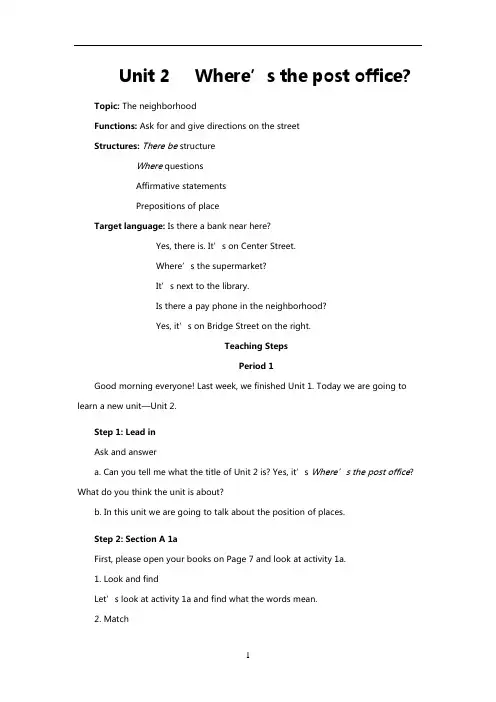
Unit 2 Where’s the post office?Topic: The neighborhoodFunctions: Ask for and give directions on the streetStructures:There be structureWhere questionsAffirmative statementsPrepositions of placeTarget language: Is there a bank near here?Yes, there is. It’s on Center Street.Where’s the supermarket?It’s next to the library.Is there a pay phone in the neighborhood?Yes, it’s on Bridge Street on the right.Teaching StepsPeriod 1Good morning everyone! Last week, we finished Unit 1. Today we are going to learn a new unit—Unit 2.Step 1: Lead inAsk and answera. Can you tell me what the title of Unit 2 is? Yes, it’s Where’s the post office? What do you think the unit is about?b. In this unit we are going to talk about the position of places.Step 2: Section A 1aFirst, please open your books on Page 7 and look at activity 1a.1. Look and findLet’s look at activity 1a and find what the words mean.2. MatchLet’s look at activity 1a and match the words with the places in the picture.3. Check the answersHave you finished? Let’s check the answers one by one.Answers: 1. f 2. a 3. e 4. i 5. c 6. b 7. h 8. g9. d4. Reada. Please read the words and the phrases after me. Post office …b. Let’s read them together.c. Would you please read them one by one?Step 3: Section A 1b1. Listen and circlea. Listen to the tape for the first time.b. Let’s circle the places in 1a when you listen to the conversations for the second time.2. Check the answersLet’s check the answers.Answers:Circled items: restaurant, post office, supermarket, Fifth Avenue, Bridge Street, Center Street3. Reada. I would like you to read the conversations together.b. Would you please read them by yourselves three times?c. This time I would like you to read them twice with your partner.d. Who would like to read in class?Step 4: Section A 1c1. ReadWould you please read the conversation in 1c with your partner?2. Practicea. Would you please ask and answer questions about the places in the picture?b. Who would like to have a try in class?Step 5: Section A 2a1. Reada. Now class, let’s move to activity 2a now. There are six pictures and six statements. Please read the six statements in the box.b. Who would like to read them for us?2. MatchPlease match the sentences with the pictures. Write each number in the box.3. Check the answersHave you finished? Please check your answers with your partner and see whether your answers are the same.Let’s check them together.Answers: Picture 1. 4; Picture 2. 6; Picture 3. 2;Picture 4. 3; Picture 5. 5; Picture 6. 1 Step 6: Section A 2b1. Listen and filla. Listen to the conversations for the first time.b. Please fill in the blanks with the words in the box when you listen to them for the second time.2. Check the answersHave you Finished? Let’s check them.Answers: 1. between 2. across from 3. on 4. next to 5. in front of 6. behind3. Reada. Let’s read the sentences together.b. I would like you to read them by yourselves.c. Who would like to have a try to read them in class?Step 7: Section A 2c1. ReadWould you please read the conversation in 2c?2. Pairworka. Let’s talk about the places in the picture on Page 7. Please work in pairs, and one asks and the other one answers. You may follow the example in 2c.b. Who would like to have a try to do the pairwork in class?Step 8: Grammar Focus1. ReadRead the sentences in the grammar box.2. Point out the notesIs there …? on cross from next to between …and …Step 9: SummarizeLet’s summarize what we learnt in this period.Step 10: Homework1. Copy the words in activity 1a and the sentences in the grammar box.2. Read the tapescript of activity 2a and 2b.Period 2Step 1: Lead inWhat did we learn yesterday? Who can tell us? Yes. Yesterday we got to know how to ask others where the places are. Besides them, we learnt the names of some places. Do you still remember how to say them? OK. Let’s review them first.Step 2: Revision1. Ask and answera. Would you please translate my Chinese into English? 邮局、餐馆……b. Please practice in pairs. Student A says in Chinese and student B translates it into English.2. DictationPlease take out your dictation exercise books and let’s have a dictation.Step 3: Section A 3a1. Look and reada. Today, let’s move to a new part of lessons. Would you please look at activity 3a on Page 9? There is a map of a neighborhood in the picture and some people are in the neighborhood.b. Please read the conversation between Paul and Nancy. And try to find out where Paul and Nancy are in the picture.2. Check the answersDid you find out who Paul and Nancy are? Where are they? Please check your answers with your partner.Answer: Paul and Nancy are the two figures outside the gate to the park.3. Reada. I would like you to read the conversation in pairs.b. Who would like to have a try in class?4. Explain some key words and phrases.excuse me in the neighborhood go straight turn leftdown Bridge Street on the right You’re welcome.Step 4: Section A 3b1. Look and completea. Let’s move to activity 3b now.b. Please look at the picture in 3a and complete the conversations.2. Check the answersHave you finished yo ur answers? Let’s check them together.Answers: 1. Yes, there is. Go straight down New Street and turn right.There’s a pay phone on theright.2. Go straight down New Street and turn right. Turn left at Bridge Street. The bank is acrossfrom the street.3. Yes, there is. Turn right, then go straight down Bridge Street. The post office is on the left.It’s across from the restaurant, next to the supermarket.3. Pairworka. Let’s practice the conversations in 3b.b. Who would like to have a try to practice in class?Step 5: Section A 4Game—Ask me a question!Let’s play a game in groups. I would like six of you to form a group. Everyone takes turns to choose a place in the picture in 1a. The other students ask questions and guess the place.Example: A: Is it on Fifth Avenue?B: Yes, it is.C: Is it next to the library?B: Yes, it is.…Step 6: SummarizeLet’s summarize what we learnt in this period.Step 7: HomeworkCopy and try to recite the conversation in 3a.Period 3Step 1: Lead inGood morning, boys and girls. Shall we continue our lessons? Could you please tell me what we learnt in Section A? Yes. We learnt to ask for and give directions.Step 2: Revisiona. I will show you a map and please tell me how I can get to the pay phone, the bank and the post office.( Look at the picture of P9. 3a 的图片。
七年级下 Unit 2 what time do you go to school 教案(全)
人教版七年级英语下册B Unit 2 What time do you go to school?教案一.单元分析本单元以学生最为熟悉的日常作息习惯为谈论话题,通过对句型:(---What time is it? ---It is six .)---What time do you usually get up?---I usually get up at six a.m. 谈论daily routines并练习时间的表达和询问方式,同时逐步的培养学生合理安排时间的能力。
整个单元以谈论日常作息时间安排为主线,将日常生活中所涉及到的语言、词汇和时间的表达法融入一系列的小任务中,七年级学生通过完成一个个的任务达到交际的目的,从而能够合理的安排自己的作息时间;且初步了解时差。
二.学情分析学生通过前段时间的学习,对一般现在时态的用法已经有了一定的语感和模仿运用的能力,也能够用简单的英语表达个人意见。
通过本单元学习能基本掌握时间的表达法并能用英语谈论作息时间安排。
三.课时安排四课时四.教学过程Period 1 (A1a-2c)I. Teaching Objectives1. Knowledge Objectives:(1) Expressions: up, get up, dress, get dressed, brush, tooth/teeth, shower, take a shower, usually,forty, wow, never, early, fifty, o’clock, half.(past, to)(2) Structure: ---What time is it? ---It is six.---What time do you usually get up? ---I usually get up at six a.m.3) Grammar: what time questions2. Ability Objectives:(1) Learn how to express the time.(2) Get Ss to ask about and say times.(3) Let Ss use what time questions.(4) Let Ss have the first understanding of always, usually and never.3. Moral Objectives: Time waits for no man.II. Teaching Importance(focus)(1) Learn how to press the time.(2) Get Ss to ask about and say times.(3) Let Ss to use what time questions.III. Teaching Difficulties1. 三种表达时间的方法,学生对past,to来表达时间会有可能混淆。
七年级英语下册unit2教案
七年级英语下册unit2教案英语教案代表着教师对课堂的假设与预想。
小编整理了关于七年级英语下册unit2教案,希望对大家有帮助!七年级英语下册unit2教案范文Unit 2 I can run really fast.Ⅰ.Type of lesson: reading and writingⅡ.Teaching aims:1.To understand the reading material about running for class monitors2.To learn to write a speech about running for a class monitorⅢ.Teaching aids: T ape recorder,videos,OHPⅣ. 课时安排:2 课时Ⅴ. Teaching procedureStep 1. Lead-in1.Ask students what they can do very well and say, "He/She is good at..."2.Ask the students to model the question "What are you good at?" Ask them to interview their partners and make notes.Step 2 . Work in pairs. Ask and answer the questions.1. Write the three monitor titles on the board. Ask the class what they are.2. Put students in pairs to ask each other both questions. Tell them to make a list of what they think each monitor does3. Ask three students to come up to the board and write one thing under one of the titles. Then give the chalks or pens to someone else.Step 3 .Read the passage and check ( √ ) the true sentences.1.Tell students that Lingling, Darning and Tony want to be monitors. Ask students to read quickly to find which monitorsthey want to be.2. Ask students to read again. This time they can use their fingers to skim through and underline the things Lingling,Darning and Tony are good at.3. Ask students to check in pairs and elicit answers from the whole class.4. Ask students to read the sentences on page 11, and talk about them in pairs and guess the answers.5. Ask students to read the passage again and decide if the sentences are true or false. If false,then say why.6. Ask students to check with their partners.If their answers are different,tell them to go back to the text,read again and check.7.Ask students to read out the sentences and say if they are true or not. If not ,ask them to say why.Step 4 Underline the correct words.1. Ask students to work in pairs. Tell them to read through the passage and choose the correct words.2. Check answers by reading the passage aloud and pausing to allow the whole classto complete it with the correct words.Step 5 Complete the sentences with the correct form of the expressions from the box.1. Ask students to look at the expressions in the box.2. Ask students complete the sentences on their own and be careful with the language forms.3. Check in pairs. Elicit answers from the whole class in full sentences.Step 6 Work in pairs. Choose the best people in your class to be the monitors in Activity 1.Say: who they are and what job they can do and why they can do it1. Write titles of the three monitors across the board.2. Ask the class for two volunteers for each monitor. Write their names underneath.3. Put volunteers in pairs to talk about what they are good at, can do well and how they can help.4. Ask the rest of the students to make a table as below with three questions about their abilities to ask the volunteers. Put it on the board.Questions Student 1 Student 2 Student 3 Student 4 Student 5 Student 6Good at?Can do?Can help?5.Tell students to talk in groups about their notes,and decide who should be their monitors and say why.Step 7 Homework1. Remember the new words and expressions in Unit2.2 . Write a passage about one of the monitors in Activity 5.Ⅵ Blackboard showingⅦ Self-reflection.英语教学非智力因素探讨1.中学英语教学中非智力因素发展现状1.1中学生普遍缺乏真正的学习动机学习动机和学习兴趣是学生非智力因素中非常重要的一部分,兴趣是最好的教师,只有学生能够真正对英语感兴趣,才能让学生产生对英语的内在需求,才能真正激发他们的非智力因素。
2024年人教版七年级英语下册教案Unit2
一、单元学习主题
本课主题属于“人与自我”主题范畴中“生活与做事”这一主题群,涉及子主题“自我管理”。
二、单元内容分析
本单元分为Section A 与Section B两部分,主要围绕话题“daily routines and times”展开听、说、读、写、看等语言活动。
本单元共有五个主要语篇,第一、二个语篇是对话的形式,通过记者对Rick和Jim的两篇采访,说明了合理安排时间的重要性;第三、四个语篇也是采访对话,分别通过记者对Scott和Tom的采访,介绍了两人的日常作息习惯;第五个语篇由两段短文构成,以“健康生活习惯”为主题,讲述了Tony和Mary姐弟两人不同的生活习惯。
五个语篇不仅为我们传递了不同的语言知识和语篇知识,也传递了“珍惜时间,保持良好生活习惯”的育人价值。
单元主题内容结构框架见下图:。
人教版英语七年级下册Unit2SectionA1a2d教学设计
(一)教学重难点
1.知识重点:本节课的核心词汇和短语,如"roller-skating", "go hiking", "visit museums"等,以及一般现在时的用法。
2.能力重点:培养学生运用一般现在时描述自己兴趣爱好的能力,提高学生的听说能力。
3.情感重点:激发学生对英语学习的兴趣,培养学生合作学习、积极交流的情感态度。
2.每个小组选择一个话题,如“Hobbies in Our Class”,用一般现在时讨论组内成员的兴趣爱好。
3.学生轮流发言,每人至少描述一个自己的兴趣爱好。
4.教师巡回指导,关注学生的语法运用和词汇表达,给予及时反馈。
(四)课堂练习
在这一环节中,教师设计多样化的练习题,帮助学生巩固所学知识,提高实际运用能力。
2.分层次教学,关注个体差异:针对学生的不同水平,设计难易程度不同的练习,使每个学生都能在课堂上有所收获。
3.情境教学法:结合学生的生活实际,创设真实的语境,让学生在实际操作中掌握一般现在时的用法。
4.合作学习法:组织小组讨论、角色扮演等活动,培养学生合作学习的能力,提高学生的口语表达能力。
5.多元化评价:采用自评、互评、师评等多种评价方式,关注学生的全面发展。
在这个阶段,学生的认知发展正处于从具体形象思维向抽象逻辑思维过渡的阶段,他们对新鲜事物充满好奇心,学习积极性较高。然而,部分学生对英语学习仍存在恐惧心理,课堂参与度不高。因此,教师在进行教学设计时,应充分考虑学生的心理特点,创设轻松愉快的学习氛围,激发学生的学习兴趣。
此外,学生在小组合作学习中,交流能力和团队协作能力有待提高。教师应关注学生个体差异,鼓励每个学生积极参与课堂活动,提高他们的自信心和自主学习能力。通过本节课的学习,让学生在掌握知识的同时,培养良好的学习习惯和团队合作精神。