
人教版新目标八年级下册-英语语法知识点精讲+练习
2016年八年级下册英语语法知识点(一)一般将来时一般将来时表示将来某个时间要发生的动作或者存在的状态。
通常与表示将来的时间状语连用,如tomorrow, the day after tomorrow, next year, next month, next week, in 100 years等。
be going to do (动词原形)结构:表示打算、准备做的事情或者肯定要发生的事情。
如:It is going to rain. will do 结构表示将来的用法:1. 表示预见Do you think it will rain?You will feel better after a good rest.2. 表示意图I will borrow a book from our school library tomorrow.What will she do tomorrow?基本构成如下:一般疑问句构成:(1)will+主语+do…? Will Sarah come to visit me next Sunday?(2)there be 结构的一般疑问句:Will there + be …?Will there be fewer trees? Yes, there will. / No, there won’t否定句构成:will + not (won’t)+doSarah won’t come to visit me next Sunday.特殊疑问句构成:特殊疑问词+will+主语+…?What will Sarah do next Sunday?(二)should的用法:should用来提出建议和忠告,后边加动词原形,否定句直接在should后边加not.例如:I think you should eat less junk food.我认为你应该少吃垃圾食品。
She drives a lot and she seldom walks. So I think she should walk a lot.她经常开车,很少走路。
所以我认为她应该多走路。
Students shouldn’t spend too much time playing computer games.学生们不应当花太多的时间玩计算机游戏。
(三)过去进行时过去进行时表示过去某一点时间正在进行的动作或者过去某一段时间内一直进行的动作。
1. 构成was /were + doing,例如:I was watching TV at 9 o’clock last night.at 9 o’clock last night是时间点They were playing football all afternoon.all afternoon是时间段2. 过去进行时的标志词at 8 o’clock last night, this time yesterday等。
例如:I was having lunch at home this time yesterday.昨天的这个时候我正在吃午饭。
At that time she was writing a book.那阵子她在写一本书。
(表示她在那段时间里一直在做那件事情。
)练一练用括号中所给动词的适当形式填空。
1. This time yesterday I ____ ______(read)books.2. At 9 o’clock last Sunday they ______ ______(have)a party.3. When I _____(come)into the classroom, she ________ ______(read)a storybook.4. She _____ ______(play)computer games while her mother ____ ______(cook)yesterday afternoon.5. I _____ ______(have)a shower when you _______(call)me yesterday.答案:1. was reading 2. were having 3. came; was reading4. was playing; was cooking5. was having; called(四)间接引语形成步骤:(1)不要逗号,冒号,引号(2)要考虑到人称的变化(人称的变化与汉语是一致的)(3)要考虑时态的变化(4)要考虑时间状语、地点状语和语示代词的变化。
1.2.练一练用括号中所给动词的适当形式填空。
1. She said I _____(be)hard-working.2. Peter told me he _____(be)bored yesterday.3. She said she _____(go)swimming last Sunday.4. Bobby said he _____(may)call me later.5. Antonio told me he _____(read)a book then.答案:1. was 2. was 3. went 4. might 5. was reading请转述他人说的话:1. I go to the beach every Saturday. (Tom)2. I can speak three languages. (Lucy)3. I will call you tomorrow. (Mike)4. I’m having a surprise party for Lana. (she)(五)if引导的条件状语从句结构:if+一般现在时,主语+将来时含义:如果……,将要……例如:If you ask him, he will help you.如果你请求他,他会帮助你。
If need be, we’ll work all night.如果需要,我们就干个通宵。
练一练根据中文提示,完成句子。
1. 如果你参加聚会,你将会过得很开心。
If you ________ the party, you __________.2. 如果明天下雨,我们将不去野餐。
If it __________ tomorrow, we ___________.3. 如果你经常听英文歌,你将会喜欢英语的。
If you often ________, you _________________.答案:1. If you go to the party, you will have a good time2. If it rains tomorrow, we won’t go to the picnic3. If you often listen to English songs, you’ll like English二. 完形填空特点及解题思路(一)题型分类与特点完形填空试题是在给出的一篇短文中有目的地拿掉若干个词,留下一些空格,要求考生借助短文保留的部分,从所给的短文整体出发,在正确理解短文意思的基础上,根据句子和句子间的内在联系、词的用法和习惯搭配等,用适当的词或词语填空,使补全后的短文意思通顺、前后连贯、结构完整。
这种题型测试的内容从形式上看是单词或短语的填空,但它必须注意到短文中上、下文意思连贯、词语搭配和语法结构正确,所以在空格上所填的词必须符合语义适用和语法正确两条原则,只考虑某一侧面都可能导致错误。
中考中完形填空试题的基本题型分两类:完形填空选择题和完形填空题。
1. 完形填空选择题:该题型的特点是将一篇短文中若干词语抽掉留下空格,对每一空格提供若干个选择项,要求考生通读短文后,在理解短文意思的基础上,运用所学的词汇、句型、语法等语言知识,从所提供的备选项中选出一个最佳答案,使短文内容完整正确。
中考完形填空主要以这种题型为主。
它所给的短文一般与初中英语教材难易程度相当,字数在150-200个单词之内,多数设置10个左右空格,所设考点涉及词汇、语法及对短文内容的理解。
短文的第一句一般不设空,以期提供一个语境,对每一空格设置的选项基本都属于相同或对等的词类,给判定选择带来一定的干扰,侧重考查了考生准确运用词汇的能力及对短文的整体理解和逻辑推理能力。
2. 选词填空题:该题型的特点是把抽出的词打乱顺序,不按原文顺序排列,放在短文前面或后面的方框内,有时还增加几个文外的词,要求考生从中选出适当的词以正确的形式填入短文空格内。
完形填空选择题的一般解题思路是:1. 跳过空格、通读全文、把握大意。
先跳过空格,通读试题所给的要完形填空的短文,获得整体印象,做到弄清文脉、抓住主旨,较好地把握短文大意。
要在阅读理解短文意思的基础上才开始判定选择,切忌仓促下笔。
2. 结合选项、综合考虑、初定答案。
在理解全文意思的基础上,再结合所给备选项细读全文,联系上、下文内容,注意从上、下文的语法结构和词语搭配及从选择项中寻找解题的提示,以词、句的意义为先,再从分析句子结构入手,根据短文意思、语法规则、词语固定搭配等进行综合考虑,对备选项逐一进行分析、比较和筛选,排除干扰项、初步选定答案。
3. 瞻前顾后、先易后难、各个击破。
动笔时要瞻前顾后、通篇考虑、先易后难。
对比较明显直接的、自己最有把握的答案先做,一下子不能确定答案的,先跳过这一空格,继续往下做,最后回过头来再集中精力解决难点。
这时可结合已确定答案的选项再读一遍短文,随着对短文理解的深入,可以降低试题的难度,提高选择的正确率。
4. 复读全文、逐空验证、弥补疏漏。
完成各道题选择后,把所选的答案代入原文,再把全文通读一篇,逐空认真复查。
看所选定的答案是否使短文意思前后连贯、顺理成章,语法结构是否正确,是否符合习惯表达法。
如发现错误答案或有疑问的,应再次推敲、反复斟酌、做出修正。
完形填空试题的一般解题思路是:1. 跳过空格、通读短文、了解大意。
解题时先跳过空格,通读完形填空的短文,了解全篇的内容和要旨。
要重视首句,善于以首句的时态、语气为立足点,理清文脉,推测全文主题及大意。
2. 复读短文、确定语义、判断词形。
把握短文大意后再认真复读短文,利用上下文的语境,结合所学过的知识,先确定空格处所需词语的意义,再根据空格在句子中的位置,判断其在句中充当的成分,从而确定所填词的词性,再依据词语搭配和语法规则,判断所填的词的正确形式。
3. 三读短文、上下参照、验证答案。
在短文的每一空白处填上一个词后,将完成的短文再细读一遍,上下参照,连贯思考。
把所填的答案放入短文中进行检验,可从上、下文内容是否协调一致、顺理成章,语法结构是否正确无误等进行综合验证,凡有疑问必须重新推敲考虑。
人教版新目标英语八年级下册:Unit 9《Have you ever been to museum》 讲解+练习题目+答案
Unit9 知识点和练习附详细参考答案1. invent(1)invent 作动词,意为“发明;创造”。
例如:Edison invented the light bulb. 爱迪生发明了电灯。
(2)invent还可以表示“虚构”。
例如:The whole story was invented. 整个故事是虚构的。
(3)invent的名词形式有两个,一个是inventor(发明者;发明家),另一个是invention (发明物)。
例如:Edison is a great inventor in history.爱迪生是历史上伟大的发明家。
Human history is also a history of great inventions.人类的历史也是一个伟大发明的历史。
【拓展】invent和discover的辨析:(1)invent 意为“发明,发明之物”指“从无到有”。
例如:Alexander Graham Bell invented the telephone in 1876.亚历山大•格雷厄姆•贝尔在1876年发明了电话。
(2)discover 意为“发现”,指“本来就已经存在,但不为人知”的事物。
例如:Columbus discovered America in 1492. 哥伦布在1492年发现了美洲。
2. unbelievableunbelievable作形容词,意为“难以置信的;不真实的”,是由believable“可相信的;可信任的”加否定前缀un-派生而来的。
其动词形式为believe,意为“相信;以为”。
例如:It's unbelievable that you are a writer. 我难相信你是一个作家。
【拓展】un-是个前缀,意为“不”。
例如:happy“高兴的”— unhappy“不高兴的”;lucky“幸运的”— unlucky“不幸的”;important“重要的”— unimportant;“不重要的”;healthy“健康的”— unhealthy“不健康的”。
人教版新目标八年级下册-英语语法知识点精讲+练习
2016年八年级下册英语语法知识点(一)一般将来时一般将来时表示将来某个时间要发生的动作或者存在的状态。
通常与表示将来的时间状语连用,如tomorrow, the day after tomorrow, next year, next month, next week, in 100 years等。
be going to do (动词原形)结构:表示打算、准备做的事情或者肯定要发生的事情。
如:It is going to rain.will do 结构表示将来的用法:1. 表示预见Do you think it will rain?You will feel better after a good rest.2. 表示意图I will borrow a book from our school library tomorrow.What will she do tomorrow?基本构成如下:一般疑问句构成:(1)will+主语+do…? Will Sarah come to visit me next Sunday?(2)there be 结构的一般疑问句:Will there + be …?Will there be fewer trees? Yes, there will. / No, there won’t否定句构成:will + not (won’t)+doSarah won’t come to visit me next Sunday.特殊疑问句构成:特殊疑问词+will+主语+…?What will Sarah do next Sunday?(二)should的用法:should用来提出建议和忠告,后边加动词原形,否定句直接在should后边加not.例如:I think you should eat less junk food.我认为你应该少吃垃圾食品。
She drives a lot and she seldom walks. So I think she should walk a lot.她经常开车,很少走路。
人教新目标版英语八年级下册语法专练(含答案解析)
人教新目标版英语八年级下册语法专练学校:___________姓名:___________班级:___________考号:___________二、单项选择6.Zhao Lan________already________in this school for two years.A.was;studying B.will;study C.has;studied D.are;studying 7.They_____a football game from7to9last night.A.were watching B.watch C.watched D.are watching 8.The famous writer__________five new books since two years ago.A.is writing B.was writing C.wrote D.has written 9.—Our country______a lot so far.—Yes.I hope it will be even______.A.has changed;well B.changed;good C.has changed;better D.changed;better10.—I called you yesterday evening,but there was no answer.—Oh,I am sorry I________dinner at my friend’s home.A.have B.had C.was having D.have had 11.—Did you notice him come in?—No.I________a football game.A.have watched B.had watchedC.am watching D.was watching12.The Lion King is a very good film.I________it three times.A.will see B.have seen C.saw D.see 13.Schools_________allow students at least one hour a day for sports.14.________you tell me how to get to the post office?A.Must B.Need C.Could D.Should 15.—Could I borrow your book?—Of course,you_______.A.can B.must C.should D.will 16.—Could you please help me do my homework?—Sorry,I________.You________do it by yourself.A.could;may B.couldn’t;should C.can’t;should D.can’t;may 17.—I’m not good at physics.What shall I do?—You should work much________than before.A.hard B.harder C.hardest D.more hardly 18.The more you smile,the________you will feel.A.happy B.happier C.happily D.more happy 19.This book is________that one,but________than that one.A.as interesting as;expensive B.as more interesting as;more expensive C.as interesting as;more expensive D.as more interesting as;as expensive三、同义句转化四、单项选择23.Teresa is________nervous________she can’t talk in front of the class.A.such;that B.too;to C.so;that D.enough;to 24.The boy________to bed________his mother came back.A.went not;until B.didn’t go;after C.went;until D.didn’t go;until 25.You can't pass the exam________you study hard.A.to swim B.how to swim C.swimming D.how swim 39.________the project in time,the staff were working at weekends.A.Completing B.Having completed C.To complete D.To havecompleted40.With the rapid development of the world,we have something new________with all by ourselves every day.A.deal B.dealt C.to deal D.dealing 41.Last summer I took a lesson on________.A.how to make dresses B.how dresses be madeC.how to be made dresses D.how dresses to be made42.The house is not large enough________.A.to live in B.to be lived in C.for live D.for living 43.It’s foolish________so.A.for you to say B.of you to say C.with you saying D.in your saying参考答案:1.was doing【详解】句意:昨天晚上我回到家时,我父亲正在洗衣服。
初中英语人教新目标八年级下册Unit 3 SectionA预习指导(知识点+练习题)
八年级英语下册Unit 3 Section A预习指导一、知识点1.Clean (动词) “清洁;打扫”(形容词) “干净的”常见搭配:clean the room 打扫房间Do some cleaning 打扫Eg: Please clean your room.请打扫你的房间。
This is a clean room.这是一个干净的房间。
2.Take...out of... 把...从...取出/带出Take out the rubbish 倒垃圾Eg: She took the book out of the bag.她从包里拿出那本书。
3.Do the dishes 洗餐具Eg: She always helps her mother do the dishes.她总是帮妈妈洗餐具。
4.Rubbish (不可数名词) “垃圾”同义词为:trash/ garbage/ litter/ wasteEg: There is lots of rubbish here.这有许多垃圾。
5.Fold one’s clothes 叠衣服Eg: Please fold your clothes.请把你的衣服叠好。
6.Sweep the floor 扫地Eg: She is sweeping the floor now.她现在正在扫地。
7.Floor (名词) “地板”常见搭配:on the floor 在地板上On the + 序数词 + floor 在...层楼Eg: My home is on the second floor.我的家在二层。
8.Make one’s bed 铺床Eg: She makes her bed every morning.她每天早上铺床。
9.Living room 客厅其它房间:Bedroom 卧室; kitchen 厨房;Bathroom 浴室;study 书房;10.No problem. 没问题11.Go out for dinner 外出吃饭Go out for ...为...外出Eg: Let’s go out for dinner.让我们出去吃饭吧!12.Go to the movies 去看电影类似词组:see the film 看电影Eg: They went to the movies last night.他们昨晚去看电影了。
人教新目标八年级英语下册Unit 4 语法聚焦和巩固题(无答案)
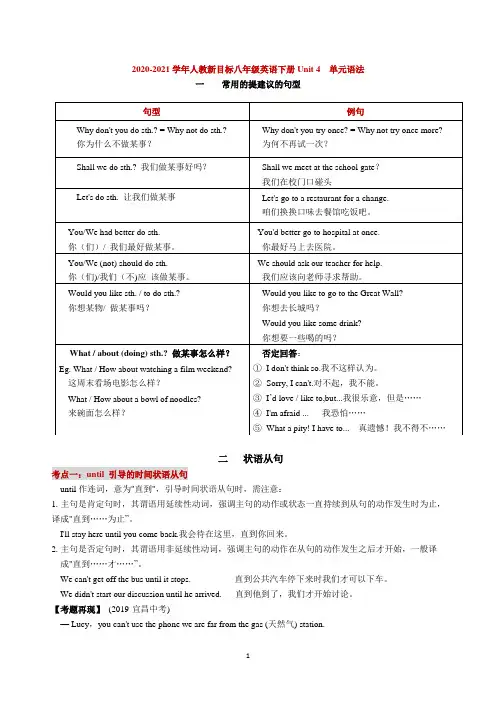
2020-2021学年人教新目标八年级英语下册Unit 4 单元语法一常用的提建议的句型二状语从句考点一:until 引导的时间状语从句until作连词,意为"直到",引导时间状语从句时,需注意:1.主句是肯定句时,其谓语用延续性动词,强调主句的动作或状态一直持续到从句的动作发生时为止,译成"直到……为止”。
I'll stay here until you come back.我会待在这里,直到你回来。
2.主句是否定句时,其谓语用非延续性动词,强调主句的动作在从句的动作发生之后才开始,一般译成"直到……才……”。
We can't get off the bus until it stops. 直到公共汽车停下来时我们才可以下车。
We didn't start our discussion until he arrived. 直到他到了,我们才开始讨论。
【考题再现】(2019·宜昌中考)— Lucy,you can't use the phone we are far from the gas (天然气) station.— OK, I won't do that again.A. afterB. whenC. thoughD. until考点二:so that 引导的目的状语从句so that意为"为了,以便”,引导目的状语从句,相当于in order that,从句中多含有can, could,may,might等情态动词。
I took a taxi so that I could get there earlier.我搭了一辆出租车,为的是能早点儿到那儿。
【拓展延伸】so that还可引导结果状语从句,意为"因此;所以”。
此时从句中通常不含情态动词。
Eg. The movie was boring so that half of the audience was asleep.这部电影太无聊了,所以一半儿的观众都睡着了。
人教新目标八年级英语下册Unit 6 An old man tried to move the mountains知识点总结和同步习题

Unit 6 An old man tried to move the mountains.【重点单词】shoot [ʃu:t] v. 投篮,射击,发射stone [ˈstəʊn] n. 石头weak [wi:k] adj. 虚弱的,柔弱的god [ɡɒd] n. 上帝,神remind [rɪˈmaɪnd] v. 提醒,使想起bit [bɪt] n. 一点,小块a little bit 有点儿,稍微silly [ˈsɪlɪ] adj. & n. 愚昧的;傻子,蠢货instead of 代替,反而turn into 变成object [ˈɒbdʒɪkt] n. 物体,目标,物品hide [haɪd] v. 躲藏,隐藏tail [teil] n. 尾巴magic [ˈmædʒɪk] n. 魔法,巫术stick [stɪk] n. & v. 棍,棒;刺,戳,插excite [ɪk'saɪt] v. 使激动,使兴奋western ['westən] adj. 西方的,欧美的once upon 从前stepsister [ˈstepsɪstə(r)] n. 继姐(妹)prince [prɪns] n. 王子fall in love 爱上,喜欢上fit [fɪt] v. 适合,合身couple ['kʌpl] n. (尤指)夫妻,两人smile [smaɪl] n.& v. 微笑marry [ˈmæri] v. 与某人结婚get married 结婚gold [ɡəʊld] n. 黄金,金币emperor [ˈempərə] n. 皇帝silk [sɪlk] n. 丝绸underwear [ˈʌndəwɛə] n. 内衣nobody [ˈnəʊbədi] pron. 无人,没有任何人,谁也不stupid ['stju:pɪd] adj. & n. 愚蠢的,傻的;傻子cheat [tʃi:t] v. 欺骗,愚弄stepmother [ˈstepmʌðə(r)] n. 继母wife [waɪf] n. 妻子husband [ˈhʌzbənd] n. 丈夫whole [həul] adj. 全部的,整体的scene [si:n] n. 舞台,(戏剧)场景moonlight ['mu:nlaɪt] n. 月光shine [ʃaɪn] v. 照耀,发光bright [braɪt] adj. & adv. 明亮的,发亮的;明亮地ground [graʊnd] n. 地面lead [li:d] n. & v. 领导,主角;带路voice [vɔis] n. 嗓音brave [breiv] adj. 勇敢的【重点短语】1. work on doing sth. 致力于做某事2. as soon as ... 一……就…....3. once upon a time 从前4. continue to do sth. 继续做某事5. make sth. happen 使某事发生6.try to do sth. 努力做某事7. the journey to sp. ......之旅8. tell the/a story 讲故事9. put on 穿10. a little bit 有点儿11. keep doing sth. 坚持做某事12. give up 放弃13. instead of 代替;反而14. turn...into... 使......变成......15. get married 结婚16. the main character 主要人物;主人公17. at other times 在另外一些时候18. be able to 能;会19. come out (书、电影等)出版20. become interested in... 对……感兴趣21. walk to the other side 走到另一边去22. a fairy tale 一个神话故事23. the rest of the story 故事的其余部分24. leave sb. to do sth. 让某人做某事25. make a plan to do sth. 筹划/计划做某事26. go to sleep 去睡觉27. lead sb. to sp. 把某人领到某地28. get lost 迷路29. change one’s plan 改变计划30. tell sb. to do sth. 叫某人做某事31. in the moonlight 在月光下32. find one’ s way home 找到某人回家的路33. the next day 第二天34. send sb. to sp. 派某人去某地35. so...that... 如此.......以致于.......【重点句型】1.So what do you think about the story of Yu Gong? 你觉得愚公的故事怎么样?2. It doesn't seem very possible to move a mountain. 把一座山给移掉好像不太可能。
人教新目标八年级下册过去进行时讲与练及答案
人教版八年级英语下册过去进行时●语法讲解1.构成:was/were+doing2.用法:过去进行时主要表示过去某一时间或某一段时间正在进行的动作。
如:His father fell and hurt himself while he was riding his bicycle. 他爸爸骑自行车时摔了下来,受伤了。
3.常用时间状语:this morning, the whole morning, all day, yesterday, from nine to ten, last morning, when, while 等。
4.when 与while 的区别(1) 引导时间状语从句时,while 连接的是时间段,而when 连接的多是时间点。
如:What was your father doing while your mother was cooking ?你妈妈做饭时,你爸爸在干什么呢?What was your mother doing when you came back?当你回来时,你妈妈在干什么呢?(2) w hile 可以连接两个并列的句子,而when 不可以。
如:I was trying my best to finish my homework while my sister was watching TV .我当时正在尽力完成作业,而我妹妹正在看电视。
(3) w hen 是特殊疑问词,可以对时间进行提问,而while 不能。
如:When were you born? 你什么时候出生的?过去进行时练习一、用动词的适当形式填空。
1. I (have) my breakfast at half past six yesterday morning.2. Mary (go) over her lessons from six to seven last night. John and Peter (do)the same thing.3. What you (do) at that time? We (watch) TV.4. Was your father at home yesterday evening? Yes,he was. He (listen) to the radio.5. They (not make) a model ship when I saw him.6. it (rain) when you left school? Yes, it . (No, it )7. What your father (do) when he was your age?8. One day, Edison (wait) for a train to arrive, and suddenly a little boy ran to the track(轨道) toplay.9. The three of them were in a hurry because their plane (leave) in five minutes.10. She (make) her dress the whole afternoon.11. While we (wait) for the bus, a girl (run) up to us.12. I (telephone) a friend when Bob (come) in.13. Jim (jump) on the bus as it (move) away.14. We (test) the new machine when the electricity (go) off.15. She (not want) to stay in bed while the others (all, work) in the fields.二、选择题1. I a meal when you me.A. cooked, were ringingB. was cooking, rangC. was cooking, were ringingD. cooked, rang2. He said he to draw a plane on the blackboard at that time.A. triesB. triedC. was tryingD. will try3. While she TV, she a sound outside the room.A. was watching, was hearingB. watched, was hearingC. watched, heardD. was watching, heard4. They a football game from 7 to 9 last night.A. were watchingB. watchC. watchedD. are watching5. What book you when I you at four yesterday afternoon?A. did, read, was seeingB. did, read, sawC. were, reading, sawD. were, reading, was seeing6. It was Friday evening. Mr and Mrs. Green ready to fly to England.A. are gettingB. getC. were gettingD. got7. Lei Feng always of others when he in the army.A. is, thinking, wasB. was, thinking, isC. did, think, isD. was, thinking, was8. A girl my pen fall off the table when she me.A. saw, passedB. was seeing, passedC. was seeing, pastD. was seeing, was passing9. We for Tom at ten last Sunday. He often kept us .A. were waiting, waitingB. were waiting, waitC. waited, waitingD. waited, wait10. He his father on the farm the whole afternoon last Saturday.A. helpsB. would helpC. was helpingD. is helping11. While mother some washing, I a kite for Kate.A. did, madeB. was doing, madeC. was doing, was makingD. did, was making12. “you angry then? The”y “too much noise. ”A. Are, were makingB. Were, were makingC. Are, madeD. Were, made13. He some cooking at that time, so he me.A. did, heardB. did, didn ’t hearC. was doing, heardD. was doing, didn ’t hear14. This time yesterday Jack his bike. He TVA. repaired, didn ’t watc B h. was repairing, watchedC. repaired, watchedD. was repairing, wasn watc’hin t g15. His parents wanted to know how he on with his new classmates.A. was gettingB. getsC. is gettingD. will get过去时中考真题Part 11. —What were you doing this time yesterday?—I on the grass and drawing a picture.A. sitB. satC. am sittingD. was sitting2. While I TV, the bell rang.A. watchB. watchedC. am watchingD. was watching3. —Why didn ’t you answer my telephone yesterday?—Sorry. I a bath.A. tookB. takeC. am takingD. was taking4. While the alien a souvenir, the girl called the police.A. was buyingB. boughtC. buysD. is buying5. —I called you at 6 o'clock yesterday evening, but nobody answered.— I'm sorry. I my friend download the movie Kung Fu PandaⅡwhen the telephone rang,A. would helpB. helpedC. was helping6. I along the road when I saw Peter. So we stopped and had a chat.A. walkedB. was walkingC. would walkD. had walked7. —What did the teacher say just now?— Sorry. I didn ’t catch it. I something else.A. thinkB. will thinkC. was thinkingD. had thought8. When I came back yesterday evening, my brother his homework.A is doing B. has done C. was doing9. M rs White dinner when her son came home.A. is cookingB. was cookingC. are cookingD. were cooking10. —D id you see Mr. Black just now?—Yes. He his car when I met him.A. parkedB. was parkingC. parksD. will park11. —Amy, I called you yesterday evening, but nobody answered the phone.— Oh, I a walk with my mother at that time.A. takeB. tookC. am takingD. was taking12. Y esterday evening, I along the street when I suddenly met my maths teacher.A. walkB. walkedC. was walkingD. am walking13.—Where were you at 7:00 last night?— I to my mom at home.A. writeB. was writingC. wrote14. —Why didn ’t you go to play football with us yesterday afternoon?—I my mother with the housework then.A. helpedB. was helpingC. had helpedD. have been helping15. He when the UFO arrived. He didn ’t wake until the UFO disappeared.A. sleptB. was sleepingC. was doing homeworkD. was singing16. I my homework at nine o'clock last Sunday morning.A. am doingB. was doingC. do17. I was very angry with John—he just when I spoke to him.A. isn ’t listeningB. hasn ’t listenedC. didn ’t listenD. wasn ’t listening18. —I called you at 4:00 yesterday afternoon, but no one answered.—Sorry, I with my friends at that time.A. swimB. swamC. will swimD. was swimming19. Mr. Li us a report on our environment when the earthquake happened in Japan.A. gaveB.is givingC. was giving20. —Mr. Lee to a student when I entered the classroom this morning.- He is very patient he is young.A. talking; butB. talks; thoughC. was talking, thoughD. talked, however21.—Were you at school when he came to see you?—Yes, I a math class.A. hadB. was havingC. am havingD. have22. I met a good friend of mine while I on the street.A. walksB. walkC. was walkingD. am walking23. I when the UFO landed.A. am watching TVB. was watching TVC. have watched TVD. watched TV24. The girl with two cats in the yard when the earthquake happened.A. was playingB. is playingC. are playingD. were playingPart 21. Paul and I tennis yesterday. He did much better than 1.A. playB. will playC. playedD. are playing2. A big party was held in NO.18 Middle School last night, the teacher with students singing and dancing happily at the party.A. isB. wasC. areD. were3. Mr. Black is going to marry a girl he in Japan last year.A. meetsB. metC. has metD. would meet4. He went into his room, the light and began to work.A. has turned onB. turned offC. turned onD. has turned off5.—W hat did Mr. Smith do before he came to China?—He in a car factory.A. worked B.works C.is working D.will work6. —Have you ever been to Hong Kong?—Yes, I ___there last month.A. went toB. have beenC. went7. This morning I had hardly got to my school when it to rain.A. had begunB. was beginningC. beganD. begins8.—Y ou have found your lost umbrella, haven ’t you?—Yes. I it behind the door this afternoon.A. have foundB. will findC. found9. Tom, along with three other boys, seen playing football a moment ago.A. isB. wasC. areD. were10. Ten minutes ago, there an eraser, a pen and some books on the desk.A. wasB. wereC. is11. —How was your trip to Hang Zhou, Jim?—Great! We to Xixi National Wetland Park.A. goB. am goingC. will goD. went12. –Do you know who cleaned the blackboard, Tina?-- Yes. John .A. doB. doesC. did13. The last time I to the cinema was two years ago.A. goB. have goneC. have beenD. went14. —Have you ever been to Canada?— Yes, I there last year with my parents.A. have beenB. have goneC. wentD. go15. I called you, but nobody answered. Where you?A. isB. areC. wasD. were16. ---Have you ever been to Shanghai?---Yes. I there a few months ago.A have been B. went C. have gone17. What’s the best present you have ever ?A. receivedB. receivesC. receiving18.—Lin Kai, hand in your homework, please.—Oh, sorry. I it at home this morning.A. was leavingB. has leftC. will leaveD. left19. I'm now in New York with my friend Jenny. We by plane on Monday.A. arriveB. arrivedC. are arrivingD. will arrive20.—Guess What! The great movie is on in the cinem.a一Nothing n ew.I it with my parents on the first day.A. saw B.see C.will see D. have been21. If it had been fine yesterday, we could have watched that air show. But it all day.A. has rainedB. had rainedC. rainedD. rains22. –When your mother you that blue dress, Lucy?–Sorry, I really can ’t rem M e a m ybert.wo or three weeks ago.A. will; buyB. does; buyC. did; buy23. -I ’v e got a ticket for the basketball game tonight.-Cool!How you it?A. had, gotB. did, getC. were, gettingD. will, get24. Hello! I'm very glad to see you. When you here?A. did; arriveB. will; arriveC. have; arrivedD. are; arriving25. —I have to be off right now.—What a pity! I you could stay a little longer with us.A. thinkB. am thinkingC. thought26. Tom was so careless that he his right arm when he was riding to school.A. hurtsB. hurtC. has hurtD. had hurt27. —I something wrong just now. May 1 use your eraser?—Of course. Here you are.A. writeB. wroteC. am writing过去进行时练习一、用动词的适当形式填空。
新目标人教版八年级英语下全册重点及练习
Unit 1 What’s the matter?重点短语:have a stomachache have a cold lie downtake one’s temperature have a fever go to a doctor to one’s surprise agree to (do sth.) get into troublebe used to take risks run out (of)cut off get out of be in control of keep on ( doing sth.) give up语言知识归纳:1. What’s the matter (with you)?此句用来询问别人的病情。
类似的句子还有:What’s wrong with you?/ What’s the trouble?matter作动词用,意为“要紧”“有关系”,主要用于疑问句和否定句。
What does it matter? It doesn’t matter.【例题】Does it ________ if we can’t finish it today?A. mindB. mindsC. matterD. matters2. I have a sore throat.have “患病”,常用“have a /an+ 名词”.have a cold have a fever have a sore back have a stomachache have a cough【例题】( )---Does he often have ______ cold? ---Yes. He also _____a cough and a sore throat.A. a; hasB. /; hasC. a; haveD. /; have3.Lie down and rest! 躺下休息lie down 躺下4.That’s probably why. 那可能就是原因。
初中英语人教新目标八年级下册Unit 2 Section A预习指导(知识点+练习题)
八年级英语下册Unit 2Section A预习指导一、知识点1.Clean up 打扫干净注意:clean up后的宾语如果是人称代词,则须位于之间Eg: Clean it up 把它打扫干净Clean (动词) “打扫”(名词) “干净的”Eg: clean the room打扫房间The room is clean.这个房间很干净。
2.Help (动) “帮忙”(1)help sb.with sth.= help sb.(to) do sth “帮忙做某事”(2)help oneself to... “随便吃/喝...”(3)can’t help doing sth. “情不自禁做某事”Help (名) “帮忙”with one’s help= with the help of sb. “在某人的帮助下”Eg: She always helps her mother clean the room.她总是帮她的妈妈打扫房间。
With the help of the teacher, my English is improving. 在老师的帮助下,我的英语正在提升。
3.Offer help 提供帮助Offer (动词) “提供”常见搭配:offer sb.sth.= offer sth.to sb.提供某人某物Eg: She offered me lots of help.= She offered lots of help to me.她给我提供了许多帮助。
4.Hope (动词) “希望”常见搭配:hope to do sth.= hope + that 从句Eg: I hope to visit Beijing one day.= I hope that I will visit Beijing one day.我希望有一天参观北京。
5.Work outside 去外面工作6.The sick kids 生病的孩子补充:“the + 形容词”常用来表示这一类人Eg: the old 老年人The young 年轻人The sick 病人7.In the hospital 在医院里In hospital 住院Eg: Mr.Wang works in the hospital.王先生在这所医院工作。
2020年春人教新目标英语八年级下册Unit4-5知识点总结
2020年春人教新目标英语八年级下册Unit 4 Why don’t you talk to your parents?1..用于提建议的句型有:What about doing sth ?=How about doing sth?(1). 同意对方的建议时,一般用:….怎么样?.Let’s do sth . 让我们一起做某事吧。
Shall we/I do sth? 我们做…好吗?had better do/not do sth 最好做/不做某事Will/Would you please do sth 请你做…好吗?Would you like to do sth? 你想去做某事吗?Would you mind doing sth?你介意做某事吗?Why don’t you do sth?= Why not do sth?为什么不呢?◆Good idea./ That’s good idea. 好主意◆OK/ All right./ Great 好/ 行/太好了◆Yes, please ./ I’d love t o 是的/ 我愿意◆I agree with you 我同意你的看法◆No problem 没问题◆Sure/ Of course/ Certainly 当然可以◆Yes, I think so 对,我也这样想(2).对对方的帮助或要求表示委婉谢绝时,一般用:◆I don’t think so 我认为不是这样◆Sorry, I can’t对不起,我不能◆I’d love to, but…◆I’m afraid…我愿意,但恐怕……2. allow doing sth 允许做某事allow sb. to do sth 允许某人做某事be allowed to do sth 被允许做某事allow与let的辨析:allow指“允许”,表示“默许,听任,不加阻止”,allow sb to do sth 允许某人做某事。