
外研版八年级英语下册Module 4Unit 2 教学导案含答案
Unit 2 We have played football for a year now.Healthy living1 I was not feeling very well so the doctor checked my heart and said I needed more exercise. I have never been very active, and I do not like sports. I have always wanted a pet, so my parents gave me a dog for my birthday. Now I get exercise by taking him for a walk every day. I have had him for three months now andI feel really healthy. -Anna2 Our teacher decided to start a girls’ football team and I thought, “What a great idea!” I was the first member of the team. We have played football for a year now and we all feel very fit. Our teacher is the coach, and she also takes part in the training with us. She is in excellent condition too. -Wang Wei3 For the last few years, I went to work on the underground. When I got to work, I always felt very sleepy and I was not happy. I bought a bike in January, since then, it has become part of my life. Now I ride to work every day. It is my daily exercise. I arrive at work with a smile on my face. -Thomas4 I was weak after a long illness, so I wanted to exercise more. Then a friend suggested, “Why don’t we go for a run before school?” So we start ed running a week ago. But I do not enjoy running, and when I get to school, I feel awful. My legs hurt and I am hot all over. Perhaps I am too weak to do any exercise. What do you think? -Richard词汇短语精讲1take part (in sth.) 参加;参与(某事)【点拨】take part表示“参加”,它后面跟宾语时一般要加介词in,构成短语take part in。
【辨析】join, join in与take part in(1)join指加入某个党派、团体组织等,并成为其中的一员,表示“参军,入团,入党”等。
(2)join in多指参加小规模的活动,如“球赛、游戏”等,常用于日常口语。
(3)take part in指参加会议或群体性活动等,着重说明句子主语参加该项活动并在活动中发挥作用。
When did your father join the army? 你爸爸是何时参军的?Come on, and join in the ball game. 快来加入球赛。
活学活用()Mr. Smith________ many important competitions since 2000.A. joinedB. took part inC. has taken part inD. will join in【答案】C●2 sleepy adj.困的;想睡的【点拨】sleepy 表示有睡意但没有睡着,在句中可作表语、宾语补足语和定语。
作表语时,表示“困倦,想睡觉”;作定语时,表示“贪睡的,寂静的”。
例如:The children feel sleepy, put them to bed. 孩子们困了,把他们放到床上吧。
John is a sleepy boy. 约翰是个贪睡的男孩。
Do you like this sleepy valley?你喜欢这寂静的山谷吗?【辨析】sleep,asleep 与go to sleep(1)sleep指“睡觉”的全过程,用于进行时态时,表示“正在睡觉”。
例如:I slept well last night. 昨晚我睡得很好。
Be quiet.Grandpa is sleeping.安静,爷爷正在睡觉。
(2)asleep 是个仅用作表语的形容词,不能放在名词前作定语;be asleep表示“睡着”,fall asleep指“入睡”,例如:He fell asleep quickly as soon as he lay down.他一躺下很快就睡着了。
(3)go to bed 指“去睡觉”表示动作,与get up意思相反。
例如:He usually goes to bed at 11:00. 他通常在11点睡觉。
活学活用单项选择( )(1)It’s 10:30. It’s time to .A.go to bedB.sleepC.sleepyD.asleep【答案】A( )(2)—Why are you so ?—Because I didn’t well last night.A.sleep; sleepyB.asleep; sleepyC.sleepy; sleepD.sleepy; asleep【答案】C●3 daily adj.每天的;天天的【辨析】daily与everyday 区别这两个词都是形容词,everyday强调每天的,daily强调日常的。
everyday 只作形容词,而daily 除作形容词,还可作副词和名词. adj.每日的, 日常的adv.每日, 日常地, 天天n.日报。
例如:He gets a daily wage. 他领的是日薪。
Cooking dinners is her everyday job. 做饭是她每日的工作。
活学活用根据汉语完成句子。
1.这是我日常穿的鞋子,不是最好的。
These are my shoes, not my best ones.2.我们每天给奶牛挤两次奶。
We milk the cows twice .【答案】1.everyday 2.daily / every day.●4 perhaps ad. 也许【点拨】perhaps意为“或许,也许,说不定”(修饰全句),比maybe 略正式。
例如:Perhaps it will snow. 天也许会下雪。
活学活用根据汉语完成句子。
或许他明天会来。
________he will come tomorrow.【答案】Perhaps /Maybe重点句型分析●1 Now I get exercise by taking him for a walk every day. 现在我每天通过遛狗来锻炼身体。
【点拨】句中by taking him for a walk every day意为“每天通过遛狗”,表示“通过某种方式”。
例如:You can do your shopping from home by using the Internet. 通过使用因特网你可以在家里购物。
活学活用根据汉语完成句子。
他以教书为生。
He made a living by (teach).【答案】teaching● 2 She is in excellent condition too.她的身体状况也很好。
【点拨】句中in excellent condition 表示“健康状况很好”,还可以用in condition。
例如:Do exercise every day and you will be back in condition soon. 每天锻炼身体,你会很快恢复健康的。
【拓展】out of condition 则指“健康状况不佳”。
例如:The horse is still out of condition after a serious illness. 这匹马在一场大病后,健康状况仍然不佳。
活学活用根据汉语完成句子。
(1) 他的健康状况不宜旅行。
He is to travel.(2) 这辆车状况良好。
The car is .【答案】(1)out of condition (2) in excellent condition● 3.I arrive at work with a smile on my face. 我面带微笑上班。
【点拨】句中with a smile on my face意为“面带微笑”,是介词短语,作伴随状语。
例如:She walked on the stage with some flowers in her hands. 她手里捧着鲜花走上舞台。
【辨析】reach, get to与arrive at/inreach是及物动词,后面可以直接跟地点。
get to和arrive at/in也指“到达……”,其中arrive at后面接小地点,arrive in后面接大地点。
如果地点是here,there,home,只用get和arrive,后面不加to,at 或in。
但是如果home前有修饰词时,如this,that,his等,则要加上to,at或in。
活学活用1.根据汉语完成句子。
他眼里含着眼泪跑出了房间。
He ran out of the room tears his eyes.【答案】with; in2.单项选择( )(1)【2012黔东南州】I arrived in Leishan last Sunday.A. reachB. reached toC. gotD. got to【答案】D 本题考查词义辨析。
arrive in,到达某地。
外研版英语八年级下册Module4 Unit2 参考学案
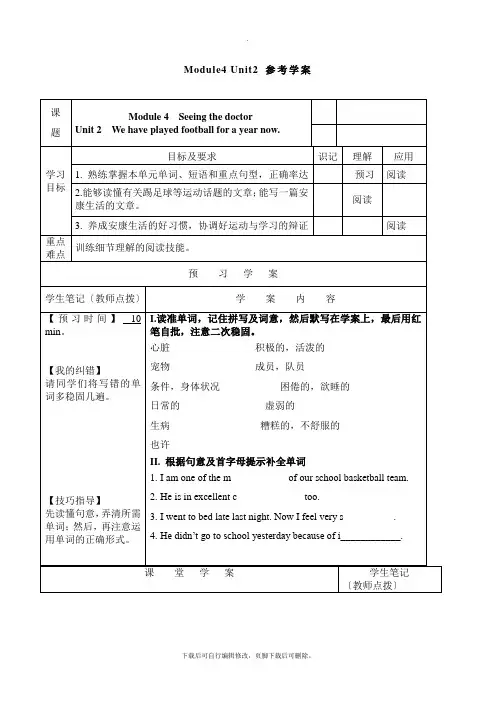
1.安康生活__________________2.给某人某物_______________
3.通过做某事__________________ 4.决定做__________________
5.参加…… __________________ 6.在过去的几年里____________
_____________________________________________________________________
自我反思
第3页
________________________________________________________
5. Does Richard enjoy running?
________________________________________________________
【Exercise】
ⅡRead again, answer the questions.
1. What does Anna’s doctor say when she doesn’t feel well?
________________________________________________________
How does Anna get exercise?
2. She needed _____________.
3. She got __________ from her parents and she takes him ______________ every day.
Wang Wei
外研版八年级英语下册Module4(答案+解析)

外研版八年级英语下册Module4SeeingthedoctorUnit1Ihaven'tdonemuchexercisesinceIgotmycomputer.学校:___________姓名:___________班级:___________考号:___________一、根据首字母填空根据句意及汉语或首字母提示完成句子中的单词1.She had a high ________ (发烧).2.I feel a little bit painful while I ________ (咳嗽).3.I have a bad ________ (头疼)and a runny nose.4.He has worked in the factory ________ last year.5.Fresh air and exercise are good for our ________.二、用单词的正确形式完成句子从方框中选出适当的介词或介词短语填空6.Daming gets up at 6:00 o'clock in the morning.What________you?7.I want to be a doctor ________ my father in the future.8.There is a long river ________ my house.9.Amy has learned French ________ many years.10.Lucy has lived in China ________ five years ago.用方框中所给短语的适当形式完成下列句子,使句子通顺、正确11.Why don't we try some Chinese ________ for a change?12.Don't take off your coat, or you'll ________.13.Did you________ five minutes ago?14.Mary ate too much candy. She________.15.He was left alone with no one to________ him.三、单选题16.Reading in the sun is ________ your eyes.A.harmful to B.harm for C.harmful for D.harm to 17.I can't hear you clearly because there is ________ noise here.A.too many B.too much C.much too D.many too 18.—How long have you lived here?—________ about 5 years ________ my family moved to the city.A.Since; for B.For; since C.For; for D.Since; since 19.Please stop________ and go out for a walk. Remember ________ warm clothes. A.to study; wearing B.studying; to wearC.to study; to wear D.studying; wearing20.—Have they had breakfast?—________.Look!How hungry they are!A.I don't think so B.I'm afraid so C.I think so D.I hope so四、完成句子根据汉语意思完成下列句子,每空一词21.自从周五我就胃痛。
外研版初中英语八年级下册整册教学设计
外研版八年级下英语全册教案Book 4 Module 1 Feelings and impressionsUnit 1 It smells delicious一、教学内容:Unit 1 It smells delicious二、课型:Listening and speaking三、教学目标:1.通过本课的学习,学生能够正确运用下列单词和词组:smell, salt, sour, soft, cookie, pizza, lovely, done, try, have a try, pie, sound, sweet tooth, jam, ear2. 能够听懂用表感觉和知觉的系动词所表述的内容,并能与图片匹配。
3. 能够使用感官动词smell、taste、feel、look、sound等词,对食物的味道进行评论,正确表达自己的喜好。
四、教学重难点:能利用系表结构的句子对事物的味道、印象等进行评论,确切地表达自己或他人的喜好或是心情等。
五、教学准备:课堂整体运用任务型教学模式,培养学生独立自主的学习能力。
本课指导学生通过听说获取信息,培养学生的听说技能。
课前将本课所需要的录音、图片、文字、和音乐制成课件,使抽象的语言变得直观,为学生运用英语进行交际创设情景,实现师生互动,生生互动和人机互动的多向交流。
达标训练题一. 根据句意和汉语提示完成句子。
1. 这菜闻起来好香啊.The dish _______________.2. 这汤尝起来不新鲜.The soup ______________ fresh.3. 这毛衣摸起来很软很舒服。
The sweater _______________________.4. Children like _______ (小甜饼)very much.5. People should eat less ______ ( 盐) everyday.6. Oh. It’s my _______(幸运的)day. I'vepassed the exam.二. 单项选择:1. These flowers ______beautiful. I will buy some for my mother.A. lookB. soundC. hearD. taste2. The air in the countryside smells _______.A. sourB. softC. deliciousD. fresh3. The idea ________ g ood. We can try it.A. tasteB. tastesC. soundsD. sound4. This game is so interesting, please_____ .A. have a lookB. give upC. have a tryD. try some5. Last Sunday was my mother’s birthday, so I _____ a big meal for her.A. cookB. cooksC. cookedD. is cookingBook 4 Module 1 Feelings and impressionsUnit 2 I feel nervous when I speak Chinese.一、教学内容:Unit 2 I feel nervous when I speak Chinese.二、课型:Reading and writing三、教学目标:1、通过本课的学习,学生能够朗正确运用下列单词和词组:fair, glasses, proud, be proud of, jeans, pretty, stranger, nervous, message, hobby, at school , mark, love, sb. can’t wait to do sth.2、进一步学习感官动词f eel look smell taste的用法,在理解的基础上,学会用它们表达情感3、能读懂对人外貌和性格的简单描述。
2020春外研版八年级英语下册Module 4 教案+教案设计+单元测试+译文+知识点归纳+阅读(付,60)
一、教案Module 4 Seeing the doctor【教材分析】Module 4的主要内容为运用现在完成时来描述自己和他人的经历,例如看病经历、运动经历等。
从全书来看,本模块承接上一模块对现在完成时的学习和运用,内容有层次的展开,学生容易接受。
Unit 1 I haven’t done much exercise since I got my computer.【教学目标】Knowledge objective:1. 词汇: cough, fever, headache, stomachache, toothache, ill, this, since, cold, catch a cold, take sb.’s temperature, fast food, health, take2. 现在完成时中for短语和since短语的使用。
Ability objective:能听懂和阅读关于介绍看病经历的语言材料,能通过相关词汇和图片描述自己和他人的看病经历;能编写关于看病的对话。
Moral objective:学会倾听他人的看病经历,理解他人的喜怒哀乐;养成关心、帮助他人的良好品质。
【教学重点】现在完成时的for短语和since短语。
【教学难点】1. 现在完成时的瞬间动词和延续性动词。
2. 现在完成时的for短语和since短语的区别。
【教学方法】PWP method, task-based method and interactive approach【教学手段】A tape recorder, multimedia and some pictures【教学过程】Teaching Procedures:Step 1 Lead-inSs look at the pictures and answer the questions.Step 2 Consolidate new wordsLook and say. The teacher shows the pictures of new words and let the students to say as quickly as possible.Step 3 Match the words in the box with the pictures.1. Look at the words first.2. Choose the right word for each picture.Step 4 Listening1. Listen to Part 2 and check what’s wrong with Betty and Daming.Keys: Betty: headache stomach acheDaming: cough fever toothache2. Listen to Part 3 and answer the two questions:1) Have Daming got a cold?2) What kind of food does Daming usually eat?Keys:1) No, he hasn’t.2)Fast food.Step 5 Reading1.Please find out sentences which have for or since in the dialogue.Keys: 1. I’ve been ill for about three days!2. I haven’t done much exercise since I got my computer last year.2.Now complete the table about Daming.3.Read Part 3 and mark T or F.Keys: FFFTTStep 6 Everyday EnglishLet Ss say what they have learnt in the passage.Step 7 Language pointsSs should master the main points from the passage in Part 3. If possible, let the students to say at first.1. I feel ill. 我感觉我生病了。
Module4Unit2教案外研版英语八年级下册
外研版八年级下册教案Module4Unit 2 We have playedfootball for a year nowLesson Objective:By the end of the lesson, students will be able to:➢Understand and use the present perfect tense to talk about past experiences.➢Discuss their own experiences in playing football.➢Develop their speaking and writing skills in English.Materials:✓Whiteboard, markers, and eraser✓Handouts with conversation prompts and sample sentences✓Pictures or videos related to footballWarm-up Activity :1)Begin the lesson by asking the students about their experiences inplaying football.2)Encourage them to share how long they have been playing footballand any memorable moments.3)Write some key vocabulary words on the whiteboard, such as “play,”“football,”“experience,”“year,”“now,”etc.Introduction:1.Show pictures or play videos related to football to engage thestudents and create interest in the topic.2.Ask the students what they know about the present perfect tenseand elicit their understanding of its usage.3.Explain that the present perfect tense is used to talk about pastexperiences and actions that have a connection to the present. Vocabulary and Language Practice:1)Provide handouts with vocabulary related to football and the presentperfect tense.2)Instruct the students to match the vocabulary words with theirmeanings or synonyms.3)Review the answers as a class, discussing the proper usage andpronunciation of each word.Example vocabulary words:◆Football◆Experience◆Year◆Play◆NowGrammar Practice :⏹Explain the structure of the present perfect tense using the pattern“have/has + past participle.”⏹Provide examples of sentences in the present perfect tense, bothpositive and negative.⏹Engage the students in a guided practice, where they transformsentences into the present perfect tense.Example transformations:●I play football. (Present simple)●I have played football for a year now. (Present perfect)Speaking Practice:1)Pair up the students and provide conversation prompts related toplaying football.2)Instruct the students to take turns asking and answering the promptsusing the present perfect tense.3)Monitor their conversations, providing feedback and languagesupport as needed.4)Encourage the students to use appropriate vocabulary andexpressions during the speaking practice.Example conversation prompts:1.How long have you been playing football?2.Have you ever played in a football tournament?3.What is the most memorable football match you have watched? Writing Activity :1)Ask the students to write a paragraph about their personalexperience in playing football using the present perfect tense.2)Provide sentence starters to help them structure their writing, such as“I have been playing football for…”or “In the past year, I have played football…”3)Remind them to include details and examples to support theirstatements.4)Allow the students to share their paragraphs with a partner andprovide feedback to each other.Group Activity and Presentation:1.Divide the class into small groups and assign each group afootball-related topic or scenario.2.Instruct the groups to create short skits or presentations using thepresent perfect tense to talk about their assigned topic.3.Provide time for the groups to prepare their presentations and thenhave them perform or present to the class.4.Encourage the students to use proper intonation and gestures whiledelivering their presentations.Wrap-up Activity :❖Summarize the main points discussed during the lesson, emphasizing the usage and structure of the present perfect tense.❖Ask the students to reflect on their learning and share one new thing they have learned about the present perfect tense or football.❖Provide a short review exercise or game, such as asking the students to create present perfect sentences based on given prompts or playing a football-themed memory game.。
八年级下册外研版Module 4 Unit 2教案(含反思)
温馨提示:此套题为Word版,请按住Ctrl,滑动鼠标滚轴,调节合适的观看比例,答案解析附后。
关闭Word文档返回原板块。
Unit 2We have played football for a year now.课题Module 4Seeing thedoctor 第二课时Unit 2We have played footballfor a year now.课型New教学目标知识目标1. 学习并掌握下列词汇:well, heart, active, pet, member, condition, sleepy, then, daily, weak, illness, exercise, awful, perhaps, take part (in sth. ), in excellent condition, feel awful, all over2. 掌握以下句型:①I have never been very active, and I do not like sports.②I have had him for three months now and I feel reallyhealth.③We have played football for a year now and we all feelvery fit.④Perhaps I am too weak to do any exercise.能力目标能读懂关于饮食和运动习惯的短文。
能够针对不健康的生活习惯或行为给出适当的建议和看法。
情感目标能够意识到生活习惯不同的人群持有不同的健康观念, 能够关心自己及他人的健康。
教学重点1. The use of “for” and “since” phrases.2. How to use Present perfect tense to describe someone’s healthy situation.教学难点1. Use Present perfect tense to describe someone’s healthy situation.2. Write an article about giving someone some advice about health. 课前预习Preview the new words教学方法The Cooperative Learning approach; Reading approach;Cooperative Learning Method教学过程教学环节教师活动学生活动备课札记Step 1 Warm up Let students look at thepictures and talk aboutsomething aboutpictures.—What’s wrong withyou?—I have a headache.…1. Look at thepictures and talkabout what’s wrongwith your partner.2. Look at thepictures and describethem.看图片谈论看医生时的常用语。
外研版八年级下册英语《Module4SeeingthedoctorUnit2》说课稿3
外研版八年级下册英语《Module 4 Seeing the doctor Unit 2》说课稿3一. 教材分析《Module 4 Seeing the doctor Unit 2》这一单元的主题是关于就医的经历。
通过本单元的学习,学生将能够掌握与就医相关的词汇和表达方式,如:fever, illness, pn, medicine, doctor等。
同时,学生还能够学会如何描述自己的病情以及与医生的交流过程。
本单元的主要目标是培养学生运用英语进行就医场景的交际能力。
二. 学情分析八年级的学生已经掌握了基本的英语语法和词汇,具备一定的听说读写能力。
然而,学生在实际运用英语描述具体场景时,往往会因为词汇量的匮乏和表达方式的单一而感到困难。
此外,学生在就医场景中的实际交际经验较少,因此需要在课堂上进行大量的练习以提高交际能力。
三. 说教学目标1.知识目标:学生能够掌握本课的生词和短语,了解就医场景的常用表达方式。
2.能力目标:学生能够运用所学的词汇和表达方式,描述自己的病情并与他人进行就医场景的交际。
3.情感目标:通过本课的学习,学生能够提高对英语学习的兴趣,增强自信心。
四. 说教学重难点1.重点:学生能够掌握与就医场景相关的词汇和表达方式。
2.难点:学生能够运用所学的词汇和表达方式,在实际语境中进行就医场景的交际。
五. 说教学方法与手段1.情景教学法:通过模拟就医场景,让学生在实际语境中练习英语交际。
2.任务型教学法:通过完成具体的就医任务,提高学生的英语实际应用能力。
3.小组合作学习:鼓励学生互相交流、讨论,提高团队合作意识。
六. 说教学过程1.导入:教师通过提问方式引导学生思考就医场景,激发学生的学习兴趣。
2.展示:教师展示就医场景的图片或视频,引导学生进行观察和描述。
3.讲解:教师讲解本课的生词和短语,让学生进行实地操作,如模拟就医对话。
4.练习:学生进行小组讨论,模拟就医场景,练习英语交际。
外研版八年级下册英语M4U2教学设计教案4
任务二:话题导入,听力训练。
1.导入Have students work alone to match the words and pictures
【听力素材的学习】
Listen and check what’s wrong with Betty and Daming.(听两遍,根据图片获取相关词汇搭配)
back+ache=backache(背痛)stomach +ache = stomachache(胃痛)
2)take one’s temperature意为“量体温”
3)That’s why you’ve got a stomach ache.这就是你得胃病的原因。
That’s why(+结果)这就是…的原因。
Listen and check (√) what’s wrong with Betty and Daming
cough
fever
headache
stomach- ache
toothache
Betty
Darming
3互帮. Check the answers in groups or in class. And try to read the sentences correctly.
重点:掌握现在完成时与一般过去时的区别。
难点:能角色扮演,谈论疾病及治疗办法。
教学准备
多媒体,白板
教学课时
一课时
教 学 过 程
活 动 设 计
个人复备
一【感情调节】
任务一:新课导入,谈论学生生病的经历。
When you see a doctor , he usually asks you some questions like this:
外研版英语八年级下册Module4_Unit 2 第三课时教案与反思
古之学者必严其师,师严然后道尊。
欧阳修铁山学校何逸春重点单词 well,heart,active,pet,sleepy重点短语take part in,in excellent condition,feel very sleepy,all over 重点句型 1.I was not feeling very well so the doctor checked my heart and said I needed more exercise.2.Now I get exercise by taking him for a walk every day.3.I have had him for three months now and I feel really healthy. 重点语法现在完成时(三)自主学习方案1.学生自学新词汇(见教材P114)完成学案中相关练习所对应的重点单词。
2.学生自学教材(P28〜29),找出课文中重点词组和句子。
完成学案中相关练习所对应的重点词组和重点句子。
课堂导学方案Step1 情景导入教师问学生是否在坚持锻炼,像跑步、踢足球、骑自行车等等。
然后播放一些锻炼的视频。
最后邀请学生用英语来表达自己所喜欢的运动。
环节说明:教师的问题及播放的视频激起学生回答问题的热情,同时又引起学生们学习的兴趣,过渡自然,导入新课。
Step 2完成教材1的任务认真观察图片,让学生们来谈谈图片中的一些活动,然后问学生哪些是健康的活动。
Step3 完成教材2的任务1.朗读短文2,把文中的人物和活动1中的图片搭配起来,集体核对答案。
2.要求学生阅读第一自然段,然后填任务3的 Anna —栏,集体核对答案。
Anna(1)She was not feeling very .(2)She needed more .(3)She got a pet from her parents and she takes him for aevery day.3.大声朗读短文2的第一自然段,找出重难点4.教师详细讲解,学生熟记语言重点。
外研版英语八年级下册【教学课件】Module 4 Unit 2
外语教学与研究出版社 八年级 | 下册
Complete the passage with the words in the box.
active awful condition daily member Perhaps
1. Tom runs six miles every morning, so he is in very good _c_o_n_d_i_ti_o_n_.
4. Ben is a(n) __m_e_m__b_e_r_ of the school football team.
5. You do not look very well.__P_e_r_h_a_p_s_ you should see a doctor.
6. I saw your grandfather taking his __d_a_il_y__ walk this morning.
外语教学与研究出版社 八年级 | 下册
How does he go to work every day? He goes to work by bike every day.
外语教学与研究出版社 八年级 | 下册
Is going to work by bike every day healthy? Yes, it is.
外语教学与研究出版社 八年级 | 下册
3. And she also takes part in the training with us. take part in表示“参加”,侧重于参加 活动。 e.g. Would you like to take part in the party tonight? 你愿意参加今晚的聚会吗?
外语教学与研究出版社 八年级 | 下册