
高三英语unit3 Australia
2. Para1. Australia is surrounded by many oceans: the Indian Ocean in the west, the Southern Ocean in the south and the Pacific Ocean in the northeast. surround vt. 包围,环绕 包围, be surrounded by/with周围都是 surround…with by/with周围都是 surround… ……把……围住 用……把……围住 eg. 1). Our village is a beautiful one with green hills 1) surrounding it. 2.)Surrounded by the trees, flowers and grass 2.) everywhere, our city has taken on a new look. 3). On walking into the classroom, the old man found himself surrounded by a group of children
Unit 3 is easy, while Unit4 is difficult. .while there is life there is hope. “While” can also mean “although” and then is usually While” although” placed at the beginning of a sentence. While the parents love the children, they are strict with them. .Never go on or off a bus while it is in motion. .It will be worth your while ,I think, to go and see him. While some of the Aboriginal languages have been lost, people are trying hard to protect and record what is left. (Para6.) Para6.) worthwhile值得花时间 精力] 值得花时间[ (one’ ☆worthwhile值得花时间[精力]的...be worth (one’s ) while doing/to do sth. 值得花时间[精力] 值得花时间[精力]
Careful reading
1.The Australian flag shows________. A. the UK flag and seven stars B. the USA flag and a large star with seven points C. the UK flag and six large stars with seven points D. the UK flag, a large star and a group of small stars 2. Who were the first people to arrive in Australia? A. Spanish, Portuguese and Dutch. B. Prisoners and criminals from England. C. Aborigines and Torres Strait Islanders. D. Asian lorers.
3. Para1. Six of the points represent the states and the seventh stands for all the territories. stand for ,represent & on behalf of (不用于被动语态 不用于被动语态) ⑴ stand for sth (不用于被动语态) ..的缩写形式 1)为..的缩写形式 PC stands for personal computer. 2)代表某事物 赞同, 3)赞同,支持或主张某事物 )(口语 容允, 口语) 4)(口语)容允,忍受 =tolerate
Unit 3 Australia
National Flag
dingo
Kangaroos
Koala-bears
The duck-billed platypus
Fast reading
How many parts can the passage be divided into? Five What’ What’s the main idea of each paragraph? Para1: The portrait of a nation Para2: The first Australians Para3: A nation of prisoners Para4: Another new world: The birth of a nation Para5: Speak Australian? No worries!
make an effort to do…努力做 do… 下定决心做make one’ 下定决心做make up one’s mind to do sth. _ make a discovery做出发现 discovery做出发现 取笑make 取笑make fun of make friends with sb. 与某人交朋友 利用 make use of make for造成,促成 朝……移动,前进 for造成 造成, ……移动 移动, 做出决定 make a decision make out辨明,看清,理解 out辨明 看清, 辨明, make sense 使有意义 make an attempt to do尝试 do尝试 make up for 弥补 eg. 1.They hurried on to make up for lost time. 2. The old lady was sixty years old and while driving she could hardly_____ the road signs ahead, which made for the severe traffic accident. A. make up B. make out C. make up for D. make sense
⑵ represent vt. sb作为某人的代表 代言人/ 作为某人的代表/ 1)represent sb作为某人的代表/ 代言人/代理 sth代表 象征,标志=stand 代表, 2)represent sth代表,象征,标志=stand for / symbolize representative n. 典型,代表,有代表性的人或事 典型,代表, sb’ ⑶ on behalf of sb./ on sb’s behalf=as the representative of or spokesman for sb 代表某人 eg 我代表我的同事(colleague)以及我自己向你表 我代表我的同事(colleague)以及我自己向你表 示谢意. 示谢意. .On behalf of my colleagues and myself I thank you I will act _____ the director and make the decision in that he is away on business. A. stands for B. stands out C. on behalf of D .represents stand out 明显,醒目,突出,杰出 stand by 支持 明显,醒目,突出,
Language study
1. Para1. Modern Australia is made up of six states and two territories.
be made up of=consist of (不用于被动形式) (不用于被动形式 不用于被动形式) 由组成 A rescue team made up of doctors, nurses and security experts were sent to Indonesia soon after the Tsunami. 海啸过后,一支由 海啸过后, 医生、 医生、护士和安全人员组成的救援小组被 派往印尼。 派往印尼。 make up ①组成②化妆 ③编造 makeup n. 组成② ①化妆品 ②结构 ③补考
7. From the national flag of Australia, we can know________. A. there are 5 states altogether in Australia B. people of Australia like American society C. people of Australia think they have something to do with the English people D. Australia suffered from immigration 8 From the text we can infer Australia came into being ________ the continent began to exist. A. long before B. long after C. at the same time when D. shortly after
5.After the Second World War, Australia began to___ A. form the commonwealth B. transform itself into the modern country as it is today C. change its attitude towards immigration D. suffer from the Depression of the 1930s 6. The last part of the text tells us __________. A. Australian English is the same as British English B. there are no differences between Australia English and British English C. all the words in Australian English have a different meaning from British words D. "down under" means the country of Australia to Australians
高三英语课件:Unit3 Australia
Language study
1. Para1. Modern Australia is made up of six states and two territories.
be made up of=consist of (不用于被动形式) 由组成 A rescue team made up of doctors, nurses and security experts were sent to Indonesia soon after the Tsunami. 海啸过后,一支由 医生、护士和安全人员组成的救援小组被 派往印尼。 make up ①组成②化妆 ③编造 makeup n. ①化妆品 ②结构 ③补考
⑵ represent vt. 1)represent sb作为某人的代表/ 代言人/代理 2)represent sth代表,象征,标志=stand for / symbolize representative n. 典型,代表,有代表性的人或事 ⑶ on behalf of sb./ on sb’s behalf=as the representative of or spokesman for sb 代表某人 eg 我代表我的同事(colleague)以及我自己向你表 示谢意. .On behalf of my colleagues and myself I thank you I will act _____ the director and make the decision in that he is away on business. A. stands for B. stands out C. on behalf of D .represents stand out 明显,醒目,突出,杰出 stand by 支持
高中英语Unit 3 Australia背景知识
Unit 3 AustraliaPart Two: Teaching ResourcesSection 2: Background information for Unit 3 Australia1.Origin and history of the name of AustraliaThe name Australia is derived from the Latin australis, meaning southern. Legends of an "unknown southern land" (terra australis incognita) date back to the Roman times and were commonplace in mediæval geography, but they were not based on any actual knowledge of the continent. The Dutch adjectival form Australische ("Australian," in the sense of "southern") was used by Dutch officials in Batavia to refer to the newly discovered land to the south as early as 1638. The first English language writer to use the word "Australia" was Alexander Dalrymple in An Historical Collection of Voyages and Discoveries in the South Pacific Ocean, published in 1771. He used the term to refer to the entire South Pacific region, not specifically to the Australian continent. In 1793, George Shaw and Sir James Smith published Zoology and Botany of New Holland, in which they wrote of "the vast island, or rather continent, of Australia, Australasia or New Holland."View of Port Jackson, taken from the South Head, from A V oyage to Terra Australis. Sydney was established on this site.The name "Australia" was popularised by the 1814 work A V oyage to Terra Australis by the navigator Matthew Flinders. Despite its title, which reflected the view of the Admiralty, Flinders used the word "Australia" in the book, which was widely read and gave the term general currency. Governor Lachlan Macquarie of New South Wales subsequently used the word in his dispatches to England. In 1817 he recommended that it be officially adopted. In 1824, the British Admiralty agreed that the continent should be known officially as Australia.2.Australia - just the factsIn land area, Australia is the sixth largest nation after Russia, Canada, China, the United States of America andBrazil. It has, however, a relatively small population.Australia is the only nation to govern an entire continent and its outlying islands. The mainland is the largest island and the smallest, flattest continent on Earth. It lies between 10° and 39° South latitude.The highest point on the mainland, Mount Kosciuszko, is only 2228 metres. Apart from Antarctica, Australia is the driest continent.Australia is the driest inhabited continent on earth. Its interior has one of the lowest rainfalls in the world and about three-quarters of the land is arid or semi-arid. Its fertile areas are well-watered, however, and these are used very effectively to help feed the world. Sheep and cattle graze in dry country, but care must be taken with the soil. Some grazing land became desert when the long cycles that influence rainfall in Australia turned to drought.The Australian federation consists of six States and two Territories. Most inland borders follow lines of longitude and latitude. The largest State, Western Australia, is about the same size as Western Europe.●EconomyAustralia has had one of the most outstanding economies of the world in recent years. As a high-growth, low-inflation, low interest rate economy, it is more vibrant than ever before. There is an efficient government sector, a flexible labour market and a very competitive business sector.With its abundant physical resources, Australia has enjoyed a high standard of living since the nineteenth century. It has made a comparatively large investment in social infrastructure, including education, training, health and transport.The Australian workforce has seen many improvements over the last decade, leading to the surge in productivity in the 1990s. The complex and centralised award based industrial relations system has given way to a more decentralised one with many employees working under workplace agreements tailored to meet enterprise needs.●ImmigrationAustralia's culturally diverse society includes its Indigenous peoples and settlers from countries all around the world.Immigration is an important feature of Australian society. Since 1945, over six million people from 200 countries have come to Australia as new settlers. Migrants have made a major contribution to shaping modern Australia. People born overseas make up almost one quarter of the total population.The federal government sets immigration intake numbers on a yearly basis. Australia's immigration policies are non-discriminatory and all applicants to migrate must meet the same selection criteria.3.Australia in briefAustralia is an independent Western democracy with a population of more than 20 million. It is one of the world’s most urbanised countries, with about 70 per cent of the population living in the 10 largest cities. Most of the population is concentrated along the eastern seaboard and the south-eastern corner of the continent.Australia’s lifestyle reflects its mainly Western origins, but Australia is also a multicultural society which has been enriched by over six million settlers from almost 200 nations. Four out of ten Australians are migrants or the first-generation children of migrants, half of them from non-English speaking backgrounds.Aboriginal and Torres Strait Islander people totalled 410 003 at the last census, nearly 2.2 per cent of the population. Two thirds of the indigenous people live in towns and cities. Many others live in rural and remote areas, and some still have a broadly traditional way of life. It is generally thought that Aboriginal people began living on the continent 50 000 to 60 000 years ago, and some authorities believe their occupation may date back 100 000 years.Australia is the only nation to occupy an entire continent. Its land mass of nearly 7.7 million km2 is the flattest and (after Antarctica) driest of continents, yet it has extremes of climate and topography. There are rainforests and vast plains in the north, snowfields in the south east, desert in the centre and fertile croplands in the east, south andsouth west. About one third of the country lies in the tropics. Australia has a coastline of 36 735km.Isolation of the Australian island-continent for 55 million years created a sanctuary for the flora and fauna. Marsupials were saved from competition with more highly developed mammals. Birds unique to Australia also survived, and distinctive trees and plants developed. Australia’s best-known animals are the kangaroo, koala, platypus and spiny anteater. Of more than 700 bird species listed in Australia, 400 - including the large, flightless emu - are found nowhere else. Australia has 20 000 species of plants, including living fossils such as the cycad palm and the grass tree, a nd brilliant wildflowers such as the waratah, Sturt’s desert pea, the flowering cones of banksia trees, and the red and green kangaroo paw. The continent has 700 species of acacia, which Australians call wattle, and 1200 species in the Myrtaceae family which includes eucalypts or gum trees.Australia’s national anthem, Advance Australia Fair, is a revised version of a late 19th-century patriotic song. It was declared the national anthem in April 1984, replacing God Save the Queen, which was designated the royal anthem. In the same year, Australia officially adopted green and gold as its national colours.Australia’s official language is English, by common usage rather than law. Australian English does not differ significantly from other forms of English, although some colloquial and slang expressions are unique.The flag of Australia is the only one to fly over a whole continent. The small Union Jack represents the historical link with Britain, the large seven-pointed star represents the six States and the Territories, and the small stars form the Southern Cross - a prominent feature of the southern hemisphere night sky.Australia’s coat of arms - the official emblem of the Australian Government - was granted by King George V in 1912. The arms consist of a shield containing the badges of the six States. The supporters are native Australian fauna - a kangaroo and an emu. A yellow-flowered native plant, wattle, also appears in the design.Australia’s national day, Australia Day, on 26 January, marks the date in 1788 when Captain Arthur Phillip, of the British Royal Navy, commanding a fleet of 11 ships, sailed into Port Jackson (Sydney Cove). Phillip formally tookpossession of the eastern part of the continent for England and established a settlement, now Australi a’s largest city, Sydney.Air travel and the great variety of Australia’s attractions are combining to bring more international tourists to Australia every year. Overseas tourists are drawn by Australia’s sunshine, sandy beaches, the vast outback, rainforests, the Great Barrier Reef, unique flora and fauna, the Gold Coast of Queensland, and the attractions of the cities, Australia’s friendly, multicultural society, and the safe and welcoming environment. Tourism is one of Australia’s largest and fastest-growing industries. In 2002, 4.8 million international tourists visited Australia, a quarter of them from Japan and another quarter from other countries of East Asia.In 2000, Australian exports grew by 25 per cent to reach a total value of $143 billion, representing the best export growth Australia had experienced for 21 years. This figure increased again in 2000 - 01, to $154 billion. In 2001 - 02, the total value of Australian exports dropped by one per cent, reflecting a more difficult global trading environment. Australia's export structures have changed considerably over the past 10 years.Although trade in commodities remains strong, new services and sophisticated manufacturing export markets have emerged. Merchandise exports were valued at $121 billion in 2001 - 02. During the same year, Australian exports of services totalled $31 billion. Exports have recorded 8 per cent average annual growth since 1991 - 92. They now account for 21 per cent of GDP, compared with around 17 per cent in 1991 - 92.Japan remains Australia's largest single export market, buying 19 per cent of total merchandise exports in 2001 - 02. The United States accounts for 10 per cent, Korea 8 per cent and New Zealand 6 per cent. China, Singapore, Taiwan, the United Kingdom, Hong Kong and Indonesia were also significant export markets. (Merchandise exports to East Asia grew by 35 per cent in 2000 and to the Middle East by 38 per cent in the same year. Growth was small in 2001 - 02: to East Asia almost zero, and to the Middle East up just one per cent).Australia's imports have always been dominated by manufactures. In 2001 - 02, 84 per cent of Australia'smerchandise imports were manufactures.4. History of AustraliaThe prehistory of Australia is a term which may be used to describe the period of approximately 40-45,000 years (or more, as is contended by some studies) between the first human habitation of the Australian continent and the first definitive sighting of Australia by Europeans in 1606, which may be taken as the beginning of the recent history of Australia. This era is referred to as prehistory rather than history because there are no written records of human events in Australia which pre-date this contact.●History of Australia before 1901Main article: History of Australia before 1901Records of the discovery of the Australian continent by European expeditions date back to the early 17th century. The first such undisputed sighting was in 1606 by the Dutch navigator Willem Janszoon, who in his ship Duyfken navigated the Gulf of Carpentaria, sighting and making landfall on the western coast of Cape York Peninsula. Other 17th century European voyagers (predominantly Dutch, but also French and English) were to follow suit, and by the start of the 18th century the western and northern coastlines of what had become known as "New Holland" had been charted. No attempts to establish settlements were made, however.In 1770, the expedition of the Endeavour under command of British Royal Navy Lieutenant James Cook navigated and charted the east coast of Australia, making first landfall at Botany Bay on April 29, 1770. Cook continued northwards, and before leaving put ashore on Possession Island in the Torres Strait off Cape York on August 22 1770. Here he formally claimed the eastern coastline he had discovered for the Crown, naming it New South Wales. Given that Cook's discoveries would lead to the first European settlement of Australia, he is often popularly conceived as its European discoverer, although he had been preceded by more than 160 years.The favourable reports of these lands relayed by Cook's expedition upon their return to England generated interest in its offered solution to the problem of penal overcrowding in Britain, which had been exacerbated by the loss ofits American colonies. Accordingly, on May 13 1787 the 11 ships of the First Fleet set sail from Portsmouth, England, bound for Botany Bay.The British Crown Colony of New South Wales started with the establishment of a settlement and penal colony at Port Jackson by Captain Arthur Phillip on 26 January 1788. This date was later to become Australia's national day, Australia Day. Van Diemen's Land, now known as Tasmania, was settled in 1803 and became a separate colony in 1825. Britain formally claimed the western part of Australia in 1829. Separate colonies were created from parts of New South Wales: South Australia in 1836, Victoria in 1851, and Queensland in 1859. The Northern Territory (NT) was founded in 1863 as part of the Province of South Australia. Victoria and South Australia were founded as "free colonies"—that is, they were never penal colonies, although the former did receive some convicts from Tasmania. Western Australia was also founded "free", but later accepted transported convicts due to an acute labour shortage. The transportation of convicts to Australia was phased out between 1840 and 1868.A gold rush began in Australia in the early 1850s, and the Eureka Stockade rebellion in 1854 was an early expression of nationalist sentiment. Between 1855 and 1890, the six colonies individually gained responsible government, managing most of their own affairs while remaining part of the British Empire. The Colonial Office in London retained control of some matters, notably foreign affairs, defence and international shipping.●History of Australia since 1901Main article: History of Australia since 1901On 1 January 1901, federation of the colonies was achieved after a decade of planning, consultation and voting, and the Commonwealth of Australia was born, as a Dominion of the British Empire. The Australian Capital Territory (ACT) was formed from New South Wales in 1911 to provide a location for the proposed new federal capital of Canberra (Melbourne was the capital from 1901 to 1927). The Northern Territory was transferred from the control of the South Australian government to the Commonwealth in 1911. Australian troops took part in both world wars. Since World War II Australia has been transformed by a massive immigration programme, and sincethe 1970s and the abolition of the White Australia policy from Asia and other parts of the world; radically transforming Australia's demography, culture and image of itself.The Statute of Westminster 1931 formally ended most of the constitutional links between Australia and Britain, but Australia did not adopt the Statute until 1942. The shock of Britain's defeat in Asia in 1942 and the threat of Japanese invasion caused Australia to turn to the United States as a new ally and protector. Since 1951, Australia has been a formal military ally of the US under the auspices of the ANZUS treaty. The final constitutional ties between Australia and Britain ended in 1986 with the passing of the Australia Act 1986, ending any British role in the Australian States, and ending judicial appeals to the UK Privy Council. Australia remains a constitutional monarchy with Queen Elizabeth II the Queen of Australia; the 1999 referendum to establish a republic was marginally rejected. Australia's links to its British past are increasingly tenuous. Since the election of the Whitlam Government in 1972, there has been an increasing focus on the nation's future as a part of the Asia-Pacific region.。
高中英语 Unit3Australia-Grammar课件
(句中的are to set up整个结构为句中谓语, 主语为we,同时也是动词不定式to set up 所表示的动作的逻辑主语,即动词不定式 to set up所表示的动作是由we产生的)。
疑问词 + 动词不定式:疑问代词和疑问
副词后可加动词不定式构成不定式短语,
在句中可表语 如:
The problem is how to prevent them from swimming in this river. The question was where to get the medicine needed.
understand ___ he said
A. What; that; what
B. What; what; what
C. That; that; what
D. Why; that; which
4. Things were not ___ D they seemed to be. A. when B. why C. that D. what
KIM: What can I do?
SAM: It’s probably the wrong kind of
meat for a barbecue. The best thing is to cook it very slowly.
KIM: You know, it smells strange too. SAM: Is it rotten? Let’s smell. Hey!
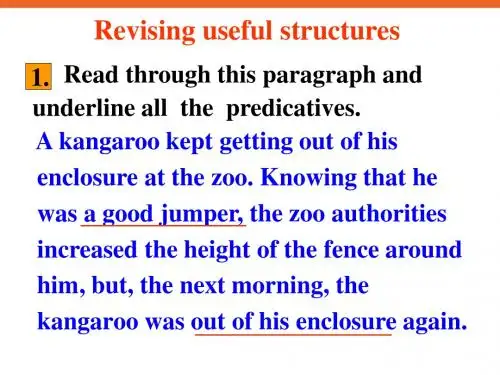
Revising useful structures
1. Read through this paragraph and underline all the predicatives. A kangaroo kept getting out of his enclosure at the zoo. Knowing that he was a good jumper, the zoo authorities increased the height of the fence around him, but, the next morning, the kangaroo was out of his enclosure again.
高中英语Unit 3 Australia(3)
Unit 3 Australia(3)Period 3 Grammar: Revising of the PredicativeⅠ. Teaching aims:Enable the Ss to grasp what can function as predicative (words, phrases, nonfinite, clauses) Enable the Ss to apply this grammar point to the daily use of EnglishⅡ. Teaching important points:What can function as predicative and how to use correctly use them to the contextⅢ. Teaching difficult points:What can function as predicative and how to correctly apply them to the contextⅣ. Teaching methods:Inductive and deductive methods, task-based learning and cooperative learningⅤ. Teaching aids:A computer, a blackboardⅥ. Teaching procedures:(Pre-class)Get the Ss to collect some pictures of Australia and describe them respectivelyStep Ⅱ Revision and lead inAs k the students to recall what they’ve learned in the previous reading passage(five short textsin the Reading part)Ask them a group of questions:Where is Australia?How do you like Australia? Use several Adjectives to describe it.Do you think Australia is a wonderful tourist destination?How would you feel if you offered a chance to tour around Australia?Then write down Ss’ answers, of course each answer contains a predicative, so underline them, thus lead in today’s main focus---grammar point the predicative.Step Ⅲ Discovering the rules1. Ask the Ss to turn to page 26 and underline all the predicatives in Exercise 1 & Exercise2. In Exercise 2, have a pair of Ss to act out the dialogue.2. Then check answers.3. Ask them to summarize what can function as predicatives in sentences.So, together with the Ss we work out that adj, noun, pronoun, numeral, adv, prepositional phrases,infinitives, -ing, -ed, clauses can function as predicatives.Step Ⅳ Further Explaining表语 Predicative表语是由系动词引导的主语补足语,补充说明主语。
最新人教版高中英语选修九精品课件:精品课件: Unit3Australia-Learning about language

2019/8/6
21
eg. She spotted someone coming out of the building. As the only man on the spot, he was in a position to take vital decisions.
他匆匆地看了一下她的脸。
[短语连接]
gaze at 盯着看, 注视着 stare at 盯着
glare at 怒视
2019/8/6
fit one’s eyes on盯着看 7
3. It is a mainly dry country with only
a few coastal areas that have
11
[短语连接]
have/ take responsibility for 对……负责
assume/ accept responsibility for 承担……责任
have a responsibility to do sth 应有做…..义务
be responsible to sb. 对某人负责
3. more than …can / could +v.不能…… more than 表示否定, 相当于not
eg. That’s more than I can tell you. 那一点我是不能告诉您的。
2019/8/6
17
4. more than +adj./adv 在语义上表示很高 的程度, 意为 “非常” “十分” “更 加”等
make a reservation 预定
Unit 3 Australia 重点词语学习
Unit 3 Australia重点词语学习associateverb1.[vn] ~ sb/sth (with sb/sth) to make a connection between people or things in your mind: I always associate the smell of baking with my childhood. He is closely associated in the public mind with horror movies. Most people immediately associate addictions with drugs, alcohol and cigarettes. You wouldn’t normally associate these two writers—their styles are completely different.2. [v] ~ with sb to spend time with sb, especially a person or people that sb else does not approve of:I don’t like you associating with those people.3. [vn] ~ yourself with sth (formal) to show that you support or agree with sth: May I associate myself with the Prime Minister’s remarks? (= I agree with them) I have never associated myself with political extremism.adj. [only before noun]1. (often in titles) of a lower rank, having fewer rights in a particular profession or organization: associate membership of the European Union an associate member / director / editor She was only the associate producer of the movie.2.joined to or connected with a profession or an organization: an associate company in Japannoun1. a person that you work with, do business with or spend a lot of time with: business associatesa close political associate of The company is called Landor Associates. He was known to be one of the convicted man’s associates.2.Associate (US) a person who has an Associate’s degree (=one that is given after completing two years of study at a junior college)barriernoun1. an object like a fence that prevents people from moving forward from one place to another: The crowd had to stand behind barriers. Show your ticket at the barrier. The car crashed into the safety barrier and burst into flames.2. ~ (to sth) a problem, rule or situation that prevents sb from doing sth, or that makes sth impossible: the removal of trade barriers Lack of confidence is a psychological barrier to success. Cost should not be a barrier to the use of legal services. The world of Disney is a magical experience that knows no age barriers.3. ~ (between A and B)| ~ (against sth) something that exists between one thing or person and another and keeps them separate: The Yangtze river is a natural barrier to the north-east. There was no real barrier between reality and fantasy in his mind. Ozone is the earth’s barrier against ultra-violet radiation. the language barrier (= when people cannot communicate because they do not speak the same language)4. a particular amount, level or number which it is difficult to get past: the first player whose earnings passed the $1.0 million barrierdefencenounPROTECTION AGAINST A TTACK1. [U] the act of protecting sb/sth from attack, criticism, etc.: soldiers who died in defence of their country When her brother was criticized she leapt to his defence. What points can be raised in defence of this argument? I have to say in her defence that she knew nothing about it beforehand.2.[C, U] ~ (against sth) something that provides protection against attack fromenemies, the weather, illness, etc.: The town walls were built as a defence against enemy attacks. The harbour’s sea defences are in poor condition. The body has natural defence mechanisms to protect it from disease. Humour is a more effective defence than violence.3. [U] the organization of the people and systems that are used by a government to protect a country from attack: (BrE) the Ministry of Defence (NAmE) the Department of Defense Further cuts in defence spending are being considered.SUPPORT4. [C] something that is said or written in order to support sth: a defence of MarxismLAW5. [C] what is said in court to prove that a person did not commit a crime; the act of presenting this argument in court: Her defence was that she was somewhere completely different at the time of the crime. He wanted to conduct his own defence.6. the defence [sing.+ sing./pl. v.] the lawyer or lawyers whose job is to prove in court that a person did not commit a crimeIN SPORT7.[sing., U] the players who must prevent the other team from scoring; the position of these players on the sports field: Welford cut through the defence to score the winning goal. (BrE) She plays in defence. (NAmE) He plays on defense.8 [C] a contest, game, etc. in which the previous winner or winners compete in order to try to win again: Milan’s defence of the European Cup policynoun (pl. -ies)1.[C, U] ~ (on sth) a plan of action agreed or chosen by a political party, a business, etc.: the present government’s policy on education The c ompany has adopted a firm policy on shoplifting.We have tried to pursue a policy of neutrality. US foreign / domestic policy They have had a significant change in policy on paternity leave. a policy document 2. [C, U] (formal) a principle that you believe in that influences how you behave; a way in which you usually behave: She is following her usual policy of ignoring all offers of help. (saying) Honesty is the best policy.3. [C] a written statement of a contract of insurance: Check the terms of the policy before you sign.taxnoun [C, U] ~ (on sth) money that you have to pay to the government so that it can pay for public services. People pay tax according to their income and businesses pay tax according to their profits. Tax is also often paid on goods and services: to raise / cut taxes tax increases / cuts changes in tax rates to pay over £1 000 in tax profits before / after tax a tax on cigarettes Income tax will be deducted by your employer. corporation tax, council tax, inheritance tax, poll tax, road tax, sales tax, stealth tax, value added tax, withholding taxverb [vn]1.to put a tax on sb/sth; to make sb pay tax:Any interest payments are taxed as part of your income. His declared aim was to tax the rich.2. (BrE) to pay tax on a vehicle so that you may use it on the roads: The car is taxed until July.3.to need a great amount of physical or mental effort: The questions did not tax me. The problem is currently taxing the brains of the nation’s experts (= making them think very hard).tax sb with sth(formal) to accuse sb of doing sth wrong:I taxed him with avoiding his responsibility as a parent.nationnoun1. [C] a country considered as a group of people with the same language, culture and history, who live in a particular area under one government:an independent nation the African nations2. [sing.] all the people in a country; population: The entire nation, it seemed, was watching TV. citizennoun1. a person who has the legal right to belong to a particular country: She’s Italian by birth but is now an Australian citizen. British citizens living in other parts of the European Union2.a person who lives in a particular place:the citizens of Budapest When you’re old, people treat you like a second-class citizen.celebrationnoun1.[C] a special event that people organize in order to celebrate sth:birthday / wedding celebrations2.[U, C] the act of celebrating sth:Her triumph was a cause for celebration. a party in celebration of their fiftieth wedding anniversary The service was a celebration of his life (= praised what he had done in his life).tolerateverb1. to allow sb to do sth that you do not agree with or like; put up with: [vn] Their relationship was tolerated but not encouraged. This sort of behaviour will not be tolerated. [v -ing] She refused to tolerate being called a liar. [also vn -ing]2. [vn] to accept sb/sth that is annoying, unpleasant, etc. without complaining; put up with:There is a limit to what one person can tolerate. I don’t know how you tolerate that noise!3. [vn] to be able to be affected by a drug, difficult conditions,etc. without being harmed: She tolerated the chemotherapy well. Few plants will tolerate sudden changes in temperature.homelandnoun1. [usually sing.] the country where a person was born: Many refugees have been forced to flee their homeland.2. [usually pl.] (in the Republic of South Africa under the apartheid system in the past) one of the areas with some self-government that were intended for a group of black African people to live in: the Transkei homelandsuperbadj. excellent; of very good quality: a superb player The car’s in superb condition. His performance was absolutely superb. You look superb.sowverb (sowed, sown / sowed, sowed)1. ~ sth (in / on sth)| ~ sth (with sth) to plant or spread seeds in or on the ground: [vn] Sow the seeds in rows. The fields around had been sown with wheat. Sow rows of lettuces between other vegetables. [v] Water well after sowing.2. [vn] ~ sth (in sth) to introduce or spread feelings or ideas, especially ones that cause trouble:to sow doubt in sb’s mind to sow confusionsow the seeds of sth to start the process that leads to a particular situation or result: In this way he sowed the seeds of his own success.sow (your) wild oats (of young men) to go through a period of wild behaviour while young, especially having a lot of romantic or sexual relationships: He wants to leave home, sow his wild oats and learn about life.verb [v]1. ~ (to / with sth) to be the same as or match sth; agree, tally: Your account of events does not correspond with hers. Your account and hers do not correspond. The written record of the conversation doesn’t correspond to (= is different from) what was actually said.2. ~ (to sth) to be similar to or the same as sth else: The British job of Lecturer corresponds roughly to the US Associate Professor.3. ~ (with sb) (formal) to write letters to sb and receive letters from themoweverb (not used in the progressive tenses)1. ~ sth (to sb) (for sth)| ~ (sb) sth (for sth) to have to pay sb for sth that you have already received or return money that you have borrowed: [vnn, vn] She still owes her father £3. 000. She still owes £3. 000 to her father [vn] The country owes billions of dollars to foreign creditors. How much do I owe you for the groceries? (figurative) I’m still owed three days' leave.2. ~ sth to sb| ~ sb sth to feel that you ought to do sth for sb or give them sth, especially because they have done sth for you: [vn] I owe a debt of gratitude to all my family. You owe it to your staff to be honest with them. [vnn] You owe me a favour! Thanks for sticking up for me—I owe you one (= I owe you a favour). I think you owe us an explanation. I think we’re owed an apology.3. ~ sth to sb/sth| ~ sb sth to exist or be successful because of the help or influence of sb/sth: [vn] He owes his success to hard work. The play owes much to French tragedy. [vn, vnn] I owe everything to him. I owe him everything. [vnn] I knew that I owed the surgeon my life.4. [vn] ~ allegiance / loyalty / obedience (to sb) (formal) to have to obey or be loyal to sb who is in a position of authority or power: All serfs owed allegiance to a lord.noun (pl. -ies)POWER1. [U] the power to give orders to people: in a position of authority She now has authority over the people who used to be her bosses. Nothing will be done because no one in authority (= who has a position of power) takes the matter seriously.2. [U] ~ (to do sth) the power or right to do sth: Only the manager has the authority to sign cheques. We have the authority to search this building.PERMISSION3. [U] official permission to do sth: It was done without the principal’s authority. We acted under the authority of the UN.ORGANIZATION4. [C, usually pl.] the people or an organization who have the power to make decisions or who have a particular area of responsibility in a country or region: The health authorities are investigating the problem. I have to report this to the authorities. the immigration authorities local authorityKNOWLEDGE5. [U] the power to influence people because they respect your knowledge or official position: He spoke with authority on the topic. the moral authority to run the countryEXPERT6. [C] ~ (on sth) a person with special knowledge; specialist: She’s an authority on criminal law. have sth on good authority to be able to believe sth because you trust the person who gave you theinformation: I have it on good authority that he is going to be promoted.desperateadj.1.feeling or showing that you have little hope and are ready to do anything without worrying about danger to yourself or others: The prisoners grew increasingly desperate. Stores are getting desperate after two years of poor sales. Somewhere out there was a desperate man, cold, hungry, hunted. I heard sounds of a desperate struggle in the next room.2. [usually before noun] (of an action) giving little hope of success; tried when everything else has failed:a desperate bid for freedom She clung to the edge in a desperate attempt to save herself. His increasing financial difficulties forced him to take desperate measures. Doctors were fighting a desperate battle to save the little girl’s life.3. [not usually before noun] ~ (for sth)| ~ (to do sth) needing or wanting sth very much: He was so desperate for a job he would have done anything. I was absolutely desperate to see her. (informal) I’m desperate for a cigarette.4. (of a situation) extremely serious or dangerous: The children are in desperate need of love and attention. They face a desperate shortage of clean water.desperately adv.:desperately ill / unhappy / lonely He took a deep breath, desperately trying to keep calm. They desperately wanted a child. She looked desperately around for a weapon. shrinkverb(shrank ,shrunk / shrunk, shrunk)1. to become smaller, especially when washed in water that is too hot; to make clothes, cloth, etc. smaller in this way: [v] My sweater shrank in the wash. [also vn]2. to become or to make sth smaller in size or amount: [v] The tumour had shrunk to the size of a pea. The market for theirproducts is shrinking. [vn] There was a movie called ‘Honey I shrunk the kids!’. Television in a sense has shrunk the world.3. [v + adv. / prep.] to move back or away from sth because you are frightened or shocked: He shrank back against the wall as he heard them approaching.a shrinking violet (humorous) a way of describing a very shy personshrink from sth to be unwilling to do sth that is difficult or unpleasant: We made it clear to them that we would not shrink from confrontation. [+ -ing] They did not shrink from doing what was right.windverb (wound, wound )1. [+adv. / prep.] (of a road, river, etc.) to have many bends and twists: [v] The path wound down to the beach. [vn] The river winds its way between two meadows.2. [vn + adv. / prep.] to wrap or twist sth around itself or sth else: He wound the wool into a ball. Wind the bandage around your finger.3. ~ (sth) (up) to make a clock or other piece of machinery work by turning a knob, handle, etc. several times; to be able to be made to work in this way: [vn] He had forgotten to wind his watch. [v] It was one of those old-fashioned gramophones that winds up.4.~ (sth) forward / back to operate a tape, film, etc. so that it moves nearer to its ending or starting position: [vn] He wound the tape back to the beginning. [v] Wind forward to the bit where they discover the body.5. [vn] to turn a handle several times: You operate the trapdoor by winding this handle.noun: Give the handle another couple of winds.wind sth down / wind down sth1. to bring a business, an activity, etc. to an end gradually over a period of time: The government is winding down its nuclear programme. The department is being wound down after the election.2.to make sth such as the window of a car move downwards by turning a handle, pressing a button, etc.: Can I wind my window down?wind up (informal) (of a person) to find yourself in a particular place or situation: I always said he would wind up in prison. [+ -ing] We eventually wound up staying in a little hotel a few miles from town. [+adj] If you take risks like that you’ll wind up dead.wind up/ wind sth up / wind up sth to bring sth such as a speech or meeting to an end: The speaker was just winding up when the door was flung open. If we all agree, let’s wind up the discussion. wind sb up / wind up sb(BrE, informal) to deliberately say or do sth in order to annoy sb: Calm down! Can’t you see he’s only winding you up? That can’t be true! You’re winding me up.—related noun wind-upwind sth up / wind up sth1. to stop running a company, business, etc. and close it completely2. to make sth such as the window of a car move upwards by turning a handle, pressing a button, etc.: Are all the windows wound up?paralyseverb [vn] [often passive]1. to make sb unable to feel or move all or part of their body: The accident left him paralysed from the waist down. (figurative) paralysing heat (figurative) She stood there, paralysed with fear.2. to prevent sth from functioning normally: The airport is still paralysed by the strike.recoververbFROM ILLNESS1. [v] ~ (from sth) to get well again after being ill/sick, hurt, etc.: He’s still recovering fro m his operation.FROM STH UNPLEASANT2. [v] ~ (from sth) to return to a normal state after an unpleasant or unusual experience or a period of difficulty: It can take many years to recover from the death of a loved one. The economy is at last beginning to recover.MONEY3. [vn] ~ sth (from sb/sth) to get back the same amount of money that you have spent or that is owed to you: He is unlikely to ever recover his legal costs.STH LOST / STOLEN4.[vn] ~ sth (from sb/sth) to get back or find sth that was lost, stolen or missing: The police eventually recovered the stolen paintings. Six bodies were recovered from the wreckage. POSITION / STATUS5. [vn] to win back a position, level, status, etc. that has been lost; regain: The team recovered its lead in the second half.SENSES / EMOTIONS6. [vn] to get back the use of your senses, control of your emotions, etc.; regain: It took her a few minutes to recover consciousness. to recover your sight She seemed upset but quickly recovered herself.snatchverb1. [usually +adv. / prep.] to take sth quickly and often rudely or roughly; grab: [vn] She managed to snatch the gun from his hand. Gordon snatched up his jacket and left the room. [v] Hey, youkids! Don’t all snatch!2. [vn] to take sb/sth away from a person or place, especially by force; to steal sth; steal: The raiders snatched $1.00 from the cash register. The baby was snatched from its parents' car.3. [vn] to take or get sth quickly, especially because you do not have much time: I managed to snatch an hour’s sleep. The team snatched a dramatic victory in the last minute of the game.snatch at sth1. to try to take hold of sth with your hands: He snatched at the steering wheel but I pushed him away.2. to take an opportunity to do sth: We snatched at every moment we could be together.noun1.a very small part of a conversation or some music that you hear: a snatch of music I only caught snatches of the conversation.2. an act of moving your hand very quickly to take or steal sth: a bag snatch to make a snatch at sth3.(taboo, slang) an offensive word for a woman’s outer sex organsin snatches for short periods rather than continuously: Sleep came to him in brief snatches.。
人教版高中英语选修九Unit3《Australia》课件(2)(新)
Iwasassociatedwithhimintheproject. 我同他一起做那个项目。
Heassociateswithallsortsofpeople. 他结交各种各样的朋友。 昨天我去了中国人民对外友好协会。 【知识拓展】associationn.联合交往;协会 inassociationwith与…联合 【考例1】
Melbourne
Canberra
Placesofinterest
TheOperaHouseinSydney,withthefamous HarbourBridge,floodlitbehind
theGreatBarrierReef offthecoastofAustralia
AyersRockintheNorthernTerritories isasacredsitetotheAboriginalpeople.
Theyarebuildingthebridgein______withanotherfirm.
parisonB.associationC.touchD.connect 【解析】答案为B。
2.adequateadj.适当的,足够的;尚可的, 差强人意的 【常用表达】beadequateforsth(数量或质量)令
Thenationalflag ofAustralia
ItincludestheUKflaganda largestarandsomesmall stars.ItwasonceacolonyofEnglan d.AustraliansspeakEnglish.Thela rgestarhassix ofthepointsstandingforsixstateso Australiaandthe seventhfortheterritories.
高中英语 Unit3《Australia》课件(1) 新人教版选修9
4. more than +adj./adv 在语义上表示很高 的程度, 意为 “非常” “十分” “更 加”等
eg. I’m more than happy to hear that. 5. more than one…不止一个, 作主语时,
eg. She spotted someone coming out of the building. As the only man on the spot, he was in a position to take vital decisions.
8. It is also possible to climb the rock, but most people don’t do this out of respect for the Aboriginal people who consider the rock to be sacred.爬上岩石也是可能 的, 但大多数人出于尊敬那些土著居民而 不那样做, 因为他们认为这块岩石是神圣 的.
Word Study nationality 国籍
national 国家的,民族的
international 国际的
nationwide 全国范围的
nation 国家
归纳
more than
1. more than + 数词, ……以上, 多 于……, ……有余, 等于over
eg. By then he was more than forty years of age.
2. GLIMPSES OF AUSTRALIA
澳大利亚小览
Unit3 Australia高三英语课件 新课标 人教版
Para. 5
7.The climate is different depending on the area. A Here “depending on” can be replaced by_____. A. with B. by C. from D. as with表示”随着”是介词; 而as 表示”随着”是连 词. 要注意之间的差别. With the days passing on, it’s getting colder. As the days pass on, it’s getting colder.
eg.) She gave birth to twins. The caterpillars feed on cabbage leaves.
A 3. One species of the snakes _______ dangerous.(para.1) A. is B. are C. were D. are to be
2. In area Australia is more or less the same as the USA.
3. Australia has about one third of the world’s sheep and produce almost one – sixth of its wool. F
The longest fence across Australia
Different climates. The only country covering an entire continent. It is a wealthy country.
Para 1 Para 2
Para 3
Para 4
Integrating skills
最新人教版选修9高中英语unit3 australia知识精讲及答案
高三英语新课 Unit3 Australia精讲一. 本周教学内容:高三新课:Unit 3(II)—Australia二. 总结与归纳:1. It was probably once connected to South America, but the continents separated as the earth’s plates moved.澳洲很可能曾经同南美洲连在一起,但是随着地球板块的活动而分离开了。
connect to / with :与……有联系/连接The child connected the moon with a fairy tale his grandma told him.separate:分离短语:separate…from….2. Having been separated from other continents for millions of years, Australia has many plants and animals that cannot be found anywhere else in the world.因为澳大利亚同其他大陆已经分离了几百万年了,所以澳大利亚与许多动植物是世界其他地方找不到的。
Having been separated from other continents for millions of years:现在分词的完成式做原因状语。
Having put up the tent, they started to cook their supper.3. One strange animals lay eggs yet feeds its young on its milk.有一种动物很奇特,会下蛋,而又给她的幼崽喂奶。
lay egg:下蛋。
lay的其他意思:摆放;把……归于相关的短语:lay out:布置;安排;lay down:放下;lay aside:把……放在一边;lay off:裁员;lay the foundation of ….:奠定……的feed sb. on sth. :用……喂养;=feed sth to sb.feed on….:以……为食In winter they feed the horses on hay and corn.Chinese people feed on rice chiefly.You can feed these turnips to the rabbits.其他短语:feed …with…:用……补给……be fed up with = be tired of…厌倦……He fed the fire with some logs.I have fed up with these boring meeting.4. In area, it is approximately the same size as the USA(without Alaska)which, however, has more than fourteen times as many people.澳大利亚的面积大致相当于美国(不含阿拉斯加)。