
2014 Unit 6 When was it invented Section B1
1b Write the name of a different food after each word. sweet ________ crispy ________ salty ______ sour______ 1c Listen and circle T for true or F false. T 1, Potato chips were invented by mistake. 2, They were invented in 1863. T 3, The customer thought the potatoes were not T thin enough. 4, The customer said they were not salty T enough. T 5, George wanted to make the customer happy. 6, The customer was happy in the end. T
The words in the box describe how food can taste. Write them under the correct pictures. Some pictures have more than one word.
sweet crispy salty sour
F F F F F F
1d Listen again. Complete the sentences.
The History of Potato Chips
Do you know how potato chips were invented? were invented by a cook called Potato chips _____________ George Crum. They were invented in 1853 ________George Crum cut the potatoes really, really ________ and then cooked them for a thin long time until they were _______. crispy Finally he put lots of salt on them so they were _______. salty
2 Rewrite these sentences using the passive voice. 1 Someone stole my watch. _________________________ My watch was stolen by someone. 2 They used five eggs to make the big cake. ________________________ Five eggs were used to make this big cake by them . 3 When did they invent the personal computer? _______________________________ When was the personal computer invented by them? 4 They asked us not to run in the hallway. We were asked not to run in the hallway by them . _____________________________ 5 Someone took the video back to the store. ____________________________________ The video was taken back to the store by someone.
九年级人教新目标
Unit 6 When was it invented?
Section B 1a-1e and Self Check
教学目标: 1.掌握单词 crispy, salty, sour, by mistake,
customer
1 crispy adj
crispy cookies 2.salty adj salt n eg: He added too much salt to the potato chips, so they are much too salty. 3 sour adj the sour taste go sour 4 by mistake make a mistake v mistook mistaken mistake A for B 5 customer n custom customers in the restaurant There are many _________ on Sundays. Eating dumplings on the eve of the Spring Festival custom of China. is the _______
1 It is often difficult to decide on the inventor of certain inventions. This is because sometimes a inventthings which are______ few people may ______ nearly the same. It’s hard to tell who came up with the idea first. Some inventions can also lead to other all of a sudden inventions ____________ . So some people doubt _______ whether the inventor used someone else’s idea to create his or her invention. That is websites why books or ______ usually ______ more than one inventor when giving information about mention inventions.
2014新目标九年级unit6When_was_it_invented_sectin_B2b-3b
●played
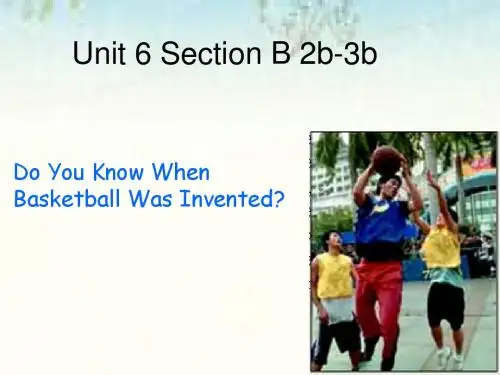
inside on a floor hard _______ ● teams ● get the ball into two
other team’s basket ________
Popularity
●played by more than 100 million people
▲include,included,including ①include用作及物动词,意思是“包括,包
含”.That can include the happiness of our children ②included用作形容词, 用在名词或代词后,意思是“包括在内”. ③including用作介词,意思是“包 括在内”. Everyone laughed,me included.每个人都笑了,包括我在内. Everyone laughed,including me.
2d Use the mind map to summarize what you and your partner remember about the development of basketball. Use the following questions to help you. 1. Who invented basketball and how is it played? Dr. James Naismith. There are two teams and players on the same team must work together to get the ball into the other team’s basket. 2. When was the first basketball game in history played? On December 21,1891. 3. Why were the Berlin Olympics important for basketball? Because basketball became an Olympic event then. 4. What are the professional basketball groups in America and China? NBA and CBA. 5. How popular is basketball? Basketball is played by more than 100 million people in over 200 countries.
Unit6Whenwasitinvented教材全解加课后练习讲解(附答案)
Unit6 When was it invented? 教师: 学生: 年级:日期: 2014 星期: 时段:辨析pleasure / pleased / pleasantpleasure n. 高兴,愉悦My pleasure. /With pleasure / It’s a pleasure. --Thanks for helping me. –My pleasure. pleased adj 高兴的be pleased to do sth 乐于做某事be pleased with 对。
满意Do not mention it. I am very pleased to help you.The teacher was pleased with the students' performance.pleasant adj 令人愉悦的Wish you a pleasant journey.3.Think about how often it’s used in our daily lives.Don’t you read the daily news in today’s newspaper?daily作副词时,每日,每天The milkman comes daily to our house.4.Well, you do seem to have a point…看来你说的确实有道理have a point意为:有道理You have a point—It would be better to wait till tomorrow.5.The pioneer of different inventions were listed there.list 列表,列清单List them and you will never forget them.list还可作名词意为:名单,清单I didn’t see his name on the list.6.For example, it mentioned that the zipper was invented by Whitcomb Judson in 1893.mention意为;提到,说到,其后可接that引导的宾语从句。
2014九上英语Unit 6 when was it invented Section A 2a-2c

Language points
1. Light的用法
一、用作形容词,表示“轻的”、“少量
的”、“浅色的”等意思。例如: —A re these bags heavy?这些包很重吗? —N o, they re light.不,不重。 I got up late this morning, so I had a light breakfast and went to school. 今早我起床晚了,所以吃了一点儿就上学了。 I like light green but Lily prefers dark blue.我喜欢浅绿色,但是莉莉喜欢深蓝色。
Car
1885
When was it invented? It was invented in 1885.
Benz.
Who was it invented by ? It was invented by Benz. What is it used for?
It is used for traveling fast.
Unit 9
When was it invented?
Period 2 Section A
2a-----2c
electricity /ilektrisəti/ n. 电;电能
In
modern cities we can’t live happily without electricity.
知识拓展
He
buried himself in an electrical book.
heel /hi:l/ n. 鞋跟;足跟
Nowadays
the
heels of women’s shoes are higher and higher, more and more beautiful.
2014秋九年级英语unit6When was it invented SectionA-B课文知识点归纳详细讲解

Unit6 When was it invented?Unit6 When was it invented?重点短语1.think of 想出seem to do sth似乎要做2.have a point 有道理at that time在那时3.by accident 偶然;意外地fall into落入;掉入4.make tea制茶less than少于5.take place发生;出现around the world 全世界6.without doubt毫无疑问the nature of... ......的本质7.drop into掉进at a low price以低价8.advise sb.(not) to do sth劝某人(不)做all of a sudden 突然;猛然9.work on从事于be similar to与......类似10.by mistake错误地in the end 最后11.the Olympics奥林匹克运动会divide ... into... 把......分开12.at the same to同时stop... from doing... 阻止......做......13.dream of 梦想the number of ......的数量14.look up to 钦佩;仰慕encourage sb. to do sth 鼓励某人做某事15.take notes 记笔记decide on 决定e up with想出重点句型1.—When was the telephone invented?—I think it was invented in 18762.—Who was it invented by ?—It was invented by Whitcomb JubsonSection A【记】Edison , a great _____________, __________over 1’000__________ all his life.(invent) 【2014甘肃白银】28. If you could ______________(发明) something new, what product would you development.【2014江苏泰州】56. Paper making is a great__________ (invent) of ancient China.①. I think the light bulb is one of the most important__________(invent)②.The car ___________(invent) in 1885.【辨析】Gibert ____________electricity, but Edison ___________ the electric light bulb.吉尔贝特发现了电,而爱迪生发明了电灯泡。
2014秋人教版新目标英语九年级Unit6-when-was-it-invented-Section
after the earthquake happened.
A. were sent B. are sent C. send D. sent
1. 完成课时作业。 2. 熟读并背诵Self Check 1。
idea first. Some inventions can also lead to other
inventions _a_l_l_o_f__a__s_u_d_d_e_n_. So some people _d_o_u_b_t_e_d_ whether the inventor came up with the
3a. Think of something that you do not like to do. Then think of an invention that could help
you. Make notes.
Problem
quickly taking notes in class
New invention
3. Find out information about an invention you would like to know more about and write sentences below.
Invention _________________________
When _________________________
句一般要用相应的过去时态(客观事实除
外)。
如:Last class our physics teacher
said that the moon goes around the
sun.
He said he would go back home next
2014九年级Unit 6 when was it invented Section A 3a-3c
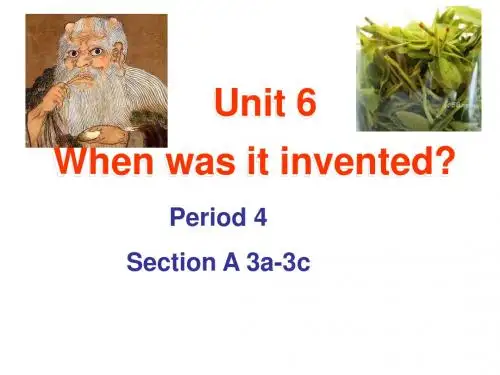
• Some leaves from a nearby tree fell into the water and remained there for some time. And a pleasant smell came from the water then. • He tasted the brown water and it was wonderful. And in this way, tea was invented.
Unit 6
When was it invented?
Period 4 Section A 3a-3c
1.An Accidental (意外的)Invention 2. What does it mean ? 3.Can you think of an invention that was invented by accident(偶然)
around 1660.
Task 1. Read the title and the first sentence.
Answer : How was tea invented ?
It was an accidental invention.\ It was invented by accident.
New words
• • • • • • • • • by accident 偶然;意外地 nearly /niəli/, /nirli/ adv. 几乎;差不 boil /bɔil/ v. 煮沸;烧开 smell /smel/ n. 气味 v. 发出气味;闻到 saint/seint/ n. 圣人;圣徒 take place 发生;出现 doubt /daut/ n. 疑惑;疑问 v. 怀疑 without doubt 毫无疑问;的确
英语人教新目标九年级全一册(2014年新编)Unit 6 When was it invented Section A 教案
Unit 9 When was it invented?Section AThe First PeriodⅠ. Teaching Aims and Demands1. Knowledge Objects(1)Key Vocabulary: invent(2)Target LanguageWhen was the telephone invented?I think it was invented in 1876.2. Ability Objects(1)Teach the students to use the new words.(2)Train the students to talk about the history of inventions.(3)Train the students’ listening and speaking skills with the target language.3. Moral ObjectsMany important inventions have changed the world a lot. Do you know the inventors of them? And when were they invented?Ⅱ. Teaching Key Points1. Key Vocabulary: invent2. Target Language: Talk about the history of inventions.Ⅲ.Teaching Difficult Points1. Train the students to talk about the history of inventions.2. Train the students to understand the target language in spoken conversation.Ⅳ. Teaching Methods1. Listening.2. Group work.3. Pair work.Ⅴ. Teaching Aids1. A tape recorder.2. Some pictures or real objects of the inventions.Ⅵ.Teaching ProceduresStep I Revision1. Revise the language points in Unit 9.Ask some students to say something about Tina and the stories happened on April F ool’s Day. Encourage them to use the Past Perfect Tense.2. Check the homework by asking some students to share the sentences they made with the verbs with the class.Step Ⅱ 1aThis activity reviews vocabulary and introduces new vocabulary which can be used to talk about inventions.Read the inventions to the students.Call the students’ attention to the five pictures, Tell the students that all of these things were invented in the last 150 years.Point to each picture and let the students tell what it is.Write the names of the five inventions on the blackboard.computer, car, calculator, telephone, TV setHave several different students guess and write the dates on the board.Ask the class to repeat the questions and answers like this.T: When was the computer invented?Class repeat.SS: When was the computer invented?T: Good. Now Tom, what is your guess?S1: 1965.T: OK. Tom, repeat after me. The computer was invented in 1965.T: Class, please repeat.SS: The computer was invented in 1965.Repeat the process with several different inventions.Tell the children that they will find out the real dates after they complete the lesson.After that, ask the students the questions below:Questions:1.Which one do you think is the oldest?2.Which one is the newest?3.Which one do you think is the oldest or the first invention?4.Which one is the newest or last invention?Ask different students to answer the questions.Have the students look at the example conversation in the box. Ask two students to read this conversation to the class.A: I think the telephone was invented before the car.B: Well, I think the telephone was invented after the car.Read the instructions again to the students. Remind them to remember the inventions from first to last.Then have the students talk about the five inventions in groups of four, using the sample conversation as a model.Ask several groups to tell the class their answers. The rest of the class listen to them and show they have different answers by raising their hands.In the next activity you will find out the real dates.Step Ⅲ 1bThis activity gives students practice in understanding the target language in spoken conversation. Get the whole class to read the instruction together.Call the students’ attention to the five inventions in the picture. Ask five students to say the names of them.Then ask them to see the five dates with a blank line in front of each.We’ll listen to a girl and a woman talking about the five inventions. They will talk about when they were invented. Listen carefully and match the inventions and the dates. Write the correct letter in front of each date as the sample given. Ask them to have a look at the sample answer. Tell them the answer in front of 1876 is d. That means that the telephone, which is letter d, was invented in 1876.Play the recording the first time. The students only listen and try to catch the main idea.Play the recording a second time. Let the students match the inventions and the dates.Check the answers by asking several students to say the answers to the class.If some of the answers are hard to get for the children, tell them not to worry and they will make it next.Then play the recording again.Pause after each sentence and let the students repeat.For some difficult sentences, get the students to repeat several times. Be sure that they make everything clear.Answersd 1876 a 1885e 1927 c 1971 b 1976Tape scriptGirl: Life must have been difficult when you were a kid.Woman: Oh; not really. Why do you say that?Girl: Well, you didn’t have many modern inventions. Like, you probably didn’t have a telephone, right?Woman: Of course we did! How old do you think I am? The telephone was invented in 1876. Girl: How about cars? I bet cars weren’t invented yet.Woman: Sure they were. Cars were invented in 1885. My family had a car. I think you need to take a history class, Alice.Girl: Ha, ha! Well, did you have a TV?Woman: No, we didn’t. The TV was invented around 1927, I think. Some friends of mine had one. But in those days, TVs were really expensive, and we couldn’t afford one.Girl: And I bet you didn’t have calculators and computers and stuff. That’s something I do know. We learned in school that hand-held calculators were invented in 1971 and personal computers were invented in 1976.Woman: You’re right. I didn’t have those things when I was young. But I do now!Step Ⅳ 1cThis activity provides guided oral practice using the target language.Read the instructions and point to the list of dates in Activity 1b.You will be talking about the dates things were invented with a partner.Call the students’ attention to t he example in the box. Ask a pair of the students to read this conversation to the class.SA: When was the telephone invented?SB: I think it was invented in 1876.Write the conversation on the blackboard.Then get the students to practice in pairs, using the information in Activity 1b. Tell them to do it like this:Student A covers the dates. Students B, asks Student A when the things in the picture above were invented. Then change roles and practice again.Ask several pairs to share their conversations with the class.Step Ⅴ SummaryIn this class, we’ve learned to talk about the history of inventions with passive voice. We’ve also done some listening practice in understanding the target language in spoken conversation. And we’ve done much oral practice, us ing the target language.Step Ⅵ Homework1.Write out two conversations in Activity 1a.2.Write out two conversations in Activity 1c.Step Ⅶ Blackboard DesignUnit 9 When was it invented?Section AThe First Period1.The names of the five inventions:computer, car, calculator, telephone, TV set2.Target language:A: When was the telephone invented?B: I think it was invented in 1876.The Second PeriodI. Teaching Aims and Demands1. Knowledge Objects(1)Key Vocabularybe used for, adjustable, heel, battery, operate, slipper, scoop, electric(2)Target LanguageWhen was the car invented?It was invented in 1885.Who were they invented by?They were invented by Julie Thompson.What are they used for?They are used for seeing in the dark.2. Ability Objects(1)Train the students’ listening skill.(2)Train the students’ communicative competence using the target language. (3)Train the students to use the new vocabulary.Ⅱ. Teaching Key Points(1)Listening practice with the target language.(2)Make communications with target language.(3)Teach the new vocabulary.Ⅲ. Teaching Difficult Points1. Teaching the Grammar Focus.2. The listening practice with the target language.3. Make communications with the target language.Ⅳ. Teaching Methods1. Listening2. Pair workⅤ. Teaching AidA tape recorderⅥ. Teaching ProceduresStep I Revision1. Check the homework.2. Revise the target language learned last class. Get the students to ask and answer questions in pairs like this:SA: When was the telephone invented?SB: I think it was invented in 1876.Tell them to ask about all the five inventions.Step Ⅱ 2aThis activity provides listening practice with the target language and review new vocabulary about inventions.Show these new words on a screen by a projector.be used for 用来做……adjustable adj.可调整的heel n.(鞋、袜等的)后跟;(足)跟battery n.电池operate v.操作;作业slipper n.拖鞋scoop v.用勺舀n.勺子;球形勺;长柄勺electric adj.电子的;电的Point to each one and teach them to read.Do it several times until the children can read them well.Ask a few students to read the new words.See if they can read each word correctly.Ask the students to read the instructions together.Write the names of the inventions on the blackboard:Shoes with adjustable heelsbattery operated slippersheated ice cream scoopRead the three names of the inventions and the students repeat. Do some explanation as well. Then point to the picture of each invention and ask students what they think is interesting about it. You’ll hear about some interesting inventions. Please listen and number the three inventions in theorder that you hear them in the conversation. Write a number in front of each invention to show what order you hear about them.Play the recording the first time, students only listen. Then play the recording again. Ask the students to write a number on each short line in front of each invention.Check the answers by asking a student to tell the answers.AnswersThe inventions should be numbered in this order.Tape scriptBoy: What are those?Girl: They’re battery-operated slippers.Boy: What are they used for?Girl: They’re used for seeing in the dark.Boy: Oh, that’s cool! Who were they invented by?Girl: Julie Thompson.And look at this heated ice cream scoop.Boy: I know what it’s for! It’s used for scooping out really cold ice cream.Girl: Right.It was invented by Chelsea Lanmon.Boy: My favorites are those shoes with adjustable heels. You know you can move the heels up and down. They were invented by Jayce Coziar and Jamie Ellsworth.Girl: And what are they used for?Boy: Well, you can change the style of your shoes. You can make the shoes go from casual to dressy.Step Ⅲ 2bThis activity provides guided listening practice using the target language.Get the students to read the instructions together. Be sure that each student knows what to do. Read the three headings Inventions. Who was it invented by? And what is it used for?Then read the information under each heading. Do some explanation if necessary.You’ll hear the same recording again.Please listen carefully to what the people are saying and draw lines to match items in the chart. Call the students’ attention to the three-part sample given in the chart. Read it to the class and explain it like this:The sample means the shoes with adjustable heels were if invented by Jayce Coziar and Jimie Ellsworth. They are used for changing the style of a shoe.After that, play the recording again and the students draw lines to match the items in the three columns.Check the answers by asking three different students to read their answers to the class.At last, play the recording for another time and pause after each sentence. The students repeat after it sentence by sentence. Do some explanation if necessary.Make sure that everyone understands all the details about the conversation.Answersshoes with adjustable heels Jayce Coziar and Jamie Ellsworth——changing the style of a shoe battery operated slippers Julie Thompson seeing in the dark heated ice cream scoop Chelsea Lanmon scooping really cold ice cream.Step Ⅳ 2cThis activity provides guided oral practice using the target language.Read the instructions to the students.Ask a pair of the students to read the sample conversation.SA: What are they used for?SB: They’re used for seeing in the dark.Get the students to ask about the three inventions first, using the information in the chart in Activity 2.Then let them role play the conversations using the information in the chart in Activity 2c.Get them to make their own conversations using the information in the chart in Activity 2c like this:(Pointing to the inventions)A: What are these?B: They are battery-operated slippers.A: What are they used for?B: They are used for seeing in the dark.A: Who were they invented by?B: They were invented by Julie Thompson.Ask the students to work in pairs. Move around the classroom checking progress and providing help if needed.Check the answers by calling on different pairs to say their conversations for the class.StepⅤ Grammar FocusThis activity introduces the target language with the Passive Voice.Call the students’ attention to the sentences in the grammar box.Ask four pairs of the students to read the questions and answers in the grammar box.SA: When was the car invented?SB: It was invented in 1885.SA: When were electric slippers invented?SB: They were invented last year.SA: Who were they invented by?SB: They were invented by Julie Thompson.SA: What were they used for?SB: They were used for seeing in the dark.Write them on the blackboard.Let the student think about the structures of these sentences.Tell them that when the subject of the sentence is the doer, we have to use be plus a past participle as the predicate of the sentence.Circle the words were in all the sentences.Ask: When do we use was in the questions, and where in the questions?Underline the singular nouns and plural nouns.Singular items like car use the singular verb was. Plural items like slippers use the plural verb were.Circle the word invented in all the sentences.You always use a past participle when you use was plus a verb or was plus a verb. And you can tell the doer with by.Say something about be used for to the children.Step Ⅵ SummaryIn this class, we’ve done some listening and writing practice with the target language. We’ve alsodone some oral practice in pairs. And we’ve discussed the Passive V oice as well. StepⅦ Homework1.Try to remember the new vocabulary on page 77.2.Write down two conversations in activity 2c.StepⅧ Blackboard DesignUnit 9 When was it invented?Section AThe Second Period1.The names of the inventions and answers of activity 2a:3 shoes with adjustable heels1 battery operated slippers2 heated ice cream scoop2.Target Language:A: When was the car invented?B: It was invented in 1885.A: When were electric slippers invented?B: They were invented last year.A: Who were they invented by?B: They were invented by Julie Thompson.A: What are they used for?B: They’re used for seeing in tile dark.The Third PeriodⅠ. Teaching Aims and Demands1. Knowledge Objects(1)Key Vocabularybulb, light bulb, microwave, oven, microwave oven, island(2)Target LanguageWhat is the microwave oven used for?It is used for cooking.2. Ability ObjectsTrain the students’ writing and speaking skills with the target language.3. Moral ObjectsIf you are alone on a tiny island, what inventions would you like to have on the island with you? Ⅱ. Teaching Key Points1. Talk about the helpful inventions and annoying inventions.2. Guide the students to discuss their opinions on the inventions.Ⅲ. Teaching Difficult Points1. Discuss the opinions on the inventions.2. Use the target language to describe the inventions.Ⅳ. Teaching Methods1. Pair work2. Group workⅤ. Teaching AidsSome pictures of the helpful inventions and annoying inventions.Ⅵ. Teaching ProceduresStep Ⅰ Revision1. Revise the three inventions talked last class. Ask about the names of the three inventions. Help the students answer:shoes with adjustable heelsbattery-operated sneakersheated ice cream scoopThen ask the two questions below on each invention:a. Who was it invented by?b. What is it used for?2. Revise the target language with the Passive V oice in Grammar Focus by asking several ones to read the sentences.3. Check the homework. Dictate the words below:bulb, light bulb, microwave oven, islandStep Ⅱ 3aThis activity provides practice with listening, speaking, reading and writing using the target language.Call the students’ attention to the three pictures of three inventions.Teach them to read the names of the inventions. Do it like this:T: Look at the first picture, please. We can see the name under the picture.Now read after me, alarm clock.SS: Alarm clock.Do the same with light bulb and microwave oven.Then read the instructions to the students.Explain helpful inventions and annoying inventions to the students like this, showing a picture of a vacuum cleaner.A vacuum cleaner is helpful.Then show a picture of a truck to the class.A very loud truck is annoying.Then let the students look at the three pictures in the textbook.Ask these questions on each invention:1. Is this invention useful or annoying?2. What is it used for?Then ask the whole class ask and answer the two questions above in pairs.Read the instructions to the students again.Point to the chart in the textbook. Tell the students to fill in the blanks with other helpful and annoying inventions on their own.Give the class about five minutes to do this.As they work, move around the’ room providing some names of inventions to them and answering questions as necessary.Point out the sample answer in the box before they start writing.After they have all finished, ask some students to read their answers to the class. Then get thestudents to work with their partners. Have each student talk about their list with another student, asking each other questions. For example,What is your first helpful invention?Why do you think it is helpful?Sample answersHelpful Inventions Annoying Inventions1. bike 1. recorder2. TV set 2. guitar3. computer 3. tractor4. plane 4. loudspeaker5. umbrella 5. mobile phoneStepⅢ 3bThis activity provides listening and speaking practice using the target language.Ask the students to read the instructions together.I think the most helpful invention is the computer because it has changed the world a lot.Then ask a pair of the students to model the sample dialogue:SA : What do you think is the most helpful invention?SB: I think the most helpful invention is the light bulb.SA: Why is that?SB: Well, it gives people more time to work and play every day.Correct any pronunciation errors. Make sure they are providing a good model. Write the conversation on the blackboard.After that, get the class to work in pairs and complete the work.Please discuss your opinions in Activity 3a with your partner now.Ask some ones to tell the class about their partners’ opinions and reasons. They may say like this: Zhang Ming thinks the most helpful invention is the car because it makes our travel easier.Step Ⅳ Part 4This activity provides oral practice using the target language.Ask the students to see the picture first.And encourage some students to describe it. They may say like this: The man is alone on a tinyisland. He is sitting under a tree and thinking. What can he see around the island is water.Then read the instructions to the class.Do some explanation if necessary. Make sure each student can understand the instructions and know what to do.Tell the class to discuss in groups of four.Imagine that you are alone on a tiny island and you had ever got a chance to choose five inventions you would like to have on the island with you. Each group has to tell what you choose and why.Remind them that they can use all the items mentioned in Activities 1a, 1b, 2a and 3a. And they can also use any other items they can think of as they talk to their partners. Tell them to use the statement in the box as the beginning.Ask two students to read it to the class.SA: I’d like to have a radio because I could listen to music all day.SB: Yes, but that’s not going to help you leave the island. I think it would be better to have…Have the students work in groups of four. Move around the classroom and helping students as necessary.Ask each group to share their statements with the class. Compare their inventions and decide which ones are the most helpful.Sample conversation:A: I’d like to have a radio because I could listen to music all day.B: Yes, but that’s not going to help you leave the island. I think it would be better to have a mobile phone. So you can contact anyone who can save you.C: I don’t agree with you. I think you should choose a computer. It will help you to ask for help from all over the world.D: …StepⅤ SummaryIn this class, we’ve learned mor e about the inventions. And we’ve done much oral practice talking about the inventions.Step Ⅵ Homework1. Remember the new words on page 78.2. Write down the conversations in Activity 3b.3. Write down the conversation in Activity 3c.Step Ⅶ Blackboard DesignUnit 9 When was it invented?Section AThe Third PeriodTarget language:A: What do you think is the most helpful invention?B: I think the most helpful invention is the light bulb.A: Why is that?B: Well, it gives people more time to work and play every day.。
2014__Unit_6_When_was_it_invented__Section_A2
A.holding water B.seeing in the dark C. scooping
--What is it used for? --It is used for…
A drawing lines B cutting things C playing
--What is it used for? --It is used for…
• • • • •
•
•
When was the zipper invented ? It was invented in 1893. Who was it invented by? It was invented by Whitcomb Judson. When was tea brought to Korea? It was brought to Korea during the 6th and 7th centuries. What is the hot ice-cream scoop used for? It’s used for serving really cold ice-cream.
• 2d • Questions: • 1 What is the subject for Paul’s • 2 Where can we see zippers?
school project? Small inventions that changed the world
On dresses, trousers, shoes, bags…… almost everywhere. By Whitcomb Judson in 1893
• 4a Rewrite the sentences using the passive
2014九年级Unit 6 when was it invented Section B 3a-3c
A sample version
From pie plate to flying disk The flying disk was invented by college students. Flying disk is a metal pie plate. In the 1950s, several college students ate pies made by a bakery in Bridgeport, Connecticut. They found it interesting to throw the pie plates with each other. Then it became a game. Today, there are flying disk clubs, magazines and even a festival.
Writing
examples.
Eg . 1 Write an article using the notes in the box.
Who: college students
What: metal pie plate, flying disk When: 1950s
Where: bakery Bridgeport, Connecticut
Talk about it
3b
Imagine
you are a businessperson. Write a description of your new invention. Try to sell the invention to the class.
2014秋九年级英语unit6When-was-it-invented-SectionA-B课文知识点归纳详细讲解简单
Unit6 When was it invented?Section A1. I think the TV was invented before the car. 我认为电视机先于汽车被发明。
【解析1】invent v 发明→inventor n 发明家→invention n 发明【辨析】invent/ discover/find/find out2.My pleasure!这是我的荣幸【解析】please v 取悦→pleasure n愉快.It’s my _____________(please) to help you.→pleased adj.(人)高兴的→pleasant adj.(物)令人愉快的They went to Qingdao and had a ___________(pleasure) trip.be pleased to do sth 愉快做某事I’m pleased _____________(meet) you.be pleased with sth 对….满意3.Think about how often it’s used in our daily lives想想看它在我们的日常生活中是多么经常被用到。
``【解析】daily adj. 日常的;每日的= everyday【拓展】day n. 天,日→daily adj. 每日的daily life 日常生活4. The pioneers of different inventions were listed there 不同发明的先驱被列在那里。
【解析】list n 列表;列清单n 名单;清单make a list of ... 制作......的目录5.For example, it mentioned that the zipper was invented by Whitcomb Judson in 1893.例如,它提到拉链是惠特科姆.贾德森于1839年发明的。