
人教版 八年级下册Unit 2 How often do you exercise
1-3 times a week.
Every day.
How often do you…? Numbers of classmates(总 40) 1-3 times a week 20 4-6 times a week
10 10
every day
play in the park
climb the mountains
go to the beach
go camping in the countryside
play computer games
exercise
Rank these activities according to how often you think your 2a classmates do them (1=most often, 6= least often).
25 ______ % 4-6 times a week
25 % ______ every day
______ % 50 1-3 times a week Play sports
1. 读2b中的短文。 2. 根据2e的调查结果写一个报告。
记住好好锻 炼身体哟!
7. So start exercising before it’s too late! it’s too late 为时太晚;来不及了 e.g. Now you know you’re wrong, but it’s too late. 现在你知道你错了,但是已经太晚 了。
it’s too late与before共同组成从句,表示 “不要等到为时已晚;不要等到来不及 的时候;趁着还来得及 ”。 e.g. You should work harder before it’s too late to catch up. 你应当更加用功,别等到为时过晚而赶 不上了。(你现在用功还赶得上。)
1. We found that only fifteen percent of our students exercise every day. percent 名词,意为“百分之……” e.g. Eighty percent of the students in our class exercise every day. 我们班里80%的学生每天都锻 炼。
注意:although引导的从句不能与but连 用。 尽管他离家很早,但是他还是迟到了。 Although he left home early, but he was late.(×) Although he left home early, he was late. (√ )
[中考链接] (2012 成都) My cousin knows a lot about C geography, ______ he is only four years old. A. because B. so C. although
3. How often do most students watch TV? Most students watch TV every day. _________________________________ What do they usually watch? They usually watch sports, game shows. _________________________________ 4. What does the writer think is the best way to relax? Exercising. _______________________________ Why? __________________________________ It’s healthy for the mind and the body.
watch TV go to the movies play computer games exercise or play sports
use the Internet
go camping in the country
Let’s do a survey.
What do you do in your free time? Do exercise, use of the Internet or watching TV?
What activities do you think is healthy for the mind and the body?
2b
Read the passage quickly and find the answer to the questions below.
1. How many kinds of free time activities are mentioned in the passage? Three. _______________________________
6. Old habits die hard. 旧习难改。 这是英语中的一句谚语,表示习惯一 旦养成,并非朝夕即可改变,多用来 描述人们一时难以改变的固有观念及 做法。 e.g. It’s the age of new technology, but my grandpa still goes everywhere with his old radio. Old habits dire hard, you see. 现在都已经是新技术时代了,可我爷爷 仍然到哪儿都带着他的收音机。你瞧, 老习惯可真难改呀。
Choose one of these free time 2e activities or think of your own. Then ask your classmates how often they do this activity and make a pie chart.
How often do you play sports?
5. Do you think the students in No. 5 are healthy? No, I don’t think so. _________________________________ Why or why not? Because most students use Internet or _________________________________ watch TV on their free time. They don’t _________________________________ like exercising. It’s unhealthy. _________________________________
【注意】 percent做主语时,谓语动词的数要根据 其后面的名词来确定。 e.g. Fifty percent of the apples are bad. 50%的苹果都坏了。 Twenty percent of the meat is in the fridge. 20%的肉都在冰箱。
2. And twenty percent do not exercise at all! not … at all 意为“一点也不”, not应 和be动词、助动词或情态连用。 e.g. The story isn’t interesting at all. 那个故事一点也没有趣。 They didn’t enjoy the vacation at all. 他们根本不喜欢那次旅行。 The old man can’t use the computer at all. 那位老人一点也不会用电脑。
5. Exercise such as playing sports is fun… such as 意为“像……这样”,表示列 举。 结构常为:名词+ such as + 例子 e.g. She likes animas such as rabbits and birds. 她喜欢像兔子、小鸟这样的小动 物。
1. How many percent of the students do not exercise at all? Twenty percent students. __________________________________ 2. How many percent of the students use the Internet every day? Ninety percent students. __________________________________
3. Although many students like to watch sports, game shows are the most popular. although 连词,“尽管,虽然;即使” e.g. We went fishing although it was cold. 尽管天气很冷,但是我们还是去钓 鱼了。
4. …the best way to relax is through exercise. through 介词,课文中意为“以,凭 借” e.g. He found the job through an ad in the newspaper. 他通过报纸上的一个广告找到这份 工作。
[拓展] through 还有“穿过”之意。表示 “从……内部穿过”。 e.g. They went through the forest yesterday. 昨天他们穿过了森林。
______ 15 % every day
10 % ______ 3 or 4 times a week 20 % ______ no exercise 90 % ______ every day
20 % ______ 1-3 times 45 % ______ a week 4-6 times a week
Unit2How often do you exercise_ Section A 教学设计与反思

Unit2 Section A Grammar Focus-3cFrom(内容来源):2013年人教版八年级英语Time(时间):Sept. 6thTopic(课题):Unit 2 How often do you exercise?Section ALesson Type(课型):New LessonLearners(授课对象):The Students from Grade 8Teacher(授课老师):Li ChunfangLearning aims made by(目标确立的依据):1.课程标准要求1)能识别不同句式的语调,如陈述句疑问句和指令等。
2)能就熟悉的话题进行简单的交流。
3)能正确的朗读课文。
2. 学情分析八二班孩子英语基础薄弱,班级没有尖子生,中等生和中等偏下学生是主力军,中等偏下学生比例占全班的30%以上。
所以教学内容设计以基础和重点为主,拓展为辅。
3.教材分析Unit 2 Section A Grammar Focus-3c 重点讲解用频度副词及一般现在时谈论周末活动,要求学生掌握学习目标中的基本短语,以及重点句型。
Learning aims(学习目标):1) 能掌握以下单词以及短语:hardly ever, maybe, least, at least,能掌握以下句型:① —What does he do on weekends? —He usually watches TV.① —How often do you watch TV? —I watch TV every day.① —Does he go shopping? —No, he never go shopping.2) 能了解以下语法:频度副词及一般现在时简单谈论周末活动情况。
教学重点:1) 对6个频度副词细微差异的理解及使用。
2) 弄清一般现在时在不同人称下动词形式及提问的变化。
教学难点:1) 第三人称单数谓语动词在此核心句型中的运用。
(完整word版)Unit2Howoftendoyouexercise知识点归纳与练习.doc
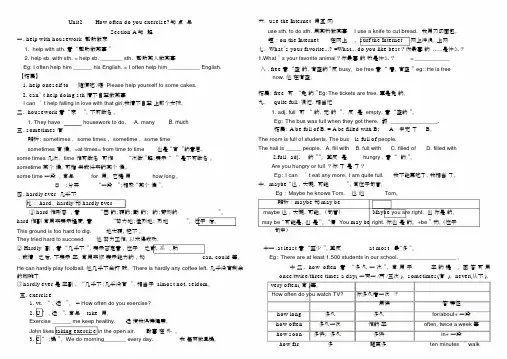
Unit2 How often do you exercise?知点与Section A 知解一. help with housework 帮助做家1.help with sth. 意“帮助做某事”2.help sb. with sth. = help sb. _______ sth. 帮助某人做某事Eg: I often help him ______ his English. = I often help him __________ English.【拓展】1.help oneself to ⋯随便吃 /喝·Please help yourself to some cakes.2.can’ t help doing sth情不自禁做某事I can’ t help falling in love with that girl.我情不自禁上那个女孩。
二. housework 意“家”。
不可数名。
1. They have housework to do. A. many B. much三. sometimes 有辨析: sometimes , some times , sometime , some timesometimes 有候。
=at times= from time to time也是“有”的意思。
some times 几次。
time 作可数名可作“次数”解;表示“ ” 是不可数名。
sometime 某个候。
可指去或将来的某个候。
some time 一段。
常与for 用。
它提用how long 。
口:分开“一段”;相聚“某个候”。
四. hardly ever 几乎不比: hard、 hardly 和 hardly ever① hard 作形容,意“困的;硬的;勤的;的;苛刻的”。
hard 作副常用来表示程度,意“努力地;猛烈地;烈地”,位于后。
This ground is too hard to dig.地太硬,挖不。
人教版八年级英语教案-Unit 2 How often do you exercise
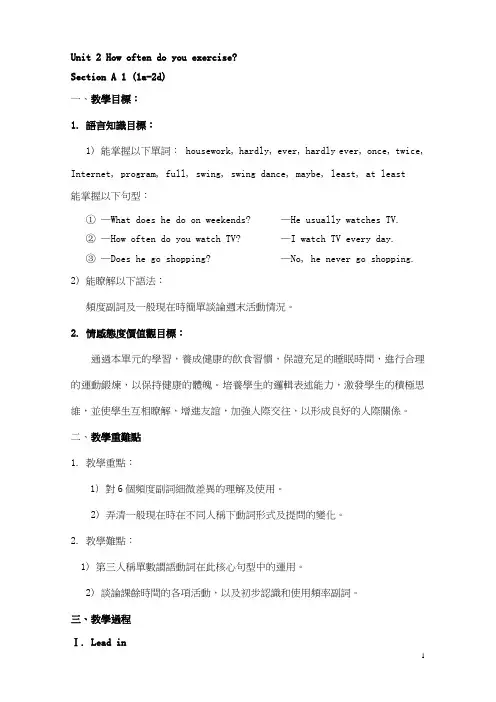
Unit 2 How often do you exercise?Section A 1 (1a-2d)一、教學目標:1. 語言知識目標:1) 能掌握以下單詞: housework, hardly, ever, hardly ever, once, twice, Internet, program, full, swing, swing dance, maybe, least, at least能掌握以下句型:① —What does he do on weekends? —He usually watches TV.② —How often do you watch TV? —I watch TV every day.③ —Does he go shopping? —No, he never go shopping.2) 能瞭解以下語法:頻度副詞及一般現在時簡單談論週末活動情況。
2. 情感態度價值觀目標:通過本單元的學習,養成健康的飲食習慣,保證充足的睡眠時間,進行合理的運動鍛煉,以保持健康的體魄。
培養學生的邏輯表述能力,激發學生的積極思維,並使學生互相瞭解,增進友誼,加強人際交往,以形成良好的人際關係。
二、教學重難點1. 教學重點:1) 對6個頻度副詞細微差異的理解及使用。
2) 弄清一般現在時在不同人稱下動詞形式及提問的變化。
2. 教學難點:1) 第三人稱單數謂語動詞在此核心句型中的運用。
2) 談論課餘時間的各項活動,以及初步認識和使用頻率副詞。
三、教學過程Ⅰ. Lead inTalk about your last weekend’s activities.Ⅱ. Presentation(1) 教師問:“W hat do you usually do on weekends ? ” (並且板書)讓學生根據自己的實際回答I usually …… on weekends.(2) 教師出示動詞卡片 watch TV,read books,exercise,swimplay football、go shopping、 go to movies讓學生回答。
Unit2Howoftendoyouexercise_GrammarFocus-3C课件人教版英语八

3a Match the questions and answers.
1. How often does he play soccer? 2. Do you drink milk? 3. How often do they stay up late? 4. Does Sue eat a healthy breakfast? 5. How often do you eat apples? 6. Do your parents play sports?
➢ always do exercise.
➢I go to the movies about once a month. ➢ I never cry.
频度副词 (Adverbs of Frequency) 种类:
1. 不表示具体次数的频度副词(按频率从高到低)
always(100%)总是>almost always几乎总是>usually通常>often经常> sometimes有时>seldom很少>hardly ever几乎从不>never(0%)从不
动词用do.
Grammar
3a Complete the questions with do or does.
1. How often __d_o_e_s__ he play soccer?
2.___D__o____you drink milk? 熬夜
3. How often__d__o____they stay up late?
2. __W__h_a_t_d_o__y_o_u_u_s_u_a_l_ly__d_o_o_n__w_e_e_k_e_n_d_s___Q? _______________________________? (what/ usually/ do/ weekends)
Unit2Howoftendoyouexercise课文翻译

Section A, 2d杰克:嗨,克莱尔,你下周有空吗?克莱尔:嗯……我下周已经安排得很满了,杰克。
杰克:是吗?怎么会呢?克莱尔:我在上舞蹈课和钢琴课。
杰克:你在学哪一种舞蹈?克莱尔:哦,摇摆舞。
它很有意思!我一周上一次课,在每周一。
杰克:你多久上一次钢琴课呢?克莱尔:一周两次,(在)周三和周五。
杰克:那么,你周二(干什么)呢?克莱尔:哦,我得跟朋友们打网球。
不过你想来吗?杰克:当然啦!Section B,2b第5中学的学生们在课余时间干什么?上个月,我们询问了我们的学生一些有关课余活动的问题。
我们的问题有关锻炼、使用网络,以及收看电视。
以下是(所获得的)结果。
我们发现我们的学生中只有百分之十五每天锻炼。
百分之四十五的学生一周锻炼四至六次。
百分之二十的学生一周只锻炼一至三次。
还有百分之二十的学生根本就不锻炼!我们都知道许多学生经常上网,但是让我们惊讶的是,有百分之九十的人每天使用网络,另外百分之十的学生每周至少使用网络三至四次。
绝大多数学生上网娱乐,并非为了做功课。
对我们提出的有关看电视的问题的回答也颇有意思。
只有百分之二的学生一周看一至三次电视,百分之十三的人一星期看四至六次电视。
另外百分之八十五的人每天都看电视!虽然许多学生喜欢观看体育节目,但游戏类节目却是最受欢迎的。
通过使用网络或观看游戏类节目来放松是件好事,但我们认为最佳的放松方式是通过锻炼。
它有益于身心的健康。
诸如参加体育运动这样的锻炼方式不但有趣,而且当你和朋友、家人一起运动时,你们还可以共度时光。
请记住:“旧习难改。
”所以赶快锻炼起来,不要等到来不及了。
人教版八年级Unit2How often do you exercise

3b Use the words given to write questions. Then ask and answer them with a partner. Questions
1. How often do you help with housework _______________________________________? (how often help with housework) What do / you usually do on weekends 2. _______________________________________? How often does your best friend exercise (what / usually / do / weekends) 3. What do you usually do after school _______________________________________? (how often / best friend / exercise)
Unit 2
How often do you exercise?
Section A
1. 初步了解并会使用频度副词描 述从事活动的频率(Adverbs of frequency) always, usually, often, sometimes, hardly ever, never 2.能谈论从事活动的频率 (Talk about how often you do things)
疑问词 how often 是问频率 (多久一次),(在 这里助动词 do (does或did) 是起帮助构成疑 问的作用)与一般现在时或一般过去时连 用, 回答一般是用表示频率的副词。 如:once, twice, three times…, sometimes, quite, often, never, every day, once a week, twice a month, three times a month, three or four times a month 等。
Unit2Howoftendoyouexercise?SectionB(3a-3c)课件人教版八年级
chdaonhhgoeam/bseiawtyso?r“kNo”
never
Bad habits ss...
once
If…, …will…
twice
three times…
Write a possible ending.
Jane is a 16-year-old high school student in the United States. American Teenager magazine asked her about her habits. Jane has a lot of good habits. She always exercises and she reads books every day. Also, she often drinks juice and she hardly ever stays up late. However, she has some bad habits, too. She usually watches TV for more than two hours a day, and she sometimes eat hamburgers. Her
For example:
I always eat fast food. …
2. Write five sentences using the information above.
1. I always play basketball after school. 2. My father always plays chess on
watch TV, too.
I. 单项选择
1. We ___D___ go out to eat but not
英语人教版八年级下册Unit 2 How often do you exerci
Unit 2 How often do you exercise?Section A 2 (Grammar Focus-3c)一、教学目标:1. 语言知识目标:1) 复习运用频率词汇及询问活动频率。
2) 一般现在时态的熟练运用。
2. 情感态度价值观目标:通过本单元的学习,养成健康的饮食习惯,保证充足的睡眠时间,进行合理的运动锻炼,以保持健康的体魄。
培养学生的逻辑表述能力,激发学生的积极思维,并使学生互相了解,增进友谊,加强人际交往,以形成良好的人际关系。
二、教学重难点1. 教学重点:1) —How often do you /does he(she)….? —He usually…2)频度副词的用法:always; usually ; often ; sometimes; hardly ever; never 2. 教学难点:1) 第三人称单数谓语动词在此核心句型中的运用。
2) 能够谈论课余时间的各项活动,以及初步认识和使用频率副词。
三、教学过程Ⅰ. Warming up and revision1. Ask and answer some oral questions on how often exercise.2. Check the homework.3. Ask Ss to role-play the conversation in 2d.Ⅱ. Grammar Focus1. 学生阅读Grammar Focus中的句子,然后做填空练习。
1) 你通常在周末做什么?______ ____ you _______ do on weekends?2) 我总是去运动。
I _______ _______.3) 他们总是在周未做什么事情?______ _____ they ________ on weekends?4) 他们经常帮助做家务。
They ________ _______ with housework.5) 她在周未做什么?What ______ she _______ on weekends?6) 她有时候去购物。
Unit2Howoftendoyouexercise?教案教学设计(人教版英语八年级)
Unit2Howoftendoyouexercise?教案教学设计(人教版英语八年级)第1课时今日寄语:A close mouth catches no flies。
病从口入,祸从口出【学习目标】1.学习Unit2中Section A单词短语,能够熟练听读单词,发音准确。
2.部分单词简单拓展运用。
继续学习一般现在时。
【要点和难点】熟练听读单词,发音准确※【预习任务】:I. housework意思是______________.是_______(可数\不可数) 名词,没有复数形式。
做家务_____________________ 做许多家务______________________1.We should(应该)help mother ____________________. 我们应该帮助妈妈做家务。
2.Housework _____(be) difficult for me .拓展与延伸:homework意为____________是_______(可数\不可数) 名词。
做家庭作业_______________ 做许多家庭作业_______________________________work意为_________是______ (可数\不可数) 名词。
job 意为_______是_____(可数\不可数) 名词Eg:) I have much _______(家庭作业) to do everyday. 我每天有许多家庭作业要去做。
He has a good _______(工作) 。
他有一份好工作。
II.hardly意为_________________。
表示否定意义。
它通常位于实义动词之前,系动词、助动词或情态动词之后。
句子中有hardly就已经表示否定,不能再使用其他否定词。
翻译:1. It hardly rains here. ______________________________.2. He could hardly see anything._______________________________.拓展与延伸:hard 既可以做形容词也可以做副词。
人教版八年级英语Unit2Howoftendoyouexercise知识点
人教版八年级英语Unit2Howoftendoyouexercise知识点Unit 2 How often do you exercise?短语:help with housework go shopping on weekendshow often hardly ever once a weektwice a month go to the movies every dayuse the Internet be free have dance and piano lessons swing dance play tennis stay up lateat least go to bed early play sportsbe good for go camping in one’s free timenot….at all the most popular such asgo to the dentist more than old habits the hardless than语法要点:What do you usually do on weekends? I always exercise.What do they do on weekends? They often help with housework.What does she do on weekends? She sometimes goes shopping.How often do you go to the movies? I go to the movies maybe once a month.How often does he watch TV? He hardly ever watches TV.Do you go shopping? No, I never go shopping.惯用法:1. help sb. with sth 帮助某人做某事2. How about…? ….怎么样?/ ….好不好?3. want sb. to do sth. 想让某人做某事4. How many + 可数名词复数+ 一般疑问句….有多少…..5. 主语+ find+ that 从句…发现…6. It’s + adj.+ to do sth. 做某事是….的7. spend time with sb. 和某人一起度过时光8. ask sb. about sth. 向某人询问某事9. by doing sth. 通过做某事10. What’s your favorite…..? 你最喜欢的……是什么?11 start doing sth. 开始做某事12. the best way to do sth. 做某事的最好方式词语辨析:1. how often 多久一次,用来提问动作发生的频率。