
八年级英语help课件
新人教版八年级英语下册unit2__I'll___help__to__clean_the_city_Section_A-1课件

3. We could put up signs. sign 是名词,具体用法如下: (1) “标牌,招牌”。例如: the sign of barber’s shop (2) “记号,符号”。 (3) “示意动作”。例如: The teacher made a sign to us to be quiet. (4) “迹象,征兆”。 例如: A red sky at sunset is a sign of good weather.
(2) need用作情态动词, 意为“必须”、“必 要”,没有人称、数的变化,后接不带to 的
动 词不定式。 通常用于疑问句和否定句中,构 成疑问句和否定句时,不需要使用助动词。
e.g. Need you go to the park with your
classmate?
(3) 由need引出的疑问句,答语表肯定时用 must或have to;表示否定时用needn’t或 don’t have to。例如: A: Need I come to work tomorrow? B: Yes, you must/have to.
Unit 2 I’ll help to clean up the
city park.
Warming up
• Do you want to be a volunteer?
• How could we help people?
Look at the pictures. What are they doing?
You could help sick people in the hospital.
I’d like to cheer up sick kids.
Language goals: How to offer help.
外研版八年级上册英语《Module12Help,Unit1》说课稿
外研版八年级上册英语《Module 12 Help,Unit 1》说课稿一. 教材分析外研版八年级上册英语《Module 12 Help, Unit 1》的主要内容是关于寻求帮助和提供帮助的场景。
本节课的主要话题是描述当我们在生活中遇到困难时如何向他人寻求帮助,以及我们如何回应他人的求助。
通过本节课的学习,学生将能够掌握一些关键的词汇和句型,如“Can you help me…?”, “What can I do for you?”, “I’m sorry, I can’t…”, 以及一些描述困难的词汇如“lost”, “broken”, “ hurt”等。
同时,学生还将通过听力、口语、阅读和写作等多种方式,提高他们的英语综合运用能力。
二. 学情分析根据我对八年级学生的了解,他们已经具备了一定的英语基础,能够听懂并运用一些基本的日常用语进行交流。
然而,他们在使用英语描述具体场景和解决问题方面还存在一定的困难。
因此,在教学过程中,我将会关注学生的个体差异,尽量采用他们能够理解的语言进行教学,并鼓励他们积极参与课堂活动。
三. 说教学目标1.知识目标:学生能够掌握本节课所学的关键词汇和句型,并能够运用它们进行简单的交流。
2.能力目标:通过听力、口语、阅读和写作等多种方式,提高学生的英语综合运用能力。
3.情感目标:培养学生乐于助人的品质,以及在面对困难时积极寻求帮助的意识。
四. 说教学重难点1.教学重点:学生能够掌握本节课所学的关键词汇和句型,并能够在适当的情境中运用它们。
2.教学难点:学生能够用英语描述具体场景和解决问题,尤其是在描述困难和对策方面。
五. 说教学方法与手段在本节课的教学过程中,我将采用任务型教学法,通过多种活动和任务,激发学生的学习兴趣,提高他们的参与度。
同时,我还会运用多媒体教学手段,如图片、视频等,帮助学生更好地理解和记忆所学内容。
六. 说教学过程1.导入:通过展示一张图片,引导学生思考他们在生活中遇到困难时会如何寻求帮助,以及他们是如何回应他人的求助的。
八年级英语下册课件Unit 2 I'll help to clean up 人教版
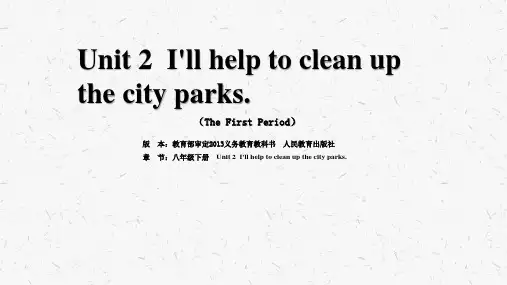
You should get your mom a mask for her safety. (is the best)
You could sing songs to cheer the kid up. (softer; is one of the
choices)
How to make a suggestion in English? How many different ways do you know to make a suggestion? Why don't you watch English movies on weekends? v.
To learn ways to help others To express plans and make sugesstions To write sentences using phrasal verbs
What's in your mind when you see “V”?
love
vacation
__d_o_in_g__s_o_m_e__s_h_o_p_p_in_g______________ 4. _..._______________________________
1b Listen and number the ways the boy and girl
河北省高阳县宏润中学八年级英语上册《Lesson 57 Help!》课件2 冀教版
• Jenny
I hope you can help me with my English project this week. 这一周我希望你能帮助 我完成英语课题。
talent较着重“才能”,一般不用复数。
And I think of myself a good person. 而且我也认为自己是个好 人。
think of…as…把…….认为/当 作……..
We think of them as our good friends. 我们把他们当作好朋友。
describe
Can you describe yourself? Tell me who you are, what you look like and anything about yourself.
ourselves
We’re old enough to look after ourselves. Don’t worry about us.
• Can you help me? What can I say about myself ?
• Li Ming
• From jenny@compmail.ca
• To: Li Ming @
• Subject: My report for school
• Date: 08/12 5:15 PM
• I can’t write your report for you. 我不能替 你写报告。
外研版八年级英语上册Module 12 Help Unit1课件
A.
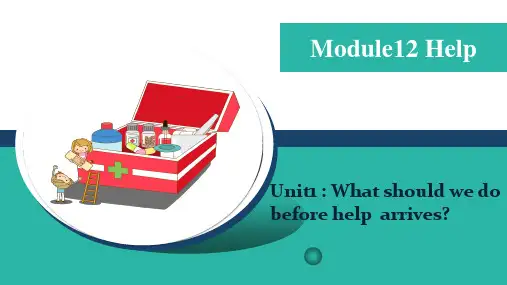
B We can cover him with a coat.
Read and fill
What's wrong with the boy?
1.He is lying at thebottomof the stairs .
(2) make+sb.+adj. 使某人... make him happy/sad
这个消息让我们很激动。 The good news made us excited.
4. No, that could be harmful! You could drop him and ...(教材P96)
Point
the imperative sentence
一、祈使句的用法
祈使句是用来表示请求、建议、命令、劝告、警告或禁止等语气的句子。 祈使句的主语you通常省略,谓语动词用原形。祈使句的句末通常用句号 或感叹号。朗读时用降调。
1.祈使句的四种句式 (1)Let型:Let+宾语+动词原形(+其他). Let him come here.让他来这儿。 (2)Do型:行为动词原形(+宾语+其他). Cut up these bananas.把这些香蕉切碎。 (3)Be型:Be+表语(+其他). Be quiet. 保持安静。 (4)No + v.-ing/名词 No smoking!禁止吸烟! 注意:为了使祈使句的语气更委婉,常在句首或句末加上please。 Sit down , please. 请坐。
make sure he's warm .
外研版八年级英语上册Module 12 Help自救常识
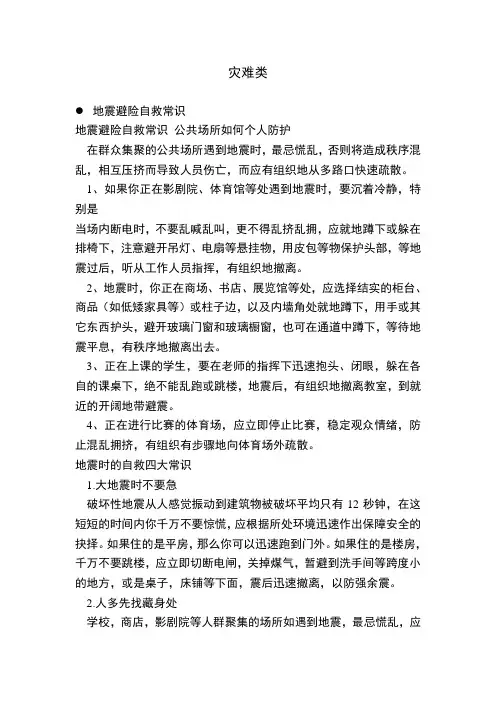
灾难类地震避险自救常识地震避险自救常识公共场所如何个人防护在群众集聚的公共场所遇到地震时,最忌慌乱,否则将造成秩序混乱,相互压挤而导致人员伤亡,而应有组织地从多路口快速疏散。
1、如果你正在影剧院、体育馆等处遇到地震时,要沉着冷静,特别是当场内断电时,不要乱喊乱叫,更不得乱挤乱拥,应就地蹲下或躲在排椅下,注意避开吊灯、电扇等悬挂物,用皮包等物保护头部,等地震过后,听从工作人员指挥,有组织地撤离。
2、地震时,你正在商场、书店、展览馆等处,应选择结实的柜台、商品(如低矮家具等)或柱子边,以及内墙角处就地蹲下,用手或其它东西护头,避开玻璃门窗和玻璃橱窗,也可在通道中蹲下,等待地震平息,有秩序地撤离出去。
3、正在上课的学生,要在老师的指挥下迅速抱头、闭眼,躲在各自的课桌下,绝不能乱跑或跳楼,地震后,有组织地撤离教室,到就近的开阔地带避震。
4、正在进行比赛的体育场,应立即停止比赛,稳定观众情绪,防止混乱拥挤,有组织有步骤地向体育场外疏散。
地震时的自救四大常识1.大地震时不要急破坏性地震从人感觉振动到建筑物被破坏平均只有12秒钟,在这短短的时间内你千万不要惊慌,应根据所处环境迅速作出保障安全的抉择。
如果住的是平房,那么你可以迅速跑到门外。
如果住的是楼房,千万不要跳楼,应立即切断电闸,关掉煤气,暂避到洗手间等跨度小的地方,或是桌子,床铺等下面,震后迅速撤离,以防强余震。
2.人多先找藏身处学校,商店,影剧院等人群聚集的场所如遇到地震,最忌慌乱,应立即躲在课桌,椅子或坚固物品下面,待地震过后再有序地撤离。
教师等现场工作人员必须冷静地指挥人们就地避震,决不可带头乱跑。
3.远离危险区如在街道上遇到地震,应用手护住头部,迅速远离楼房,到街心一带。
如在郊外遇到地震,要注意远离山崖,陡坡,河岸及高压线等。
正在行驶的汽车和火车要立即停车。
4.被埋要保存体力如果震后不幸被废墟埋压,要尽量保持冷静,设法自救。
无法脱险时,要保存体力,尽力寻找水和食物,创造生存条件,耐心等待救援人员平时的防震应急准备工作当政府有短期预报或临震预报后,人们应立即行动起来开始应急防震准备。
八年级英语人教版下册Unit2 I will help clean up the city parks精品课件(共57张PPT)
Gong Wei
music
sing for the old people
Role play. Take turns being one of the people in 3b . Ask for and give advice.
A: I’d like to join the school volunteer project, but I’m not sure what I should do. B: What do you like doing? A: I love playing soccer. B: Well, you could help coach a soccer team for little kids.
3a Being a volunteer is great!
Number 77 High School is home to three very special young people: Li Huiping, Lan Pei,and Zhu Ming. These three students all volunteer their time to help other people. This volunteer work takes each of them several hours a week, so it is a major commitment. Huiping loves to read, and she puts this love to good use by working in the after-school care center at her local elementary school. Here, she helps young children to read. Pei loves animals, and plans to study to be a veterinarian when he leaves school. He spends every Saturday morning working in an animal hospital. Ming wants
初中英语八年级上册Module12Help作业课件打包7套 外研版
Module 12ꢀHelpUnit 1ꢀWhat should we do before help arrives?第一课时一、用所给动词的适当形式填空。
(5×3分=15分)1.Hello ,everyone.Today ‘s topic is about __________(make)friends on the Internet.2.We will do what we can ___________(protect)the environment.3.I have some trouble ____________(learn)English grammar.making to protect learningbe 4.Tim isn ‘t at home.He could _____(be)in the playground now.5.Please ______(call)me when you arrive at the station.call二、根据句意,用方框中所给短语的适当形式完成句子。
(5×2分=10分)in pain,make sure,such…that,lift up,first of allmake sure6.Check your test paper again and_________ there are no spelling mistakes in it. 7.The girl hurt her leg and couldn‘t move.Maybe she was_________.in pain 8.Hello,class. ___________let me introduce a new classmate to all of you.First of all9.It is ________ fine weather ________ we want to go out for a walk today.such that10.The boy is very strong.He can______ the heavy box.lift up三、根据句意及汉语提示写单词。
英语人教版八年级下册I'll help to clean up the课件
3c. Use infinitives to complete the sentence below.
1. Mario would like ______an to be animal doctor. 2. Mario works for an animal hospital because he wantsto ______ learn about how_______ to care for animals. to look for a job at an after3. Mary decided ________ school reading program last year. She still works there now_______ to help kids learn to read. 4. Mary has a dream job because she can do what she loves________. to do
Mario says that volunteering is a hard work, but he wants to learn more about how to care for animals. He gets such a strong feeling of satisfaction when he sees the animals get better and the look of joy on their owners’ faces. Mary says that volunteering there is a dream come true for her. She can do what she loves to do and helps others at the same time.
八年级英语Help课件
Writing exercise: Students are required to use their vocabulary and grammar knowledge to complete short essay writing and improve their language expression ability.
Retrieval skills
The ability to quickly recall related information from memory to help in understanding the listening material
Language analysis
Identifying the language patterns, vocabulary, and grammar used in the listening material
Unit 3: Listening and Speaking
Listening skills and comprehension
Speaking skills and promotion
Unit 4: Writing Skills
Basic writing skills and formats
Essay writing and paragraph development
Repeated review method
Understanding sentence structure: Learn different types of sentences (simple sentences, compound sentences, compound sentences) and sentence components (subject, predicate, object, attributive, adverbial, etc.).