
英美国家概况复习资料下
New ZealandAn independent member of the British Commonwealthit's national flag is similar to the Australian flagA British union jack in the top left hand cornerThe southern cross on a blu backgroundNational anthem:God defend New ZealandIt lies in the south pacific oceanIt is between the equator and the south pole.Made up of 2 main islands:north island and south islandCapital:WellingtonThe size of the country is similar to Britain or Japan.It is the first country to get the new day as it is just west of the international date line.The most serious potential natural disasters are earthquakes and volcanoes.A fault line runs the length of the country.ClimateGenerally temperate, but because the country runs north south, the climate is varied.In the north:subtropicalIn some mountainous areas of south:almost sub-arcticThe red pohutukawa:New Zealand Christmas treeThe kiwi is a national symbol and new Zealand refer to themselves as kiwisNative people:the Maori.National day/Waitangi day:February 6th2 official languages: new Zealand:English MaoriCanada:English French The republic of Ireland : English Irish/GaelicThe making of new ZealandThe first European to visit new Zealand in 1642 was a Dutchman, Abel Tasman .The first Englishman in 1769 was captain James cook of the British royal navy.In1840 Hobson, representing queen Victoria, and some Maori chiefs, signed the treaty of Waitangi. Modern new Zealand was founded.The first country to give women the right to vote(1893).The world's largest exporter of mutton and dairy products.2nd largest exporter of wool.Head of state:the British monarch represented by the governor-generalThe government is headed by the prime minister.Leader of the majority partyIt's parliament has only one house:the house of representatives.A two-party system:the national party The labor partyRepublic of IrelandThe British isles are made up of 2 large islands and hundreds of small ones.The two large islands are great britain and Ireland.Ireland is also called the emerald isle because of its rich green countrysideIreland is divided into 2 political units: northern Ireland / the republic of IrelandNorthern Ireland is part of the UKThe republic of Ireland is an independent countryIt occupies about 5/6 of the island of Ireland.Different names of the countryThe constitution provides (article4) that the name of the state is eire , or in the English language, Ireland. However, the country is generally called the republic of Ireland.National flag:the national flag is a tricolor of green, white and orange.National emblem:the official symbol or coat of arms of Ireland :the harp.National emblem-shamrockThe national flower of northern Ireland is the shamrock, a three-leaved plant.it symbolized the rebirth of spring. National anthem: the solder's songNational day:st patrick's day march 17thIt commemorates st.patrick, the patron saint of Ireland who died on march 17th,461 A.D.It is bounded on the northeast by northern IrelandOn the north and west by the atlantic oceanThe capital is DublinHighest mountain:carrantuahillLongest river:ShannonThe most significant feature of irish landscape is bogsThe climate of Ireland is described as mild moist changeableIreland has excessive rainfallThe basic ethnic stock is CelticThere are no significant ethnic minorities.Historically Ireland has been free of ethnic conflicts because of its racial homogeneityEmigration plagues the country2 official languages: IrishOne of the most catholic countries of Europe :93%The UK1.the official nameThe united kingdom of Great Britain and Northern IrelandBritainThe united kingdomU.KThe British EmpireThe British commonwealth of nations (1931-)2.national Anthem and flag and capitalGod save the queenThe British meteor flag/union jack3.geographical features:The British islesTwo large islands:1.great britain :England ,Wales &Scotland 2.ireland:northern Ireland &republic of irelandSome hundreds of small islandsAn island country in north Atlantic ocean, off the north coast of Europe, separated from the main continent of Europe by the English channel in the south and the north sea in the east.4.Rivers and LakesThe Severn. The longest riverThe Thames :the best known river on which London standsThe lough neagh:the largest lakeThe lake district5.climateA maritime type of climate:Moderate, changeable, damp, warm6.the peopleThe English(Anglo-Saxons )The Scottish(celts)The welsh(celts)The Irish (celts)The cockney :a Londoner7.religionChurch of England(52%)Roman catholic (9%)Presbyterian (3%)Methodist(2%)The two established churches in Britain :The church of EnglandThe church of Scotland (presbyterian)8.major citiesLondonBirminghamManchesterLiverpoolEdinburgh (capital of Scotland )Glasgow(a major port, an industrial center, the largest city in Scotland )Belfast(Northern Ireland)CardiffThe UK is a constitutional monarchy :the head of the state is the king or queen who reigns but does not rule. The central government includes the monarch, parliament, and the cabinet.MonarchyElizabeth IIThe crown represents both the sovereign and the government, and is the symbol of supreme executive power. The king or queen is addressed as your majesty.ParliamentHouse of parliament and the big BenThree branches/elements: the monarch, the house of lords, and the house of commons;The term of each P is 5 yearsParliament -house of lordsNoble titles/nobility:1.duke, duchess2.marquis,marchioness3.earl,countess4.viscount, viscountess5.baron, baronessMPs are elected through general election;Citizens of 21years old and above (except those holding noble titles)Related terms:1.the party in powerCabinet-prime ministerThe PM, the leader of the party in power, is appointed by the queen;Duties:1.the composition of the cabinet2.presides over the cabinet3.the allocation of functions among ministersrm the queen of the general business of the governmentThe most senior ministers(usually about 20) compose the cabinetJustice and lawBritain does not have a written constitution.The primary sources of British law:1.statutes成文法mon law 不成文法3.equity law 衡平法4.european community law 欧共体法The British criminal law presumes the innocence of the accused until he has been proven guilty beyond reasonable doubtCapital punishment for murder has been abolished in the U.KSocial affairsBritain is a welfare state.The system is funded out of national insurance contributions and taxation.Festivals:Christmas, EasterEaster celebrates the resurrection of Christ.Cultural affairsEducation is compulsory for all between the ages of 5 and 16.The universities of Oxford and Cambridge(Oxbridge)Newspaper :Quality dailies:the times, the guardianWeekly magazines:the economistRadio:BBC the British broadcasting corporationHistory1.the origin of a nation(1).early settlers in Britaina.the Liberians (Stonehenge)b.the beaker folkc.the celts(2).roman BritainThe roman invasion: Julius Caesar(3).the Anglo -SaxonsJutes, Saxons and angles(4).the Viking and Danish invasionsAlfred the Great :the father of the British navy(5).the Norman conquest ; the battle of Hastings;a.harold of Wessex vs William the conquerb.consequences of the Norman conquest1.established the feudal system2.opened relations with the continent3.introduced Norman -French culture, language, manners and architecture;4.tightened the church's connection2.the shaping of the nation 1066-13811.norman rule(1).william's rule:The feudal system/The grand council/Domesday book(2).henry II and the Plantagenet dynastyConsolidated the monarchyReformed the courts and the law2.the great charterThe confrontation between king John and his barons led to the charter on June 19,1215The beginning of parliament3.the hundred years' war with France 1337-1453The name is given to the intermittent war between France and England that lasted from 1337 to1453Causes of the war:territorial &economicThe battle of argencourtJoan of ArcConsequences of the war4.the black death of 1348-49&the peasant uprising(1).black and it's consequencesIt swept though England in the summer of 1348 without warning and cure. It killed between one half and one third of the population of england(2).the peasant uprisingJohn Ball-1387Wat Tyler3.transition to the modern age(1). The wars of the rosesThe house of Lancaster (red rose)The house of York (white rose)The war ended in 1485 with the accession of Henry Tudor as Henry VIII, the founder of the Tudor monarchy.The middle ages also ended with the accession of the new king.(2).the English reformationHenry VIII and the English reformationRebuild the power of the monarchReligious reform of the church"Bloody Mary"Against protestantism in favor of roman Catholicism(3),Elizabeth IBritish naval power and the destruction of the Spanish ArmadaThe English renaissance became flourishingThe reign of elizabeth I was a period of political and religious stability on the one hand and economic prosperity on the other, laying the foundation of the British empire.(4).the English renaissanceTransitional period between the middle ages and modern times(1350-1650)the flourishing of Elizabethan drama, poetry,prose, W.Shakespeare; F.Bacon(5).Britain under James IThe divine right of kings;The king James bible or authorized version in 1611Religious persecution and the mayflower(6).charles I and the Par: the civil warsCharles I 's quarrels with the parliamentOliver Cromwell;the new modal armyConsequences of the civil wars:overthrew feudal system in England(7).establishment of the commonwealthAfter the king's execution, the HC proclaimed England to be thereafter a commonwealth, a republic, without king and the HLCromwell assumed the title of lord protector, a dictator and kept it for 5years until his death in 1658(8).the restoration and the glorious revolution of 1688The restoration and Charles II ;4.the rise and fall of the british1.whigs and Tories2.the industrial revolutionThe capitalist accomplished "primitive accumulation of capital" through enclosure/expansion/slave tradeRural-urban3.the Christ movementA movement for political reform, so called from the people's charter, drifted largely by William LovettAn expression of working class resentment against economic distress, the poor law and the failure of the attempt to develop trade unionism.4.trade unions and labor party5.colonial expansionForeign plunder, colonial expansion and aggression enabled the English bourgeoisie to establish the largest empire in historyThe formation of the empire wen through two processes:aggression and annexationThe sun-never -set empire6.20th centuryWorld war IMilitary blocsThe treaty of VersaillesThe disastrous effects of ww I1.disillusion2.economic recession3.political unrestWorld war IICauses of the warProceeding of the warConsequences of the war。
英美概况知识点总结题库

英美概况知识点总结题库一、英美概况基本概念英美概况是指英国和美国两个国家的基本情况和特点,包括地理、历史、政治、经济、文化、社会等方面的情况。
英美两国是世界上最有影响力的国家之一,其发展历史和国情具有重要的影响力。
因此,了解英美概况对于理解世界格局和国际关系有着重要的意义。
二、英美概况的地理特点1. 英国地理特点(1)英国位于欧洲西北部,包括英格兰、苏格兰、威尔士和北爱尔兰四个主要地区。
英国总面积244,820平方公里,是欧洲第三大岛国。
(2)英国地势大致呈现出中高原低洼的地形特点,山地和丘陵地区占据了半岛的西南部和中部,而低洼平原主要分布在东南和中南部地区。
2. 美国地理特点(1)美国位于北美洲中部,是世界第四大国家,总面积达到9,638,131平方公里。
(2)美国地形多样,山脉主要集中在西部,大平原和丘陵地区主要分布在中西部,而东部则是低洼平原地区。
美国有众多河流,包括密西西比河、科罗拉多河、哥伦比亚河等。
三、英美概况的历史沿革1. 英国历史沿革(1)英国有着悠久的历史文化,公元前55年,罗马帝国入侵了不列颠岛,成为不列颠的一部分。
5世纪,盎格鲁-撒克逊人从德国北部迁入英格兰,并在836年建立了第一个统一的英国王国。
(2)1066年,诺曼征服导致了英国的政治和社会结构发生了较大变化,12世纪中叶英国建立了自己的君主立宪制度。
16世纪的宗教改革导致了英国国教的建立,17世纪的克伦威尔革命结束了君主专制,成立了军政府。
18世纪末,英国工业革命开启了现代化的起点。
(3)19世纪,英国成为世界上最强大的殖民地帝国,印度和非洲大部分地区被英国殖民。
20世纪,英国在两次世界大战中扮演了关键角色,但在战后开始了殖民帝国的解体和国际地位的下降。
2. 美国历史沿革(1)美国历史的起源可以追溯到公元前1492年,哥伦布发现了北美大陆。
17世纪早期,英国殖民者开始在北美建立殖民地。
(2)18世纪末,美国爆发了独立战争,美国终于于1776年宣布独立,建立了独立的民主共和国。
英美国家概况复习资料
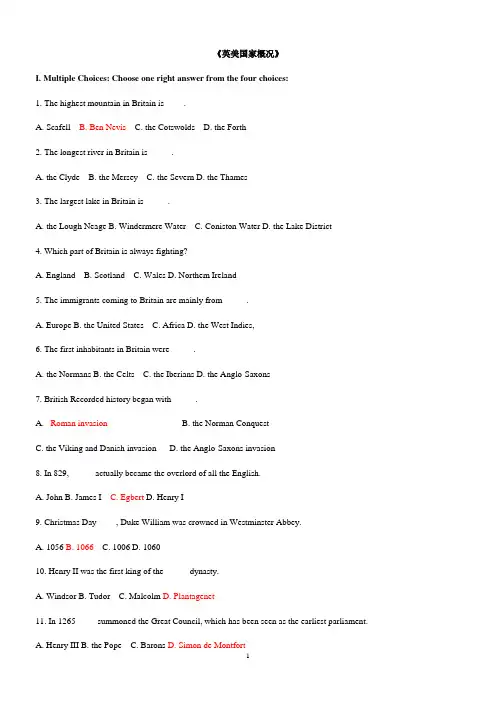
《英美国家概况》I. Multiple Choices: Choose one right answer from the four choices:1. The highest mountain in Britain is ____.A. ScafellB. Ben NevisC. the CotswoldsD. the Forth2. The longest river in Britain is _____.A. the ClydeB. the MerseyC. the SevernD. the Thames3. The largest lake in Britain is _____.A. the Lough NeageB. Windermere WaterC. Coniston WaterD. the Lake District4. Which part of Britain is always fighting?A. EnglandB. ScotlandC. WalesD. Northem Ireland5. The immigrants coming to Britain are mainly from _____.A. EuropeB. the United StatesC. AfricaD. the West Indies,6. The first inhabitants in Britain were _____.A. the NormansB. the CeltsC. the IberiansD. the Anglo-Saxons7. British Recorded history began with _____.A.Roman invasionB. the Norman ConquestC. the Viking and Danish invasionD. the Anglo-Saxons invasion8. In 829, _____ actually became the overlord of all the English.A. JohnB. James IC. EgbertD. Henry I9. Christmas Day ____, Duke William was crowned in Westminster Abbey.A. 1056B. 1066C. 1006D. 106010. Henry II was the first king of the _____ dynasty.A. WindsorB. TudorC. MalcolmD. Plantagenet11. In 1265 ____ summoned the Great Council, which has been seen as the earliest parliament.A. Henry IIIB. the PopeC. BaronsD. Simon de Montfort12. The Hundred Years’ war started in ____ and ended in ____, in which the English had lost all the territories of France except the French port of ____.A. 1337, 1453, FlandersB. 1337, 1453, CalaisC. 1346, 1453, ArgencourtD. 1346, 1453, Brest13. The Wars of Roses lasted for _____ years and king _____ was replaced by king _____.A.30, Richard III, Henry TudorB. 50, Richard III, Henry TudorB. C. 30, Richard I, Henry Tudor D. 50, Richard I, Henry Tudor14. The Renaissance began in ____ in the early ____ century.A. England, 14B. England, 15C. Italy, 14D. Italy, 1515. The English Civil War is also called _____.A. the Glorious RevolutionB. the Bloody RevolutionC. the Catholic RevolutionD. the Puritan Revolution16. In _____, a small group of Puritans sailed from _____ in the Mayflower to be the first settlers in the North America.A. 1620, LondonB. 1620, PlymouthC. 1720, LondonD. 1720, Plymouth17. In the 18th century, there appeared ____ in England, which owed a great deal to the invention of machines.A. the Industrial RevolutionB. the Bourgeois RevolutionC. the Wars of the RosesD. the Religious Reformation18. English colonial expansion began with the colonization of _____ in 1583.A. CanadaB. AustraliaC. IndiaD. Newfoundland19. _____ was famous for his abdication because of his marriage with a divorced American:A. Edward VIIIB. Edward VIIC. George VID. George VII20. In January _____ Britain became a member of the European Economic Community.A. 1957B. 1967C. 1973D. 197921. soon after _____, Britain not only gave up its econmic hegemony but also suffered a deep loss of its position of industrial leadership.A. 1900B. the First World WarC. the Second World WarD. 196022. In the 1970s among the developed countries, Britain maintained the lowest _____ rate and the highest _____ rate.A. inflation, growthB. growth, inflationC. growth, divorceD. growth, birth23. The following are all reasons of British decline of coal industry except _____.A.the exhaustion of old minesB. costly extractionB. C. little money being invested D. the labour shortage24. Britain’s foreign trade is mainly with _____.A. developing countriesB. other Commonwealth countriesC. other developed countriesD. EC25. The House of Lords is presided over by _____.A. the Lord ChancellorB. the QueenC. the Archbishop of CanterburyD. the Prime Minister26. A General Election is held every _____ years and there are _____ members of Parliaments are elected.A. five, 600B. five, 650C. five, 651D. four, 65127. The Prime Minister is appointed by _____ and he or she always sits in _____.A. the Archbishop of Canterbury, the House of CommonsB. the Archbishop of Canterbury, the House of LordsC. the Queen, the House of CommonsD. the Queen, the House of Lords28. The ultimate authority for law-making resides in _____.A. the QueenB. the CabinetC. the House of LordsD. the House of Commons29. The sources of British law include _____.A. statutes, common law, equity law and European Community lawB. statutes, common law and equity lawC. statutes, common law and European Community lawD. a complete code and statutes30. In criminal trials by jury, _____ passes sentenced and _____ decide the issue of guilt or innocence.A. the judge, the juryB. the judge, the judgeC. the jury, the juryD. the Lord Chancellor, the jury答案I. Multiple Choices: Choose one right answer from the four choices.1. B2. C3. A4. D5. D6. C7. A8. C9. B 10. D11. D 12. B 13. A 14. C 15. D16. B 17. A 18. D 19. A 20. CII. Fill in the blanks:1. Ceographically speaking, the north and west of Britain are _______, while the east and south-east are mostly______.2. Welsh is located in the ______ of Great Britain.3. The ancestors of the English ______, while the Scots, Welsh and Irish the ______.4. In the mid-5th century, three Teuronic tribes ______, _____, and _____ invaded Britain. Among them, the _____ gave their name to English people.5. The battle of _______ witnessed the death of Harold in October, 1066.6. Under William, the ______ system in England was completely established.7. The property record in William’s time is kno wn as ______, which was compiled in _____.8. _____’s grave became a place of pilgrimage in and beyond chaucer’s time after he was murdered.9. ______ was the deadly bubonic plague, which reduced England’s population from four million to ______ million b y the end of the 14th century.10. One of the consequences of the Uprising of 1381 was the emergence of a new class of ______ farmers.11. James I and his son Charles I both believed firmly in ______.12. During the Civil War, the Cavaliers supported ________, while the Roundheads supported _______.13. After the Civil War, Oliver Cromwell declared England a ______, later, he became _________.14. In 1707, the Act of _______ united England and ______.15. The two parties originated with the Glorious Revolution were _____ and _______. The former were the forerunners of the ______ Party, the latter were of the ______ party.16. In 1765, the Scottish inventor _____ produced a very efficient _____ that could be applied to textile and other machinery.17. After the Industrial Revolution, Britain became the “______” of the world.18. During the Second World War ________ led Britain to final victory in 1945.19. In 1974 and 1977, the two ______ shock caused inflation to rise dramatically.20. Natural gas was discovered in 1965 and oil in 1970 under _______.II. Fill in the blanks:1.highlands, lowlands2. west3. Anglo-Saxons, Celts4. Jutes, Saxons, Angles, Angles5. Hastings6. feudal7. Domesday Book, 10868. Thomas Becket9. Black Death, two 10. yeomen 11. the Divine Right of Kings 12. the king, the Parliament 13. Commonwealth, Lord Protector 14. Union, Scotland 15. Whigs Tories Liberal Conservative 16. James Watt steam engine 17. workship 18. Winston Churchill19. oil 20. the North SeaIII. Explain the following terms.1. the Hardian’s Wall: It was one of the two great walls built by the Romans to keep the Picts out of the area they had conquered.2. Alfred the Great Alfred was a strong king of the wisemen. It was created by the Anglo-Saxons to advis e the king. It’s the basis of the Privy Council which still exists today.3. William the Conqueror William was Duke of Normandy. He landed his army in Oct, 1066 and defeated king Harold. Then he was crowned king of England on Christams Day the same year. He established a strong Norman government and the feudal system in England.4. the battle of Hastings In 1066, King Edward died with no heir, the Witan chose Harold as king. William, Duke of Normandy, invaded England. On October 14, the two armies met nea r Hasting. After a day’s battle, Harold was killed and his army completely defeated. So this battle was very important on the way of the Roman conquest.5. Domesday Book Under William, the feudal system was established. William sent officials to compile a property record known as Domesday Book, which completed in 1086. It was the result of a general survey of England made in 1085. It stated the extent, value, the population, state of cultivation, and ownership of the land. It seemed to the English like the Book of doom on Judgement Day.6. the Great Charter King John’s reign caused much discontent among the barons. In 1215, he was forced to sign a document, known as Mangna Cara, or the Great Charter. It has 63 clauses. Though it has long been regarded as the foundation of English liberities, its spirit was the limitation of the king’s powers, keeping them within the bounds of the feudal law of the land.7. the Hundred Years’ War It referred to the intermittent war between France and England that last from 1337 to 1453. The causes were partly territorial and partly economic. When Edward III claimed the French Crown but the Frenchrefused to recognize, the war broke out. At first the English were successful, but in the end, they were defeated and lost almost all their possessions in France. The expelling of the English was a blessing for both countries.8. Joan of Arc She was a national heroine of France during the Hundred Years’ War. She successfully led the French to drive the English out of France.9. the Black Death It was the deadly bubonic plague who spread through Europe in the 14th century. It swept through England without warning and any cure, and sparing no victims. It killed between half and one-third of the population of England. Thus, much land was left untended and labour was short. It caused far-reaching economic consequences.10. the Wars of Roses They referred to the battles between the House of Lancaster and the House of York between 1455 and 1485. The former was symbolized by the red rose, and the latter by the white one. After the wars, feudalism received its death blow and the king’s power became supreme. Thdor monarchs ruled England and Wales for over two hundred years.11. Bloody Mary Henry VIII’s daughter and a devout Catholic. When sh e became Queen, she persecuted and burnt many Protestants. So she was given the nickname “Bloody Mary”. Mary is also remembered as the monarch who lost the French port of Calais.12. Elizabeth I One of the greatest monarchs in British history. She reigned England, Wales and Ireland for 45 years and remained single. Her reign was a time of confident English nationalism and of great achievements in literature and other arts, in exploration and in battle.13. Oliver Cromwell The leader during the Civil War who led the New Model Army to defeat the king and condemned him to death. Then he declared England a Commonwealth and made himself Lord of Protector. He ruled England till the restoration of charles II in 1660.14. the Bill of Rights In 1689, William and Mary accepted the Bill of Rights to be crowned jointly. The bill excluded any Roman Catholic from the succession, confirmed the principle of parliamentary supremacy and guaranteed free speech within both the two Houses. Thus the age of constitutional monarchy began.15. Whigs and Tories It referred to the two party names which originated with the Glorious Revolution of 1688. The Whigs were those who opposed absolute monarchy and supported the right to religious freedom for Noncomformists. The Tories were those who supported hereditary monarchy and were reluctant to remove kings. The Whigs formed a coalition with dissident Tories and became the Liberal Party. The Tories were the forerunners of the Conservative Party.16. James Watt The Scottish inventor who produced an efficient steam engine with rotary motion that could be applied to textile and other machinery.17. Winston Churchill Prime Minister of Britain during the Second World War. He took over Chamberlain in 1940 and received massive popular support. He led his country to final victory in 1945. He was defeated in the general election of 1945, but returned to power in 1951.18. Agribusiness It refers to the new farming in Britain, because it’s equipped and managed like an industrial business with a set of inputs into the farm of processes which occur on the farm, and outputs or products which leave the farm. The emphasis is upon intensive farming, designes to give the maximum output of crops and animals.19. the British Constitution There is no written constitution in the United Kingdom. The British Constitution is not set out in any single document, but made up of statute law, common law and conventions. The Judiciary determines common law and interpret statues.20. Queen Elizabeth II The present Sovereign, born in 1926, came to the throne in 1952 and was crowned in 1953. The Queen is the symbol of the whole nation, the center of many national ceremonies and the leader of society.IVRead the following statements carefully and decide if each of them is True or False: ( 20 points )( ) 1. The Bill of Rights is the term for the first twelve amendments to the Constitution.( ) 2. The stock market crash in 1929 was the beginning of a long economic depression in the U. S.( ) 3. George Washington was the first president of the United States.( ) 4. The system of the parliamentary government of the U.K. is based on a written constitution.( ) 5. Benjamin Franklin alone drafted the Declaration of Independence, and on July 4, 1776, the Congress adopted the declaration.( ) 6. Britain was the first country to start the Industrial Revolution which contributed to the establishment of the British Empire.( ) 7. The word English means “the language that belongs to the Angles.”( ) 8. The Pennines are known as the “Backbone of England”.( ) 9. The largest lake in Britain is the Lough Neagh Lake in Wales which covers an area of 397 square kilometers. ( ) 10. Both the First Continental Congress and the Second Continental Congress were held in Boston.( ) 11. The American Constitution founded feudalism and introduced checks and balances.( ) 12. The national church in Scotland is also the Church of England.( ) 13.Of all the English university Oxford and Cambridge are the most prestigious( ) 14. The House of Lords is now made up of two kinds of Lords: the Lords Spiritual and the Lords Temporal.( ) 15. William, Duke of Normandy, founded a strong fleet which first beat the Danes at sea and he became known as “Father of the British Navy.”( ) 16. Anglo-Saxons in Britain are believed to be ancestors of the Highland Scots, the Irish and the Welsh people. ( ) 17. After Margaret Thatcher was elected Britain’s first ever woman prime minister in 1979, she adopted a new program to cure the “British disease”.( ) 18. America Vespucci proved that the land discovered by Columbus was not Indian, but a new continent. As a result, the new continent was named after him and became known as America.( ) 19. Declaration of Independence was formally adopted by the Continental Congress on July 14, 1776, a day which has been celebrated each year as Independence Day of the United States.( ) 20. When the news of American victory at Yorktown reached London, the Parliament voted to end the War and peace negotiation began in 1782.1~5 FTTFF 6~10 TTTFF 11~15 FFTTTIIV Give an one-sentence answer to each of the following questions.1. What is the longest river in Britain?The longest river in Britain is Severn river.2. How long did the Wars of the Roses go on?The War of the Roses went on for 30 years.3. When did American Civil War break out?. American Civil War began in 1861.4. What were the mainstream Americans called?The mainstream Americans are called WASPs.5. What does American Congress consist of?American Congress consists of Senate and House of Representatives.IIIV Write between 100-150 words on the following topic: ( 10 points )Cold WarKey to Model 2Some historians say that the world entered Cold War immediately after the Second World War ended. The conflicts arose basically from the separate concepts of postwar world order. The United States, relying on its large economic and military strength, tried to play the role of world police under the pretext of fighting against the Soviet expansion. The Soviet Union put forward the theory that there could be no long-term peaceful coexistence between socialism and capitalism and the Soviet Union should rapidly build up its strength for the final struggle against capitalism, represented by the United States and Britain. Cold War was characterized by international tension and conflicts without bloody “hot war” between the Soviet Union and the United States. Cold War did not end until after the collapse of Berlin Wall in 1989.。
英美概况大题知识点总结

英美概况大题知识点总结1. 位置与面积:- 英国位于欧洲大陆的西北部,由英格兰、苏格兰、威尔士和北爱尔兰四个国家组成,是一个岛国,又称不列颠群岛。
- 美国位于北美洲的中北部,东临大西洋,西濒太平洋,与加拿大和墨西哥为邻。
是全球第三大、北美洲第二大的国家。
2. 地形:- 英国地貌复杂,地势起伏。
苏格兰地区有高山,如本提高地、格兰特群山、高地等,英格兰和威尔士地势较低,北爱尔兰地区以丘陵地形为主。
- 美国地大物博,地貌多样。
东部大西洋沿岸是低洼平原,中部是多河流盆地、大草原和沙漠,西部有洛矶山脉、科罗拉多高原和内华达高原,阿拉斯加地区是冰川遍布的高山地区,夏威夷是火山构成的群岛,加利福尼亚州和华盛顿州有大片的森林。
3. 气候:- 英国气候温和,受海洋性气候和大西洋洋流的影响。
冬季不太寒冷,夏季不太炎热,年降水量较多。
- 美国气候多样,北部地区属于温带大陆性气候,南部地区属于亚热带气候。
阿拉斯加地区气候寒冷,夏威夷地区气候属于热带海洋性气候。
整体上,美国西部偏干燥,东部偏湿润。
4. 主要城市:- 英国主要城市包括伦敦、曼彻斯特、伯明翰、利物浦等。
伦敦是英国首都,也是英国最大的城市,世界上最重要的金融中心之一。
- 美国主要城市包括纽约、洛杉矶、芝加哥、旧金山、华盛顿等。
纽约是美国最大的城市,也是世界金融中心之一,华盛顿是美国首都。
5. 自然资源:- 英国主要矿产资源包括煤炭、天然气、铁矿石和石油。
海洋渔业资源也非常丰富。
- 美国拥有丰富的煤炭、石油、天然气、铁矿石等矿产资源,以及广大的农业土地和丰富的水资源。
6. 语言和宗教:- 英国官方语言是英语,宗教主要是基督教,其中以英国国教会和天主教最为流行。
- 美国官方语言也是英语,宗教信仰多元,基督教、犹太教、伊斯兰教等都有一定的信徒。
英美历史概况:1. 古代历史:- 英国在古代分别由凯尔特人、罗马人、盎格鲁-撒克逊人和维京人等民族统治,1066年诺曼征服后建立了专制统治的王朝。
英美概况知识点总结 美国
英美概况知识点总结美国美国概况知识点总结1. 地理位置:美国位于北美洲的中央,与加拿大和墨西哥接壤,东临大西洋,西临太平洋。
2. 面积:美国是世界上第四大的国家,总面积约为9.83万平方公里。
3. 人口:美国是世界上第三大的人口国家,人口约为3.27亿。
4. 政治体制:美国是一个联邦制共和国,政治体制为总统制,国家元首为总统。
5. 首都:美国的首都是华盛顿哥伦比亚特区。
6. 经济实力:美国是世界上最大的经济体,国内生产总值(GDP)居世界首位。
7. 联邦制度:美国是一个由50个州组成的联邦制国家,每个州都享有一定的自治权利。
8. 文化多样性:美国是一个移民国家,拥有来自世界各地的不同种族和文化,因此其文化也非常多样化。
9. 科技实力:美国在航空航天、信息技术、医药和生物技术等领域处于世界领先地位。
10. 社会体系:美国拥有完善的社会保障体系和医疗保健制度,以及广泛的教育资源。
英国概况知识点总结1. 地理位置:英国位于欧洲大陆西北部,横跨大不列颠岛和爱尔兰岛东北部。
2. 面积:英国总面积约为24.12万平方公里。
3. 人口:英国是世界上人口密度最高的国家之一,人口约为6600万。
4. 政治体制:英国是一个君主立宪制国家,国家元首为君主,国家首相为政府首脑。
5. 首都:英国的首都是伦敦,也是英国最大的城市和金融中心。
6. 经济实力:英国是世界上经济实力较强的国家之一,拥有发达的金融、服务和制造业。
7. 文化传统:英国有着悠久的文化传统,包括文学、音乐、戏剧和艺术等领域。
8. 政治影响:英国是联合国安全理事会常任理事国之一,对国际事务有重要影响。
9. 教育体系:英国拥有世界一流的教育资源和大学,吸引了大量国际学生前来留学。
10. 社会福利:英国的社会福利制度完善,提供医疗保障、养老金和失业救济等项目。
美国和英国在政治、经济和文化等方面都有着自己独特的特点,对于全球事务具有重要的影响力。
这些国家的概况知识点总结可以帮助我们更好地了解它们的国情和影响力。
英语国家概况复习资料
英语国家概况复习资料英语国家概况复习资料英语国家概况是学习英语的重要一环,了解英语国家的历史、文化、地理等方面,有助于更好地理解和运用英语。
在这篇文章中,我们将回顾一些关于英语国家的基本知识,帮助大家复习和加深对这些国家的了解。
一、英国(United Kingdom)英国是英语的发源地,也是英语国家中最重要的一个。
它由四个国家组成:英格兰、苏格兰、威尔士和北爱尔兰。
英国是一个具有悠久历史和丰富文化的国家,拥有众多的文学、音乐和戏剧作品。
莎士比亚、狄更斯、毛姆等伟大的作家都出自英国。
此外,英国还有许多著名大学,如剑桥大学和牛津大学。
二、美国(United States)美国是世界上最大的英语国家之一,也是世界上最强大的国家之一。
它拥有丰富的资源和多元化的文化。
美国是一个移民国家,各种不同的文化和宗教在这里融合。
美国有众多著名的城市,如纽约、洛杉矶和芝加哥,每个城市都有其独特的魅力和特色。
此外,美国还是全球科技和创新的领导者,许多世界知名的科技公司都来自美国。
三、加拿大(Canada)加拿大是北美洲的一个国家,是英语和法语并存的国家。
加拿大是一个拥有广阔土地和丰富资源的国家,同时也是一个多元文化的国家。
加拿大的自然风光非常壮观,有着世界上最美丽的国家公园和湖泊。
此外,加拿大在教育和医疗领域也非常发达,拥有世界一流的大学和医疗系统。
四、澳大利亚(Australia)澳大利亚是一个位于南半球的国家,也是一个英语国家。
澳大利亚拥有宽广的土地和独特的动植物资源,是世界上最大的岛屿国家。
澳大利亚的自然环境非常独特,有着世界上最壮观的珊瑚礁和大堡礁。
此外,澳大利亚还以其高质量的教育和研究机构而闻名,吸引着来自世界各地的留学生。
五、新西兰(New Zealand)新西兰是一个位于南太平洋的岛国,也是一个英语国家。
新西兰的自然环境非常优美,有着壮丽的山脉、湖泊和海岸线。
新西兰是一个农业和旅游业发达的国家,其乳制品和葡萄酒在世界上享有盛誉。
英美概况知识点总结

英美概况知识点总结英美概况是指英国和美国的基本情况和特点。
英国是位于欧洲的一个岛国,由英格兰、苏格兰、威尔士和北爱尔兰四个国家组成,首都是伦敦。
美国则是位于北美洲的一个国家,由50个州组成,首都是华盛顿特区。
1. 地理位置英国位于欧洲西北部,东临北海,西濒大西洋,与法国相隔仅有英吉利海峡相隔。
美国则位于北美洲的中北部,东临大西洋,西濒太平洋,与加拿大相邻。
2. 历史文化英国是一个具有悠久历史的国家,拥有世界上最古老的君主制度。
英国文化对世界产生了深远的影响,包括文学、音乐、戏剧、电影等方面。
美国则是一个相对年轻的国家,但在短短几百年的时间里,美国发展成为世界上最强大的经济体和军事力量之一。
美国文化以自由、多元和创新为特点,融合了来自世界各地的移民文化。
3. 政治制度英国是一个君主立宪制国家,君主为国家元首,政府首脑为首相。
英国议会制度发源于英国,对世界各国影响深远。
美国则是一个联邦制共和国,总统为国家元首和政府首脑,国会为立法机关。
美国的总统制度也对世界其他国家的政治制度产生了影响。
4. 经济发展英国是一个高度发达的资本主义经济体,金融、服务业和创新产业是其经济的支柱。
英国拥有伦敦金融城,是全球金融中心之一。
美国则是世界上最大的经济体,以市场经济为基础,拥有发达的制造业、科技产业和金融服务业。
美国的股市和创新科技企业在全球具有重要地位。
5. 教育体系英国拥有全球顶尖的大学,如剑桥大学和牛津大学,以及众多优秀的高中和中学。
英国教育体系注重学术传统和素质教育。
美国则拥有世界上最多的大学和研究机构,美国的教育体系注重实践和创新,鼓励学生个性发展。
6. 社会福利英国实行社会福利制度,医疗、教育、退休金等福利待遇相对较高。
美国的社会福利制度相对较少,个人的社会保障和福利待遇更多依赖于个人努力和私人保险。
7. 文化特色英国有悠久的文化传统,包括皇室、茶文化、乡村庄园、英式足球等。
美国则是一个多元文化的国家,融合了来自世界各地的移民文化,美国足球、篮球、好莱坞电影等都是美国文化的代表。
英美国家概况复习材料
英美国家概况复习材料英美国家概况复习材料1.PuritanismPuritans were those who followed the doctrine of John Calvin and wanted to purify the Church of England. They believe that human beings were predestined by God before they were born. Some were God’s chosen while others were damned to hell. No church nor good works could save people. The sign of being God’s elect was the success in his work or the prosperity in his calling. They also argued that everyone must read the Bible in order to find God’s will and establish a direct contact with God. These beliefs had great impact on American culture.2.The Declaration of IndependenceThe Declaration of Independence was mainly drafted by Thomas Jefferson and adopted by the Congress on July 4, 1776, when the people of 13 English colonies in North America were fighting for their freedom and independence from the British colonial rule. The document declared that all mem were equal and that they were entitled to have some unalienable rights such as life, liberty and the pursuit of happiness. It also explained the philosophy of government: the powers of governments came from the consent of the governed and the purpose of governments were to secure the rights mentioned above. The theory of politics and the guiding principles of the American Revolution mainly came from John Locke.3.The Articles of ConfederationAfter the War of Independence was won, the new nation of the United States was organized under the agreement of the Articles of Confederation with a weak national government calledthe Congress. Each state had its own government, made ists own laws and handled its internal affairs. The states did not cooperate with the Congress and with each other. The Congress had no power to force any state to contribute money to the national government and the Congress could not tax any citizen either. Asa result, the Articles of Confederation failed.4.The making of the US ConstitutionThe Articles of Confederation failed. The Congress decided to hold a constitutional convention to revise the Articles of Confederation. The delegates from 12 states (Rhode Island refused to participate) gathered in Philadelphia in 1787 and ended up in writing a new constitution and set a federal system with a strong central government. The Constitution provided that an election of the president would be called, federal laws would be made only by aCongress made up of the House of Representatives and the Senate and a Supreme Court would be set up. This new Constitution was finally approved by the majority of the citizens in over 9 of the 13 states and was officially put into effect in 1787.5.Industrial Revolution in AmericaAfter independence, America was principally an agricultural country. The Industrial Revolution in England brought many changes to American industry between 1776 and 1860. One key development was the introduction of the factory system. A second development was the “American system”of mass production. A third development was the application of new technologies to industrial tasks. A fourth development was the emergence of new forms of business organization----the bank and corporation.6.The executiveThe chief executive is the president, who is elected to a four-year term. A president can be elected to only two terms according to an amendment passed in 1951. The president can propose legislation to Congress. He can veto any bill passes by Congress. The veto can be overridden by a two-thirds vote in both houses. The president can appoint federal judges as vacancies occur. He is the commander in chief of the armed forces. The president has other broad authorities in running the government departments and handling foreign relations.7.Industrial Revolution inAmericaAfter independence, America was principle an agricultural country. The Industrial Revolution in England brought many changes to American industry between 1776 and 1860. One key development was the introduction of the factory system. A second development was the “American system” of mass production. A third development was the application of new technologies to industrial tasks. A forth development was the emergence of new forms of business organization—the bank and corporation.8.Religious diversityFrontier America made the United States a fertile ground for the growth of new religious movements. Many religious communities and secular utopias, experiments in new forms of social living, were founded in 18th and 19th century America. Many small sects and cults appear in America society all the time. They have certain tendencies in common. They regard the larger society as hopelessly corrupt. Some of them never win a large following, but some others prosper and graduate into the rank of the respectable denominations. Some non-Western religions such as Buddhism, Islam and Hinduism are also growing.9.The “ Lost Generation”In the aftermath of World War I, many novelists produced a literature of disillusionment. Some lived in Europe. They were known as the “Lost generation”. Two of the mostrepresentative writers of the “Lost Generation”were Hemingway and Fitzgerald.10.Higher educationIn America, higher education refers to education on the college level. America higher education includes four categories of institutions. They are the university, the four-year undergraduate institution ( the college) the technical training institution and the two-year or community college. Some are supported by public funds and some by private funds. Many universities and colleges have won reputations for providing their students with a higher quality of education. The great majority are providing their students with a higher quality of education. The great majority are generally regarded as quite satisfactory.11.The civil rights movementIt is one of the most important spontaneous action in1955 was believed to be the true beginning of the civil rights movement. The black students’ sit-in at a department lunch counter in North Carolina touched off the nationwide civil rights movement. During the first half of the decade, civil rights organizations like SNCC, CORE, and SCLC struggled for racial integration by providing leadership, tactics, network and people. In the latter half of the decade, some black organizations changed their nonviolent tactics, and emphasized on more radical means to end dis crimination12.CountercultureIn the wake of the free Speech Movement and the New Left, there appeared a phenomenon that historians called the “counterculture.”The counterculture rejected capitalism and other American principles. They had morals different from those taught by their parents. Some groups pf youth tried to construct different ways of life. Among the most famous were the hippies. They sought new experience through dropping out, and drug taking. But it was music, rock music in particular, that became the chief vehicle for the counter cultural assault on the traditional American society. The counterculture exerted a great influence upon people’s attitudes toward social morals, marriage, career and success.13.Poverty as a social problemThe United States is one of the wealthiest countries in the world. Yet over 24 million people or about 10% of the population are living at or below the official poverty line, incomes that the federal government considers insufficient to meet basic requirement of food, clothing, and shelter. There are millions more living slightly above the poverty line, whose plight is not much better. Also, the social services in the United States compare unfavorably with those in most industrialized societies. Furthermore, the affluent majority seems indifferent to the problems of the poor. This raises some serious moral problems and inevitably creates fierce conflicts of interest and many political controversies. Therefore, poverty in the United States is a big social problem.。
英美国家概况考试复习
英美国家概况考试复习Ⅰ.Read the following statements carefully and decide whether they are True or False.1.The British history before 55BC isbasically undocumented.2.The Celts became the dominant group inBritain between the 8th and 5th centuries BC.3.The name of Britain came from a Celtictribe—the Britons.4.The Anglo-Saxons came to Britain in themid-5th century.5.The chief or king of the Anglo-Saxontribes exercised power at their own will. 6.The Vikings began to attack the Englishcoast in the 8th century.7.Henr yⅡbuilt up a large empire whichincluded England and most of France.8.The Magna Carta was designed to protectthe rights of both the privileged class and the townspeople.9.The Hundred Years’War was a series ofwars fought between England andNormans for trade and territory.10.In an effort to make a compromisebetween different religious factions, Queen Elizabet hⅠactually defended the fruit the Religious Reformation.Ⅱ. Choose the one that best completes each of the following statements.1. The_attack on Rome ended the Roman occupation in Britain in 410.A. NormanB. DanishC. CelticD. Germanic2. By the late 7th century,_became the dominant religion in England.A. Celtic ChristianityB. Anglo-Saxon ChristianityC. Germanic ChristianityD. Roman Christianity3. Westminster Abbey was built at the time of .A. St. AugustineB. Edward the ConfessorC. William the ConquerorD. Alfred the Great4. The_marked the establishment offeudalism in England.A. Viking invasionB. signing of the Magna CartaC. Norman ConquestD. Adoption of common law5. The end of the Wars of the Roses led to the rule of_ .A. the House of ValoisB. the House of YorkC. the House of TudorD. the House of Lancaster6. The direct cause for the Religious Reformation was King HenryⅧ’s eff ort to .A. divorce his wifeB. break with RomeC. support the ProtestantsD. declare his supreme power over the church7. The English Civil War broke out in 1642 between_.A. Protestants and PuritansB. Royalists and ParliamentariansC. nobles and peasantsD. aristocrats and Christians8._was passed after the Glorious Revolution.A. Bill of RightsB. Act of SupremacyC. Provisions of OxfordD. Magna Carta9. The Industrial Revolution was accomplished in Britain by the middle of the_century.A. 17thB. 18thC. 19thD. 20th10. Britain faced strong challenges in its global imperial dominance by the beginning of the_century.A. 17thB. 18thC. 19thD. 20thⅢ. Give brief answers to the following questions.1.What are the two components of the British parliament?2.What were some of Queen Victoria’s major achievements?3.What were the two camps in Europe in World WarⅠ?4.Why did Britain cooperate closely with the United States after World Wa rⅡ?Answers:1.T hey are the House of Commons and the House of Lords.2.Q ueen Victoria made tremendous achievements in almost every aspect. She promoted further industrial revolution, the building of railways and the growing of trade and commerce. By the end of her reign, Britain had developed to an empire including a quarter of the global population and nearly a quarter of the world’s landmass.3.T he Central Powers which included Germany, Austria-Hungary, the Ottoman Empire and Bulgaria and the Allied Powers which were mainly comprised of France, the Russian Empire, the British Empire, Italy and the United States.4.B ecause they were allied during the war and shared the same worries about the former Soviet Union.Ⅳ. State your understa nding of the following questions.1.What were the results of the IndustrialRevolution in Britain?2.The Rise and Fall of the British Empire?Answers:1.The Industrial Revolution changed Britainin many ways. First, industrial productivity increased dramatically. Britain became the most advanced industrial country and also the financial center in the world. Second, urbanization took place. Many new cities sprang up. Third, it caused great changes in the class structure. The old social classes declined, and new ones emerged and developed. The conflict between the capitalists and the proletarians became the most important political issue.2.Colonization of Newfoundland, the firstBritish colony overseas, in 1583 marked the beginning of theBritish Empire. By 1837,Britain had long been an empire which included the colonies in Canada, Australia, New Zealand, India and many small states in the West Indies. By the end of the 19th century, the British Empire included a quarter of the global population and nearly a quarter of the world’s landmass. During the mid-19th century, the British government consolidated the existing colonies by bringing them under the direct control of the government. Before World Wa rⅠ, Britain had the largest colonial empire in the world. However, Britain suffered great loss to its manpower in the two World Wars and exhausted its reserves of gold, dollars and overseas investment. Most of Britain’s colonies gained independence since the 1940s, which inevitably led to the fall of the Empire.。
英美国家概况(下)学期复习2
选择题1、The modern American economy progressed from colonial economy to farming economy,and eventually ,to industrial economy。
现代美国经济进展从殖民地经济到农场经济,终于,工业经济2、Chartered companies were NOT granted the diplomatic authority by the British King or Queen。
特许公司不是发放外交权力被英国王或女王。
3、President Johnson tried to build a “Great Society”by introducing various programs like the following except Unemployment Pension。
约翰逊总统希图建造一个“大社会”由介绍各个的方案喜欢下面除失业养老金。
4、The following statements are all true except Agribusinesses maintain a balanced pattern between agricultural imports and exports.下面声明是所有真只是农业综合企业保持一个平衡模式在农业之间进口和出口。
5,American Motors is not one of the three giants in the American automobile industry。
美国汽车不是之一三个巨人在美国汽车业6,At present,U.S. exports account for 10% of the world’s total. 目前,u。
s。
出口说明10原因%的世界的总。
7,higher education in the United States began with the founding of Harvard university。
英语国家概况课后题
英语国家概况课后题摘要:一、英语国家概况概述1.英美两国的历史背景2.地理位置及气候特点3.政治体制及社会制度二、英国概况1.历史发展简述2.地理位置及气候特点3.政治体制及社会制度4.经济状况及产业结构5.文化教育及著名旅游景点三、美国概况1.历史发展简述2.地理位置及气候特点3.政治体制及社会制度4.经济状况及产业结构5.文化教育及著名旅游景点正文:一、英语国家概况概述英语国家概况主要涉及英国和美国两个国家。
这两个国家具有深厚的历史背景,独特的地理位置和气候特点,以及各自的政治体制和社会制度。
在这部分,我们将对这两个国家进行简要的概述。
二、英国概况英国,全名“大不列颠及北爱尔兰联合王国”,位于欧洲西北部,由英格兰、苏格兰、威尔士和北爱尔兰四个部分组成。
英国是一个具有君主立宪制政体的国家,现任君主是伊丽莎白二世女王。
英国气候多样,但总体上属于海洋性气候,四季分明。
英国的经济以服务业为主,特别是金融、教育、旅游等产业具有较高地位。
在文化教育方面,英国拥有世界一流的大学,如牛津、剑桥等,吸引了全球众多学子前来求学。
著名旅游景点包括白金汉宫、大本钟、伦敦塔桥等。
三、美国概况美国,全名“美利坚合众国”,位于北美洲,东临大西洋,西濒太平洋。
美国是一个民主共和制国家,实行总统制。
美国的气候同样多样,但大部分地区属于温带大陆性气候。
美国是全球最大的经济体,拥有高度发达的工业、农业和服务业。
美国在科技、金融、航空航天等领域具有领先地位。
在文化教育方面,美国拥有众多世界顶级大学,如哈佛、耶鲁、斯坦福等。
著名旅游景点包括自由女神像、大峡谷、黄石国家公园等。
以上就是对英国和美国这两个英语国家的概况介绍。