
仁爱英语七年级下册Unit5 Topic1 知识点
Unit5 Topic1 知识点1. Happy New Year! 新年快乐! ---- The same to you. 也祝你新年快乐!2. Your new bike looks very nice! 你的自行车看起来很棒!系表结构:系动词look + adj. (look表示“看起来”)例如:His mother looks very young. 你的妈妈看起来很年轻。
Look还可作为行为动词,常用短语:look the same看起来一样 look like看起来像……look for寻找 look at 看……3. at the school gate 在学校门口4. come to+地点来到某地 go to+地点去某地(如果地点状语为 here/there/home 时,前面不加介词 to)例如:come to school 来学校 go home 回家5.交通方式的表达:1.) by+交通工具(表示使用某种交通方式,中间不加限定词,如果交通工具前有a, the, my 等限定词,就不能用by,而是用in或是on,即:on / in + a/ the/my +交通工具)(这两种方式通常位于句尾)2.) take a / the /my +交通工具例如:骑自行车 ride a bike/ by bike / on a bike 坐公交 by bus / take a bus/on the bus坐地铁 by subway / take the subway / on the subway(表达乘坐地铁只能用the)3.)特殊情况:“步行”的两种表达是“ on foot”和“walk”4.)骑车去某地: go to sp. by bike / on a bike = ride a bike to sp.步行去某地”: go to sp. on foot = walk to sp.乘坐飞机去某地:go to sp. by plane =take a plane to sp.5.) 对交通方式进行提问用“how”:例如:How do you usually come to school? 你通常怎样来学校?—I usually come to school by subway. 我通常乘坐地铁来学校。
6. how often 表示“多久一次”(对频度进行提问)频度的表达方式:1.)常用频度副词always> usually>often> sometimes>seldom>never(注意:频率副词在句中常放在be动词,情态动诃,助动词之后,行为动词之前。
例如:She is always busy with her work.她总是忙于工作。
He often gets up at 6 in the morning 他经常早上六点钟起床。
)2.)表示频率的短语:次数+单位时间(次数的表达方法1.“一次”once,“两次”twice; 2.表达三次或三次以上时用“数词+times”)例如: once a week一周一次 three times a year每年三次How often do you go to the library?你多久去一次图书馆?--once/twice/three times/four times a week/month/year7.get to + 地点到达某地例如:get home到家8. It’s time for class.该上课了。
It’s time for sth. = I t’s time to do sth.该做某事了。
例如:It’s time for school. = It’s time to go to school. 该上学了。
9. do one’s homework 做某人的家庭作业例如:do my homework 做我的作业have a class / have classes 上课 have an English class 上英语课10. get up 起床 get up early 早起go to bed 睡觉 go to bed early早睡例如:We should go to bed early and get up early. 我们应该早睡早起。
11. go+V.-ing 表示去做某事例如:go fishing 去钓鱼 go shopping 去购物 go boating 去划船12. in one’s free/ spare time 在某人的空闲时间例如:in my free/ spare time 在我的空闲时间13. come on 快点,加油,来吧 watch TV 看电视 at school 在学校on weekdays 在平日 on weekends在周末 on Sundays 在每个周日 know about / learn about 知道,了解 school life 校园生活an American student 一个美国学生the school life of American students 美国学生的校园生活in America / in the U.S.A. 在美国 for a short time 一会儿 every day每天after class 课下 after dinner 晚饭后 after school 放学play basketball 打篮球 play soccer / football 踢足球(进行球类运动则不带the)listen to music听音乐 read books读书 meet friends见朋友have breakfast 吃早饭 have lunch吃午饭 have dinner 吃晚饭go to the zoo去动物园 go to the park去公园 go to the library去图书馆in the morning 在早上 in the afternoon 在下午 in the evening 在晚上14. The early bird catches the worm. 早起的鸟儿有虫吃。
/ 笨鸟先飞。
15. be over 结束例如:What time is school over? 几点放学? Class is over.下课。
16.be different from 与……不同,不同于……例如: The new book is different from the old one. 这本新书不同于那本旧的。
时间表达法:1.) 顺读法:先读点钟再读分钟。
①整点:点钟+ o’clock (o’clock可以省略。
) 例如:3:00 three o’clock 或者 three②当0<分钟<10时:点钟 + O + 分钟例如:6:05 six o five③当10≤分钟<60时:点钟 + 分钟例如:8:26 eight twenty-six2.) 逆读法:先读分钟再读点钟。
①整点:点钟+ o’clock (o’clock可以省略。
) 例如:3:00 three o’clock 或者 three②当0<分钟≤30时:分钟 + past + 钟点即“几点过几分”例如:7:22 twenty-two past seven③当30<分钟<60时:(60 - 分钟) + to + (钟点 + 1) 即“差几分到几点”例如:9:55 five to ten④整刻钟:一刻钟(即15分) a quarter past + 点钟三刻钟(即45分) a quarter to + (点钟 + 1)例如:1:15 a quarter past one 10:45 a quarter to eleven⑤半点(即30分):half past + 点钟例如: 11:30 half past eleven一般现在时1.)表示现在的状态。
例如: My name is Jane. I am a student. 我叫简。
我是学生。
2.)表示经常的或习惯性的动作。
例如:Kangkang goes to school on bike. 康康骑自行车上学。
3.)表示特征或能力。
例如:He can play soccer. 他会踢足球。
4.)表示客观真理。
例如:The earth goes around the sun. 地球围绕着太阳转。
(一)be动词的一般现在时的句式:肯定句:主语 + be + 其他。
例如:She is Maria. 她是玛利亚。
否定句:主语 + be + not + 其他。
例如:She isn’t Maria. 她不是玛利亚。
一般疑问句:Be + 主语 + 其他?肯定回答:Yes, 主语 + be. 否定回答:No, 主语 + be + not.例如: Is she Maria? 她是玛利亚吗?Yes, she is. 是的,她是。
No, she isn’t. 不,她不是。
特殊疑问句:特殊疑问词 + be + 主语 + 其他? (即:特殊疑问词 + 一般疑问句?)例如:Who is she? 她是谁?(二)行为动词的一般现在时的句式:(注意:当谓语动词是行为动词时,要用助动词do 或does帮助构成疑问句和否定句。
)1.)肯定句:主语 + 动词原形 / 动词的单三形式 + 其他。
I come from America. 我来自美国。
2.)否定句:主语+ don’t / doesn’t + 动词原形 +其他。
I don’t come from America. 我不是来自美国。
3.) 一般疑问句:Do / Does + 主语 +动词原形 +其他?回答: 肯定回答:Yes, 主语+do / does.否定:No, 主语+don’t / doesn’t.Do you come from America? 你来自美国吗?Yes, I do. / No, I don’t .4.)特殊疑问句:特殊疑问词+do / does + 动词原形 +其他?(即:特殊疑问词+一般疑问句?)Where do you come from? 你来自哪里?(三) 一般现在时中,如果谓语动词是“情态动词+动词原形”,其句式变化是:肯定句:主语 + 情态动词 + 动词原形 + 其他。
例如:I can see pandas at the zoo. 在动物园我能看到熊猫。
否定句:主语 + 情态动词 + not + 动词原形 + 其他。
例如:I can’t see pandas at the zoo. 在动物园我不能看到熊猫。
仁爱七年级下册 unit 5 必考知识点

仁爱七年级下册 unit 5 必考知识点unit 5 topic 1一、必考词语:1. wake up醒来,唤醒get up 起床2. go to school去上学go home 回家3. go dancing / shopping / skating / swimming去跳舞;购物、滑冰;游泳go doing something 可用于表达去进行某种娱乐休闲活动。
4. 表示交通方式:on foot 步行 by boat 坐船by ship 坐船 by air 乘飞机by plane 乘飞机 by train 坐火车by bike 骑自行车by subway搭乘地铁by car 坐小汽车by bus坐公共汽车5. take the subway / bus / car搭乘地铁;公共汽车;小汽车6. drive a car to work = go to work by car驾车去上班take a bus to work = go to work by bus 乘公共汽车去上班go to school on foot = walk to school步行去上学7. ride a bike / horse骑自行车;骑马8. after school / class放学以后;下课以后9. play the piano / guitar/ violin弹钢琴;吉他;小提琴play basketball / soccer / football 打篮球;踢足球;打橄榄球play puter games玩电脑游戏play with a puter 玩电脑 play sports 做运动10. next to紧挨着,在…旁边11. on weekdays在工作日 at weekends在周末12. have breakfast / lunch / supper / dinner / meals 吃早餐;中餐;晚餐;正餐;一日三餐have classes / lessons / a meeting上课;上课;开会13. watch tv / movies / games / the animals看电视;电影;比赛;动物read novels / newspapers / books看小说;报纸;书14. wash one’s face / clothes洗脸;衣服15. 反义词:up – down, early – late近义词:quickly– fastget up early 早起 be late for 迟到16 表示建筑物(尤其学校建筑物):on the playground在操场 at school / home / table学校;家里;桌旁in a puter room / teachers’ office / classroombuilding / gym / library / lab / canteen在电脑室;教师办公室;教学楼;体操馆;图书馆;实验室;食堂17. around six o’clock = at about six o’clock大约在六点18. 频率副词:never, seldom, sometimes, often, usually, always重点详解1.i always e to school by bus.by+交通工具名称,表示使用某种交通方式,中间不加限定词,如果交通工具前有a, the, my 等限定词,就不能用by,而是用in或是on.on the train=by train on his bike=by bike in my car=by car.巧辩异同on foot 与 walkon foot “走路”,是介词短语,不能作谓语,只作方式状语,位于句末。
仁爱英语七年级Unit5Topic1重点归纳
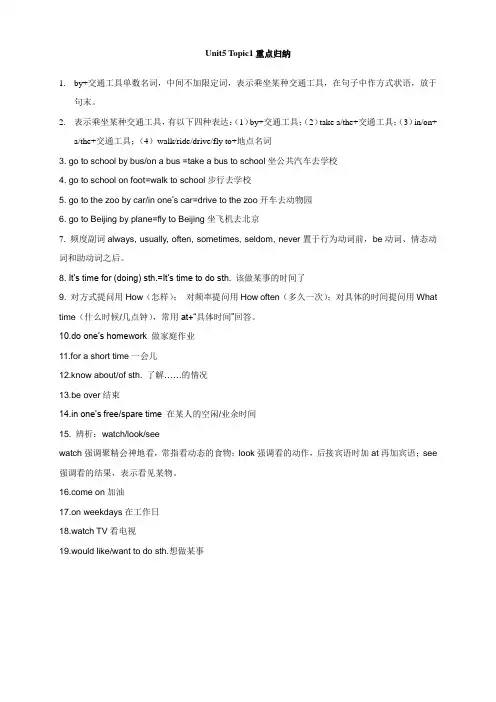
Unit5 Topic1重点归纳1.by+交通工具单数名词,中间不加限定词,表示乘坐某种交通工具,在句子中作方式状语,放于句末。
2.表示乘坐某种交通工具,有以下四种表达:(1)by+交通工具;(2)take a/the+交通工具;(3)in/on+a/the+交通工具;(4)walk/ride/drive/fly to+地点名词3. go to school by bus/on a bus =take a bus to school坐公共汽车去学校4. go to school on foot=walk to school步行去学校5. go to the zoo by car/in one’s car=drive to the zoo开车去动物园6. go to Beijing by plane=fly to Beijing坐飞机去北京7. 频度副词always, usually, often, sometimes, seldom, never置于行为动词前,be动词、情态动词和助动词之后。
8. It’s time for (doing) sth.=It’s time to do sth. 该做某事的时间了9. 对方式提问用How(怎样);对频率提问用How often(多久一次);对具体的时间提问用What time(什么时候/几点钟),常用at+“具体时间”回答。
10.do one’s homework 做家庭作业11.for a short time一会儿12.know about/of sth. 了解……的情况13.be over结束14.in one’s free/spare time 在某人的空闲/业余时间15. 辨析:watch/look/seewatch强调聚精会神地看,常指看动态的食物;look强调看的动作,后接宾语时加at再加宾语;see 强调看的结果,表示看见某物。
e on加油17.on weekdays在工作日18.watch TV看电视19.would like/want to do sth.想做某事。
七年级英语(仁爱版)下册 Unit-5-Topic-1 知识点总结语言点归纳
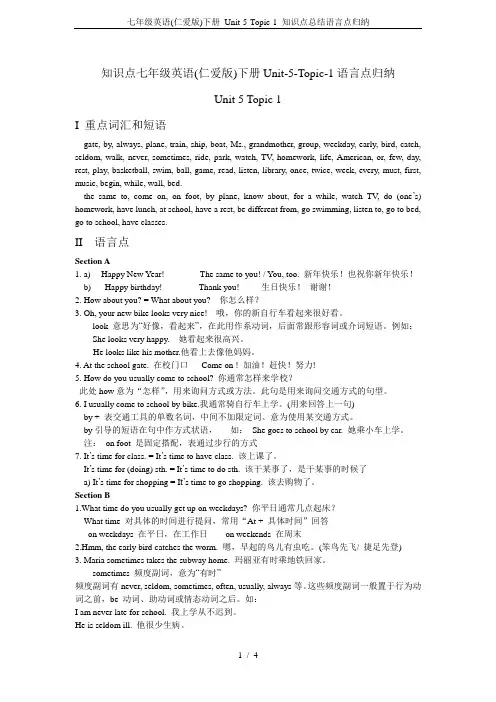
知识点七年级英语(仁爱版)下册Unit-5-Topic-1语言点归纳Unit 5 Topic 1I 重点词汇和短语gate, by, always, plane, train, ship, boat, Ms., grandmother, group, weekday, early, bird, catch, seldom, walk, never, sometimes, ride, park, watch, TV, homework, life, American, or, few, day, rest, play, basketball, swim, ball, game, read, listen, library, once, twice, week, every, must, first, music, begin, while, wall, bed.the same to, come on, on foot, by plane, know about, for a while, watch TV, do (one’s) homework, have lunch, at school, have a rest, be different from, go swimming, listen to, go to bed, go to school, have classes.II 语言点Section A1. a) ---Happy New Year! ---- The same to you! / You, too. 新年快乐!也祝你新年快乐!b) ----Happy birthday! -----Thank you! 生日快乐!谢谢!2. How about you? = What about you? 你怎么样?3. Oh, your new bike looks very nice! 哦,你的新自行车看起来很好看。
仁爱版七年级下Unit5-Topic1语法专项课件频度副词PPT课件一等奖新名师优质课获奖比赛公开课
考 察 频 度 副 词 。 hardly 几 乎 不 , sometimes 有 时 , only仅仅,usually经常。由too expensive(太贵)可 知,“几乎不看电影”,所以答案选A。
考点大观 易错辨析 通关训练
【典例3】— _____ is it from home to the shopping mall?
→How often do you write to your brother?
考点大观 易错辨析 通关训练
易错点1 how often与how long/far/soon旳使用方法
区别 How often “多久一次”,用来对表达频率旳副词或短语提问。
(多用于一般目前时)
How long
问询时间时,表达“多长时间”,回答用“for+时间段”或
“有时;不时”,意思与at times相近,多用于一般目前 时。
some times “几次;几倍”,其中time为“次;倍”,是可数名词。
some time “某些时间”,其中time意为“时间”,是不可数名词。 sometime “某个时候”,常用于一般将来时。
易错点3
考点大观 易错辨析 通关训练
这冰很硬,能够在上面滑。
考点大观 易错辨析 通关训练
【典例1】— Zhang lili, “The most beautiful teacher”, is good to
her students.
— Yes, and she is ________ popular with her
students.
never旳频度是0,意为“历来不;永不”。
频度副词经典例句
考点大观 易错辨析 通关训练
2020年春仁爱版英语七年级下册词组及重点句型
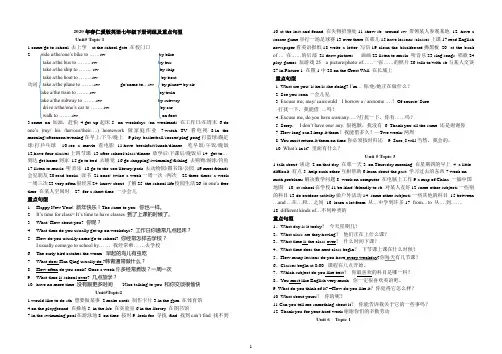
2020年春仁爱版英语七年级下册词组及重点句型Unit5 Topic 1e/go to school 去上学at the school gate 在校门口2. ride a/the/one’s bike to ……sw by biketake a/the bus to …….. sw by bustake a/the ship to …….. sw by shiptake a/the boat to ……..sw by boat动词take a/the plane to ……..sw go/come to…sw by plane= by air take a/the train to ……..sw by traintake a/the subway to ……..sw by subwaydrive a/the/one’s car to ……..sw by carwalk to ……..sw on foote on 加油,赶快4.get up起床5. on weekdays /on weekends 在工作日/在周末6.do one’s (my/ his /her/our/their….) homework做家庭作业7.watch TV看电视8.in the morning/afternoon/evening在早上/下午/晚上9.play basketball/soccer/ping-pong打篮球/踢足球/打乒乓球10.see a movie看电影11.have breakfast/lunch/dinner 吃早饭/午饭/晚饭12.have four classes上四节课13.after school/class/dinner 放学后/下课后/晚饭后14. get to….到达get home到家15.go to bed 去睡觉16.go shopping/swimming/fishing 去购物/游泳/钓鱼17.listen to music 听音乐18.go to the zoo/library/park 去动物园/图书馆/公园19.meet friends 会见朋友20.read books 读书21.once/ twice a week一周一次/两次22.three times a week 一周三次23.very often很经常24. know about 了解25. the school life校园生活26. in one’s free time 在某人空闲时27. for a short time 一小会儿重点句型1.Happy New Year! 新年快乐!The same to you. 你也一样。
+Unit+5+Topic+1+Section+D 仁爱版七年级英语下册

Grammar 语法
Adverbs of Frequency 频度副词 我从不乘地铁来学校。 I _n_e_v_e_r_ come to school by subway. 我很少走路去上学。 I _s_e_ld_o_m_ walk to school. 玛瑞亚有时乘地铁回家。Maria _s_o_m__e_ti_m__e_s takes the subway home. 李想经常骑自行车去上学。 Li Xiang _o_f_t_e_n_ rides a bike to school. 我们通常步行去公园。 We _u_s_u_a_l_ly_go to the park on foot. 他们总是乘公交车去动物园。They _a_l_w_a_y_s_ go to the zoo by bus.
…
2. Compare the school life of American students with yours and report it to the class.
Chinese Students
American Students
3. Write a passage. You may use the expressions in Functions if necessary.
Interviewer: Where do they usually have lunch?
Michael: They usually have lunch at school and
then begin class at about one o’clock in the
afternoon.
be over 结束
Project
1. Survey your classmates about their school life.
初中英语 仁爱7下Unit 5 Topic1 知识点
Unit 5 Topic1 知识点重点单词1.大门2.乘(车等);靠近3.总是,一直4.快点儿;加油5.步行6.飞机7.火车8.船,轮船9.小船,轮船10.平日11.早的12.鸟13.捉住;接住14.有时15.很少;不常16.步行;散步17.决不,从来没有18.骑(自行车、马等)19.公园20.观看;注视21.电视;电视机22.看电视23.电影24.开始25.在学校;在上课26.在……后27.床28.篮球29.游;游泳30.听,仔细听31.音乐;乐曲32.图书馆,图书室33.周;星期34.一次;从前35.两次;两倍36.伟大的,极好的37.墙38.长城39.生活;生命40.美国人41.或者;否者42.结束;穿过43.在…上面44.更多的;更多45.谈话重点短语1.go …on foot = walk ( to )…2.at the school gate在学校大门口3.on weekdays在平日 ,在工作日4.on weekends=on the weekend在周末5.You are right. = That’s right. 你是对的。
6.play soccer 踢足球7.see a movie 看电影8.get up 起床9.after school 放学后10.after class 下课后11.after breakfast / lunch / supper12.早餐 / 午餐 / 晚餐后13.at school 在学校、在上课14.play soccer/basketball 踢足球/打篮球15.go swimming/fishing 去游泳/钓鱼16.listen to music 听音乐17.watch TV 看电视18.d o one’s homework 做作业19.go to the zoo/ park 去动物园 / 公园20.read books/a book 读书21.in o ne’s free time在某人空闲时间22.have a rest 休息一下23.meet friends 拜访朋友24.once/twice/three times a week 一周一/两/三次25.very often 经常26.every day 每天e to the library 来图书馆28.时间表达:i.8:00 eight o’clockii.9:05 nine o fiveiii.10:15 ten fifteen / a quarter past teniv.11:30 eleven thirty / half past elevenv.12:45 twelve forty-five/ a quarter to onevi.17:50 seventeen fifty / ten to eighteen29.go to bed 上床睡觉30.talk with / to sb.与某人谈话31.at school 在学校、在上课32.go to school 去上学33.and so on ……等等34.go to…on foot= walk to… 步行去…35.go to…by bike = ride a bike to… 骑自行车去…36.go to…by car = drive a car to… 开车去…37.go to…by plane = fly to… 乘飞机去…38.go to…by subway/underground39.= take the subway/ underground to… 乘地铁去…40.go to…by bus/train/ship/boat = take a bus/ train/ship/boat toi.乘公共汽车/火车/轮船/小船去…重点句型1. Happy New Year!The same to you.2. Your new bike looks very nice. Thank you.3. — How do you usually come to school?—I usually come to school by subway.4. —How often do you go to the library?—Once/Twice/Three times a week/Very often/Every day/Seldom(对划线部分进行提问)What time does the class begin? / What time do the classes begin?7. We have no more time. 我们没有更多的时间了。
仁爱版七年级下册unit 5 topic1 复习
短语复习
once a week 一周一次 一周两次 twice a week 一年五次 five times a year 在七点钟 at seven o’clock 吃早/中/晚餐 have breakfast/ lunch/supper
步行 on foot
复习句子
Happy New Year 回答
看书 read books 踢足球 play football 打篮球 play basketball 做作业 do one’s homework 放学后 after school 在工作日 on weekdays every day 每天 去学校 go to school 去上班 go to work
复习短语
go to bed 去睡觉 看电视 watch TV 乘地铁 take the subway go home 回家 get home 到家 听音乐 listen to music 去公园 go to the park 去动物园 go to the zoo
复习短语
We have four classes in the morning.
复习句子
小明有时候骑车去公园。 Xiao Ming sometimes go to the park by bike.
ቤተ መጻሕፍቲ ባይዱ
他们总是乘坐公交车去公园。 They always go to the park by bus.
They always take a bus to the park 她通常晚上看一会电视。 She usually watches TV for a short time.
仁爱英语七年级下五单元topic1 知识点
Unit5 Our School LifeTopic1 I usually come to school by subway Section A一.背一背1.Happy new year! 新年快乐!2.at the school gate 在学校门口3.The same to you. 你也是。
4.Nice to see you again. 再次见面很高兴。
5.by bike 骑自行车6.by subway=by underground坐地铁7.You’re right. 你说得对。
8.How about you? 你呢?e on! 快点;加油10.on foot 步行二.金点剖析1. --Happy new year! 新年快乐!-- The same to you. 你也一样.【记一记】:【考一考】--Merry Chrismas!-- _____________. (回答)2. Oh, your new bike looks very nice! 你的新车看起来很漂亮!【记一记】:拓展:look ____ 看look ____ 看上去像look ____ 照看【考一考】1. Ann’s mother is not at home. So Ann has to _________ her sister.2.Jim _______ his father. They both(都) have small eyes.3. Please _______ the photo! It’s wonderful.4. Your dress _____ very nice. May I have a look?A. watchB.seesC. looksD. shows3.--How do you usually come to school? 你平时怎么去上学?-- I usually come to school by subway.【记一记】:注意:① by,on, in 引导的短语在句中只能作状语,与go,come,get等连用。
仁爱版英语七年级下册知识点归纳(完整版)
仁爱版英语七年级下册知识点归纳(完整版)-CAL-FENGHAI-(2020YEAR-YICAI)_JINGBIAN仁爱版英语七年级下册知识点归纳?英语七年级下册知识点归纳Unit?5?Topic1?重点语法一般现在时(常与频度副词never,?seldom,?sometimes,?often ,usually,?always等连用)重点句型?—How?do?you?usually?come?to?school???—I?usually?come?to?school?by?subway.????????????—How?often?do?you?go?to?the?library????—Once/Twice/Three?times?a?week/Very?often/Every?day/Seldom重点详解1I?always?come?to?school?by?bus.???by+交通工具名称,表示使用某种交通方式,中间不加限定词,如果交通工具前有a,?the,?my?等限定词,就不能用by,而是用in或是on.???on?the?train=by?train???on?his?bike=by?bike???in?my?car=by?car.???巧辩异同on?foot?与?walk????on?foot?“走路”,是介词短语,不能作谓语,只作方式状语,位于句末。
??walk?“走路”,是动词,可以作谓语。
? ? ??go?to…on?foot=?walk?to? ? ???I?often?go?to?school?on?foot.?=I?often?walk?to?school.?????同样,go?to….by?bike?=?ride?a?bike?to?????? ? ? ? ? go?to….?by?car?=?drive?a?car?to????????? ??go?to?…?by?plane?=?fly?to????????? ? ? ? ? go?to…?by?bus?=?take?a?bus?to2???Come?on!?It’s?time?for?class.???????come?on?“快点,加油,来吧”。