
2020年牛津译林版9A英语九年级上册Unit3 Teenage problems单元同步试卷 (含答案)
Unit3 Teenage problems单元同步试卷Class_______ Name _______ 一、单项填空(20分)( ) 1. Kate is really kind_______ me. It's very kind_______ her to help me with my lessons.A. to; forB. to; ofC. for; forD. for; of( ) 2. The long story made him_______.A. feels sleepyB. feel sleepingC. feels sleepingD. feel sleepy( ) 3. I wonder_______ you would like to come to my birthday party.A. thatB. whetherC. that ifD. that whether( ) 4. Mary, don't give up your hope and don't stop working hard, _______.A. tooB. eitherC. also eitherD. neither( ) 5. What_______ advice it is! Thank you very much!A. a usefulB. an usefulC. an uselessD. useful( ) 6. I_______ an iPhone for my birthday, but I didn't want to_______ it.A. received; acceptB. received; receiveC. accepted; acceptD. accepted; receive( ) 7. Kitty looks a little pale. She_______ ill today. But I am not sure.A. maybeB. must beC. may beD. can't be( ) 8. She doesn't know when_______ tomorrow.A. will she startB. startingC. she startedD. to start( ) 9. What would you like to_______ us about your homework?A. speakB. talkC. sayD. tell( )10. _______ you the truth, she knows nothing about it.A. To tellB. TellingC. TellD. Told( )11. _______ great fun we had_______ snowmen!A What; making B. What a; to makeC. What; to makeD. What a; making( )12. The film_______ for half an hour. We are too late.A. has been onB. has begunC. was onD. began( )13. He would rather_______ to school than_______.A. ride a bike; take a busB. by bike 'by busC. rides a bike; takes a busD. to ride a bike; to take a bus( )14. Most people in the south_______ rice to noodles.A. likeB. preferC. enjoyD. love( )15. As good friends, we should help each other. That's_______ friends are_______.A. what forB. why; forC. what; onD. why; on( )16. _______ he is very tired,_______ he still keeps on doing the experiment.A. But;/B. Thoug; butC. Though; /D. But; though( )17. -Uncle Wang hardly smokes,_______ ?-_______. He often tells us smoking does harm to our health.A. does he; YesB. does he; NoC. doesn't he; YesD. doesn't he; No( )18. I have a problem and don't know_______ solve it.A. how can IB. what can IC. how toD. what to( )19. There are so many shoes in the shop. I can't decide_______ at the moment.A. to buy which oneB. which one to buyC. to buy which pairD. which pair to buy( )20. -Don't shout at your friends and family members when feeling stressed, boy!-_______.A. Is that so?B. I don't know.C. Go away.D. Sorry, I won't.二、完形填空(10分)One afternoon, I went to pick up my mother from work. I got there a little early, so I 1 my car by a small park, and 2 for her.As I looked outside the car window. I saw a little boy, around two years old, running freely (自由地) on the grass as his mother 3 from a short distance. The boy had a big "smile on his face as if he had just been set free from a prison (监狱). The boy would then fall to the grass, 4 up, without looking back at his mother, run as 5 as he could, again, still with a smile on his face, as if nothing had happened.At that moment, I thought to myself, "why don't most adults try this way?" Most adults, when they fall down, get up quickly and don't even make a second attempt (尝试). They would be so embarrassed (尴尬) that they would not try again if someone saw them fall. Or, because they fall, they would find a good 6 for themselves that they're not fit for it. They would end up because they are too afraid to attempt again for fear of failure.However, for kids, when they fall down, they don't consider(认为) their falling down as a failure, instead, they treat it as a 7 experience. They try again and again until they 8 . The answer must be that they have not connected "falling down" with the word "failure". As a result, they are not discouraged (泄气) in any way. Besides, they 9 think to themselves that it's quite OK to fall down and that it's not wrong to do so. In other words, they allow themselves to make 10 , so they stayed energetic.I was deeply moved by the boy's persistence (坚持不懈) and the manner in which he did ( ) 1. A. left B. stopped C. repaired D. drove( ) 2. A. waited B. cared C. prepared D. looked( ) 3. A. watched B. noticed C. surveyed D. supported( ) 4. A. hold B. get C. end D. pick( ) 5. A. well B. long C. fast D. soon( ) 6. A. cause B. sign C. chance D. excuse( ) 7. A. learning B. running C. teaching D. falling( ) 8. A. progress B. improve C. achieve D. succeed( ) 9. A. hardly B. perfectly C. probably D. nearly( )10. A. mistakes B. choices C. plans D. wishes三、阅读理解(20分)(A)Some people think only school children do not agree with their parents, however, it is not true. Communication is a problem for parents and children of all ages. If it's hard for you to communicate with your parents, don't worry about it. Here are some suggestions for you to bridge generation gap(代沟).Don't argue with your parents. Don't get to your parents when you are angry. Your parents probably won't consider your ideas if you are shouting at them You can't express(表达) yourself well if you are angry. Go to some place to cool off. Make sure you understand why you are unhappy. Then think about what you want to say to your parents. If you don't think you can speak to them at the moment, try writing a letter.Try to reach a compromise (和解). Perhaps you and your parents disagree(有分歧) on something. You can keep your disagreement and try your best to accept each other. Michael's mother didn't agree with him about buying a car. They argued over it, but finally they came to a compromise. Michael bought the car, but only drove it on certain days.Of course your parents might refuse to compromise on something. In these situations, it is especially important to show love and respect (尊敬)to them. Showing respect will keep your relationship strong.Talk about your values. The values of your parents are probably different from those of your own. Tell your parents what you care about, and why. Understanding your values might help them see your purposes in life.A good relationship with your parents can make you a better and happier person. It is worth having a try.( ) 1. From the passage we know_______ have a communication problem.A. parents and children of al agesB. children and other peopleC. parents and their school childrenD. teachers and their students( ) 2. How many pieces of advice does the writer give us to bridge the generation gap?A..5B. 4C. 3D. 2( ) 3. The underlined phrase "cool off" in the passage means_______.A. make yourself happyB. make yourself quiet and relaxedC. become angryD. go away( ) 4. If the values of your parents are different from those of yours, you'd better_______.A. argue with themB. keep away from themC. agree with them all the timeD. tell your parents what you care about( ) 5. The best title for the passage is_______.A. How to Bridge the Generation GapB. How to Deal with Family ProblemsC. How to Be Good ParentsD. How to Be a Good Child(B)People all have problems. If we don't deal with these problems, we can easily become unhappy. Worrying about our problems can affect how we do at school. It can also influence the way we behave with our families. So how do we deal with our problems? There are many ways and here is one of themMost of us have probably been angry with our friends, parents or teachers. Perhaps they said something you didn't like, or you felt they were unfair. Sometimes people can stay angry for years about a small problem. Time goes by, and good friendship may be lost.When we are angry, however, we are usually the ones affected. Perhaps we have seen young children playing together. Sometimes they have disagreements, and decide not to talk to each other. However, this usually does not last for long. This is an important lesson for us to learn.( ) 6. What is the writer?A. A shopkeeper.B. A doctor.C. A student.D. A dentist.( ) 7. What is the main idea of the passage?A. How to deal with problems.B. How to do at school.C. How to behave with families.D. How to talk to each other.( ) 8. What will happen if people stay angry for long according to the text?A. They feel unfair.B. They may get sick.C. Good friendship may be lost.D. They may miss each other.( ) 9. Children decide not to talk to each other probably because_______.A. they become unhappyB. they have different ideasC. they worry about a small problemD. they want disagreements( ) 10. From the passage, we know an important lesson for us isA. playing togetherB. learning to forgetC. staying angryD. feeling unfair四、单词拼写(12分)1. Don't_______ (打扰)your father. He is thinking about a Maths problem.2. This is one of the best_______(选择)she has made. She is very pleased with it.3. She was seriously ill and she could_______ (几乎不) stand.4. The best way is to let your parents see your_______ (进步)after each exam.5. Do you think it is_______(值得)doing this thing?6. There's_______(大量)of work for girls of her age.7. Simon, please pay more attention to your_______(拼写).8. As students, our first_______(任务)is to study hard.9. Reading is of great_______(价值)to our writing.10. -How did you_______ with your old computer?-Oh, I sent it to my cousin. He needs it very much.11. -Why were you_______ by your school football team? They don't know how well you play it,do they?-No, they don't. They say I'm too small and short to enter it.12. -Thanks for buying me such a beautiful gift.-It's my_______.五、翻译句子(18分)1.那个男孩别无选择,只能睡觉去了。
牛津译林版英语九年级上册 Unit 3 《Teenage problems.》 教学设计5

牛津译林版英语九年级上册 Unit 3 《Teenage problems.》教学设计5一. 教材分析牛津译林版英语九年级上册Unit 3《Teenage problems》主要讨论了青少年时期可能遇到的各种问题,如学习压力、与父母沟通、朋友间的矛盾等。
本节课旨在通过讨论这些问题,让学生了解青少年时期的困惑和挑战,提高他们解决问题的能力。
本课的核心词汇和句型为学生提供了表达自己观点和倾听他人意见的语言工具。
二. 学情分析九年级的学生正处于青少年时期,他们面临着各种挑战和压力。
他们在学习、生活、人际交往等方面都有自己独特的困惑。
通过对学生的观察和了解,我发现他们在英语听说读写方面有较好的基础,但部分学生在表达自己观点时仍存在一定的困难。
因此,在教学过程中,我需要关注这部分学生的需求,帮助他们更好地表达自己。
三. 教学目标1.知识目标:学生能够掌握本节课的核心词汇和句型,正确运用它们表达自己的观点和倾听他人意见。
2.能力目标:学生能够在课堂上进行流畅的英语口语交流,提高他们的口语表达能力。
3.情感目标:学生能够理解青少年时期的困惑和挑战,学会关心他人,提高人际沟通能力。
四. 教学重难点1.重点:学生能够熟练运用本节课的核心词汇和句型进行英语口语交流。
2.难点:学生能够正确表达自己的观点,并在交流中倾听他人意见。
五. 教学方法1.任务型教学法:通过设计各种任务,让学生在实践中运用英语,提高他们的口语表达能力。
2.合作学习:鼓励学生之间进行小组讨论,培养他们的团队协作能力。
3.情感教学:关注学生的情感需求,营造一个轻松、愉快的学习氛围。
六. 教学准备1.教学材料:教材、多媒体课件、录音机、磁带。
2.教学工具:黑板、粉笔、挂图。
七. 教学过程1.导入(5分钟)利用多媒体展示一些青少年时期常见的问题,如学习压力、与父母沟通等。
引导学生谈论这些问题,激发他们的兴趣。
2.呈现(10分钟)呈现本节课的核心词汇和句型,让学生通过听力练习和小组讨论来熟悉这些词汇和句型。
牛津译林版英语九上Unit 3《Teenage problems》(Grammar)教学设计

牛津译林版英语九上Unit 3《Teenage problems》(Grammar)教学设计一. 教材分析《牛津译林版英语九上Unit 3 Teenage problems》主要讨论青少年时期可能遇到的各种问题,如学习压力、与父母沟通、健康饮食等。
本单元通过不同的话题帮助学生了解青少年阶段可能面临的挑战,并学会用英语表达这些问题。
单元中包含了大量的词汇和表达方式,以及一些复杂的语法结构,如现在分词作状语等。
二. 学情分析九年级的学生已经具备了一定的英语基础,能够理解和运用一些基本的英语表达方式和语法结构。
然而,对于一些复杂的语法结构和词汇,他们可能还需要进一步的引导和帮助。
此外,由于青少年阶段本身就是充满挑战和变化的,学生应该能将自己的人生经验和所学内容联系起来,提高他们的学习兴趣和参与度。
三. 教学目标1.学生能够掌握本单元中的重点词汇和表达方式,如“pressure”,“communicate”, “healthy eating”等。
2.学生能够正确运用现在分词作状语等语法结构。
3.学生能够用英语讨论青少年时期可能遇到的问题,并给出相应的建议。
四. 教学重难点1.重点:本单元的重点词汇和表达方式,以及现在分词作状语的语法结构。
2.难点:如何正确运用现在分词作状语,以及如何在讨论中运用所学词汇和表达方式。
五. 教学方法1.任务型教学法:通过不同的任务和活动,让学生在实际的语言环境中学习和运用英语。
2.合作学习:鼓励学生之间的合作和交流,提高他们的语言表达能力和团队合作能力。
3.引导式教学法:教师引导学生通过观察、思考和讨论,发现和理解语言规律。
六. 教学准备1.教材:牛津译林版英语九上Unit 3 Teenage problems。
2.多媒体教学设备:用于展示PPT和视频材料。
3.教学素材:与本单元主题相关的图片、视频等。
七. 教学过程1.导入(5分钟)通过提问方式引导学生谈论他们所知道的青少年时期的问题,激发学生的兴趣和参与度。
牛津译林版英语9A Unit3 Teenage problems知识归纳与拓展

9A Unit3 Teenage problems 【单词拓展】1.deal vi.处理,对付(deal—dealt—dealt)→deal n.大量;很多;交易2.teenage adj.青少年的→teenager n.青少年→teens n.十几岁3.choice n.选择-→choose n.选择,挑选4.awake adj.醒着的--→wake v.醒来唤醒(wake--woke—woken)5.valuable adj.宝贵的;贵重的'→value n.价值;有用;重要→valueless adj.没有价值的;不值钱的6.worry n.担心;担忧的事-→worry v.担心→worrying adj.令人担忧的→worried adj.担忧的7.pronounce vt.发音→pronunciation n.发音,读音8.silence”.安静,寂静;沉默→silent adj.沉默的;寂静的→silently adv.沉默地9.s tress”.精神压力紧张→stressed adj.紧张的,感到有压力的10.suggestion n.建议→suggest vt.建议11.hardly adv.几乎不→hard adv.努力地;辛苦地12.imagine vt.&vi.想象;设想→imagination n.想象力13.worth adj.有……的价值,值得-→worthless adj.没用的;无价值的→worthy adj.值得的14.doubt vt.怀疑-→doubtful adj.不确定的;怀疑的15.solve vt.解决→solution n.解决办法【短语归纳】1,eat less and exercise more少吃多锻炼2.have enough time to do sth有足够的时间做某事3.drive sb mad使某人发狂4.have no choice but to do sth除了做某事以外别无选择5.stay up熬夜6.stay awake保持清醒7.offer sb some suggestions给某人提供一些建议8.develop our hobbies培养我们的爱好9.stay out late在外面待到很晚10.achieve a balance获得平衡11.work out算出;解决12.agree with sb同意某人(的看法)13.solve the problem解决问题14.pay no attention to 不理睬15.seem much happier显得更加高兴16.make progress in在……上取得进步17.be of sb’s age与……同龄【句型分析】1.I dream of a long holiday so that I could have more time for my hobbies.(P36) 句中的so that用来引导目的状语从句,常与may,can,will等连用,意为“为的是”,相当于“in order that”。
牛津译林版九年级上册9AUnit3 Teenage problems词汇趣味讲解(配练习含答案)
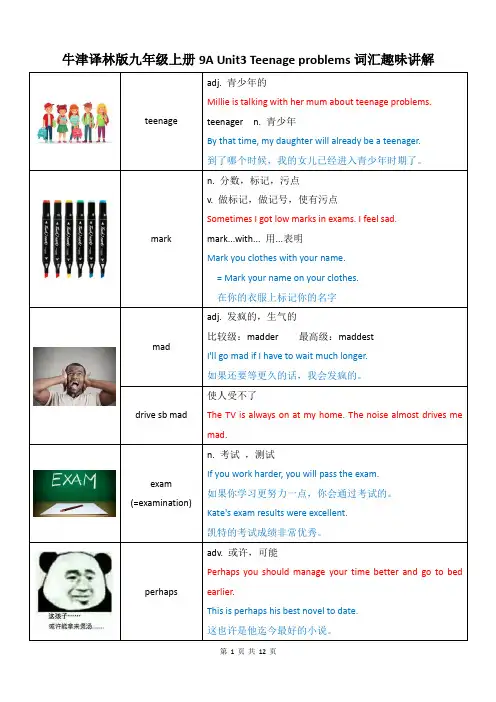
牛津译林版九年级上册9A Unit3 Teenage problems词汇趣味讲解teenage adj. 青少年的Millie is talking with her mum about teenage problems. teenager n. 青少年By that time, my daughter will already be a teenager. 到了哪个时候,我的女儿已经进入青少年时期了。
mark n. 分数,标记,污点v. 做标记,做记号,使有污点Sometimes I got low marks in exams. I feel sad. mark...with... 用...表明Mark you clothes with your name.= Mark your name on your clothes.在你的衣服上标记你的名字mad adj. 发疯的,生气的比较级:madder 最高级:maddest I'll go mad if I have to wait much longer. 如果还要等更久的话,我会发疯的。
drive sb mad 使人受不了The TV is always on at my home. The noise almost drives me mad.exam (=examination) n. 考试,测试If you work harder, you will pass the exam.如果你学习更努力一点,你会通过考试的。
Kate's exam results were excellent.凯特的考试成绩非常优秀。
perhaps adv. 或许,可能Perhaps you should manage your time better and go to bed earlier.This is perhaps his best novel to date.这也许是他迄今最好的小说。
牛津译林版九年级上册Unit 3《Teenage problems》(Study skills)教学
牛津译林版九年级上册Unit 3《Teenage problems》(Study skills)教学设计一. 教材分析牛津译林版九年级上册Unit 3《Teenage problems》(Study skills)围绕着青少年的学习方法展开,旨在让学生通过阅读、听力、口语和写作等环节,了解并掌握各种学习方法,以及如何有效地解决学习中遇到的问题。
本节课的主要内容包括:不同学生有不同的学习风格和策略,如何选择适合自己的学习方法,以及如何养成良好的学习习惯等。
二. 学情分析九年级的学生已经具备了一定的英语基础,能够进行简单的听、说、读、写操作。
但部分学生在面对较复杂的文章时,可能会存在阅读困难,理解能力有限。
此外,学生对学习方法和策略的认识相对较弱,需要老师在教学中进行引导和启发。
三. 教学目标1.知识目标:让学生掌握与学习方法相关的词汇和表达,如effective,strategy, improve等。
2.能力目标:培养学生通过阅读、听力、口语和写作等多种方式,理解和运用本节课所学内容。
3.情感目标:引导学生认识到学习方法的重要性,激发学生探索适合自己的学习方法,养成良好的学习习惯。
四. 教学重难点1.重点:让学生理解和运用本节课所学词汇和表达。
2.难点:引导学生如何选择适合自己的学习方法,以及如何养成良好的学习习惯。
五. 教学方法1.任务型教学法:通过设定各种任务,让学生在实践中学习和运用英语。
2.合作学习法:鼓励学生分组讨论,培养学生的团队协作能力。
3.情感教学法:关注学生的情感需求,激发学生的学习兴趣。
六. 教学准备1.教材:牛津译林版九年级上册Unit 3《Teenage problems》(Studyskills)2.多媒体设备:电脑、投影仪、音响等3.教学素材:相关学习方法的文章、视频等4.课件:制作与本节课相关的内容,包括词汇、图片、视频等七. 教学过程1.导入(5分钟)利用课件展示一些关于学习方法的名言,如“活到老,学到老”、“适合自己的才是最好的”等,引导学生思考如何选择适合自己的学习方法。
牛津译林版九年级上册Unit3《Teenageproblems》(reading1)说课稿
牛津译林版九年级上册Unit 3《Teenage problems》(Reading 1)说课稿一. 教材分析《牛津译林版九年级上册Unit 3 Teenage problems(Reading 1)》是一篇关于青少年问题的阅读文章。
文章主要讲述了一个青少年在成长过程中遇到的各种问题,如学习压力、与父母沟通、朋友之间的关系等。
通过这篇文章,学生可以了解到青少年成长过程中可能遇到的问题,并学会如何面对和解决这些问题。
二. 学情分析九年级的学生正处于青春期,他们面临着与文章中相似的问题。
因此,他们对这篇文章的主题会有共鸣,学习兴趣会比较浓厚。
然而,由于他们的英语水平不同,有的学生可能对文章中的一些词汇和语法结构理解起来有一定的困难。
三. 说教学目标1.知识目标:学生能理解文章的主要内容,掌握文章中的一些重要词汇和短语,如“pressure”、“communicate”、“relationship”等。
2.能力目标:学生能用英语简单描述青少年面临的问题,并学会如何解决这些问题。
3.情感目标:学生能认识到青少年时期的重要性,学会珍惜时光,积极面对生活中的困难。
四. 说教学重难点1.重点:学生能理解文章的主要内容,掌握文章中的一些重要词汇和短语。
2.难点:学生能用英语描述青少年面临的问题,并学会如何解决这些问题。
五. 说教学方法与手段1.教学方法:采用任务型教学法,让学生在完成任务的过程中,提高英语听说读写的能力。
2.教学手段:利用多媒体课件、图片、卡片等辅助教学,激发学生的学习兴趣。
六. 说教学过程1.Pre-reading:教师通过提问引导学生思考青少年时期可能遇到的问题,激发学生的学习兴趣。
2.While-reading:学生速读文章,回答相关问题;教师引导学生详细阅读文章,讨论文章中的细节。
3.Post-reading:学生分组讨论,用英语描述青少年面临的问题及解决方法;教师学生进行汇报,给予评价。
牛津译林版九年级上册Unit3《Teenageproblems》(Task)说课稿
牛津译林版九年级上册Unit 3《Teenage problems》(Task)说课稿一. 教材分析《Teenage problems》是牛津译林版九年级上册Unit 3的一篇课文,主题是关于青少年问题的。
通过描述青少年在成长过程中所面临的各种问题,如学习压力、与父母关系、朋友关系等,让学生了解并关注这一年龄段所特有的困惑和挑战。
本节课的主要目标是让学生能够理解课文内容,掌握相关的语言知识,提高阅读理解能力。
二. 学情分析九年级的学生已经具备了一定的英语基础,能够听、说、读、写一些简单的英语句子。
但他们在阅读理解方面还存在一定的困难,特别是对于一些长篇的文章。
因此,在教学过程中,我们需要关注学生的阅读理解能力,引导他们通过关键词、句子来理解文章的大意。
三. 说教学目标1.知识目标:让学生掌握课文中的关键词汇和句型,提高阅读理解能力。
2.能力目标:培养学生通过关键词、句子来理解文章大意的技巧。
3.情感目标:让学生认识到青少年时期所面临的问题,引导他们正确面对和处理这些问题。
四. 说教学重难点1.重点:课文的理解和相关的语言知识的掌握。
2.难点:对于一些长篇的文章,学生如何通过关键词、句子来理解文章的大意。
五. 说教学方法与手段1.教学方法:采用任务型教学法,让学生在完成任务的过程中,提高阅读理解能力。
2.教学手段:利用多媒体课件,为学生提供丰富的视觉、听觉材料,激发学生的学习兴趣。
六. 说教学过程1.导入:通过提问方式,引导学生谈论青少年时期所面临的问题,激发学生的学习兴趣。
2.阅读理解:学生自主阅读课文,回答相关问题,教师给予指导。
3.单词学习:学生通过课文,学习并掌握相关的词汇。
4.句型练习:学生模仿课文中的句型,进行口语练习。
5.小组讨论:学生分组讨论,分享自己面临的青少年问题,并尝试寻找解决办法。
6.总结:教师引导学生总结课文内容,加深对文章主题的理解。
7.作业布置:让学生写一篇关于自己青少年问题的文章,培养写作能力。
牛津译林版9AUnit3《teenageproblems》教学设计(共5课时)
2.短片观看后,引导学生分享自己的感受和认识,为新课学习奠定情感基础。
3.提问:“What kind of teenage problems do you think are the most common?”让学生预测本节课将讨论的青少年问题,激发学生的好奇心。
牛津译林版9AUnit3《teenageproblems》教学设计(共5课时)
一、教学目标
(一)知识与技能
1.学生能够理解并掌握本章节关于青少年问题的核心词汇和短语,如:conflict, communicate, independence, rebellion, stress, depression等,并能熟练运用这些词汇进行讨论和表达。
2.语法讲解:结合课文,讲解一般现在时、一般过去时等时态的用法,并举例说明。
3.词汇学习:通过例句、同义词、反义词等形式,帮助学生深入理解重点词汇和短语。
4.阅读策略:指导学生运用扫读、精读等策略,提高阅读理解能力。
5.课堂讲解:针对课文中的难点和重点,进行详细讲解,确保学生理解到位。
(三)学生小组讨论
4.个性化教学:针对不同学生的学习特点,实施差异化教学,提高教学效果。
5.教学评价:采用多元化的评价方式,如自我评价、同伴评价、教师评价等,全面评估学生的学习过程和成果。
6.家校合作:与家长保持沟通,了解学生在家的表现,共同关注学生的成长,形成教育合力。
四、教学内容与过程
(一)导入新课
在导入新课环节,教师将通过以下方式激发学生的学习兴趣和探究欲望:
4.教师展示与本节课相关的词汇和短语,如:conflict, communicate, independence等,让学生尝试猜测它们的意思,为新课学习做好词汇准备。
03最新牛津译林版 9A Unit 3 Teenage problems知识点讲解
最新牛津译林版9A Unit 3 Teenage problems语言点知识点讲解一、课本中重点词、短语、句型讲解▲Comic strips & Welcome to the unit1. What’s wrong, Eddie? 怎么了,埃迪?形容词wrong意思是“出错的”,此句相当于What’s the matter with you, Eddie? 或What happened to you, Eddie?What’s wrong with sb. / What’s the matter with sb.?/ What happened to sb.?常用来询问别人发生了什么事。
例如:---What’s wrong with you? You look very tired.---Thank you. I’m OK.2. Why not eat less and exercise more? 为什么不少吃一点,多多锻炼呢?这一咱表示建议的句子。
日常会话中还会用到:Why don’t you do---? “你为什么不做---呢?”表示对别人进行一种语气强烈的建议。
例如:---Today is a fine day. Why don’t you go boating together?---I think it’s a good idea.用于“建议别人做某事”的句型还有:Would you like to do---? Shall we do ---? Let’s do ---. Would you please do---?等。
3. Maybe you’re right. 也许你是对的。
此处“maybe”表示“也许;大概”的意思。
相当于“perhaps”,放在句首,表示后面句子所叙述的情况也许会发生,或也许是事实。
“may be”表示“也许是”,是“情态动词+动词原形be”形式,通常放在句中。
牛津译林版9AUnit3《Teenageproblems》优秀教学案例(共9课时)
3.小组合作:教师组织丰富的小组活动,鼓励学生互相讨论、分享和合作。通过小组合作,学生能够提高团队协作能力,培养创新思维和解决问题的能力。
3.教师讲解西方国家关于青春期问题的相关文化背景,帮助学生更好地理解教材内容。
4.教师结合实例,讲解青春期问题的应对策略,引导学生学会正确面对和处理青春期问题。
(三)学பைடு நூலகம்小组讨论
1.教师将学生分成若干小组,每组选择一个青春期问题,进行深入讨论和分析。
2.教师引导学生从多角度、多层次思考问题,鼓励学生提出自己的观点和看法。
本案例背景旨在为学生提供了一个关于青春期问题的学习平台,通过英语语言的学习,让学生认识到青春期烦恼的存在,并学会如何应对。教材以人性化的语言呈现,注重培养学生的情感态度、价值观和思维能力,使他们在学习过程中获得启示,提高自我认知和解决问题的能力。
在教学过程中,教师需遵循教材结构,合理安排课时,注重培养学生的语言技能、思维品质和学习策略。同时,教师要关注学生的个体差异,充分调动学生的积极性,使他们在课堂活动中积极参与、主动探讨,提高课堂教学效果。
二、教学目标
(一)知识与技能
1.学生能够掌握本课核心词汇和短语,如“teenage problems”、“identity crisis”、“pressure from parents”等,并能够熟练运用这些词汇描述青春期问题。
2.学生能够理解并运用本课所学的句型和语法结构,如一般现在时、现在进行时等,表达自己的观点和感受。
3.学生能够通过听力、阅读和口语活动,提高英语听、说、读、写综合能力,增强英语语言运用能力。