
新外研版七年级下册Module11unit1
1. Some ______ visit the Great Wall
every year.
A. visiter B. visitor C. visitors
2. Chinese often _____ when they meet.
A. shake hands B. shakes hands
C. touch noses
shake hands [ʃeɪk]
hug [hʌg]
many kinds of of body language
smile [smaɪl] bow [bau]
cry
stop
nod
Do you know the meaning of the following gestures (手势)?
Come here.
2. We Chinese often shake hands and smile. shake hands 表示“握手”。 Shake hands with sb. 表示“和某人握手”。 3. In India people put their hands together and nod their heads.
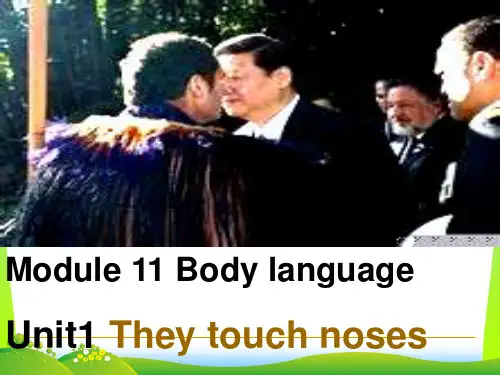
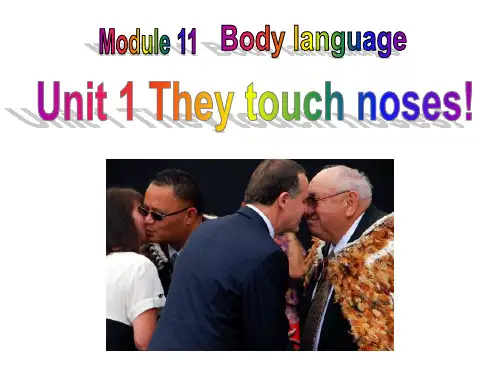
In New Zealand Maori people touch noses
when they meet.
In Japan, people bow.
Say“T ”or“F” 1. Russians usually kiss the visitors three times, right, left, right. F left,right,left 2. Chinese often shake hands and smile when they meet visitors. T never kiss the visitors. F 3. Chinese always 4. Americans shake hands, and some kiss or hug each other. T 5. People put their hands together and nod their heads in India. T 6. Maori people touch heads noses when they meet. F
Match the pictures with the words and expression from the box.
bow 3 kiss 1 shake hands 2 smile 1/2/3
Listen and match the pictures with the nationality(国籍).
In China, people shake hands and smile American people shake hands and kiss sometimes ______
India people put their hands _________ together When they In ______, meet and nod their heads ________. visitors In ________, Russia people kiss each other three times touch noses Maori people ______
4. New Zealand 5. India ['zilənd]
['indiə]
Countries China Japan Britain America France Australia Canada Russia Germany India
People and languages Chinese Japanese British American French Australian Canadian Russian German Indian
In the US
Some people shake hands, kiss or hug each other .
In India
People put hands together and nod heads
In Russia, people usually kiss three times, left, right, left.
Language points
1. in Russia, people usually kiss three times. “times” 在这里表示次数, three times 表 示 “三次” 在英文中, 一次, once 两次, twice 三次以上都用“ 数词+times” 如: My mother goes shopping once a week. 我妈妈每周购物一次。
--What are they doing? --They are touching their noses!
[tʌtʃ]
They touch noses when they meet visitors.
What kind of body language do you know?
kiss [kɪs]
British German Russian 2 French
1
Japanese 3
Let’s learn
In China
We Chinese often shake hands and smile when we meet visitors. Sometimes we nod our heads.But we never kiss.
That’s because you were not careful enough. 那是因为你但是不 teachers 几个俄罗斯老师 2.welcome the visitors 欢迎来访者 3.in Russia 在俄罗斯 4.three times 三次 5.shake hands 握手 6.nod our heads 点点头 7.do different things in different countries 在不同的国家做不同的事情 8.in the USA 在美国 9.hug each other 互相拥抱 10.put their hands together 把手合拢 11. touch noses 碰鼻子
put … together 表示“把……放在一起”。
4. They touch noses!
touch noses 表示“碰鼻子”。
5. 名词的复数:
Chinese → Chinese German → Germans Japanese → Japanese Russian → Russians 6. And some kiss or hug each other. each other 表示“彼此,互相”, 通常 放在动词后。
OK
You are very good. / Well done!
Bye-bye.
I’m sorry!
Nice to meet you!
Say hello! The last
The best
success
Different countries have different body languages 1. China 2. America 3. Russia ['rʌʃə]
3. They help ______ when they are in trouble. A. each B. each other C. the other 4. They all live _____ in a three-bedroom house. A. together B. with C. each 5. Would you like to talk with _______? A. German B. Germans C. Germen
7. That’s because people do different things in different countries.
That’s because….. 是一个常用句式,其中, that 表示刚刚谈到的内容。 注意,这里要用that,而不能用 this , 因为 this 表示将要谈及的内容。如:
【新】外研版七年级英语下册Modele11 Unit1精品课件(共25张PPT).ppt
(二)重难点解读:(10分钟认真完成并 牢记)
1. three times(译)三次一次once两次 twice
2. three times a week(译)一周三次 ①His parents drove to school three
times.
How many times did his parents drive to school?
Stop!
Come It’s ok. here.
Bye-bye.
You are very good.
/ Well done!
surprised
shy
happy
Let’s learn more about body language body language in different countries.
In Russia ,people usually kiss three times,left,right,left.
In Japan, people bow.
In India people put their hands together.
And do you know what Maori people do when then meet?
Some Russian
teachers.
They usually kiss three times , left,right,left.
What do people do in China We Chinese often shake
when they meet?
hands and smile.
Do people shake hands in Yes,they do
Module11Unit1课件外研版英语七年级下册
我之前就来过这里很多次了。
(2)同样表示次数的还有:once一次,twice两次;对于次 数的提问用“how many times”。如: — How many times have you been to the park? 你去过这个公园多少次了? — Twice .两次。
课堂导学
1.Lingling,you know,in Russia,people usually kiss three
times,left,right,left. 玲玲,你知道吗,在俄罗斯,人们(见面的时候)通常亲吻三次,左边, 右边,左边。 (1)times的意思是“次数,倍数”,表示次数,常用于三次及三次以上。 一次, once 两次, twice 三次以上都用“times” 如:
2.We Chinese often shake hands and smile when we meet visitors,and sometimes we nod our heads. 我们中国人见到来访者的时候经常握手并微笑,有时 会点头示意。 (1)shake hands的意思是“握手”,shake hands with sb. 表示“与某人握手”。
when they
In (4) _R_u__ss_i_a_, people kiss meet each other three times (6) v_i_s_it_o_r_s__.
Maori people (5) _t_o_u_c_h_ noses.
Learning to learn
People in different countries may use different body language to express the same meaning and feelings. When you speak with people from other countries, try to understand and respect their body language.
Module11+Unit1+课件+2022-2023学年外研版英语七年级下册
shake hands
smile
America —What do Americans do when they meet? —Americans ______ when they meet.
shake hands
hug
kiss
India
—What do Indians do when they meet? —Indians ______ when they meet.
touch noses
Work in groups and discuss.
What do different people do when they meet?
America
World Map
Germany The UK
Russia
France
China
India
Japan
Maori people (毛利人)
put the hands together
nod head
New Zealan—dWhat do Maori people do when they meet? —Maori people ______ when they meet.
touch noses
1 Match the pictures with the words and expression from
Lead-in:
bow
Different body languages to “say hello” !
kiss
smile
nod head
shake hands
Lead-in:
Different body languages to “say hello” !
外研社七年级下英语M11课文

Module 11 Body languageUnit 1 They touch noses!Lingling: We’re going to have some Russian teachers at school tomorrow, and I’m welcoming the visitors. How do I do that?Betty: Lingling, you know, in Russia, people usually kiss three times, left, right, left. Lingling: What! No, I didn’t know that. We Chinese often shake hands and smile when we meet visitors, and sometimes we nod our heads. But we never kiss. Only parents andchildren do that.Betty: That’s because people do different things in different countries.Lingling: So what do people in the US usually do when they meet?Betty: In the US some people shake hands, and some kiss or hug each other. In India people put their hands together and nod their heads. And do your know what Maori people inNew Zealand do when they meet?Lingling: No, What do they do?Betty: They touch noses!Questions:1. How many times does Russians kiss when they meet each other?_______________________________________________________________________________ 2. What do Chinese do when we meet visitors?_______________________________________________________________________________ 3. What do people in the US usually do when they meet?_______________________________________________________________________________ 4. Do India people put their hands together and nod their heads when they meet?_______________________________________________________________________________ 5. What do Maori people in New Zealand do when they meet?_______________________________________________________________________________ Unit2 Here are some ways to welcome them.Body language around the worldby Wang Lingling Our new foreign students are going to arrive very soon, and here are some ways to welcome them.How close do you stand when you talk to a friend? You can stand close to people in the Middle East but don’t stand too close to North American! Give them more personal space.How about touching people? Chinese girls often walk arm in arm with their friends. South American sometimes hold your arm when they talk to you, so you can’t move away! But in Britain many people don’t like other people to touch them at all.Do you look at people when you talk? In some places, it isn’t polite to look at people when they talk, but in other countries it isn’t polite to look somewhe re else. In Britain and the US, people usually look at each other when they talk.And how do you say goodbye? That’s easy, wave to say goodbye. But be careful! In Greece,it’s not at all polite! In fact, it’s very rude!Questions:1.Is body language the same in different countries?___________________________________________________________________________2.Is it all right to stand close to people in the Middle East?___________________________________________________________________________3.Do the British like touching people?___________________________________________________________________________4.Do Americans look at people when they talk?___________________________________________________________________________5.Do people in Greece wave goodbye?___________________________________________________________________________Unit 3The Japanese bowIn Japan, people bow to say ”thank you”, ”sorry”, ”hello”, ”goodbye”, ”you’re welcome”, ”excuse me” , and many other things. Children and young people bow lower when they greet older people. It’s a way of being polite and showing respect.答案:M11 U11. Three times.2. We Chinese often shake hands and smile when we meet visitors, and sometimes we nod our heads.3. In the US some people shake hands, and some kiss or hug each other.4. Yes, they do.5. They touch noses.M11 U21. No, it isn’t.2. Yes, it is.3. No, they don’t.4. Yes, they do.5. No, they don’t.。
Module+11+Unit+1+课件外研版英语七年级下册

to visit our schoo_Ml._W_a_oe_r_ia_rpe_e_ow_pe_lle_c_oming_t_th_oe_um_c_h. _Wn_o_hs_ee_ns_w_e meet a
student from China, we can shake han_pd_u_st_ah_na_dn_d_sms__tio_leg_,e_wthheern...,
A:What are they doing? B:They are putting hands together and the man is nodding his head. A:Are they Chinese? B:No, they aren't. I think they are from India, they are Indians.
That’s because you were not careful enough.
3. smile v. &n. 微笑
◆We Chinese often shake hands and smile when we meet
visitors, and sometimes we nod our heads.
2. That’s because people do different things in different countries. That’s because….. 是一个常用句式,其中,that 表示 刚刚谈到的内容。 注意,这里要用that,而不能用 this , 因为this 表示将 要谈及的内容。如:
_sh__a_k_e_h_a_n_d_s__a_nd smile
假设有个来自不同国家的国际学校交流_n_o团_d_要t_h_来e_i_r我_h_们e_a_d学_s 校参观
外研版七年级下册Module11Unit 1知识点总结课件(共15张PPT)
In China, people shake hands and smile.
American people shake hands and sometimes (1) k__i_s_s__.
In (2)I_n_d__i_a_, people put their hands (3)t_o_g_e_t_h__e_rand nod their
A.Each;has B.Each;have C.Every;has D.Every;have
2.Each_l_i_k_e_s_(like) playing football.
当堂检测1
C1. We Chinese often ________ and smile when we meet visitors.
when they meet
(6v) _is_i_t_o_r_s__.
heads.
In (4)R_u__s_s_ia__, people kiss each
other three times.
Maori people (5) _to__u_c_h_ noses.
Japan日本 India印度
France法
A: Where are they from?
国
B: They are from ...They are....
A: What do people in …usually do when they meet?
202X外研版英语七年级下册Module11 Unit1课件(共23张PPT)
• In India ,people __p_u_t____their hands _t_o_g_e_t_h_e_r_.
• 5. 毛利人见面时碰鼻子。
• Maori people _to__u_c_h__n_o_s_e__s when they meet .
Sum up
India
Indian
In India people put their hands together and nod their heads.
New Zealand
Maori
What do the Maori people do when they meet ?
They touch noses .
6.That’s because表示“那是因为……”。
• 单词拼写
• 1.We Chinese often s_h_a_k_e__ hands . • 2.There are lots of v_is_i_t_o_rs__ in Guilin. • 3.In Russia , people usually k_is_s____
• 1.New words :bow , kiss , shake , smile ,nod ,hug ,touch ,British ,German,
• Japanese, Russian , Russia, India ,nose, finger, foot ,knee, head, visitor
We Chinese often shake hands and smile ,and sometimes we nod our heads.
Which country is it ? Who is he ?
外研版七年级英语下册 Module 11 Unit 1课件 (1)
Pre-listening-1.师友互学
Task 1 Read.
1.[baʊ ]
bow
v. 鞠躬;弯腰
2.[kɪs]
kiss
v. & n. 吻;亲吻
3.[ʃeɪk]
shake v. (shook) 摇晃
4.shake hands
握手
5.[smaɪl] smile v. & n. 微笑
6.[ˈbrɪtɪʃ] British adj. 英国的;英国人的
6.[ˈbrɪtɪʃ] British adj. 英国的;英国人的
7.[dʒɜːmən] German n. 德国人; 德语 adj. 德国的; 德国人的; 德语的
8.[ˌdʒæpəˈniːzJ] apanese n. 日本人; 日语 adj. 日本的; 日语的; 日本人的
9.[ˈrʌʃn] Russian n. 俄罗斯人; 俄语 adj. 俄罗斯的; 俄罗斯人的; 俄语的
Pre-listening-1.师友互学 Task 3 Read, spell and translate.
1.[baʊ ]
bow
v. 鞠躬;弯腰
2.[kɪs]
kiss
v. & n. 吻;亲吻
3.[ʃeɪk]
shake v. (shook) 摇晃
4.shake hands
握手
5.[smaɪl] smile v. & n. 微笑
what nod head hug each
India together Maori touch nose
int. 什么(表示惊奇) v. 点(头) n. 头;头部 v. 拥抱;紧抱 pron. 各个;每个
互相;彼此
新外研版七年级下册英语 Module 11 Unit 1 教学课件
what nod head
hug
each
n. 俄罗斯人;俄语 adj. 俄罗斯的;俄罗斯人的;俄语的 n. 游客;观光者 n. 俄罗斯 int. 什么(表示惊奇) v. 点(头) n. 头;头部
v. 拥抱;紧抱
pron. 各个Βιβλιοθήκη 每个第八页,共二十七页。新课讲解
each other
Some Russian teachers.
2. What will Maori people do when they meet?
They will touch noses.
3. How many countries are mentioned(提及)?
Five countries.
Russia
China The US
touch noses
第四页,共二十七页。
新课导入
What are they doing?
bow
put hands together
第五页,共二十七页。
新课导入
What are they doing?
wave hands
give Hada
第六页,共二十七页。
新课讲解
bow
kiss shake
shake hands smile
India
New Zealand
kiss shake smile hug put nod touch kiss shake smile hug put nod touch kiss shake smile hug put nod touch
kiss shake smile hug put nod touch
That’s because….. 是一个常用句式,表示 “那是因为……”,(后面 接的是原因)
外研版英语七年级下册Module11Unit1Theytouchnoses课件
【重点探究1】 shake hands作动词短语,意为“握手”,shake hands with sb.意为“与某人握手”。 Do you shake hands with your friends when you meet them? 你和朋友见面时会握手吗?
在美国,有些人握手,有些人亲吻或彼此拥抱。 【重点探究1】 each other 构 成 固 定 短 语 , 意 为 “ 互 相 ” , 相 当 于 one another。
【重点探究2】 each指两个或两个以上的人或事物中的“每个”。each作 形容词时修饰单数名词;作代词时,单独使用,充当主语时谓 语动词使用单数形式。each of...作主语时,谓语动词使用单数 或复数形式均可。放在复数名词和代词后作同位语时,谓语动 词使用复数形式。 He gave a book to each of his parents.他给他父母各送了一本 书。 He gave each boy an apple.他给每个男孩一个苹果。
动词(v.):
1.bow / ________ / 鞠躬;弯腰
2.________ /ʃeɪk/ 摇晃
C.quickly D.correctly
3.nod / ________ / 点(头) ): ________ /'brɪtɪʃ/ 英国的;
shake hands作动词短语,意为“握手”,shake hands with sb.
代词(pron.): each / ________ / 各个;每个
副词(adv.): ________ /tə'geðə/ 一起;共同
兼类词: 1.kiss / ________ / v.&n.吻;亲吻 2. ________ /smaɪl/ v.&n.微笑