
高二英语听力系列模拟试题4(附答案+听力下载)
高二英语听力模拟试题4
第一节(共15小题:每小题2分,满分30分)
听下面5段对话或独白。
每段对话或独白后有几个小题,从题中所给的A、B、C三个选项中选出最佳选项,并标在试卷的相应位置。
听每段对话或独白前,你将有时间阅读各个小题,每小题5秒钟;听完后,各个小题将给出5秒钟的作答时间。
每段对话或独白读两遍。
听第1段材料,回答第1—3题。
1. Where is Pat calling from?
A. From her home.
B. From her school.
C. From her office.
2. Who does Pat want to call?
A. Tom.
B. Her friend Anna.
C. Tom and Anna.
3. Why can’t Pat speak to Anna now?
A. Because Anna is at work.
B. Because Anna is busy.
C. Because Anna isn’t at home?
听第2段材料,回答第4—6题。
4. Whaere does the man live?
A. Washington.
B. London.
C. Potohac.
5. How far is his home from Washington?
A. About 15 miles.
B. About 45 miles.
C. About 25 miles.
6. How long does it take the man to go from home to work in the morning?
A. 55 minutes.
B. 45 minutes.
C. 15 minutes.
听第3段材料,回答第7—9题。
7. What are they talking about?
A. Children.
B. Vacation.
C. Jobs.
8. Will the man take a vacation this summer?
A. Yes.
B. No.
C. He isn’t sure yet.
9. What do you know about the woman’s two sons?
A. They are on vacation now.
B. They are both in college.
C. They will graduate next year.
听第4段材料,回答第10—12题。
10. Why do the speaker and her husband mormally not go to the sales?
A. They don’t care for cheap things.
B. They don’t like crowds and they lack money.
C. They cannot afford to buy anything on sale.
11. Why did they decide to go to the sales last year?
A. The husband needed some new clothes.
B. They wanted to buy a TV set.
C. They wanted to buy some new clothes and a TV set.
12. What was in the box the speaker’s husband was carrying?
A. A TV set.
B. Toys for their children.
C. New clothes for his wife.
听第5段材料,回答第13—15题。
13. What can we learn from the passage?
A. More men than women are now crying.
B. More women are now working outside their homes.
C. More Heart diseases are on the rise.
14. Why do people cry?
A. Because they are suffering from certain diseases.
B. Because they have to work ouside their homes
C. To get rid of poisonous things produced by strong feelings.
15. What effect does living and working in a modern society have on some people?
A. It makes them cry.
B. It makes them produce chemicals.
C. It gives them heart disease and other deseases.
第二节听取信息(共5小题;每小题1分,满分5分)
听下面一段对话或独白。
请根据题目要求,从所听到的内容中获取必要的信息,填入非选择题答题纸标号为16至20的空格中。
你将有2分钟的作答时间。
本段对话读两遍。
高二英语听力模拟试题4
1-5 ABCCA 6-10 BBABB 11-15 CABCC 16. his studies
17. the record 18. the teachers’s college 19. no trouble 20. his lessons。
人教版高中英语必修四Unit4单元测试题及答案(含听力材料)

人教版高中英语必修四Unit4单元测试题及答案(含听力材料)蹇呬慨4绗?(鎬诲垎120鍒?よ妭锛屾弧鍒?0鍒嗭級?鍏? 1.5鍒?婊″垎7.5鍒???殑A,骞舵爣鍦ㄨ瘯鍗风殑鐩,浣犻兘鏈?0绉掗挓鐨勬椂闂存潵鍥炵瓟?1. What happened to the man this morning? A. He couldn鈥檛talk. B. His car broke down. C. He was knocked down by a car. 2. What time is it now? A. 5:30. B. 5:45. C. 6:30. 3. What are the two speakers talking about? A. The man鈥檚vacation. B. Koala. C. A funny man. 4. What is Simon like? A. He is friendly. B. He is funny. C. He is troublesome. 5. What does the woman mean? A. She is tired of training. B. She enjoys the teamwork. C. She likes the 10-minute show. ?鍏?51.5鍒?婊″垎22.5鍒? ?,A銆丅銆丆涓変釜閫夐」,硅瘽鎴栫嫭鐧藉墠,?姣忓皬棰?绉掗挓锛涘惉瀹屽悗,姣忓皬棰樺皢缁欏嚭5?6娈垫潗鏂?鍥炵瓟绗?銆?棰樸€?6. What does the woman think of working in IT? A. The work is not good. B. The work is very hard. C. The work has two advantages. 7. What does the woman advise the man to do? A. The man shouldn鈥檛be in IT. B. The man should work hard. C. The man should take better care of himself. 7娈垫潗鏂?鍥炵瓟绗?鑷?0棰樸€?8. What is the probable relationship between the speakers? A. Colleagues. B. Teammates. C.Classmates. 9. Which sport does the man like best? A. Baseball. B. Tennis. C. Basketball. 10. What does the woman mean by saying "sorry"? A. She has never done sports herself. B. She doesn鈥檛like those sports. C. She has no time to play tennis.8娈垫潗鏂?鍥炵瓟绗?1鑷?3棰樸€?11. What is the man? A. A story-teller.B. A teacher.C. A doctor. 12. What is the problem of the woman鈥檚son? A. He cannot tell stories well. B. He is poor in all his subjects. C. He is only interested in Chinese. 13. What does the man advise the woman to do? A. Take her son to the hospital. B. Bring her son to meet him. C. Teach her son to have more interests.9娈垫潗鏂?鍥炵瓟绗?4鑷?7棰樸€?14. What is the woman鈥檚article about?A. Growing old.B. Enjoying life.C. Understanding the world. 15. What is the man鈥檚opinion? A. Life is simple now. B. Life is getting better. C. It鈥檚hard to grow old.16. What about other people? A. They are enjoying getting older. B. They get better as they get older. C. They refuse to stay young. 17. How does the woman feel about growing old? A. It鈥檚hard. B. It鈥檚natural. C. It鈥檚good. 10娈垫潗鏂?鍥炵瓟绗?8鑷?0 棰樸€?18. What does the passage talk about? A. How to do exercise every day. B. How to get a good eating habit. C. How to build muscle mass.19. What is a good way to build muscle mass? A. Weight training. B. Cut out milk and fruit juice. C. Do exercise together with your teacher. 20. Which of the following should you eat or drink to gain weight? A. Baked chicken. B. High-sugar sodas. C. Fried chicken nuggets.鍒?5鍒嗭級?鍏?51鍒?婊″垎15鍒? 浠嶢銆丅銆丆銆丏鍥涗釜閫夐」涓?浣抽€夐」銆?21. As it was his first time to visit the science museum, the boy seemed ________ about everything there. A. anxious B. curious C. particular D. frightened 22. As we all know, the dove and the olive branch ______ peace. A. present B. mark C. replace D. represent 23. The kids seated themselves ______ to the teacher and listened _______ with great interest. A. closely; close B. close; closely C.closely; closely D. close; close 24. The little boy ________ for the apples on the tree, but of course he was not tall enough. A. handed out B. went out C. reached out D. brought out 25. Daddy didn鈥檛mind what we were doing, as long as we were together, _____ fun. A. had B. have C. to have D. having 26. Children, who grow up in a large family, are more _______ to get along well with others. A. similar B. probable C. likely D. possible 27.As a bus driver, you should try your best to _______ accidents.A. meetB. avoidC. overcomeD. miss 28. What really brings us together is a(n)________ purpose to protect wildlife from being destroyed. A. common B. general C. ordinary D. normal 29. We should do all we can to ______ the rights of the farmer workers who can鈥檛get their pay despite all their hard work. A. gain B. defend C. fight D. receive 30. The woman wanted to get her pay raised, so she made every_________ to approach her boss. A. effort B. strength C. courage D. mind 31. Can you think of a situation ________ people communicate only by means of body language?A. thatB. whichC. whereD. when 32. New York _______ second in the production of apples last year, producing 850,000,000 pounds. A. formed B. ranked C. located D. produced 33. _________ the guide, the reporter entered the house of the farmer who is famous for helping other villagers get rich. A. Followed B. Being followed C. Following D. To follow 34. Don鈥檛_________ me. What I really mean is that he is smart and can deal with each situation well. A. believe B. refuse C. misunderstand D. disappoint 35. 鈥昚ou haven鈥檛been to Australia, have you? 鈥昣________. How I wish to go there! A. Yes, I have B. Yes, I haven鈥檛C. No, I have D. No, I haven 鈥檛?鍏?0 1.5鍒?婊″垎30鍒? 闃,?閫夊?People spend their whole lives searching for love. I am no 36 . One day, I decided to look into the 37 . There was 38 waiting for me. The dog had been found with only three legs, and had a damaged ear. He was considered 39 . I often 40 out at the Humane Society (鍔ㄧ墿淇濇姢鍗忎細) or made some do-nations. That day I was 41 something as usual, and happened to see him. Looking down through the wire net, I thought he was a 42 little thing, and my heart went out to him. 43 I really couldn鈥檛take another dog home;I had claimed (棰嗗吇) four 44 . There had to be a 45 , I thought. I couldn鈥檛save them all. On my way home, I knew the dog would be 46 if I didn鈥檛take him, and I felt so sad. As I passed a church, I saw a 47 on the wall saying "Is there room at the hotel?" I knew at that moment there was always 48 for one more, especially one that needed my 49 . As soon as the Humane Society opened the next morning, their 50 rang. "I鈥檓coming for that 51 dog. Save him for me, "I told them. I got there as 52 as I could. And he gave his heart to me completely, from the moment I 53 him. In my experience, there is 54 like the feeling of rescuing the dog. He is a lovely creature and I wouldn鈥檛55 him for other puppies (骞肩姮) in the world. 36. A. similar B. curious C. different D. doubtful 37. A. zoo B. world C. crowd D. cage 38. A. love B. mystery C. comfort D. inspiration 39. A. dangerous B. cruel C. unhealthy D. unfriendly40. A. helped B. examined C. conducted D. watched 41. A. looking for B. giving awayC. picking outD. bringing back 42. A. happy B. lovely C. strange D. funny 43. A. So B. And C. But D. Though 44. A. once B. even C. still D. already 45. A. chance B. disadvantage C. limit D. doubt 46. A. destroyed B. fastened C. threatened D. controlled 47. A. photo B. sign C. clue D. door 48. A. room B. time C. excuse D. problem 49. A. treatment B. promise C. guidance D. love 50. A. doorbell B. alarm C. phone D. clock 51. A. pretty B. ugly C. rare D. disabled 52. A. early B. fast C. soon D. long 53. A. found B. met C. claimed D. controlled 54. A. nothing B. everything C. anything D. something 55. A. charge B. protect C. fight D. tradeВ锛堝叡102鍒嗭紝婊″垎20鍒嗭級,A銆丅銆丆銆丏鍥涗釜閫夐」涓?閫夊嚭鏈€浣抽€夐」銆?A 闅惧害:鈽?The "Thumbs-Up" While Western culture has become used to the thumbs-up as a positive signal (probably coming from World War II pilotsusing the signal to communicate that they were "good to go" with ground crews), there are cultures where a thumbs-up may land you in trouble. In West Africa, as well as Greece, Italy and Middle East, the thumbs-up is pretty much the biggest insult(渚). Rather more charming is a thumbs-up in Germany and in parts of Japan 鈥晅hey just see it as the hand signal for the number one. The "A-OK" This sign is mainly used by divers(娼滄按鍛?to mean "OK"(to prevent being confused with thethumbs-up sign, which means "rise"). Basically the meaning comes out as "great", or "completely fine". However, in a few countries in Europe, people may think you鈥檙e telling them that you think they鈥檙e a 'zero鈥? The "V Sign" The sign comes in two formats: one with the palm faced outwards, and one with the palm inwards. In America they mean the same thing 鈥?victory". However, if the outside of your hand is facing your target, you鈥檙e giving somebody a long-established insult in Great Britain and many English-speaking countries such as Australia, Ireland and New Zealand. Winston Churchill famously used the "incorrect" version of the V sign during the early years of the war, turning the outside inside later. The V sign is also considered rude in Italy. The "Corna" The corna hand gesture has most recently been adopted by fans of rock and heavy metal music. Nowadays many Americans use the gesture simply to mean "rock on", or in support of the University of Texas in Austin (known as the "Hook鈥檈m Horns"). Today it is still popular in Spain, Brazil and Slovakia () . Historically, however, the symbol possibly dates back to Ancient Greece. 56. Which of the following signs doesn鈥檛have an insulting meaning? A. The "Thumbs-Up". B. The "A-OK". C. The "V Sign". D. The "Corna". 57. The pilots in World War II used to make the "Thumbs-Up" sign to show _________. A. the plane was very good B. the plane was ready to take off C. they were going to land on the ground D. they were thankful to the ground crews 58. What information can we get from the passage? A. The "V Sign" was first used by Winston Churchill. B. Italians often use the "Thumbs-Up" to praise others. C. You are most likely to see the"Corna" in a heavy metal music concert. D. The "A-OK" and the "Thumbs-Up" have the same meaning to divers. 59. If you travel abroad, you 鈥檇better not use the "V Sign" in ______________. A. Greece or Italy B. Germany or Japan C. Ireland or Italy D. Spain or Brazil B 闅惧害:鈽呪槄The 1960 Presidential Debates between Vice President Nixon and Kennedy were the first nationally televised de-bates in presidential campaign history. 70 million voters were given the opportunity to not only hear the candidates (鍊欓€変汉), but to compare them as well. Surprisingly, there was a big difference between the TV viewers and the radio listeners. While the radio listeners clearly thought that Nixon had won the first debate, the television viewers were impressed by Kennedy鈥檚smile, charm and athletic appearance. Now let鈥檚think about some other situations: what if a baseball manager knew the opposing team鈥檚signals and were able to anticipate (棰勬湡)their game plan? Likewise, as a professional salesperson, you would be wise to notice your customers鈥檅ody language and adjust your presentation accordingly. Top salespeople recognize the importance of non-verbal communication. They understand that oneof the easiest and most effective ways to close sales is to be aware of their customers 鈥檅uy signals. In addition to monitoring your customers鈥檅ody language, it鈥檚important to be mindful of your own gestures and keep them positive. Remember to unfold your arms, uncross your legs, nod your head in agreement and smile frequently. Matching and mirroring your body language gestures is a way of telling another that you like them and agree with them. The psychological principle behind matching and mirroring is that people want to do business with salespeople thatthey believe are similar to them. In 1872, Charles Darwin published the book The Expressions in Man and Animals and launched the modern study of non-verbal communication. Actually, it is a mixture of movement, posture and tone of voice. 60. The example of the 1960 Presidential Debates is used to show __________. A. the presidential debates were always fierce B. the debates always attracted a wideaudience C. the voters paid more attention to the candidates鈥檇ebating skills D. the voters鈥檕pinions were affected by the candidates鈥檔on-verbal communication 61. Salespeople can close sales effectively because they can__________. A. perform body language well B. notice their customers鈥檅ody language C. adjust their body language to their customers鈥?D. understand what their customers鈥檃re saying 62. Charles Darwin wrote the book The Expressions in Man and Animals to _________. A. report his research on body language B. conclude man can learn a lot from animals C. teach people how to communicate with animals D. show the big difference between man and animals C 闅惧害:鈽呪槄鈽?In the US and Canada winter swimmers are called Polar Bears, but in Finland they鈥檙e just called Finns. Why and how do people swim in near-freezing water during the winter? An ice hole in a lake, sub-zero (闆跺害浠ヤ笅鐨? temperatures, a bathing suit, a wool cap, gloves, and shoes are for some people the perfect conditions for a quick dip in the water. Winter swimming is an activity that I never thought of before moving to Finland, but those who take part in the cold-water sport absolutely love it. My Finnish friend Katariina is the winter swimming leader of a group of international friends. She has been winter swimming for three years, and says, "every time I get out of the water, I have a new level of energy. "Katariina has persuaded many people, both Finns and foreigners, to try this sport, and has a group of winter swimming lovers who swim with her twice per week. The best conditions for winter swimming are -15 to -20 degrees with no wind. Katariina says that the hardest part, especially for beginners, is to psych () yourself up for the water; but once you do, it feels great. Swimmers only stay in the water for 30-60 seconds before getting out, getting dressed, and heading to the comfort of their warm cars. Winter swimmers do not put their heads in the water in case of hypothermia (浣撴俯杩囦綆). Katariina says that foreigners who go winter swimming feel proud of themselves, and happy that they have tried it at least once. 63. What are Finns and Polar Bears,according to this passage? A. They are people who love winter swimming. B. The names of animals living in Finland and at the South Pole. C. They are beginners at winter swimming. D. The people of Finland. 64. What are perfect conditions for winter swimming? A. A lake with ice, but warm weather. B. A warm car, and a frozen lake nearby. C. An icy lake of -15鈩僼o -20鈩僿ithout wind. D. A bathing suit, a wool cap and gloves. 65. What鈥檚the most difficult for winter swimming beginners? A. Preparing things for winter swimming. B. Persuading themselves to get into the winter. C. Getting into the water again. D. Staying longer in the water.鍐欎綔锛堝叡涓よ妭锛屾弧鍒?5鍒嗭級?鍏?01鍒?婊″垎10鍒? One day, a old man was in a hurry to cross the street.66. _______ He saw a car come. "Never mind," he thought. "I can 67. _______ run cross before it reaches me." He was wrong. Fortunately 68. _______ the driver stopped the car in time, and he didn鈥檛have 69. _______ time to think of the cars that was behind him. As a 70. _______ result, the second car ran into the first one and the 71. _______ third car ran into a post by roadside. All of the 72. _______ cars were broking. The drivers were all very angry. 73. _______ They quarreled with one another, and shouting at the 74. _______ old man, but none of them could do anything until the police has arrived to solve the matter. 75. _______闈㈣〃杈?婊″垎15鍒? ,浗鏈嬪弸Bob鍑轰簡浜嬫晠,?Bob? 1.,鎵撶畻鏄熸湡浜斾笅鍗堟淳浣犱负浠h〃鍘紱2.,绛変粬鍑洪櫌鍚?浣犱滑浼氬府浠栬刀涓婏紱?璇蜂粬鍛婄煡锛?3.甯屾湜浠栧湪鐥呭簥涓婁笉瑕佽繃浜庢偛浼?绁濇効浠栨棭鏃ュ悍澶嶃€?娉ㄦ剰:(1) 鍙傝€冭瘝姹?on behalf of 浠h〃锛?(2)璇嶆暟:100宸﹀彸銆?__________________________________________________________________ _____________________________________________________________________ _____________________________________________________________________ _____________________________________________________________________ _____________________________________________________________________ _____________________________________________________________________ _____________________________________________________________________ _______________ ?Diving around Halaveli Island was a really unforgettable experience. I participated in a day diving trip that had lunch on the boat. We went to Maalhoss Thila first. The current (姘存祦) can be very strong here but we were lucky and had a mild one. We enjoyed all the different colors of coral and fish. The maximum depth of this dive was 30m, and we stayed for about 40 minutes. The water was reasonably warm, so I was not cold only wearing ashort-sleeved wetsuit. I was a bit worried about having lunch on the boat, as sometimes my stomach feels bad, but it was perfectly fine this time 鈥昿erhaps because the boat had not stopped and was moving toward the other dive place, or because the size of the boat was reasonably large. Our next diving place was called Manta. And as expected, the huge Manta was soon around us. It is one of the most exciting moments I have had in my life. We only dove to 14m this time, which allowed us to stay a bit longer 鈥昦lmost 50 minutes. On the way back all the women took strategic position on the deck, sunbathing and relaxing, while the men were getting bored and ate the leftovers from lunch. No matter how different we were, we all enjoyed our trip. Another dive I would like to recommend(鎺ㄨ崘)is called Maaya Thila, and it is the best night dive I have ever had. We saw a huge turtle sleeping in a cave, and sharks playfully chasing each other. They did not look friendly at all, but fortunately they did not decided to have us for dinner. But anyway what happened that night under water will remain a fond memory to be retold on specialoccasions by all the participants. It will be told with a smile on our faces. 1. What information can we get from the passage? A. The author enjoyed different colors of fish in Manta. B. Diving in Maaya Thila is one of the most unforgettable experience for the author. C. The author dove into Maaya Thila and stayed there for 50 minutes.D. There were no dangerous sharks in Maaya Thila. 2. The author was worried about having lunch on the boat because __________. A. the boat was not stopped B. it was moving toward the other dive place C. the boat was not big enough D. he / she felt sick when eating on boats 3. How many diving places are mentioned in the passage?A. 1.B. 2.C. 3.D. 4. 4. We learn from the last paragraph that ________. A. Maaya Thila was only suitable for a night dive B. many people had been killed at Maaya Thila C. Maaya Thila is popular among all the participants D. few people have the courage to dive at Maaya Thila 5. The author wrote this passage to ________. A. share some wonderful experiences of diving with readers B. make an attractive advertisement for a famous park C. give you some tips when you go out for a dive D. tell the readers how to spend a weekend or a long holiday鍙傝€冪瓟妗?1-5 BACCB 6-10 BCCBA11-15 BCBAB 16-20 BACAA 21-25 BDBCD26-30 CBABA 31-35 CBCCD 36-40 CDACA 41-45 BBCDC 46-50 ABADC 51-55 DBCAD 56-60 DBCCD 61-65 CAACB 66. 鈫抋n 67. come 鈫抍oming 68. cross 鈫抋cross 69. and 鈫抌ut 70. was 鈫抴ere 71. 鈭?2. roadside鍓嶅姞the 73. broking鈫抌roken 74. shouting鈫抯houted 75. 鍘绘帀has 涔﹂潰琛ㄨ揪(One possible version) Dear Bob, We were just told about the accident you had. I鈥檓sorry to hear about it and our other classmates are all sad about the news. I 鈥檓going to see you on behalf of others on this Friday afternoon. I will bring you a couple of books you will enjoy. We will help you to catch up in school as soon as you are out of hospital. If there is anything else we can do for you, please let me know. All of us send our best wishes for your quick recovery. Don鈥檛worry about your studies. We do hope that you will not be too sad in bed and that you will recoversoon. Sincerely yours, Li Hua? 1-5 BDCCA Text1 W: Why didn鈥檛you show up for class this morning? M: I don鈥檛even want to talk about it. My car broke down. Text2www. M: Mum, it鈥檚a quarter to 6 now. Time for the CBS TV show! W: Not exactly, honey, our clock is 15 minutes fast.Text3 W: I had a great time in Australia. I met a very cute old man with eyes like a koala. M: What鈥檚his name? W: I forgot his name, so I just call him "Koala Man". Text4 M: Don鈥檛you like my friends, Lily? W: They鈥檙e great! But I think Simon is a pain; he likes to make fun of others.Text5 W: I鈥檝e been training for over 20 days to be a volunteer, but only for a10-minute show. M: You must be tired out. W: Oh, it鈥檚not so bad. I like to work as a team.Text6 M: I think I鈥檇like to be in IT. W: That鈥檚good work, but you know, every coin has two sides. My brother works in IT, usually a hard 15-hour day. He was found to have high blood pressure when he was only 25. M: Well, what should I do then? W: Don鈥檛be worried. Just take care of your health, have regular meals and sleep well, and then everything should be OK.Text7 W: Hi, you鈥檙e new, aren鈥檛you? M: Yes, I am. And I like making friends. W: Me too. Do you have any hobbies? M: Yes, I like sports very much. I like baseball a lot 鈥昩ut I guess I like tennis better. W: Do you often play tennis? M: Yes, quite a bit. How about a game sometime after class? W: Sorry. I鈥檓strictly a spectator 鈥晅ennis, football, baseball, basketball, golf ... I watch them all, but I don鈥檛do any sports myself.Text8 W: I am sorry to say I have a problem. You work in the school and you educate the kids well. M: Yes. Quite right. What鈥檚up? W: Well. My son is always studying Chinese rather than other subjects after school. I want him to do well in all subjects. M: That鈥檚not common for a kid of his age. Do you often tell him stories beforeschool? W: Yes. I like Chinese too. I think this may affect him a little. M: That鈥檚it. Tomorrow bring your son here and I鈥檒l talk with him. I鈥檓sure we can find him other interests. W: Thank you very much.Text9 W: I鈥檓working on an article about growing older. Can you give me some tips? M: Err ... I can tell you how I feel about it. W: Sure, go ahead. M: As I get older, I get a better understanding of the world. It鈥檚not as simple as I thought 10 years ago. W: So is life getting better or worse, in your eyes? M: I鈥檇say I鈥檓getting better at enjoying the present. W: What about other people? Do you think they all agree with you? M: I can鈥檛say, but it seems that lots of people get better with age. W: I see. But I find it hard to get older. M: It鈥檚natural. Nobody would refuse to stay young, but you will understand more about the world. W: Thank you. What you鈥檝e said does help me a lot. M: Well, I hope so. Good luck to you!Text10 Trying to get bigger? We have some eating and exercising tips that will help you gain weight! First, to build muscle mass you have to do the right exercise. Weight training is good because it uses resistance which builds muscle mass. Make sure to ask your coaches, PE teacher or a doctor for help before using weights 鈥晅hey can be dangerous to your health if you don鈥檛use them the right way, or if you鈥檙e too young. Second, cut out foods that are fried, like French fries, chicken nuggets and fish sticks. Choose healthy foods like baked chicken, fish and potatoes. Then, make sure to drink healthy beverages like water, milk and fruit juice. Stay away fromhigh-sugar sodas 鈥晅hey add bad calories and have no nutrition. It鈥檚also a good idea to eat a lot of protein, 30 minutes after a workout. Once again, this will help build muscle mass. If you eat a lot of healthy food and mix it in with weight training or resistance-based exercises, you will gain good weight.。
高二听力训练版包含MP3
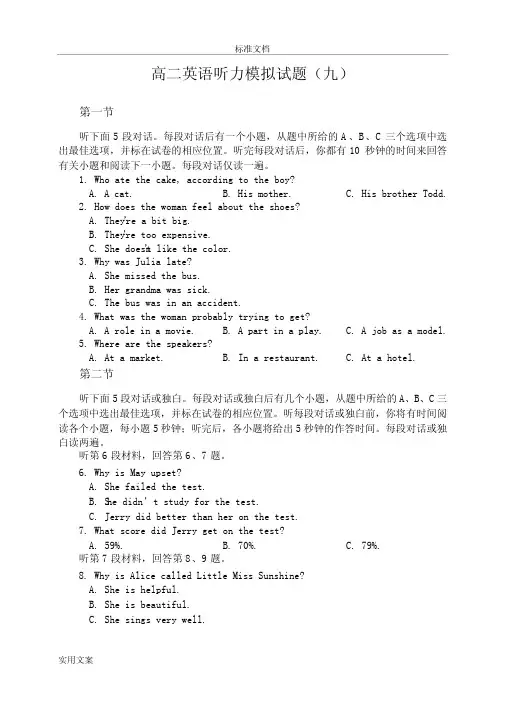
高二英语听力模拟试题(九)第一节听下面5段对话。
每段对话后有一个小题,从题中所给的A、B、C三个选项中选出最佳选项,并标在试卷的相应位置。
听完每段对话后,你都有10秒钟的时间来回答有关小题和阅读下一小题。
每段对话仅读一遍。
1. Who ate the cake, according to the boy?A. A cat.B. His mother.C. His brother Todd.2. How does the woman feel about the shoes?A. They’re a bit big.B. They’re too expensive.C. She doesn’t like the color.3. Why was Julia late?A. She missed the bus.B. Her grandma was sick.C. The bus was in an accident.4. What was the woman probably trying to get?A. A role in a movie.B. A part in a play.C. A job as a model.5. Where are the speakers?A. At a market.B. In a restaurant.C. At a hotel.第二节听下面5段对话或独白。
每段对话或独白后有几个小题,从题中所给的A、B、C三个选项中选出最佳选项,并标在试卷的相应位置。
听每段对话或独白前,你将有时间阅读各个小题,每小题5秒钟;听完后,各小题将给出5秒钟的作答时间。
每段对话或独白读两遍。
听第6段材料,回答第6、7题。
6. Why is May upset?A. She failed the test.B. S he didn’t study for the test.C. Jerry did better than her on the test.7. What score did Jerry get on the test?A. 59%.B. 70%.C. 79%.听第7段材料,回答第8、9题。
2023年高二英语听力练习题及答案
2023年高二英语听力练习题及答案[音频播放器](提示:音频播放器可使用 HTML 代码 <audio>,并嵌入相应音频文件的链接,可在此处添加相关音频链接)一、听力理解(共20小题,每小题1分,满分20分)听下面5段对话。
每段对话后有一个小题,从题中所给的A、B、C 三个选项中选出最佳选项。
听完每段对话后,你都有10秒钟的时间来回答有关小题和阅读下一小题。
每段对话仅读一遍。
1. What does the woman want to do?A. Borrow a pencil.B. Buy a pencil.C. Lend a pencil.2. What is the man going to do this weekend?A. Go camping.B. Stay home.C. Visit his friends.3. What does the woman think of the party?A. It’s too long.B. It’s boring.C. It’s fantastic.4. What are the speakers mainly talking about?A. The weather.B. The traffic.C. The environment.5. What does the man think of the woman’s performance?A. It was amazing.B. It was terrible.C. It was boring.听下面5段对话或独白。
每段对话或独白后有几个小题,从题中所给的A、B、C三个选项中选出最佳选项。
听每段对话或独白前,你将有时间阅读各个小题,每小题5秒钟;听完后,各小题将给出5秒钟的作答时间。
每段对话或独白读两遍。
听第6段材料,回答第6至8题。
6. How does the woman feel about her trip to Paris?A. Excited.B. Disappointed.C. Surprised.7. Why did the woman change her schedule?A. To take a walk.B. To visit a museum.C. To get some rest.8. What will the speakers probably do next?A. Go to the airport.B. Have a meal.C. Go sightseeing.听第7段材料,回答第9至11题。
高二第二学期英语第四次阶段性测试(含答案)

高二第二学期英语第四次阶段性测试第I卷(选择题共95分)第一部分: 听力(共两节, 满分20分)第一节听下面5段对话, 从题中所给的A、B、C三个选项中选出最佳选项。
每段对话仅读一遍。
1.What does the woman mean?A. He has dialed the wrong number.B. John Smith is not in.C. Nobodyis called John Smith.2.Why isn’t the man going to work?A. He is sick.B. His boss has fired him.C. He wants to playtennis.3.What will the man have?A. Bread.B. Milk.C. Eggs.4.Where does this conversation probably take place?A. In an office.B. In a street.C. In a shop.5.What’s the man’s job?A. He is a lawyer.B. He is a shop assistant.C. He works forlawyers.第二节听下面5段对话或独白, 从题中所给的A、B、C三个选项中选出最佳选项。
每段对话或独白读两遍。
听第6段材料,回答第6至8题。
6.Where did this dialogue happen?A. At the station.B. In the hospital.C. In the shop.7.What is the woman going to buy?A. Bag.B. Shoes.C. Trousers.8. What color does her daughter like?A. WhiteB. Blue.C. Red.听第7段材料,回答第9至11题。
高二英语下学期四月月考(含听力)测试题(原卷版)
英语
湖北省武昌实验中学高二年级四月月考
英语试卷
第Ⅰ卷
第一部分:听力(共两节,满分30分)
做题时,先将答案标在试卷上。录音内容结束后,你将有两分钟的时间将试卷上的答案转涂到答题卡上。
第一节 (共5小题;每小题1.5分,满分7.5分)
听下面 5 段对话。每段对话后有一个小题,从题中所给的 A、B、C 三个选项中选出最佳选项。听完每段对话后,你都有 10 秒钟的时间来回答有关小题和阅读下一小题。每段对话仅读一遍。
C. They sent them to their families.
18. What was a nurse’s main duty?
A. Cooking meals.B. Looking after children.C. Educating children.
19. How did the Victorian upper class parents treat their children actually?
A. At 3:00.B. At 4:00.C. At 5:00.
9. Why is the woman worried?
A. The weather is bad.B. The report is not finished.C. An appointment will be delayed.
听下面一段较长对话,回答以下小题。【此处可播放相关音频,请去附件查看】
15. What do the woman’s parents expect her to be?
A A restaurant manager.B. A politician.C. A teacher.
16. What is the woman good at doing?
人教版高中英语必修二第四单元综合检测卷(附听力原文与参考答案)

必修二Unit 2 单元综合检测卷(时间: 120分钟满分: 150分)第一部分听力(共两节, 满分30分)第一节(共5小题; 每小题1. 5分, 满分7. 5分)听下面5段对话。
每段对话后有一个小题, 从题中所给的A、B、C三个选项中选出最佳选项。
听完每段对话后, 你都有10秒钟的时间来回答有关小题和阅读下一小题。
每段对话仅读一遍。
1. What does the man usually have for breakfast?A. Fried cakes.B. Fried rice-noodles.C. Noodles.2. What will the woman do first?A. Withdraw some money.B. See the dentist.C. Go to the history seminar.3. What is the time by Sandra’s watch?A. 2: 55.B. 3: 00.C. 3: 05.4. What does the woman mean?A. Filling out the forms is no easy thing to do.B. She forgot to fill out the forms.C. She’ll remind the man about the forms.5. What is the conversation mainly about?A. Differences between meat and fruit.B. Different ideas about meat and vegetables.C. Different kinds of meat.第二节(共15小题; 每小题1. 5分, 满分22. 5分)听下面5段对话或独白。
每段对话或独白后有几个小题, 从题中所给的A、B、C 三个选项中选出最佳选项。
高二英语听力系列模拟试题4(附答案+听力下载)
高二英语听力模拟试题4第一节(共15小题:每小题2分,满分30分)听下面5段对话或独白。
每段对话或独白后有几个小题,从题中所给的A、B、C三个选项中选出最佳选项,并标在试卷的相应位置。
听每段对话或独白前,你将有时间阅读各个小题,每小题5秒钟;听完后,各个小题将给出5秒钟的作答时间。
每段对话或独白读两遍。
听第1段材料,回答第1—3题。
1. Where is Pat calling from?A. From her home.B. From her school.C. From her office.2. Who does Pat want to call?A. Tom.B. Her friend Anna.C. Tom and Anna.3. Why can’t Pat speak to Anna now?A. Because Anna is at work.B. Because Anna is busy.C. Because Anna isn’t at home?听第2段材料,回答第4—6题。
4. Whaere does the man live?A. Washington.B. London.C. Potohac.5. How far is his home from Washington?A. About 15 miles.B. About 45 miles.C. About 25 miles.6. How long does it take the man to go from home to work in the morning?A. 55 minutes.B. 45 minutes.C. 15 minutes.听第3段材料,回答第7—9题。
7. What are they talking about?A. Children.B. Vacation.C. Jobs.8. Will the man take a vacation this summer?A. Yes.B. No.C. He isn’t sure yet.9. What do you know about the woman’s two sons?A. They are on vacation now.B. They are both in college.C. They will graduate next year.听第4段材料,回答第10—12题。
2024年武汉市高二英语听力模拟题答案
2024年武汉市高二英语听力模拟题答案一、听力部分本次高二英语听力模拟题旨在检测同学们对于英语听力的理解和掌握能力。
以下是本次模拟题的答案及详细解析,希望能帮助同学们更好地总结经验,提高听力水平。
Section 11、 B 听力原文中提到“the blue one”,明确指出是蓝色的那个,所以答案是 B。
2、 A 男士说“Tomorrow morning at 9 o'clock”,表明时间是明天早上 9 点,答案选 A。
3、 C 女士提到“by train”,意思是乘火车,答案为 C。
4、 B 关键信息是“a big garden”,有一个大花园,故选 B。
5、 A 对话中说“on the second floor”,即在二楼,A 选项正确。
Section 26、 C 提到“three days a week”,一周三天,答案是 C。
7、 A 男士说“because it's interesting”,因为有趣,所以选 A。
8、 B 关键表述“play football”,踢足球,答案为 B。
9、 C 女士说“at 5:30”,5 点半,C 选项符合。
10、 A 提到“go swimming”,去游泳,A 是正确答案。
Section 311、 B 原文提到“in the library”,在图书馆,答案选 B。
12、 C 男士说“last week”,上周,C 选项正确。
13、 A 关键信息是“read a book about history”,读一本关于历史的书,A 符合。
14、 B 女士说“because it's too difficult”,因为太难了,答案是 B。
15、 C 提到“help her with her math”,帮助她数学,C 选项正确。
Section 416、 A 听力中说“in the countryside”,在乡村,A 选项正确。
17、 B 关键表述“go fishing”,去钓鱼,答案为 B。
49第2部分高二英语听力全真模拟训练(40)(教学设计)2025版高二英语听力专项分类训练(提升篇)
目标:让学生了解高二英语听力全真模拟训练的基本概念、组成部分和原理。
过程:
讲解高二英语听力全真模拟训练的定义,包括其主要组成元素或结构。
详细介绍高二. 高二英语听力案例分析(20分钟)
目标:通过具体案例,让学生深入了解高二英语听力全真模拟训练的特性和重要性。
2. 作业反馈:
及时对学生的作业进行批改和反馈,指出存在的问题并给出改进建议,以促进学生的学习进步。具体反馈方式如下:
- 针对学生的听力练习,教师会仔细批改学生的答案,并给出具体的错误分析和改正建议,帮助学生发现自己的不足并加以改进。
- 对于学生的听力技巧应用练习,教师会评估学生对技巧的掌握程度,并给出针对性的指导意见,帮助学生更好地运用技巧进行听力理解。
还可以为学生提供一些英语听力学习资料,如听力技巧书籍、听力练习软件等,帮助学生更好地进行听力训练。
作业布置与反馈
1. 作业布置:
根据本节课的教学内容和目标,布置适量的作业,以便于学生巩固所学知识并提高能力。具体作业内容如下:
- 听力练习:要求学生完成高二英语听力专项分类训练(提升篇)中的相关练习,包括不同类型的听力材料,以巩固课堂所学。
49第2部分 高二英语听力全真模拟训练(40)(教学设计)2025版高二英语听力专项分类训练(提升篇)
主备人
备课成员
教学内容分析
本节课的主要教学内容为高二英语听力全真模拟训练,具体包括以下几个部分:
1. 听力材料:本次教学选用的听力材料为高二英语听力专项分类训练(提升篇)中的第49第2部分,内容包括日常对话、故事情节、讲座演讲等多种类型,旨在提升学生在不同场景下的英语听力理解能力。
教学手段:
1. 多媒体设备:利用多媒体课件、视频等资源,为学生提供丰富的听力材料和真实场景的模拟,提高学生的学习兴趣和效果。
2021年高二下学期第四次阶段测试英语试题含答案
2021年高二下学期第四次阶段测试英语试题含答案第一部分听力(共两节,满分20分)第一节(共5小题;每小题1分,满分5分)听下面5段对话。
每段对话后有一个小题,从题中所给A、B、C三个选项中选出最佳选项,并标在试卷的相应位置,听完每段对话后,你都有10秒钟时间来回答有关小题和阅读下一小题,每段对话仅读一遍。
1. Where does the conversation take place probably?A. In a shop.B. At home.C. In a swimming pool.2. On which days doesn’t the man’s son work?A. Monday, Wednesday and Friday.B. Monday, Friday and Saturday.C. Tuesday, Thursday and Sunday.3. Who is going after Jack?A. Mrs. Green.B. Mr. Green.C. His brother.4. What does the man mean?A. Mark should clean the car this time.B. The car doesn’t need cleaning.C. He cleaned the car last time.5. When should the delivery be made to the man?A. On Sunday.B. On Saturday.C. On Thursday.第二节(共15小题;每小题1分,满分15分)听下面5段对话或独白。
每段对话或独白后有几小题。
从题中所给的A、B、C三个选项中选出最佳选项,并标在试卷的相应位置。
听每段对话或独白前,你将有5秒钟来阅读各个小题;听完后,每个小题将给出5秒钟的作答时间,每段对话或独白读两遍。