
2013最新新目标英语七年级下学期unit6_I'm_watching_TV_课件
汉译英 1.我们正在看电视. We are watching TV. 2.他们正在打扫教室. They are cleaning the classroom. 3.汤姆正在吃早饭. Tom is having breakfast. 4.那个女孩正在买玩具. The girl is buying toys.
is she What ___ doing ______? sleeping She is ___ ______.
Are they reading ____ a book? aren’t No, they ____.
What ____ are they
doing ? _______ They’re writing _____.
They are swimming.
They are doing their homework. They are walking.
They are having a party. They are studying.
There are many people in the happy apartment. What are they doing?
Look!
区别下面的几组句子:
I do my homework every day. I am doing my homework now.
He cleans his room every afternoon. He is cleaning his room now.
区别这两种时态主要是看时间状语。 两种时态区别主要体现在动词的形式上。
• • • • • • • • •
现在进行时的肯定句的构成形式: 主语+be+现在分词(v-ing)+其他 现在进行时的否定句的构成形式: 主语+be +not+现在分词(v-ing)+其他 现在进行时的一般疑问句句的构成形式: Be+主语+v-ing+其他? Yes, 主语+be. No, 主语+be+not. 现在进行时的特殊疑问句句的构成形式: 特殊疑问词+be+主语+现在分词+其他?
选择填空:
1. What are you doing? I_____ A. eat B. can eat C. eating D. am eating 2. We want _______this book. A. reading B. am reading C. read D. to read 3. Our teacher is __the blackboard . A. clean B. cleans C. cleaning D. to clean 4. That boy isn’t ____the teacher . A. listen B. listens C. listening D. listening to
一般现在时
A:含义和时间状语
⑴经常发生或反复发生的动作或存在的状态, 通常和表示频率的副 词连用,如: always,usually,often,sometimes, hardly ever(几乎不), never, every day/week/year/month/morning… 等时间状语连用. 1) He gets up at six every day.他每天六点起床 2) She works eight hours a day .她每天工作八小时
B: No, she is not. She is writing a letter.
Let’s guess what are they doing?
Is Nancy doing homework?
No, she isn’t. she’s writing a letter. 2c
Let’s guess what are they doing?
现在进行时
be + v. -ing
am / is / are + 现在分词
The Present Progressive Tense ( 现在进行时) 1、定义:
现在进行时表示现在(说话瞬间)正在进行的动作。例如:
现在进行时也可表示当前一段时间内的活动或现阶段正在进 行的动作。例如:
2、结构:
现在进行时是由助动词be(am/is/are)加动词-ing形式构成的。 I am watching TV now.
5.It’s 8 o’ clock . Jim’s parents __TV. A. is watching B. are watching C. watch D. to watch 6.__ your sister ____ on the phone? A. Is ,talk B. Is,talking C. does, talk D. does ,talking 7.__you __the window?—Yes, I am. A. Do, clean B. Is, cleaning C. Are, cleaning D. Do, cleaning 8. What __ you ____for? A. are , look B. is, look C. are, looking D. do , look
Is Mary doing homework?
No, she isn’t. she’s playing with a bi
Let’s guess what are they doing?
Is Tom doing homework? No, he isn’t. he’s drawing.
Let’s guess what are they doing?
1b Listening
What are these people doing?
1b Listen. What are these people doing?
Name
doing
Jenny Dave and Mary
John
watching TV eating dinner doing homework
leaving
• sit
sitting
动 词 现 在 分 词 变 变 变
• shop
shopping
cutting stopping putting getting beginning swimming running
• cut
• stop
• put
• get • begin • swim • run
I am playing computer. She is singing.
见 课 本
They are dancing. He is swimming.
It is flying.
请 归 纳 什 么 是 现 在 进 行 时 ?
(P99-100)
The Present Progressive Tense
haveing seeing talking
running beginning
being
eating reading swimming opening
run
begin listen
listening
paint
painting
2a. Listen to the conversation and
He is cooking.
He is drawing.
What’s he doing?
He is thinking.
He is sleeping.
He is eating an apple.
He is fishing.
What’s she doing?
She is singing.
She is reading.
What are you doing?
I’m…
reading
running
taking a shower
eating breakfast
watching TV
talking on the phone
What’s he doing?
He is talking on the phone. He is playing computer games. He is playing the violin.
play→playing 一般在动词原形末 尾加-ing。
• write
writing taking having making coming arriving dancing
动 词 现 在 分 词 变 型
• take • have
• make
• come • • arrive • dance
• leave
watch→watching dance→dancing clean→cleaning come→coming eat→eating read→reading talk→talking have→having arrive→arriving 以不发音字母e 结尾的动词, 先去掉e,再加 -ing。
sing→singing
answer these questions.
He is watching TV. 1.What is Steve doing? ______________
2. What is Jack doing ?
He is listening to a CD.
What s he doing now? He is eating dinner.
,
What s he doing? ,
,
He s running.
What are they doing?
Are they…?
They re dancing.
人教新目标版英语七下Unit6《I’mwatchingTV》(SectionB1a-1e)说课稿
人教新目标版英语七下Unit 6《I’m watching TV》(Section B 1a-1e)说课稿一. 教材分析人教新目标版英语七下Unit 6《I’m watching TV》(Section B 1a-1e)主要围绕着日常生活中的休闲活动展开。
通过本节课的学习,学生能够掌握描述日常活动的一般现在时态,以及如何用英语询问和回答他人正在做什么。
本节课的语言目标包括:能够听懂、说出一般现在时态的句子;能够正确运用“What are you doing? I’m doing…”进行问答。
同时,教材还通过丰富的情境和任务型活动,培养学生的合作意识和跨文化交际能力。
二. 学情分析七年级的学生已经具备了一定的英语基础,能够听懂并运用简单的英语进行交流。
但是,对于一般现在时态的运用还不够熟练,需要通过本节课的学习进一步巩固。
同时,学生对于描述日常活动的词汇和表达还不够熟悉,需要在课堂上进行大量的练习和运用。
三. 说教学目标1.知识目标:学生能够掌握一般现在时态的构成和用法,能够用英语描述自己和他人的日常活动。
2.能力目标:学生能够听懂、会说、会写一般现在时态的句子,能够用英语进行简单的问答。
3.情感目标:通过本节课的学习,学生能够培养良好的学习习惯,提高学习英语的兴趣。
四. 说教学重难点1.教学重点:一般现在时态的构成和用法,以及描述日常活动的词汇和表达。
2.教学难点:一般现在时态的句子结构,以及如何正确运用一般现在时态进行问答。
五. 说教学方法与手段1.教学方法:采用任务型教学法,通过丰富的情境和活动,激发学生的学习兴趣,提高学生的参与度和积极性。
2.教学手段:利用多媒体课件、图片、卡片等辅助教学,创设真实、生动的学习情境,帮助学生更好地理解和运用语言。
六. 说教学过程1.导入:通过播放一段关于日常活动的视频,引导学生思考并讨论:What are they doing? 从而引出一般现在时态的概念。
人教版新目标Unit6-I'm-watching-TV知识点与练习
Unit6 I’m watching TV一.写出动词的形式。
clean_______ wash ________ read________ watch________ sing________ listen________ have________ talk________draw________ drive________ play_______ speak________ write________ look________ make________ walk________ run________ exercise________ use________ drink________ eat________ study________ dance________ show________teach________ get________ brush________ take________work________practice________ 二.短语归纳1.做家庭作业____________2.打电话交谈____________3. 读报____________4.去看电影____________5.那听起来不错____________6.打扫房间___________7.洗衣服____________ 8. 洗碗____________ 9.用电脑____________10.看电视____________ 11. 做汤____________ 12. 听音乐____________13. 有点儿____________ 14. 电视节目____________ 15. 想要做某事____________ 16. 没忙什么____________ 17. 和某人一起做...____________ 18. 在家____________ 19. 做晚餐____________ 20. 喝茶____________ 21.在周末____________22. 去超市____________ 23. 去购物____________ 24. 写信____________25. 为考试学习____________ 26. 其他任何的____________27. 寄宿家庭___________ 28. 希望做某事____________ 29. 端午节____________ 30. 看比赛____________31. 像____________ 32. 非常喜欢____________33. 在客厅____________二.重要句型现在进行时的构成1)肯定句: 主语+ am/is/are+ doing +其他+时状.2)否定句:主语+am/is/are +not+ doing+其他+时状.3)一般疑问句:Am/Is/Are +主语+ doing+其他+时状?肯定回答:Yes,主语+am/is/are否定回答:No, 主语+am not/isn’t/aren’t4)特殊疑问句形式: 特殊疑问词+is/am/are+主语+现在分词+其他?Exercises:1.他正在干什么?___________________________他正在吃饭___________________________2.你正在听什么?___________________________我正在听音乐。
初中英语七年级下册Unit 6 I'm watching TV课件
嗯,没什么事。
3. Do you want to join me for dinner? 你想跟我一起吃个饭吗? join sb for something 表示“与某人 一起做某事;参与或加入到某人的行 列中一起做某事”。例如: e.g. Can you join us for lunch? 你能和我们一起吃午饭吗
Laura: Yeah. I’d love to. Jenny: Let’s meet at my home first.
Come at half past six. Laura: OK. See you then.
1. This is Jenny. 我是詹妮。 这是打电话用语。当打电话时,介绍自己时 用“This is…”或“It’s…”;问对方用“Is that…?”或“Who’s that?”例如: Hello? This is Bob? Who’s that? 喂?我是鲍勃,你是谁? Hi, Bob. It’s Mike here. 你好,鲍勃。我是迈克。
Answers I'm watching TV. She's washing her clothes. They are listening to a CD.
Are you doing your homework?
Yes,I am./No,I'm not.I'm cleaning my room.
Is he reading a newspaper?
Practice
阅读Grammar Focus部分,完成下列句子。
Yes,he is./No,he isn't.He's playing basekeball.
人教版新目标Unit6-I'm-watching-TV知识点
Unit6 I’m watching TV一、词组、短语及用法1.do one’s homework (此处的do是“做”的意思)2.talk on the phone 打电话交谈3.watch look see read 的大致区别:watch 观看,看watch TV 看电视watch a football game 看一场足球比赛see 看见(看的结果)I can see the bird in the tree.look 看(看的动作)Please look at the blackboard.read 阅读,读书,读报She is reading a story.4.go to the movies 去看电影5.That sounds good. 那听起来不错 show 电视节目7.at six o’clock 在六点钟8. wait for sb /sth 等侯某人/某物9. all 、also 、often 、never 等副词应该放在be动词,情态动词及助动词之后,行为动词之前。
He never stop talking. I often get up at six.We are all students.The boys can also swim.They all like English. Lions also come from South Africa.10. thanks for sth 谢谢某物Thanks for your letter.thanks for doing sth 谢谢做了某事Thanks for joining us.11. some of + 宾格代词(us / you /them )some of us 我门当中的一些人Some of +名词复数some of the students 一些学生12. in the first /second /next / last photo 在第一/第二/下一个/最后一张照片里13. at school 在学校at home 在家at the pool 在游泳池at the mall在商店14. be with sb 与某人一起He is with his parents. 他和他的父母在一起。
七年级英语下册_Unit_6_I’m_watching_TV学案_人教新目标版
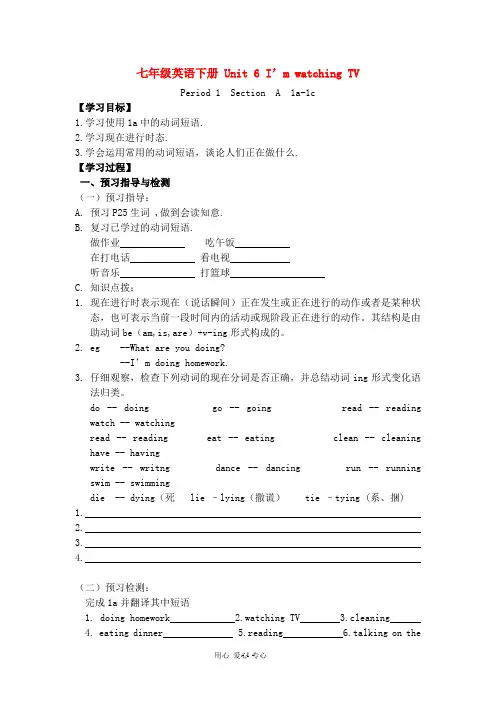
七年级英语下册 Unit 6 I’m watching TVPeriod 1 Section A 1a-1c【学习目标】1.学习使用1a中的动词短语.2.学习现在进行时态.3.学会运用常用的动词短语,谈论人们正在做什么.【学习过程】一、预习指导与检测(一)预习指导:A.预习P25生词 ,做到会读知意.B.复习已学过的动词短语.做作业吃午饭在打电话看电视听音乐打篮球C.知识点拨:1.现在进行时表示现在(说话瞬间)正在发生或正在进行的动作或者是某种状态,也可表示当前一段时间内的活动或现阶段正在进行的动作。
其结构是由助动词be(am,is,are)+v-ing形式构成的。
2.eg --What are you doing?--I’m doing homework.3.仔细观察,检查下列动词的现在分词是否正确,并总结动词ing形式变化语法归类。
do -- doing go -- going read -- readingwatch -- watchingread -- reading eat -- eating clean -- cleaninghave -- havingwrite -- writng dance -- dancing run -- runningswim -- swimmingdie -- dying(死 lie –lying(撒谎) tie –tying (系、捆)1.2.3.4.(二)预习检测:完成1a并翻译其中短语1. doing homework2.watching TV3.cleaning4. eating dinner5.reading6.talking on thephone二、课堂互动探究1.Pairwork: 使用句型What are you doing? I’m…谈论正在进行的动作。
2.得分小能手:看谁能用现在进行时态造句,并造的又多又准确,注意动词ing的结构哟。
人教新目标版2013—2014年度下学期七年级英语教案Unit 6 I’m watching TV.

人教新目标版2013—2014年度下学期七年级英语教案主备人:备课时间:2014年月日成员:Unit 6 I’m watching TV.一、Teaching Goal:In this unit students learn to talk about what people are doing. Teach students how to cooperate and be good at watching something and love our lives.二、Teaching difficulties1. The vocabulary and the sentence structures.2. Learn the grammar: Present progressive tense.3. Oral practice using the target language.三、Teaching MethodsListening and practicing methods, pair work, Task-Based Learning method.四、Teaching AidsA tape recorder, some pictures and cards.五、Teaching Time: 5 periodsPeriod 1 (Section A:1a—2b)Teaching ProceduresStep 1.Revision1. Greetings.2. Revise the words and expressions in Unit 4.Step 2.Presatation: Lead in1. Do “Ask and answer” practice with the Ss.2. The teacher asks the students to give more verbs phrases and write them down on the blackboard.(show many pictures to help the Ss.)Teach the new words and expressions.3. Teach the Present Progressive.1)Introduction: Talk about the title of this unit. Show some pictures to introduce the Present Progressive tense.T: What’s she/he doing?Ss: She/He is v-ing (Help the Ss to answer the questions and show the sentences)2) Let the Ss to say what the Present Progressive is.3). Tell the differenceWrite down the V-ing forms by another lines of go, watch, do, play and eat . Ask the Ss to have a look and find the difference between them. For example: go and going, watch and watching, do and doing, etc. Then ask the Ss to read them again and do more exercises.Step3.Activity 1a:Match1. Help the Ss talk about the pictures. The Ss read these V-ing wordsafter the teacher. Match the words and the activities. Check the answers.2. Help the Ss do “Ask and answer” practice in pairs.3. Ask some Ss to do actions and let the class guess what he/she is doing.Step4.Activity 1b & 1c: Listening and pair work.1. Play the recording for the Ss to listen. Play again. Ss listen and write the number of the activity each person is doing. Check the answers.2. Pairwork: Ask the Ss to do “Ask and answer” practice about the picture in pairs. Some pairs present their dialogues to the class.Step 5.Activity 2a & 2b: Listening and Practice1.Activity 2a:Talk about the picture in 2b.Ask the Ss to read the questions in 2a. Then listen to the tape and and write the answers. Check the answers.2.Activity 2b:Play the recording again. Help the Ss put these questions and answers in order to make a conversation. Go through the answers with the Ss.Step 6 Pairwork: Activity 2c1.Talk about the pictures in 2c. Ask Ss to read the sample conversation. Let Ss look at the first group of pictures, and ask them to guess what the people are doing.2. Then imitate the sample conversation, work in pairs. Some pairs present their dialogues to the class.3. A guessing game: Guess the activities according to the Ss’ actions.Step 7 Homework: 1.Copy the new words and recite.2.Make up their own dialogues.教学后记:Period 2 (Section A:2d—3c)Teaching aimsGo on learning to talk about what people are doing.Language points1.To learn the following sentences.⑴—Is Nancy doing homework ?—Yes, she is ./No, she isn’t .She is writing a letter.⑵—Do you want to go to the movies? —Yes ,I do .⑶—When do you want to go? —Let’s go at six o’clock.2.To learn the following words and phrases:⑴adjective: sure⑵verb phrases: wait for , talk about , talk to sb.Teaching difficultiespresent participle: run-running , write-writing Present progressive tense: Subject +be+doing +…Teaching stepsWarming-up and revision⑴Watch VCD which is connected with the present progressive tense.⑵RevisionThe teacher asks Ss to do some actions, ask and answer one by one (chain work)T: What are you doing? S1: I am reading an English book. What are you doing ?S2: I am writing .What are you doing ? S3: I am playing the guitar. What are you doing?Show some pictures, point to them and ask.T: Look at picture 1! What is he /she doing ? S1: He/She is talking on the phone.T: Look at picture 2! What are they doing? S2: They are singing and dancing.T: Look at picture3. What is he doing? S3: He is swimming.2. PresentationThe teacher asks one student to come to the blackboard and do an action.T: Are you playing soccer? S: No, I’m not.T: Are you playing basketball? S : Yes, I am.Ask more students like this.PracticeHave students make a similar dialogue like thisS1: Are you reading a book? S2: No, I am not.S1: Are you reading a newspaper ? S2: Yes ,I am.4. Guessing gamesThe teacher uses pictures to ask the students. Cover one part of the picture and then uncover it little by little.T: What is he doing ? S1: Is he playing the computer?T: No, he isn’t . S2: Is he playing the guitar? (show another picture)What are they doing? Teacher continues to ask students and shows them more pictures.5. Pair work (work on 2c)T: let’s look at the pictures and guess what the people are doing. Please practise in pairs.A: Is Nancy writing a letter? B: No, she isn’t. She is writi ng a letter. Then check the answers.6. Work on 3aT: Look at the pictures and make conversations. Please write the correct number of the pictures next to the conversations below. Then check the answer. [Conversation A=3 Conversation B=2 ]The teacher reads the conversation before the class, and the Ss repeat the sentences. Ss practice the conversation in pairs and act out the conversation.7. Pair work(work on 3c)(1)Show a picture and teach the new phr ase“wait for a bus”.(2)Look at the pictures and answer the questions below. Ask Ss ask and answer like this.S1: Where is he? S2: He is in the store/ the supermarket.S1: What is he taking? S2: He is taking a bottle of juice.S1: What is he waiting for? S2: He is waiting for a bus.(3)T: Please look at the pictures again and talk about the four pictures.8. Grammar FocusWhat are you doing? What is he/she doing?I am watching TV. He is doing homework.Is he/she doing? Yes, he/she is./No, he/she isn’t/Are they doing? Yes, they are./ No, the y aren’t.9. HomeworkRead and recite 3a.Write the story about the four pictures.教学后记:Period 3 (Section B:1a-1e)Teaching aims询问别人正在哪里干某事. 继续学习某人正在干某事.Teaching pointsTo learn the following sentences.—Where do people play basketball? —At school.—Where is he swimming? —He is swimming at the pool.To learn the following vocabularies: toy, shopping, mall, pool.Teaching stepsWarming-up. chant and revisionChantWhat are you doing? I’m reading books.What is he doing? He is watching TV.What is she doing? She is doing homework.What are they doing? They are eating dinner.Revision Ask a student to do an action and askT: Are you eating breakfast? S1: No, I’m not .T: Are you singing? S2: Yes, I am .T: Is he writin g a letter? S3: No, he isn’t .T: What is she doing? S4: She is singing .T: Are you reading a newspaper? (To another student)S5: No, I’m not .T: What are you doing? S6: I am reading an English book .T: Is he reading a Chinese book? S7: No, he isn’t .T: Is she reading an English book? S8:Yes, she is .PresentationShow some pictures and present the new vocabularies .T: What is he doing?S1: He is swimming .T: Where is he swimming?S2: He is swimming in the river .T: No, he isn’t swimming in the river. He is swimming at the pool .T:Look! What are these? They are toys . What are the girl and her mother doing? They are shopping .T: Where are they shopping?S1: They are shopping in the store .S2: They are shopping in the supermarket .T: Maybe, look, they are shopping at the mall .PracticeShow some pictures and phrases, let Ss practice in pairs like this .A: What is he doing?B: He is boating .A: Where is he boating?B: He is boating on the river .Complete the chart . (work on 1a)T: Look at the pictures and complete the chart .Then check the answer .1). library reading books2). school playing basketball3). pool swimming4). mall shoppingPairworkLet Ss look at the chart , ask and answer in pairs .A: Where do people play basketball?B: At school .A: Where do people swim?B: At the pool .Listening comprehension2a. T: You will hear three short conversations. Please listen carefully and write down the places you hear in the chart below . Then check the answers: mall, school , library .2b. T: Now look at 1b on page 28. Please listen to the tape again and fill in the chart . Let’s write down what they are doing.Ss listen to the tape twice and write down the answer on their charts.7. Pairwork (work on 1c) .T: Now look at the chart and use the information in the chart to make a conversation like this .A: Hello! Is Tina there?B: No, she isn’t . She is at the mall .A: Oh, is he shopping at the mall ? / What is she doing ?B: No, she isn’t ./ She is eating lunch with a friend .8. Groupwork (Make a survey )1). T: Let’s make a survey, please ask Ss in your classroom where their parents are and what their parents doing now . Please ask and answer in threes, then fill in the chart .2.) After the Ss finish the survey .Let them give a report .9.Homework:1). Listen to the tape and repeat the conversation on Section B.2b.try to imitate the pronunciation and intonation.2). Collect some pictures and bring them to the classroom.3). Write the report down in the exercise book .教学后记:Period 4 (Section B:2a—2c)Teaching aims:Ss can use the present progressive tense to describe the pictures.Ss can ask and answer questions about the picture fluently.Language pointsTo use the following sentences:Here is a photo / picture of my family.I’m with my sister Gina.Thank you for your letter and the photosTo learn the following phrasesThank you for sth. / doing sth. be withTeaching difficultiesHow to write the sentences about the present progressive tense correctly.Teaching steps1.warming-up and revision(1)The teacher asks Ss some questions.T: Hello, how are you? S1: I’m great. Thank you.T: How is your father? S1: He is very well.T: Where is your father? S1: He is at the mall.T: What is he doing? S1: He is shopping.T: Is your father shopping now? S2: No, he isn’t. He is watching TV.T: Where is he watching TV? S2: He is watching TV at home.(2) Show some pictures, let Ss ask and answer the questions in pairs.S1: Look! What is she doing? S2: She is reading a book.S1: Where is she reading a book? S2: She is reading a book under a tree.2. Work on 3a.(1)Show the pictures of 3a and let Ss say it one by one.S1: He is playing basketball.S2: The girl is doing homework.S3: The boy is watching TV.S4: He is swimming.S5: They are eating and talking.(2) T: Here is a letter from Mike to his pen pal, Linda. Please read the letter and underline the activities and circle the places. Check the answers(3) T: Now read the letter again and number the photos, using 1,2,3,4.Check the answers: 1, 4, 2, 3(4) Let Ss work in pairs, ask and answer about the photos like this.A: What is Mike doing in Photo 1?B: He is playing basketball.A: Is he playing basketball at school?B: Yes, he is.3.WritingShow the pictures to the Ss and let Ss finish the sentences, then check the answers.They are dancing. He is running.Yao Ming is playing basketball.The teacher is writing. Xie Tingfeng is singing.4.Group workT: Now take out your photos or pictures, please work in fours and tell your partners about your pictures or photos. I’ll give you two minutes to practice it.T: At this time I’ll ask several students to say something about your photos.5. PracticeT: Take out the pictures or photos of your own and write one or two sentences about them.Ss write the sentences in their exercise books, the teacher walks around the class and see if the Ss can write the sentences correctly. Give Ss some help if necessary.The teacher collects some pictures and sentences, shows them to the Ss and checks the answers.6. Fill in the blanks. ( finish 2b)(1) T: Here is another photo, look at the photo and the letter next to it. Please take out your pens and fill in the blanks. Check the answers: watching TV reading the newspaper talking eating(2)Show the picture of 2b, let Ss say the picture like this:7. Homework.Write a short composition about your own photos or pictures.教学反思:Period 5 (3a-Selfcheck)Teaching aims:Revise the contents of Unit 6.Ss can use the present progressive tense correctly.Language pointsRevise the key words, phrases and sentences in this unit.To learn two new words: camera, birdKey points and teaching difficulties.Consolidate the present progressive tense.Teaching steps:Step 1 Warming-up and revisionLet one student take out a photo or a picture of his / her own and show it to the whole class, then he / she will ask some questions about the photo or the picture.S1: Where is my father?S2: He is…..S1: What is he doing?S3: He is…S1: Is my mother doing…?S4: No, she isn’t. She is …Ask more Ss to come to the blackboard to do it.Step 2 PresentationUse two pictures and present the new words: camera, birdT: What is this?S1: Sorry, I don’t know.T: It’s a camera. We can use a camera to take a photo.T: Look! What is it? S2: It’s a bird.T: That’s right. What is the bird doing?S3: I think it is singing.S4: I think it is flying.Step 3 Complete the storyT: Look at the pictures on Page 30, Part 3. please complete the story and write the sentences in the blanks.Check the answers:What is he doing? He is looking at the birds.What are they doing? They are talking.What is the boy doing? He is running.What is the boy carry? He is carrying a bag.What is in the bag? It’s a camera.What is the boy doing? He is taking a photo.Step 4 Divide the Ss into two parts and read the dialogue. Let Ss act out the dialogue.Step 5 Key words checkStep 6 HomeworkReview the key words and phrases.教学后记:。
2013年新版新目标英语七年级下unit6_I’mwatchingTVSectionA第二课时 - 副本
四.选择填空. 1.My mother is _____TV. A.looking at B.seeing C.reading D.watching 2.---____you ____a book? ---Yes,I am. A.Do,read B.Are ,read C.Are ,reading D.Are ,looking 3.Kate _____,the other students _____. A.sing,listen B.is singing,is listening C.sing,are listening D.is singing,are listening 4.I ___my eraser,but I can’t ______ it. A.look for ,finding B.am finding,look for C.am looking for,find D.find,look for
read a newspaper
What is he doing?
He is reading a newspaper.
Is he…? Yes, he is./No, he isn’t. He is …
wash the dishes
=>do the dishes
What is she doing? She is washing the dishes. Is she…? Yes, she is./No, she isn’t. She is…
talk on the phone on 通过,以……的方式
on the radio
A : What are you doing? B:I’m talking on the phone.
A :Are you talking on the phone?
人教版新目标七年级英语下册Unit6I’mwatchingTV语法篇试题含答案
按要求转换句型2. My sister is washing clothes now. (改为一般疑问句并作肯定回答)your sister clothes now?, .3. She often plays soccer after school. (用now改写句子)She soccer now.4. The boys often play basketball after school. (对划线部分提问)the boys often after school?5. The teachers are watching TV in the meeting room. (对划线部分提问)in the meeting room?A.waterB.wateredC.have wateredD.are watering2. --- What's that noise?--- Bob and his sister computer games.A.have playedB.are playingC.playedD.will play3. He sometimes a picture, but now he .A.draw; singsB.drawing; singingC.draws; is singingD.is drawing; sings4. --- stories every day?--- No. But now I .My mother .李雷正在使用电脑吗?Is Li Lei a ?汤姆晚饭后经常洗餐具。
Tom often after dinner.巩固提高人们不是在工作。
他们在吃午饭。
People . They lunch.is it?18. Tina is reading some books. (改为否定句)Tina reading books.19. The girls are watching a movie at the cinema. (对划线部分提问) the girls a movie?20. There is a photo of my friend. (改为复数句子)There some of my friends.一、单项选择17. What time18. isn't, any19. Where are, watching20. are, photos一、单项选择7 in Qingdao. She is 8 at No. 2 High School.She gets up 9 six every morning. After that, she 10 Chinese. She 11 breakfast at seven o'clock.Now it is seven o'clock in the morning. Miyoko 12 breakfast 13 her Chinese parents."Have another egg, Miyoko. It's just 7:15," her mother says. " 14 , thank you, Mom. I must go now. Wang Lili is waiting for me 15 the bus stop. Today, we are having a Chinese contest. Byebye, Mom."eseC.beD.are.11. A.hasB.is havingC.to haveD.having12. A.hasB.is havingC.to haveD.having13. A.withB.andC.toD.for14. A.YesB.NotC.NoD.Oh15.A.forB.atC.onD.in一、单项选择 1. A2. D3. C4. D5. A二、完形填空 6. A 7. C 8. C 9. D 10. A 11. A12. B13. A14. C15. B__________________________________________________________________________________________________________________________________________________________________阅读理解A1. Arthur's neighbors are .A.noisyB.angryC.singingD.sleeping2. The man in Apartment 3 is .A.painting his apartmentB.cleaning his apartmentC.fixing his apartmentD.moving3. The noisy people in Apartment 5 are .A.youngB.oldC.womenD.men4. The dog in Apartment 6 isn't .A.sleepingB.making noiseC.singingD.arguingC.think about one thingD.both A and B2. The living room is not a good place for study because it is too .A.quietB.noisyC.goodD.clean3. You'll feel tired easily if the light is .A.goodB.enoughC.badD.wonderful4. You should remember to before you study.A.clean the deskB.tidy the roomC.turn on the lightD.go to the bedroom5. The best title(标题) for this passage(文章) is .Scientists can do wonderful things with plants. They can make food just like meat and cheese. And they can make it without the help of animals. It is very good food, too. Now they have begun to say, "We make our paper from wood. We can also make food from wood. The next thing is not very difficult." What is the next thing? Perhaps it is food from paper. Scientists say, "We can turn paper into food. It will be good, cheap food. And it may be cheaper than meat of fish or eggs."So please keep your old books and letters. Don't feed them to your cat. One day, they will be on your plate, if what scientists say may come true.1. The writer asks us to keep our old books and letters because .A.they are useful for reading in the futureB.they may be used to feed cats nowC.now scientists can make food from woodD.scientists can do wonderful things with food3. What's the main idea of this passage?A.All food comes from plants in some way.B.It will not be long before food can be made from paper.C.Scientists can do everything wonderful with plants.D.Scientists can make food without the help of animals.阅读与表达(判断式)Today is Sunday. It is time to play games. Look! There is a child near the house. What is he doing? He is watering(浇) some flowers. Who are the man and the woman behind the house?They're workers. What are they doing? They are working. Look at the children near the river. They are Young Pioneers. Are they playing or working? Some are singing, some are playing games, and some are playing basketball. They are very happy.根据短文内容,判断正误,正确的为T,错误的为F。
Unit6-I'm-watching-TV说课稿
Unit6 I'm watching TV说课稿尊敬的各位领导、老师:大家好,我是来自三棵榆树镇中学的李然。
很高兴今天和大家一起分享的我的模式,我的课。
在日常教学实践中,根据我个人的教学习惯和我校的实际情况,摸索出自己的教学模式,具体模式如下:观察交流,走进新课--讲练结合,听说训练--拓展提升,自我挑战--畅谈收获,分层作业。
今天我说课的内容是新人教版七年级英语下册Unit6 I’m watchingTV.Section A 1a-2c,下面我将从说教材、说教法学法、说教学流程三个大方面进行简要说明。
一说教材从以下几方面1、教材的地位和作用本单元是新目标英语七年级下册unit6。
本节课教材内容围绕着描述人们正在进行的活动展开,内容比较贴近学生的日常生活,易于激发学生的学习兴趣。
并通过这个话题引出现在进行时的一般疑问句,否定句以及特殊疑问句等语言功能。
通过本节课的教学,进一步培养学生观察和描述动作及运用英语的能力,使学生体会到学习英语的快乐。
2、学情分析:初一学生,他们精力旺盛,求知欲强,乐于表现自己。
因此我在教学活动中尽量让他们参与到活动中来,有更多的机会来说英语,减少他们的恐惧感,通过学生间的合作学习,降低他们的学习难度,使他们体验到成功的喜悦。
3、教学目标:(1)知识目标。
掌握重点短语、句型. watching TV , cleaning, reading a newspaper, talking on the phone。
What are you doing? I'm watching TV.What's he/she doing? He/She's reading.(2) 技能目标。
能用现在进行时态准确的描述和表达正在发生的动作。
(3)情感目标。
通过对本单元的任务型活动,提高学生的观察能力和判断能力,我的目的是能培养学生学习英语的强烈兴趣,乐于参加各种活动的积极情感,乐于合作,培养学生团结合作的精神。
七年级英语下册《Unit6IamwatchingTV》教案(新版)人教新目标版
Unit 6 I am watching Tv知识目标:一、Learn the new words and ph rases:1.Newspaper2.read a newspapere4.soup5.make soup6.wash7.movie8.go tomovie s9.just 10.eat out二、掌握下列句型:What are you doing? I’m watching TV.What is he doing ? He is washing his cl othes.What is she doing ? She is washing her clothes.What are they doing? They are listening to a CD.Is he washing hi s clothes? No, he isn’t. He is playing basketball.能力目标: 1.能够掌握现在进行时态的用法。
2. 能够掌握w hat 引导的特殊疑问句。
情感目标:谈论自己和他人正在做的事情。
教学过程:●Step 1: Show some pictures(PPT) to learn some new words:1.newspaper2.read a newspapere4.soup5.make soup6.wash7.movie8.go to movies9.just 10.eat out●Step2: learn 1a: Match t he activities with the people.First read the words, then match.Check the answers. 1--.i 2—d3—g4—a(i), 5—h ,6—e ,7—b; 8.---c 9--f●Step3.Presentation Learn the following sentences by PPT:1. What are y ou doing? I’m watching T V.2.What is he doin g ? He is washing his clothes.3.What is she doing ? She is washing her clothes.4. What are they doing? The y are listening to a CD.5.Is he washing his clothes? No, h e isn’t. He is playing basketball.●Step4: Listen to 1b and number the conversations.First let the Ss listen carefully.. Then check the answers. a—1; b---8; c----5 ●Ste p5: Pairwork:According to 1b—Practice the conversations like t his:A: What is he doing ?B: He’s using the computer.A: What are they doing?B: They are listening to a CD.●Step6: Listening 2aListen to 2a and match the answers.Check the●Step7:Lis tening:Listen again. Complete the sentences.are doing; watching TV ; listening toa CD ; boring; interesting; go to●Step8: Role- play the conversation in 2b●Step 9: Summary1. What are you doing? I’m watching TV.2.What is he doing ? He is washing his clothes.3.What is she doing ? She is washing her clothes.4. What are the y doing? They are listening to a CD.5.Is he wa shing his clothes? No, he isn’t. He is playing basketball.●Step10. Test1. Who _____ over there now?A. singingB. are singC. is singingD. sing2. It’s eight o’clock. The students _____ an English class.A. haveB. havingC. is havingD. are having3. Listen! The baby _____ in the next room.A. cryingB. criedC. is cryingD. cries4. Look! The twins _____ new sweaters.A. are wearingB. wearingC. are wearD. is wearing5. Don’t talk here. Grandparents _____.A. is sleepingB. are sleepingC. sleepingD. sleep教学后记:学生学习积极性较高,对于所学知识掌握较好。