
外研版(三起)-英语-六年级上册-Module 1Unit 2 It’s in the west教案∣外研版(三起) (1)
Module 1 Unit 2
It’s in the west .
【教学目标】
1. 语言目标:
(1)能听说、认读下列单词:map 、country、San Francisco、Houston 以及复习方位词east 、west、south 、north..
(2)能听说、认读并运用下列句型:Where is New York?It’s here ,in the east.说明地理位置。
(3)感叹句型:What a + 形容词+ 名词!
2. 技能目标:
学生能讲述某地的地理位置和相关的基本信息。
3. 情感目标:
培养学生在各种任务中积极与他人合作的良好学习习惯,通过对家乡和祖国的介绍,培养学生热爱家乡和祖国的情感。
【教学重点】
1. 能听说、认读并运用下列句型:Where is New York?It’s here, in the east.说明地理位置。
2. 学生能讲述某地的地理位置和相关的基本信息。
3. 感叹句型:What a + 形容词+ 名词!
【教学难点】
1.运用Where is New York?It’s her e ,in the east.说明地理位置。
2.学生能讲述某地的地理位置和相关的基本信息。
3.感叹句型:What a+形容词+名词!
【教学准备】
PPT、单词卡片、西湖风景区的明信片若干张、一张美国地图、配套资源光盘。
【教学流程】
Step 1 Warming up and review
1. Greetings. (师生间进行简单的问候。
)
T: Good morning, boys and girls!
Ss: Good morning, Miss Li !
T: Welcome to back .Nice to meet you.
S1: Nice to meet you, too.
2. Let’s sing .
教师播放上一节课的第一部分,“Listen and chant ”,让学生跟唱,活跃课堂气氛。
跟唱完后教师问学生:“Where’s the Great Wall ?” -----It’s in china .为引出中国地图做铺垫。
3. Free talk:复习方位介词 .
老师出示一张中国地图进行介绍:“This is a map of China. I’m from Shandong. It’s in the east of China(在中国的东部)”如果有必要,可以用中文稍加解释和说明,然后向学生们提问:“Where are you from? Where is your friend from?’’从而引出其他方位介词。
Step 2 Presentation and Practice
一、Look , listen and say
1. 老师出示若干张西湖风景的图片,提问学生。
T:Do you know this place?
Ss:Yes.It's the West L ake .
T:Ok ,Can you tell me something about it ? Where is the West Lake ?
Ss:Yes, It's…(全班学生可以自由回答)
2. 学生先翻开Page5,自主阅读第一部分,找出答案The West Lake is in the east of china .
并翻译。
3. 教师播放第一部分的动画视频,学生观看视频并尝试跟读(教师可视情况多放几遍)
4. 讲解第一部分课文。
1> Where is the West Lake ? 西湖在哪里
—It’s in the east of China . 它在中国东部。
Where’s +地点?…在哪里?问地点的句型。
—It’s+方位短语。
2>方位短语:in the east在东部in the west 在西部
in the south 在南部in the north 在北部
5. Follow the tape
回顾对话内容,再次完整播放录音动画,学生集体跟读录音。
老师可以在每句话后停顿,请学生模仿跟读,并注意人物所使用的语言。
6. Practise. Game :Let’s do as I .
游戏巩固方位单词:根据老师的口令做动作.例如:
Please turn to the north .
Please turn to the south .
Please turn to the ea st .
Please turn to the west .
老师随意发出口令,学生要尽快执行口令。
老师可以不断加快发出口令的速度,以加大活动难度。
二、Listen and read.
1. 老师出示Simon的图片,向学生提问:“Who is he?” “Where is he from?
引导回答:“Simon’s from New York ,the U S .” 老师把单词写在黑板上,领读,然后提问:“Where is New York?”
老师出示美国地图并向学生提问:“This is a big map of the US. Can you find New York?” 2. 看美国地图,学习两个地点读音:San Francisco 旧金山Houston 休斯顿
教师出示美国地图,提问:
T :How many places can you see on this map ?
----We can see three places . They are New York , San Francisco and Houston .
(引出单词“San Francisco 旧金山、Houston 休斯顿”板书并领读。
)
3 . 单词训练。
(1). 句子展现。
Where is it?
(2). 游戏:挑战你的记忆力。
4. 呈现课文文本对话,让学生先自主阅读课文,并通过观察地图,回答教师的问题。
Q :Where’s New York / San Francisco / Houston ?
4.教师播放Page 5 第2部分的动画,学生观看视频并尝试跟读(教师可视情况多放几遍)
5.文本解读:讲解第2部分课文。
1>What a big map of US . 多么大的一张美国地图。
此句是感叹句,用来表示说话时的
喜悦、惊讶等情感。
由"what"引导的感叹句:“what”意为“多么”用作定语,修饰名词(被强调部分),单数可数名词前要加不定冠词a/an , 复数可数名词或不可数名词前不用冠词。
这类句子的结构形式是:
what+(a/an)+形容词+名词.+主语+谓语+(it is)(主语和谓语可省略).
如:① What a clever girl ( she is )! 多么聪明的女孩。
2>What about San Francisco ? 旧金山怎么样?“What about …”意为“……怎么样”
6 . Follow the tape
回顾对话内容,再次完整播放录音动画,学生集体跟读录音。
老师可以在每句话后停顿,请学生模仿跟读,并注意人物所使用的语言。
7 . Situaitional dialogue. 学生在小组中分角色朗读故事。
Step 3 Consolidation
1.在图片中填入正确的方位词。
2.将下列句子和对话补充完账。
3.句型操练。
教师出示中国地图,标出几个典型省市,学生根据地图反复练习。
T: Where’s Shanghai / Neimengu / Xizang / Hainan ?
-----It’s _______________________.
Step 4 Extension
1. 做相应的配套练习。
Step 5 Summary
总结今天所学的内容。
a ) 单词:New York 纽约San Francisco 旧金山Houston 休斯顿。
b) 句型:Where’s …?It’s ….讲述某地的地理位置和相关的基本信息。
c)感叹句:What a + 形容词+ 名词!.
d)“What about …”意为“……怎么样”。
Step 6 Homework
1.能独立完整地朗读对话。
2. 完成配套教辅相应的练习。
板书设计:。
2024年外研版英语六年级上册Module 1《Unit 2 It’s more than four

绩 ,
八
分
方
法
。
愿
全
天
下
还在路上……
about it?All right.It’s _______eight
myeoraersthoalnd.And it’s more than four
hundred _____ high!Wow,mtheatrt’ess
really_____!
high
The building is 200 metres high.
How old is it ? It’s more than eighty years old .
How tall(high) is it ?
It’s more than four hundred metres high!
the Empire State Building
帝国大厦(Empire State Building),是一 栋超高层的现代化办公大楼,是当时使用材料 最轻的建筑,建成于西方经济危机时期,成为 美国经济复苏的象征,它和自由女神像一起被 称为纽约的标志。它位于美国纽约市的一栋著 名的摩天大楼,共有102层,1930年动工, 1931年落成,只用了410天,1931年5月1日, 世界最高建筑,纽约帝国摩天大厦在盛大的仪 式下正式开典。它的名字来源于纽约州的别称 帝国州(Empire State),所以英文原意实际 上是“纽约州大厦”。
Practice:fill in the blanks
Simon,look at this building.It’s so
h_i_g_h_!It’s the__E_m_p_i_re__S_ta_t_e_Bu. ildiInt’gs an
______o_f_f_ic_e.Cbuailndiyngou tell me more
外研版六年级英语上册 (It's in the west)课件教学
It’s in the west
外研版(三起)·六年级上册
New York 纽约
San Francisco旧金山
Houston 休斯顿
These are pictures of the West Lake.
Where is the West Lake? It’s in the east of China. Is it beautiful? Yes, it is.
more than 超过
常见短语: more than+名词:不仅仅是 例:Jason is more than a lecturer,
he is a writer,too. 杰森不仅是一个演讲者, 他还是一个作家。
more than+数词:超过 例: I have known David for more than 20 years. 我已经认识David超过20年了。
country too. too
也
I like Math. I like Chinese too.
I like Math. I also like Chinese.
What …!
what 开头的感叹句
我们用 what+(a/an)+形容词+物品来表达噢。
好大一棵树!
What a big tree!
Daming: And Houston is in the south. Simon: TThhaatt’’ssrriigghhtt.. 对。(表示肯定别人的看法) Daming: The US is a big country. Simon: Yes, it is. And China is a big
六年级上册英语说课稿-Module 1 Unit 2 It’s in the west 外研社(三起

六年级上册英语说课稿-Module 1 Unit 2 It’s in the west 外研社(三起)一、教学目标1.知识与能力目标学习地理位置词汇:east, west, south, north等,能够用英语描述方位关系。
了解英语语音和语调,通过听、说等方式提高自身英语口语水平。
2.态度价值目标学生能够积极参与课堂,思维活跃,认真听讲,积极回答问题,主动与他人交流,乐观向上,积极进取。
二、教学重难点1.教学重点:地理位置词汇的掌握及口语表达的训练。
2.教学难点:方位关系的形象化、运用语音语调表达方位关系。
三、教学内容及安排1.Warming up导入课堂,介绍本节课要学习的内容,通过图片、地图等方式调动学生学习英语的兴趣。
2.Presentation通过图片、地图等形式呈现英语中的地理位置词汇,划分东南西北四个方向,让学生理解方位关系,搭配示范,让学生学会如何发音、语调、表达。
3.Practice对学生进行地理位置语言表达的训练,使他们能够熟练运用所学内容。
例如,以图片或地图为背景,以英语读出地名,并回答“Where is it?”的问题。
同时,要求学生说出四个方向中,目标地点是在哪个方向,体验英语口语的实际应用。
4.Production通过学生英语语言游戏的形式进一步应用所学内容,例如,以英文字母Y为主题,让学生介绍中国的一些城市,并告诉从学校到城市的方位关系,并形成英语表述的饶有趣味的小故事。
5.Summary and Homework总结今天所学内容,导出重点、难点,鼓励学生积极尝试,提高英语口语水平。
四、教学调整与改进1.鼓励学生互动,互相问答,以激发学生的兴趣。
2.通过趣味化的小游戏来加强口语训练,提高学生的语言能力。
3.随时根据学生的口语表达情况进行教学调整,及时帮助学生解决困难。
4.不同程度的学生在教学过程中有不同的应对方法,可以通过丰富的例子来帮助学生更好的理解和参与。
五、教学思考1.本节课的教学目标达成度如何?2.学生学习效果如何?是否能够通过学习达到知识和技能提高的目的?3.学生学习的兴趣是否被调动,是否积极参与课堂?4.本节课中的难点正确有效地解决了吗?5.课程设计是否适合学生群体,能否满足学生的不同需求?6.是否有必要改变或修正此次教学的教学计划?7.在本节课教学过程中,有没有任何可以改进和提升的地方?。
外研版(三起)-英语-六年级上册-Module1 Unit2 period1(练习及解析)-外研社(三起)
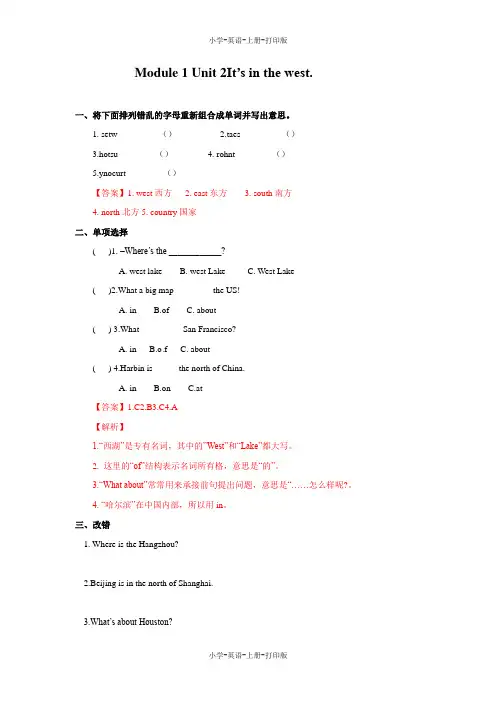
Module 1 Unit 2It’s in the west.一、将下面排列错乱的字母重新组合成单词并写出意思。
1. setw ________ ()2.taes ________ ()3.hotsu ________()4. rohnt ________()5.ynocurt ________()【答案】1. west西方 2. east东方 3. south南方4. north北方5. country国家二、单项选择( )1. –Where’s the ____________?A. west lakeB. west LakeC. West Lake( )2.What a big map ________ the US!A. inB.ofC. about( ) 3.What _________ San Francisco?A. inB.o fC. about( ) 4.Harbin is _____ the north of China.A. inB.onC.at【答案】1.C2.B3.C4.A【解析】1.“西湖”是专有名词,其中的”West”和“Lake”都大写。
2. 这里的“of”结构表示名词所有格,意思是“的”。
3.“What about”常常用来承接前句提出问题,意思是“……怎么样呢?。
4. “哈尔滨”在中国内部,所以用in。
三、改错1. Where is the Hangzhou?________________________________________________________2.Beijing is in the north of Shanghai.________________________________________________________3.What’s about Houston?________________________________________________________4.How a big map of the US!________________________________________________________5.Haikou is in the south of China, and Hongkong it’s in the south too.________________________________________________________【答案】1.Where is Hangzhou?2.Beijing is to the north of Shanghai.3.What about Houston?4.What a big map of the US!5.Haikou is in the south of China, and Hongkong is in the south too.【解析】1. Where is Hangzhou? (Hangzhou是城市名称,前面不用加定冠词。
小学英语外研版(三年级起点)六年级上册Module 1训练课件ppt(13张PPT)
Unit 2 It’s in the west.
Ⅰ.选词填空
north,in,country,south,of,fifty
1.New York is in the east of the US. 2.What a big map of China! 3.Its flag has got fifty stars. 4.The US is a big country . 5.Boston is in the north and Houston is in the south .
B.thousand kilometres
C.thousands kilometre
Ⅲ.按要求完成下列各题
1.The Great Wall is more than twenty thousand kilometres long.(对画线部分提问)
How long is the Great Wall? 2.Is it in our town?(做肯定回答)
Ⅲ.根据句意及首字母提示补全单词 1.Please tell me m ore about it. 2.Can you tell me s omething about your school? 3.There are about ten t housand books here. 4.About eight m illion people live in Shenyang. 5.The road is about six k ilometres long.
Ⅱ.单项填空
( B )1.—
is the West Lake?
—It’s in the east of China.
A.What
B.Where
外研版(三起)英语六年级上册 Module 1 Unit 2 课件
Thanks!
What is it?
Listen and check Simon and Daming are talking about their favourite place of interest.
What is it? The West Lake.
Listen and answer
1. Where's the West Lake? It's in the east of China.
Play中 a game Choose one city/place of interest on the map, and talk about it with your partner. Then ask others to guess.
A: Where is it? B: It’s in the … A: Is it in … city/province? B: Yes, it is./No, it isn’t. A: Can you … there? B: Yes, I can./No, I can’t. A: Is it …? B: Yes, it is./No, it isn’t.
Make 中an interview
Ask your classmates about the cities they want to visit.
Interview 1
1. What city would you like to visit? 2. Where is it?
Interview 2 (East/West/ North/South)
Listen, f中ill and imitate
In _A_m_e_r_ic_a__, there is ___lo_t_s___ to see. Many _d_if_f_e_re_n_t_ places ___l_ik_e___ New York and Tennessee.
(三起点)外研版六年级英语上册《Module1_Unit2_第1课时教案》
Module1 Unit2 第1课时教案一、教学内容外研版小学英语六年级上册第一模块第二单元第一课时: Unit 2 1. Look, listen and say.2. Listen and read.3. Look and write. Then ask and answer.二、教学目标1. 大多数学生能够听、说、读、写单词或短语: map, right, in the east/west/north/south of.2. 大多数学生能够听懂并用句型“Where is…?It’s in the (east/west/north/south)of…” 讲述某地的地理位置和相关的基本信息。
3. 能够运用所学的语言知识与同伴进行交流。
三、教学重难点(一)重点:1. 听、说、读、写单词和短语map, right, in the east/west/ north/ south.2. 学习句型:Where is...? It’s here, in the... (east/west/north/south).(二)难点:1. 运用句型: Where is...? I t’s here, in the... (east/west/north/south).讲述某地的地理位置和相关的基本信息。
2. in the east/west/north/south的用法。
四、教学准备1. 单词卡片(“Module1 Unit2单词卡片集”直接使用)。
2. 音频(使用)。
3. PPT课件。
4. 人物大明和西蒙的头饰。
五、教学设计Step 1 Warm-up1. Free talk.(1) Show a map of China on the screen. And tell the students:This is a map of China. Teach the new word: map (using the card) and practice the word by making sentences. eg: This is a map of...(2) Point to the map and tell the students:The West Lake is in Hangzhou. It’s in the east of China.Sanya is in the south of China. Lasa is in the west of China. Beijing is in the north of China.【设计思路】从一幅中国地图入手,激发学生的学习积极性,拉近师生间的距离。
M1U2It’sinthewest(教案)-六年级英语上册(外研版三起)
Module 1 Unit 2 It’s in the west.一、教学目标(一)语言知识1.全体学生能听懂、认读并正确书写单词:east,west,north,south,map,right,country。
2.全体学生能够初步运用语句: “Where’s …?”“It’s in the ...”谈论方位(二)学习能力1.全体学生能听懂并运用“Where’s New York?”“It’s in the east.”这样的语句来询问并回答某个城市的方位。
2.全体学生能认读课文,感知单词重音和句子重读并阅读相关短文。
(三)思维能力1.师生,生生交流合作学习,运用方位词进行地点的描述.训练听说能力。
2.采用模仿,创编,训练学生读写能力。
(四)文化品格中国是一个幅员辽阔、历史悠久的伟大的国家,美国也是世界上最重要的国家之一,在教学过程中引导学生在英语交流中接触外国文化,通过介绍自己喜欢熟悉的地方来增强祖国意识,鼓励学生享受沟通乐趣,同时有意的培养学生团队的合作意识。
三、教学重、难点1.重点:掌握本节课所学新单词及有关描述方位的四会单词:east,west,north,south,map,right,country。
全体学生能够初步运用语句: “Where’s …?”“It’s in the ...”这样的语句来谈论方位。
2.难点:全体学生能听懂并运用“Where’s New York?”“It’s in the east.”来询问并回答某个城市的方位,并进一步描述城市特征。
大部分学生能将所学知识运用到活动场景中,互相询问自己喜欢的城市和相关信息,用英语详细介绍自己所了解的一座城市的相关特征。
四、教学用具PPT、任务单、地图五、教学过程Step1.Warming- up2 .Chant together通过韵律热身, 以轻松愉快的氛围开始一堂英语课,激发学生英语学习兴趣,边唱歌边做动作,复习方位的表述并为学生创设一个极佳的语言环境。
最新外研版(三起)六年级英语上册Module1 ~Module10单元重难点思维导图(可直接打印)
3. 询问城市或景点地理位置及回答: —Where’s+ 城市或景点? —It’s in the+ 方位词(+of+ 某地).4. 方位词5.what 引导的感叹句动作类:look at 看方位类:in the west 在西部in the east of China 在中国的东部地点类:the Great Wall 长城the West Lake 西湖 in New York 在纽约1. 询问某物的长度及回答:—How long is the Great Wall? —It’s more than twenty thousand kilometres long.2. 询问城市大小及回答: —How big is + 城市名称? —It has got about+ 人口数量.more than 超过 a picture of... 一张…的图片tell me more about 告诉我更多关于… how long 多长 how big 多大 a big map of the US 一张美国的大地图Module 1Unit 1 It’s more than twenty thousand kilometres long.Unit 2 It’s in the west.3. 介绍人或物的句型:单数:This is+ 某人或某物.复数: These are+ 可数名词复数+ 其他.4.do 的强调用法send an email 发送一封电子邮件 go to Chinatown 去唐人街in China 在中国 lots of 许多,大量Chinese dancing 中国舞蹈the Huangshan Mountain 黄山 the Changjiang River 长江1. 描述(某地) 有某物的句型:There be + 名词(+ 其他).2. Let ’s 引导的提建议的句型:Let ’s + 动词原形(+ 其他).noodle shop 面条店 too late 太晚 miss your family 想念你的家人Chinese shops and restaurants 中国商店和餐馆a famous mountain 一座著名的山Module 2Unit 1 There’s Chinese dancing.Unit 2 There are lots of beautiful lakes in China.3. 询问某人的业余爱好:— What is + 形容词性物主代词+hobby?— 动词-ing 形式(短语)+is + 形容词性物主代词+ hobby.4. 介绍来自某地的某物:This/These+名词+be from+ 地点动作类:collect stamps 收集邮票 fly kites 放风筝 take pictures 拍照 play games 玩游戏其他类: have/has got 拥有 be from 来自1. 表达某人有某物的句型:主语+have/has got+ 物品.2. 询问某人是否拥有某物的句型及其答语:Have/Has+ 主语+got+ 物品?肯定回答: Yes, 主语+ have/has.否定回答: No, 主语+ haven’t/hasn’t.picture books 图画书 lots of stamps 许多邮票stamps from China 来自中国的邮票a dragon kite 一个龙风筝 toy plane 玩具飞机another Chinese stamp Module 3Unit 1 Collecting stamps is my hobby.Unit 2 What’s your hobby?2. 表达自己最喜欢某个节日的句型:(1) 节日名称+ is my favourite festival.(2) 形容词性物主代词/ 名词所有格+favourite festival is+ 节日名称.☆ 想要知道对方最喜欢的节日,常用 “What ’s your favourite festival?”来询问动作类:fly the flag 升(国)旗 sing songs 唱歌 hang lanterns 挂灯笼see the dragon boat race 看龙舟比赛do dragon dances 舞龙 eat dumplings 吃饺子watch a big football gamemy favourite festival 我最喜欢的节日 have fun 玩得高兴 moon cake 月饼have a special meal 吃一顿特别的饭 1. 询问对方在某个节日做什么的句型:—What do you do at/on+ 节日名称?—We (+ 频度副词)+ 动词原形+ 其他节日类:Thanksgiving Day 感恩节 Flag Day(美国) 国旗制定纪念日the Spring Festival 春节 the Mid-Autumn Festival 中秋节the Dragon Boat Festival 端午节the Lantern Festival 元宵节Module 4Unit 1 Thanksgiving is my favourite festival.Unit 2 Our favourite festival is the Spring Festival.3. 表达某人具有某种能力的句型:主语+can+ 动词原形(+ 其他).4. 表达个人喜好的句型:I like+ 名词/ 动词的-ing 形式.动作类:play chess 下国际象棋ride my bicycle 骑我的自行车write emails 写电子邮件 play football 玩( 美式) 橄榄球sing songs 唱歌 collect stamps 收集邮票1. 初次见面时的打招呼用语:Pleased to meet you! 很高兴见到你!2. 询问某人是否具有某种能力:—Can+ 主语+ 动词原形(+ 其他)?— Yes, 主语+can.(Yes, of course.)/ No, 主语+can’t.其他类:pen friend 笔友 write to... 给...... 写信 of course 当然pet dog 宠物狗 speak English 讲英语in English 用英语 speak French 讲法语 be from 来自 in Chinese 用汉语play games 玩游戏Module 5Unit 1 Can you be my Chinese pen friend?Unit 2 I can speak French.3. 选择疑问句:Have you got+ 某物(+ 其他) +or+ 某物(+ 其他)?4. and 、or 与but 的辨析动作类: have classes 上课go swimming 游泳 ride our horses 骑马地点类:in the UK 在英国 in the park 在公园里其他类: live in 居住a book about China 一本关于中国的书 want to 想, 想要 have got 有,拥有1. 表达某人拥有某物的句型: 主语+have/has got+ 某物(+其他).2. 询问对方是否有某物及回答: —Have you got +某物(+其他)? —Yes, I have./No, I haven’t.have got a cold 感冒 in the north 在北部 play with 和……一起玩an email in French 一封用法语写的电子邮件a knife and fork 一副刀叉 Chinese history 中国历史 use chopsticks 使用筷子write to sb. 给某人写信Module 6Unit 1 You’ve got a letter from New York.Unit 2 You’ve got a letter from New York.2. 询问人或动物是否喜欢做某事:—Do/Does+ 主语+love/like+ 某物?—Yes, 主语+do/does./No. 主语+don’t/doesn’t.3. 询问原因的特殊疑问句及答语:—Why + 一般疑问句? —Because+ 原因.动作类:come out of 从……中出来 look at 看……play with children 和孩子们玩耍get frightened 变得害怕 sleep in winter 冬眠1、描述人或动物的喜好的句型:主语+like/likes + 某物/ 动词-ing 形式(短语).主语+love/loves + 某物/ 动词-ing 形式(短语).主语+love/loves to+ 动词原形+ 其他.learn a lesson from... 从……中吸取教训twelve hours a day 一天十二个小时a fantastic present 一件很棒的礼物a photo of ... 一张……的照片 what colour 什么颜色Module 7Unit 1 I don’t believe it!Unit 2 Pandas love bamboo.2. 询问某人是否做了某事的句型:—Did + 主语+ 动词原形(+ 其他)?—Yes ,主语+did./No, 主语+didn’t.3.询问对方是否喜欢做某事:—Do you like + 动词-ing 形式(+ 其他)?—Yes, I do./No, I don’t.clean your room 打扫你的房间 watch films 看电影 by bus 乘公共汽车write stories in English 用英语写故事make a list 列一个清单long ago = a long time ago 很久以前 not really 不全是, 事实上没有in the sea 在大海里 I’d love to 我很乐意1. 询问对方是否经常做某事的句型:—Do/Does+主语+ often +动词原形(+其他)?—Yes, 主语+do/does./Yes, of course.—No, 主语+don ’t/doesn ’t./Not really./Not very often.climb a tree 爬树 go shopping 去购物 have a picnic 去野餐do my homework 做我的家庭作业 play with dolls 玩玩具娃娃read books 读书 take photos 照相 play computer games 玩电脑游戏eat fast food 吃快餐Module 8Unit 1 Do you often play with dolls?Unit 2 I often go swimming..2.询问数量的句型及其回答:—How many + 可数名词复数+ are there (+ 其他)?—There + be 动词(is/are)+ 数词.3.提建议的句型:I think+ 主语+should+ 动词原形+其他.take a photo 拍一张照片in the UN 在联合国 fly to China 飞去中国all around 到处,遍及make a big family 组成一个大家庭one of the presents 其中的一件礼物 the UN building 联合国大厦1. 询问对方意愿的句型及其回答:Do you want to + 动词(短语)原形(+ 其他)?肯定回答: Yes, I/we do. /Yes, please.否定回答: No, I/we don ’t. /No, thank you.member state 成员国the flag of China 中国国旗 give... to... 把……给…… go inside 进去 lots of 许多的 all around the world 全世界 a good idea 一个好主意give presents to sb. 给某人赠送礼物Module 9Unit 1 Do you want to visit the UN building?Unit 2 I want to go to Shanghai.2. 祈使句的否定句:① Don’t+ 动词原形+其他. ② No+ 名词/动词的-ing 形式!3.时间的表达法stand up 起立 go straight on 直走 turn left 向左转 turn right 向右转 sit down 坐下 at five 在五点 twenty to five 四点四十stand in line 排队 be quiet 保持安静1. 祈使句的肯定句:①实义动词开头:动词(短语)原形+其他!② be 动词开头:Be+ 形容词+其他!③ let 开头:Let+ 宾语+ 动词原形+ 其他!be late 迟到 excuse me 打扰一下 be out 出局 library card 借书卡the library rules 图书馆规则 learn Chinese 学习中文 on your right 在你的右边in the library 在图书馆里Module10Unit 1 Don’t talk in the library.Unit 2 Go straight on!。
六年级英语上册素材-Module1 课文翻译 外研版(三起)
Module 1more than [mɔ:(r)] [ðən] 超过thousand [ˈθaʊznd] 一千kilometre [ˈkɪləmi:tə(r)] 千米,公里something [ˈsʌmθɪŋ] 某事物,某种东西*million [ˈmɪljən] 百万map [mæp] 地图right [raɪt] 正确的country [ˈkʌntri] 国家Unit1 It’s more than twenty thousand kilometers long Activity 1:Listen and chant.听一听,并说唱This is the Great Wall.这是长城。
It’s very beautiful.它非常美丽。
It’s long and old.它既长又古老。
And we love it all.我们都喜欢它。
Activity 2:Listen,read and act out.听一听,读一读,并表演Daming is visiting the US. He’s in New York with his cousin Simon.大明正在游览美国。
他和他表哥西蒙在纽约。
Simon: These postcards are great!西蒙:这些明信片太棒了!Daming: Yes, they are. And look at this one. It’s a picture of the Great Wall.大明:是的,它们很棒。
看这一张。
它是一张长城的图片。
Simon: Tell me more about the Great Wall. How long is it?西蒙:告诉我更多关于长城的信息。
它多长?Daming: It’s more than twenty thousand kilometers long.大明:它有两万多公里长。