
初中英语_Unit8 I'll help to clean up the city parks教学设计学情分析教材分析课后反思
Unit 8 I’ll help to clean up the city parks.Period 2 Section A (2d -3c )一、Teaching Aims :Key Vocabularycheer up come up with give out put off doing sthput up signs make plans help out with care for old peoplehand out call up sb write downTarget LanguageI’d like to work outside.I hope to clean up the city parks.I volunteer to visit the sick children in the hospital.You could give out food at a food bank.Ability aims1. Train the students to express offering to help with the target language.2.Train the students’ listening skill.3.Train the students to use the new phrasal verbsMoral aimOffer help to the others as much as possible.Make them know “ Giving is better than receiving”.Teaching Key Points1. Listening practice with target language.2. Make communications with target language.3. How to use the phrasal verbs.4. How to express offering to help with target language.Teaching Difficult Points1. Teach the students how to use the new phrasal verbs.2. Teach the students to express offering to help with target language.3. Make communications with target language.二、Teaching procedures :Step 1 Lead-in1. T: Look at the picture .Do you want to be a volunteer ? How could we help others?2. Review: Show some pictures in PPT, let the students tell: What can we do to help others ?Step 2 Work on 2d .1. Read the conversation and answer the questions.A. Who worked at the old people’s home last summer?B . Who is going to help the old people there this summer?C .Should we help old people ? Why ?D . What can we do for the old people ?E. What can we ask them to tell us?2. Practice the conversation with their partner. Then let some pairs to act out the conversation.nguage points.4.Play a video for the students, let them know we should care for the old people. Step 3 Grammar focus1. Read grammar, and fill in the blanks2. Summarize how to use the infinitive and do some exercise.Step 3 Work on 3a1.Tell Ss to read the sentences in 3a and try to fill in the blanks with the phrasal verbs in the box.2 . students do it.3. Check the answers.Step 4 Work on 3cComplete the sentences with your own ideas. Use infinitives.1. I’d like to volunteer _____________________________________________2. At 12: a.m., I called my friend ____________________________________3. I’m very busy but I could help __________________________________4. Summer vacation is coming. and I want __________________________5. I want to travel alone. My parents told me (not) ___________________Step 5 Work on 3c:1. Fill in the blanks with the correct forms of the verbs in the box.2. Check the answers with the Ss.Step 6 Play a video: Because kindness keeps the world afloatStep 7 Homework1、Finish the exercise in your learning paper.2、Do something what you can do for your parents or your friends.三、Blackboard design:Unit 8 I’ll help to clean up the city parks.Period 2 Section A (2d -3c )V+ to do sthV+ sb +to do sthUnit8 I’ll help to clean up the city parks学情分析1. 农村学生学英语起步晚,怕犯错。
在教学中努力营造宽松、民主、和谐的教学氛围,积极鼓励他们大胆尝试,保护他们的自尊心和积极性。
2. 对于六年级第二学期的学生来说,他们在经过多半年的英语学习后,已具有了相当的英语基础,同时也具备一些运用的语言知识的能力。
在这样的基础上,学生对于讨论跟他们生活息息相关的相关内容很容易产生兴趣,老师应在这一教学过程中教育学生要自觉遵守交通法规。
3. 加大难度,学习更多的动词不定式的用法。
4. 抓住中学生活泼、好动、好胜心强的特点,引进小组竞争机制,倡导其参与活动。
效果分析1、从简单到难有坡度感,并且重难点突出,课堂气氛还算不错,基本上能够突破教学难点,巩固教学重点,完成教学任务。
2、本节课的重点是动词不定式的用法以及用volunteer这个话题来做活动,通过归纳总结学生能明确动词不定式的用法,并能正确使用,也能在真实的情景中熟练运用所学举行来进行对话3、基本完成所设定的教学目标教学反思本课时主要运用动词词组围绕”volunteer”展开话题,怎样在规定的时间内通过什么样的活动来激发学生的学习热情,让学生自然地学会运用如此多的动词词组,并成为课堂教学的主角是这一课时的难点.新课程基本理念是面向全体学生,实施素质教育;整体设计目标,体现灵活开放;突出学生主体,尊重个体差异;采用活动途径,倡导体验参与;注重过程评价,促进学生发展;开发课程资源,拓展学用渠道。
作为新时代的英语教师,要在有效的40-45分钟时间内,设计灵活新颖的活动来激发学生的学习热情,让学生自然地学会和运用所学知识,并成为课堂教学的主角。
上完整节课后,发现活动设计基本合理,从简单到难有坡度感,并且重难点突出,课堂气氛还算不错,基本上能够突破教学难点,巩固教学重点,完成教学任务。
不过部分活动可以新颖些,过度语言或许可以丰富点,与学生的交流可以加强些,还有一个重要问题就是没有很好的利用自己设计的评价体系,只把它作为了一个摆设,在课堂中应该时刻鼓励落后的Team,最后应该称赞胜利的冠军等。
我发现自己还有许多地方需要学习,需要改进,在客观的列出自己的优缺点后,我将继续努力,发扬优点,改进缺点,努力提升自己的各方面素质。
Unit 8 I’ll help to clean up the city parks.教材分析本单元是鲁教版七年级下册的第八单元,包括四个板块的内容(Section A, Grammar Focus, Section B, Self Check ),这一单元的四大部分基本上是围绕着“志愿者工作”这一话题展开,语言技能和语言知识都是依据这一中心话题而设计的。
这一话题非常贴近学生生活实际,学生会非常感兴趣,因此在教学过程中,应充分调动学生的积极性,鼓励他们大胆开口,运用英语表达与此话题相关的内容,以此来对学生进行情感态度的培养,让学生学会关爱别人,帮助他人,并引导他们积极投身于志愿活动中。
本课的教学内容是本单元的第二课时,语法和阅读部分是这节课的核心内容,它的任务不仅仅是训练和提高学生的阅读技能,也涵盖了实际交际、语法、词汇和知识点等内容,同时他还培养学生正确的情感态度、价值观等。
通过让学生找出文中的和语法中的不定式,来使学生认识了解不定式这种语法结构然后讲解展示不定式的语法,最后通过练习进行巩固。
评测练习一、根据句意以及首字母提示完成单词1. Shanghai is a big c________ in the east of China.2. Tom is s________ and he has to go to see a doctor.3. Something is wrong with his eyes. The poor b___________ man can see nothing.4. The old man can’t hear you because he is d__________.5. Mr. Smith exercises every day, so he is s________ and healthy.二、用括号内所给单词的适当形式填空6. Staying with animals often gives me a __________ (feel) of fear.7. Tom is the __________ (own) of the car. He has had it for two months.8. He smiled in ______________ (satisfied) when he won the game.9. Where there is a ______________ (difficulty) there is a way out.10. The players are in _____________( training) for the next flight.课标分析新目标英语强调的是任务型教学,强调学生要成为教学活动的主体,而老师只是从中起到协调引导作用,因此在我的教学设计里,比较重视学生活动。
九年级英语Unit8 I’ll help clean up the city parks.讲解及练习

第 1 页 (共4 页) 第 2 页 (共4 页)学校 姓名 班级 考场 考号---------------------------------○密------------------ -------------------○封----------------------------- -- --○线----------------------------※※※※※※※※※※※※※※※答※※※※※※※※※※※※※※※※※※题※※※※※※※※※※※※※※※※线※※※※※※※※※※※※※九年级英语Unit8 I ’ll help clean up the city parks.讲解及练习短语总结: (1)动词+介词agree with 同意,赞成 ask for 要求,寻求 arrive in / at 到达 begin with 以……开始 come from 来自 get to 到达 laugh at 嘲笑 look after 照顾 listen to 听 wait for 等待(2)动词+副词(3)动词+名词+介词have a look at 看一看 make friends with 交朋友make room for 为……腾出空间 pay attention to 将注意力集中在……take care of 照顾;照看 (4)动词+形容词+介词be angry with 生……的气 be busy with 忙于…… be good / bad for 对……有好处(坏处) be different from 与……不同 be interested in 对……感兴趣 be famous for 因……而出名 课文讲解1.No ,we can‟t put off making a plan … 不行,我们不能推迟制定计划 put off doing 意为“推迟做某事”2.Not only do I feel good about helping other people ,but I get to spend time doing what I love to do .帮助别人,不但我能感到快乐,而且我开始花时间做我喜欢做的事了(1)这是一个倒装句。
《Unit8_I_will_help_clean_up_the_city_parks》课件3_人教新目标版

work do you think I could do?
B: You could sing for the patients in
hospital.
Sample dialogue 2:
A: I like cooking. What kind of volunteer work do you think I could do? B: You could help cook for the old without children in our community.
sing for groups of people at the city
hospital to cheer them up.
The reasons why they like their work:
Not only do they feel good about
helping other people, but they get to
3c.Role Play
Sample conversation 1: A: I’d like to join the school volunteer project, but I’m not sure what I should do. B: What do you like doing? A: I like writing stories. B: Well, you could help teach young children to write.
2022春鲁教五四制七年级英语下册 Unit 8 习题课件
课后巩固
三、根据汉语意思完成句子 11. 你明天要去食品救济站分发食物吗? Will you go to ____g_i_v_e_ ____o_u_t__ food at the food bank tomorrow?
题组专训
5. Could you join us by __h_a_n_d_in__g_/g_i_v_in_g__o_u_t_(_th_e_)__ __n_e_w__b_o_o_k_s_(分发新书), please? 【中考·连云港】
题组专训
6. 你能想出一个更好地解决这个问题的办法吗? Can you ___c_o_m__e_ ____u_p___ ___w_i_t_h__ a better way to solve the problem?
先练后背
7. 这个男孩可以在食品救济站分发食物。 The boy ___c_o_u_ld__ __g_iv_e_/_h_a_n_d__ ___o_u_t___ food at the food bank.
先练后背
8. 女孩可以去医院看望生病的孩子使他们振作起来。 The girl could visit the sick kids in the hospital ____t_o___ ___c_h_e_e_r_ ___t_h_e_m__ ____u_p___.
课后巩固
3. I think we can do many things _t_o_h_e_l_p__ (help) these sick children.
4. We can't put off __d_o_i_n_g__(do) our homework until tomorrow.
九年级英语下教案人教版Unit 8 I’ll help clean up the city parks. Period 2
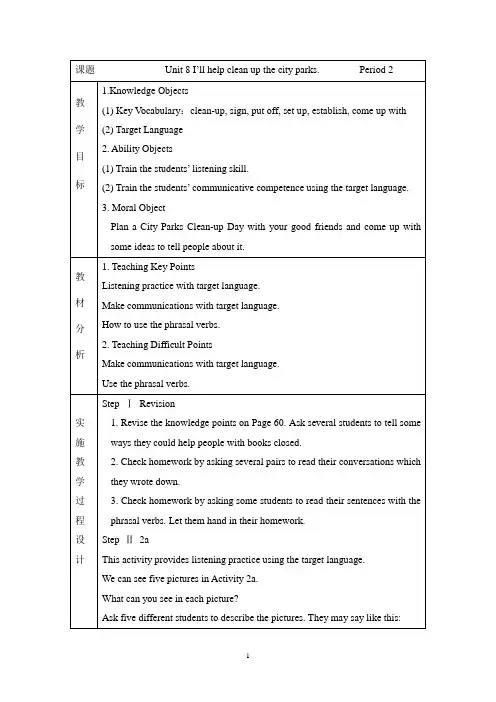
After that, ask a student to read the words on the TV screen, on the sign and in the newspaper.
Girl 1: Um…Well…we could put up signs.
Boy 2: That’s a good idea!
Girl 2: I’11 hand out advertisements after school.
Boy 1: OK. Great! And we could each call up ten people and ask them to come.
2. Check homework by asking several pairs to read their conversations which they wrote down.
3. Check homework by asking some students to read their sentences with the phrasal verbs. Let them hand in their homework.
课题Unit 8 I’ll help clean up the city parks.Period 2
教
学
目标Biblioteka 1.Knowledge Objects
(1) Key Vocabulary:clean-up, sign, put off, set up, establish, come up with
(2) Target Language
Unit 8 I‘ll help to clean up the city parks Section A 鲁教版英语七年级下册同步练习题(含答案)
鲁教版七下U8 Section A同步练习一、根据句意,用括号内所给词的适当形式填空1. My mother used to _______________ (work )in the post office.2. Let's make some______________ (notice )on the street after school.3. The students shouldn't put off ___________ (do)their work.4. My brother, Tom, is busy __________ (do )his homework.5. Class begins. The students stop __________________ (speak )and listen to the teacher.二.根据汉语提示完成句子,每空一词1.怀特先生总能想出一些解决问题的好主意。
Mr. White can always _________ __ __________some good ideas to solve problems.2.请把这些通告分发给在这周围的人们。
Please ________ _________ these notices to the people around.3.我妈妈过去常常开车上班,但是现在她骑自行车。
My mother _______ _________ go to work by car, but now she rides a bike.4.(2019新中考)作为青少年,我们应该关爱照顾老人.As teenagers, we should ________ _______ the old.5.振作起来!我相信你很快会感觉好些的。
_______ ______, I'm sure you'll feel better soon.三.补全对话A: How are you, Lucy?B: Fine, thanks. And how are you?A: Very well. I've heard that a foreign teacher is helping the people in Qinghai. Why don't we do something for others?B: That's a good idea.1________________________________________?A: Yes. I m going to give my old clothes to the children in the countryside. 2__________________________________________?B:I’d love to. 3_________________________________________________?A: I have time on both Friday and Saturday. 4____________________________? B: I'm busy on Friday but free on Saturday morning. Shall we start at 10 o'clock?A: 5______________________. Let's make it at 10: 30 a.m. on Saturday.B: That would be fine. Shall we meet at the school gate?A: All right四.补全阅读(2019新疆中考)阅读下面短文,把A一E五个句子填入文中空缺处使短文内容完整。
九年级英语下教案人教版Unit 8 I’ll help clean up the city parks.

Unit 8 I’ll help clean up the city parks.Ⅰ. Analysis of the Teaching Material1. Status and FunctionIn this unit, students learn to express what kind of volunteer work they would like to do. And they will know much about the volunteers and volunteer work. And they will learn to choose a volunteer job based on their own skills. Students will understand to do some volunteer work is good for both themselves and the others. All the students will be interested in the volunteers and volunteer work and they will make great progress in English after learning this unit.(1) The first period mainly provides some new vocabulary to the students, especially some phrasal verbs. Most new vocabulary and phrasal verbs are very useful on helping the children express what they would like to do and what they could do. And the first period gives the children lots of practice in writing, listening and speaking with the target language.(2)The activities in the second period provide the students much more listening practice and oral practice using the target language. And the students will get chances to practice the phrasal verbs by listening and speaking. All these will helpmuch in improving the students’ English.(3) In the third period, students will read an article on volunteers. They will practice getting detailed information from an article. And they will do some writing and oral practice as well. Students can improve their reading skill and know more about the volunteers.(4) The fourth period provides much practice on understanding and using the new phrasal verbs. It also gives much more listening and speaking practice. Students will enjoy the story of Jimmy and make much progress in listening. (5) The fifth period will train the students how to make notes based on an article. It also provides some practice on phrasal verbs. Students can do much speaking practice through groupwork as well.(6)The sixth period is designed to train the students’ writing skill. It also provides some more practice on using the new phrasal verbs.2. Teaching Aims and Demands(1) Knowledge ObjectsIn this unit, students learn to express the volunteer work they would like to do and give suggestions to the others. They will also learn some new phrasal verbs.(2) Ability ObjectsTo train the students to use the phrasal verbs, and to train the students’ listening, speaking and writing skills using the target language.(3) Moral ObjectBeing a volunteer is great!3. Teaching Key PointsTo help students learn and grasp the phrasal verbs and the target language. To let students know something about the volunteer work.4. Teaching Difficult PointsTo train students’ listening, speaking, reading and writing skills with the target language.To train the students to use the phrasal verbs.5. Studying WayGet students to be interested in volunteer work and do something really on it. Ⅱ. Language FunctionOffer helpⅢ. Target Language1. I’d like to work outside.2. I’ll help clean up the city parks.3. You could give out food at a food bank.Ⅳ. StructurePhrasal verbsⅤ. Vocabularyput off, hand out, call up, give away, run out of, clean up, set up, take after, fix up, cheer up, give out hunger, sign, repair.Ⅵ. Recyclingcome up with, put up, think up hospital, park, bank, food, lunch, bike, money, outside, volunteer, advertisementⅦ. Learning StrategiesSequencingDeducingⅧ. Teaching TimeSeven periodsThe First PeriodⅠ. Teaching Aims and Demands1. Knowledge Objects(1) Key Vocabularyclean up, hunger, homeless, cheer up, give out, volunteer, food, bank(2) Target LanguageI’d like to work outside.You could give out food at a food bank.2. Ability Objects(1) Train the students to express offering to help with the target language.(2) Train the students’ listening skill.3. Moral ObjectOffer help to the others as much as possible.Ⅱ. Teaching Key Points1. Key Vocabularyclean up, hunger, homeless, cheer up, give up2. Target LanguageHow to express offering to help with target language.Ⅲ. Teaching Difficult Points1. Teach the students how to use the new phrasal verbs.2. Teach the students to express offering to help with target language.Ⅳ. Teaching Methods1. Teaching by giving sample sentences and making up sentences.2. Teaching by showing pictures.Ⅴ. Teaching Aids1. A tape recorder2. Some pictures on volunteer’s offering helpⅥ. Teaching ProceduresStep Ⅰ Revision1. Revise the language points in Unit 7.Ask some questions like this: Where would you like to go on vacation? (I’d like to/I’d love to/l hope to… )Why?(Because…)2. Revise the contents in Unit 7. Say to the class like this:What things Who can say something about Singapore?do you like there and what things don’t you like about it?Ask them to give the answers without looking at the books.3. Check homework by asking some students to read their sentences they’ve made with the verbs. Let them hand in their homework.4. Dictate ten words in Unit 7.Step Ⅱ laThis activity introduces the key vocabulary and provides some writing practice. In this unit we learn to offer to help.We’ll use some phrasal verbs. Each phrasal verbs has two or three words, such as clean up, cheer up, give out.Here is an example o n how to use clean up. Look at the title of Unit 8. I’ll help clean up the city parks. Repeat it twice, please.Ask the children to read the title twice.Then go on saying, "clean up means make a place clean and tidy, put thingsthere in order". Let’s see another example, We should always clean up after a picnic.Who can explain this sentence in your own, words?Ask one student to explain the sentence.He or she may say like this. This sentences means we should burn wastepaper, collect litter and empty bottles, etc.Then say to the class. Who can make more sentences with clean up?Ask several students to share their sentences to the class.Do the same with the other phrasal verbs.Some sample sentences1. clean up—make a place clean and tidy, put things in orderWe should always clean up the dirty parts of the sea.2. cheer up—make someone feel happyThe good news cheers everyone up.3. give out—hand out, distributeLin Tao helped the teacher give out the new textbooks to the class.Read the instructions to the students.Please look at the picture now. We can see a bulletin board and two children in it. What is the bulletin board about?Help students to answer: Volunteer Today!Then continue saying, "Who can tell me the meaning of volunteer?"Ask one student to try to explain it. Then tell them the meaning of it. Volunteer means a person who offers to do something unpleasant or dangerous. It means a person who offers to help the others sometimes. Volunteer is used as a verb in this lesson.Draw the students’ a ttention to the three posters on the board.We can see one sentence in each poster.And we can see some people in each poster, too. What are the volunteers doing in each poster? Please work in pairs and talk about the posters.Give the students a few minutes to talk about what they will say. Let them talkabout all the three items. Move around and help the pairs as needed.Then read the sentences in the posters to the class. Ask the pairs of students to explain what the sentence means in their own words. Or tell what the volunteers are doing in the posters.For example, for the first poster, a pair might say:It means there is trash in the park. There are papers on the ground. We can help clean up the park by picking up papers and trash. We can make the park clean.After the students have finished all the items, ask the students to add some other ways they can help people. Get them to write the ways down in the box below the picture.At last, ask some students to share their ideas with the class. Write any new words or phrases on the board and explain these words to the class, if necessary.Some sample answers:Visit some single elderly people and help them with housework.Help clean up the neighbourhood.Cheer up the people who look sad.Help the teacher give out the papers to the students.Save money to help the poorer children.Step Ⅲ 1bThis activity gives students practice in understanding the target language in spoken conversation.Call the students’ attention to the two lists in the box in Activity lb. Ask some students to read the eight sentences on the lists to the class. Explain any new words and phrases in it.Make sure that all the students can understand the meanings of the eight items.Then get the children to read the instructions together.Say, we will hear four conversations.Your task is to match the items in the two lists. We can see the blanks in front of the first line of each conversation. Listen to the conversations and write the letter in front of the first line of each conversation. Put the letters of the second line of conversations in right places.Point out the sample answer to the class.Play the recording the first time. Tell the students to only listen.Then play the recording a second time.Tell them to write a letter in front of each numbered sentence this time.Check the answers.Answers1. c2. a3. d4. bTapescriptConversation 1Boy 1: I’d like to work outside.Girl 1:You could help clean up the city parks.Conversation 2Boy 2:I’d like to help homeless people.Girl 1:You could give out food at the food bank.Conversation 3Girl 2:I’d like to cheer up si ck kids.Girl 1: You could visit them in the hospital.Conversation 4Girl 1:I’d like to help kids with their schoolwork.Girl 2:You could volunteer in an after-school study program.Optional activityAsk the students to choose a volunteer job they might like to do and draw a picture of it. They can draw a picture like the posters in the textbook. They can also add a sentence describing the job. They may do this in several groups. After they’ve finished, display the pictures on a bulletin board and discuss these pictures with the class.Step Ⅳ 1cThis activity provides guided oral practice using the target language.Read the instructions with the class.Call their attention to the example in the speech bubbles in Activity la. Ask a pair of students to read this conversation to a class. Then let them practice in pairs.Note their pronunciation of "like to" in phrases such as, I’d like to help hungry people. Tell them English speakers usually pronounce the words "like to" as if they were spelled like-tuh.Play the I’d like to statements on the recording to demonstrate this pronunciation.After they’ve finished practicing the sample conversation, ask them to make up similar conversations based on the other two posters. Get two pairs to demonstrate two conversations first. They may say like this:S A: I’d like to cheer up sick kids.S B: You could visit sick children in the hospital.S A: I’d like to help homeless people.S B: You could give out food at a food bank.Then let the whole class practice in pairs.After that, play the recording of activity 1b and let the children read after it twice.Then ask them to practice similar conversations using the information in Activity 1b.Step Ⅴ SummarySay, In this class, we’ve learned how to express offering help. And we’ve learned several phrasal verbs. At last, we did some oral practice using target language.Step Ⅵ Homework1. Make up one sentence with each of the following phrasal verbs:clean up, cheer up, give out2. Write out three conversations of activity 1c.Step Ⅶ Blackboard DesignThe Second PeriodⅠ. Teaching Aims and DemandsKnowledge Objects(1) Key Vocabularyclean-up, sign, put off, set up, establish, come up with(2) Target LanguageI’ll help clean up the city parks.2. Ability Objects(1) Train the students’ listening skill.(2) Train the students’ communicativ e competence using the target language.(3) Train the students to use the new phrasal verbs: cheer up, set up, come up with, put off/3. Moral ObjectPlan a City Parks Clean-up Day with your good friends and come up with some ideas to tell people about it.Ⅱ. Teaching Key Points1. Listening practice with target language.2. Make communications with target language.3. How to use the phrasal verbs.Ⅲ. Teaching Difficult Points1. Make communications with target language.2. Use the phrasal verbs.Ⅳ. Teaching Methods1. Listening2. Pairwork3. Role play the conversationⅤ. Teaching AidsA tape recorderⅥ. Teaching ProceduresStep Ⅰ Revision1. Revise the knowledge points on Page 60. Ask several students to tell some ways they could help people with books closed.2. Check homework by asking several pairs to read their conversations which they wrote down.3. Check homework by asking some students to read their sentences with the phrasal verbs. Let them hand in their homework.Step Ⅱ 2aThis activity provides listening practice using the target language.We can see five pictures in Activity 2a.What can you see in each picture?Ask five different students to describe the pictures. They may say like this: Picture 1: We can see a TV screen in Picture 1.Picture 2: There is a girt putting a sign on the board.Picture 3: A boy is making a call.Picture 4: We can see a copy of newspaper with the advertisement.Picture 5: A boy is giving out advertisements to people.After that, ask a student to read the words on the TV screen, on the sign and in the newspaper.We’ll hear some students at a club meeting. They are talking about how their club can help clean up the city parks.Ask the class to read the instructions together. Tell them to note the box of each picture, they will have to tick in the boxes of the items they hear on the recording.Now listen to the club members talking about what they can do to clean up the city parks and tick in the right small boxes.Play the recording the first time.Students only listen.Play the recording again. Ask students to check the things they hear.Check the answers.AnswersThe following pictures should be checked: b c cTapescriptBoy 1: OK. Now we need to come up with a plan to tell people about the city park clean-up.Girl 1: Yeah, but I’m hungry, Bob. let’s have lunch first.Girl 2: No, we can’t put off making a plan. Clean-up Day is only two weeks from now.Boy 2: You’re right. Sally, while we talk, I’ll write down all our ideas. Then we can decide which ideas are best.Girl 1: U m… Well … we could put up signs.Boy 2: That’s a good idea!Girl 2: I’11 hand out advertisements after school.Boy 1: OK. Great! And we could each call up ten people and ask them tocome.Boy 2: Hey, we’ve coming up with a lot of good ideas, aren’t we?Step Ⅲ 2bThis activity provides listening and writing practice using the target language. Read the instructions with the class. And let them have a look at the sentences.Read the first sentence to the students.Tell them it is a sample answer.Say, We will hear the same recording again. This time listen carefully to what the students say and fill in the blanks in the sentences.Play the tape again and the students write out the answers.Check the answers.Answers1. come up with2. put off3. write down4. put up5. hand out6. call upStep Ⅳ 2cThis activity provides guided oral practice using the target language.Ask students to look at the sample conversation first. Ask a pair to read it to the class.Ask the class to read the instructions together.Say. You’ll work in pairs to role play t he conversation in Activity 2b.Each pair will make a conversation like the sample one. You can use the sentences in Activity 2b as a guide.Ask the students to work in pairs. More around the classroom, checking the progress of the pairs and offering help as needed.Ask one or two pairs to say their conversations to the class.Step Ⅴ Grammar FocusThis activity introduces several phrasal verbs.Say, Do you remember the meaning of cheer up? Who can tell us?Ask a student to explain the phrasal verb cheer up like this:Cheer up means make someone happy.Then get students to make up some sentences with it.Say, Let’s learn some more phrasal verbs today. Please open your books at page 61. Look at the content in Grammar Focus and try to tell me the meanings of set up and come up with.Ask two children to tell their meanings like this:Set up means establish or start.Come up with means think up.Then get students to read the sample sentences in the grammar box.Write the phrasal verbs and the sentences on the blackboard.Get students to make more sentences with these phrasal verbs to get a further understanding.Step Ⅵ SummarySay, In this class, we’ve done some listening and writing practice with target language. We also did some oral practice in pairs. And we’ve discussed some phrasal verbs as well.Step Ⅶ Homework1. Write two conversations like the sample in Activity 2c.2. Make up one sentence with each of the following phrasal verbs: set up, come up with, put off, hand out, call upStep Ⅷ Blackboard DesignThe Third PeriodⅠ. Teaching Aims and Demands1. Knowledge Objects(1) Key Vocabularymajor, commitment, veterinarian, coach(2) Target LanguageI’d like to join the school volunteer project.You could help coach a football team for little kids.2. Ability ObjectsTrain students’ reading skill.Train students’ speaking skill with target languag e.Train students’ writing skill with target language.3. Moral ObjectIf there is a student volunteer project in your school, try to join it; if not, try to set up one; being a volunteer is great!Ⅱ. Teaching Key Points1. Guide students to read the article in Activity 3a.2. Help students to use the target language to express what kinds of volunteer work they could do and what they like to do.1. Teaching Difficult Points1. Read the article for comprehension.2. Use the target language to express what kinds of volunteer work they could do and what they like to do.Ⅳ. Teaching Methods1. Pairwork2. Role playⅤ. Teaching AidsSome pictures that the volunteers are working, or some signs of the volunt eers’ clubs.Ⅵ. Teaching ProceduresStep Ⅰ Revision1. Check the homework by asking some children to read their conversation.2. Check the homework by asking some children to share their sentences with the phrasal verbs with the class.3. Revise the target language they learned last class. Ask several pairs to talk about the ways they could help people, using the conversation in the speech bubbles in activity la as a sample.Step Ⅱ 3aThis activity provides reading practice using the target language.Have the students look at the picture of the three children. Ask them who they think the children are.Then call the students’ attention to the title of the article and ask the children to read it out. Ask them the question again.This time they may answer. They are three volunteers.Read the instructions to the students.This is an article about volunteers. You have two tasks to do: first underline the kinds of work the volunteers do; second circle the reasons why they like their work.Continue saying. The names of the three volunteers are Li Huiping, Lan Pei and Zhu Ming. The article tells you about the different things they do to helppeople.Please read the article the first time and underline the things they do. There are three questions on the blackboard to help you.Write the three questions on the blackboard and tell them to scan the passage to get the answers and underline the words.Questions1. What does Li Huiping do to help people as a volunteer?2. What does Lan Pei do?3. What does Zhu Ming do?Check the answers by asking three students to answer the questions.Read the article to the class and do some explanation on any new words. Tell the students to raise their hands when I come to any word or sentence they don’t understand. Pause and do some explanation.Try to explain the new words in English like this: major means more important, for example, a major operation, the major roads; A veterinarian means an animal doctor, a doctor who treats animals.After that, get the students to read the article a second time to circle the reasons.Check the answers with the class.Then have the students read the article loudly twice. Encourage them to ask questions if they still can’t understand any words or sentences.Move around the classroom and answer the students’ questions.AnswersUnderlined words: She helps young children learn to read after school. …volunteers every Saturday morning at an animal hospital… sings for groups of people at the City Hospital.Circled words: You can do the things you love to do…he has learned a lot about animals …he has met some wonderful people at the hospital.Step Ⅲ 3bThis activity provides reading and writing practice using the target language.Read the instructions to the students.And tell them I love English. I could teach English in an after-school program. Hui loves playing football. What could Hui do if he wants to join the school volunteer project?Help the students answer. He could coach a fcf6tball team for little kids.Tell them coach means teach or train.Then ask the students to look at the table in Activity 3b.We can see three columns in this form.There are four names in the first column.And we can know what each of them loves doing from the second column, the column of loves. Now our task is to fill in the blanks in the third column, the column of Could. Get the students to discuss in pairs and fill the results of their discussions in the blanks.Move around the classroom to make sure that they are discussing in English and offer them help as necessary.Ask several pairs to report their answers to the class. Answers will vary but should show a sense of volunteering as well as a relationship to the skill. They may give answers in completely sentences orally but write in phrases. Sample answersStep Ⅳ 3cThis activity provides listening and speaking practise using the targetlanguage.Ask a pair of the students to model the sample conversation first.S A: I’d like to join the school volunteer project, but I’m not sure what I should do.S B: What do you like doing?S A: I love playing football.S B: Well, you could help coach a football team for little kids.Write the conversation on the blackboard.Model for the rest of the class.Then let the whole class practice in pairs. Remind them to use the sample conversation, but replace the words loves and skills.Move around the classroom while they are working, checking the progress and offering help as necessary.Ask two or three pairs to share their conversations to the class.Step Ⅴ Part 4This activity provides written and oral practice using the target language. Read the instructions to the class.Call the students’ attention to the clart on the left. Point out the titles Things I like to do and volunteer work I could do to the students.At first, each of you writes down three things you like to do on the lines in the column of Things I like to do. You can write in either complete sentences or phrases. For example, you can fill in the blank with I love drawing pictures, or Drawing pictures.Get the students to write down their own answers individually.As students write, move around the room helping with vocabulary if necessary. Show some pictures of volunteers’ work to remind them as well. Ask several to read their things they like to do to the class.Then work in pairs and give each other suggestions about what volunteer work you could do with those interests. Ask a pair to model the sample conversationbefore they begin to practice.S A:I like to read about Chinese history.What kind of volunteer work do you think I could do?S B: You could start a Chinese History Club.Write the conversation on the blackboard.Get students to practice in pairs.As the students practice, move around the classroom, correcting some mistakes they may make and helping them answer the questions.Tell them to fill in the blanks in the column of Volunteer work I could do with the suggestions that their partners have given them.After all of them have finished writing, ask one or two pairs to share their conversations to the class.Sample answersStep Ⅵ SummaryIn this class, we’ve learned more about the volunteers and their work. And we’ve done much oral and written practice on volunteer work with target language.Step Ⅶ Homework1. Write a conversation like the sample on in Activity 3c.2. Write a conversation like the sample one in Activity 4.Step Ⅷ Blackboard DesignThe Fourth PeriodⅠ. Teaching Aims and Demands1. Knowledge Objects(1) Key Vocabularyrun out of, take after, fix up, give away, repair, not…any more, similar advertisements(2)Target LanguageWhat do you do, Jimmy?I fix up bikes and give them away.2. Ability Objects(1) Train the students’ reading,writing, speaking and listening skills with the target language.(2) Train the students to use the new phrasal verbs.3. Moral ObjectCome up with a good idea to help others. It will bring you much enjoyment. Ⅱ. Teaching Key Points1. Train the students’ reading, writing, speaking and listening skills with the target language.2. Teach the students to use the new phrasal verbs properly.Ⅲ. Teaching Difficult PointTeach the new phrasal verbs.Ⅳ. Teaching Methods1. Making up sentences2. Listening3. PairworkⅤ. Teaching AidA. tape recorder.Ⅵ. Teaching ProceduresStep I Revision1. Revise the contents of the article in Activity 3a. Section A by asking some questions like these.Questions1. What does Li Huiping love to do?And what does she do as a volunteer?2. What does Lan Pei love and what does he plan to be when he leaves school? Where does he spend every Saturday working?3. What about Zhu Ming? Say something about Zhu Ming.4. What do they say about their volunteer work?5. What do they plan to do?2. Check the homework by asking some students to read the conversations they wrote. Correct any mistakes they might have made. Let them hand in their homework.Step Ⅱ 1aThis activity introduces new target language.Read the instructions to the students.Make sure that each one knows what to do.Let the students look at the sentences in the left column first. Try to explain the four sentences in English for the children, especially the new phrasal verbs in the sentences. Say to them like this:Please look at the sentences on the left column. Let’s get the meanings of them.Let’s see the first one. I’ve run out of itHere, run out of is a phrasal verb. It means reach an end of, use up or become short of. I’ve run out of it, means I’ve used it up, nothing left.Explain the other sentences in the same way like this.2. I take after my mother.take after——be like sb. or be similar to sb.I take after my mother. ——I am like my mother.3. I fixed it up.fix up——install, fit together and place in position, repair, renewI fixed it up. ——I installed it, or I repair it.4. I gave it away.give away——make a present of, donateI gave it away.——I donated it. I gave it to someone without money.After explaining the sentences, read each sentence in the box and ask the students to repeat.Then ask several students to explain the sentences with letters in front of them.Tell them to explain them in their own sentences. For example, Sentence a, the student might respond. My bicycle was broken. I couldn’t ride it. I got new tires and a new seat. Now it works fine.Read the instructions again and ask the students to match the sentences with similar meanings.Say, Now match the numbered sentences with the lettered sentences in the box.Write the letter of one sentence in front of the number of the matching。
初二英语下册Unit8_I’ll_help_to_clean_up_the_city_parks知识点详解
Unit8 I’ll help to clean up the city parkshelp sb with sth help oneself to sth随便吃&可数名词欢呼We all cheered when EXO arrived.We heard the cheers when EXO arrived.练习:He failed in the test and looks sad, let’s_____.A put him upB set him upC cheer him upD clean him up分发= hand out 散发(光、热)用完,耗尽印制出 B giving out C selling out D putting out扑灭(后接名词、代词、动名词作宾语)收起来put on穿上put out扑灭;伸出put up张贴,搭建put back放回原处可数名词:公告牌,通告,布告Take notice of what I say.notice sb doing sth/notice sb do sth…(现在不了) 没有人称和时态变化习惯于(一直在做)Be used to do被用来做Be used for+n/ doing被用于…Eg:Stamps are used for sending mails.练习:She goes to climb mountains every Sunday.But she _______ hate climbing mountains.B was used toC is used toD is used forLonely是adj孤单的(感情色彩较强)alone既是adj单独的,独自He feels lonely without friends. He is alone in the room.独自呆在房间’t feel .every强调全部、都The sun shines day this month. 这个月每天都阳光灿烂。
鲁教版七年级英语下册Unit 8 I'll help to clean up the city pa
Unit 8 I’ll help to clean up the city parks.导学案Section A【要点1】put off【经典练】选择填空:It’s a bad habit to ________ what you can do today until tomorrow.A. write downB. talk aboutC. worry aboutD. put off【巧点拨】put off意为“推迟”,由“动词+副词”构成,其后接代词时要用宾格,且将其置于put和off之间。
如:It’s difficult for us to finish the work today. We can put it off till tomorrow. 今天我们要完成这项工作很困难。
我们可以推迟到明天完成。
【超链接】常见含有put的短语有:put on穿上(衣服、鞋子等)、上演;put away把……收起来放好;put up举起、张贴;put out 扑灭、熄灭(火);put down放下等。
【要点2】used to【经典练】选择填空:She used to ________ a bus to school, but now she is used to _______ to school.A. taking; walkB. take; walkC. taking; walkingD. take; walking【巧点拨】♦used to意为“过去常常……”,其后跟动词原形。
used to do sth. 表示“过去常常做某事(暗含现在不做了)”。
如:He used to take a walk after supper. 他过去常常晚饭后散步。
♦be used to意为“习惯于……”,其中to是介词,其后接名词或V-ing形式。
be used to doing sth. 表示“习惯于做某事”。
初中英语_Unit8 I'll help to clean up the city parks.教学设计学情分析教材分析课后反思
Unit8 I’ll help to clean up the city parks.Section B(2a-2e)一、教学目标:1、知识目标:掌握重点单词:broken,letter,Miss,blind, deaf,carry,train,excited,change.2、能力目标:能够读懂以志愿工作和慈善机构为话题的阅读材料。
3、情感目标: 和别人分享做志愿者的快乐,乐于帮助别人二、教学重难点:1、教学重点:掌握重点单词:broken,letter,Miss,blind, deaf,carry,train,excited,change.2、教学难点:能够读懂以志愿工作和慈善机构为话题的阅读材料。
三、教学过程:Step1Lead in:1.Show some picturesT:Who need our help?Some people are disabled.They have difficulties with many normal things. We should help them,and show our kindness to them.Let’s make a difference in our life.2.Watch a short videoWhat’s the name of the dog?Hedy. (a guide dog/a special trained dog.)Step2Before reading1.Skim the letter and answer two questions.Q1:What kind of letter is it?Q2:Who Wrote this letter? Why?Step3 Careful readingPara.1 What’s “Animal Helpers”?Para.2 Read the letter,can you tell the difficulty in Ben Smith’s life:Many normal things are difficult for him.He has difficulties_____________________ .Para3&Para4 Choose True or False.1.Lucky was brought home after six months of training. ( )2.Ben felt sad to have a dog helper. ( )3.Miss Li is a kind-hearted woman. ( )4.Lucky is a clever dog because he understands many Chinese words and orders.( )5.Miss Li changed Ben’s life.( )Step4 After reading1.Fill in the blanks with the proper words.Ben Smith is a _________ man. He has many __________ in his life. He can’t _____ his _____ or legs well. Some normal things like answering the telephone, ________ and closing the doors, or ________ things are difficult for him. But “Lucky”, the dog-helper, makes __________ to his life. Lucky is a fantastic dog. It is very ______ and ___________ many English words. It can understand him when he gives himorder.2.Discuss the questions with your partner.Q1:In what other ways do you think dogs are able to help people?Q2: What other animals can we train to help people?3.Remember the motto:Helping others will benefit yourself as well.Step5 Homework.Write a reply to Ben Smith. In your letter:1.Offer to help him more.2.Say why you are able to help.3.Say what you could do to help.学情分析本班七年级学生的英语基础知识比较薄弱,阅读课对于他们来说有一定难度。
鲁教版七年级英语下册第八单元测试题 Unit 8 附答案
鲁教版七年级英语下册Unit 8 I’ll help to clean up the city parks.单元测试题(100分)一.单项选择(15分)( ) 1. Can you come up ________ a good idea?A. ofB. toC. withD. for( )2.Tony could help ________ the city parks.A. cleanedB. clean upC. clean outD. cleans up( )3. Let’s ask our parents ________ us finish the work.A. helpB. to helpC. helpingD. helped()4.I ________ like to help kids with their schoolwork.A. couldB. wouldC. shouldD. will( )5. I’m making some plans________ in an old people’s home this summer.A. to workB. workingC. worksD. am working( ) 6. Can you look after the children well? Do you know how to ________?A. cheer them upB. cheer up themC. give them upD. give up them ( ) 7. Though he is _______ at home, he doesn’t feel_______ for he has many things to do.A.alone; lonelyB. lonely; aloneC. alone; aloneD. lonely; lonely()8.Not only the students ________ also their teacher likes A. tooB. exceptC. howeverD. but()9.—I’ve made much progress in grammar. The ideas you ________ worked out fine.—Glad I could help.A. came up withB. ran out ofC. looked up to()10.I ________ some clothes to charity because they are too small for me.A. take afterB. hang outC. give awayD. put off()11. I _______ some clothes to charity because they are too small for me.A. take afterB. hang outC. give awayD. put off()12. Now, I can spend time _____ what I love to do.A. to doB. doingC. doD. did()13. His wants to be a pilot. I think his dream will _____ in the future.A. come inB. come outC. come overD. come true()14. We visited the sick kids and tried our best to ________.A. cheer him upB. cheer up himC. cheer them upD. cheer up them()15. This is ____ difficult problem that few students can work it out.A.soB. so aC. suchD. such a二.完形填空(10分)One day, the students of Class 6 were reading in the classroom. Mrs. Brown came in and told the whole class that they would have to change 1 in March. The naughtiest class in the grade could not 2 it. The pupils all disagreed with the decision, so they shouted when Mrs. Brown said it was because a newpupil would 3 the class. The class was in disorder. “Why must we move to another classroom just because someone new is coming.” One of them asked 4 . Mrs. Brown waited patiently before the class without saying anything. The students saw it and they became quiet. Mrs. Brown told them to be 5 to their new classmate and then she left.The following week, the class understood 6 . The principal(校长) himself brought the new student to their class. 7 , Mr. White pushed the new student to the class because the student was in a wheelchair. Mr. White 8 the new student as Jeff and asked them to be friendly to him. He said that Jeff now was a 9 of the class and they should work together. He added, “A house divided(分开) against itself cannot stand.” 10 could fully understand what Mr. White meant at first.( )1.A. partner B. lesson C. teacher D. classroom( )2.A.try B. catch C. believe D. manage( ) 3.A.leave B. help C. visit D. join( ) 4.A.sadly B. angrily C. seriously D. coldly( ) 5.A.nice B. useful C. honest D. careful( ) 6.A.why B. where C. when D. how( ) 7.A.So far B. Above all C. As usual D. In fact( ) 8.A.mistook B. described C. introduced D. remembered( ) 9.A.hope B. member C. monitor D. symbol( ) 10.A.Nobody B. Somebody C. Anybody D. Everybody三.阅读理解:(20分)AIndonesia is my mother’s homeland and one of my favorite countries. Since I was young, I had learned a lot about the country and become interested in it. For a long time I had wanted to do something for the country and people there, and I thought volunteering(做志愿者)would be a good and fun way to do so.I received the greatest pleasure from being with the children.Teaching my first English class in Aceh was exciting, but I was rather nervous. As time went by, I learned how to be a better teacher. Teaching was actually the most enjoyable of my many responsibilities(责任).Many children were shy at first. But when they relaxed, they would start talking and telling you a lot of funny things. I believed we were helping them build up their confidence.For the children who are more in need,The Education Program(TEP)will collect donations(募捐) to help them.As a volunteer, I had to visit the TEP children at home once a month and help them write a thank-you letter to their sponsors. This was a way for the children to communicate with their sponsors. Sometimes the sponsors would write back to the children. Seeing the children’s happy faces, I had a great sense of pleasure.()1.The writer believed volunteering would be a good way to ________.A. play outdoorsB. get the greatest pleasureC. learn more about IndonesiaD. do something for Indonesia()2.The writer felt ________ when he gave his first class.A. relaxedB. nervousC. unhappyD. comfortable()3.The writer visited the TEP children ________.A. to help them write a thank-you letterB. to play with themC. to help them with their studyD. to help them build up their confidence()4.The underlined word “sponsors” means “_________”.A.领导B.发起者C.亲戚D.资助者()5.According to the passage, which of the following is true?A. When I was young, I wanted to be a teacher.B. I learned how to be a better teacher at first.C.I learned a lot from my experience as a volunteer.D. The children in the poor area were brave and easy to talk to.21BOne day a lonely girl found two weak birds while she was walking in the woods(树林).She took them home and put them in a small cage. She fed them with love and the birds grew strong. Every morning they greeted her with a beautiful song. The girl loved them very much and wanted their singing to last forever.One day the girl left the cage’s door open. The larger and stronger of the two birds flew out of the cage. The girl watched worriedly as it circled (盘旋) high above her. She was afraid that it would fly away and she would never see it again. So when it flew close, she grasped (抓) at it wildly. She was very happy that she held it tightly within her hand! Suddenly, she felt something had happened to the bird. She opened her hand and was surprised to find the bird was dead. Her love for the bird killed it.She noticed the other bird jumping in the cage. She could feel that it wanted to be free. It hoped to fly into the clear, blue sky. She lifted(举起) it from the cage and flew it into the air. The bird circled once, twice, three times…When the bird was flying happily in the sky, she was so glad. Just then the bird flew closer and sat softly on her shoulder. It sang the sweetest song she had ever heard.The fastest way to lose love is to hold it tight; the best way to keep love is to let it fly!( )6. The girl loved the two birds very much because _________.A. they greeted her every morningB. they were hungry but very strongC. they liked staying in the cage quietlyD. they didn’t eat much food( )7. One day the girl forgot to close the door to the cage and _______ of the two birds flew out of the cage.A. the sickB. the femaleC. the larger and strongerD. the white and blue( )8. The girl held the bird rightly in her hand because she was afraid that ________.A. it would be killedB. it was feeling coldC. the other bird felt lonelyD. it would fly away( )9. The girl felt that the other bird ____ when it was jumping in the cage.A. wanted to see what happenedB. wanted to be freeC. wanted to sing a beautiful song againD. wanted to eat something( )10. What does the story want to tell us?A. We should protect the endangered birds.B. The cage is used to keep birds.C. The birds are easily killed.D. To keep love is to let it fly.四.词汇运用:(10分)1. He smiled with ___________ (satisfied) when he won the race.2. What is the ___________ (different) between A and B?3. Russian is a ___________ (difficulty) language to learn.4. He shows great ___________ (kind) to his students,so he is very popular.5. I think football is an___________ (excited) sport.6. He decided to go on a _________(旅行;行程) early in the next morning.7. ________ (几个) students were sitting in the classroom, reading English.8. I can’t _________ (想象)what he looks like.9. If I do not _________ (理解) what he says,I always ask him.10. This time I noticed a great _________ (变化)in her.五.完成句子:(10分)1. 他们为何打算在那儿建一个食物赈济处?Why are they going to _________ _________ a food bank there?2. 今天上午我修理了自行车。