
高中英语 Unit 2 Sailing the oceans Using language课件 新人教版选修9
DZ: Now that I've heard about it I am very impressed. All those men pushed together in a very small boat, it must have been terrible for them to stay friendly. Meanwhile they were being driven mad by lack of fresh water and there was all that salt water all around them. That's the reason I think it was the greatest sea escape.
DZ: Yes indeed. That is one good quality. However having a bad temper and getting angry quickly shows a bad quality. WF: Now think about the voyage to Timor. On that journey he was fair with the food, kept everyone occupied working out the boat's position, and kept the crew cheerful.
Why are you..?
How could you…?
Why did you…?
It was because… As he…
Because of …?
The reason is that… Now that…
Since he…
He…, so he is ill with fever after the voyage.
However, he was also kind to his men at other times so I think he was a reasonable leader. LY: What did he do? WF: He provided cabbage so the sailors would not get ill and made them dance so that they would stay healthy. That shows he was a good leader.
gradual gradually foresee thirst tear hardship jaw
adj. 逐渐的; 逐步的 adv.逐渐地; 逐步 vt. 预见; 预知 n. 渴; 口渴 vt. 扯破; 撕破 n. 困难; 艰难 n. 颚; 颌; 下巴
Expressions
set loose jaws of death 出发;开始 鬼门关;死神
Unit 2
Words
incident departure crew deposit dilemma drawback dusk n. 事件; 事变 n. 出发; 离开 n. 工作人员; 队 vt. 放; 存入银行 n. 进退两难的局面 n. 缺点; 障碍 n. 薄暮; 黄昏
routine n. 常规; 日常事务 reckon vt. 计算; 估计 reckoning n. 计算; 估计 starvation n. 挨饿; 饿死 psychology n. 心理学 psychologically adv. 心理上地;心理学地 tension n. 紧张; 不安; 张力
troubles. In addition he treated
everyone the same when it came to
right and it was the greatest example of navigational skill against the odds! Do you agree? DZ, WF and LY (together): Yes. We do.
But he was a bad leader in a general situation because he got angry over small things (like accusing people of stealing food or disobeying him) and was too easy-going in Tahiti (where he let the men relax too much so they did not want to go back to England).
1 Why do you think this winter
describes his journey as one of the greatest in navigational history? Do you agree? Give your reasons.
2 What kind of leadership qualities do you think Captain Bligh showed? Are these the only qualities needed for good captain? Make a list of the qualities you think are important. Give your reasons. The words and expressions below might be useful for you.
DZ: No, no! That seems a bit cruel although it was due to his bad temper the crew took over the ship. It was also due to his good temper that the crew survived in the small boat. I think Liu Yongfu is right. He was good in a crisis because he was fair with the food, encouraged team spirit, made people cheerful and used his skills to get them home.
The fact that he tried so hard to build co-operative behavior shows good leadership qualities. LP: Indeed he did. That is why some people regard him as a hero. LY: Well, he seems contradictory. He is a good leader in a crisis and a bad one the rest of the time.
A sample letter report
Dear Sir,
I think Captain Bligh should certainly receive a special medal for his amazing voyage across the sea to Timor. This is a journey that could not have been completed without great navigational skill. In addition Captain Bligh did not lose one man.
LP: When you put it that way I suppose it was a great achievement. Captain Bligh was certainly excellent in the way he kept the men occupied and tried to take their minds off their
2 Sample dialogue
DZ: What leadership qualities do you think Captain Bligh showed? LP: Since he had such violent disagreements with his crew, I think he was a bad leader. WF: Do you really? He does seem to have had a bad temper so that has given him a bad reputation.
LP: He was a strange mixture indeed!
2 Now write a report to your leader explaining to him why you think Captain Bligh should or should not receive the medal. Follow these steps.
THE GREATEST NAVIGATIONAL JOURNEY: A LESSON IN SURVIVAL 1 When Captain Bligh returned home he was treated as a hero. It was discussed whether he should receive a special medal or not. Get into groups of four and discuss these questions. Then role-play the dialthink that journey was more difficult? It didn't last very long. Captain's Bligh's journey lasted over forty days, was very hot and they had very little food and water. It was because Captain Bligh was a great leader that they survived.
高中英语 Unit2Sailing the oceans-Textbook课件 新人教选修9
Comprehending
1 Read the passage and answer the following questions. 1 What is the use of a bearing circle, astrolabe, quadrant or sextant? (B)
2 Which do you think was easier to work out: latitude or longitude?
Latitude, bre how far you had travelled from land on a straight line. It was discovered a long time before longitude.
3 Why is the position of the sun and various stars useful for working out latitude?
The position of the sun and stars are useful for working out latitude because they are fixed points in the sky and their movements in relation to the earth are already known. So they can be used to measure a ship's position.
3 What would you do if you came across the following problems during your voyage? Read the chart below and fill in your plans of action to deal with them.
高中英语 Unit 2 Sailing the oceans Sailing the oceans教

第一部分《金色教案》教学设计说明About the topic and the structures单元话题和结构本单元的话题是“大海航行”,介绍了航海知识和航海探险逸事。
通过学习学生应该了解:我国历史上就是航海的先驱国,自古以来一直处于领先地位,对航海技术的发展有着杰出的贡献。
目前,我国已成为世界上的航运大国,正向着世界航运强国推进。
实现航运强国的历史重任落在你们这一代身上。
本单元还将学习“不同动词形式作谓语”。
《金色教案》教学设计在单元课时划分上与课本保持一致,即“阅读课、知识课、运用课三课时/三课型划分”。
但在实际教学过程中,我们建议教师依据学生基础、教学条件、学校安排的因素,对课本、对《金色教案》教学设计重新划分课时、裁剪、拼接使用我们提供的材料,以便“物尽所用”,达到最佳教学效果。
教师也可以按照我们提出的“实际教学过程课时划分建议”进行教学。
Period 1 Reading 阅读课Warming Up 部分教师可以选择“了解航海家”、“了解郑和”、“了解马克·波罗”等形式激发背景知识、为其后的阅读作好词语、结构和心理的准备。
教师可补充:西周天子穆王乘“八骏西行三万里”(《穆天子传》);孔子率70弟子周游列国;庄王与惠子游于濠梁之上;秦始皇统一中国后,多次巡游、封禅;张骞衔命出使西域,打开了中国通往西方的丝绸之路;张骞自中原使往西域,直达今之中亚;司马迁弱冠之年走出书斋,自长安起步,足及豫、鄂、湘、赣、浙、苏、鲁、川、滇等省份;法显、宋云、惠生、玄奘西行求法取经,长途跋涉,直达今之印度;郑和的舰队7渡印度洋,摇达东非;徐霞客在中华大地上的履痕,遍及19个省市区,直涉各地的偏、远、险、幽之境。
Pre-re ading向学生介绍有关“navigational instruments”,为其后的阅读做心理的铺垫和准备。
补充:中国很早就可以通过观测日月星辰测定方位和船舶航行的位置。
郑和船队已经把航海天文定位与导航罗盘的应用结合起来,提高了测定船位和航向的精确度,人们称“牵星术”。
2020学年高中英语Unit2SailingtheoceansSectionⅣUsingLangu
2019-2020学年高中英语Unit 2 Sailing the oceans Section ⅣUsing Language讲义新人教版选修9编辑整理:尊敬的读者朋友们:这里是精品文档编辑中心,本文档内容是由我和我的同事精心编辑整理后发布的,发布之前我们对文中内容进行仔细校对,但是难免会有疏漏的地方,但是任然希望(2019-2020学年高中英语Unit 2 Sailing the oceans Section ⅣUsing Language讲义新人教版选修9)的内容能够给您的工作和学习带来便利。
同时也真诚的希望收到您的建议和反馈,这将是我们进步的源泉,前进的动力。
本文可编辑可修改,如果觉得对您有帮助请收藏以便随时查阅,最后祝您生活愉快业绩进步,以下为2019-2020学年高中英语Unit 2 Sailing the oceans Section ⅣUsing Language讲义新人教版选修9的全部内容。
Section ⅣUsing LanguageⅠ.阅读P17-18课文内容,从三个选项中选择最佳答案1.Why didn’t Captain Bligh finish the voyage with them?A.Because he wasn’t skillful enough。
B.Because he was deposited into a small boat.C.Because he was seriously ill.2.They can’t get a correct reading f rom the quadrant as .A.the quadrant was brokenB.the boat moved so quicklyC.the boat moved constantly3.What was the hardest to cope with for them?A.The bad weather。
高中英语 Unit 2 Sailing the oceans A sample lesson pla
高中英语 Unit 2 Sailing the oceans A sample lesson plan for Using Language 教案新人教版选修9Period 3 A sample lesson plan for Using Language(THE GREATEST NAVIGATIONAL JOURNEY: A LESSON IN SURVIVAL)IntroductionLanguage is learned to be used in and for communicatio n.So in this period we shall have the students read a narrative writing about sailing at se a. Then they listen and speak about Viking sailing and Polynesian seame n. In the end they are helped to rewrite the story on page 17.Objectives■To help students read the passage THE GREATEST NAVIGATIONAL JOURNEY:A LESSON IN SURVIVAL on page 17■To help students listen and speak about Viking sailing and rewrite the text just readProcedures1. Warming up by learning something about William BlighWilliam Bligh in 1814Vice Admiral of the Blue William Bligh, FRS (9 September 1754 - 7 December 1817) was an officer of the British Royal Navy and colonial administrator. He is best known for the famous mutiny that occurred against his command aboard HMAV (His Majesty's Armed Vessel) Bounty and the remarkable voyage he made to Timor on the Bounty's launch after being set adrift by the mutineers. Many years after the Bounty mutiny he was appointed Governor of New South Wales, with a brief to clean up the corrupt rum trade of the NSW Corps. He had some success in his task but quickly faced opposition which culminated in the Rum Rebellion led by John Macarthur. 2. Reading for formsRead the text THE GREATEST NAVIGATIONAL JOURNEY: A LESSON IN SURVIVALon page 17 to: cut/ the sentence into thought groups, blacken the predicative, dark enthe connectives and underline all the useful expressions.3. Copying expressions and making sentencescatch in a dilemma, risk certain death, sit close together,face an uncertain future, have no charts, take with sb., set the course, make sure, stay on that course, keep to a straight course, in addition, keep sb. work out the position, take a great deal of time, cope with, drive sb. mad, preserve one’s good spirits, talk hopefully about, g et worse, sink into…, take one’s minds off one’s stomachs and thirst, keep sb. alive, set loose, have fever, show the hardships, suffer the hardships, escape the jaws of death, complete the greatest navigational feat of all time4. Listening and speaking about Viking sailing and Polynesian seamen●The name Viking is a borrowed word from the native Scandinavian term for the Norse warriors who raided the coasts of Scandinavia, the Bri tish Isles, and other parts of Europe from the late 8th century to the 11th century. Vikings traveled to the west and Varangians, who were best known as the Varangian Guards of the Byzantine emperors, to the east. This period of European history (generally dated to 793 - 1066 AD) is referred to as the Viking Age.●Where is Polynesia?A division of Oceania including scattered islands of the central and southern Pacific Ocean roughly between New Zealand, Hawaii, and Easter Island. The larger islands are volcanic, the smaller ones generally coral formations.Now go to page 19. Let’s go to listen to something about Viking sailing the oceans. While listening try to circle those aids in the box on page 19 that the early sailors used to find their ways at se a.Now you shall listen to the tape once a gain to fill in the chart on page 19.On page 20 there are four sayings from Polynesian seame n.What does each of them mean? Now in pairs talk about each of the sayings.5. Closing down by writing, by imitation, a passage of your own based on the text on page 17A possible versionI am proud to have traveled with my father on his journey of over 60 days through about 4,000 kilometers in an open car across China in 2006. Our outward journey in the car to Hainan had been filled with the kind of incidents that I thought would be my stories when I returned home.But how wrong I was! On our departure from Taiyuan,some of the bad men took over the car. They deposited my father onto a small bike to 1et us find our own way home.But what else was to be done? We on the road were caught in a dilemma.Once we were far away from the bad men,our routine the following three days was the same.At sunrise and sunset my father measured our position listening to the local new on the radio and set the course /using the signs along the road.It was extremely diff icult for us to get a correct direct ion from the radio as the bike moved constantly.I used a system called “people reckoning”.I knew there were villages directly northwest of our original positio n. So my task was to make sure we discover any of the villages. As you can see now from the map we kept to a str aight course pretty well. In addition, my father kept me busy singing songs to overcome our tiredness. Although this took a great deal of strength, it didn’t matter. Songs were, after all, what I had a lot of!You could not imagi ne a more disturbing sight than what we looked like when arriving in Yaojiagou over three days after being robbed of our open car.Our clothes were torn,we had fever and our faces showed the hardships we had suffered.But after a rest,some good meals and some new clothes,everything changed.We couldn’t stop talking about our journey and everybody wanted to hear about it.We were the heroes who had escaped the jaws of death by completing the greatest traveling feat of all time!。
Unit;2;Sailing;the;oceans1

Unit;2;Sailing;the;oceans选修9unit 1 breaking records unit 2 sailing the oceans 1. fitadj.安康的;精力充足的;适宜的n. 适合vt. 适合;安装;使合身vi. 适合,符合exercise keeps you fit.运动能使你保持安康。
常用构造:be fit for sth.适合某事be fit to do sth.适合做某事易混辨析:fit/suitfit与suit都可作动词,意为iexcl;°适合iexcl;±。
fit多指尺寸,大小的iexcl;°适宜iexcl;±; suit多指款式、颜色、条件、身份、口味等的iexcl;°适宜iexcl;±。
this coat fits him.这件外套他穿正合身。
(指大小)the style of the clothes suits him well.这件衣服的款式很适合他。
〔指款式、颜色〕高手过招选词填空〔fit/suit〕①we all think that he is for the position.②does the new post your brother?③the climate here me very well.答案:①fit ②fit ③suits2. doomvt. 注定;判决n. 厄运;消灭常用构造:be doomed to 注定(后接名词或不定式)go to oneiexcl;macr;s doom 走向死亡fall to oneiexcl;macr;s doom 坠入死亡/灭亡meet oneiexcl;macr;s doom 死亡;灭亡oneiexcl;macr;s doom is sealed 某人在劫难逃send sb. to his doom 将某人处死the species was doomed to extinction.这一物种注定要灭亡。
20162017学年高中英语Unit2SailingtheoceansPeriodⅣUsingLan
Unit 2 Sailing the oceans Period Ⅳ Using LanguageⅠ.单词拼写【导学号:15680041】1.Can you give me some (背景) on the situation?2.A strong man will bear (困苦) without complaining.3.Working in the sun soon gave us a (口渴).4.He could never have (预见) that one day his books would sell in millions.5.Humans are sensitive to (逐渐的) changes of brightness and color.6.Did that ever cause (紧张) in your relationship?7.I'd like to (存入) two hundred dollars.8.He was faced with the (进退两难困境) of whether or not to return to his country.9.The only (缺点) to the project is its expense.10.Toni (估算) that it must be about three o'clock.【答案】 1.background 2.hardship 3.thirst4.foreseen 5.gradual 6.tension 7.deposit8.dilemma 9.drawback 10.reckonedⅡ.阅读理解ALondon,England(CNN)—The youngest person to sail solo around the world returned home on Thursday from his 30,000mile,282day ocean journey.Mike Perham,17,sailed into Lizard Point in Cornwall,the southernmost point in Britain,at 9:47 a.m.,his race team said.“It feels absolutely brilliant,” Mike told CNN by phone hours before crossing the finish line.“I'm really,really excited to be going across the line at last.It doesn't feel like long since I crossed it first.”Mike se t off on his roundtheworld trip on November 18,2008.He has been sailing his yacht,,singlehandedly,though a support team has been sailing next to him along the way.The teen has now achieved the title of Youngest Sailor to Circumnavigate the Globe Solo,according to the Guinness World Records.Mike learned how to sail when he was seven years old from his father,Peter and at age 14,he sailed across the Atlantic alone.The teenager's school—which Mike describes as “highly supportive” of histrip—has redesigned his coursework to fit in with his trip.It also gave him some coursework to do during “quiet moments,” according to Mike's Web site.There haven't been many of those quiet moments.Repeated autopilot failures forced him to stop for repairs in Portugal,the Canary Islands,South Africa,and twice in Australia,according to his Web site.Bad weather in the Southern Ocean—between Australia and Antarctica —forced Mike to battle 50ft waves and 57 mph winds.He said at one point,a “freak wave”picked up the boat and turned it on its side.“My feet were on the ceiling at the time,” he told CNN.“That was a really hairy moment,and I was certainly thinking,‘Why am I here?’ But we took the sails off and the day after I thought,‘This is brilliant!’”Mike describes his father as his biggest hero,always supportive of what he wanted to achieve.Peter Perham said he wasn't too worried about his son facing dangerous situations at sea,as long as he knew what to do and stayed safe.【语篇解读】本文是一篇新闻报道。
高中英语Unit2SailingtheoceansSectionⅠWarmingUpReading—
The cross-cultural educational experience focuses on the Mississippi and China’s longest river,the Yangtze.
been________method(s) to find longitude by the 17th century.
A.two
B.three
C.one
D.no
5.What’s the main idea of the passage? A.Why early seaman wanted to sail the ocean. B.There is useful information in an encyclopedia. C.Early sailing men went exploring the seas using their skills and simple instruments. D.Latitude and longitude are important to plot a ship’s position. 答案:1-5.AADAC
1._____a_t____ the mercy of 2.work ___o_u_t_____ 3.compare sth.___w_i_t_h____ sth. 4.in __r_el_a_t_io_n___ to... 5.make __m_i_s_ta_k_e_s__
受……支配 制定出 把……与……相比较 与……相关联 犯错误
最新精编高中人教版选修9高中英语 unit 2 sailing the oceans词汇讲解
Unit 2 Sailing the oceansTeaching ResourcesSection 3: Words and expressions from Unit 2Sailing the oceansmercynoun (pl. -ies)1.[U] a kind or forgiving attitude towards sb that you have the power to harm or right to punish humanity:to ask / beg / plead for mercy They showed no mercy to their hostages. God have mercy on us. The troops are on a mercy mission (= a journey to help people) in the war zone.2. [C, usually sing.] (informal) an event or a situation to be grateful for, usually because it stops sth unpleasant: It’s a mercy she wasn’t seriously hurt. His death was a mercy (= because he was in great pain.at the mercy of sb/sth not able to stop sb/sth harming you because they have power or control over you:I’m not going to put myself at t he mercy of the bank. We were at the mercy of the weather. leave sb/sth to the mercy / mercies of sb/sth to leave sb/sth in a situation that may cause them to suffer or to be treated badly: privatized companies left to the mercy of market forces (humorous) I’ll leave you to the tender mercies of these ladies!throw yourself on sb’s mercy (formal) to put yourself in a situation where you must rely on sb to be kind to you and not harm or punish youlongsideprep.1. next to or at the side of sth: A police car pulled up alongside us. a lifeboat moored alongside theyacht Much of the land alongside the river is below sea level. 2. together with or at the same time as sth/sb: Traditional beliefs still flourish alongside a modern urban lifestyle.explorationnoun [C, U]1. the act of travelling through a place in order to find out about it or look for sth in it: the exploration of space oil exploration (= searching for oil in the ground)2. an examination of sth in order to find out about it: the book’s explorations of the human mindaccelerateverb1. to happen or to make sth happen faster or earlier than expected: [v] Inflation continues to accelerate. [vn] Exposure to the sun can accelerate the ageing process.2. [v] (of a vehicle or person) to start to go faster: The runners accelerated smoothly around the bend. The car accelerated to overtake me. secureadj.HAPPY / CONFIDENT1. feeling happy and confident about yourself or a particular situation: At last they were able to feel secure about the future. She finished the match, secure in the knowledge that she was through to the next round.CERTAIN / SAFE2. likely to continue or be successful for a long time; safe: a secure job / income It’s not a very secure way to make a living. The future of the company looks secure.3. ~ (against / from sth) that cannot be affected or harmed by sth: Information must be stored so thatit is secure from accidental deletion.BUILDING / DOOR / ROOM4.guarded and/or made stronger so that it is difficult for people to enter or leave:Check that all windows and doors have been made as secure as possible. a secure unit for child offenders The building is secure against intruders.FIRM5.not likely to move, fall down, etc.; stable: The aerial doesn’t look ver y secure to me. It was difficult to maintain a secure foothold on the ice. (figurative) Our relationship was now on a more secure footing.verbGET STH1. ~ sth (for sb/sth)| ~ sb sth (formal) to obtain or achieve sth, especially when this means using a lot of effort: [vn] to secure a contract / deal The team managed to secure a place in the finals. She secured2. 000 votes. The delegation has secured the promise of a ceasefire. [vn, vnn] He secured a place for himself at law school. He secured himself a place at law school.FASTEN FIRMLY2. [vn] ~ sth (to sth) to attach or fasten sth firmly: She secured the rope firmly to the back of the car. The tables on board were secured firmly to the floor.PROTECT FROM HARM3. [vn] ~ sth (against sth) to protect sth so that it is safe and difficult to attack or damage: to secure a property against intruders The windows were secured with locks and bars. (figurative) a savings plan that will secure your child’s futureA LOAN4. [vn] to legally agree to give sb property or goods that are worth the same amount as the money that you have borrowed from them, if you are unable to pay the money back: a loan secured on the house randomadj. [usually before noun] done, chosen, etc. without sb deciding in advance what is going to happen, or without any regular pattern: the random killing of innocent people a random sample / selection (= in which each thing has an equal chance of being chosen) The information is processed in a random order.nounat random without deciding in advance what is going to happen, or without any regular pattern: She opened the book at random (= not at any particular page) and started reading. The terrorists fired into the crowd at random. Names were chosen at random from a list.awkwardadj.1.making you feel embarrassed: There was an awkward silence. I felt awkward because they obviously wanted to be alone.2. difficult to deal with:Don’t ask awkward questions. You’ve put me in an awkward position. an awkward customer (= a person who is difficult to deal with) Please don’t be awkward about letting him come. It makes things awkward for everyone when you behave like that.3. not convenient, inconvenient: Have I come at an awkward time?4. difficult or dangerous because of its shape or design: This box is very awkward for one person to carry. This tool will reach into awkward corners, such as under kitchen units.5. not moving in an easy way; not comfortable: He tried to dance, but he was too clumsy and awkward. I must have slept in anawkward position—I’m aching all over.referencenounMENTIONING SB / STH1. [C, U] ~ (to sb/sth) a thing you say or write that mentions sb/sth else; the act of mentioning sb/sth: The book is full of references to growing up in India. She made no reference to her illness but only to her future plans. the President’s passing reference to (= brief mention of) the end of the war LOOKING FOR INFORMATION2.[U] the act of looking at sth for information: Keep the list of numbers near the phone for easy reference. I wrote down the name of the hotel for future reference (= because it might be useful in the future). The library contains many popular works of reference (= reference books).ASKING FOR ADVICE3. [U] ~ (to sb/sth) (formal) the act of asking sb for help or advice: The emergency nurse can treat minor injuries without reference to a doctor.NUMBER / WORD / SYMBOL4. [C] (abbr. ref.) a number, word or symbol that shows where sth is on a map, or where you can find a piece of information: The map reference is Y4.. Please quote your reference number when making an enquiry.FOR NEW JOB5.[C] a letter written by sb who knows you, giving information about your character and abilities, especially to a new employer: We will take up references after the interview.6. [C] a person who agrees to write a reference, for you, for example when you are applying for a job:My previous boss will act as a reference for me.IN BOOK7. [C] a note in a book that tells you where a particular piece of information comes from: There is a list of references at the end of each chapter.in / with reference to(formal) used to say what you are talking or writing about: With reference to your letter of July 22...verb [vn] (formal) to refer to sth; to provide a book, etc. with references: Each chapter is referenced, citing literature up to 2004.preciseadj.1. clear and accurate; exact: precise details / instructions / measurements Can you give a more precise definition of the word? I can be reasonably precise about the time of the incident.2. [only before noun] used to emphasize that sth happens at a particular time or in a particular way: We were just talking about her when, at that precise moment, she walked in. Doctors found it hard to establish the precise nature of her illness.3.taking care to be exact and accurate, especially about small details: a skilled and precise worker small, precise movements (disapproving) She’s rather prim and precise. to be (more) pr ecise used to show that you are giving more detailed and accurate information about sth you have just mentioned: The shelf is about a metre long—well, 98cm, to be precise.simplifyverb (simplifies, simplifying, simplified, simplified) [vn] to make sth easier to do or understand: The application forms have now been simplified. I hope his appointment will simplify matters. a simplified version of the story for young childrenportableadj. that is easy to carry or to move: a portable TV The equipment is lightweight, portable and easy to store. (figurative) a portable loan / pension (= that can be moved if you change banks, jobs, etc.) portable softwarenoun a small type of machine that is easy to carry, especially a computer or a television: The kids are upstairs watching the portable (= television).shortcomingnoun[usually pl.] a fault in sb’s character, a plan, a system, etc.:She made me aware of my own shortcomings. Despite a number of shortcomings, the project will still go ahead.updateverb [vn]1. to make sth more modern by adding new parts, etc.: It’s about time we updated our software.2. ~ sb (on sth)| ~ sth to give sb the most recent information about sth; to add the most recent information to sth bring up to date: I called the office to update them on the day’s developments. Our records are regularly updated.tendencynoun (pl. -ies)1. [C] ~ (for sb/sth) (to do sth)| ~ (to / towards sth) if sb/sth has a particular tendency, they are likely to behave or act in a particular way: to display artistic, etc. tendencies I have a tendency to talk too much when I’m nervous. There is a tendency for this disease to run in families. She has a strong natural tendency towards caution. This material has a tendency to shrink when washed.2. [C] ~ (for sb/sth) (to do sth)| ~ (to / towards sth) a new custom that is starting to develop: There is a growingtendency among employers to hire casual staff.3. [C+sing./pl. v.] (BrE) a group within a larger political group, whose views are more extreme than those of the rest of the group: the militant tendency reliableadj.1. that can be trusted to do sth well; that you can rely on; dependable: We are looking for someone who is reliable and hard-working. a reliable friend My car’s not as reliable as it used to be.2.that is likely to be correct or true: Our information comes from a reliable source. a reliable witness How reliable are the local weather forecasts? These tests are a reliable indicator of future performance. swoopverb [v]1. [usually +adv. / prep.] (of a bird or plane) to fly quickly and suddenly downwards, especially in order to attack sb/sth; dive: The aircraft swooped down over the buildings. A hawk swooped low over the field.2. ~ (on sb/sth) (especially of police or soldiers) to visit or attack sb/sth suddenly and without warning: Officers swooped on the vehicles as they left the ferry.noun1. an act of moving suddenly and quickly through the air in a downward direction, as a bird does dive2.~ (on sth/sb) an act of arriving somewhere or attacking sth/sb in a way that is sudden and unexpected:Large quantities of drugs were found during a police swoop on the star’s New York home.peckverb1. ~ (at sth) (of birds) to move the beak forward quickly and hit or bite sth: [v] A robin was pecking atcrumbs on the ground. Hens pecked around in the yard. [vn] A bird had pecked a hole in the sack. Vultures had pecked out the dead goat’s eyes.2. [vn] ~ sb (on sth) (informal) to kiss sb lightly and quickly: He pecked her on the cheek as he went out. She pecked his cheek.a / the pecking order (inform al, often humorous) the order of importance in relation to one another among the members of a group: New Zealand is at the top of the pecking order of rugby nations. to be first in the pecking orderpeck at sth to eat only a very small amount of a meal because you are not hungry; pick at: She sat nervously pecking at her food.expeditionnoun1. an organized journey with a particular purpose, especially to find out about a place that is not well known: to plan / lead / go on an expedition to the North Pole2. the people who go on an expedition: Three members of the Everest expedition were killed.3. (sometimes humorous) a short trip that you make when you want or need sth: a shopping expeditioncompulsoryadj. that must be done because of a law or a rule: It is compulsory for all motorcyclists to wear helmets. English is a compulsory subject at this level. compulsory education / schooling compulsory redundanciesSurvivalnoun1. [U] the state of continuing to live or exist, often despite difficulty or danger: the struggle / battle / fight for survival His only chance of survival was a heart transplant. Exporting is necessary f or oureconomic survival. Continued trade in these products is a threat to the survival of the species.2. [C] ~ (from sth) something that has continued to exist from an earlier time: The ceremony is a survival from pre-Christian times.the survival of the fittest the principle that only the people or things that are best adapted to their surroundings will continue to existincidentnoun1.[C] something that happens, especially sth unusual or unpleasant: His bad behaviour was just an isolated incident. One particular incident sticks in my mind.2. [C, U] a serious or violent event, such as a crime, an accident or an attack: There was a shooting incident near here last night. The demonstration passed off without incident.3.[C] a disagreement between two countries, often involving military forces: a border / diplomatic incidentdeparturenoun1. [C, U] ~ (from ... ) the act of leaving a place; an example of this: His sudden departure threw the office into chaos. Flights should be confirmed 4.8 hours before departure. They had received no news of him since his departure from the island.2. [C] a plane, train, etc. leaving a place at a particular time: arrivals and departures All departures are from Manchester. the departure lounge / time / gate the departures board3.[C] ~ (from sth) an action that is different from what is usual or expected: It was a radical departure from tradition. Their latest single represents a new departure for the band.depositnounMONEY1. [usually sing.] a ~ (on sth) a sum of money that is given as the first part of a larger payment: We’ve put down a 5.% deposit on the house. T hey normally ask you to pay £1.00 (as a) deposit. All deposits are non-refundable.2. [usually sing.] a sum of money that is paid by sb when they rent sth and that is returned to them if they do not lose or damage the thing they are renting: to pay a deposit They’l l probably ask you to leave a deposit.3.a sum of money that is paid into a bank account: Deposits can be made at any branch.4. (in the British political system) the amount of money that a candidate in an election to Parliament has to pay, and that is returned if he/she gets enough votes: All the other candidates lost their deposits.verb [vn]PUT DOWN1. [+adv. / prep.] to put o r lay sb/sth down in a particular place: She deposited a pile of books on my desk. (informal) I was whisked off in a taxi and deposited outside the hotel.LEAVE SUBSTANCE2. (especially of a river or a liquid) to leave a layer of sth on the surface of sth, especially gradually and over a period of time: Sand was deposited which hardened into sandstone.MONEY3. to put money into a bank account: Millions were deposited in Swiss bank accounts.reckonverb1. (informal, especially BrE) to think sth or have an opinion about sth: [v (that)] I reckon (that) I’mgoing to get that job. He’ll be famous one day. What do you reckon (= do you agree)? [v] It’s worth a lot of money, I reckon. ‘They’ll never find out.’ ‘You reckon?’ (= I think you may be wrong about that) 2. be reckoned (not used in the progressive tenses) to be generally considered to be sth: [vn to inf] Children are reckoned to be more sophisticated nowadays. [vn-n] It was generally reckoned a success. [also vn-adj] 3. [v to inf] (BrE, informal) to expect to do sth: We reckon to finish by ten. He wasn’t reckoning to pay so much.4. ~ sth (at sth) to calculate an amount, a number, etc.: [vn] I could see him reckoning the cost as I spoke. The age of the earth is reckoned at about 4.6.00 million years. [v (that)] They reckon (that) their profits are down by at least 2.0%. [vn to inf] The journey was reckoned to take about two hours.reckon on sth to expect sth to happen or to rely on sth happening: They hadn’t reckoned on a rebellion. [+ -ing] We’d reckoned on having good weather.reckon sth up / reckon up sth(especially BrE) to calculate the total amount or number of sth: He reckoned up the cost of everything in his mind.reckon with sb/sth1. [usually passive] to consider or treat sb/sth as a serious opponent, problem, etc.: They were alreadya political force to be reckoned with.2. (usually used in negative sentences) to consider sth as a possible problem that you should be prepared for; take sth into account: [+ -ing] I didn’t reckon with getting caught up in so much traffic.reckon without sb/sth (especially BrE) to not consider sb/sth as a possible problem that you should be prepared for; not take sth into account: They had reckoned without the determination of the opposition.tensionnoun1. [U, C, usually pl.] ~ (between A and B) a situation in which people do not trust each other, or feel unfriendly towards each other, and which may cause them to att ack each other: There is mounting tension along the border. international / racial / political tensions Family tensions and conflicts may lead to violence. The incident has further increased tension between the two countries.2. [C, U] ~ (between A and B) a situation in which the fact that there are different needs or interests causes difficulties: Th ere is often a tension between the aims of the company and the wishes of the employees.3. [U] a feeling of anxiety and stress that makes it impossible to relax: nervous tension We laughed and that helped ease the tension. Walking and swimming are excellent for releasing tension.a tension headac he 4.[U] the feeling of fear and excitement that is created by a writer or a film/movie director: dramatic tension As the movie progresses the tension builds.5. [U] the state of being stretched tight; the extent to which sth is stretched tight: muscular tension Adjust the string tension of your tennis racket to suit your style of playing. When knitting, try to keep the same tension throughout. Massage can relieve tension in your shoulders and back.verb [vn] (technical) to make a wire, sail, etc. tight and stretchedgradualadj.1. happening slowly over a long period; not sudden: a gradual change in the climate Recovery from the disease is very gradual.2. (of a slope) not steepforeseeverb (foresaw, foreseen ) to think sth is going to happen in the future; to know about sth before it happens; predict: [vn] We do not foresee any problems. The extent of the damage could not havebeen foreseen. [v (that)] No one could have foreseen (that) things would turn out this way. [v wh-] It is impossible to foresee how life will work out. [also vn -ing]thirstnoun1. [U, sing.] the feeling of needing or wanting a drink: He quenched his thirst with a long drink of cold water. She woke up with a raging thirst and a headache.2. [U] the state of not having enough water to drink: Thousands are dying of thirst.3. [sing.] ~ (for sth) a strong desire for sth: a thirst for knowledge tearverb (tore ,torn)DAMAGE1. to damage sth by pulling it apart or into pieces or by cutting it on sth sharp; to become damaged in this way; rip: [vn] I tore my jeans on the fence. I tore a hole in my jeans. He tore the letter in two.a torn handkerchief [vn-adj] I tore the package open. I tore open the package. [v] Careful—the fabric tears very easily.2. [vn] ~ sth in sth to make a hole in sth by force; rip: The blast tore a hole in the wall.REMOVE FROM STH / SB3. [vn + adv. / prep.] to remove sth from sth else by pulling it roughly or violently; rip: The storm nearly tore the roof off. I tore another sheet from the pad. He tore his clothes off (= took them off quickly and carelessly) and dived into the lake.4. ~ yourself / sb (from sb/sth) to pull yourself/sb away by force from sb/sth that is holding you or them: [vn] She tore herself from his grasp. [vn-adj] He tore himself free.INJURE MUSCLE5. [vn] to injure a muscle, etc. by stretching it too much: a torn ligament She tore a calf muscle playing squash.MOVE QUICKLY6. [v + adv. / prep.] to move somewhere very quickly or in an excited way: He tore off down the street.A truck tore past the gates.-TORN7.(in adjectives) very badly affected or damaged by sth:to bring peace to a strife-torn country a strike-torn industrytear sb/sth apart, to shreds, to bits, etc. to destroy or defeat sb/sth completely or criticize them or it severely: We tore the other team apart in the second half. The critics tore his last movie to shreds. tear at your heart / tear your heart out (formal) to strongly affect you in an emotional waytear your hair (out) (informal) to show that you are very angry or anxious about sth: She’s keeping very calm—anyone else would be tearing their hair out.(be in) a tearing hurry / rush (especially BrE) (to be) in a very great hurrybe torn (between A and B)to be unable to decide or choose between two people, things or feelings: I was torn between my parents and my friend.tear sb off a strip / tear a strip off sb(BrE, informal) to speak angrily to sb who has done sth wrong that’s torn it (BrE, informal) used to say that sth has happened to spoil your plans—more at heart, limb, loose adj.tear sb apart / tear apart sb to make sb feel very unhappy or worried; rip sb apart: It tears me apart to think I might have hurt her feelings. His distress tore me apart.tear sth apart / tear apart sth1. to destroy sth violently, especially by pulling it to pieces: The dogs tore the fox apart.2. to make people in a country, an organization or other place fight or argue with each other: Racial strife is tearing our country apart.3. to search a place, making it look untidy and causing damage: They tore the room apart, looking for money.tear at sth to pull or cut sth violently so that it tears: He tore at the meat with his bare hands.tear yourself away (from sth)/ tear sth away (from sth)to leave somewhere even though you would prefer to stay there; to take sth away from somewhere: Dinner’s ready, if you can tear yourself away from the TV. She was unable to tear her eyes away from him (= could not stop looking at him). tear sth down / tear down sth to pull or knock down a building, wall, etc.: They’re teari ng down these old houses to build a new office block.tear into sb/sth1. to attack sb/sth physically or with words: The wind tore into him.2. to start doing sth with a lot of energy: They tore into their food as if they were starving. The band tore into their opening number. tear sth up / tear up sth to destroy a document, etc. by tearing it into pieces; rip sth up: She tore up all the letters he had sent her. (figurative) He accused t he leader of tearing up the party’s manifesto (= of ignoring it).hardshipnoun [U, C] a situation that is difficult and unpleasant because you do not have enough money, food, clothes, etc.: economic / financial, etc. hardship People suffered many hardships during that long winter. The two men endured great hardship during their trek across Antarctica. It was no hardship to walk home on such a lovely evening.backgroundnounFAMILY / EDUCATION, etc.1.[C] the details of a person’s family, education, experience etc.: a person’s family / social / cultural / educational / class background The job would suit someone with a business background. In spite of their very different backgrounds, they immediately became friends.PAST2.[C, usually sing., U] the circumstances or past events which help explain why sth is how it is; information about these: the historical background to the war background information / knowledge The elections are taking place against a background of violence. Can you give me more background on the company?OF PICTURE / PHOTO3. [C, usually sing.] the part of a picture, photograph or view behind the main objects, people, etc.: a photograph with trees in the backgroundLESS IMPORTANT POSITION4. [sing.] a position in which people are not paying attention to sb/sth or not as much attention as they are paying to sb/sth else: He prefers to remain in the background and let his assistant talk to the press.A piano tinkled gently in the background. background music There was a lot of background noise (= that you could hear, but were not listening to).COLOUR UNDER STH5. [C, usually sing.] a colour or design on which sth is painted, drawn, etc.: The name of the company is written in red on a white background.in the background (computing) (of a computer program) not being used at the present time andappearing on the screen behind programs that are being usedroarverb1.[v] to make a very loud, deep sound:We heard a lion roar. The gun roared deafeningly. The engine roared to life (= started noisily). The wind was roaring in my ears.2. ~ (sth) (out) to shout sth very loudly: [v] The crowd roared. [vn] The fans roared (out) their approval. He roared out James’s name. [v speech] ‘Stand back,’ he roared.3. [v] ~ (with laughter) to laugh very loudly: He looked so funny, we all roared. It made them roar with laughter.4. [v + adv. / prep.] (of a vehicle or its rider / driver) to move very fast, making a lot of noise: She put her foot down and the car roared away. A group of young men on motorcycles roared past.5. [v] (of a fire) to burn brightly with a lot of flames, heat and noise: A log fire was roaring in the hearth.noun1.a loud deep sound made by an animal, especially a lion, or by sb’s voice: His speech was greeted bya roar of applause. roars of laughter 2.a loud continuous noise made by the wind or sea, or by a machine: I could barely hear above the roar of traffic. the roar of the Atlantic。
高中英语 Unit2Sailing the oceans-Textbook课件 新人教选修9.ppt
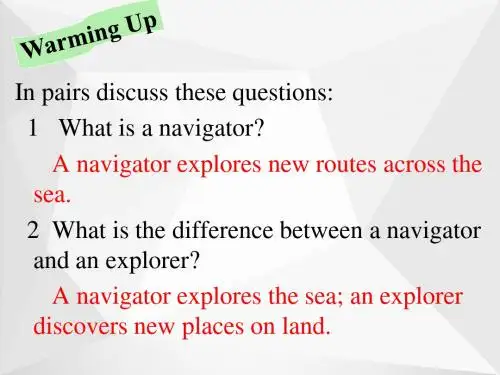
1 What is a navigator?
A navigator explores new routes across the sea.
2 What is the difference between a navigator and an explorer?
2 Why are speed and time important in working out the longitude of a ship?
Speed and time are important in finding out the longitude of a ship because the earth moves fifteen degrees westwards every hour. If you know your direction, speed and time, you can work out the approximate longitude or change in your position in relation to the stars.
use knots to find your
You knew your
speed and work out
latitude but didn't your approximate
know your longitude. longitude
use the compass and
You were blown off- the astrolabe,
A navigator explores the sea; an explorer discovers new places on land.
高中英语知识讲解:Unit+2+Sailing+the+oceans+2 Unit+2 Section+Ⅱ —Language+Points含答案
Section ⅡWarming Up & Reading—Language PointsThe voyages of travellers before the 17th century show that they were not at the mercy of the sea even though they did not have modern navigational aids.17世纪以前的航海记录显示,尽管没有现代航海技术的帮助,他们(旅行者们)也不是任凭海洋摆布的。
(1)voyage①He made a voyage to Japan.他航行至日本。
②I wish you a happy voyage.祝你航行平安。
[自我探究]voyage是名词,意为航行,(尤指)航海,航天。
单词意义区别trip指定期的较短的往返旅行journey表示去某地所花的时间和旅行的距离,尤其指较长距离的定期旅行;多指陆地旅行travel泛指从一地到另一地的“旅行,游历”(用单数形式,不加定冠词)。
指“国外的游历、游记”时常用复数形式,但前面不加many或数词修饰,它也可以用作动词tour“周游,观光,旅游;考察”,指周游若干地方,有一定的旅行路线,最后又回到出发地voyage指海上航行或太空旅行。
是可数名词③We went on a trip to the mountains.我们到山里去旅游了。
④We had a long journey ahead of us.我们前面的旅程还很长。
⑤Foreign travel never really appealed to him until he retired.他到退休后才真正对出国旅行产生了兴趣。
⑥We went on a 10-day tour of central Africa.我们到中非游玩了10天。
⑦This is a voyage of exploration.这是一次探索之旅。