
江苏省永丰初级中学牛津译林版九年级下册英语课件:Unit2Studyskills(共19张PPT)
you will
I think you’ll laugh when you read this
You may be surprised to know that. there is
letter. Believe it or not, there’s a real
our teachers, unfamiliar people
our friends
Formal
Informal
Greetings 问候语
Dear Mr / Mrs / Ms…, Ladies and gentleman
Hi, Hello …
Endings 结束语
Байду номын сангаас
Faithfully yours, Lots of love, Yours faithfully Yours,
Hi!
Improper expressions
She shouldn’t use contractions.
I think you’ll lauSghhe swhohuelndn…’t uBseelieve it or not, there’s …
contractions.
It’s said that it’s a lot of …esp. when you’re a 78-yr-old …
Harry Potter in the world.
It is
it is
It’s said that it’s a lot of trouble being
Harry
Pottere,spesepci.awllyhen
you are
you’re a
78-year-old
78-yr-old man and you happen to share
1. Children are usually curious about the _u_n_k_n_o_w__n things in the world. (未知的)
2. Maths is short for _m__a_th_e_m__a_t_ic_s___.
3. English is _w_i_d_e_ly__ (wide) spoken all over the world.
you happen to share the name of a world-famous boy with
magic power.
The real Harry Potter often gets phone calls from both children
and TV stations. “The kids want to know if I’m Harry
Potter,”Dhoees Kitty need to improve her letter? Why?
says with a smile. “I tell them I’ve been Harry Potter for nearly 80
She shouldn’t use informal greetings or endings.
9下 Unit 2 Great people
Study skills
FoF正rmo式rma用laal语nand和di非ninf正foorr式mm用aall语llaanngguuaagege
学习目标: 1.辨别和了解正式用语和非正式用语。 2. 能根据场景正确使用正式用语和非正式用
语。
根据汉语、首字母或所给的词写出正确 的单词。
…
Formal Idioms (习语, 土话)
Abbreviations (缩略词)
Contractions (缩写式)
Informal
have a big mouth (大嘴 巴,爱说闲 话)
esp. Dec. Sat.
…
we’ll, isn’t,
I’d rather…
Hi!
Kitty’s letter to J. K. Rowling.
Kitty is writing to J. K. Rowling, the British writer, to tell her something about Harry Potter. Help Kitty check the language she is using and improve it if necessary.
4. They are famous for the _d_i_sc_o_v_e_r_y____ (discover) of radium.
5. The boy wants to be a _s_c_ie_n_t_i_st____ (science) when he grows up.
Formal and informal language
…if I’m Harry Potter… “I tell them I’ve been …”
… isn’t his cup of tea, and he doesn’t care if he’s ...
Love Kitty
She should sign her full name.
She shouldn’t use idioms.
I think you’ll laugh when you read the letter. Believe it or not,
there’s a real Harry Potter in the world. It’s said that it’s a lot of
trouble being Harry Potter, esp. when you’re a 78-yr-old man and
When we speak or write, we can use formal and informal language. We use formal language with our teachers or unfamiliar people. However, when we speak or write to our friends, we use informal language.
2024九年级英语下册Unit2 ls课件牛津译林版
TIP You may use the information about different famous people in this unit. You can also search for more information on the Internet or in the library.
There she met Pierre Curie, a (5) __F__r_en_c_h___ scientist. They got married in (6)____1_8_9_5___. ② The couple won the (7) ___N_o_b__el__P_r_iz_e_f_o_r_P__h_y_s_ic_s____ in 1903 for the discovery of (8) ___ra_d__iu_m___. That was not the end of the story. In (9) ____1_9_1_1___, Marie Curie won her second Nobel Prize, but sadly, Pierre was not there to share the joy with her—he died in a traffic accident in (10) ____1_9_0_6___. 因为,由于
Unit 2 Great people
Period 4 Integrated skills & Study skills
A Marie Curie A1 Millie wants to give a presentation on Marie Curie. Look at
新牛津译林版九年级英语下Unit 2 Study skills 教学课件

The real Harry Potter often gets phone callschildren from both children and TV stations. “The kids
want to know if I’m Harry Potter,” he says with
I am
I have
a smile. “I tell them I’ve been Harry Potter
for nearly 80 years!” However, the real Harry Potter says the
is not his favorite
Harry Potter series isn’t his cup of tea, and he
Dear Mary, How are you doing these days ? I’m so glad to hear you have passed the exams. Congratulations! Last week I ran across Monica in the street. She invited me to go to her school party next Friday, so why not join us?
Yours, Sally
Endings such as Lots of love and Yours can be used only in informal letters or emails.
have a big mouth 说话冒失;大嘴巴
in the soup在困境中 Idioms such as have a big mouth and in the soup are informal language.
牛津译林版英语九年级下册Unit2 Reading2课件
A. to fly B. flight C. flown D. flying
cut in 插嘴,插队 cut short 缩短
Pay attention to the following :
thSeeficrsot n(mdans) ptoadcoe tratvoegelther with “与… 一起, 连同”
take … back to further together with
A test pilot tests all types of aircraft. test vt. 测试;检验
这张测试卷能够检验你的英语知识。 This __te_s_t_ paper can _t_e_s_t _ your knowledge of English.
Armstrong通过试飞各种类型的飞机,成为一名 有经验的飞行员。 Armstrong became an experienced pilot __b_y_t_e_s_ti_n_g__ _a_ll_t_y_p_e_s_o_f_a_i_r_c_ra_f_t___.
9B Unit 2 Great people
Reading (II)
Early years
➢ takeRheisteflilr(s复t fl述igh)t 他第一次坐飞机
flight n….wbeasbobrofnlrynono/nvi…n. in…. …becoamfley-i-n-tfleerwes--t-efldowinn…--.-flying
初中英语九年级下册(牛津译林版)Unit2Studyskills教学设计
3.引导学生通过自主阅读、总结和反思,培养良好的学习习惯和自主学习能力。
4.设计形式多样的课堂活动,如角色扮演、小组竞赛等,激发学生的学习兴趣,提高学生的学习积极性。
(三)情感态度与价值观
三、教学重难点和教学设想
(一)教学重难点
1.重点:本章节的重点在于帮助学生掌握有效的学习方法和技巧,提高学习效率。具体包括:
-学会运用不同的时态描述学习过程和计划;
-掌握并运用本章节的核心词汇和短语;
-能够结合自身实际,制定合理的学习计划和时间安排。
2.难点:难点在于如何引导学生将这些学习方法内化为自身的学习习惯,并在实际中灵活运用。具体包括:
3.导入新课:在学生讨论的基础上,教师引出本节课的主题——Study skills,并强调学习技巧在提高学习效率方面的重要性。
(二)讲授新知
1.教学内容:本节课主要讲授以下三个方面的学习技巧:
- How to manage your time effectively(如何有效管理时间);
- Different ways to study(不同的学习方法);
1.培养学生树立正确的学习观念,认识到学习方法和技巧在学习过程中的重要性,养成良好的学习习惯。
2.培养学生积极向上的学习态度,鼓励他们勇于面对挑战,克服困难,不断提高自己。
3.培养学生的团队合作精神,让他们在合作中学会互相尊重、互相帮助,共同提高。
4.增强学生的自信心,让他们在学习和生活中都能保持积极的心态,迎接挑战。
3.鼓励学生积极参与作业,培养良好的学习习惯和自主学习能力。
4.作业评价要注重过程和结果,关注学生在作业中的表现,鼓励学生自我反思和改进。
牛津译林版英语九年级下册课件:Unit 2
•Who is he?
Yuan Longping.
•Can you say something about him?
What does he do?
●He is a rice scientist.
●He saw people die of hunger, so he began research into hybrid rice. ●He happened to find a natural hybrid rice plant that had many advantages over others.
3. Why did he begin research into hybrid rice?
Because he saw people die of hunger.
4. What is he considered?
He is considered the “Father of Hybrid Rice”.
1. When was he born? He was born on 7 September, 1930.
2. What did he do after graduating from college?
He worked as a teacher in an agriculture school.
Unit 2 Great people
Study skills & Task
Formal and informal language
Greetings Endings Idioms(习语) Abbreviations(省略) Contractions(缩写)
Who?
unfamiliar people
译林版英语九年级下册教学教案Unit 2 Study skills
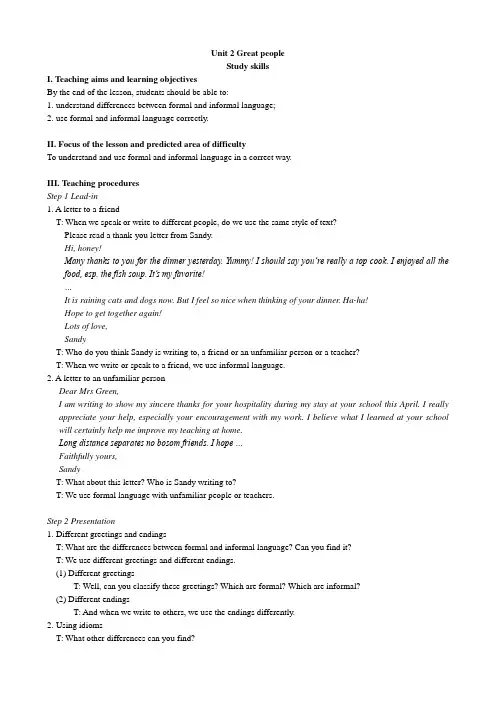
Unit 2 Great peopleStudy skillsI. Teaching aims and learning objectivesBy the end of the lesson, students should be able to:1. understand differences between formal and informal language;2. use formal and informal language correctly.II.Focus of the lesson and predicted area of difficultyTo understand and use formal and informal language in a correct way.III. Teaching proceduresStep 1 Lead-in1. A letter to a friendT: When we speak or write to different people, do we use the same style of text?Please read a thank-you letter from Sandy.Hi, honey!Many thanks to you for the dinner yesterday. Yummy! I should say you’re really a top cook. I enjoyed all the food, esp. the fish soup. It’s my favorite!…It is raining cats and dogs now. But I feel so nice when thinking of your dinner. Ha-ha!Hope to get together again!Lots of love,SandyT: Who do you think Sandy is writing to, a friend or an unfamiliar person or a teacher?T: When we write or speak to a friend, we use informal language.2. A letter to an unfamiliar personDear Mrs Green,I am writing to show my sincere thanks for your hospitality during my stay at your school this April. I reallyappreciate your help, especially your encouragement with my work. I believe what I learned at your school will certainly help me improve my teaching at home.Long distance separates no bosom friends. I hope …Faithfully yours,SandyT: What about this letter? Who is Sandy writing to?T: We use formal language with unfamiliar people or teachers.Step 2 Presentation1. Different greetings and endingsT: What are the differences between formal and informal language? Can you find it?T: We use different greetings and different endings.(1) Different greetingsT: Well, can you classify these greetings? Which are formal? Which are informal?(2) Different endingsT: And when we write to others, we use the endings differently.2. Using idiomsT: What other differences can you find?We can use idioms like “It rains cats and dogs.” in informal language. Well, what are idioms?T: Idioms are phrases and sentences that do not mean exactly what they say. Even if you know the meaning of each word you see or hear, you may not understand the idiom because you don’t understand the culture behind it, e.g. It rains cats and dogs.T: Usually we use idioms in spoken English. They are informal. What idioms do you know?T: Do you know these idioms? What do they mean?T: Language is wonderful. Read more, and you will learn more.3. Using contractions and abbreviationsT: What about contractions and abbreviations?T: Contractions are short forms of words when apostrophe replace letters, e.g. we’ll, she’s, can’t.Abbreviations use only the first letters of a name or phrase, or leave out letters to shorten a word, e.g. UK, Dr. They are both used in informal language.T: What other contractions and abbreviations do you know? Work in groups.T: Perfect! Many hands make light work!Step 3 Practice1. Classify the expressionsT: Now can you classify the expressions correctly?T: So formal language is used for unfamiliar people or teachers while informal language is for friends and parents.2. Improve Kitty’s letterT: Kitty is writing to J. K. Rowling, the British writer, to tell her something about Harry Potter.Please read her letter.T: Does Kitty need to improve her letter? Why?T: To Kitty, J. K. Rowling is an unfamiliar person.She shouldn’t (use informal greetings or endings.)She shouldn’t (use contractions or abbreviations.)She shouldn’t (use idioms.)She should sign her full name.T: Please rewrite Kitty’s letter.T: Good job! Read it by yourselves.Step 4 ProductionWriting a letter to the headmasterT: Work in groups. Write a letter to the headmaster and advise him to organize a school trip. Pay attention to your expressions. You can use the following expression as an example.IV. HomeworkWrite a letter to your headmaster to recommend yourself as chairperson of the Students’ Union.。
牛津译林版九年级英语下册Unit-2-复习课件(共25张PPT)
重点语法:
The Attributive Clause
定语从句
定语可以由形容词、代词、数词、名词、分词、
不定式、介词短语等来担任,修饰名词。
He is a clever boy. This is my father. Give me three apples. I have a story book. The man standing there is our English teacher.
关系代词: that who which 的用法:
1I.twishtoh:指e b人o,o作k主th语at或I宾le语nt (h作im宾y语es可te省rd略ay,. 作
主语不可省略)
YTahoe mMainng(wwhhoo )pIlatyaslkeind wNiBthAisiosuar tefaamchoeurs. sApopretrssmonanw. ho steals things is called a thief. ‘Harry Potter’ is a good film which many children like.
牛津译林版九年级英语下 册9B Unit 2
Revision
重点短语:
1.关心穷人 care for the poor 2.某人第一次坐飞机 take one’s first flight 3.选中某人做某事 select sb to do sth 4.某人被选中去做某事 sb. be selected to do sth 5. 上飞行课take flying lessons 6.学生飞行员执照 student pilot’s licence 7. 第一次 for the first time 8. 缩短飞行cut the flight short 9.有史以来最伟大的人
牛津译林版九年级英语下册Unit2 Study skills课件 (共17张PPT)
—Yeah!
4. —How are you?
10. —How have you been?
—Just so so.
—Fine, thanks. And you? 11. How nice to see you!
5. How do you do?
12. Hello!/Hi!
6. What’s up?
13. Great seeing you.
9B Unit 2 Great people
FoFrmormalaal nanddininffoorrmmaall llaanngguuaagege
Friends
Hi, honey!
Parents
Many thanks to you for the dinner yesterday.
Yummy! I should say you’re really a top cook. I
I am writing to show my sincere
thanks for your hospitality during
my stay at your school this April. I
really appreciate your help
especially your encouragement
now. But I feel so nice when
thinking of your dinner. Ha-ha!
Hope to get together again!
Faithfully yours, Sandy
Lots of love, Endings
Sandy
Classify the greetings.
Unit2Integratedskills-江苏省永丰初级中学牛津译林版九年级英语下册课件(共30张PPT)
Warm up
What kind of people are great?
• People with great contributions to the world are great.
• People who have changed the way we live are great.
I think Marie Curie is one of the greatest scientists in history! She was from (1) _P__o_la_n_d__. When she was 24, she went to (2) _P_a_r_i_s__ to study (3) m__a_t_h_e_m_a_t_i_c_s and (4) _p_h_y_s_i_c_s at a university. There she met Pierre Curie, a (5) _F_r_e_n_c_h__ scientist.
and (10)_p_h_y_s_i_cs______
Married to: Pierre Curie a (11)_F_r_e_n_c_h___ scientist, in 1895
n. 发现,发现物 Famous for: the discovery of (12)_r_a_d_i_u_m__ Won the Nobel Prize for: (13)_p__h_y_si_c_s_ in
university n. 数学 maths
• married a French scientist called Pierre Curie
in 1895 n. 镭 n. 科学家science
• discovered radium in their laboratory in 1898
江苏省永丰初级中学牛津译林版九年级英语上册课件:Unit2Reading2(共34张PPT)
I'm too sleepy to watch the end of the show. 我太困倦了,不能把戏看完。
The baby is sound asleep. 那婴儿正酣睡着。
The music sent me asleep. 音乐使我睡着了。
He is a very lazy person, sleeping all day. 他非常懒惰,整天睡觉。
影响/改变我们的心情 3.make us feel happy or sad, energetic or
sleepy 使我们感觉快乐或悲伤,精力充沛 或昏昏欲睡
4.feel relaxed / stressed 感到放松/焦虑的
5.be painted blue 被漆成蓝色 paint sth +颜色 把某物涂/刷成…颜色
This is a sleepy little town. 这是一个宁静的小镇。
[拓展] sleepy, asleep和sleeping这三个词都有“睡
着的”意思, 但有区别: sleepy侧重于“想睡 但并没睡着”, 在句中作定语或表语。asleep 是表语形容词, 意思是"睡着了", 在句中只能 作表语或宾语补足语, 不能作定语。sleeping 意思是"睡着的", 在句中作定语。如:
2. It could be because the walls were painted
blue, a calm and peaceful colour.
calm作形容词, 意为“镇静的;沉着的;安 静的”。如:
When faced with difficulties, we should stay calmsfied with … 对……满意 14.people living in cold climates