
新人教选修六 Unit 4 Global warming单元教学设计
Step4Fast reading
Ask students’ to skim the text and match the main idea with each paragraph.
教学
课题
Unit 4 Global warming period1
课程
类型
Warming up and reading
课时
一课时
教材
分析
本节课的内容是人民教育出版社出版的NSE高中教材必修6第四单元的Pre-reading, Reading, Comprehension部分,本单元的话题是全球变暖。本节课是单元的阅读课,教材以说明文的文体呈现,教师可在充分利用教材资源的基础上,结合学生的实际情况设计教学活动,旨在帮助学生有效地掌握阅读技巧,形成有效地学习方法和阅读策略,同时了解说明文篇章结构和写作特点,为下一步进行说明文的写作教学做好准备。
Answer the questions aloud
Get the Ss to look at the pictures and the title of the reading passage and predict the content and then lead into the new lesson.
二、技能目标
Can understand the main idea of the whole passage
(四)情感态度目标
To know the importance of protecting the environment.
教学
方法
Task-based approach and communicative approach
2.How to improve the students’ reading ability .
教学
目标
一、知识目标
To master the expression about global warming, and learn to analyze the difficult sentences.
课时
一课时
教材
分析
This is the third teaching period of the unit .In this period ,the teaching emphasis will be put on the uses of it
学情
分析
Students may know something about it ,but they still need to summarize the uses of it
教学
重点
1.Improve the students’ reading ability.
2.Master the useful words and expressions.
教学
难点
1.How to help the students master the usage of the useful words and phrases in the passage .
Step 3language points
Go through the passage and deal with any language points
Learn the useful language points
Step 4Practice
Ask students to do some practice
Step 2 listening
Play the tape for students and pay attention to some important words and phrases
Listen to the tape and pay attention to some important words and phrases
4. The rise in carbon dioxide is causing a steady increase in global warming.
5. George Hambley believes that global warming will do good rather than harm to the earth.
do some practice
Step 5Homework
Finish off the exercises in workbook.
Reflection After Teaching(教学反思)
教学
课题
Period 3 learning about Grammar
课程
类型
Grammar learning
Para5 E puzzles about global warming
Para6 Fdifferent attitudes to global warming
Para7 Gan introduction to the passage
Read the passage quickly and try to find the main idea with each paragraph.
6. It is clear what the effects of global warming will be.
Read the passage carefully and try to find some detailed information
Step 6 Discussion
Ask students to discuss :Should we do nothing about global warming?
2. Enablestudents to make sentences after the useful sentence patterns
(三)情感目标
1. Stimulate students’ interest in learning English.
2. Develop students’ spirit of cooperation and teanwork
教学
手段
Some slides , a tape-recorder and a blackboard .
教学过程设计
教学步骤
教师活动
学生活动
Step 1Revision
Check the homework
Read the new words in this period
Step 2Lead-in
As we know , we depend on energy to do many things in our daily lives . For example , energy
Step5
Careful reading
Ask students to read the text carefully and decide the following statements True or False.
1.The temperature in the last century did not seem to increase much.
教学
目标
(一)知识目标
To grasp someuseful words and expressions andlearn some useful sentence patterns
(二)能力目标
1. Get students to use someuseful words and expressions correctly .
lights our cities and heats our building .
Do you know what other things we use energy for ?
Where does all this energy come from ?
Make a list of things that use energy and make another list of as many sources of energy as you can .
课程
类型
Important language points
课时
一课时
教材
分析
This is the second teaching period of the unit .In this period we will deal with some important language points in the passage .make sure students can grasp some useful words ,phrases and sentences patterns .
Para1 Athe cause of the earth’s becoming warmer
Para2 B the consequence of burning fossil fuels
Para3 Cthe increase of carbll go on
Discuss the question in groups and try to write down
Step 7 Homework
Do Ex 1 in workbook
Reflection After Teaching(教学反思)
教学
课题
Petiod 2 Important language points
学情
分析
Students are poor at English .many of them can not use certain words ,phrases and sentences patterns correctly . They need a lot of practice to improve their English .
高中英语选修六人教版:Unit+4+Global+Warming+重点语言点的讲解+教学设计.doc
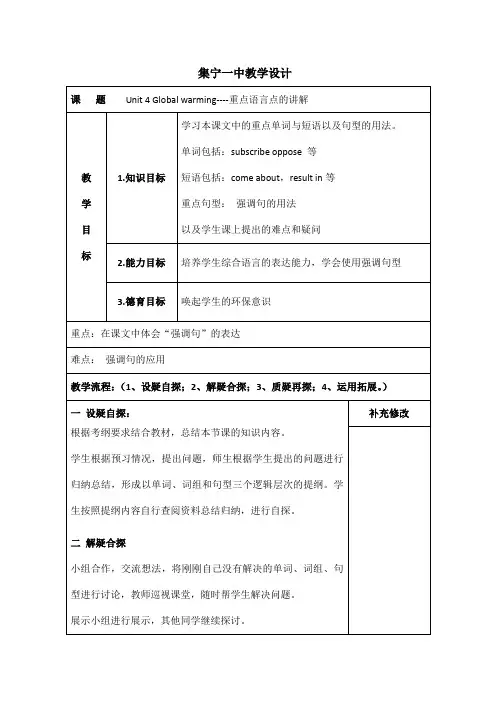
集宁一中教学设计品味人生1、不管鸟的翅膀多么完美,如果不凭借空气,鸟就永远飞不到高空。
想象力是翅膀,客观实际是空气,只有两方面紧密结合,才能取得显着成绩。
2、想停下来深情地沉湎一番,怎奈行驶的船却没有铁锚;想回过头去重温旧梦,怎奈身后早已没有了归途。
因为时间的钟摆一刻也不曾停顿过,所以生命便赋予我们将在汹涌的大潮之中不停地颠簸。
3、真正痛苦的人,却在笑脸的背后,流着别人无法知道的眼泪,生活中我们笑得比谁都开心,可是当所有的人潮散去的时候,我们比谁都落寂。
4、温暖是飘飘洒洒的春雨;温暖是写在脸上的笑影;温暖是义无反顾的响应;温暖是一丝不苟的配合。
5、幸福,是一种人生的感悟,一种个人的体验。
也许,幸福是你风尘仆仆走进家门时亲切的笑脸;也许,幸福是你卧病床上百无聊赖时温馨的问候;也许,幸福是你屡遭挫折心灰意冷时劝慰的话语;也许,幸福是你历经艰辛获得成功时赞赏的掌声。
关键的是,你要有一副热爱生活的心肠,要有一个积极奋进的目标,要有一种矢志不渝的追求。
这样,你才能感受到幸福。
6、母爱是迷惘时苦口婆心的规劝;母爱是远行时一声殷切的叮咛;母爱是孤苦无助时慈祥的微笑。
7、淡淡素笺,浓浓墨韵,典雅的文字,浸染尘世情怀;悠悠岁月,袅袅茶香,别致的杯盏,盛满诗样芳华;云淡风轻,捧茗品文,灵动的音符,吟唱温馨暖语;春花秋月,红尘阡陌,放飞的思绪,漫过四季如歌。
读一段美文,品一盏香茗,听一曲琴音,拾一抹心情。
8、尘缘飞花,人去楼空,梦里花落为谁痛?顾眸流盼,几许痴缠。
把自己揉入了轮回里,忆起,在曾相逢的梦里;别离,在泪眼迷朦的花落间;心碎,在指尖的苍白中;淡落,在亘古的残梦中。
在夜莺凄凉的叹息里,让片片细腻的柔情,哽咽失语在暗夜的诗句里。
9、用不朽的“人”字支撑起来的美好风景,既有“虽体解吾犹未变兮”的执着吟哦,也有“我辈岂是蓬蒿人”的跌宕胸怀;既有“我以我血荐轩辕”的崇高追求,也有“敢教日月换新天”的豪放气魄。
33 我是一只蜜蜂,在祖国的花园里,飞来飞去,不知疲倦地为祖国酿制甘甜的蜂蜜;我是一只紫燕,在祖国的蓝天上,穿越千家万户,向祖国向人民报告春的信息;我是一滴雨点,在祖国的原野上,从天而降,滋润干渴的禾苗;我是一株青松,在祖国的边疆,傲然屹立,显示出庄严的身姿。
新人教选修六 Unit 4 Global warming单元教学设计

教学课题Unit 4 Global warming period1 课程类型Warming up and reading课时一课时教材分析本节课的内容是人民教育出版社出版的NSE高中教材必修6第四单元的Pre-reading, Reading, Comprehension 部分,本单元的话题是全球变暖。
本节课是单元的阅读课,教材以说明文的文体呈现,教师可在充分利用教材资源的基础上,结合学生的实际情况设计教学活动,旨在帮助学生有效地掌握阅读技巧,形成有效地学习方法和阅读策略,同时了解说明文篇章结构和写作特点,为下一步进行说明文的写作教学做好准备。
学情分析The students are interested in the topic .After a year’s English learning ,most of them have formed some basic reading skills ,which contribute to the development of the class.教学重点1.Improve the students’ reading ability.2.Master the useful words and expressions.教学难点1.How to help the students master the usage of the useful words and phrases in thepassage .2.How to improve the students’ reading ability .教学目标一、知识目标1、初步理解、掌握课文中关于全球变暖方面的词语,学习分析课文中的长难句子,初步感知课文中出现的的本单元要学的语法现象。
2、利用已获取的信息发表自己对全球变暖问题的看法。
二、技能目标1、能理解文章主旨大意,获取信息、处理信息、进行推理判断和表达的能力。
新人教选修六 Unit 4 Global warming单元教学设计新部编版

教师学科教案[ 20 – 20 学年度第__学期]任教学科:_____________任教年级:_____________任教老师:_____________xx市实验学校Step 5HomeworkFinish off the exercises in workbook.1consume v.消费,消耗;吃完;喝光Make a list of the things that consume energy in your home ,school ,or any other places you can think of.列举一些在家里、学校里或者其他你能想到的地方消耗能量的东西。
(回归课本)用法点拨The car consumes a lot of fuel.这辆汽车很费燃料。
She consumed the big cake.她把那块大蛋糕吃光了。
归纳拓展consumer n .消费者consumption n .消费(量),消耗(量) time-consuming adj .耗费时间的 consumer goods(家用)消费品consuming adj .使人全神贯注的;强烈的 翻译句子(1)新的灯泡耗电量更小。
The_new_light_bulbs_consume_less_electricity. (2)足球让许多孩子都非常着迷Football_is_a_consuming_passion_for_lots_of_kids.2matter v.要紧,有重大关系So how has this come about and does it matter?那么这是如何产生的,有什么要紧吗?(回归课本) 用法点拨⎩⎪⎨⎪⎧⎭⎪⎬⎪⎫It doesn ’t matter to me It matters nothing to me It makes no matter to me whether he is satisfied. 他满意与否对我关系不大(不重要)。
选修六-Unit-4-Global-Warming-教案设计
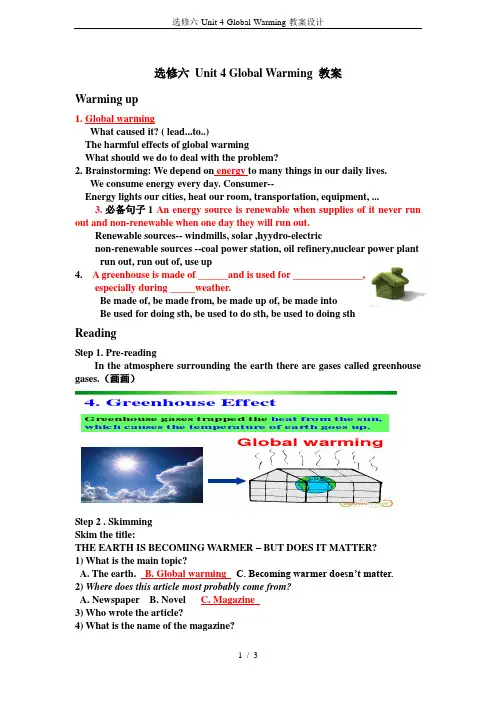
选修六 Unit 4 Global Warming 教案Warming up1. Global warmingWhat caused it? ( lead...to..)The harmful effects of global warmingWhat should we do to deal with the problem?2. Brainstorming: We depend on energy to many things in our daily lives. We consume energy every day. Consumer--Energy lights our cities, heat our room, transportation, equipment, ...3. 必备句子1 An energy source is renewable when supplies of it never run out and non-renewable when one day they will run out.Renewable sources-- windmills, solar ,hyydro-electricnon-renewable sources --coal power station, oil refinery,nuclear power plant run out, run out of, use up4. A greenhouse is made of ______and is used for ______________, especially during _____weather.Be made of, be made from, be made up of, be made intoBe used for doing sth, be used to do sth, be used to doing sthReadingStep 1. Pre-readingIn the atmosphere surrounding the earth there are gases called greenhouse gases.(画画)4. Greenhouse EffectGlobal warmingGr eenhouse gases tr appe d the heat fr o m the sun,whic h causes the tempe r atur e of ea r th goes up.Step 2 . SkimmingSkim the title:THE EARTH IS BECOMING WARMER – BUT DOES IT MATTER?1) What is the main topic?A. The earth.B. Global warmingC. Becoming warmer doesn’t matter.2) Where does this article most probably come from?A. NewspaperB. NovelC. Magazine3) Who wrote the article?4) What is the name of the magazine?Tip: In English, some nouns begin with a capital letter(大写字母), such as names of people and places, title s of magazines, newspapers, stories and books, people’s titles(头衔), etc..必背句子2—Earth Care’s Sophie Armstrong explores these questions.Step 3 Careful reading1) What causes global warming?(para 1)= How has this come about?come about表示“发生、产生”,多指事情已经发生了,但还不知道为什么,常用于疑问句和否定句,例如:happen常指具体事件的发生,特别指那些偶然的或未能预见的“发生”。
Globalwarming-Reading教案(新人教版高中英语选修6unit4)
Global warming-Reading教案(新人教版高中英语选修6 unit 4) Pre-reading1. Questioning and answeringAsk students something about a green house. What is it? What is it for? Could you tell the class in English what you know about a green house?A green house is built of glass to be used for growing plants. The air inside the green house is warm because the glass lets in the sun and keeps it from running away. So the air inside is warm and is good for growing plants throughout the cold seasons.2. Introduces students to the topic of the reading passage and the term “greenhouse gases”.3. Do exercises⑴What is the building made of and what its purpose?⑵What’s greenhouse effect?Teaching aims:To read the text “The earth is becoming warmer—but does it matter” and understand what it says.To make students find out some useful words and expressions. Teaching procedures:Step 1. Read the text (Page26)Answer the following questions.1 what is the purpose of the first paragraph?To introduce the topic.2 what are the diagrams for?To illustrate points by providing evidence.3 what is the purpose of the last paragraph of the article?To reflect on the major theme of the text and to predict what might happen in the future.Step 2. Read again for more detailsTo understand the main idea of the text, we are going to read it once again. Write down the key sentence of each paragraph at the same time.Key sentence of each paragraph:A debate over whether it is human activity that has caused the global warming or whether it is just a natural phenomenon.Many scientists believe people have caused the increase in the earth’s temperature.The increased extra amount of carbon dioxide traps more heat energy causing the global temperature to go up.The levels of carbon dioxide have increased greatly over the last 100 to 150 years.There are some different attitudes towards the causes of this increasein carbon dioxide.Over the next 100 years the amount of warming could be as low as 1 to 1.5 degrees Celsius but it could be as much as 5 degrees Celsius. An increase of five degrees would be a catastrophe.Future warming would cause the sea level to rise by several meters. Some predict any warming will be mild with few bad environmental consequences.More carbon dioxide is a positive thing.No one knows what the effects of global warming will be.Step 3. Listen to the tape and then find out some useful words and expressions.。
Unit4《GlobalWarming》教案6(人教版选修6)
Unit 4 Global warmingReading:The earth is becoming warmer –But does it matter? knowledge ability goals知识能力目标:Enable the students to talk about the causes and effects of global warming. Help the students learn how to talk about the causes and effects of global warming and express ideas about what people should do about it.Teaching procedures & ways教学过程与方法:Task-based method.warming up;Pre-reading. While-reading .post–reading .homework. Emotional and valuable aims情感态度与价值观:Help the students build up a kind of awareness of saving up energy and protecting environment.Teaching important point教学重点:Help the students learn how to debate over the topic "We should do nothing about global warming."Teaching difficult point教学难点:Enable the students to learn the writing skills of the text and get a better understanding of articles of this kind.Teaching aids教具准备Multi-media classroom and other normal teaching tools.Teaching procedures:StepI warming upCan you tell what we use energy for?Energy lights our citiesEnergy heats our buildingsEnergy entertains us( watching TV; playing computer etc.)Present Ss a group of pictures and let them decide what kind of energy it is and decide whether it is renewable or non-renewable.…Where does all the energy come fr om?Picture1 Wind millsPicture2 : a coal power stationPicture3:an oil refinery Picture4:a nuclear power plant Picture5:Solar panels Picture6: a hydro damStep II Pre-reading ;1. Show a picture of greenhouse on the screen, and ask1. What is it in the picture?It ’s a greenhouse made of glass.2. What is it used for?It ’s used for growing plants, especially during cold weather.3. How does it work?The air inside is warm because the glass traps the heat from the sun and keeps it from escaping. This makes the greenhouse heat up and so the plants can grow throughout the cold period.4. What is greenhouse gases?The gases surrounding the earth,including carbon dioxide, methane and water vapor.5. What do you think greenhouse gases do?They trap heat from the sun and therefore warm the earth.Step III While- readingTask 1: skimmingGlance quickly at the magazine article and answer the questions.1. Who wrote the magazine article? What is the name of the magazine?Sophie Armstrong wrote the magazine article. The name of the magazine is Earth Care.2. What are the names of the three scientists mentioned in the article?They are Dr. Janice Foster, Charles Keeling and George Hambley.3…. What is the main topic of the article?Global warming/ the warming of the earth.Task 2:listen andScan the textRead it quickly and try to get the general idea and divide the whole passage into several parts and summarize the main idea.False: 1, 2, 4, 9, 10Correct sentences:1. The temperature last century increased much.2. Not everyone believes that global warming is caused by human activities. 4. Natural gas is not a greenhouse gas but a fossil fuel.9. George Hambley thinks that more carbon dioxide is a positive thing and it will make plants grow faster.10. It is unknown what the effects of global warming will be.Task 3: Group activity .Should we do nothing about global warming?StepⅣPost-reading:1.write a summary.Do not include your own opinion, but be sure to use our own words (about 30words.)(不能添加自己的见解,但是要用自己的语言概括.大约30个词左右)The reading passage is a discussion and puts forward different points of view about the effect of increased carbon dioxide in the atmosphere the causes of theearth’s increased temperature and the possible effects .Ste pIIV.HomeworkRead the passage again and review the new words and expressions.。
人教版高中英语选修6 Unit 4 Global warming教学设计(精品)
人教版高中英语选修6 Unit 4 Global warming教学设计Step 1 Lead-in(2mins)通过欣赏影片, 引入这节课,激发学生的学习兴趣,从而引出主题(化石燃料的燃烧)。
(设计意图:此步骤从视觉、听觉、感觉的角度设计英语课堂教学结构,使学生的学习与感受融于一体,引起学生对主题的思考与关注。
)Step 2 Pre-reading (1mins)以下为听力短文中可能遇到的生词:fossil fuels,industrial society,energy,concentrate,radiation,nuclear power,etc.让学生说出意思,并且领读两遍。
(设计意图:该活动能让学生快速进入课堂学习的状态,开始思考学习的主题,激发学生联想与主题相关的信息,开拓学生的思路。
学生会联想到一些相关词汇;还会让学生认识到减少空气中二氧化碳的重要性,从而引入到话题what shall we do in our daily life ?)Step 3 Listening (20mins)The listening text is a radio interview about the use of fossil fuels and other sources of energy. It contains two parts and examples of the focus function for this unit:agreeing and disagreeing.Task1 Pair Work(7mins)Do the following exercise in pairs. Li bin is interviewing Professor Keeling about using different sources of energy. Read the statements below and tick the ones you agree with. Then listen to Part 1, and decide which statements Professor Keeling does NOT agree with.1.We should stop depending on fossil fuels for our energy. ( )2.90% of our energy comes from fossil fuels. ( )3.We can replace fossil fuels with cleaner sources of energy. ( )4.Nuclear power is a good source of energy. ( )教师活动:让学生快速浏览题目,猜测教授会否定哪些观点。
人教版高中英语选修6 Unit4 Global warming reading 教学设计
人教版高中英语选修6 Unit4 Global warming reading 教学设计单元要览:本单元的中心话题是人类当今面临的环境问题,主要探讨了“全球变暖”和“节约能源”等方面的问题。
由于人类过多使用不可再生能源,大气中二氧化碳的含量逐年增加,导致全球气温上升。
通过学习本单元,让学生了解能源分为“不可再生能源”和“可再生能源”,帮助学生树立“节约能源、保护环境”的主人翁意识。
学情分析:教学对象为高中二年级学生,智力发展趋于成熟。
他们的认知能力比初中阶段有了进一步的发展,渐渐形成用英语获取信息、处理信息、分析问题和解决问题的能力,因此我特别注重提高学生用英语进行思维和表达的能力。
他们学习英语方法由死记硬背转型向理解型并应用到交际上,他们有自己的学习技能和策略,学会把语言学习与现实生活和兴趣联系起来。
通过任务型课堂活动和学习,学生的学习自主性得到加强,不再认为英语的课堂学习很枯燥,主动参与到活动中去,成为课堂的主体,同时也加强了与他人交流合作的能力。
不过,本班学生的水平参差不齐,有些差距还相当大。
因此在教学过程中,布置的任务要兼顾各个层次的学生,使他们都有所收获。
教学内容分析:The central part of this unit is the reading passage with the title of “The Earth Is Becoming Warmer—But Does It Matter?” talking about the global issue which has a great effect on human beings' life.Warming Up gives six pictures to help students list the sources of energy they can think of in our daily life.Then they will be led to discuss which energy source is “renewable” andwhich is “non-renewable”.This part is designed to help the students to recall their background knowledge about energy and prepares students for the whole unit.Pre-reading provides a picture of a greenhouse and then tells us what a greenhouse is and what “greenhouse gases” are.The students will be led to discuss what they think greenhouse gases do,leading to the topic of the reading passage.Reading is a passage from an environmental magazine for young people.It puts forward the possible effect of increased carbon dioxide in the atmosphere and different points of view about it.It also analyzes the causes of the earth's increased temperature.It poses questions and encourages students to think about the issues.There are two graphs in it that tell us the “temperature difference from long-term average,1860-2000” and “carbon dioxide content in the atmosphere,1957-1997”.Characters in the passage—Dr Janice Foster,George Hambley and Charles Keeling are all real persons and their views reflect the views of some scientists today.Comprehending consists of three written or oral exercises for the students to do so as to help the students to get a betterunderstanding of the text,that is to say,to help the teacher to check how much the students have understood the text.教学目标设计Knowledge and skills1.To know the meanings of the following new words and phrases:consume(消费;消耗;耗尽),come about(发生;造成),random(胡乱的;任意的),phenomenon(现象),subscribe(同意;捐赠;订阅;签署文件),subscribe to(同意;赞成;订购),fuel(燃料),quantity(量;数量),quantities of (大量的),tend(趋向;易于;照顾),go up(上升;增长;升起),per(每;每一),data(资料;数据),result in(导致),trend(趋势;倾向),catastrophe(大灾难;浩劫),flood(洪水;洪灾),oppose(反对;反抗),opposed(反对的;对立的),be opposed to(反对),consequence(结果;后果),state(陈述;说明),range(种类;范围),even if(即使),keep on(继续),glance(看一下;扫视),steady(平稳的;持续的),steadily(平稳地,持续地)2.To learn about some facts and views about global warming. 3.To learn how the information is organized.4.To develop the students' reading ability by skimming and scanning the passage. 5.To develop the students' speaking ability by talking about global warming.教学方法:1.While doing Warming Up the teacher can lead in the topic of this unit by showing students some pictures or videos about sources of energy,making the students recall their own knowledge about energy.2.During Pre-reading the teacher can go around the classroom and discuss the questions with severalstudents.This discussion should be student-centered and lead them to the topic of global warming.The teacher should also ask the students to look at the graphs in the reading passage and try to find out the general idea of the text.3.While doing Reading and Comprehending,the teacher may first ask the students to read the text quickly to get the general idea of each paragraph.After reading the passage,students are encouraged to answer some questions and discuss the text structure.4.To consolidate the contents of the reading passage,the students should be required to retell the text in their own words at the end of the class.教学情感目标:1.To make students realize the harm of global warming and the importance of environmental protection.2.To develop students' sense of cooperative learning.教学重、难点:1.To enable the students to learn about global warming and to develop their reading ability.2.To enable the students to talk about what we should do to prevent global warming.教学过程:Step 1 Warming up1.Warming up by reading and talking:Read through the exercise with the class.Put students in groups of four to talk about what we use energy for,what are the sources of these energy and whether the sources are renewable or non-renewable.Suggested answer:The six photos are:windmills;a coal power station;an oil refinery;a nuclear power plant;solar panels;a hydro-electric dam.2.Warming up by discussion:Let the students have a discussion and collect suggestions fromstudents and write them under the appropriate heading.Show a picture of a greenhouse to students and ask them what agreenhouse is made of and what its purpose is.Suggested answer:It's made of glass and plants can grow in it when it's cold outside.Ask the students how it works.Suggested answer:The glass traps the heat from the sun,making the air warm so that plants grow better.Step2.Pre-readingAsk students what they think “greenhouse gases” are and what they think greenhouse gases do.Look at the picture above and explain it to their partners.Suggested answer:Greenhouse gases perform the same function as the glass in a glasshouse:they trap the heat of the sun and keep the air surrounding the earth warm.This is called the greenhouse effect.)Step.3 Reading and comprehending1.Fast readingAsk students to read the passage quickly so as to get the key words and general idea of each paragraph and answer the following questions:(1)What is the main topic of the article?_________________________________________________________________ (2)Who wrote the magazine article?What is the name of the magazine?_________________________________________________________________ (3)What are the names of the three scientists mentioned in the article?Do they agree with one another?_________________________________________________________________ Suggested answers:(1)Global warming/the warming of the earth.(2)Sophie Armstrong,Earth Care.(3)Dr Janice Foster,Charles Keeling,George Hambley.They don't agree with each other.2.Detailed reading(1)Read the passage carefully and judge whether the statements are true(T) or false(F).①Janice Foster believes that global warming is caused by the burning fossil fuels.( )②Natural gas is a greenhouse gas.( )③Carbon dioxide is a byproduct of burning fossil fuels.( )④People accept Charles Keeling's data because he took accurate measurements.( )⑤Flooding could be one of the effects of future global warming.( )⑥George Hambley believes scientists are just guessing about the effects of global warming.( )⑦George Hambley is worried about the effects of carbon dioxide on plant growth.( )⑧It is clear what the effects of global warming will be.( ) (Suggested answers:TFTTTTFF)3.Structure analyzingAsk students to read the text carefully and try to find out how many parts they can divide theSuggested answer:Step 4 Language studyDealing with any language problem if any(words or sentences students might not understand)to help the students to have a better understanding of the text.Step 5 Listening,reading aloud and underliningAsk students to read the passage aloud to the tape and let them pay attention to the pronunciation of each word and the pauses within each sentence.Tell them to pick out all the useful expressions or collocations from the passage while reading and copy them to the notebook after class as homework.Collocations:come about,There is no doubt that...,subscribe to,due to,greenhouse effect,quantities of,tend to,be trapped in,go up,result in,on the one hand...on the other hand,be opposed to,build up,keep on.Step 6 RetellingAsk students to talk about global warming in their own words.Give them some key words and expressions on the blackboard.Then let them try to retell the passage.Step 7 Homework1.Learn the useful new words and expressions in this part by heart.2.Try to find some data about global warming on the Internet,and show your class in the next period and talk about them. Step 8 Reflection after teaching。
高中英语Unit4GlobalwarmingReading教案新人教版选修6
Unit 4 Global warmingReadingTeaching goalsTarget languagewords and phrases:energy, light(v.), heat(v.), renewable, non-renewable, run out, compare, phenomenon, graph, fuel, trap, data, climate, catastrophe, consequence, range, per, glance, compare to, come about, fierce debate, result in, build up, keep onAbility goalsEnable the students to talk about different sources of energy.Enable the students to read the text, understand what it is about and talk about the causes and effects of global warming.Teaching important & difficult pointsEnable the students to get a better understanding of articles of this kind. Teaching aidsA projector and a blackboardTeaching proceduresStep 1 Warming upT:Now let's look at a picture on the slide and answer the question below.What is the greenhouse made and used for?A greenhouse is made of glass and is used for growing plants, especially during cold weather.What's greenhouse effect?Step 2 ScanningRead the text quickly and find the answer to the questions:1. Who wrote the magazine article? What is the name of the magazine?Sophie Armstrong, Earth Care.2. What are the names of the three scientists mentioned in the article?Dr Janice Foster, Charles Keeling, George Hambley.3. What do they think about global warming? Do they agree with one another? They don't agree with each other.Dr. Janice Foster thinks the effects of global warming could be very serious. George Hambley thinks global warming will be mild with few bad environmental consequences.Charles Keeling believes it is the burning of more and more fossil fuels that is resulting in a bigincrease in carbon dioxide.The first graph shows the temperature increase of one degree Fahrenheit between 1860to 2000.The second graph shows the carbon dioxide content in the atmosphere from 1957 to 1977.4. What are the two graphs about?The first graph shows the temperature increase of one degree Fahrenheit between1860to 2000. The second graph shows the carbon dioxide content in the atmosphere from 1957 to 1977.5. What is the main topic of the article?Global warming/ the warming of the earth.Step 3 SkimmingRead the passage carefully and judge whether the statements are true or false.1. The temperature last century didn't increase much.2. Everyone believes that global warming is caused by the activities of humans.3. Janice Foster believes that global warming is caused b the burning fossil fuels.4. Natural gas is a greenhouse gas.5. Carbon dioxide is a byproduct of burning fossil fuels.6. People accept Charles Keeling's data because he took accurate measurements.7. Flooding could be one of the effects of future global warming.8. George Hambley believes scientists are just guessing about the effects of global warming.9. George Hambley is worried about the effects of carbon dioxide on plant growth.10. It is clear what the effects of global warming will be.Keys: True: 3, 5, 6, 7, and 8 False: 1, 2, 4, 9, 10Step 4 Detailed readingRead the text carefully and try to find out how many parts we can divide the text into and find out the main idea of each part.Part (Para_ to Para_ )Main ideaPart 1 (Para _1_)introduce a debate over the issue of global warmingPart 2 (Para _2__ to _4__)illustrate how global warming comes aboutPart 3 (Para _5__ to 10___)list two different attitudes among scientists towards global warmingPart 4 (Para _11__ to ___)It's up to readers to think and decide whether people should do something about global warming or not.Step 5 DebateGet into groups of six. Decide which three in your group are going to agree with the statement and which three are going to disagree with the statement.Group A: We shall do something about global warming.Group B: We shall do nothing about global warming.Group A discuss why they agree with the statement; Group B discuss why they disagree. Group A and B get together. Tell each other the reasons why agree or disagree with the statement.Step 6 Homework1. Read the passage again and review the new words and expressions.2. Prepare the debate in groups.3. Surf the Internet for more information about global warming。
人教版高中英语选修6《Unit4Globalwarming》教案
人教版高中英语选修6《Unit4Globalwarming》教案人教版高中英语选修6《Unit 4 Global warming》教案【一】教学准备教学目标Teaching Aims:In this class Ss will be able to① practice skimming and scanning for information needed like what are the two concerns and what are Earth Care’s suggestions.② Master the phrases such as: put up with, so long as, and so on, make a difference, have no effect on … , by making sentences or by using them into the post er.③ become aware of the s erious effects of global warming and the importance of saving energy to be environmentally friendly.④ Summarize the points according to their understanding.⑤ work together to design a poster by using the suggestions in the article.教学重难点Teaching Difficulties:Students may find it hard to add more suggestions about how to save energy in our daily life and to summarize the points according to those suggestions. Students may not know clear what is a poster and how to design an attractive and persuasive poster in short time.教学过程Teaching Procedure:Step1. Lead-in (individual & collective work)1. Teacher begins the class by asking: Have you ever seen themovie The Day After Tomorrow? and then let students enjoy a short movie clip with the following two questions:① What kinds of disasters have you seen in the film?② Can you guess how they came about (happen)?2. introduce the topic: global warming. And then have a further question:①What other disaster will be caused by global warming?【Designing Purpose】To arouse students’ interest by watching the movie clip and educe the topic, that is global warming. And then by showing a lot of pictures, make students know and understand the terrible effects of global warming, thus making preparations for promoting environmental protection.Step2. While Reading (Individual work)Skimming: Go through the first letter to f ind:① who is the writer?② what are his two concerns?Scanning: Read the second letter and answer the following questions:① Does Earth Care agree with Ouy ang Guang’s opinion that individuals can have no effect?② what are Earth Care’s suggestions?③ Can we carry those suggestions out? Why?【Designing Purpose】To help the students grasp the main information of the two letters by skimming and scanning. While stud ents get the answer to question1, ask them to find the supporting sentence : Together, individuals can make a difference. We do not have to put up with pollution. Guess the meanings of the two italicized phrases according to the surroundings and their understanding.Step3. Post reading (Pair work)1. Discussion: Make students discuss whether they can find more ways or suggestions about reducing carbon dioxide and saving energy in our daily life.Suggested ways:1) Use less hot water 7)Change a light bulb 8)Try car sharing2) Take a shower instead of a bath3) Buy fresh food instead of frozen4) Buy things that are actually in season5) Eat less high fat food like KFC and Macdonald6) Clean filters(过滤器) on your air conditioner.【Designing Purpose】To cultivate students to work in pairs and learn to summarize an opinion and share the knowledge of saving energy in daily life. To practice the ability of understanding the meaning of new words and expressions to remove the obstacles in reading.Step4. learn what is a poster (collective work)Know what is a poster by giving a simple sample and try to get the structure.【Designing Purpose】To know clearly a poster should have a heading, contents and an eye-catching slogan, which will make it easy for students to design an acceptable poster.Step5. Prepare the poster (individual & group work)1. Decide our content s:①Choose and decide five most important suggestions. (individual work)②Write them down on your paper and try to make them persuasive by using imperativesentences. (individual work)③Compare your list with your group members and decide five for your poster. (groupwork)2. Slogan and heading: showing sample posters to help them decide a heading and a slogan for your poster.【Designing Purpose】This is the most important part of this writing task. Students will be able to summarize and compose sentences by choosing and organizing what they want to say, thus improving their writing ability and the process of output based on what they have learned in reading part. And by learning some sample posters to help them decide their own heading and slogan.Step6. produce &show time (group work)With the heading, slogan and ways, students will not find it difficult to make a poster. What theyShould pay attention is how to illustrate their poster and make it more attractive. And then choose several pairs to represent their posters.【Designing Purpose】Making the poster will improve their cognitive capability of the importance of environmental protection and at the same time they can enjoy a sense of achievement in show time. And they make believe that individuals can really make a difference.课后习题Homework:Put their poster up around the school to make more students know about energy saving and global warming. Write a short passage to tell others how to solve the problem of global warming based on the suggestions you have collected and send it in your QQ zone or blog.板书板书设计:tsunami/ flood/More suggestions: make full use of paper/ use both sides of paperreuse waterlimit the time of using private carssend emails instead of cardsuse less hot wateralways take a shopping bag with youdrive a bicycle but not e-bicycle人教版高中英语选修6《Unit 4 Global warming》教案【二】教学准备教学目标Teaching goals 教学目标1. Target language 目标语言a. 重点词汇和短语energy, light (v.), heat (v.), renewable, non-renewable, fuel, blame, run outb. 交际用语Expressing agreement and disagreementYes, I agree with you.Yes, I think so.I believe that you’ve got it right.I don’t think so.I d on’t think that’s right.I’m afraid you are wrong.2. Ability goals 能力目标Enable the students to talk about different sources of energy and express their own ideas.3. Learning ability goals 学能目标Help the students learn how to give their ideas about the use of energy.教学重难点Teaching important points 教学重点Enable the students to express agreement and disagreement.Teaching difficult points 教学难点Enable the students to learn how to express agreement and disagreement.教学过程Step ⅠRevisionT: Good morning, everyone.Ss: Good morning, teacher.T: Sit down, please. Before class, I’ll check your homework first. Mary, would you read your homework to us?Check the students’ homework and have a discussion with the students about the mistakes Mary made. Let the students have a clear understanding about the mistakes and then correct them.Step ⅡWarming upT: As we all know, we depen d on energy to do many things in our daily life. Some people even say we could do nothing without energy. Can you tell me what we use energy for?Sa: Energy lights our cities.Sb: Energy heats our buildings.Sc: Energy entertains us. With the help of electricity, people have got a lot of fun from watching TV, playing computers and so on.Sd: There are many other electrical appliances that make our life more convenient and comfortable such as washing machines, microwaves, air conditioners and so on.Se: Today energy also helps people realize many so-called dreams in the past. For example, people can “fly” from one place to another by plane which runs on energy.Sf: It’s true. In fact, not only planes but also cars, ships and trains run on energy.T: Well done. All that you’ve just said is right. So it seems that energy plays a very important role in the modern world. Then where does all the energy come from? Open your books and turn to page 25. Look at the pictures on this page. They may help you find out the answers.After a while.T: Who’d like to tell us your answers?Sg: Wind power.Sh: Coal power.T: Right. Is there any difference between them?Si: Yes. Wind will never run out while coal is a limited source.T: It’s true. As we know, an energy source is renewable when supplies of it never run out while some supplies, such as coal, will definitely run out one day. Energy of this kind is called non-renewable sources. Please think of as many sources as you can and decide which energy sources on your list are renewable and which are non-renewable.If necessary, give some words related to the pictures which might be difficult for the students such as oil refinery, hydroelectric power and so on.The teacher should also collect as much information about different sources of energy as possible and show it to the students in class through a computer. In this way, the students will become more interested in this topic and their knowledge on this aspect will be enlarged.Sample answers:Step Ⅲ Listening and DiscussingT: Fromwhat we’ve just talked about, it is clear that energy does a lot of good to us.But every coin has two sides. Is there any negative effect of using energy?Sa: Yes.People use too much energy which is resulting in an increase in carbon dioxide.That is how the global warming comes about.Sb: Andmeanwhile it pollutes the environment.T: It’strue. Many people have realized the problem. N ext we’ll do some listeningpractice on this topic. Let’s see what other people think of this issue.Thestudents are asked to read the questions quickly to find out the listeningpoints first. Then listen to the tape twice and give the correct answers.T: No wplease turn to page 31. Let’s do listening. Before you listen to the tape,please read fast the statements in Exercise 1 to find out the listening points.Pay much attention to the key points while listening.Play thetape for the first time. Help the students get a general understanding aboutthe dialogue. The students listen and try to finish Exercise 1. Play the tapeagain, train the students’ ability to spot specific information and understandthe implication in the dialogue. The students listen and finish Exercise 2.Severalminutes later.T:Have you finished the exercises?Ss: Yes.T: OK,let’s check your answers.Explainsome difficult points if necessary.T: Nowread what Professor Chen and Li Bin say. Work in groups. Discuss who you agreewith and give reasons. Use some of the phrases listed in Exercise 2 or anyothers you know.课后习题Homework1. Review the new words and expressions you learned in this class.2. Preview Reading.。