
人教版八年级上册英语Review unit 6-7
八年级上册英语Review unit 6---unit 7Unit6Key phrases1.长大______________________2. 想要成为______________________3.练习做某事______________________4.继续做某事______________________5.确信,多……有把握______________________6.确保,查明______________________7.搬到______________________ 8.上表演课______________________9.把……送到……______________________ 10.另外一种语言______________________ 11.得到许多锻炼______________________ 12.学弹钢琴______________________13.能够______________________ 14.许诺,发誓______________________ 15.答应某人去做某事______________________ 16.下决心______________________17.在一年的开始______________________ 18.与……有关______________________ 19.开始一种爱好______________________ 20.明年______________________21,告诉某人关于某事_________________ 22.各种不同的决定____________________ 23.制定一周的计划______________________ 24.写下,记下______________________ 25.因为这个原因______________________ 26,太……而不能______________________27.是你自己成为一个更好的人______________________28.自我提高______________________29.取得更好的成绩______________________Key points1. I’m going to move to Shanghai. 我打算搬到上海去。
【解析】move v 移动,搬动【记】movie(电影) —i →move move to + 地点搬到某地①I’m going to ________(搬) to Beijing next month.( ) ②The family moved ____ there , and had a happy life. A. in B. to C. /D. with2.My parents want me to be a doctor, but I’m not sure about that.我父母想让我当医生,可是我没有把握。
【解析1】doctor ['dɒktə(r)] n医生see the doctor 看医生at the doctor’s 在诊所【陕西西安】John wants to be a ____ , so he often helps sick people in the hospital.A. reporterB. doctorC. scientistD. cook【解析2】sure adj. 确信的be sure about 确信make sure 确保(1) be sure +about / of +名词、代词或动名词对……有把握She is sure of success. 她确信会成功。
(2) be sure to do sth 务必;确信I’m sure to go with you. 我确信和你一起去(3) be sure +that 从句We are sure that you can make great progress this term.(4)▲make sure + that 从句Make sure that you can find out the truth soon.确保你能很找出真相。
▲make sure to do sth 务必干……▲make sure of sb./ sth 弄清楚某人/事( ) ①Please check your paper to _______ there are no mistakesA. think ofB. try outC. find outD. make sure( ) ②You need to take notes at the meeting so make sure ___ a pen and some paper with you.A. bringB. bringingC. to bringD. not bring3.I’m going to keep on writing stories. 我打算继续写作。
【解析】be going to + 动词原形表示将要发生的事或打算、计划、决定要做的事情,其中的be 动词要根据句子主语来确定。
一般将来时常与表示将来的时间的状语如tomorrow; next week等连用。
I’m going _____________(give) her a present when she __________(come).【解析】keep on 继续Keep on doing sth继续做某事(指经过一段时间的间隙后“继续做同一件事”)keep sb. doing sth 使某人处于某种状态keep sb/ sth from doing sth 阻止某人做某事【拓展】work on 从事hold on 等一下(电话用语)get on 相处( ) Although it’s late, he still keeps on ____ his homework.A. doesB. doingC. doD. did4.I’m going to write articles and send them to magazines and newspaper.我打算写文章并将文章投给杂志和报纸。
【解析1】article ['ɑːrtɪkl] n文章,论文【解析2】send [send] v邮寄,发送→sent →sentsend sb. Sth = send sth to sb. 送某人某物【拓展】give (pass/ show/ sell) sb. sth = give ( pass/ show / sell ) sth to sb.【短语】send for 派人去请send up 发射;send off 寄出;为……送行send out 派遣;发出( ) ①Please send ____ best wishes to Mary. A. I B. me C. my D. mine ( ) ②On June16,2012, China _____ its Shenzhou IX spaceship.A. set outB. set offC. sent upD. sent out5. What do you want to be when you grow up? 长大后你想做什么?【解析1】when “当……时”, when 引导的时间状语从句,从句用一般现在时,主句用一般将来时She is going to be an astronaut when she grows up.Jim is a computer fan and he wants to be a computer engineer when he ______________(长大)。
【解析2】grow →grew →grown v (1) 生长,成长(2) 种植( )①When he ___ , he ___ to be a policeman.A. grow up ; wantB. grows up ; wantC. grows up ; wantsD. grow up ; wants ( )②The farmer likes _____ vegetables in his garden, and they all ____ well.A. growing; grow upB. to grow ; grow upC. growing; growD. to grow ; grows6. He’s going to take acting lessons 他打算去上表演课【词形变换】act v 表演→actor n 男演员→actress n 女演员【名言】Think carefully before you act . 三思而后行【短语】an actor 一个男演员act as 充当,起作用take acting lessons 上表演课【注】take singing lessons 上声乐课take … lessons = have… lessons 上……课give sb. a lesson 给某人一个教训①Li Long loves art and wants to be an___________ (act) in the future②—Are they going to take ________________(act) lessons?—No, they aren’t .③If you are going to be an actor, you have to ________.A. take acting lessonsB. take act lessonsC. take acting lessonD. take act lesson7. Well, don’t worry. 嗯,不要担心。
【解析】worry v 担心→worried adj. 焦急的worry about = be worried about 为……担心①Don’t be _________(worry). You’ll catch up with others.( )②Don’t ____ about things so much. It will make you stressed out.A. afraidB. worryC. worriedD. terrified8. Just make sure you try your best. 只要你尽力就好。
人教英语八年级上册Unit6GrammarFocus共20张课件
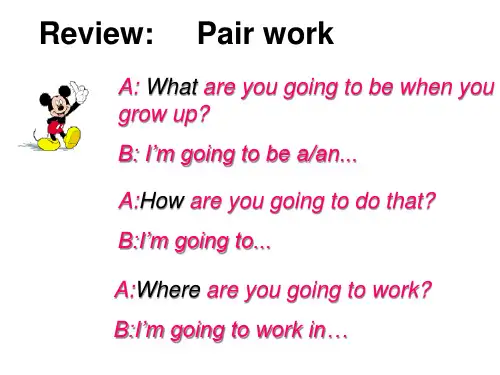
actortake acting lessons
--What are you going to be when you grow up?--I’m going to be an actor.--How are you going to do that?--I’m going to take acting lessons.
C
D
B
C
5、Nelly is goin
3a Match what these people want to do with what they are going to do.
____1. My friend wants to be an engineer. ____2. My brother wants to be an actor. ____3. I want to be a scientist. ____4. My sister wants to be a school teacher. ____5. Those boys want to be soccer players. ____6. My friend and I want to be singers. ____7. My cousin wants to be a cook. ____8. I want to be a race car driver.
when
want
How
going
Where
going
study
When
start
3b Fill in the blanks. Then pr
What
Where
How
When
八年级英语上册-Unit-7-Will-people-have-robots备课教案-(新版)人教新

一、教材分析
单元教材分析:will + 动词原形 来表达一般将来时态。 学会表达自己对未来的看法;学会谈论自己未来的打算。
二、学情分析
1.八年级处于思维活跃期,对学习本单元有好处,可以进一步开阔学生视野。
2.本单元总体知识结构比较单一,内容相对比较简单。
教学重点:
教学重点:
1)学习掌握一般将来时态的意义和结构。
2) 掌握There be句型的一般将来时态的结构。
(含教法学法、媒体应用等)
教学难点
教学难点:
掌握more/fewer;more/less的用法。
情态动词will + 动词原形来表达一般将来时态。
(同属教学重难点的,在本栏书写)
五、课时安排
三、教学目标
(结合课标)
知识技能
学会表达自己对未来的看法;学会谈论自己未来的打算。。
过程方法
首先进行集中识字,为本单元的学习作好铺垫。其次,采用情景交际法和任务型教学法并充分利用听力材料和阅读材料,训练和提高学生的听力和阅读水平。在听读的基础上创设语言情景和合作探究的方式加强读写训练。培养学生的听、说、读、写综合能力。
Period 1 Se-2d 听说课
Period 3 Section A Grammar Focus-3c语法课
Period 4 Section B1a-1e 听说课
Period 5 Section B2a-2e 阅读课
Period 6 Section B3a-3c阅读课
Period 7 self check and unit review
六、知识结构
七、其它补充
情感态度价值观
人教版八年级上册Review of Unit7Will people have robots课件

—Yes, that's why they're getting fatter and fatter.
C A. more
B. less
C. fewer D. much
( )5.__careful you are, ___mistakes you will make .
A. The more; the more
29.做这样/简单的工作
do such /simple jobs
30.看起来似乎不可能 31. 更少/更多……
seem (to be) impossible fewer/more+可数名词复数 less/more+不可数名词
自学指导与检测二10’: 一般将来时
一、概念:表示将来某个时间要发生的动作或存在的状态,也表 示将来经常或反复发生的动作,常与表示将来的时间状语连用, 如 tomorrow,next week,next year,in the future等。
e.g.:They'll have a test next week. 他们下周要进行测验。
We will/shall visit the Summer Palace. 我们要去游览颐和园。
I'm going to write a letter to my friend. 我要给我的朋友写一封信。
( )3.If there is ______ pollution, the air in our city will be _______dirtier.
A A.less; more B.more; much C.less; less D.more; more
( )4.— Many people eat_____ meat than they did before.
新版人教版八年级英语上册教案(全册 共106页)
新版人教版八年级英语上册教案(全册共106页)目录Unit 1Where did you go on vacation?Unit 2How often do you exercise?Unit 3I'm more outgoing than my sister.Unit 4What's the best movie theater?Unit 5Do you want to watch a game show?Unit 6I'm going to study computer science.Unit 7Will people have robots?Unit 8How do you make a banana milk shake?Unit 9Can you come to my party?Unit 10If you go to the party,you'll have a great time!Unit 1Where did you go on vacation?本单元教材以Where did you go on vacation?为中心话题,围绕着描述“过去发生的事情”展开,学习和运用一般过去时态的一般疑问句Did you go/see/buy...?和特殊疑问句Where/What/How...?询问过去的事件,让学生学会谈论和分享过去发生的事件。
本课教学内容与学生的实际生活密切相关,易于引发学生运用简单的英语进行交流。
在学习活动中,学生通过交换对过去发生的事情的描述及看法,促进学生之间和师生之间的情感交流,增进情谊。
Section A的主要学习内容是:复习一般过去时态和动词的规则与不规则变化,学习一般过去时态的一般疑问句:Did you...?及不定代词的用法。
Section B安排了许多听、说、读、写的任务活动,教师在教学中可以灵活运用这些活动,将其中的一些活动进行变化或整合,充分调动学生参与的积极性,提高学生的听说读写能力。
统编人教版八年级英语上册优质课件 Review of Unit 7
6. 这事与你无关,你最好不要参与进来。 This has nothing to do with you and you’d better not __p_la_y__ ___a___ __p_a_r_t_ ___i_n__it.
7. 空闲时间咱们去逛公园吧!它是免费的。 Let’s go to the park in our _f_r_e_e_ _t_im__e_! It’s _f_r_e_e_.
impossible 不可能存在或发生的;不可能的 (adj.)
side
一方(的意见、态度、立场) (n.)
probably 很可能;大概 (adv.)
during 在……期间 (prep.)
holiday 假期;假日 (n.)
word
单词;词 (n.)
phrases
1. 免费 2. 活到两百岁 3. 100年后 4. 更少使用地铁 5. 有关未来的书 6. 处于极度危险
纸;纸张 (n.) 污染;污染物 (n.) 将来;未来 (n.) 污染 (v.) 环境 (n.) 行星 (n.)
earth plant part peace sea build
地球;世界 (n.) 种植(v.) 植物 (n.) 部分 (n.) 和平 (n.) 海;海洋 (n.) 建筑;建造 (v.)
play a role in saving the earth
9. 醒来
wake/ woke up
10. 摔倒
fall down (过:fell down)
11. 在未来
in the future
即时演练
一、单项选择。
1. Now the environment is becoming worse and
人教版八年级英语上册Review of unit 6

(2011 . 菏泽) —Which city is your favorite? —Hangzhou, of course. It’s the ______place that I want to visit. A. worse B. worst C. better D. best
(2011. 潍坊) Everything is getting ______. A . Good and better B. better and better C. best and better D. best and best
1. 基础知识的复习 2. 形容词或副词的比较级和最高级的复习
Part Ⅰ Words and expressions
1. 在某些方面,我们看起来一样,在某些方面 我们看起来不同。 ___some ______ ___, we look ___ ____ ___, and in some In ways the same look different ways, we_____ _______. 2. 我的头发比她的短。 hers My hair is ________ shorter than_______. 3.她比我稍微外向一些。 more outgoing She is a little _____ _______ than ____me. 4.我们都很喜欢去参加派对。 both ____ enjoy going parties. We ____ ______to 5.对于我来说,好朋友喜欢和我做一样的事情。 do _____ the For me , a good friend likes to ____ same things ___me. as _____ ______
(2010—2011 期末考试) 21.Who is _________boy , Tom, Jack or Nick? A. tall B. the tall C. the tallest D. taller 23.He thinks this book is _____than that book. A. much interesting B. the most interesting C. most interesting D. much more interesting
人教版英语八年级上册Unit 6 说课稿
Unit 6 It’s raining!Good morning, everyone. I am Liu Liqin from the Shangcai No.2 Middle School . I have taught English for over twenty years and I like my job. Today, I will talk about Unit 9 It’s raining. Go for it Junior English Book .There are 5 periods to finish this unit. I will talk about the first period with the following parts.一.Teaching material analysis1. Theaching items: This lesson is the first lesson in Unit 9. It’s also a main point in this lesson, which provides an example for the target sentence construction. It increases the students synthetic ability of hearing, speaking, reading, writing by reviewing the present continuous tense.2. Aims to the teaching:A. Aim to the knowledge:To learn the target words: raining, windy, cloudy, sunny, snowing in this lesson. The target sentence construction in this lesson is: How is the weather?B. Aim to the abilities :To improve the students communication ability.C. Aims to the emotion:To train the students to love our nation, and develop their good charactor.3. Difficult and important points:To get the local weather information by using their knowledge which they have learnt.二. Teaching method--- the investigative methodAs we all know: the main instructional aims of learning English in middle school is to cultivate students’basic abilities of listening 、speaking、reading and writing and their good sense of the English language. So in this lesson, I’ll mainly use“Task-based”teaching method. That is to say, I will let the Ss learn in real situations, finish a task by making a survey to help the Ss to get a better understanding of the key structure of the conversation. And in this lesson communication method、scene method .三.Study method---the investigative methodI request the students to study English hard. Each unit in Go for it contains pair work, group work and games. The students who sit at the same table and groups can make a discussion and learn each other. It makes each student be relaxed. They needn’t worry about making mistakes. It can arouse students to think and to say what they want to say. Students become more relaxed and pleased in this kind of environment.四.The time table of teaching steps1. Review. It will take me 7 minutes.2. Presentation. This is the most important part in this lesson. It will take me 32 minutes.3. The study of diffuse thought. It will take me 4 minutes.4. Briefly summary and homework. It will take me 2 minutes五.Teaching stepsI’ll finish this lesson in 5 steps.Step1---ReviewPurpose: To form a better surrounding for the students by speaking and doing some total physical response and at the same time it provides situations to review leart knowledge the next step.1. Let a student greet and make a duty report.2. Free talk between T and Ss about last unit.3. Review the present continuous tense by software.I will make a conversion with the students . I ask students to answer .th e questions:“ What is he doing?” Students answer:“ He is singing.” The second picture,“ What are they doing?” “They are playing chess.”And then I will let the students ask and answe r in pairs using the target sentences “What is he doing?”“What is she doing?”“What are they doing?”. Make sure the students ask and answer correctly. They can use the words: dance、go to school、swim、play computer games、paint、watch TV and run.Step2---PresentationThe purpose is to present the key words one by one. It is much easier for the students to learn and grasp the meaning. CAI provides a real situation for students to understand the conversation better.I’ll mainly talk about this step.1. I’ll use a picture to ask a question: “Is it raining?” Ss answer:”Yes,it is.” Then I’ll tell them if you want to know the weather, you can ask:“How is the weather?” The answer is:“It’s raining.” “raining ”is a target word and “How is the weather?” is a target sentence. Help the Ss understand the meaning by body language. Then lead the Ss to read the sentences. Make sure they can say them out correctly.I will use the other pictures to teach the target words “windy 、cloudy、sunny and snowing”.2.I will use the other pictures to teach the other target words“ windy, sunny, cloudy and snowing.”These are the sentences they must master. “How is the weather?” “It’s cloudy”. “It’s windy.” “It’s sunny.” “It’s snowing.” and “It’s raining.”3. After they finish learning the target words. I will ask them to open the books and turn to P53. I will teach 1aThis activity introduces the key words.After they finish it, I will give them the right answers.4. We will do listening exercise 1bThis activity gives students practice in understanding the target language in spoken English.The students can listen twice and finish them.5. 1c pairwork.This activity provides guided oral practice using the target language.Ask the students to make a conversation in pairs according to the model.6. After they finish it, we will go on listening exercises. Look at Page 54-2a.At first I will point to the four pictures. Ask students to tell what each person is doing in each picture. For example: “The boy is talking on the phone”. “The man is playing basket ball.”and so on. Then I will play the tape twice and the Ss number the pictures. I will give them the right answers.7. Go on learn ing 2b. It’s listening exercise s,too.I will ask a student to read the list of names and another student read the list of activities for the class. Then play the tape twice. The students listen and match the names and the activities. After they finish it, I will give them the correct answers.8. 2c-Pairwork.I will ask Ss to make conversations in pairs, I’ll ask some pairs to presen t their conversations to the class.9. After learning the text. I will let Ss do some more oral exercises.This is a weather report. I’ll let the students make a conversation in pairs with the weather information using the target words and sentences.It is sunny/rainy…….Step 3. The study of diffuse thought.Purpose: In order to raise students English level, I will teach them word-building --how to change nouns into adjectives. It can help them improve the abilities of remembering words easily. The words are sun–sunny, snow–snowy, wind-windy, rain-rainy, cloud-cloudy.Step 4. Summary and homework.Purpose: It’s important for students to speak English as much as pos sible in class or after class. It’s ne cessary for them to do some exercise after class to consolidate the knowledge they learned.In this lesson, We have learnt some words and sentences about the weather .Ss can use these to ask and answer about local weather information.Homework for this lesson is:1) Finish off the workbook.2) Listen to the local weather report and get ready for the conversation for tomorrow.3) Remember the target words and sentences by heart.Design of blackboardUnit 9 It’s raining!How’s the weather? ---It’s raining/rainy.---It’s sunny.---It’s cloudy.---It’s windy.--- It’s snowing/snowy.What’s he/she doing? ---He’s/she’s……What’re they doing? ---They’re ……。
Unit+8+Review+课件+2024-2025学年人教版八年级英语上册
名词修饰词
修饰词
可数名词
a/an, 具体数词以及 many, few, a few, some, any, a lot of, lots of等。
不可数名词
much, little, a little, some, any, a lot of, lots of 等以表示量的 短语(a cup/glass /piece/set/pair of)
on the table.
3.-How much water do we need?
-Three cups of water are (be) enough.
4.There are too many D on the table.
A. honey B. sugar C. breads D. bananas
量词短语主谓一致
1.-Are you thirsty? -Yes,please give us C
.
A.three bottle of water B.three bottle of water
C.three bottles of water D.three bottles of waters
2.There is (be)one piece of cake and two glasses of milk
A.man B.woman C.people D.student
3.I paid ten dollars for a few B and much
.
A.food; milk
B.apples; juice
C.yogurt; milk
D.sandwich; bananas
It's time to do...
八年级英语上册unit6教案
Unit 6 I’m going to study computer science教材解读本单元以“What do you want to be when you grow up?”引出话题,谈论人们将要做什么,使学生们学会如何了解或表述将来的一种状态,正确使用be going to do 结构。
重点掌握和运用“What do you want to be when you grow up?” “How are you going to do that?及其答语和相关的词汇、句型。
单元目标一、知识与技能1. 了解并掌握be going to do的用法,掌握重点句型:What do you want to be when you grow up? How are you going to do that? 和答语。
2. 语言技能目标:能用be going to do 的各种形式进行准确的描述和表达将要发生的动作;通过情景中的操练培养学生的发散思维能力,激发学生的想象力,培养学生的语言交际能力;能够用自己在本单元中所学的语言内容与笔友进行对话与通信。
二、过程与方法通过听、说、读、写等任务型活动,熟练应用词汇和句型。
三、情感、态度与价值观通过对话互动,激发学生英语学习的兴趣,增进相互之间的了解,提高运用英语的能力,而且通过让学生描述自己对将来的打算,促使他们树立健康、积极的生活目标。
教法导航采用情景法、交际法及任务型教学途径并配以多媒体辅助教学。
通过设疑、提问、启发、诱导等方法,唤醒全体学生的主体意识,从而调动学生的积极性,让学生处于积极思维状态之中,全方位,多角度培养学生运用语言的能力。
学法导航进行听、说、读、写操练,使整个教学从知识的内化到外显呈现出一种动态、和谐的发展过程。
课时支配第1课时:Section A 1a-2c第2课时:Section A 2d-3c第3课时:Section B 1a-2e第4课时:Section B 3a-Self Check教案Ⅰ第1课时Section A 1a-2d教学目标一、知识与技能1. 掌握重点词汇:grow up, computer programmer, cook, doctor, engineer, violinist, driver, pilot, pianist, scientist, be sure about, make sure2.能掌握以下句型:─What do you want to be when you grow up?─I want to be a basketball player.─How are you going to do that?─I’m going to practice basketball every day.─Where are you going to work?─When are you going to start?─I’m not sure about that.3. 能运用所学的知识,描述人们将要做的事情。
Review of Unit6 人教版英语八年级上册英语
Sentences review
1. Most of the time, we make promises to other people.
(1)promise 诺言(cn.) 许下承诺:_m_a_k_e__p_ro__m_i_s_e_s_/ _m_a_k_e a promise 信守承诺:__k_e_e_p_a__p_ro__m_i_s_e____ 违背诺言:_b_r_e_a_k__a_p_r_o_m__is_e______
Review of
Unit 6 I’m going to study computer science.
学习目标 1'
1. Review the important words and phrases of U3. 2. Review the key language points. 3. Review the important sentences.
Phrases review
9. _ta_k__e_s_in_g_i_n_g__le_s_s_o_n_s_上歌唱课
10.m__a_k_e_t_h_e_s_o_c_c_e_r_t_e_a_m__组建足球队 11. _w_r_i_te__d_o_w_n___写下;记录下 12. _d_i_ff_e_r_e_n_t_k_i_n_d_s_o_f___ 不同种类的 13. _m__a_k_e__p_r_o_m_i_s_es_____ 许下诺言 14. ___ta_k_e__u_p___学着做;开始做 15. __h_a_v_e_.._.i_n__co_m__m__o_n__ 有……共同之处 16. __N__e_w__Y_e_a_r_’s__r_e_so_l_u_t_io_n___a_k_e_s_u_r_e_确保;查明→m__a_k_e_s_u_r_e__to__d_o_s_t_h_._ 务必要做某事→m__a_k_e_s_u_r_e_o_f__st_h_._→_m__a_k_e_s_u_r_e__th_a_t_从句 6. __b_a_s_k_e_tb_a_l_l_p_l_a_y_e_r篮球运动员 7. _b_e_g_o_o_d__a_t_擅长于 8. _m_a_k__e_r_e_s_o_lu_t_io_n__s _制订计划