
人教版高一英语必修一Unit 3 Travel journal
Destination(目的地)
It begins at an altitude of 5000 metres.
4. Why did Wang Kun use the title Journey DOWN The Mekong?
It runs through low valleys to the plains, and the river delta enters the South China Sea.
Homework
The exercise on P19
watch a movie about travel
share the movie next class
Thank you !
Group w ork
Para.1 ----- group 1 Para.2 ----- group 2 Para.3 ----- group 3
Skimming
Match the main idea with the right paragraph
Para. 1
The geographical information of the river.
Our Travel Plan
Destination Traffic Tool
Schedule
Information about the place Our expectation
……
Our Travel Plan
We are going to … to spend our New Year Holiday. We plan to go there by …. We are leaving … so that we can arrive …. It is known that ….And we want to know more about it, for example, ….What’s more, we …
six It runs through ______ countries
China
Myanmar Mekong River
Thailand
Cambodia
Lancang River
Laos
Vietnam
Reading
Journey down the Mekong
Part I:
THE DREAM AND THE PLAN
Down sion
The New Year Day is coming, where are you going to spend your holiday?
Task: Work with your partners and make a travel plan for your group.
The plan of the schedule for the trip
Para. 2
Para. 3
The dream of cycling along the Mekong River
Scanning
• Who is the writer?
点击添加文本 Wang
Kun.
• Where do they dream to go?
The Mekong River. Wang Wei.
• Who first had the idea?
点击添加文本
Careful reading
• Para. 1: What is their plan?
Participants (参与者) Traffic tool Starting place Wang Wei, Wang Kun, Dao Wei and Yu Hang Mountain bike Where the Mekong begins Where it ends
Unit 3 Travel Journal
英教111 黄梦琴
Mekong river
The Mekong is a transboundary river in Southeast Asia. It is the world's 12th-longest river and the 7th-longest in Asia. From the Tibetan Plateau ,this river runs through China's Yunnan province, Burma (Myanmar), Laos, Thailand, Cambodia and Vietnam.
新人教版 Book1 Unit 3 Travel journal课文

Book 1 Unit 3 Travel JournalJOURNEY DOWN THE MEKONGPART 1 THE DREAM AND THE PLANMy name is Wang Kun. Ever since middle school, my sister Wang Wei and I have dream ed about taking a great bike trip. Two years ago she bought an expensive mountain bike and then she persuad ed me to buy one. Last year, she visited our cousins, Dao Wei and Yu Hang at their college in Kunming. They are Dai and grew up in western Yunnan Province near the Lancang River, the Chinese part of the river that is call ed the Mekong River in other countries. Wang Wei soon got them interested in cycling too. After graduating from college.we finally got the chance to take a bike trip.I asked my sister, "Where are we going?" It was my sister who first had the idea to cycle along the entire Mekong River from where it begins to where it ends. Now she is plan ning our schedule for the trip.I am fond of my sister but she has one serious shortcoming. She can be really stubborn. Although she didn’t know the best way of getting to places, she insist ed that she organize the trip properly. Now, I know that the proper way is always her way. I kept asking her, “When are we leaving and when are we coming back?” I asked her whether she had looked at a map yet. Of course, she hadn’t; my sister doesn’t care about detail s. So I told her that the source of the Mekong is in Qinghai Province. She gave me a determined look — the kind that said she would not change her mind. When I told her that our journey would begin at an altitude of more than 5,000 metres, she seemed to be excited about it. When I told her the air would be hard to breathe and it would be very cold, she said it would be an interesting experience. I know my sister well. Once she has made up her mind, nothing can change it. Finally, I had to give in.Several months before our trip, Wang Wei and I went to the library. We found a large atlas with good maps that showed detail s of world geography. From the atlas we could see that the Mekong River begins in a glacier on a Tibetan mountain. At first the river is small and the water is clear and cold. Then it begins to move quickly. It becomes rapids as it pass es through deep valley s, travel ling across western Yunnan Province. Sometimes the river becomes a waterfall and enter s wide valleys. We were both surprised to learn that half of the river is in China. After it leave s China and the high altitude, the Mekong becomes wide,brown and warm. As it enters Southeast Asia, its pace slows. It makes wide bend s or meanders through low valleys to the plains where rice grows. At last, the river delta enters the South China Sea.PART 2 A NIGHT IN THE MOUNTAINSAlthough it was autumn, the snow was already beginning to fall in Tibet. Our legs were so heavy and cold that they felt like block s of ice. Have you ever seen snowmen ride bicycles? That’s what we looked like! Along the way children dressed in long wool coats stop ped to look at us. In the late afternoon we found it was so cold that our water bottles froze. However, the lakes shone like glass in the setting sun and looked wonderful. Wang Wei rode in front of me as usual. She is very reliable and I knew I didn’t need to encourage her. To climb the mountains was hard work but as we looked around us, we were surprised by the view. We seemed to be able to see for mile s. At one point we were so high that we found ourselves cycling through clouds. Then we began going down the hills. It was great fun especially as it gradually became much warmer. In the valleys colourful butterflies flew around us and we saw many yaks and sheep eating green grass. At this point we had to change our caps, coats, gloves and trousers for T-shirts and shorts.In the early evening we always stop to make camp. We put up our tent and then we eat. After supper Wang Wei put her head down on her pillow and went to sleep but I stayed awake. At midnight the sky became clear er and the stars grew bright er. It was so quiet. There was almost no wind —only the flame s of our fire for company. As I lay beneath the stars I thought about how far we had already travelled.We will reach Dali in Yunnan Province soon, where our cousins Dao Wei and Yu Hang will join us. We can hardly wait to see them!。
必修一Unit-3--Travel-journal-知识点1
Unit 3 《Travel journal》知识点【短语归纳】one-way fare 单程票round-trip fare 来回票graduate from 从…毕业care about 忧虑,关切care to do情愿/同意做某事give in (vt) 上交give in (to) 倒戈;屈服;让步give up 放弃give up doing/sth as usual 像平常一样at midnight 午夜at an altitude of 在…海拔上attitude to/ toward(s) 对…看法change one's mind 改变办法make camp 野营,宿营make up one's mind to do 决心干某事put up one's tents 搭起帐篷sth be familiar to sb某事为某人所熟识dream of/ about doing sth 幻想做某事go for long bike rides 做长途自行车旅行persuade sb to do sth= persuade sb into doing sth 劝服某人做某事persuade sb not to do sth= persuade sb out of doing sth 劝服某人不做某事determine to do sth ( 动作) / be determined to do sth (心理)决心干某事get sb interested in 使某人对..感爱好insist on (one's) sth/ doing sth 肯定要;坚持要the best way of doing sth/ the best way to do sth 干某事的最好方法sb be familiar with sth某人熟识某事can't wait/ can hardly wait to do sth 迫不及待想干某事for one thing… for another (用来引出某事的理由)一则… 二则…take one's breath away 使某人大吃一惊【重点句子】1.It was my sister who first had the idea to cycle along the Mekong River.强调句基本句型:it is/ was…. that….其中指人时可用who(主),whom(宾)。
高中英语必修一Unit-3-Travel-journal知识点
stop doing 停止做某事16. as usual 像平常一样17. so…that 如此… 以至于…So + adj + a/an + n. + thatSuch + a/an +adj. + n. + that18. be familiar with 对…熟识(人作主语)be familiar to 为…所熟识(物作主语)二、学问要点1. Which kind of transport do you prefer to use: bus or train?prefer v.更宠爱;选择某事物(而不选择其他事物)(1)prefer sth.更宠爱……prefer (sb.) to do sth.更宠爱(某人)做……prefer that更宠爱[that从句中常用(should)+动词原形]prefer sth./doing...to sth./doing...与……相比更宠爱……;宁愿……,不愿……e.g. I would prefer meat to fish.我宠爱肉赛过(宠爱)鱼。
I prefer singing to acting. 我宠爱唱歌赛过演戏。
prefer to do...rather than do...宁可……也不……e.g. He prefers to stay at home rather than go shopping.他宁可呆在家里也不情愿去逛商店。
(2)preference n. 偏爱;爱好;宠爱give preference to sb./sth.给……以实惠;优待2. Then she persuade me to buy one.然后她动员我也买了一辆.persuade vt.劝服; 劝服; vi.被劝服persuade sb. (not) to do sth.persuade sb. into / out of doing sth.e.g. I persuaded him to do it. = persuade him into doing it.我已劝服他做这件事。
人教版高中英语 必修一 Unit3 Travel journal Reading 课件 共43张
Skim the text and choose the main idea for each paragraph.
Preparation for their trip.
Wang Kun and Wang Wei's dream.
Wang Wei is stubborn.
Read Paragraph 1 and decide whether the statements are True (T) or False (F). 1. It was Wang Wei who bought the
When are you leaving? How are you going to …? When are you arriving in/at …? Where are you staying? How long are you staying in …? When are you coming back?
places
1. quick
2. efficient
airplane 3. provides
meals
1. expensive 2. journey ends
far from the city
Imagine that you plan to spend a holiday. Choose a place you want to visit. Think about the fare for different kinds of transport and decide how to get there. Then, get into pairs. Use these questions to make a dialogue about your holidays.
高中英语人教版必修1Unit3Traveljournalreading课件
adventurous
Wang Kun enthusiastic, careful, thoughtful, easygoing
* What can we learn from the story ?
Life is just a series of trying to make up your mind. 生活是由一系列下决心的努力所构成的. Success belongs to the persevering. 胜利属于有毅力者.
South China Sea
glacier
rapids
waterfall
valley
plain
delta
rapids glacier mountain delta plain valley waterfall bank
I really enjoyed my school field trip in geography two months ago. We saw so many beautiful thing: a _g_l_ac_i_er_ that flowed like a river of ice through a __va_l_le_y_ that cut the mountains into two parts. We also discovered a river that was falling off the mountain and became a wonderful __w_at_e_r_f_a_ll. This was even more exciting to see than the __ra_p_i_ds___ where the water seemed to boil. Later we followed the river to a quieter __p_l_ai_n____ and finally into a ___d_e_lt_a____ and the sea.
人教版高中英语必修一教案Unit 3 Travel journal (含答案)
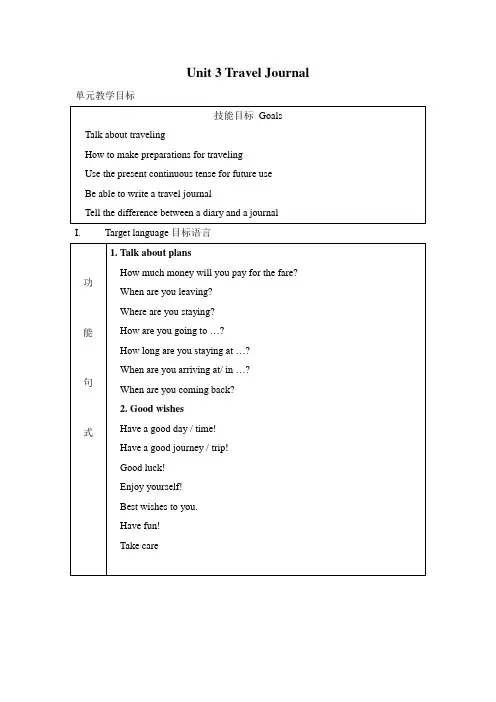
Unit 3 Travel Journal 单元教学目标I.Target language目标语言Ⅲ教材分析与组合1. 教材分析本单元以travel为主题,使学生通过travel了解他们所去国家或地区的风土人情,地理地貌及气候特征。
让学生体会英语作为工具给他们带来的乐趣。
学生可以利用英语扩大自己的视野,获取知识,了解世界。
学生可以通过相互讨论和相互交流以丰富各自的地理知识。
进一步扩大学生的词汇量。
能正确使用现在进行时的形式表达将来的计划和安排。
本单元把Travel Down the Mekong分成六部分,其中三部分作为阅读材料而另三部分作为听力材料。
通过本单元的学习使学生掌握一些重要词汇及词组,并能够写出自己的旅行日志来提高自己的写作水平。
1.1 Warming-up 让学生想象去旅游并选择一个地方为题,讨论所需费用,并决定四种交通方式,使学生了解旅行前的准备及计划。
1.2 Pre-reading 部分的三个问题是通过讨论河流在人民生活中的作用以及看图回答问题,让学生找到湄公河流域的国家,作为阅读的“热身”1.3 Reading 是日志的第一部分,它讲述了王坤和王薇的骑车旅行梦想和计划,描述了他们为这次旅游所做的准备,对旅游路线的选定以及他们通过查阅地图对湄公河情况的了解。
文章用第一人称的方式,通过对王薇做事的方式的介绍,让大家了解了她的性格特点,使人倍感亲切,给人留下深刻的印象。
日志的第二部分放在workbook 中,主要讲述他们在西藏山中度过的一宿,以及旅行中的苦与乐。
1.4 Comprehending第一题是信息题,通过问答使学生进一步理解课文以训练学生获取信息的能力。
第二题是理解题,让学生用自己的话解释课文中的句子。
第三题是推断题,让学生通过主人公的行为来推断他们对旅行的态度。
第四、五题是语言运用题,用以提高学生运用语言的能力。
1.5 Learning about language分两部分,第一部分是旨在通过三个题型的练习使学生掌握目标语言。
Unit3 Travel journal 课件(新人教版必修1)
(3)try to persuade sb.to do sth.= advise sb.to do sth.
尽力劝说某人做某事(但未必劝服)
[教材P18原句]
Two years ago she bought an expensive
mountain bike and then she persuaded me to buy one. 两年前,她买了一辆昂贵的山地车,然后说服我也买了一辆。 ①He's so stubborn that I'm afraid I can't persuade him to change his mind. 他那么固执,我怕我说服不了他改变主意。
4.We can hardly wait to see them! 我们迫不及待地想要见到他们。
解读:can hardly wait to do sth./for sth.= cannot wait to do
sth./for sth. “迫不及待地要做某事;急切地做某事”。
仿写:经过长期的战乱之后,利比亚人民迫不及待地想过
上平静的生活。
The people of Libya _______________ after a long war. 答案:could hardly/couldn't wait to live a peaceful life
1.prefer vt.更喜欢;选择某事物(而不选择其他事物) (1)prefer sth. to sth. prefer doing to doing (2)prefer (sb.) to do sth. 喜欢„„而不喜欢„„ 宁愿„„而不愿„„ 更喜欢(某人)做„„
Ⅲ.经典句型必会 1.Although she didn't know the best way of getting to
人教版高一英语必修一Unit3Traveljournal知识点详解和练习试卷1
Unit 3. Travel journal一、学问讲授1、Which kind of transport do you prefer to use: bus or trainsth. 更喜爱…(sb.) to do sth. 更喜爱〔某人〕做…prefer that 〔should 〕+动词原形… 更喜爱…sth./doing...to sth./doing … 及…相比更喜爱…;宁愿…,不愿…to do...rather than do … 宁可…也不…eg :I would prefer meat to fish.I prefer singing to acting.He prefers to stay at home rather than go shopping.2、Then she persuade me to buy one.(1)、劝服; 劝服;sb 劝服某人persuade sb. (not) to do sth.sb. into / out of doing sth.eg :I persuaded him to do it.=I persuaded him into doing it.〔2〕、使信任,使信服persuade sb of sth 使某人信服某事persuade sb that … 使某人信任…eg :He has persuaded me of its truth.I am persuaded that such is the fact.【留意】假如“劝告〞不服, 不能干脆用persuade, 而应用try to persuade sb to do 或advise sbto do, 或者用persuade 的否认式。
3、After graduating from college, we finally got the chance to take a bike trip.、Although she didn’t know the best way of getting get to places, she insisted that she organize the trip properly.(1)、although, though 引导让步状语从句不能再和but, and, however 连用, 但可以和副词yet, still 连用。
人教版高中英语必修一 Unit 3 Travel Journal reading 课件(共36张PPT)
3. ___B____ planned the schedule for the trip.
A. Wang Kun
B. Wang Wei
C. Dao Wei
D. Yu Hang
Who will join in the trip?
Wang Kun
}
Wang Wei
Dao Wei
{ cousins
Yu Hang
Para 3
1. When you travel along the Mekong River
maybe you can not see ___D______.
A. waterfalls
B. hills and valleys
C. plains where rice grows D. desert
Para 1:
1. Wang Kun and Wang Wei’s dream was to______.
A. travel around China
B. travel around Yunnan Province
C. take a great motorcycle trip
D. take a great bike trip
ቤተ መጻሕፍቲ ባይዱ
2. The source of the Mekong is in __D_____
and it enters the________. A. Yunnan Province; South China Sea B. Guizhou Province; East China Sea C. Hunan Province; East China Sea D. Qinghai Province; South China Sea
高中英语人教版必修1《Unit 3 Travel journal》课件
①While traveling in a foreign country, there is a chance that you might get into trouble. So②it is advised to get in touch with your country's consulate4. In order to do this without any problems, it is good to carry a list showing the addresses and telephone numbers of the consular offices in the country you plan to visit.
人教版 高中数学
Unit 3 Travel journal
• Valuable Advice for Traveling Abroad
• Traveling isn't just about buying a ticket or taking your bags with you. Without proper plans and safety measures1, a trip that seems wellplanned at the beginning can turn into a nightmare2.
能成为噩梦。
人教版 高中数学பைடு நூலகம்
THANKS
• Notes:
• 1.measure /'meʒə(r)/n.方法;措施 • 2.nightmare /'naItmeə(r)/n.噩梦 • 3.background /'bækgraʊnd/n.背景 • 4.consulate /'kɒnsjələt/n.领事馆