
七年级下英语1-3单元知识点大归纳
2013人教版七年级下册英语各单元知识点大归纳Unit 1 Can you play the guitar◆短语归纳1. play chess 下国际象棋2. play the guitar 弹吉他3. speak English 说英语4. English club 英语俱乐部5. talk to 跟…说6. play the violin 拉小提琴7. play the piano 弹钢琴8. play the drums 敲鼓9. make friends 结交朋友 10. do kung fu 练 (中国) 功夫 11. tell stories 讲故事 12. play games 做游戏 13. on the weekend/on weekends 在周末 ◆用法集萃◆典句必背1. Can you draw Yes, I can. / No, I can’t.2. What club do you want to join I want to join the chess club.3. You can join the English club.4. Sounds good./That sounds good.5. I can speak English and I can also play soccer.6. Please call Mrs. Miller at 555-3721. ◆话题写作 Dear Sir,I want to join your organization (组织) to help kids with sports, music and English. My name is Mike. I am 15 years old. I’m a student in No. 1 Middle school. I can play the guitar well. I can sing many songs. I can swim and speak English well, too. I think I can be good with the kids. I also do well in telling stories.I hope to get your letter soon.Yours, MikeUnit 2 What time do you go to school◆短语归纳1. what time 几点2. go to school 去上学3. get up 起床4. take a shower 洗淋浴5. brush teeth 刷牙6. get to 到达7. do homework 做家庭作业8. go to work 去上班9. go home 回家 10. eat breakfast 吃早饭 11. get dressed 穿上衣服 12. get home 到家13. either…or… 要么…要么… 14. go to bed 上床睡觉 15. in the morning/ afternoon/ evening 在上午/下午/晚上 16. take a walk 散步 17. lots of=a lot of 许多,大量 18. radio station 广播电台19. at night 在晚上 20. be late for=arrive late for 迟到 ◆用法集萃◆典句必背1. What time do you usually get up I usually get up at six thirty.2. That’s a funny time for breakfast.3. When do students usually eat dinner They usually eat dinner at a quarter to seven in the evening.4. In the evening, I either watch TV or play computer games.5. At twelve, she eats lots of fruit and vegetables for lunch..6. She knows it’s not good for her, but it tas tes good.7. Here are your clothes. ◆话题写作主题:谈论日常作息习惯My School DayI am a student. I usually get up at seven, and I eat breakfast at seven thirty. Then I go to school at eight. School starts at eight thirty. I eat lunch at twelve. I go home at 17:00. I often eat dinner at 19:00 and then play the piano. I do my homework at 20:00. At 22:00, I go to bed.Unit 3 How do you get to school◆短语归纳1. get to school 到达学校2. take the subway 乘地铁3. ride a bike 骑自行车4. how far 多远5. from home to school 从家到学校6. every day 每天7. take the bus 乘公共汽车8. by bike 骑自行车9. bus stop 公共汽车站10. think of 认为 11. between … and … 在…和…之间 12. one 11-year-old boy 一个11岁的男孩 13. play with … 和…玩 14. come true 实现 15. have to 不得不 ◆用法集萃 ◆典句必背1. How do you get to school I ride my bike.2. How far is it from your home to school3. How long does it take you to get to school4. For many students, it is easy to get to school.5. There is a very big river between their school and the village.1. play +棋类/球类 下……棋,打……球2. play the +西洋乐器 弹/拉……乐器3. be good at doing sth.= do well in doing sth. 擅长做某事4. be good with sb. 和某人相处地好5. need sb. to do sth. 需要某人做某事6. can + 动词原形 能/会做某事7. a little + 不可数名词 一点儿……8. join the …club 加入…俱乐部9. like to do sth. =love to do sth. 喜欢/喜爱做某事1. take… to …= go to … by… 乘…去…2. How do / does (sb )get to … …是怎样到…的3. How far is it from … to … 从…到…有多远4. It takes sb. some time to do sth. 做某事花费某人多长时间。
5. How long does it take to do sth. …花费多长时间6. It is + adj. + to do sth. 做某事是….7. Thanks for + n. / Ving 感谢你(做)某事。
1. at + 具体时间点 在几点(几分)2. eat breakfast/ lunch/dinner 吃早饭/午饭/晚饭3. thirty\half past +基数词 ……点半4. fifteen\a quarter to +基数词 差一刻到……点5. take a/an +名词 从事……活动6. from …to … 从……到……7. need to do sth 需要做某事◆话题写作主题:上学的交通方式写作思路:开篇点题:点出自己的出行方式;具体内容:自己选择这种交通方式的原因;结束语: 表明自己的观点。
The Best Way for Me to Go to SchoolDifferent students go to school in different ways in our school, but I like to go to school on foot.First, I live near the school, so my home is not far from my school. And it takes me a few minutes to get there. Second, there is a crossing on my way to school, and sometimes the traffic is very busy. I think it is safer to go to school on foot. Third, I think walking is good for my healt h. It’s a kind of sport and it makes me study better.So in my opinion, the best way to go to school is on foot. What about you自我检测:Unit 1 Can you play the guitar1弹钢琴2下象棋3拉小提琴4加入音乐俱乐部5敲鼓6说英语7游泳俱乐部8运动俱乐部9擅长讲故事10喜欢画画11讲故事俱乐部12学校演出13和某人谈话(2种)14表演功夫15向某人展示什么_________=__________ 16忙于做某事17在周末_________=_______ 18空闲________=___________ 19.与某人相处友好…20擅长。
(2种)21在体育方面提供帮助22说英语的学生23在敬老院。
24在六月25在六月一日的上午26教某人做某事27、want 3种用法28、对什么什么有好处29帮助某人做某事(3种)30让我们现在参加吧!31跟人们一起做游戏_______________________ people32在音乐室______________ 33.学生运动中心________________Unit 1 句子:1.你会拉小提琴吗不会,但是我会下棋。
牛津译林版初中英语七年级下册重要内容总结

牛津译林版初中英语七年级下册重要内容
总结
本文档总结了牛津译林版初中英语七年级下册的重要内容。
以
下是各个单元的主要内容:
Unit 1: Classroom language
- 介绍了一些教室用语,如问候、请教、赞扬等。
Unit 2: School life
- 着重介绍了各科目的研究内容,如数学、科学、历史等。
Unit 3: My weekends
- 描述了学生们的周末活动,如打篮球、唱歌、看电视等。
Unit 4: Food and drinks
- 教授了一些食物和饮料的词汇,如苹果、面包、茶、咖啡等。
Unit 5: At the snack bar
- 研究了在小吃店点餐的常用句型,如“What would you like?”、“Here you are.”等。
Unit 6: Festivals and celebrations
- 介绍了一些重要的节日和庆祝活动,如春节、圣诞节、生日等。
Unit 7: Hobbies
- 研究了各种爱好和运动,如阅读、游泳、踢足球等。
Unit 8: At the zoo
- 通过描述动物的外貌和生活性,使学生了解不同的动物种类。
Unit 9: My body and health
- 关注了身体部位和健康问题,如头、肚子、感冒、发烧等。
Unit 10: My family
- 描述了家庭成员的关系和工作,如爸爸、妈妈、姐姐、弟弟等。
这些是牛津译林版初中英语七年级下册的重要内容总结。
希望能对您有所帮助!。
人教新目标七年级下册1-3单元词组总结背诵(可打印)
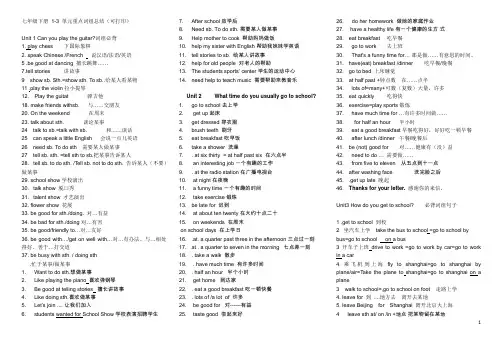
七年级下册1-3 单元重点词组总结(可打印)Unit 1 Can you play the guitar?词组必背1. play chess 下国际象棋2. speak Chinese /French 说汉语/法语/英语5 .be good at dancing 擅长跳舞……7.tell stories 讲故事9 show sb. Sth.=show sth. To sb..给某人看某物11 .play the violin拉小提琴12. Play the guitat 弹吉他18. make friends withsb. 与……交朋友20. On the weekend 在周末23. talk about sth. 谈论某事24 talk to sb.=talk with sb. 和.......谈话25 can speak a little English 会说一点儿英语26 need sb. To do sth 需要某人做某事27 tell sb. sth. =tell sth to sb.把某事告诉某人28. tell sb. to do sth. /Tell sb. not to do sth. 告诉某人(不要)做某事29. school show学校演出30. talk show 脱口秀31. talent show 才艺演出32. flower show 花展33. be good for sth./doing. 对…有益34. be bad for sth./doing对…有害35. be good/friendly to…对…友好36. be good with…/get on well with…对…有办法、与…相处得好、善于…打交道37. be busy with sth. / doing sth.忙于某事/做某事1. Want to do sth.想做某事2. Like playing the piano 喜欢弹钢琴3. Be good at telling stories 擅长讲故事4. Like doing sth.喜欢做某事5. Let’s join .... 让我们加入6. students wanted for School Show学校表演招聘学生7. After school放学后8. Need sb. To do sth. 需要某人做某事9. Help mother to cook 帮助妈妈做饭10. help my sister with English 帮助我妹妹学英语11. tell stories to sb. 给某人讲故事12. help for old people 对老人的帮助13. The students sports’ center学生的运动中心14. need help to teach music 需要帮助来教音乐Unit 2 What time do you usually go to school?1. go to school 去上学2. get up 起床3. get dressed 穿衣服4. brush teeth 刷牙5. eat breakfast 吃早饭6. take a shower 洗澡7. . at six thirty = at half past six 在六点半8. an interesting job 一个有趣的工作9. . at the radio station 在广播电视台10. at night 在夜晚11. a funny time 一个有趣的时间12. take exercise 锻炼13. be late for 迟到14. at about ten twenty 在大约十点二十15. on weekends 在周末on school days 在上学日16. .at. a quarter past three in the afternoon 三点过一刻17. at . a quarter to seven in the morning 七点差一刻18. . take a walk 散步19. . have much time 有许多时间20. . half an hour 半个小时21. get home 到达家22. . eat a good breakfast 吃一顿快餐23. . lots of /a lot of 许多24. be good for 对------有益25. taste good 尝起来好26. do her homework 做她的家庭作业27. have a healthy life 有一个健康的生方式28. eat breakfast 吃早餐29. go to work 去上班30. That's a funny time for…那是做……有意思的时间。
英语七下笔记1至12单元

英语七下笔记1至12单元以下是英语七下1至12单元的笔记,供您参考:Unit 1:- 学习一般现在时态,描述日常习惯和喜好。
- 掌握动词be的用法,以及人称代词的主格和宾格形式。
- 学习形容词和副词的比较级和最高级形式。
Unit 2:- 学习一般过去时态,描述过去发生的事情。
- 掌握动词的过去式形式,以及过去进行时的用法。
- 学习表示时间和地点的介词和副词。
Unit 3:- 学习一般将来时态,描述未来计划和预测。
- 掌握动词的将来式形式,以及将来进行时和将来完成时的用法。
- 学习表示意愿、可能性和必要性的情态动词。
Unit 4:- 学习现在进行时态,描述正在发生的事情。
- 掌握动词的现在分词形式,以及现在进行时的用法。
- 学习表示情感和感觉的动词和形容词。
Unit 5:- 学习一般现在时态的被动语态,描述被动情况。
- 掌握动词的被动语态形式,以及by引导的方式状语从句。
- 学习表示位置和方向的介词和副词。
Unit 6:- 学习形容词和副词的用法,描述事物的性质和程度。
- 掌握形容词和副词的位置和顺序,以及比较级和最高级的用法。
- 学习表示比较关系的连词和介词。
Unit 7:- 学习代词的用法,代替名词或名词短语。
- 掌握人称代词、物主代词、反身代词和不定代词的形式和用法。
- 学习表示目的、原因、条件和结果的连词和介词。
Unit 8:- 学习定冠词和不定冠词的用法,修饰名词。
- 掌握定冠词the、不定冠词a/an的形式和用法,以及冠词的省略情况。
- 学习表示数量、种类和单位的介词和副词。
七年级下册英语1到3单元知识归纳

七年级下册英语1到3单元知识归纳Unit 1: My Day。
In this unit, we learned how to talk about daily routines and activities. We learned how to use simple present tense to describe what we do every day. For example, "I get up at 7 o'clock in the morning." We also learned how to ask and answer questions about daily routines using the question words "what", "when", and "where". It's important to remember to use the correct word order when forming questions and answers.Unit 2: My School。
In Unit 2, we talked about school subjects, classrooms, and school activities. We learned how to talk about our favorite subjects and teachers. We also learned how to describe our school facilities and the things we do at school. For example, "I have English class on Monday and Wednesday." We practiced using prepositions of place to talk about where things are located in the school, such as "the library is next to the cafeteria".Unit 3: My Family。
人教版英语七年级下册Unit 1-3中考总复习 知识点总结+首字母练习+语法填空

七年级下册1-3单元考点 1. afraid教材例句:But he is not afraid because he loves school. (Unit 3 P17)be afraid of sth./doing sth.害怕某事/做某事be afraid to do sth.因害怕而不敢做某事考点2. Stop教材例句:I usually leave my home at 8:00 and walk to the bus stop. (Unit 3 P18) 名词:车站bus stop动词:「stop doing sth.停止做某事stop to do sth.停下来去做某事-stop... from doing sth阻止某人做某事考点 3. Be good at, be good for, be good to.与be good with教材例句:You are very good at telling stories. (Unit 2 P2)「be good at doing sth. = do well in (doing) sth.擅长做某事be good for 对...有好处be bad for...对...有坏处be good to = be kind to=be friendly to 对…友好be good with= get along /on well with 善于应付… 考点3.四个“说”-教材例句:You are very good at telling at stories. (Unit 1 P2) 寸ell sb. about sth. = tell sth. to sb.告诉某人某事speak+语言speak English talk to/with sb.say + 说话的内容say thanks to sb.^tell-told-toldspeak-spoke-spoketalk-talked-talked-say-said-said双基练习:首字母填空John thinks playing chess can train his mind and help him think more clearly in some way, so he will join a chess c .1.We were divided into five g to discuss that difficult question in the math class today.2.You can't make your d come true in one day, because it requiresefforts.3.In many countries around the world, street food is popular with not only local people but a outsiders.4.In the evening, I e watch cartoons or play computer games.5.My father used to go to work b bus, but now he rode a bike instead in order to keep fit.6.When you feel stressed, you can watch some h programsto relax yourself.7.Mary, together with her parents, I near the sea.8.The two words sound similar, but I still find some differences b them.9.You can choose to finish your homework at school, o you can do it at home.巩固提高:语法填空How can you team up with some strangers to complete tasks in a short time? Thafs a question Judy had never thought about before,1. after this five-day summer camp, she thinks she has found the answer to it.This past summer, Judy took part in the SSP Mars, Mission Workshop with 30 students who came 2. different schools across Shanghai. They were divided into different 3.(group) and given the task of designing a plan for traveling to Mars. There were a few problems. The first one was how to 4.(quick)getalongwithothers.Everyone introduced 5. (they) at first. It was helpful to know each other. They worked as a team, which helped them work much better. Next, they had to learn to make compromises (妥协、). “We have a lot of discussions every day. Sometimes we 6.(agree) with what others say. We would then reconsider all the ideas and choose 7. right one." Judy said.On the last day, they needed to complete a team report. After 8. (work) with each other for five days, they solved all the problems easily.“It 9. (be)a wonderful experience to work together towards a common goal/ She said. Judy is now looking forward to the nextchance 10. (join)a summer camp.。
初一下册英语各单元知识点
初一下册英语各单元知识点初一下册英语共有10个单元,分别是:
Unit 1: Greetings and Introductions
- 问候语和自我介绍的用法
- 姓名、年龄、国籍等基本信息的表达
Unit 2: Classroom Language
- 教室用语的应用,如请假、提问等
- 数字、颜色、家具等基本词汇
Unit 3: My School Life
- 关于校园生活的词汇和句型,如上课、放学等- 学科相关的词汇,如数学、英语等
Unit 4: My Family
- 家庭成员的称呼和描述
- 家庭成员关系的表达,如父母、兄弟姐妹等
Unit 5: My Daily Routine
- 日常活动的词汇和句型,如起床、洗脸等
- 时间词汇和介词的使用,如早上、在家等
Unit 6: My Hobbies
- 介绍自己的爱好和兴趣
- 常见的活动和运动词汇
Unit 7: Festivals and Holidays
- 介绍常见的节日和假期
- 相关的庆祝活动和特色食物等
Unit 8: My City
- 城市相关的地理和建筑物词汇- 指示方向和交通方式的表达
Unit 9: At the Restaurant
- 在餐厅用餐的基本用语和礼仪- 常见的食物和饮料词汇
Unit 10: Shopping
- 购物场景下的问询和购买方式- 常见商品和货币的表达。
初一英语1-3单元知识点
初一英语1-3单元知识点一、Unit 1 My name's Gina.1. 重点单词- name:名字,例如:My name is Tom.(我的名字是汤姆。
)- nice:令人愉快的;宜人的,如:Nice to meet you.(很高兴见到你。
) - to:常用于动词原形前,表示目的或意图,像:Nice to meet you.中的to。
- meet:遇见;相逢,例如:I meet my friend at the school gate.(我在学校门口遇见我的朋友。
)- too:也;又;太,如:I'm fine, too.(我也很好。
);The box is too heavy.(这个盒子太重了。
)- your:你的;你们的,例如:What's your name?(你的名字是什么?) - his:他的,如:His name is Jack.(他的名字是杰克。
)- her:她的,例如:This is her book.(这是她的书。
)2. 重点句型- What's your name? 你叫什么名字?- 回答:My name's...或者I'm...,例如:What's your name? My name's Gina.(你叫什么名字?我的名字是吉娜。
)- Nice to meet you. 很高兴见到你。
- 回答:Nice to meet you, too.(也很高兴见到你。
)- Are you...? 你是……吗?- 回答:Yes, I am. / No, I'm not.例如:Are you Tom? Yes, I am.(你是汤姆吗?是的,我是。
)3. 语法点- 形容词性物主代词:your(你的/你们的)、his(他的)、her(她的)。
形容词性物主代词后面要接名词,用来表示所属关系,如:your book(你的书),his pen(他的钢笔),her bag(她的包)。
人教版英语七年级下册 Unit 1 ---unit3重难点 归纳
Unit 1 Can you play the guitar◆短语归纳1. play chess 下国际象棋2. play football 踢足球3. play the guitar 弹吉他4. play the violin 拉小提琴5. call sb. at给某人打电话6. want to do 想要做某事7. make friends with sb 和某人结交朋友8. play games 做游戏9 d o kung fu 练(中国) 功夫10 tell stories 讲故事11. on the weekend/on weekends 在周末12. speak English/Chinese 说英语/汉语13. English club 英语俱乐部14. talk to 跟…说15.talk with sb 和..谈话◆用法集萃1.1)play +棋类/球类下……棋,打……球(不加任何冠词)2)play the +西洋乐器弹/拉……乐器(加定冠词the)3)Play 后面跟玩具或者其他名词市,一般加介词with 例如:Dolphins can play with a ball. 海豚会玩球。
Play with sb. 和某人玩2. be good at doing sth.= do well in doing sth. 擅长做某事3. be good with sb=get on well with sb . 和某人相处地好4. need sb. to do sth. 需要某人做某事5. can + 动词原形能/会做某事6. a little + 不可数名词一点儿……7. join the …club 加入…俱乐部8. like to do sth. =love to do sth. 喜欢/喜爱做某事like doing sth= love doing sth9. What about sth/doing sth 做某事怎么样例如:What about having a rest?10.Let’s do sth 让我们做某事(let 后出现的动词用动词原形)例如:Let’s go swimming.◆重难点注释一.Can 的用法1. 表示能力She can sing that song in English. 她能用英文唱那首歌。
七年级下册英语单元知识点总结道客
七年级下册英语单元知识点总结道客道客七年级下册英语单元知识点总结七年级下册英语单元知识点总结英语学习是我们初中学习的重要一环,对于初中七年级下册英语单元知识点的掌握,不仅能够帮助我们更好地理解课文,还能够提高我们的英语语言能力。
下面是对七年级下册英语单元知识点的总结,希望对同学们的学习有所帮助。
Unit 1: Greetings and Introductions这个单元主要是学习问候和介绍的表达方式。
学习如何问候他人,如何介绍自己和他人的基本信息。
同时,还学习了一些关于国家和国籍的词汇。
Unit 2: School Life这个单元主要是学习关于学校生活的表达方式。
学习如何表达自己的课程安排,学习如何询问他人的学习情况。
同时,还学习了一些学校设施和学习用品的词汇。
Unit 3: Hobbies这个单元主要是学习关于爱好的表达方式。
学习如何表达自己的爱好,学习如何询问他人的爱好。
同时,还学习了一些关于运动、音乐和艺术的词汇。
Unit 4: Family and Friends这个单元主要是学习关于家庭和朋友的表达方式。
学习如何介绍自己的家庭和朋友,学习如何询问他人的家庭和朋友。
同时,还学习了一些家庭成员和人际关系的词汇。
Unit 5: Food and Drinks这个单元主要是学习关于食物和饮料的表达方式。
学习如何点餐和询问他人的饮食习惯。
同时,还学习了一些关于食物和饮料的词汇。
Unit 6: Health and Body这个单元主要是学习关于健康和身体的表达方式。
学习如何描述自己和他人的健康状况,学习如何询问他人的健康状况。
同时,还学习了一些关于身体部位和常见疾病的词汇。
Unit 7: Clothes and Weather这个单元主要是学习关于服装和天气的表达方式。
学习如何描述自己和他人的服装,学习如何询问他人的服装和天气情况。
同时,还学习了一些关于服装和天气的词汇。
Unit 8: Shopping这个单元主要是学习关于购物的表达方式。
初一英语各单元知识点总结
初一英语各单元知识点总结摘要:1.初一英语各单元知识点概述2.各单元重点语法知识点梳理3.各单元词汇及短语总结4.初一年级英语听力、阅读、写作技巧点拨5.学习策略与建议正文:初一英语各单元知识点总结一、初一英语各单元概述初一英语教材涵盖了各个生活场景,从自我介绍、学校生活到家庭、朋友、购物等,让学生在轻松愉快的氛围中学习英语。
各单元主题紧密围绕初一年级学生的实际需求和兴趣,激发学生学习兴趣。
二、各单元重点语法知识点梳理1.第一单元:一般现在时、一般疑问句及回答、家庭成员词汇。
2.第二单元:一般过去时、一般疑问句及回答、学校设施词汇。
3.第三单元:一般将来时、一般疑问句及回答、计划安排词汇。
4.第四单元:现在进行时、现在进行时疑问句及回答、日常活动词汇。
5.第五单元:现在完成时、现在完成时疑问句及回答、家庭故事词汇。
6.第六单元:过去进行时、过去进行时疑问句及回答、购物经验词汇。
7.第七单元:过去完成时、过去完成时疑问句及回答、旅游经历词汇。
8.第八单元:将来进行时、将来进行时疑问句及回答、梦想与理想词汇。
三、各单元词汇及短语总结1.第一单元:hello、hi、nice to meet you、family、mother、father、brother、sister、friend等。
2.第二单元:classroom、library、playground、teacher、student、schoolbag、pencil等。
3.第三单元:tomorrow、weekend、plan、activity、go swimming、go hiking等。
4.第四单元:now、breakfast、lunch、dinner、hobbies、sports等。
5.第五单元:yesterday、last week、last year、never、already、so far 等。
6.第六单元:shopping、store、market、price、bargaining、try on 等。