
新概念英语第一册65-66课笔记1
考试(听写单词):1) 鼓drum [drʌm]2) 吉他guitar [gi'tɑ:]3) 手风琴accordion [ə'kɔ:diən]4) 电子琴e lectronic organ [ilek'trɔnik 'ɔ:gən]5) 小号trumpet ['trʌmpit]6) 长笛flute[flu:t]7)羽毛球badminton['bædmintən]8) 冰球ice hockey [ais 'hɔki]9)高尔夫球golf [gɔlf]10)棒球baseball['beis,bɔ:l]11)网球tennis ['tenis]12)排球volleyball['vɔli,bɔ:l]13) 吵闹的noisy ['nɔizi]14) 图书馆library ['laibrəri]15) 倚、靠lean [li:n]16) stomachache ['stʌməkeik] 胃痛;腹痛17) remember [ri'membə] 记住;牢记18) Europe ['juərəp] 欧洲19) medicine['medisin] 药;药品20) conversation [,kɔnvə'seiʃən]谈话;会话Nobody likes taking medicine.London is in Europe. China is in Asia.课文:Lesson 64Don’t … ! 不要干什么You mustn’t … ! 不许干什么You mustn’t play computer games.你不许玩电脑游戏。
You mustn’t the computer game.你不许玩电脑游戏。
(特指你我都知道的那个。
)You mustn’t come home late.你不许回家晚。
You mustn’t go to bed late.你不许上床晚。
You mustn’t talk in class. 你们不许上课谈话。
Peter mustn’t talk in class. Peter不许上课谈话。
Peter mustn’t play ice hockey.Peter不许玩冰球。
Helen mustn’t play the electronic organ.Helen mustn’t go to Beijing in the plane.Helen不许坐飞机去北京。
Helen mustn’t go to Beijing by airplane.Helen不许坐飞机去北京。
Helen mustn’t knock at the door.We mustn’t talk in the library.我们不许在图书馆谈话。
(一般用这种表达方式。
)We mustn’t speak in the library我们不许在图书馆讲话。
You mustn’t drive/drive a car.She mustn’t dance. [dɑ:ns] 她不许跳舞。
You mustn’t talk with her.你不许和她交谈。
You mustn’t talk about my family with him.Peter mustn’t lean out of the window.Peter不许把身体探出窗外。
Peter mustn’t play with matches. Peter不许玩火柴。
match [mætʃ] n. 1)火柴2)比赛football match 足球赛baseball match 棒球赛I like watching a volleyball match.我喜欢看排球赛。
I like watching volleyball matches.我喜欢看排球赛。
(泛指)this volleyball match 这场比赛(特指)the volleyball match 这场比赛Don’t ta ke any aspirins. 不要吃(任何)阿斯匹林。
Don’t take this medicine.不要吃这药。
Don’t call the doctor.不要叫医生。
Don’t play with matches.不要玩火柴。
Don’t talk in the library.不要在图书馆交谈。
Don’t make a noise.不要制造噪声。
Don’t drive so quickly!不要开车快。
Don’t out of the window!不要身体探出窗外。
Don’t break that vase!不要打碎那个花瓶。
I can get up for two hours each day.每一天我可以起床两小时。
Jimmy can get up for two hours each day.I listen to the stereo.Jimmy listens to the stereo.I don’t feel well now.Jimmy doesn’t feel well now.I don’t get up at five o’clock every day.Jimmy doesn’t get up at five o’clock every day.I don’t go to school on foot.Jimmy doesn’t go to school on foot.I mustn’t watch TV(television). ['teli,viʒən] Jimmy mustn’t watch TV.Are you feeling better now.现在你感觉好多了吗?Yes,I am. 是的。
He is sleeping. 他正在睡觉。
Now he is better.现在他感觉好多了。
I mustn’t feel sleepy in class.我上课不许感觉困。
Jimmy mustn’t feel sleepy in class.I often play ice hockey at school.Jimmy often plays ice hockey at school.I often play the electronic organ after class. Jimmy often plays the electronic organ after class. I often play table tennis with Peter.Jimmy often plays table tennis with Peter.I often play the flute.Jimmy often plays the flute.I often play golf with Viky.Jimmy often plays golf with Viky.I often talk with Viky about my school.Jimmy often talks with Viky about my school.I often do my homework in my study(书房) in the evening.晚上我经常在书房写作业。
Jimmy often does his homework in his study in the evening. Jimmy晚上经常在书房写作业。
study English = learn English 学英语study 1)学习2)书房区别:study + 名词学习什么learn + 名词learn + to do 学做什么反身代词:myself [mai'self] 我自己 ourselves [,auə'selvz] yourself yourselveshimself themselvesherself oneself 自己本身itselfI wash clothes myself. 我自己洗衣服。
I often wash clothes myself.Peter often washes clothes himself.Peter often washes his clothes himself.I always go to school myself.Helen always goes to school herself.by oneself 独自一人She goes to school by herself every day.他每天独自一人去上学。
for oneself 为某人自己We made a bookcase for ourselves.我们为自己做了一个书架。
They cook a meal for themselves.他们为他们自己做了一顿饭。
enjoy [in'dʒɔi] v. 欣赏;享受;喜爱1)enjoy oneself = have a good time 玩得开心Peter often enjoys himself. Peter 经常玩得开心。
Amy has a good time. Amy玩得开心。
Amy enjoys herself. Amy玩得开心。
They enjoy themselves. 他们玩得开心。
Are you enjoying yourselves ? 你们玩得高兴吗? Do you often enjoy yourselves? 你们经常玩得开心吗?You must enjoy yourselves. 你们必须玩得开心。
2)enjoy doing sth 喜欢做某事I enjoy reading 我喜欢读书。
I enjoy eating. 我喜欢吃。
speaking.swimming.playing in the playground.playing table tennis.drawing.running.playing computer games.watching TV.studying.writing.drinking.talking with my friends.like doing 喜欢做某事enjoy doing 做某事时,能够享受到乐趣enjoy (my) life 享受生活You must enjoy my life.3)enjoy +名词享受…enjoy English 喜欢英语enjoy this book. 喜欢这本书enjoy free time. 享受空闲(休息)的时间。
新概念课堂笔记 第一册 Lesson 65-66
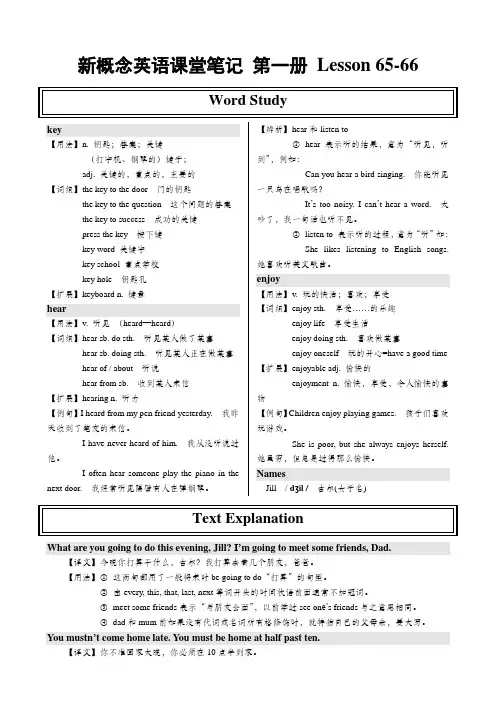
新概念英语课堂笔记第一册Lesson 65-66key【用法】n. 钥匙;答案;关键(打字机、钢琴的)键子;adj. 关键的,重点的,主要的【词组】the key to the door 门的钥匙the key to the question 这个问题的答案the key to success 成功的关键press the key 按下键key word 关键字key school 重点学校key hole 钥匙孔【扩展】keyboard n. 键盘hear【用法】v. 听见(heard—heard)【词组】hear sb. do sth. 听见某人做了某事hear sb. doing sth. 听见某人正在做某事hear of / about 听说hear from sb. 收到某人来信【扩展】hearing n. 听力【例句】I heard from my pen friend yesterday. 我昨天收到了笔友的来信。
I have never heard of him. 我从没听说过他。
I often hear someone play the piano in the next door. 我经常听见隔壁有人在弹钢琴。
【辨析】hear和listen to○1hear表示听的结果,意为“听见,听到”,例如:Can you hear a bird singing. 你能听见一只鸟在唱歌吗?It’s too noisy. I can’t hear a word. 太吵了,我一句话也听不见。
○2listen to 表示听的过程,意为“听”如:She likes listening to English songs. 她喜欢听英文歌曲。
enjoy【用法】v. 玩的快活;喜欢;享受【词组】enjoy sth. 享受……的乐趣enjoy life 享受生活enjoy doing sth. 喜欢做某事enjoy oneself 玩的开心=have a good time 【扩展】enjoyable adj. 愉快的enjoyment n. 愉快,享受,令人愉快的事物【例句】Children enjoy playing games. 孩子们喜欢玩游戏。
新概念一 最新lesson 65-66
revision
better certainly get up yet rich food remain
['betə] ['sɜːtənli] [get ʌp] [jet] [rɪtʃ] [fu:d] [rɪ'meɪn]
第一人称 第二人称
第三人称
单数
myself yourself
himself herself itself
复数 ourselves yourselves themselves
反身代词
• 当宾语和主语是同一个人时,一般需要用反身代词 • 反身代词有:myself,herself,himself,ourselves,
2. 顺时表达
3:10 three ten 4:16 four sixteen
逆时表达
3.一刻钟/半点
5:15 6:30
a quarter past five
half past six
4.半小时之内用past
7:10 ten past seven 8:16 sixteen past eight
yourselves,themselves
e.g. The old lady is talking to herself.
• I— • you— • it-• she— • he— • we— • they--
myself yourself itself herself himself ourselves themselves
I __c_a_n_t_y_p_e__this letter. I _m__u_s_t_s_t_a_y_at home. She ___c_a_n_’_t _g_o___to school yet. We __m__u_s_t_n_’t__p_la_y__with matches. _C__a_n__ you _s_i_n_g__ a song? __M__u_st_ he __c_o_m_e_ home early?
新概念英语第一册lesson65-66
to the front door please? FATHER: No, you can't. MOTHER: Jill's eighteen years old, Tom.
hear sb to do sth. 听见某人 做某事,表示听见的是某人
经常做的事 hear from 收到某人的来信
英语表示时间(一)
1. 表示几点钟用基数词加可以省略的o’clock 5:00 读作 five o’clock 或 five
2. < 30分钟,表示几点过几分,在分钟后加past, 再加小时
hear v. 听见
• Do you hear?
• hear sb doing sth. • 听见某人正在做某事; • hear sb to do sth. • 听见某人 做某事,表示听见的是某人
经常做的事 • hear from 收到某人的来信 • hear of(about) 听说
listen to 听(动作) hear听(结果) I listen to the teacher carefully in class, But I can’t hear anything.
key [ki:]n.钥匙
• n. 答案;键; • adj. 关键的 • the key to sth. 某事的答案 • the keys of a piano 钢琴的键
The key to the problem The keys of a piano key words Can I have the key to the front door? 我能有前门的钥匙吗?
新概念英语第一册Lesson65~70课后答案
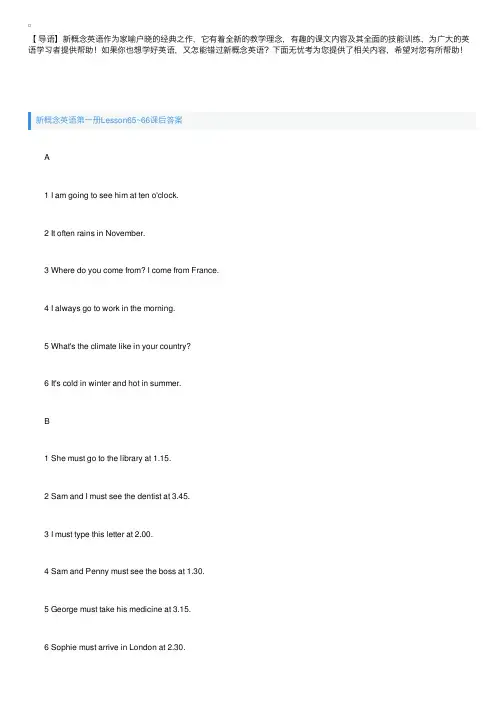
【导语】新概念英语作为家喻户晓的经典之作,它有着全新的教学理念,有趣的课⽂内容及其全⾯的技能训练,为⼴⼤的英语学习者提供帮助!如果你也想学好英语,⼜怎能错过新概念英语?下⾯⽆忧考为您提供了相关内容,希望对您有所帮助!新概念英语第⼀册Lesson65~66课后答案 A 1 I am going to see him at ten o'clock. 2 It often rains in November. 3 Where do you come from? I come from France. 4 I always go to work in the morning. 5 What's the climate like in your country? 6 It's cold in winter and hot in summer. B 1 She must go to the library at 1.15. 2 Sam and I must see the dentist at 3.45. 3 I must type this letter at 2.00. 4 Sam and Penny must see the boss at 1.30. 5 George must take his medicine at 3.15. 6 Sophie must arrive in London at 2.30. 7 You must catch the bus at 3.30. 8 I must arrive there at 3.00. 9 They must come home at 2.15. 10 I must meet Sam at 1.45. 11 He must telephone me at 2.45.新概念英语第⼀册Lesson67~68课后答案 A 1 I was at church on Sunday. 2 I was at the office on Monday. 3 My son was at school on Tuesday.4 My wife was at the butcher's on Wednesday.5 She was at the grocer's on Thursday. 6 My daughter was in the country on Friday. 7 I was at home on Saturday. B 1 When was Tom at the hairdresser's? He was at the hairdresser's on Thursday. 2 When was Mrs. Jones at the butcher's? She was at the butcher's on Wednesday. 3 When was he at home? He was at home on Sunday. 4 When was Penny at the baker's? She was at the baker's on Friday. 5 When was Mrs. Williams at the grocer's? She was at the grocer's on Monday. 6 When was Nicola at the office? She was at the office on Tuesday.新概念英语第⼀册Lesson69~70课后答案 A 1 We were at the stationer's on Monday. 2 We were there at four o'clock. 3 They were in Australia in September. 4 They were there in spring. 5 On November 25th, they were in Canada. 6 They were there in 1990. B 1 Where were you and Susan on March 23rd? We were at the office on March 23rd. 2 Where were Sam and Penny in 1986? They were in India in 1986. 3 Where were you and Penny on Saturday? We were at the baker's on Saturday. 4 Where were Sam and Penny in 1993? They were in Canada in 1993. 5 Where were you and Penny in August? We were in Austria in August. 6 Where were Sam and Penny on May 25th? They were at home on May 25th. 7 Where were you and Penny in December? We were in Finland in December. 8 Where were you and Sam on February 22nd? We were at school on February 22nd.。
新概念英语第一册 Lesson65-66(带答案)(共28张PPT)
» 介词in的使用:
年:____in_2_0_1_5_______ 在2015年 月:____in__M_a_y______ 在五月
季节:__i_n_S_p_r_in_g_____ 在春天
上午/下午/晚上: _in__th_e__m_o_rn_i_n_g/_a_f_t_er_n_o_o_n_/e_v_e_n_in_g__
他 相 关 指 标 也实现 了益增 则增,益 降则降 的效果 ,都优 于去年 水平。 二 、 招 商 引 资与项 目建设
由 于 我 们 过 去过高 地估计 了自己 的实力 ,在招商 引资方
(2) key n. 钥匙,答案 e.g. 表示_钥__匙__:Can you give me the key _t_o__
» 试一试: Neil is asking Yoyo about what she usually does.
What do you usually do __i_n_ spring?
__I__u_s_u_a_ll_y_g_o__t_o_f_l_y_a__k_it_e__in_ spring. (放
_t_h_e_m__+__se_l_ve_s___t_h_e_m_s_e_lv_e_s他/她们自己
注意:
单数人称代词的反身代词在后加___s_e_lf___; 复数人称的反身代词在后加__s_e_l_ve_s____
反身代词的用法
1. 当宾语和主语是同一人时,一般需要用反身代词 e.g. __Y_o_u_ can see _y_o_u_r_s_el_f_ in the mirror.
风筝)
What do you usually do ___o_n_ October
1st?
新概念65-66笔记
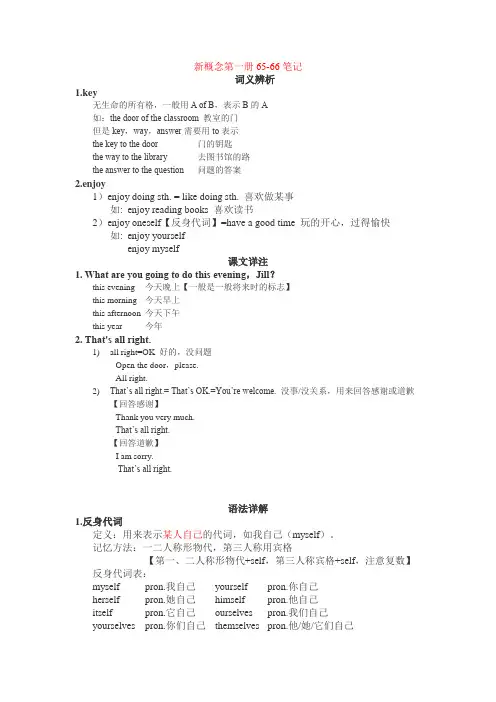
新概念第一册65-66笔记词义辨析1.key无生命的所有格,一般用A of B,表示B的A如:the door of the classroom 教室的门但是key,way,answer需要用to表示the key to the door门的钥匙the way to the library 去图书馆的路the answer to the question 问题的答案2.enjoy1)enjoy doing sth. = like doing sth. 喜欢做某事如: enjoy reading books 喜欢读书2)enjoy oneself【反身代词】=have a good time 玩的开心,过得愉快如: enjoy yourselfenjoy myself课文详注1.What are you going to do this evening,Jill?this evening 今天晚上【一般是一般将来时的标志】this morning 今天早上this afternoon 今天下午this year 今年2.That's all right.1) all right=OK 好的,没问题--Open the door,please.--All right.2) That’s all right.= That’s OK.=You’re welcome. 没事/没关系,用来回答感谢或道歉【回答感谢】--Thank you very much.--That’s all right.【回答道歉】--I am sorry.-- That’s all right.语法详解1.反身代词定义:用来表示某人自己的代词,如我自己(myself)。
记忆方法:一二人称形物代,第三人称用宾格【第一、二人称形物代+self,第三人称宾格+self,注意复数】反身代词表:myself pron.我自己yourself pron.你自己herself pron.她自己himself pron.他自己itself pron.它自己ourselves pron.我们自己yourselves pron.你们自己themselves pron.他/她/它们自己反身代词用法:enjoy oneself 玩得开心help oneself to 随便吃/喝点...say to oneself 自言自语dress oneself 给自己穿衣服teach oneself 自学make oneself at home 别拘束2.时间表达法1)整点表达法,小时+(o’clock)如: It’s six (o’clock).6点了。
新概念英语第一册第65课Lesson65课文单词知识点
【知识点讲解】1. going to do sth. 意思是打算做什么、将要做什么?2. half past ten ,意思是十点半,也可以直接说成ten thirty;a quarter past eleven ,意思是11点一刻,quater 就是一刻,四分之一的意思,11:15也可以直接说成eleven fifteen 。
这里我们看到关于精确时间的表达,几点钟、几分,最简单的表达当然就是直接把数字读出来。
比如09:05读作nine O five;12:35读成twelve thirty five ……“过” 这个表达,就如文中讲到那样用“past ”这个介词;如果是“不到”则用"to"这个介词。
比如“差10分钟10点” 就可以读成 ten to ten 。
3. enjoy yourself!意思是好好玩,也可以简单说成"enjoy!" 在很多场合都可以用得上,比如祝朋友有个好旅行、好好吃一顿、运动一下等等,在很多行动之前你都可以用它来表达一种祝愿。
Lesson65FATHER: What are you going to do this evening. Jill? JILL: I'm going to meet some friends. Dad.FATHER: You mustn't come home late. You must be home at half past ten. JILL: I can't get home so early, Dad!Can I have the key to the front door please? FATHER: No, you can't.MOTHER: Jill's eighteen years old, Tom. She's not a baby. Give her the key. She always comes home early.FATHER: Oh, all right! Here you are.But you mustn't come home after a quarter past eleven. Do you hear?JILL: Yes. Dad. Thanks, Mum.MOTHER: That's all right. Goodbye. Enjoy yourself!JILL: We always enjoy ourselves, Mum. Bye-bye.父亲:今晚你打算干什么,吉尔? 吉尔:我打算去看几个朋友,爸爸。
裕兴新概念英语第一册笔记:Lesson 65 Not a baby
Lesson 65 Not a babyNew words and expressions:Dad n.爸(儿语)key n.钥匙baby n. 婴儿hear v.听见enjoy v. 玩得快活yourself pron. 你自己ourselves pron. 我们自己mum n. 妈妈Dad n.爸(儿语)mum n.妈妈key1) n.钥匙key to ……的钥匙eg. Which is the key to the front door?前门的钥匙是哪一把。
eg. The key doesn't fit the lock.这把钥匙不合这把锁。
2) n. 题解,答案,秘诀the key to the problem 解决这个问题的办法a key to success 成功的秘诀3) n.(乐器,电脑的)键keyboard 键盘hear v.听见listen v,听eg. Listen. Someone is knocking at the door.听,有人敲门。
listen to……听……,表示有意识地去听,强调动作eg. Let's listen to the stereo.我们来听立体声音响吧’hear v. 听见……(强调听到的结果)eg. I can't hear you. 我听不到你说的话。
eg. Do you hear the noise? 你有没有听到声响?hear from……收到……的来信eg. I hear from my boyfriend every week.我每周都收到男朋友的来信。
enjoy v.欣赏,喜爱,享受enjoy + 名词/ doingeg. I enjoy the movie very much.我非常喜欢这部电影。
eg. She enjoys swiming very much. 她非常喜欢游泳。
eg. My daughter doesn't enjoy going to school.我的女儿不喜欢上学。
新概念一L65-66讲义
写作:December 1st, December 1, Dec.1或1st December, 1. December, 1. Dec.
读作:December (the) first,December one或the first of December
新概念1讲义Lesson 65-66
教学内容
本课重点语法要求:1.反身代词2.时间及日期的表达方式3.复习be going to将来时
Lessons 65-66
1.I’m going to meet some friends.我打算去见几个朋友。
meet some friends=see some friends见朋友be going to表示“打算….”
2.Enjoy yourself.好好玩吧!
enjoy oneself=have a good time
3.hear Vs listen
hear听见,听到(强调结果)listen注意听(强调听的动作)
eg: I listened carefully but heard nothing.
4.key钥匙
一.构成
1第一、第二人称的反身代词是由形容词性物主代词加上self或selves构成的
my+self→myself our+selves→ourselves
your+self→yourself your+selves→yourselves
2第三人称的反身代词是由宾格加上self,selves构成的
him+self→himself her+self→herself
可以作宾语的同位语
eg: I want to meet the boss himself.我想见见老板本人。
新概念英语第一册Lesson65-66笔记(语法点+配套练习+答案)
give sb. sth.
=give sth. to sb.
Giveusourcoats, please. (we)
Remember to give my regards tohim. (he)
四、词组
Lesson65 Not a baby
1、单词分类;
n.
pron.
v.
Dad
key
baby
mum
yourself
ourselves
hear
enjoy
二、课文复习
三、课文重点
重点
例句
key
n.
1.键
2.钥匙,关键
the key to ......的钥匙,...的关键
adj.关键的
key word关键词,重点单词
5.Jane is too young to look afterherself.
2表示强调时,用于加强某个名词或代词的语气,意为自己
herself
它自己
itself
enjoy oneself =have a good time=have fun,玩得开心,玩得愉快
1.I enjoy ____myself_____ in San ya.
2.He is enjoying ____himself________.
3.She always enjoysherselfat home.
前门钥匙
Have a good time!
玩得开心
give sb. sth.
给某人某物
What’s the time?