
MSDS物质安全数据表
Acidity/pH pH值
Boiling point/boiling range沸点/沸程
Flash point闪点
Flammability (solid, gas)易燃性(固体,气体)
Explosive properties爆炸特性
Oxidising properties氧化性
9.3Other information
其它信息
SEБайду номын сангаасTION10. STABILITY AND REACTIVITY
第十部分稳定性和反应活性
10.1Conditions to avoid
应避免的情况
10.2Materials to avoid
应避免接触的物质
10.3Hazardous decomposition products
第十二部分生态学资料
12.1Ecotoxicity
生态毒理学
12.2Mobility
流动性
12.3Persistence and degradability
持久性和降解性
12.4Bioaccumulative potential
生物累积的潜在可能性
12.5Results of PBT assessment
环境暴露控制
SECTION9. PHYSICAL AND CHEMICAL PROPERTIES
第九部分理化特性
9.1General information
常规信息
Appearance外观:
Odour气味:
9.2Important health, safety and environmental information
第三部分成分组成信息
3.1General Chemical Description
总体化学品描述
3.2Base Substances of Preparation
配制品基本成分
components
成分
EC-No.
CAS-No.
Content (% or range)
浓度(浓度范围)
3.3Declaration of Ingredients according to EC 1907/2006(REACH Regulation)(If necessary)
7.1Handling
安全处理措施
7.2Storage
安全贮存条件
7.3Specificuse(s)
特殊用途
SECTION8. EXPOSURE CONTROLS/PERSONAL PROTECTION
第八部分接触控制/个体防护
8.1Exposure limit values
最大暴露浓度
8.2Exposure controls
危害分解产物
SECTION11. TOXICOLOGICAL INFORMATION
第十一部分毒理学资料
Acute oral toxicity急性经口毒性
Acute dermal toxicity急性经皮毒性
Acute inhalational toxicity急性吸入毒性
Irritant effect on skin皮肤的刺激
— list ofallR phrasesmentioned in the document本文档中涉及物质的风险分级列表
—recommended restrictions on use关于用途的推荐性限制
— sources of key data used to compile the Safety Data Sheet.该安全资料表的关键数据源
Skin皮肤接触
Eye contact眼睛接触
Ingestion食入
4.2Advice to doctor
医生注意
SECTION5. FIRE-FIGHTING MEASURES
第五部分消防措施
5.1 Suitablefire-fightingequipment
合适的消防设备
Suitable适合
Unsuitable不适合
遵照EC 1907/2006(REACH)成分声明(如果需要)
Hazardous components
危险成分
EC-No.
CAS-No.
Content(% or range)
浓度(浓度范围)
Classification
分类
Please refer to section 16 for an overview of all R-phrases mentioned here.
Material
according to
物质
遵照
化学品名
SECTION1. IDENTIFICATION OF THESUBSTANCE/PREPARATIONAND OF THECOMPANY
第一部分物质/配制品/公司名称
1.1Identification of thechemical(substance or preparation)
Fire fighting equipment消防设备
Protection gear保护用具
5.2Dangerous decomposition products:
危险燃烧分解产物
5.3Additional information for firefighters
消防员需注意的附加信息
SECTION6. ACCIDENTAL RELEASE MEASURES
涉及的所有风险分级(R-phrases)请参阅第十六部分。
SECTION4. FIRST AID MEASURES
第四部分急救措施
4.1General information
一般建议
Exposure Route
接触途径
Specific First Aid Measures
具体急救措施
Inhalation呼吸吸入
化学品(物质或配制品)名称
1.2Use of thechemical
化学品用途
1.3Companyidentification
公司信息
Company name公司名:
Address地址:
Postal code邮编:
Country国家:
Telephone number电话:
Fax number传真:
E-Mail(person responsible forSDS)责任人邮箱:
陆地运输
Classification according toIMDG
海运
Classification according toIATA
航空运输
SECTION15. REGULATORY INFORMATION
第十五部分法规信息
SECTION16. OTHER INFORMATION
第十六部分其它信息
第六部分泄露应急处理
6.1Personal precautions
人员的预防措施
6.2Environmental precautions
环境预防措施
6.3Methods for cleaningup/taking up
清除的方法
SECTION7. HANDLING AND STORAGE
第七部分操作处置和储存
暴露控制
Occupational exposure controls
职业接触控制
(a) Respiratory protection呼吸系统防护
(b) Handprotection手防护
(c) Eye protection眼睛防护
(d) Skinprotection皮肤防护
Environmental exposure controls
Irritant effect on eye眼睛的刺激
Sensitization过敏性
Carcinogenicity致癌性
Mutagenicity致畸性
Reproduction toxicity生殖毒性
Accumulative toxic effect累积毒性
SECTION12. ECOLOGICAL INFORMATION
Dateof latest versionSDS最新版日期:
1.4Emergency Telephone
应急电话
In case of an emergency, please contact:
紧急情况请联系:
SECTION2. HAZARDS IDENTIFICATION
第二部分危险鉴定
SECTION3. COMPOSITION/INFORMATION ON INGREDIENTS
Vapour pressure蒸汽压力
Relative density相对密度
Solubility溶解度
Water solubility水溶性
Partition coefficient: n-octanol/water分配系数:辛醇/水
Viscosity粘度
Vapour density蒸汽密度
Evaporation rate蒸发率
PBT评估结果
12.6Other adverse effects
其它不利影响
SECTION13. DISPOSAL CONSIDERATIONS
第十三部分废弃处理
SECTION14. TRANSPORT INFORMATION
第十四部分运输信息
Classification according to ADR
MSDS化学品安全数据表

MSDS化学品安全数据表一、概述MSDS(Material Safety Data Sheet)即化学品安全数据表,是一份详细描述化学品性质、危害特性、安全操作要求等信息的文档。
它为使用者提供了关于化学品的重要安全信息,匡助使用者正确、安全地处理、储存和运输化学品,以保护人员和环境的安全。
二、化学品基本信息1. 化学品名称:XYZ化学品2. 化学品别名:ABC化学品3. 化学式:C10H12O24. 份子量:164.2 g/mol5. CAS号:123-45-66. 外观:无色液体7. 气味:芳香三、物理性质1. 熔点:-10°C2. 沸点:150°C3. 相对密度:1.2 g/cm³4. 溶解性:可溶于水四、健康危害1. 急性毒性:经口LD50为500 mg/kg(小鼠)2. 皮肤刺激性:对皮肤有轻度刺激作用3. 眼刺激性:对眼睛有轻度刺激作用4. 吸入危害:可引起呼吸道刺激五、安全措施1. 防护措施- 吸入:避免吸入化学品的蒸汽或者喷雾。
使用防护口罩或者面具。
- 眼睛:避免化学品接触眼睛。
使用防护眼镜或者面罩。
- 皮肤:避免长期接触化学品。
使用防护手套、长袖衣物和长裤。
- 其他:工作场所应配备紧急洗眼器和淋浴设施。
2. 应急措施- 吸入:立即将患者移至空气新鲜处。
如有呼吸难点,进行人工呼吸或者使用呼吸器。
- 眼睛:即将用大量清水冲洗眼睛,持续15分钟。
如刺激持续,就医。
- 皮肤:即将用肥皂和水彻底清洗受污染的皮肤。
如刺激持续,就医。
- 意外泄漏:迅速撤离泄漏区域,防止进一步泄漏。
穿戴适当的防护装备清理泄漏物。
3. 储存要求- 储存温度:室温(20-25°C)- 储存条件:密封保存,远离火源和氧化剂。
4. 废弃物处理- 废弃物分类:根据当地法规和规定进行分类。
- 废弃物处置:交由合法的废物处理单位处理。
六、其他信息1. 稳定性:稳定于常温和常压下。
2. 包装:常用包装为塑料瓶或者钢桶。
MSDS化学品安全数据表
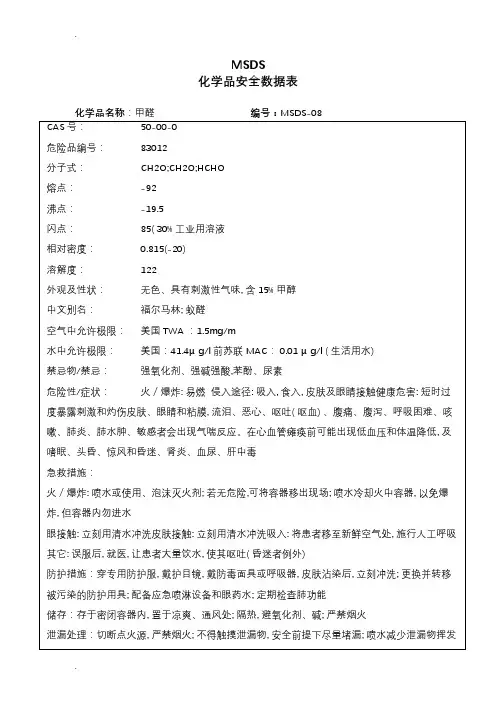
MSDS化学品安全数据表CAS号:50-00-0危险品编号:83012分子式:CH2O;CH2O;HCHO熔点:-92沸点:-19.5闪点:85( 30% 工业用溶液相对密度:0.815(-20)溶解度:122外观及性状:无色、具有刺激性气味, 含15% 甲醇中文别名:福尔马林; 蚁醛空气中允许极限:美国TWA :1.5mg/m水中允许极限:美国:41.4μg/l 前苏联 MAC: 0.01 μg/l ( 生活用水)禁忌物/禁忌:强氧化剂、强碱强酸,苯酚、尿素危险性/症状:火/爆炸: 易燃侵入途径: 吸入, 食入, 皮肤及眼睛接触健康危害: 短时过度暴露刺激和灼伤皮肤、眼睛和粘膜, 流泪、恶心、呕吐( 呕血) 、腹痛、腹泻、呼吸困难、咳嗽、肺炎、肺水肿、敏感者会出现气喘反应。
在心血管瘫痪前可能出现低血压和体温降低, 及嗜眠、头昏、惊风和昏迷、肾炎、血尿、肝中毒急救措施:火/爆炸: 喷水或使用、泡沫灭火剂; 若无危险,可将容器移出现场; 喷水冷却火中容器, 以免爆炸, 但容器内勿进水眼接触: 立刻用清水冲洗皮肤接触: 立刻用清水冲洗吸入: 将患者移至新鲜空气处, 施行人工呼吸其它: 误服后, 就医, 让患者大量饮水, 使其呕吐( 昏迷者例外)防护措施:穿专用防护服, 戴护目镜, 戴防毒面具或呼吸器, 皮肤沾染后, 立刻冲洗; 更换并转移被污染的防护用具; 配备应急喷淋设备和眼药水; 定期检查肺功能储存:存于密闭容器内, 置于凉爽、通风处; 隔热, 避氧化剂、碱; 严禁烟火泄漏处理:切断点火源, 严禁烟火; 不得触摸泄漏物, 安全前提下尽量堵漏; 喷水减少泄漏物挥发MSDS化学品安全数据表化学品名称:氢氧化钠编号:MSDS-09CAS号:1310-73-2危险品编号:82001英文名称:SODIUM HYDROXIDERTECS号:WB4900000UN号:1823(固体);分子式:HNaO;NaOH熔点:318沸点:1390相对密度: 2.12外观及性状:白色, 可潮解的固体, 有片状、条状或块状中文别名:苛性钠; 火碱空气中允许极限:美国TWA :2mg/m水中允许极限:美国:推荐PH值应在5~9(生活用水) , EPA禁忌物/禁忌:水、酸、可燃液体、有机卤素、金属( 如铝、钛、锌、硝基甲浣、硝基化合物)危险性/症状:火/爆炸: 不燃侵入途径: 吸入, 食入, 皮肤及眼睛接触健康危害: 短期暴露, 严重刺激皮肤, 引起深度烧伤; 严重刺激眼睛、角膜烧伤, 甚至失明; 吸入后, 可导致肺炎, 严重刺激鼻、咽喉; 食入后, 烧伤口腔和咽喉,症状有恶心、呕吐、腹痛、腹泻、喉肿、窒息、胃肠穿孔、昏迷; 长期暴露同上急救措施:火/爆炸: 选用适合周围火源的灭火剂眼接触: 立即冲洗皮肤接触: 立即用水冲洗吸入: 将患者移至新鲜空气处, 施行人工呼吸食入: 就医, 给饮大量水,但勿催吐防护措施:戴防护镜, 穿适当防护服, 选用适当呼吸器; 提供应急淋浴设施及眼药水; 定期检查肺功能储存:避免接触水, 酸, 易燃物体, 有机卤化物, 金属, 硝基化合物; 存于密闭容器内, 置于凉爽、通风处泄漏处理:须穿戴防护用具进入现场; 对固体泄漏物放入有大量水的大容器中; 用稀盐酸中和, 对液体泄漏物, 用稀盐酸中和, 用拖把或真空水泵吸收运输:须贴“腐蚀”标签, 航空、铁路限量运输MSDS化学品安全数据表CAS号:10045-94-0危险品编号:61030分子式:HgN2O6;Hg(NO3)2熔点:70~79沸点:180(分解)相对密度: 4.39外观及性状:白色或淡黄色晶体中文别名:硝酸高汞空气中允许极限:美国TWA :0.1mg/m水中允许极限:美国:0.144 μg/l 中国 MAC:0.001mg/l(以Hg计)禁忌物/禁忌:有机物、乙炔、乙醇、磷、硫、次磷酸危险性/症状:火/爆炸: 与有机物( 木头、纸、油等) 接触易燃侵入途径: 吸入, 皮肤渗入健康危害: 接触刺激、灼热眼睛; 遇酸、热分解出汞蒸汽, 在体内积累;暴露引起多涎、兴奋、牙龈炎、性情变异、损害脑、肺、肾急救措施:火/爆炸: 喷水或使用干粉、二氧化碳眼接触: 用大量水冲洗15分钟; 就医皮肤接触: 用大量水冲洗吸入: 将患者移至新鲜空气处; 症状显露, 就医防护措施:穿戴清洁、完好的防护用具, 以保护皮肤; 戴防尘镜和面罩, 保护眼睛; 选用适当的呼吸器; 定期进行神经系统、尿液和血液检查储存:储存时, 远离禁忌物泄漏处理:须穿戴防护用具进入泄漏现场; 使用专用汞蒸汽抑制剂或专用真空装置收集泄漏物, 置于专用容器内; 使用清理汞泄漏的专用工具运输:须贴“毒品”标签, 航空、铁路限量运输附注: 剧毒, LD50:8mg/kg(小鼠腹腔)MSDS化学品安全数据表化学品名称:高锰酸钾编号:MSDS-11CAS号:7722-64-7危险品编号:51048分子式:KMnO4熔点:240相对密度: 2.7外观及性状:深紫色晶体中文别名:过锰酸钾; 灰锰氧水中允许极限:中国 MAC:4(以高锰酸根计)禁忌物/禁忌:甘油、1 , 2-亚乙基二醇、聚丙烯、羟胺、三硫化二氢、锑、砷、硫酸、过氧化氢、磷酸、任何磨碎的易燃物质、醇酸、铁盐、碘化物、草酸危险性/症状:火/爆炸: 不燃, 但易引燃其他物质, 助燃侵入途径: 吸入, 皮肤及眼睛接触, 食入健康危害: 吸入, 刺激鼻子; 浓溶液刺激皮肤, 稀溶液使皮肤起棕色斑点, 外层坚硬、穿透物差, 亦刺激眼睛; 食入稀溶液(1%)灼烧咽喉、恶心、呕吐、胃痛; 浓溶液2%-3% 可产生贫血症, 咽喉肿胀甚至窒息;更浓溶液损伤肾和循环系统, 引起虚脱急救措施:眼接触: 用大量水冲洗15分钟以上; 就医皮肤接触: 脱掉被污染衣物, 用水冲洗5 分钟以上, 必要时就医吸入: 洗鼻子, 必要时就医食入: 吃蛋白和牛奶, 咽喉肿胀、呼吸困难时, 施行气管切开术; 就医防护措施:穿戴清洁完好的防护用品( 衣服、手套、鞋帽) , 操作液体时, 戴防化镜和面具或戴面具式呼吸装置; 处理固体时, 戴防尘镜和面具或戴面具式呼吸器; 定期进行肺功能检查储存:避禁忌物; 存于密闭容器中, 置于凉爽、通风处; 谨防容器受损泄漏处理:由专业人员穿戴防护用具清理现场, 用象硫代硫酸钠、亚硫酸氢盐或铁盐的弱还原剂覆盖, 使用亚硫酸氢盐或铁盐时需加3 摩尔硫酸催化反应, 在大的含有水容器中装泥浆或淤泥然后加入苏打灰中和运输:需贴“氧化剂”标签,航空、铁路限量运输附注: LD:0.14g/Kg(成人经口)MSDS化学品安全数据表CAS号:7778-50-9危险品编号:51080分子式:Cr2K2O7;K2Cr2O7熔点:398沸点:500(分解)相对密度: 2.676(25)0)溶解度:102(100); 12.5(2外观及性状:黄红色晶体中文别名:红矾钾空气中允许极限:美国TWA :0.10mg/m禁忌物/禁忌:可氧化物质危险性/症状:侵入途径: 吸入, 皮肤及眼睛接触健康危害: 严重损伤眼睛,甚至失明; 吸入后引起鼻隔膜穿孔、痛疼, 有时流血或流浓, 结硬痂; 刺激鼻、咽喉、支气管, 导致咳嗽、喘鸣;皮肤严重溃疡, 过敏出疹; 此物可渗入皮内层急救措施:火/爆炸: 喷水或使用干粉、二氧化碳、泡沫灭火剂眼接触: 立即用大量水冲洗30分钟以上; 立即就医皮肤接触: 立即脱掉被污染衣服, 用水冲洗患处吸入: 流鼻涕或呼吸困难时, 立即就医防护措施:定期进行肺透视, 检查鼻子和皮肤, 症状严重或高度暴露时, 由过敏专家评估暴露历史, 采取特殊措施; 每天检查皮肤上是否出现小包; 轻度溃疡不早治疗, 会导致慢性病; 穿戴清洁、完好的防护用品( 衣服、手套、鞋、帽) , 选用适当呼吸器( 带护目镜);定期进行肺功能检查储存:避免与易燃物: 有机物或易氧化物质( 如纸、木材、硫、铝、朕氨和塑料) 接触; 储存在规定场所, 并做标记泄漏处理:须穿戴防护用具进入现场; 保持现场通风; 用简便、安全的方法收集泄漏粉末于密闭容器内, 不得将泄漏物排入下水道运输:须贴“氧化剂”标签, 航空、铁路运输限量运输MSDS化学品安全数据表化学品名称:盐酸编号:MSDS-13MSDS化学品安全数据表化学品名称:天然气编号:MSDS-14CAS号:危险品编号:21007中文名称:天然气英文名称:NATURAL GAS分子式:CH4沸点:-160相对密度:0.45外观及性状:通常包括85%的甲烷及少量乙烷(9%)、丙烷(3%)、氮(2%)和丁烷(1%) 中文别名:沼气空气中允许极限:尚无资料禁忌物/禁忌:危险性/症状:火/爆炸: 可燃侵入途径: 吸入健康危害: 局部接触, 压力筛中的液体, 可引起冻伤; 本品为窒息剂, 空气中含量过高, 可导致呼吸短促、失去知觉,甚至缺氧而死亡; 不完全燃烧可产生一氧化碳急救措施:火/爆炸: 关闭供给源, 若关闭困难, 而燃烧并不危及周围环境, 则可任其燃烧, 否则应使用粉沫、泡沫或二氧化碳灭火剂灭火; 对于液体天然气, 应喷水保持贮罐的冷却, 但禁止水与液化天然气直接接触防护措施:保持良好的通风储存:泄漏处理:疏散人员, 请教专家, 禁止将水直接喷到天然气中运输:浓缩气体: 须贴“易燃气体”标签, 禁止航空客运或铁路运输, 航空货运限量运输液体: 须贴“易燃液体”标签, 严禁航空、铁路运输MSDS化学品安全数据表.化学品安全数据表化学品名称:百草枯编号:MSDS-16CAS号:1910-42-5危险品编号:61896分子式:C12H14Cl2N2;;C12H1;4N2Cl2熔点:>300外观及性状:无色晶体,300 ℃分解中文别名:对草快空气中允许极限:美国TWA :0.1mg/m水中允许极限:美国:3.0 μg/l禁忌物/禁忌:强氧化剂危险性/症状:侵入途径: 吸入,皮肤吸入,食入,皮肤及眼眼睛接触健康危害: 眼接触立即使角膜混浊;皮肤接触立即产生皮炎及指甲萎缩、变色、发红、肿胀并有灼烧感;吸入后症状为:气短、肺水肿,可导致肺部纤维变性;食入后立即灼伤嘴及食管,引起溃疡并、恶心、呕吐、腹泻、腹痛;其它症状为暂时可痊愈性肝损伤、肾炎、心脏损伤,最终可导致死亡急救措施:火/爆炸: 喷水、喷雾或用干粉、二氧化碳、泡沫灭火剂眼接触: 用大量温水冲洗15分钟皮肤接触: 脱下沾染衣物,用肥皂、水冲洗皮肤吸入: 将患者移至新鲜空气处,呼吸停止时, 施行呼吸复苏术; 心跳停止时, 施行心肺复苏术;呼吸困难,输氧或采取其他辅助呼吸方法防护措施:带护目镜,保护眼睛,穿防护服,皮肤保护,配备紧急冲洗设施;防护重点是眼睛、呼吸系统、心脏、肝、肾、肺及消化系统,应对其进行定期检查储存:储于密闭容器内, 置于凉爽、通风处泄漏处理:隔离泄漏现场,通风,转移并隔离被污染衣物;如果水被污染,报告当地环保部门,不得触摸池漏物,安全情况下堵漏,喷水减少泄漏物挥发量;少量液体泄漏,用蛭石、干沙、泥土或类似物质吸收, 并置于密闭容器内,待处理;干粉泄漏,用干净铲子把泄漏物铲入容器内;大量液体泄漏,围堤防止蔓延,待处理;整个清理工作应于上风高处进行运输:须贴“远离食品”标签,航空、铁路限量运输附注: 误饮15克20% 的溶液可致死MSDS化学品安全数据表CAS号:10265-92-6危险品编号:61125分子式:C2H8NO2PS;CH3OP(O)(NH2)SC;H3熔点:44.5外观及性状:亚白色晶体中文别名:多灭灵; 杀螨隆; 脱麦隆禁忌物/禁忌:强酸、强碱危险性/症状:火/爆炸: 可燃, 火中容器会爆炸侵入途径: 吸入, 食入, 皮肤接触健康危害: 急性暴露, 引起瞳孔缩小成针点、视觉模糊、头痛、头晕、肌肉痉挛、呼吸沉重、呕吐、腹泻、腹痛、癫痫发作、昏迷; 食入后心跳变慢; 皮肤接触后心率加快、胸痛、低血压、呼吸短促、压抑、癫痫、患精神病急救措施:火/爆炸: 使用干粉、二氧化碳、泡沫或雾状灭火剂; 穿戴压气式呼吸器和专用防护服眼接触: 用温吞水冲洗15分钟皮肤接触: 用肥皂、水冲洗吸入: 将患者移至新鲜空气处; 仔细观察脉搏及呼吸率, 脉搏停止时, 施行心肺复苏术; 呼吸停止时, 进行人工呼吸;呼吸困难时, 输氧储存:储存时, 避免接触强酸、强碱泄漏处理:处理工作应在高处、上风处进行; 不得触摸泄漏物; 喷水降低泄漏物挥发量; 用沙土或其它不可燃吸附剂吸收少量泄漏液, 置于密闭容器内; 用铲子铲起干粉泄漏物, 置入清洁、干燥的容器中; 移离泄漏现场, 大量泄漏应围堤处理运输:须贴“毒品”标签, 航空、铁路限量运输附注: 高毒性, LD50:7.5mg/kg ( 大鼠经口)MSDS化学品安全数据表化学品名称:农达除草剂编号:MSDS-18MSDS化学品安全数据表。
物质安全数据表(表调剂MSDS)

一、标识
中文名:表调剂
英文名:/化学ຫໍສະໝຸດ :/俗称:/化学类别:/
相对分子式量:/
危险性类别:/
二、主要组成与性状
主要成份:肽盐。
外观兴形状:白色粉末。
主要用途:金属表面调整。
三、健康危害
侵入途径:口鼻吸入。
健康危害:接触其蒸气或烟雾,可引起急性中毒,出现眼结膜炎,鼻炎及口腔粘膜有烧灼感,鼻血,齿银出血气管炎热,误服可旨起消化道灼伤,溃疡形成,有可能引起胃穿孔,腹膜炎等。眼和皮肤接触可致辞灼伤。
七、储运注意事项:应贮存在通风、干燥的库房内。包装必须密封,以防止吸收水分结块。不可与酸类、铵盐和有毒、有味物品共贮混运。运输过程中应防雨淋和日晒。有条件时可采用集装网和集装托盘装卸和运输。
八、防护措施
手防护:戴橡胶手套
身体防护:空防护服、长筒靴
眼睛防护:呼吸系统防护中已作防护。
工程控制:生产过程密闭,加强通风。
灭火方法:消防人员必须佩戴氧气呼吸器,穿全身防护服,用酸性物质如碳酸氢钠,碳酸钠,清石灰待和中。也可用大量水扑救。
危险特性:能与一些活性金属粉末发生反应,放出氢气。遇氰化化物能产生剧毒的氰化氢化气体。与碱发生中合反应,并放出大量的热气,具有较强的腐蚀性。
六、泄漏应急处理:隔离泄漏污染区,限制出入,建议应急处理人员佩戴自正压式呼吸器,穿防护服,勿使泄漏物与还原剂,有机物,易燃物接触,小量泄漏,用干净的铲子收集于干燥,有盖的容器中,大量泄漏:收集回收或运至废物处理场所处置。
四、急救措施
皮肤接触:脱去被污染的衣著,用大量清水清洗,至少15分钟,就医。
眼睛接触:立即提眼帘,用大量流动清水或生理盐水流澈底清洗,就医。
物质安全数据表(MSDS)-消泡剂(污水处理)

化学品中文名:消泡剂
化学品英文名:defoamer
分子式或其简写:/
第二部分:成分/组成信息
□纯品 ■混合物
有害物成分
浓度
CAS No.
/
第三部分:危险性概述
危险性身体无害。
环境危害:轻微
燃爆危险:本品不燃
第四部分:急救措施
《危险化学品安全技术全书》
修改说明:若发现新的危害性,在有关信息发布后的半年内,须对此说明书的内容进行修订。
其他信息:无
废弃处置方法:根据国家和地方有关法规的要求处置。或与厂商或制造商联系,确定处理方法。
废弃注意事项:处置前应参阅国家和地方有关法规。
第十四部分:运输信息
危险货物编号:无
UN编号:无
包装标志:无
包装类别:无
包装方法:塑料桶包装
运输注意事项:确保容器不泄漏、不倒塌、不坠落、不损坏,瓶口朝上。
第十五部分:法规信息
危险化学品安全管理条例(2002年1月9日国务院第52次常务会议通过);
安全生产许可证条例(2004年1月7日国务院第34次常务会议通过);
常用危险化学品的分类及标志(GB 13690-92);
工作场所有害因素职业接触限值(GBZ 2-2002);
危险化学品名录。
第十六部分:其他信息
参考文献:GB 16483—2000《化学品安全技术说明书填写指南》
临界压力(MPa):无意义
辛醇/水分配系数:无资料
闪点(oC):60
引燃温度(oC):无资料
爆炸下限[%(V/V)]:无意义
爆炸上限[%(V/V)]:无意义
溶解性:水溶性物质
主要用途:消泡,抑泡。
化学品物质安全数据表(MSDS)

ARALDITE®2011SAFETY DATA SHEETProduct name ARALDITE®2011:1.1Product identifier 1.3Details of the supplier of the safety data sheet e-mail address of person responsible for this SDS:Global_Product_EHS_AdMat@Product description:1.2Relevant identified uses of the substance or mixture and uses advised against Product code:000573301.4Emergency telephone number SupplierTelephone number :EUROPE:+3235751234France ORFILA:+33(0)145425959ASIA:+656336-6011China:+862039377888Australia:1800786152New Zealand:0800767437USA:+1/800/424.93002-Component adhesive system Product use :Supplier :Huntsman Advanced Materials (Europe)BVBAEverslaan 453078Everberg /Belgium Tel.:+41612992041Fax:+41612992040Classification Xi;R36/38R43N;R51/53::Human health hazards Irritating to eyes and skin.May cause sensitisation by skin contact.:Environmental hazardsToxic to aquatic organisms,may cause long-term adverse effects in the aquatic environment.See Section 11for more detailed information on health effects and symptoms.2.1Classification of the substance or mixture Product definition :Working pack (preparation)See Section 16for the full text of the R phrases or H statements declared above.Classification according to Directive 1999/45/EC [DPD]The product is classified as dangerous according to Directive 1999/45/EC and its amendments.2.2Label elementsHazard symbol orsymbols:Irritant,Dangerous for the environmentIndication of danger ::Other hazards which do not result in classificationNot available.Containers to be fitted with child-resistant fasteningsNot applicable.Tactile warning of danger Not applicable.::Special packaging requirements Safety phrasesS2-Keep out of the reach of children.S24-Avoid contact with skin.S29-Do not empty into drains.S37-Wear suitable gloves.S46-If swallowed,seek medical advice immediately and show this container or label.S61-Avoid release to the environment.Refer to special instructions/safety data sheet.R36/38-Irritating to eyes and skin.R43-May cause sensitisation by skin contact.R51/53-Toxic to aquatic organisms,may cause long-term adverse effects in the aquatic environment.Risk phrasesHazardous ingredients:::reaction product:bisphenol A-(epichlorhydrin);epoxy resin (number average molecular weight <700)N(3-dimethylaminopropyl)-1,3-propylenediamine bisphenolF-epoxy resinbisphenol A -epoxy resins,number average MW >700-<11002.3Other hazardsSupplemental label elements:Contains epoxy constituents.See information supplied by the manufacturer.Substance/mixture Working pack (preparation):Occupational exposure limits,if available,are listed in Section8.There are no additional ingredients present which,within the current knowledge of the supplier and in theconcentrations applicable,are classified as hazardous to health or the environment and hence require reporting in this section.[1]Substance classified with a health or environmental hazard [2]Substance with a workplace exposure limit[3]Substance meets the criteria for PBT according to Regulation (EC)No.1907/2006,Annex XIII [4]Substance meets the criteria for vPvB according to Regulation (EC)No.1907/2006,Annex XIII TypeWash out mouth with water.Remove dentures if any.Remove victim to fresh air and keep at rest in a position comfortable for breathing.If material has been swallowed and the exposed person is conscious,give small quantities of water to drink.Stop if the exposed person feels sick as vomiting may be dangerous.Do not induce vomiting unless directed to do so by medical personnel.If vomiting occurs,the head should be kept low so that vomit does not enter the lungs.Get medical attention if adverse health effects persist or are severe.Never give anything bymouth to an unconscious person.If unconscious,place in recovery position and get medical attention immediately.Maintain an open airway.Loosen tight clothing such as a collar,tie,belt or waistband.Skin contactImmediately flush eyes with plenty of water,occasionally lifting the upper and lowereyelids.Check for and remove any contact lenses.Continue to rinse for at least 10minutes.Get medical attention.Flush contaminated skin with plenty of water.Remove contaminated clothing and shoes.Wash contaminated clothing thoroughly with water before removing it,or wear gloves.Continue to rinse for at least 10minutes.Get medical attention.In the event of any complaints or symptoms,avoid further exposure.Wash clothing before reuse.Clean shoes thoroughly before reuse.4.1Description of first aid measures Remove victim to fresh air and keep at rest in a position comfortable for breathing.If not breathing,if breathing is irregular or if respiratory arrest occurs,provide artificial respiration or oxygen by trained personnel.It may be dangerous to the personproviding aid to give mouth-to-mouth resuscitation.Get medical attention if adverse health effects persist or are severe.If unconscious,place in recovery position and get medical attention immediately.Maintain an open airway.Loosen tight clothing such as a collar,tie,belt or waistband.In case of inhalation of decompositionproducts in a fire,symptoms may be delayed.The exposed person may need to be kept under medical surveillance for 48hours.IngestionInhalationEye contact ::::Protection of first-aiders:No action shall be taken involving any personal risk or without suitable training.It may be dangerous to the person providing aid to give mouth-to-mouth resuscitation.Wash contaminated clothing thoroughly with water before removing it,or wear gloves.4.2Most important symptoms and effects,both acute and delayed Potential acute health effects Inhalation :Exposure to decomposition products may cause a health hazard.Serious effectsmay be delayed following exposure.Irritating to mouth,throat and stomach.:Ingestion Skin contact :Irritating to skin.May cause sensitisation by skin contact.Irritating to eyes.:Eye contactNotes to physician In case of inhalation of decomposition products in a fire,symptoms may be delayed.The exposed person may need to be kept under medical surveillance for 48hours.:Specific treatments Over-exposure signs/symptoms Skin contactIngestionInhalation No specific data.No specific data.Adverse symptoms may include the following:irritation redness:::Eye contact :Adverse symptoms may include the following:irritationwatering redness 4.3Indication of any immediate medical attention and special treatment needed :Symptomatic treatment and supportive therapy as indicated.Following severeexposure the patient should be kept under medical review for at least 48hours.Promptly isolate the scene by removing all persons from the vicinity of the incident if there is a fire.No action shall be taken involving any personal risk or without suitable training.This material is toxic to aquatic organisms.Fire water contaminated with this material must be contained and prevented from being discharged to any waterway,sewer or drain.Hazardous thermaldecomposition productsHazards from the substance or mixture Decomposition products may include the following materials:carbon dioxide carbon monoxide nitrogen oxideshalogenated compoundsIn a fire or if heated,a pressure increase will occur and the container may burst.Fire-fighters should wear appropriate protective equipment and self-contained breathing apparatus (SCBA)with a full face-piece operated in positive pressure mode.Clothing for fire-fighters (including helmets,protective boots and gloves)conforming to European standard EN 469will provide a basic level of protection for chemical incidents.Special protectiveequipment for fire-fightersUse an extinguishing agent suitable for the surrounding fire.5.1Extinguishing media :::None known.Suitable extinguishing media:Unsuitable extinguishing media:5.2Special hazards arising from the substance or mixture 5.3Advice for firefighters Special precautions for fire-fighters:6.2Environmental precautionsStop leak if without risk.Move containers from spill area.Approach the release from upwind.Prevent entry into sewers,water courses,basements or confined areas.Wash spillages into an effluent treatment plant or proceed as follows.Contain and collect spillage with non-combustible,absorbent material e.g.sand,earth,vermiculite or diatomaceous earth and place in container for disposalaccording to local regulations.Dispose of via a licensed waste disposal contractor.Contaminated absorbent material may pose the same hazard as the spilt product.Avoid dispersal of spilt material and runoff and contact with soil,waterways,drains and rm the relevant authorities if the product has caused environmental pollution (sewers,waterways,soil or air).Water polluting material.May be harmful to the environment if released in large quantities.Large spill:Stop leak if without risk.Move containers from spill area.Dilute with water and mopup if water-soluble.Alternatively,or if water-insoluble,absorb with an inert dry material and place in an appropriate waste disposal container.Dispose of via a licensed waste disposal contractor.Small spill :6.3Methods and materials for containment and cleaning up 6.1Personal precautions,protective equipment and emergency procedures For non-emergency personnel:For emergency responders :6.4Reference to other sectionsSee Section 1for emergency contact information.See Section 8for information on appropriate personal protective equipment.See Section 13for additional waste treatment information.No action shall be taken involving any personal risk or without suitable training.Evacuate surrounding areas.Keep unnecessary and unprotected personnel from entering.Do not touch or walk through spilt material.Avoid breathing vapour or mist.Provide adequate ventilation.Wear appropriate respirator when ventilation is inadequate.Put on appropriate personal protective equipment.If specialised clothing is required to deal with the spillage,take note of anyinformation in Section 8on suitable and unsuitable materials.See also Section 8for additional information on hygiene measures.::The information in this section contains generic advice and guidance.The list of Identified Uses in Section 1should be consulted for any available use-specific information provided in the Exposure Scenario(s).7.1Precautions for safe handling Protective measures :Advice on general occupational hygiene:Put on appropriate personal protective equipment (see Section 8).Persons with ahistory of skin sensitization problems should not be employed in any process in which this product is used.Do not get in eyes or on skin or clothing.Do not ingest.Avoid breathing vapour or mist.Avoid release to the environment.Refer to special instructions/safety data sheet.Keep in the original container or an approved alternative made from a compatible material,kept tightly closed when not in use.Empty containers retain product residue and can be hazardous.Do not reuse container.Eating,drinking and smoking should be prohibited in areas where this material is handled,stored and processed.Workers should wash hands and face before eating,drinking and smoking.Remove contaminated clothing and protective equipment before entering eating areas.See also Section 8for additional information on hygiene measures.accordance with local regulations.Store in original container protected from direct sunlight in a dry,cool and well-ventilated area,away from incompatible materials (see section 10)and food and drink.Keep container tightly closed and sealed until ready for use.Containers that have been opened must be carefully resealed and kept upright to prevent leakage.Do not store in unlabelled e appropriate containment to avoid environmentalcontamination.storage,including any incompatibilities7.3Specific end use(s)Recommendations::Industrial sector specific solutionsNot available.Not available.Storage hazard class Huntsman Advanced Materials:Storage class 10,Environmentally hazardous liquidsRecommended monitoring proceduresOccupational exposure limits If this product contains ingredients with exposure limits,personal,workplaceatmosphere or biological monitoring may be required to determine the effectiveness of the ventilation or other control measures and/or the necessity to use respiratory protective equipment.Reference should be made to European Standard EN 689for methods for the assessment of exposure by inhalation to chemical agents and national guidance documents for methods for the determination of hazardous substances.Safety eyewear complying with an approved standard should be used when a risk assessment indicates this is necessary to avoid exposure to liquid splashes,mists or dusts.Eye/face protection::No exposure limit value known.Skin protectionAppropriate engineering controls:No special ventilation requirements.Good general ventilation should be sufficient to control worker exposure to airborne contaminants.If this product containsingredients with exposure limits,use process enclosures,local exhaust ventilation or other engineering controls to keep worker exposure below any recommended or statutory limits.Wash hands,forearms and face thoroughly after handling chemical products,beforeeating,smoking and using the lavatory and at the end of the working period.Appropriate techniques should be used to remove potentially contaminated clothing.Contaminated work clothing should not be allowed out of the workplace.Wash contaminated clothing before reusing.Ensure that eyewash stations and safety showers are close to the workstation location.8.2Exposure controls Hygiene measures :No DELs available.Predicted effect concentrations No PECs available.The information in this section contains generic advice and guidance.The list of Identified Uses in Section 1should be consulted for any available use-specific information provided in the Exposure Scenario(s).8.1Control parametersDerived effect levels Individual protection measuresIn case of inadequate ventilation wear respiratory protection.Respirator selection must be based on known or anticipated exposure levels,the hazards of the product and the safe working limits of the selected respirator.be worn at all times when handling chemical products if a risk assessment indicates this is necessary.Respiratory protection:Personal protective equipment for the body should be selected based on the task being performed and the risks involved and should be approved by a specialist before handling this product.:Environmental exposure controls:Emissions from ventilation or work process equipment should be checked to ensure they comply with the requirements of environmental protection legislation.In some cases,fume scrubbers,filters or engineering modifications to the process equipment will be necessary to reduce emissions to acceptable levels.Body protection:Other skin protectionAppropriate footwear and any additional skin protection measures should beselected based on the task being performed and the risks involved and should be approved by a specialist before handling this e gloves approved to relevant standards e.g.EN 374(Europe),F739(US).Suitabilityand durability of a glove is dependent on usage,e.g.frequency andduration of contact,chemical resistance of glove material and dexterity.Always seek advice from glove suppliers.Additional information can be found for instance at www.gisbau.de.Not available.Physical state Melting point/freezing point Initial boiling point and boiling rangeVapour pressure Relative density Vapour density Solubility(ies)Liquid.Not available.Not available.Not available.Not available.Not available.Odour pH Not available.Colour Evaporation rateNot available.Auto-ignition temperature Flash pointNot available.Closed cup:110°C [DIN 51758EN 22719(Pensky-Martens Closed Cup)]Not available.Not available.Not available.Not available.Odour threshold Partition coefficient:n-octanol/waterUpper/lower flammability or explosive limits :::::::::::::::9.1Information on basic physical and chemical properties Appearance Burning time Not applicable.Burning rateNot applicable.::Decomposition temperature:Not available.Flammability (solid,gas):Not available.Water solubility:Not available.Explosive properties :Not available.Oxidising properties :9.2Other information Density: 1.05g/cm 3[25°C (77°F)]10.6Hazardousdecomposition products10.4Conditions to avoid No specific data.Under normal conditions of storage and use,hazardous decomposition products should not be produced.The product is stable.10.2Chemical stability No specific data.:::10.5Incompatible materials :10.3Possibilityof hazardous reactions :Under normal conditions of storage and use,hazardous reactions will not occur.10.1Reactivity :No specific test data related to reactivity available for this product or its ingredients.Acute toxicityIrritation/Corrosion Conclusion/Summary:Not available.11.1Information on toxicological effectsmolecular weight<700):Slightly irritating to the skin.bisphenol F-epoxy resin:Slightly irritating to the skin.Eyes:reaction product:bisphenol A-(epichlorhydrin);epoxy resin(number averagemolecular weight<700):Slightly irritating to the eyes.bisphenol F-epoxy resin:Non-irritating to the eyes.Conclusion/Summary:Not available.Conclusion/Summary:Not available.CarcinogenicityPotential chronic health effectsPotential acute health effects Inhalation :Exposure to decomposition products may cause a health hazard.Serious effectsmay be delayed following exposure.Irritating to mouth,throat and stomach.:Ingestion Skin contact :Irritating to skin.May cause sensitisation by skin contact.Irritating to eyes.:Eye contact TeratogenicityReproductive toxicity Symptoms related to the physical,chemical and toxicological characteristics Skin contact Ingestion Inhalation No specific data.No specific data.Adverse symptoms may include the following:irritation redness:::Eye contact :Adverse symptoms may include the following:irritation watering rednessNot available.Information on the likely routes of exposure:Delayed and immediate effects and also chronic effects from short and long term exposure Short term exposure Long term exposure Potential immediate effects Potential delayed effects ::Potential immediate effectsPotential delayed effects ::Not available.Not available.Not available.Not available.Once sensitized,a severe allergic reaction may occur when subsequently exposed to very low levels.General:No known significant effects or critical hazards.Carcinogenicity :No known significant effects or critical hazards.Mutagenicity :No known significant effects or critical hazards.Teratogenicity:Conclusion/Summary :Not available.Developmental effects :No known significant effects or critical hazards.Fertility effects :No knownsignificant effects or critical hazards.Other information :Not available.12.1ToxicityMobilityNot available.:12.3Bioaccumulative potential 12.6Other adverse effectsNo known significant effects or critical hazards.12.2Persistence and degradability Conclusion/Summary :reaction product:bisphenol A-(epichlorhydrin);epoxy resin (number average molecular weight <700):Not readily biodegradable.12.4Mobility in soil Soil/water partition coefficient (K OC )Not available.:12.5Results of PBT and vPvB assessment :12.7Other ecological informationNot applicable.The generation of waste should be avoided or minimised wherever possible.Significant quantities of waste product residues should not be disposed of via the foul sewer but processed in a suitable effluent treatment plant.Dispose of surplus and non-recyclable products via a licensed waste disposal contractor.Disposal of this product,solutions and any by-products should at all times comply with the requirements of environmental protection and waste disposal legislation and any regional local authority requirements.Waste packaging should be recycled.Incineration or landfill should only be considered when recycling is not feasible.This material and its container must be disposed of in a safe way.Care should be taken :Methods of disposal The information in this section contains generic advice and guidance.The list of Identified Uses in Section 1should be consulted for any available use-specific information provided in the Exposure Scenario(s).13.1Waste treatment methods ProductEuropean waste catalogue (EWC)Yes.Hazardous waste :containers or liners may retain some product residues.Avoid dispersal of spilt material and runoff and contact with soil,waterways,drains and sewers.PackagingMethods of disposal:Special precautions:The generation of waste should be avoided or minimised wherever possible.Waste packaging should be recycled.Incineration or landfill should only be considered when recycling is not feasible.This material and its container must be disposed of in a safe way.Care should betaken when handling emptied containers that have not been cleaned or rinsed out.Empty containers or liners may retain some product residues.Avoid dispersal of spilt material and runoff and contact with soil,waterways,drains and sewers.Environmentally hazardous substance,liquid,n.o.s.BISPHENOL A EPOXY RESINEnvironmentally hazardous substance,liquid,n.o.s.(BISPHENOL A EPOXY RESIN)Marine pollutant (reaction product:bisphenol A-(epichlorhydrin);epoxy resin (number average molecular weight <700),bisphenol F-epoxy resin)Environmentally hazardous substance,liquid,n.o.s.(BISPHENOL A EPOXY RESIN)UN3082not available UN3082UN308214.1UN number14.2UN proper shipping nameADN/ADNR IMDG IATA ADR/RID14.7Transport in bulk according to Annex II of MARPOL 73/78and the IBC Code:Not applicable.National regulations Other EU regulations Not applicable.Annex XVII -Restrictions on the manufacture,placing on the market and use of certain dangerous substances,mixtures and articles :Europe inventory :All components are listed or exempted.Black List Chemicals :Not listed Priority List Chemicals :Not listed Integrated pollution prevention and control list (IPPC)-Air :Not listedIntegrated pollution prevention and control list (IPPC)-Water :Not listedChemical WeaponsConvention List Schedule I Chemicals:Not listedChemical WeaponsConvention List Schedule II Chemicals:Not listedChemical WeaponsConvention List Schedule III Chemicals:Not listedInternational regulationsReferences:The provision of Safety Data Sheets comes under Regulation 6of CHIP (CHIP is the recognised abbreviation for the Chemicals Hazard Information and Packaging Regulations).This is an addition to the Health and Safety at Work Act 1974.15.1Safety,health and environmental regulations/legislation specific for the substance or mixture EU Regulation (EC)No.1907/2006(REACH)Annex XIV -List of substances subject to authorisation 15.2Chemical Safety Assessment This product contains substances for which Chemical Safety Assessments are still required.Substances of very high concern :None of the components are listed.16November 2011Date of printingDate of issue/Date of revisionVersionNotice to readerDate of previous issue ::::R21/22-Harmful in contact with skin and if swallowed.R34-Causes burns.R38-Irritating to skin.R36/38-Irritating to eyes and skin.R43-May cause sensitisation by skin contact.R51/53-Toxic to aquatic organisms,may cause long-term adverse effects in the aquatic environment.:Full text of abbreviated R phrasesC -Corrosive Xn -Harmful Xi -IrritantN -Dangerous for the environment :Full text of classifications[DSD/DPD]Indicates information that has changed from previously issued version.16November 2011No previous validation.1Full text of abbreviated H statements:Abbreviations and acronyms:ATE =Acute Toxicity EstimateCLP =Classification,Labelling and Packaging Regulation [Regulation (EC)No.1272/2008]DNEL =Derived No Effect LevelEUH statement =CLP-specific Hazard statement PNEC =Predicted No Effect Concentration RRN =REACH Registration Number Classification according to Regulation (EC)No.1272/2008[CLP/GHS]Procedure used to derive the classification according to Regulation (EC)No.1272/2008[CLP/GHS]Full text of classifications [CLP/GHS]:H302Harmful if swallowed.H312Harmful in contact with skin.H314Causes severe skin burns and eye damage.H315Causes skin irritation.H317May cause an allergic skin reaction.H318Causes serious eye damage.H319Causes serious eye irritation.H411Toxic to aquatic life with long lasting effects.Acute Tox.4,H302ACUTE TOXICITY:ORAL -Category 4Acute Tox.4,H312ACUTE TOXICITY:SKIN -Category 4Aquatic Chronic 2,H411AQUATIC TOXICITY (CHRONIC)-Category 2Eye Dam.1,H318SERIOUS EYE DAMAGE/EYE IRRITATION -Category 1Eye Irrit.2,H319SERIOUS EYE DAMAGE/EYE IRRITATION -Category 2Skin Corr.1B,H314SKIN CORROSION/IRRITATION -Category 1B Skin Irrit.2,H315SKIN CORROSION/IRRITATION -Category 2Skin Sens.1,H317SKIN SENSITIZATION -Category 1Skin Corr.1B,H314Eye Dam.1,H318Skin Sens.1,H317Aquatic Chronic 2,H411MSDS no.:00057330and belief accurate at the date of publication,NOTHING HEREIN IS TO BE CONSTRUED AS A WARRANTY, EXPRESS OR OTHERWISE.IN ALL CASES,IT IS THE RESPONSIBILITY OF THE USER TO DETERMINE THE APPLICABILITY OF SUCH INFORMATION AND RECOMMENDATIONS AND THE SUITABILITY OF ANY PRODUCT FOR ITS OWN PARTICULAR PURPOSE.THE PRODUCT MAY PRESENT HAZARDS AND SHOULD BE USED WITH CAUTION.WHILE CERTAIN HAZARDS ARE DESCRIBED IN THIS PUBLICATION,NO GUARANTEE IS MADE THAT THESE ARE THE ONLY HAZARDS THAT EXIST.Hazards,toxicity and behaviour of the products may differ when used with other materials and are dependent upon the manufacturing circumstances or other processes.Such hazards,toxicity and behaviour should be determined by the user and made known to handlers,processors and end users.ARALDITE®is a registered trademark of Huntsman Corporation or an affiliate thereof in one or more countries, but not all countries.NO PERSON OR ORGANIZATION EXCEPT A DULY AUTHORIZED HUNTSMAN EMPLOYEE IS AUTHORIZED TO PROVIDE OR MAKE AVAILABLE DATA SHEETS FOR HUNTSMAN PRODUCTS.DATA SHEETS FROM UNAUTHORIZED SOURCES MAY CONTAIN INFORMATION THAT IS NO LONGER CURRENT OR ACCURATE. NO PART OF THIS DATA SHEET MAY BE REPRODUCED OR TRANSMITTED IN ANY FORM,OR BY ANY MEANS,WITHOUT PERMISSION IN WRITING FROM HUNTSMAN.ALL REQUESTS FOR PERMISSION TO REPRODUCE MATERIAL FROM THIS DATA SHEET SHOULD BE DIRECTED TO HUNTSMAN,MANAGER, PRODUCT SAFETY AT THE ABOVE ADDRESS.。
MSDS物质安全数据表模板
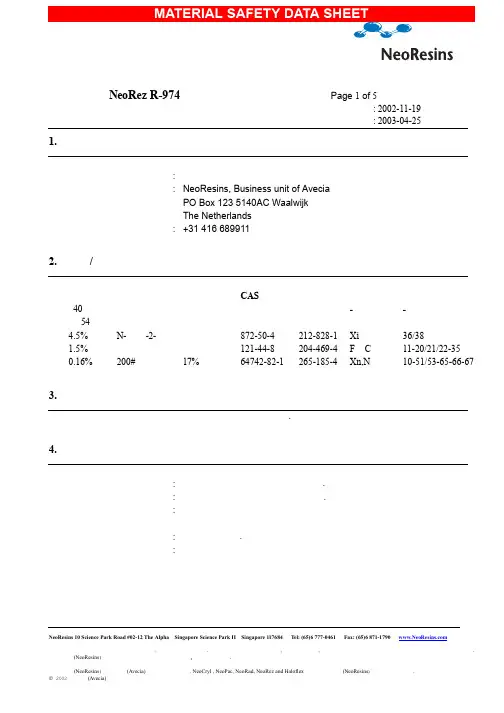
R35 造成严重灼伤;R36/38 对眼睛和皮肤有刺激性。
R51/53 对水生物有毒性,在水生环境中可能造成长时间不利影响。
R65 有害:如果吸入可能造成肺的损伤。
R66 重复暴露可能造成皮肤干裂
R67 蒸汽可能造成瞌睡和昏晕。
EINECS 注册(欧洲) : 此聚合物已经由指令 92/32/EEC 第 13.2 条通报了 EINECS(欧洲现
6. 泄露应急处理
人员防护 环境注意事项 清理方法
7. 操作处置与储存
: 防止皮肤和眼睛接触,防止吸入蒸汽。 : 不要排放到周围环境里。 : 用沙,土或其它适当的吸附剂将泄漏物吸收并转移到密封容器中处
理掉。
搬运 储存
: 不要在不通风处打开储罐以防吸入高浓度汽雾。不要吸入蒸汽,防
止皮肤和眼睛接触。 : 不要冷冻,贮存温度应在 5℃至 40℃之间。
MITI 注册(日本)
:
BAGT Nr./ 毒性级别(瑞 : 616200/无
士)
VOC(挥发性有机化合物) : VOC 列表 2(瑞士):4.5% N-甲基-2-砒咯烷酮
非欧盟国家立法
:-
本数据表的制定依照了委员会指令2001/58/EC, 67/548/EEC 和 88/379/EEC 以及相关的修正案,并且
利康树脂 (NeoResins)是奥维斯 (Avecia) 公司的树脂部门 . NeoCryl , NeoPac, NeoRad, NeoRez and Haloflex 都是利康树脂 (NeoResins)产品的注册商标 . 2002 奥维斯 (Avecia) 亚太有限公司
产品名称:NeoRez R-974
产品名称:NeoRez R-974
13. 废弃处置:
物质安全数据表MSDS汇总
適用滅火劑:泡沫、水霧、CO2 、乾 粉。 滅火時可能遭遇之特殊危害: 特殊滅火程序:使用水霧冷暴露火 焰下之容器設備。救火者須著防護衣 及呼吸器。 消防人員之特殊防護設備: 消防人員必須配戴全身式化學防護衣 及空氣呼吸器(必要時外加抗閃火鋁 質被覆外套)。
處置: 1. 不使用時及空容器,亦 應保持密閉。 2. 避免容器受撞擊損害。 儲存: 1.貯存於陰涼、乾燥、通風 良好的區域,避免陽光直接 照射並遠離不相容物,熱源 及火源。2.貯存在適當,有 標籤的容器內。 3.使用適當,經檢查核准之 貯槽、建築物、貯存室及貯 存櫃。
不同暴露途徑之急救方法: 1.接觸時,使用清水沖洗至少15分鐘。 2.皮膚接觸時,使用肥皂水及清水清洗暴露 之部位及脫掉被污染之衣物。 3.吸入時應移至新鮮空氣處,必要時使用呼 吸器及藥物治療,保持身體及休息。 最重要症狀及危害效應: 對急救人員之防護: 眼 部:化學安全眼鏡。 呼 吸:有機濾毒罐口罩。 手 套:橡膠手套(Neoprene gloves)
物質安全數據表(MSDS)
-- 依供应商提供的MSDS汇总
序 号
化学品 名称 物化性质 危害警告 预防措施 急救措施 消防措施 贮存措施 泄露/废物 处理措施
1
適用滅火劑:泡沫、水霧、CO2 、乾 粉。 物质状态:液体;颜色:微黄 健康危害效应:对眼睛和皮 滅火時可能遭遇之特殊危害: 色油状液体;气味:植物油 肤有刺激性;环境影响:泄 工程控制:无;急救控制:无; 特殊滅火程序:使用水霧冷暴露火 味;沸点/沸点范围:150℃ 露时以水冲洗,则污染水 不同暴露途径及急救方法:皮肤接触:用清 环氧大豆 呼吸防护:无;眼睛防护:安全 焰下之容器設備。救火者須著防護衣 (5mmHg);测试方法:开杯 闭 源;物理性及化学与危害: 水冲洗;最重要危害效应:无;对急救人员 油 眼镜;手部防护:橡皮或乳胶手 及呼吸器。 杯;密度:(20℃) 无;特殊危害:眼睛沾到会 防护:通风不良时佩戴合适的呼吸器; 套;皮肤及身体防护:无; 消防人員之特殊防護設備: 0.982~1.002;溶解度:0.01 刺痛眼睛 ;主要症状:无; 消防人員必須配戴全身式化學防護衣 (20℃) 物品危害分类:无; 及空氣呼吸器(必要時外加抗閃火鋁 質被覆外套)。 工程控制: 提供良好的自然通 风条件。呼吸系统:一般不需要 含量 99.5~99.7% 57437-59- 危险性类别:无; 特殊防护,但当作业场所空气中 9;外观与性状: 侵入途径:无; 氧气浓度低于18%时,必须佩戴 淡黄至黄色、无臭、粘稠液体 健康危害: 目前,未见职业 空气呼吸器。眼睛防护: 一般 氯化石蜡 。 中毒的报道。 不需特殊防护。身体防护: 穿 熔点(℃): 无资料 环境危害: 无 一般作业防护服。手防护: 戴 沸点(℃): 无资料 燃爆危险: 本品不燃。 一般作业防护手套。其他防护: 相对密度(水=1) 50℃: 工作完毕,彻底清洗。保持良好 1.23-1.25 的卫生习惯。 物質狀態:液體 ;顏色:無色 至淡黃 氣味:無味 pH值: NP 沸點/沸點範圍: 270.0-280.0℃( 5hPa) 分解溫度: >280℃ 閃火點: ca.200℃ ;測試方法: DIN EN 22 719 自燃溫度: 400℃ 爆炸界限: 在標準條件下沒有爆炸界限 蒸氣壓:<0.01hPa( at 20 ℃) 蒸氣密度:(空氣=1) 9.98 密度:0.972-0.977g/cm3 (20 ℃) 溶解度:0.46%( at 20 ℃) 危险特性: 受高热分解产生有毒的 腐蚀性烟气。有害燃烧产物:一氧化 碳、二氧化碳、氯化物。灭火方法: 本品不燃。消防人员必须穿全身防火 防毒服,在上风向灭火。尽可能将容 器从火场移至空旷处。喷水保持火场 容器冷却,直至灭火结束。灭火时尽 量切断泄漏源,然后根据着火原因选 择适当灭火剂灭火。
危险物品安全数据表MSDS
常用危险物品安全数据表(MSDS) 使用场所:编号:防护措施应急措施进入眼睛时触及皮肤时洒在地面时灭火方法关闭气源,用水、泡沫、二氧化碳灭火,灭火时站上风处并戴防毒面具。
储存阴凉通风,远离火源、热源,避免日晒、雨淋水湿,与氧气、压缩空气及其他化学危险品隔离存放。
禁止使用易产生火花的机械设备和工具、配备相应的消防器材,使用防爆行电气与照明设备。
常用危险物品安全数据表(MSDS)使用场所:编号:品名氩气(Ar)月用量kg性质相对密度分子量相对气体密度沸点(℃)1.41739.948 1.379-185.9危险有害性惰性气体,本身无燃爆危险, 但盛装氩气容器与设备遇明火高温可使器内压力急剧升高至爆炸。
本身无毒,但空气中浓度高时有窒息危险。
对环境无危险,对水体无污染。
闪点:燃点:熔点(℃):-189.2临界温度(℃):-122.4临界压力(MP A):4.864爆炸限度:上限(%)下限(%)对人身健康的危害:当空气中氩气浓度高于33%时就有窒息的危险。
当氩气浓度超过50%时,出现严重症状,浓度达到75%以上时,能在数分钟内死亡。
液氩可以伤皮肤,眼部接触可引起炎症。
防护措施应急措施进入眼睛时用清水冲洗。
触及皮肤时用清水冲洗。
洒在地面时灭火方法用水冷却火中容器,用着火环境相适应的灭火剂。
储存储存于通风库房,远离火种、热源、气瓶应有防倒措施。
常用危险物品安全数据表(MSDS)使用场所:编号:品名二氧化碳(CO2)月用量kg性质相对密度分子量相对气体密度沸点(℃)0.929548 1.53-78.5危险有害性不燃气体, 但盛装液体二氧化碳的设备与容器遇高温、明火有爆炸危险,流速过快容易产生和积聚静电。
本身无毒,但二氧化碳浓度高时就会改变血液的PH值,长时间吸入二氧化碳将引起代谢障碍。
非危险废气物,但大气中二氧化碳增加产生温室效应。
闪点:燃点:熔点(℃):-56.6临界温度(℃):31临界压力(MP A):7.382爆炸限度:上限(%)下限(%)对人身健康的危害:本身无毒,但当空气中浓度超过3%时能出现呼吸困难、头痛眩晕、呕吐等。
物质安全使用数据表(MSDS)
物质安全使用数据表(MSDS)第一部分化学品及企业标识化学品中文名称:脱模剂化学品俗名或商品名:金属压铸脱模剂化学品英文名称:casting release agent第二部分成分/组成信息成分长链烷改性砖乳液气味有极微量特征性气味外观乳白色至米色液体第三部分危险性概述危险性类别:环保型不易燃烧侵入途径:吞服环境危害:本产品为环保、无毒、无公害产品。
燃爆危险:本产品为水溶性,不燃烧,使用中应远离火源避免阳光直照和射,没有使用完的产品,桶盖密闭,以免质变。
第四部分急救措施皮肤接触:用清水彻底冲洗皮肤吸入:无特殊反应食入:现时未发现会对健康或生命构成危害。
第五部分消防措施危险特性:不易燃烧有害燃烧产物:CO2灭火方法及灭火剂:可用泡沫,二氧化碳、干粉、沙石扑救、用水灭火效。
第六部分泄露应急处理应急处理:大量物质溢漏应有容器收集后并弃置,小量物质溢漏时,如果当地法规允许,将其冲入下水道。
废物弃置方法:第七部分操作处置与储存操作注意事项:防止阳光长时间暴晒。
储存注意事项:储存于阴凉,通风库房仓、仓库温度宜5一45℃,保持容器密封,应与氧化剂、食用化学品分开存放,切忌混储。
第八部分接触控制/个体防护工程控制:加强通风。
呼吸系统防护:无害物质,无需特别防护。
眼睛防护:无害物质、无需特别防护。
身体防护:无害物质,无需特别防护。
手防护:无害物质,无需特别防护。
其他防护:工作现场禁止吸烟。
第九部分理化特性外观与性状:乳白色至米色液体粘度性:600一1200cps/25℃。
MSDS化学成分安全数据表
1、无色透时液体;
2、易挥发,易燃
用途
用于清洗及工业燃料用等。
危害性
1、长时间接触皮肤有剌激感;
2、吸入该产品蒸气过量会造成头痛晕弦;
3、该产品及蒸气易引火燃烧。
包装与储存
1、用铁罐或铁桶包装;
2、本品是易燃、易爆品,请密封低温储存(≤30℃)远离火源,最好有通风的危险化学品专用储存仓。
危害性
1、长时间接触皮肤有刺激感;
2、吸入该稀释剂蒸气过量会造成头痛晕弦;
3、该稀释剂及蒸气易引火燃烧。
包装与储存
1、用铁桶包装;
2、本品是易燃、易爆品,请密封低温储存(≤30℃)远离火源,最好储存在危险化学品专用储存仓。
泄漏处理措施
使用吸管或干布吸取并使用清水冲洗。
清理方法
用清水清洗干净,再用海绵布吸收后放入空容器内,达到环保目的。
个人防护措施
大量时,必要时带手套、口罩、防护眼睛操作。
搬运注意事项
搬运时,确定容器无泄漏,装载时严禁倒置、摔落、损伤,切实捆绑。
其他意外情况的处理措施
皮肤接触,迅速用水和肥皂清洗皮肤附着部位,如果有搔痒、炎症等症状,要立即请医生诊治;眼睛接触,立即用水清洗,至少15分钟以上。洗完后,立即请医生诊治;就医;吸入,如果吸入蒸气后有不适感,要立即转移至空气新鲜的场所,迅速请医生诊治;食入,用水清洗口腔。大量饮水在胃内稀释并吐出,之后立即请医生处治。
包装与储存
储存于阴凉、通风的库房。远离火种、热源。
泄漏处理措施
迅速清除附近的着火源,准备灭火器材;用破布、纱布、砂等吸附泄露液,并回收至容器中;作业时,必须穿戴保护器具,室内要充分通风。
废弃处理
销毁时,使用焚烧设备,每次少量焚烧。作为产业废弃物委托获得许可的处理业者处理。