
牛津译林版7B Unit3 Welcome to Sunshine Town Reading课件(共21张PPT)
Detail reading
Read and answer 1.What can I enjoy in the local theatre?
You can enjoy Beijing opera.
2.Who can sing Beijing opera in our class?
7B Unit3
Welcome to Sunshine Town
Reading 1
In the morning
There are a lot of trees and flowers.
The sky is blue and the air is fresh.
In the morning
In the morning, the park is quiet. Many people like jogging in it.
Homework
a. Read the context aloud
b. 完成《同步导学》上的本课时练习。
e f
g h
b d
a
c
T T F F
T
F
Ted and Mary are exchange students from the Uk. They want to call Daniel and Amy to ask questions about Sunshine Town. Work in groups of four to make up conversation between them.
At night lots of local theatres
当地剧院
Beijing Opera
京剧
In a modern city
Problem: air pollution 空气污染
New words in this lesson
underground 地铁 air 空气 Western 西方的 famous 著名的 fresh 新鲜的 Western 西方的 Beijing opera京剧 close 近的 far 远的 local 本地的 theatre 剧院 jogging 慢跑 take 花费 look forward to期盼着
b e d
a c
Sunshine Town
Fast reading
What can the exchange students do in Sunshine Town?
They can go to the park, go shopping, eat Chinese food and enjoy Beijing Opera.
At noon
Chinese food
It’s near.
It takes ten minutes to get there on foot.
At noon
Western food
by underground
It’s famous but it’s far away.
We have to go there by undergread and answer 1.How long is it from the centre of Beijing to Sunshine Town by underground? It is 40 minutes from the centre of Beijing to Sunshine Town by underground. 2.What can you see in Sunshine Park?
We can see trees ,lakes and green hills. 3.What do local people like doing in the park in the morning? They like jogging.
Detail reading
Read and answer 1. Are the most things in the town cheap or expensive? They are cheap. / They are not expensive.
2. What can you buy for your family and friends there? Wonderful presents
Detail reading
Read and answer 1.If I like Chinese food, what can I try? You can try Beijing Duck in the Chinese restaurants. 2.If I don’t like Chinese food, where can I go?
牛津译林版英语七下Unit3《WelcometoSunshineTown》(Grammar)说课稿
牛津译林版英语七下Unit 3《Welcome to Sunshine Town》(Grammar)说课稿一. 教材分析《Welcome to Sunshine Town》是牛津译林版英语七年级下册Unit 3的一篇课文,主要介绍了阳光镇的环境、设施和居民生活。
本文通过讲述阳光镇的故事,引导学生学习一般现在时态的被动语态。
教材内容丰富,插图生动,贴近学生生活,有利于激发学生的学习兴趣和积极性。
二. 学情分析七年级的学生已经掌握了基本的英语语法知识,对一般现在时态有所了解。
但部分学生对被动语态的用法还不够熟练,需要在课堂上进行针对性的训练。
此外,学生的阅读理解能力和口语表达能力有待提高,教师应注重引导学生进行深入的文本解读和交流互动。
三. 说教学目标1.知识目标:让学生掌握一般现在时态的被动语态结构,理解并运用被动语态描述事物。
2.能力目标:提高学生的阅读理解能力,培养学生的口语表达和写作能力。
3.情感目标:培养学生热爱生活、保护环境的美好情感,增强团队协作意识。
四. 说教学重难点1.重点:一般现在时态的被动语态结构及用法。
2.难点:被动语态在实际语境中的运用,尤其是动词短语的搭配。
五. 说教学方法与手段1.情境教学法:通过设置阳光镇的情境,让学生在真实的环境中感受和运用被动语态。
2.任务型教学法:引导学生参与各种小组活动,提高学生的合作能力和口语表达能力。
3.交际式教学法:注重师生互动,生生互动,激发学生的学习兴趣和积极性。
4.多媒体教学手段:运用图片、音频、视频等丰富教学内容,提高学生的学习体验。
六. 说教学过程1.导入:展示阳光镇的图片,引导学生谈论自己喜欢的城市或小镇,导入新课。
2.阅读理解:让学生阅读课文,回答相关问题,理解课文内容。
3.语法讲解:讲解一般现在时态的被动语态结构及用法,引导学生进行相关练习。
4.小组活动:学生分组讨论,用被动语态描述小组成员的动作,培养学生的实际运用能力。
牛津译林版英语七下Unit3《WelcometoSunshineTown》说课稿3
牛津译林版英语七下Unit 3《Welcome to Sunshine Town》说课稿3一. 教材分析《Welcome to Sunshine Town》是牛津译林版英语七年级下册Unit 3的一篇阅读文章。
文章介绍了一个名叫Sunshine Town的地方,通过描述那里的环境、设施和人们的生活,让学生了解到一个和谐、美好的社区是如何构成的。
文章语言简单,内容贴近生活,旨在提高学生对英语学习的兴趣,同时培养他们的阅读能力和语言运用能力。
二. 学情分析七年级的学生已经掌握了一定的英语基础知识,具备一定的阅读理解能力。
他们对新鲜事物充满好奇,善于模仿和探究。
针对这一特点,教师在教学过程中要善于激发学生的兴趣,引导他们主动参与课堂活动,发挥他们的主观能动性。
三. 说教学目标1.知识目标:学生能够掌握文章中的关键词汇和句型,理解文章大意。
2.能力目标:学生能够运用所学知识进行简单的交流,提高阅读理解和语言运用能力。
3.情感目标:学生能够体会到Sunshine Town的美好,激发他们对和谐社区的向往。
四. 说教学重难点1.重点:文章关键词汇和句型的掌握,以及阅读理解能力的提高。
2.难点:对文章深层含义的理解,以及情感目标的达成。
五. 说教学方法与手段1.情境教学法:通过设置真实的情境,让学生在实践中学习和运用英语。
2.互动教学法:引导学生积极参与课堂活动,提高他们的学习兴趣和积极性。
3.任务型教学法:通过完成具体任务,培养学生的合作意识和解决问题的能力。
六. 说教学过程1.导入:教师可以利用图片或视频展示Sunshine Town的美丽景色,激发学生的兴趣,引入新课。
2.阅读理解:学生独立阅读文章,回答相关问题,教师引导学生进行讨论和解答。
3.词汇学习:教师针对文章中的关键词汇和句型进行讲解和练习,让学生充分理解和掌握。
4.情境实践:教师创设情境,让学生运用所学知识进行交流和互动。
5.情感教育:教师引导学生关注文章中的情感元素,分享自己的感悟和体验。
牛津译林版 7BUnit 3 课文默写(汉译英)无答案

每天我能闻到花香,听到鸟儿歌唱。
我的房子附近有一个湖。
有时我们在那儿划船。
我们镇上大约有100户人家。
一些家庭养牛,另一些家庭种植小麦。
这儿的人们相互了解。他们都很友好。
每天有去镇中心的公共汽车。
通常我妈妈开车带我们去那儿购物。
我们喜欢这儿的生活。
我认为这是一个居住的绝妙的地方。
好的。我们在那儿可以干什么?
我们可以在湖上划船。
那太好了!我们几点见面?
我们明天上午8:30在你的宾馆前见面。
好的。北海公园离宾馆有多远?
乘公共汽车大约40分钟。
好的。我们将在那儿玩个痛快!
Task
中文
英文
你好,我是约翰。
我将带你参观我的家乡。
看!这是我的房子。
它在一个农场里。它有两层。
这儿的大部分人都住在这样的房子里。
我希望你不久就能来参观!
7B Unit3 Welcome to Sunshine Town!
Comic strip
中文
英文
霍波,我的一个老朋友要来看我。
但是冰箱里什么也没有了。
我们去超市吧。
等一下......埃迪,我们只有五块钱了。
买一罐狗粮够吗?
当然不够!
也许我们能点个披萨......
Welcome to the unit
你想要尝一尝吗?
这儿有许多中式餐馆。
如果你不喜欢中餐,也有一些餐馆。
你想要...欣赏京剧吗?
为什么不去我们本地的剧院欣赏京剧呢?
如果你想更多地了解中国艺术,不要错过那儿的戏剧演出。
欢迎到我们镇上来。
我们盼望不久就能见到你们。
Integrated skills
牛津译林版七年级下册Unit 3《Welcome to Sunshine Town》(Study s

牛津译林版七年级下册Unit 3《Welcome to Sunshine Town》(Study skills)教学设计一. 教材分析《Welcome to Sunshine Town》是牛津译林版七年级下册Unit 3的一篇课文,主要介绍了阳光镇的环境、设施和居民生活。
本课内容贴近学生生活,有助于激发学生学习英语的兴趣。
通过本课的学习,学生能够掌握相关词汇和句型,提高听说读写能力。
二. 学情分析七年级的学生具有一定的英语基础,对新鲜事物充满好奇。
但部分学生可能在听说方面存在困难,需要教师给予更多的关注和指导。
在课堂上,教师应充分调动学生的积极性,鼓励他们主动参与学习。
三. 教学目标1.知识目标:学生能够掌握课文中的相关词汇和句型,理解课文内容。
2.能力目标:学生能够运用所学词汇和句型进行简单的交流,提高听说读写能力。
3.情感目标:学生能够培养对美好环境的向往,增强环保意识。
四. 教学重难点1.重点:课文中的词汇和句型。
2.难点:课文的理解和运用。
五. 教学方法1.情境教学法:通过设定真实的生活情境,让学生在实际环境中学习英语。
2.任务型教学法:引导学生参与各种任务,提高实际运用英语的能力。
3.游戏教学法:通过趣味游戏,激发学生的学习兴趣,巩固所学知识。
六. 教学准备1.教学课件:制作课件,展示课文内容和相关词汇。
2.教学素材:准备相关的图片、视频等素材,辅助教学。
3.课堂活动:设计多样的课堂活动,激发学生的学习兴趣。
七. 教学过程1.导入(5分钟)利用课件展示阳光镇的美景,引导学生谈论自己对美好环境的向往。
教师用简单英语进行引导,激发学生的学习兴趣。
2.呈现(10分钟)教师展示课文标题《Welcome to Sunshine Town》,引导学生预测课文内容。
然后播放课文动画,让学生初步感知课文内容。
3.操练(15分钟)学生跟读课文,模仿语音语调。
教师抽取学生进行角色扮演,表演课文内容。
同时,教师引导学生运用课文中的句型进行互动交流。
牛津译林7B单元教案 Unit 3 Welcome to Sunshine Town 最新译林牛津初一英语下册

Unit 3 Welcome to Sunshine TownWELCOME TO THE UNITTeaching aims and demands:.1.Make suggestions about visiting places and doing activitiese.g. Let`s go swimming.2. Use “How much” and “How many”, “no” and “none” to express quantities .3..To revise vocabulary about activities and places in new situations4..To make suggestions about visiting different placesStep 1. Lead-inAsk students about what they like and could do in their areas, e.g.T: What do you like doing?S1: I like shopping.T: Where can we do some shopping?S1: The shopping mall/center.In the same way, present “eating” “restaurant” “watching” “cinema” “playing” “sports center”Step 2. Presentation1. The Beijing Sunshine Secondary School students are planning a visit for British exchange students coming to their school.Do part A and B to activate students’ ideas about what people can do in their community.2. Ask students to do Part A and B on their own using the information provided in the picture prompts.3. Underline some phrases.Step 3. PracticeDo a chain work.S1 says what he/she likes, e.g. I like eating Chinese food. S2 repeat what S1 likes, then adds what he/she likes, e.g.Paul likes eating Chinese food and I like playing tennis.Step 4. Presentation1.Say: What does Eddie like? (sleeping and eating)There is no food now. Eddie and Hobo are going to the supermarket.2.Listen to the tape and answer:How much money do they have?3.Play the tape. Listen then check the answer.4.Students listen and read after the tape.5.Go through the dialogues6. Act out.Unit 3 Welcome to Sunshine Town ReadingObjectives:1. To read and learn about something about Sunshine Town.2. To grasp the main idea of each paragraph..3. Ask Ss to write an article to introduce their own home town, using the context as a model.Teaching Procedures:1.Ask some students some questions “Are there any tall buildings in your home town?” “What can you do in your town?”, etc.2.Presentation(1).Use the pictures to teach the new words.underground air pollution lake building theatre(2) Now let’s listen to the tape and say “T” or “F” according to the text. Check the answers with the whole class.① It takes 40 minutes to walk to the center of Beijing from Sunshine Town.②There is less air pollution in Sunshine Town.③ Many students live in tall buildings.④There are only two shopping malls in Sunshine Town.⑤You can eat Beijing Duck in Sunshine Town.⑥You can enjoy Beijing Opera at the theatre.(3) Ask Ss to read the text after the tape.(4) Language points:① It is only 40 minutes from the center of Beijing by underground.= It takes 40 minutes to go to Sunshine Town from the center of Beijing by underground.② There is less air pollution in Sunshine Town than in other areas of Beijing.Less…than…→more…than…e.g. There is less water in this glass than in that one.I have more books than he.③ Here is such a tall building. such+a/an+adj.+n.(single)e.g. such a beautiful garden such an interesting story④be close to =be near→ be far from⑤⑥Why don’t you visit our local theater with us?Why don’t you do=Why not do e.g. Why don’t you go swimming?Why not come with me?(5) Sum-up Go through the new words and language points.3. Read after the tape. Retell the passage.Unit 3 Welcome to Sunshine TownGRAMMARTeaching Aims:1.Noun +’s2.Possessive adjectives and pronouns3. The words:postcard key ring yours hers4. T he phrases: all overAbilities:1 Use Noun +’s correctly2 Use Possessive adjectives and pronouns correctlyTeaching ProceduresStep 1 : Revision1.Free talk2.Revise what they learned in ReadingStep2:PresentationNoun + ’sStep I Presentation1 Show a picture of a dog and write the following on the blackboard:教boy ’s.2 Show a house and write Kobe ' S on the blackboard.3 Show a picture with many shoes on it and say: There are a lot of shoes in this picture . whose shoes are they?Then present some women’s faces and say:The shoe s are these women’s.Write women’s on the blackboard.4 Show a picture of a bedroom and write:brothers’.5 Mark boy ' s with colourful chalk,and tell the students we usually add ‘s to express the idea of belonging.6 Ask the students to find out the rules.step II Practice1 Finish PartA .2 Ask and answer:whose … is that ? whose … are they ?B Possessive adjectives and pronounsStep I Presentation1 Present possessive pronouns with the things in the classroom.Write my 、mine 、his 、her and hers on the blackboard.2 Present the following with the same step :our 、ours 、your 、yours 、their 、theirs 、its .3 Explain:We use possessive adjectives and pronouns to show that something belongs to someone or something .Step II Practice1 Finish PartB .2 Ask the students to read the dialogue.step III Make a similar dialogue and checkUnit 3 Welcome to Sunshine TownTeaching aims and demands:.1. To listen for detail and abstract information about making arrangements.2. To order information from a tour g uide’s introduction.Teaching procedures:Ⅰ. Bring some pictures about famous local places to class. Ask a few very general questions. “Do you like the place?”“Have you visited there?”.Ⅱ. Go through some key vocabulary items in PartA1&A2: exhibitions, golden thrones, potteryⅢ. Tell Ss to fill in the table in PartA2 carefully, then check the answers.Ⅳ. NotesBaohe Palace---works of art这里的works作可数名词,是“作品”,“著作”的意思,而work作为不可数名词是“工作”之意.e.g. I like reading the works of Shakespeare.At last I found work in the city.Ⅴ. Explain to Ss that they will listen to a tour guide’s introduction. Listen to the recording. Ask them to do the task on their own first, then check answers.Ⅵ. Ask Ss to read Simon’s notes in PartA4. Play the recording again and ask Ss to complete PartA4. Check answers as a class.Part BⅠ. Read after the tape.Ⅱ.Two Ss in a pair and role-play the conversationⅢ.Ask Ss to make a new dialogue. Using the dialogue in Part B as a model.Ⅳ.Talk to Ss about making arrangements.e.g. visiting friends, going to cinema, going to a restaurant.Study skillsStep I presrntationQueations:( 1 ) What is your favourite place in your city / town ?( 2 ) How do you get there ?( 3 ) How far is it from your home to the city / town centre ?( 4 ) Who’s famous in your city / town ?( 5 ) What food is famous in your city / town ?2 write down some answers on the blackboard,then underline the stress words.3 Can you find other important information in these sentences ?4 Encourage the students read more and find the key words.重要词:nouns , main verbs , adjectives and adverbs非重要词:articles , prepositions , pronouns and conjunctionsstep II exerciseRead together, then find the stress words.Teaching procedures:Step 1 PresentationThe teacher can talk about our own hometown with the students.1 .Do you like the city / town you live in ?2. Do you like your hometown ?3. Are people here very friendly ? Do they often help each other ?4. Do many people drive cars to go to work?Bb: hometown friendly drive each other 。
牛津译林版七年级下册(新)英语教案7BUnit3WelcometoSunshineTownReading1
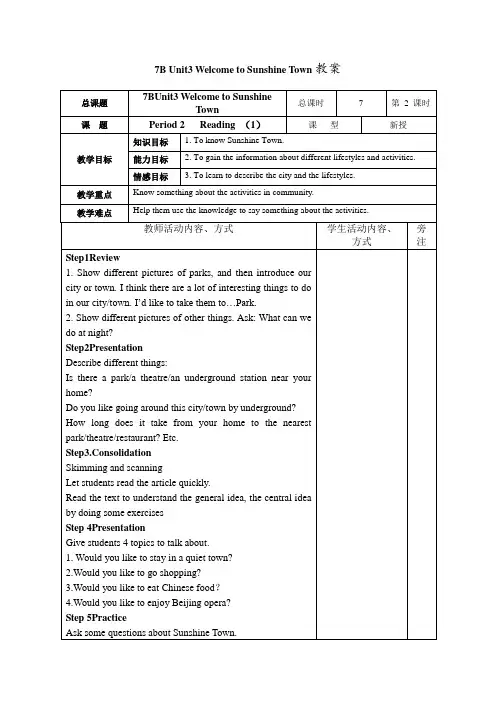
情感目标 3. To learn to describe the city and the lifestyles.
教学重点 Know something about the activities in community.
教学难点 Help them use the knowledge to say something about the activities.
Review the names of the things Teach new vocabularies. Consolidate the new learning vocabularies by guessing game. Step7Extension Learn new vocabularies. Read text quickly, and do the exercises Read the whole text, finish exercises Step7Extension Students can learn better by listening to the script. Reading fast can develop the right reading habits. Understanding of different types of read the questions to help students complete the curricular and articles. The free communication is the stage of reading the text, the integrated use of the knowledge. Enable students to appreciate the power of collective intelligence cooperation, complementarity and common progress. Consolidate the knowledge. Put forward their own views. Step8Homework Show some pictures to review the words . Have a guess according to the description of the teacher.
新版译林7B unit3 welcome to Sunshine Town(完整课件)
2. Local people like jogging in the park
in the morning.
3. There are not many shops in
Sunshine Town.
4. The things in the shops are nice but
expensive.
5. You can get Beijing duck in the town.
Reading A video(视频/短片) about Sunshine Town
Practice
Is there a park near your home? Do you like going around this city? Do you like jogging in the park? Do you think the air is fresh there? Which do you like, Chinese food or Western food? Do you like watching Beijing opera?
6. You can learn how to sing Beijing
opera in the town.
Three Foxes Once there were three foxes, they worked together. They lived a happy life. Little by little, the youngest fox became lazy, and often quarreled with the other foxes. The eldest had to leave, and the second fox was driven off, too. Looking at the warm house with a lot of good food in it, the youngest fox smiled. The eldest fox opened a new hill again. The second eldest fox dug a pool. Two of them because rich soon. The youngest fox ate up the food left by the other two foxes. In the end it felt so cold and hungry that it could not stand up.
[译林版]7B Unit3 Welcome to Sunshine Town知识点总结
7B Unit3 Welcome to Sunshine Town知识点总结1.Welcome to Sunshine Town.欢迎来到阳光镇。
1)“Welcome to +地点”表示“欢迎来到……!”如:欢迎到我们的学校来!2) welcome后面如果接副词,则应省略介词to。
如:欢迎回家/回来。
3)welcome做形容词,意为“受欢迎的”。
如:不用谢。
2. An old friend of mine is coming to visit me, Hobo.is coming是现在进行时,表示将要发生的动作。
在英语中一些位移动词,如come,go,leave等可用现在进行时表示将要发生的动作。
如:一Lingling! Supper is ready.—玲玲,晚饭准备好了。
一I’m coming,Mum. –我就来,妈妈。
an old friend of mine 我的一位老朋友of后用的是名词性物主代词这是双重所有格结构。
双重所有格是指既含有没那个词的所有格或名词性物主代词,又含有of短语的一种表达所有关系的结构。
如:这是我妹妹的一位老师。
在英语中冠词与物主代词不能同时放在同一个修饰词前,要表示“我的一个….”或“他的两个…..”则须用“冠词/数词+名词+of+名词性物主代词”结构。
如:Tim的一个钢笔她的一本书3There’s nothing in the fridge. Nothing=not anything 没有什么Nothing something anything 这些词是不定代词,形容词修饰时要放后面。
如:没有什么重要的Nothing做主语时,谓语动词用单数形式。
Nothing本身含有否定意思,谓语动词不能再用否定式。
如:There is nothing in my bag.==没有什么能阻止西蒙努力学习。
4Let’s go to the supermarket.Let’s是let us 的缩写,后接动词原形,通用用来表示提出建议、请求等。
译林版英语7BUnit3WelcometoSunshineTown知识点总结
s ten minutes’ walk /two hours18、Western restaurants/food/countries 西餐馆/西餐、西方国家西餐、西方国家 19、enjoy Beijing opera 欣赏京剧欣赏京剧20、visit our local theatre 参观我们当地的剧院参观我们当地的剧院21、learn more/a lot about Chinese art 更多地了解中国的艺术更多地了解中国的艺术learn from sb. 向某人学习向某人学习向某人学习 learn a lot 学到很多学到很多学到很多learn from each other 互相学习互相学习He learned that our principal would go to Taiwan. 他得知我们校长将去台湾他得知我们校长将去台湾22、Don Don’’t miss the opera shows 别错过戏剧表演别错过戏剧表演miss doing sth/miss sb 错过做---,想念某某,想念某某 go missing 没了没了miss sth/doing sth(错过) miss sb.(想念);错误,过失(名词)I don’t want to miss __________(watch)the TV play. 失之毫厘,谬以千里______________________________________ 23、welcome to our town 欢迎来我们镇欢迎来我们镇24、look forward to meeting you 期待着见到你期待着见到你look forward to sth / doing sth 盼望某物/做某事做某事pay attention to doing /devote …to doing/prefer doing to doing/be used to doing 25、all over the place 满地是满地是all over/around the world 26、a day at the Palace Museum 在故宫的一天在故宫的一天27、works of art 艺术品艺术品work 作品(可数) 工作(不可数)也可做动词 这项工作很艰苦,我们应该努力工作去完成。
牛津译林版英语七下Unit 3《Welcome to Sunshine Town》(Welcome
牛津译林版英语七下Unit 3《Welcome to Sunshine Town》(Welcome to the unit)说课稿一. 教材分析《Welcome to Sunshine Town》是牛津译林版英语七年级下册Unit 3的一篇阅读文章,主要介绍了一个名为Sunshine Town的地方,通过描述那里的环境、设施和人们的生活,让学生了解一个理想的生活环境。
本文语言简单易懂,贴近生活,富有生动性,有利于激发学生的学习兴趣。
二. 学情分析针对七年级的学生,他们已经具备了一定的英语基础,能够进行简单的英语交流。
但他们在阅读理解方面还存在一定的困难,需要通过教师的引导和帮助,提高阅读理解能力。
此外,学生对新鲜事物充满好奇,喜欢通过图片、视频等直观手段进行学习,因此在教学过程中,我将会运用多种教学手段,激发学生的学习兴趣。
三. 说教学目标1.知识目标:学生能够掌握文章中的关键词汇和句型,理解文章的主旨大意。
2.能力目标:学生能够运用所学词汇和句型进行简单的口语交流,提高阅读理解能力。
3.情感目标:学生能够了解并欣赏美好环境,激发他们对美好生活的向往。
四. 说教学重难点1.重点:文章中的关键词汇和句型的学习和运用。
2.难点:对文章细节内容的理解和把握,以及情感目标的达成。
五. 说教学方法与手段1.交际法:通过情景模拟、角色扮演等方式,让学生在实际语境中运用所学知识。
2.任务型教学法:引导学生参与各种任务,激发他们的学习兴趣,提高实践能力。
3.多媒体教学法:运用图片、视频等直观手段,帮助学生更好地理解文章内容。
六. 说教学过程1.导入:通过展示图片,引导学生谈论他们喜欢的城市或小镇,激发学生对本文的兴趣。
2.阅读理解:学生自主阅读文章,回答相关问题,教师引导学生讨论,帮助他们理解文章内容。
3.词汇学习:教师讲解文章中的关键词汇和句型,学生进行口语练习。
4.情景模拟:学生分组进行角色扮演,运用所学知识进行实际操作。