
译林版英语四年级下册Unit 7-8单元知识点
Unit 7 What’s the matter? 知识汇总
一、语音
o / əʊ/close home no nose open old so go cold
Go home, Joe, and show Rose your nose!
二、词汇
1. have a pie 吃个派
2. some water 一些水
3. Here you are. 给你。
4. want to go to bed 想睡觉
5. be ill 生病的,不舒服的
6. drink some water 喝些水
7. tired and thirsty又累又渴8. Good night. 晚安。
9. have a cake 吃块蛋糕10. a happy girl 一位快乐的女孩
11. show Rose your nose给罗斯看你的鼻子12. take this pill 吃这片药13. Mrs. Mouse 老鼠夫人14. Mr. Fox 狐狸先生
15. go home 回家16. want to sit on the chair想要坐在椅子上
三、句型
1. What’s the matter? 怎么了?
2. Come and have a pie, Taotao. 过来吃个派,涛涛。
3. I’m not hungry, I’m thirsty. 我不饿,我渴。
4. Can I have some water? 我可以喝些水吗?
5. Are you ill? No, but I’m tired. 你病了吗?没,但我累了。
6. I want to go to bed. 我想要睡觉。
7. Good night, dear. 晚安,亲爱的。
8. Here is some water for you. 这儿有些水给你。
9. Are you cold? 你冷吗?No, I ’m not. / Yes, I am.
10. This is Mrs Fox speaking. 我是狐狸夫人。
(打电话用语)
11. Are you all right, Bobby? 波比,你还好吗?
12. Have some water, Wang Bing. 王兵,喝一些水。
13. Here’s a hot dog. 这有个热狗。
14. Here are some hot dogs. 这有些热狗。
15. If you are ill, go to/and see a doctor. 如果你生病了,去看医生吧。
Unit 8 How are you? 知识汇总
一、语音
o / ɒ/coffee, dog, hot, not, sock, box, fox
The hot dog in the box is not lunch for the fox!
三、词汇
1. speak to Miss Li 和李老师通话
2. come to school 来到学校
3. have a cold 感冒
4. take care 保重
5.have a cough and a headache 得了咳嗽并头痛
6. I’m fine. 我很好。
7. at school 在学校8. Not so good. 不太好。
9. go and see 去看看10. a bad cough 严重的咳嗽
11. See you. 再见12. have a fever 发烧
13. have a bad cold 重感冒14. have a high fever 发高烧
15. at home 在家16. not bad 还不错
17. the hot dog in the box 盒子里的热狗18. after school 放学后
三、句型
1. This is Yang Ling speaking.我是杨玲。
(电话用语)
2. May I speak to Miss Li?我可以和李老师通话吗?(电话用语)
3. I can’t come to school today. 今天我不能到学校来了。
4. I have a cold and a fever. 我感冒并发烧了。
5. I’m sorry to hear that. 听到这个消息我很难过。
6. Take care, Yang Ling. 保重,杨玲。
7. How are you now? I’m fine, thank you./Not so good. I have a cough.
你现在好吗?我很好,谢谢。
/不太好。
我咳嗽了。
8. Can you come to school tomorrow? 你明天能来学校吗?
9. See you tomorrow. 明天见。
10. Is Bobby there? No. He’s at school. 波比在吗?不在,他在学校。
11. The hot dog in the box is not lunch for the fox!
盒子里的热狗不是那只狐狸的午餐。
12. Well, go and see Doctor Wu! 那么,去看吴医生吧!
13. Can I come to see you after school? 放学后我能来看望你吗?
14. See you soon. 一会见。
译林版英语四年级下册知识总结与整理
译林版英语四年级下册知识总结与整理
四年级下册主要内容包括以下几个方面:
词汇
四年级下册词汇主要涉及动物、食物、身体部位、天气、交通工具、数字、家庭成员等方面。
需要掌握这些词汇的拼写、发音和基本用法,以便于进行听、说、读、写等基本语言实践。
语法
四年级下册语法内容主要包括一般现在时、动词的进行时、名词单数和复数、形容词比较级和最高级等方面。
需要掌握这些语法知识并能够正确地运用到实际语言交际中去。
阅读
四年级下册的阅读内容为各类短文,主要包括图表、故事、科普知识等。
需要通过阅读能够理解短文中所蕴含的信息,同时培养对语言的理解和运用能力。
写作
四年级下册写作主要包括书写、句型和话题写作。
需要能够正确使用所学词汇和语法知识,准确地表达所要表达的意思。
四年级下册英语具体考察内容和形式根据各地实际情况而有所不同,需要根据教材内容制定相应学习计划并加以实践。
通过课上学习和课下练习,逐步提高英语听、说、读、写能力,实现英语学习的良好开端。
Unit8语法(复习讲义)-2023-2024学年四年级英语上册单元速记·巧练(译林版三起)
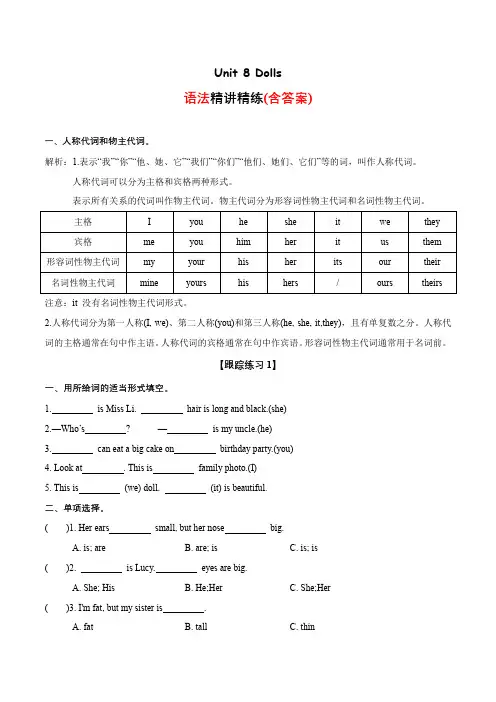
Unit 8 Dolls语法精讲精练(含答案)一、人称代词和物主代词。
解析:1.表示“我”“你”“他、她、它”“我们”“你们”“他们、她们、它们”等的词,叫作人称代词。
人称代词可以分为主格和宾格两种形式。
表示所有关系的代词叫作物主代词。
物主代词分为形容词性物主代词和名词性物主代词。
注意:it 没有名词性物主代词形式。
2.人称代词分为第一人称(I, we)、第二人称(you)和第三人称(he, she, it,they),且有单复数之分。
人称代词的主格通常在句中作主语。
人称代词的宾格通常在句中作宾语。
形容词性物主代词通常用于名词前。
【跟踪练习1】一、用所给词的适当形式填空。
1. is Miss Li. hair is long and black.(she)2.—Who’s ? — is my uncle.(he)3. can eat a big cake on birthday party.(you)4. Look at . This is family photo.(I)5. This is (we) doll. (it) is beautiful.二、单项选择。
( )1. Her ears small, but her nose big.A. is; areB. are; isC. is; is( )2. is Lucy. eyes are big.A. She; HisB. He;HerC. She;Her( )3. I'm fat, but my sister is .A. fatB. tallC. thin( )4.—Are eyes big? —No. They're small.A. theyB. yourC. there二、描述某人或某物特征的句型。
二、描述某人或某物特征的句型。
解析:1. “...is tall/short/fat/thin/long/big/small.”用来描述某人或某物、某人或某物的某个部位的特征。
译林版四年级下册英语教案:Unit 7 What’s the matter? 单元教案

译林版四年级下册英语教案:Unit 7 What’s the matter?教学目标1.能听、说、读、写单词和短语:matter,toothache,headache,stomachache,cold,sore throat,fever, cough;2.能听懂并简单运用日常用语,询问他人的身体状况;3.能够用What’s the matter?来问别人身体不适的原因;4.能了解并掌握洗手的重要性,养成良好的卫生习惯。
教学重难点1.询问别人身体不适的原因和反应;2.锻炼学生的口语表达能力;3.培养学生良好的个人卫生习惯。
教学过程Step 1. Warming up1.Greeting: Good morning/afternoon, class.2.Ask some general and review questions about the previous English lessons, such as:•What did we learn about colors?•What did we learn about food and drinks?•What did we learn about clothes?Step 2. Presentation1.Show students some pictures of people who may feel sick, such as someone with a headache or stomachache.2.Ask students, What’s the matter? to elicit the target language.3.Teach the students the new words and phrases: matter, toothache, headache, stomachache, cold, sore throat, fever, cough. Have the students repeat the words after the teacher.e the pictures to teach the phrases: He/She has atoothache/headache/stomachache/cold/sore throat/fever/cough.Step 3. Practice1.Role play: Divide the students into pairs. One student plays the role of someone who feels sick, and the other student plays the role of the doctor. The doctor asks What’s the matter? and the patient answers with one of the phrases they have learned.2.Class survey: Have the students survey each other about how they are feeling today. The students ask each other, How are you feeling today? and answer with one of the phrases they have learned.3.Song activity: Play the song “Head, Shoulders, Knees and Toes” and have the students sing and touch their body parts.4.Demonstrate and practice washing hands: Use a hand washing poster to demonstrate how to wash hands properly, and have the studentspractice washing their hands.Step 4. Production1.Show pictures of some situations and have the students answer the question, What’s the matter? and make suggestions about what the person should do. For example, if the picture shows someone coughing, the students can say, He/She has a cough. He/She should drink some warm water.2.Worksheets: Have the students complete worksheets about the target language, match the symptoms with the pictures, and fill in the blanks with the correct words.Step 5. Wrap up1.Recap the target language, phrases, and structures that they have learned in this lesson.2.Assign homework activities, such as reviewing the new vocabulary words and phrases and practicing them with family members.教学反思在本次课程中,我采用了多种教学方法,包括图片演示、角色扮演、问卷调查、歌曲活动和手工活动等,这些活动丰富了课堂氛围,并激发了学生参与的积极性。
新译林版四年级英语上册1-8单元常考知识点汇总

新译林版四年级英语上册1-8单元常考知识点汇总Unit 1: I Like DogsKey Vocabulary:likedogcatpandahorsetigerUseful Phrases:look atcute and fathave a cakeon the login the treerun with meon the matboys and girlsCommon Sentences:1.Look at these pandas.When referring to multiple pandas。
use "these" as it is a plural word。
Add an "s" to the end of "panda" to make it plural。
Example: Look at those mangoes。
2.I like cats.When expressing a liking for a type of animal。
use "like" and add the plural form of the animal。
Example: I like pandas。
3.Do you like dogs。
Yes。
I do./No。
I don't.When answering a yes/no n。
use the same verb as the n and add "do" or "don't" to indicate agreement or disagreement。
Example: Can you swim。
Yes。
I can./No。
I can't.I like pandas because they are cute and chubby。
江苏译林版小学英语四年级下册单元知识点总结
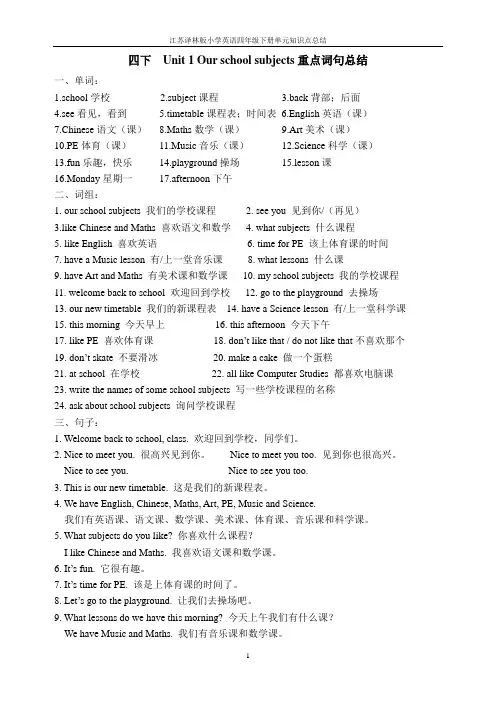
四下Unit 1 Our school subjects重点词句总结一、单词:1.school学校2.subject课程3.back背部;后面4.see看见,看到5.timetable课程表;时间表6.English英语(课)7.Chinese语文(课)8.Maths数学(课) 9.Art美术(课)10.PE体育(课) 11.Music音乐(课)12.Science科学(课)13.fun乐趣,快乐 14.playground操场15.lesson课16.Monday星期一17.afternoon下午二、词组:1. our school subjects 我们的学校课程2. see you 见到你/(再见)3.like Chinese and Maths 喜欢语文和数学4. what subjects 什么课程5. like English 喜欢英语6. time for PE 该上体育课的时间7. have a Music lesson 有/上一堂音乐课8. what lessons 什么课9. have Art and Maths 有美术课和数学课10. my school subjects 我的学校课程11. welcome back to school 欢迎回到学校12. go to the playground 去操场13. our new timetable 我们的新课程表14. have a Science lesson 有/上一堂科学课15. this morning 今天早上16. this afternoon 今天下午17. like PE 喜欢体育课18. don’t like that / do not like that不喜欢那个19. don’t skate 不要滑冰20. make a cake 做一个蛋糕21. at school 在学校 22. all like Computer Studies 都喜欢电脑课23. write the names of some school subjects 写一些学校课程的名称24. ask about school subjects 询问学校课程三、句子:1. Welcome back to school, class. 欢迎回到学校,同学们。
[译林版]四年级英语下册分单元知识点练习
![[译林版]四年级英语下册分单元知识点练习](https://360docs-1393072327.cos.ap-beijing.myqcloud.com/06e45bfe3b3567ec112d8a54.webp)
Unit 1 Our school subjects (1)班级:姓名:学号:一、英汉互译。
1. 两门学科2. make a big cake3. 今天下午4. all like our teacher5. 是…的时间了6. my school subjects7. 一本美术书8. skate well9. 多少节数学课10.welcome to Suzhou二、选择题。
( ) 1. How many _______do you have this term(学期)?We have eight.A. subjectB. lessonC. subjectsD. lessons( ) 2. It’s time _______ English. Let’s go to the classroom(教室).A. atB. forC. inD. on( ) 3. What lessons do you have this morning? We _______ Chinese, Maths and Music.A. doB. have C are D is( ) 4. A: Do you have _____ PE lessons this week(星期)? B: Yes, I do.A. any B some C a D an( ) 5.The Science book is _______ the bedroom, ________ the chair.A on; inB in; onC at; onD in; in( ) 6. __________ a timetable for you.A. HereB. Here’s C .Here are D.It is( ) 7.Art and Science ________ fun.Ais B am C are D not( ) 8.A: How much is the book? B: _____________A It’s five.B They’re four yuan. C. It’s four yuan. D. They are four.( ) 9.—What ________ do you like? —I like English and Chinese.A.subjectB. subjectsC. a subjectD. an subjectUnit 1 Our school subjects(2)班级:姓名:学号:一、用所给词的适当形式填空。
Unit7What'sthematter?重点知识练习(讲义)-译林版英语四年级下册
译林版四下Unit 7 What's the matter?一、语音O o /əʊ/ G o home, J o e, and sh o w R o se your n o se!cl o se, h o me, n o, n o se, o pen, c o ld, s o, cl o thes, g o, s o fa, sh o w, b o at, c o at 二、单词1.thirsty 渴的2. water 水3. il 生病的4.tired 累的5. happy 快乐的6.dear 亲爱的7.Mrs 夫人8.speak 说话三、词组l. e and have a pie 过来吃个派2. not hungry but thirsty 不饿但是渴3.have some water 喝一些水4. not ill but tired 没有生病但是累的5. want to go to bed 想睡觉6.Good night.晚安。
7. tired and thirsty 又累又渴8. happy or sad 快乐还是悲伤9. Mrs. Mouse 老鼠夫人10.all right 好的11.show Rose your nose 把你的鼻子给罗斯看看12. take this pill 吃这片药13. my dear friends 我的亲爱的朋友14. feel cold 觉得冷15. drink some juice喝一些果汁16. a glass of hot water 一杯热水17. a happy family一个快乐的家庭18.speak to Mike 和Mike 说话19. want a fan 想要把扇子20. sit down坐下四、句型1. What's the matter? 怎么了?I'm sad. 我难过。
2. What's the matter?怎么了?Are you ill?你病了吗?No, but I'm tired. 不,但我累了。
译林版英语四年级下册各单元重点短语和句子总结
短语及句子归纳Unit 1短语1.our new timetable 我们的新课表2.like Chinese 喜欢语文3.like Maths喜欢数学4.like English喜欢英语5.go to the playground去操场6.what lessons什么课7.what subjects什么课程(科目)8.this morning今天早上9.this afternoon今天下午10.don’t skate不滑冰11.make a cake做一个蛋糕e and make a cake过来做一个蛋糕13.our school subjects我们的学校课程14.at school 在学校Unit 1句子句子1.Welcome back to school. 欢迎回校。
2.Nice to see you. 见到你很高兴。
3.What about you? 你呢?4.It’s fun. 有趣。
5.It’s time for PE. 该上体育课了。
6. A: What subjects do you like? 你喜欢什么科目?B: I like Art and Music.我喜欢美术和音乐。
7.A:What lessons do we have this morning?我们上午有什么课?B:We have English、Chinese、and Maths.我们有英语、语文和数学。
e and make a cake.过来做一个蛋糕。
9.They like Music. We all like English.他们喜欢音乐。
我们都喜欢英语。
Unit 2短语和句子1. after school 放学后2. What day is it today? 今天星期几?3. What a pity! 真遗憾!4. All right. 好的。
5. what day星期几6. on Saturday 在星期六7. what lessons 什么课8.have Chinese and Maths 有语文和数学课9. get up at five 五点起床10. after school放学后11. go and play table tennis去打乒乓球12. a football match 一场足球比赛13. have a swimming lesson 有一节游泳课14. don’t have any lessons 没有课15. every day 每天16. at six 在六点17. come and play table tennis 来打乒乓18. Let’s go and play table tennis. 咱们去打乒乓吧。
(完整word版)译林版英语四年级下册Unit7-8单元知识点
Unit 7 What’s the matter? 知识汇总一、语音o / əʊ/close home no nose open old so go cold Go home, Joe, and show Rose your nose!二、词汇1.hav..pi.吃个.......2.som.wate.一些水3.Her.yo.are.给你......4.wan.t.g.t.be.想睡觉5.b.il.生病的,不舒服.....6.drin.som.wate.喝些水7.tire.an.thirsty又累又.... 8.Goo.night.晚安。
9.hav..cak.吃块蛋..... 10..happ.gir.一位快乐的女孩11.sho.Ros.you.nose给罗斯看你的鼻...12.tak.thi.pil.吃这片药13.Mrs.Mous.老鼠夫..... 14.Mr.Fo. 狐狸先生15.g.hom.回........16.wan.t.si.o.th.chair想要坐在椅子上三、句型1.What’.th.matter.怎么了?.an.hav..pie.Taotao.过来吃个派,涛涛。
3.I’.no.hungry.I’.thirsty.我不饿, 我渴。
4.Ca..hav.som.water.我可以喝些水吗?5.Ar.yo.ill.No.bu.I’.tired.你病了吗?没, 但我累了。
6..wan.t.g.t.bed.我想要睡觉。
7.Goo.night.dear.晚安,亲爱的。
8.Her.i.som.wate.fo.you.这儿有些水给你。
9.Ar.yo.cold.你冷吗?No..’.not..Yes..am.10.Thi.i.Mr.Fo.speaking.我是狐狸夫人。
(打电话用语)11.Ar.yo.al.right.Bobby.波比, 你还好吗?12.Hav.som.water.Wan.Bing.王兵, 喝一些水。
译林版四年级英语下册第七单元4B Unit7 教案
Unit 7 What’s the matter?Ⅰ The background information本单元的话题是询问和表达“感受”和“感觉”,根据课文主体内容及结构,本单元可分为四个课时,可根据教材中的人物刘涛的家庭和校园生活为主线贯穿和推进这个单元的学习。
教师要充分运用课本资源,以交际为目的,帮助学生习得语言而非学得语言。
学生已有的学习经验:在三、四年级上学期的学习中已经学过有关的衣物类单词,并对其进行描述。
学生已有的生活经验:在生活中初步积累过一些关于课程的词汇。
首先充分利用书本,根据书本上的图片让意和形结合,充分调动学生的感知,让学生学的愉快而轻松。
其次,结合三年级已学的相关知识,让学生以旧带新,并且新旧结合,滚动复习,拓展语言运用面。
最后丰富学生的语言知识,通过模仿角色进行表演的方式让学生真正用到所学语言。
在字母发音上要让学生学会方法,自己归归类,自己总结发音规律,方便记忆。
同时也要指导学生练习单词重音和句子重音,培养学生的朗读节奏和语感。
Ⅱ Teaching aims and learning objectives学完这一单元,学生将能够:一、能听懂,会读,会说,会写单词:happy , hungry, ill, sad, thirsty, tired.二、能听懂,会读,会说句子:What’s the matter ? Are you happy/hungry /ill/sad/thirsty /tired? I’m happy/hungry /ill/sad/thirsty /tired . Here’s …for you .三、能诵读歌谣《 Are you ill? 》。
四、了解字母o在单词中的读音。
Ⅲ Focus of the lesson and predicted area of difficulty一、在语境中理解和运用表示feelings 的形容词。
二、在语境中感知词汇dear, Mrs, speak. 在此基础运用单元目标句型,What’s the matter? I’m ..Can I have…? Here you are. Come and have…I want to …Good night.三、最终让学生产生主动关心帮助他人的情感体验。