
初中英语_Unit 7will people have robots section B (2a教学设计学情分析教材分析课后反思
Unit7 Will people have robotsSectionB(2b--2e)ByStep1:每日一语: If you laugh once, you will be ten years younger. 笑一笑,十年少. Step2:Teaching aims:一Knowledge aims:(知识目标)1必记单词:human,servant,dangerous,already,factory, believedisagree,even,shape,inside,side,possible, impossible2必记短语over and over again,wake up,look for,hundreds of,fall down3重点语法:will 构成的一般将来时二技能目标:通过阅读,了解未来机器人的作用及对人类的影响,能就未来的生活展开想象,进行书面描写。
三情感目标:亲近自然,热爱科学,激发对美好未来生活追求的梦想。
Step3: Free talksStep4:Skimming(2b)Listen to the tape and match each paragraph with the question it discuss. Paragraph 1 Will robots think like humans in the future?Paragraph 2 What will robots be like in the future?Paragraph 3 What can robots do today?Paragraph 4 What are robots like in moviesStep5:Careful reading task 1Read Para. 1, and answer:1.In what kind of movies ,we sometimes see robots?2. What are they like?Step6:Careful reading task 2Read Para 2. complete the sentences.1.Robots can build in factories.2.They can do jobs many times andnot get bored.Step7:Careful reading task 3Read Para 3. decide True or False.( )1.Some robots in Japan are fun to watch, because they can dance and walk ( )2.scientists are trying to make robots look like animals.( )3.we can make robots move like people and think like a human .( )4.Scientist James White believes that robots will never be able to do the same things as we can.Step8: Careful reading task 4Read Para 4. complete the diagram.Robots in the future How long:________________Shapes :__________________-in India:_______use for:___________________Step8: Post reading (先根据课文填空再复述2d)Some robots are very human-like. They can walk and ______ like people. Some scientists think that in the future they will _______ robots more like humans. This may not _______ in the near future, but at some point, robots will even be able to ______ like people. However, some scientists ________.James White believes that robots will not be able to do the _______ things as we can. For example, he thinks that robots will ______ be able to wake up and know where they are. Which side do you ________ with?Step9:Pairwork•A:If you have a robot ,what would you like the robot to do for you?•B:I would like the robot to ……help with the housework help look for people play games with me walk and dance with me look after babies talk to me help me do the most unpleasant jobsStep10: Write a short paragraph.I want to have a robot in the future. It will look like a ______.It will be able to _____, and it will also be able to help me _______________________________________________... .I think I will like it very much.help with the housework, walk and dance with me,look for people,play games with me,look after babies do the most unpleasant job …….当堂检测一.单项选择1.The next time you see Nikos, he _____sixteen years old.A. will beB. isC. wasD. will2.Margot_______computer science last year.A. studiesB. studiedC. will studyD. is studying3.In ten years, John_______ an astronaut.A. isB. will beC. wasD. will4. ______ travelers come to visit our city every year. (2011 哈尔滨市)A. Hundred ofB. Hundreds ofC. Five hundredsD. Hundred5. ______ trees have been planted near here, so the air is very fresh. (2010 四川达州)A. Two hundredsB. Hundred ofC. Hundreds ofD. Hundreds二翻译短语1.科幻小说2.帮忙做家务3.花费好几百年的时间4.看起来像5.让机器人走路或跳舞6.和人一样做相同的事三.用动词的适当形式填空。
1Where ______ you ____(live) five years ago. --I _____ (live) in Changsha.2. He ______(be) a teacher after he left college.3. Now he __________(have) lots of free time, but he _________(have) less free timein ten years.4. There ________(be) fewer children in people’s home in 10 years.教学反思:本节课你的收获(知识或学法方面…)Homework写作发挥你的想象, 写一篇作文介绍你们未来的学校、教室或未来的你, 题目自拟。
I think we will need robots for cleaning the house… …学情分析—unit 7 Will people have robots ? section B (2a--2e)1、知识经验储备本单元的中心话题是“Make predictions”, 2b这篇文章及2c、2d、2e的练习正是通过学生感兴趣的有关未来机器人的谈论来培养学生良好阅读习惯和提高学生阅读能力。
新版新目标七年级下每个单元的阅读文章篇幅较长,生词较多,学生也阅读能力和习惯都比较差,独自完成这些阅读文章还有很大的困难。
2、思维误区与障碍通过阅读,了解未来机器人的作用及对人类的影响,能就未来的生活展开想象,进行书面描写。
突破:创设情境教学:将本课内容与实际生活联系起来,为学生创设真实的学习情景,让学生和老师互动,或者小组形式交流学习,并在课堂上循环训练。
这样既能激发学生学习的兴趣,又能巩固课堂知识。
效果分析---Unit 7 will people have robots? section B (2a--2e)课堂目标1、目标定位准确:符合课程标准的要求,包括知识、能力、情感态度与价值观;目标与授课班级学生的心理特征和认知水平相适应;目标关注了学生差异。
2、目标告知清楚:学习前对学生将目标告知清楚,表述明确具体,有针对性。
让学生真正明确本节课具体要求和学什么、怎么学、达到什么目标。
教学设计1、教学目标明确、具体,符合课程标准要求、教材分析和学情分析适切、有针对性,教学内容的取舍与呈现合理。
2、教学设计合理,教学策略和方法选择恰当;教学任务要求符合学生实际,具有可操作性。
教师素养1、教态自然大方,态度温和,师生交流顺畅,上课规范,应变自如;课堂驾驭能力较强,学生课堂秩序活而不乱教学过程1、师生双方能够合理运用信息化教学设备开展教学活动,信息技术与教学活动融合运行、和谐自然,能够凸显信息技术的优势。
人教版英语八年级上册Unit 7《Will people have robots》教学设计

人教版英语八年级上册Unit 7《Will people have robots》教学设计一. 教材分析人教版英语八年级上册Unit 7 “Will people have robots” 主要围绕未来科技的发展,特别是机器人的应用进行展开。
本节课主要通过一个关于未来世界的对话,让学生掌握一般将来时的用法,以及如何谈论未来的一些预测。
教材还包括一些阅读材料和任务,旨在提高学生的阅读理解和口语表达能力。
二. 学情分析八年级的学生已经掌握了基本的英语语法和词汇,对一般现在时和一般过去时已经有了初步的了解。
但是,对于一般将来时的用法和如何准确地谈论未来的预测还需要进一步的讲解和练习。
此外,学生在阅读理解和口语表达方面还需要加强。
三. 教学目标1.学生能够理解和运用一般将来时。
2.学生能够通过阅读材料和对话,了解未来科技的发展趋势。
3.学生能够提高自己的阅读理解和口语表达能力。
四. 教学重难点1.一般将来时的用法。
2.如何准确地谈论未来的预测。
3.阅读理解和口语表达能力的提高。
五. 教学方法1.任务驱动法:通过设定一些与学生生活息息相关的情景,让学生在完成任务的过程中学习和运用语言。
2.交际法:通过模拟真实的交流场景,让学生在实际的语言环境中学习和运用语言。
3.合作学习法:通过小组讨论和合作,让学生相互学习,共同提高。
六. 教学准备1.教材和教学参考书。
2.多媒体教学设备。
3.与课程内容相关的网络资源。
七. 教学过程1.导入(5分钟)通过向学生展示一些机器人的图片,引起学生的兴趣,然后提问:“你们认为未来的人们会拥有机器人吗?”,让学生发表自己的看法。
2.呈现(10分钟)老师通过讲解和示范,向学生介绍一般将来时的用法,并举例说明如何准确地谈论未来的预测。
3.操练(10分钟)学生分组进行角色扮演,模拟真实的交流场景,运用一般将来时进行对话。
老师对学生的表现进行指导和评价。
4.巩固(10分钟)学生阅读教材中的阅读材料,理解并回答相关问题。
unit-7-Will-people-have-robots知识点总结(推荐文档)
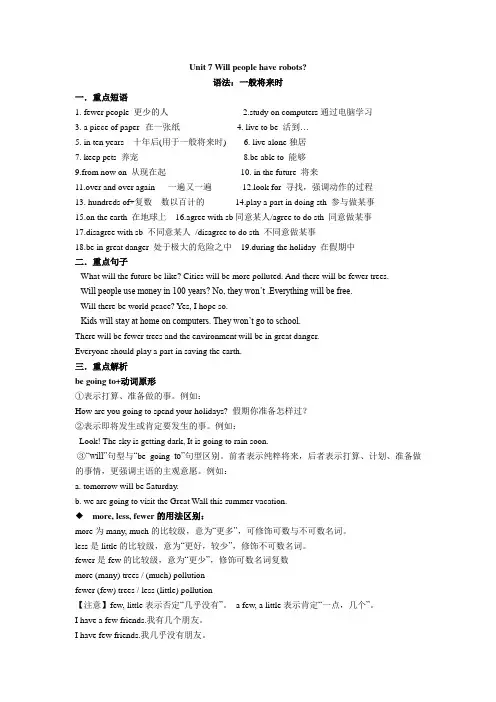
Unit 7 Will people have robots?语法:一般将来时一.重点短语1. fewer people 更少的人2.study on computers通过电脑学习3. a piece of paper 在一张纸4. live to be 活到…5. in ten years 十年后(用于一般将来时)6. live alone独居7. keep pets 养宠8.be able to 能够9.from now on 从现在起10. in the future 将来11.over and over again 一遍又一遍12.look for 寻找,强调动作的过程13. hundreds of+复数数以百计的14.play a part in doing sth 参与做某事15.on the earth 在地球上16.agree with sb同意某人/agree to do sth 同意做某事17.disagree with sb 不同意某人/disagree to do sth 不同意做某事18.be in great danger 处于极大的危险之中19.during the holiday 在假期中二.重点句子--What will the future be like? Cities will be more polluted. And there will be fewer trees.--W ill people use money in 100 years? No, they won’t .Everything will be free.--Will there be world peace? Yes, I hope so.--Kids will stay at home on computers. They won’t go to school.There will be fewer trees and the environment will be in great danger.Everyone should play a part in saving the earth.三.重点解析be going to+动词原形①表示打算、准备做的事。
Unit 7 Will people have robots知识点归纳
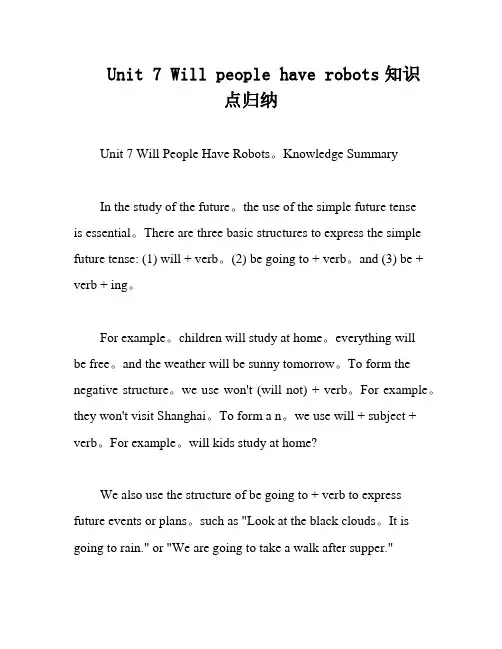
Unit 7 Will people have robots知识点归纳Unit 7 Will People Have Robots。
Knowledge SummaryIn the study of the future。
the use of the simple future tenseis essential。
There are three basic structures to express the simple future tense: (1) will + verb。
(2) be going to + verb。
and (3) be + verb + ing。
For example。
children will study at home。
everything willbe free。
and the weather will be sunny tomorrow。
To form the negative structure。
we use won't (will not) + verb。
For example。
they won't visit Shanghai。
To form a n。
we use will + subject + verb。
For example。
will kids study at home?We also use the structure of be going to + verb to express future events or plans。
such as "Look at the black clouds。
It is going to rain." or "We are going to take a walk after supper."nally。
we use the present continuous tense (be + verb + ing) for certain verbs that indicate an n that will happen in the future。
英语八年级上册Unit 7 Will people have robots[课件]
![英语八年级上册Unit 7 Will people have robots[课件]](https://360docs-1393072327.cos.ap-beijing.myqcloud.com/e655d8c9e109581b6bd97f19227916888486b967.webp)
2b
Read the article and match each paragraph with the question it discusses.
Para 1
Will robots think like humans in the future?
Para 2
What will robots be like in the future?
What will the future be like?
world peace pollution more robots
Do you think it will be possible or impossible?
Everything will be possible. Let’s study harder and our beautiful dreams will come true one day.
= She __s_e__e_m__s_t_o__b_e_i_l_l _.
= It _s_e_e__m__s that she ___i_s__il_l__ .
1. 在工厂 _i_n_f_a_c_t_o_r_ie_s____ 2. 做简单工作__d__o_s_im__p_l_e_j_o_b_s___ 4. 多次;反复地 _o_v_e_r_a_n__d_o_v_e_r_a_g_a_i_n__ 5. 许多;大量 __h_u_n_d_r_e_d_s_o_f________ 6. 看起来像人类 _lo_o_k__li_k_e__h_u_m_a_n__s _
八年级英语上册Unit7Willpeoplehaverobots全部重要知识点(带答案)
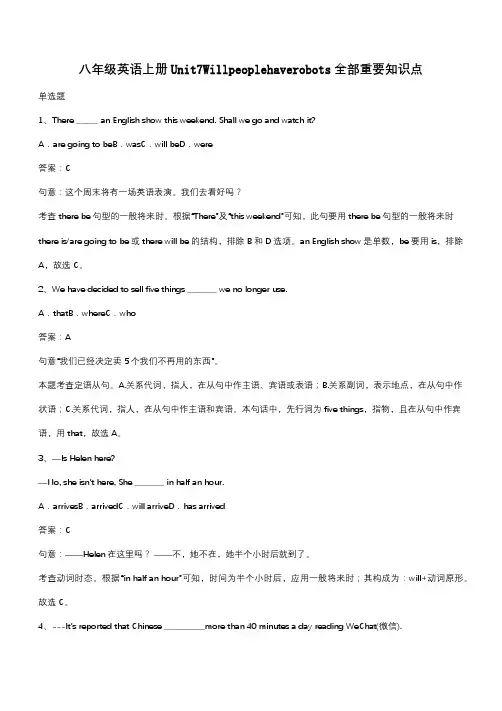
八年级英语上册Unit7Willpeoplehaverobots全部重要知识点单选题1、There ______ an English show this weekend. Shall we go and watch it?A.are going to beB.wasC.will beD.were答案:C句意:这个周末将有一场英语表演。
我们去看好吗?考查there be句型的一般将来时。
根据“There”及“this weekend”可知,此句要用there be句型的一般将来时there is/are going to be或there will be的结构,排除B和D选项。
an English show是单数,be要用is,排除A,故选C。
2、We have decided to sell five things ________ we no longer use.A.thatB.whereC.who答案:A句意“我们已经决定卖5个我们不再用的东西”。
本题考查定语从句。
A.关系代词,指人,在从句中作主语、宾语或表语;B.关系副词,表示地点,在从句中作状语;C.关系代词,指人,在从句中作主语和宾语。
本句话中,先行词为five things,指物,且在从句中作宾语,用that,故选A。
3、—Is Helen here?—No, she isn’t here, She ________ in half an hour.A.arrivesB.arrivedC.will arriveD.has arrived答案:C句意:——Helen在这里吗?——不,她不在,她半个小时后就到了。
考查动词时态。
根据“in half an hour”可知,时间为半个小时后,应用一般将来时;其构成为:will+动词原形。
故选C。
4、---It’s reported that Chinese ___________more than 40 minutes a day reading WeChat(微信).---It’s true. But I think WeChat is taking too much of our time.A.spendB.costC.payD.take答案:A试题分析:句意:——据报道中国人一天花费四十多分钟读微信。
unit-7-Will-people-have-robots知识点总结
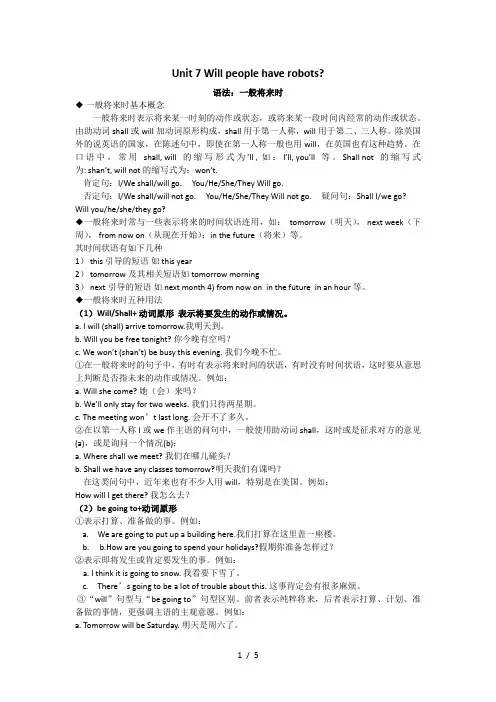
Unit 7 Will people have robots?语法:一般将来时◆一般将来时基本概念一般将来时表示将来某一时刻的动作或状态,或将来某一段时间内经常的动作或状态。
由助动词shall或will加动词原形构成,shall用于第一人称,will用于第二、三人称。
除英国外的说英语的国家,在陈述句中,即使在第一人称一般也用will,在英国也有这种趋势。
在口语中,常用shall,will的缩写形式为’ll,如:I’ll,you’ll等。
Shall not的缩写式为:shan’t,will not的缩写式为:won’t.肯定句:I/We shall/will go.You/He/She/They Will go.否定句:I/We shall/will not go.You/He/She/They Will not go.疑问句:Shall I/we go?Will you/he/she/they go?◆一般将来时常与一些表示将来的时间状语连用,如:tomorrow(明天),next week(下周),from now on(从现在开始);in the future(将来)等。
其时间状语有如下几种1)this引导的短语如this year2)tomorrow及其相关短语如tomorrow morning3)next引导的短语如next month4)from now on in the future in an hour等。
◆一般将来时五种用法(1)Will/Shall+动词原形表示将要发生的动作或情况。
a.I will(shall)arrive tomorrow.我明天到。
b.Will you be free tonight?你今晚有空吗?c.We won’t(shan’t)be busy this evening.我们今晚不忙。
①在一般将来时的句子中,有时有表示将来时间的状语,有时没有时间状语,这时要从意思上判断是否指未来的动作或情况。
《Unit-7Will-people-have-robots》的教学设计及其评价
新目标英语八年级上册第七单元第一课时Unit 7 Will people have robots?(Section A 1a-2c)一、教材分析:(一)、本节教材的地位和作用本课是新目标英语八年级上册的第七单元的Section A 的第一部分,本节教材所涉及内容在中考中占有相当重要的地位。
本节教材围绕着“将来发生的事”展开,要求学生学习和运用“will+v(原)”构成的一般将来时态。
本课教学内容与学生的实际生活相关,可以利用学生的想象,引导学生运用简单的英语来描述将来的生活和事物。
在学习活动中,学生通过对将来发生的事情的描述,促进学生对美好未来的憧憬。
(二)、教学目标:(1)知识与技能 1.指导学生学习有关将来要发生的事情的表达及语法知识点“一般将来时” 。
2.培养学生的口头表达能力、阅读理解能力和写作能力。
1. 学习有关的单词及词组:robot, paper, pollution, tree, subway, computer, will, won ’ t ,they’ll, fewer, be free, on paper, live to be, in 100 years, etc. 2. 学习重要句型:(1)People will have robots in their homes. (2)Will people have robots?. (3)Kids won’ t go to school.(4) There will be less pollution. 3. 掌握语法点:The Simple Future Tense ( 一般将来时) (1)教师自制的多媒体课件;(2)上课环境为多环境。
(2)情感目标:通过学生对自己in five years 的展望,设想自己五年,十年,甚至是二十年后的生活,贴近学生生活实际,符合学生好奇的心理,激发学生浓厚的学习兴趣。
(3) 学习策略:通过任务型的教学,让学生学会自主学习,归纳总结,培养主动学习的能力。
英语八年级上册Unit 7 Will people have robots[课件]
• Which side do you agreneewvitehr? We all believe that there will be more
robots inБайду номын сангаасthe future. However, it may take__________ of years.
hundreds
Nothing is impossible if you put your heart in it! 只要努力,一切皆有可能!
2. Today there are already robots working in factories. Some can help to build cars, and they do simple jobs over and over again. Fewer people will do such jobs in the future because they are boring, but robots will never get bored.
Do you think people will have their own
robots in the future? What do you want robots to do? Why?
I think people ... ..
I want robots to……
.
Do you think you will have Ryobuortsowcann rdoobmoatnsy?kinds of things.
Homework
happen boring
agree same
car hundred talk dance
make never
部编版八年级英语上册Unit7Willpeoplehaverobots带答案知识点总结归纳
(名师选题)部编版八年级英语上册Unit7Willpeoplehaverobots带答案知识点总结归纳单选题1、They usually go shopping ______ their lunch time.A.againstB.amongC.betweenD.during2、It usually takes us quite a long time to ________ master a skill. A.trulyB.simplyC.hardlyD.probably3、Thanks for letting us borrow your camera. We__________it to you next Monday.A.returnB.will returnC.have returned4、—There ________ a Chinese Characters Dictation (汉字听写大赛) in our school next Friday. Did you tell Olive about it?—Oh, I ________. I will call her at once.A.will be; forgotB.is going to have; forgotC.are going to be; forgetD.will be; forget5、— Do you often go swimming_____ Sunday mornings?— Yes. Why not _____with me this Sunday?A.on, goB.in; to goC.on; goingD.in going6、Mr Brown ________ to China last year and ________ in love with this country.A.comes; fallsB.came; fellC.came; fallsD.comes; fell7、Jack is good at math, so he can’t ________ that he didn’t pass the math exam. A.promiseB.describeC.believeD.relax8、Mother’s Day is_____the second Sunday in May in the United States.A.onB.inC.at语法填空9、The old buildings are too _________ (danger) for them to live in.10、We’re told that a charity show ________ (take) place next Sunday.11、Swimming alone in the river is _______ (danger) for children.12、We ________ (have) a picnic if it is fine tomorrow.13、It is ________ (possible) for us to finish the work in such a short time.完成句子14、我认为在2060年你想要的东西都会免费。
人教版八年级上册Unit7WillpeoplehaverobotsSectionB2b教学设计教案
4.教师展示与本节课相关的词汇和短语,如“robots”, “take over”, “perform”, “require”, “be necessary for”等,让学生初步了解并感知这些词汇的用法。
3.学生能够运用目标词汇和句型,描述未来机器人的功能、工作场景及对未来社会的影响。
4.学生能够理解并运用阅读策略,如预测、扫描、细读等,提高阅读理解能力。
(二)过程与方法
1.通过小组合作、讨论、分享等方式,培养学生合作学习和解决问题的能力。
2.通过阅读课文,引导学生运用预测、扫描、细读等阅读策略,提高阅读效率和理解能力。
2.教师对学生的练习成果进行现场批改和指导,帮助学生发现并改正错误。
(五)总结归纳
1.教师引导学生回顾本节课所学内容,总结一般将来时态和目标词汇的用法。
2.学生分享本节课的收获和感悟,以及在学习过程中遇到的困难和解决方法。
3.教师对学生的总结进行补充和归纳,强调重点,提醒学生加强课后复习。
4.教师布置课后作业,巩固本节课所学知识,为下一节课的学习做好准备。
提示:可以从以下几个方面展开:
a.机器人在未来的功能和应用领域。
b.机器人对人类社会的影响。
c.人们对机器人的态度和看法。
3.预习下一节课的内容,提前了解与未来科技相关的词汇和句型,为课堂学习做好准备。
4.搜集与未来科技相关的新闻或资料,下节课分享给同学们,共同探讨未来科技的发展趋势。
作业布置要求:
1.学生在完成作业时,注意语法和词汇的准确性,提高语言表达的流畅性和连贯性。
2.家长协助督促孩子完成作业,关注学习进度,鼓励孩子积极思考,发想象力。