
2019-2020学年度牛津上海版英语六年级下册unit 4 Staying healthy复习巩固四十八
2019-2020学年度牛津上海版英语六年级下册unit 4 Staying healthy复习巩固四十
八
第1题【单选题】
There are more than people in Shanghai.
A、30 million
B、30 millions
C、million of
D、millions of
【答案】:
【解析】:
第2题【单选题】
What about a picnic tomorrow?
A、go to
B、going to
C、go on
D、going on
【答案】:
【解析】:
第3题【单选题】
— Do you eat vegetables and fresh fruit?
—I eat fruit, but I don"t like vegetables.
A、plenty of, a few
B、much, some
C、plenty of, some
D、much, a few
【答案】:
【解析】:
第4题【单选题】
Which of the following words matches the sound/w?ns/?
A、one
B、once
C、wins
D、ones
【答案】:
【解析】:
第5题【句型转换】
My grandmother does exercise in the park twice a day. (对划线部分提问) ____________does your grandmother do exercise
in the park?
【答案】:
【解析】:
第6题【句型转换】
Sally had a bad headache last weekend. (改为否定句) Sally____________a bad headache last weekend. 【答案】:
【解析】:
第7题【翻译】
将下列词组翻译成英语
保持健康______
户内运动______
喜欢工作______
喜欢音乐______
最喜欢的户外运动______
在操场上______
弹钢琴______
玩拼图______
【答案】:无
【解析】:
第8题【选词填空(词汇运用)】
______(Keep/Keeping) a healthy diet is very important for us.
【答案】:
【解析】:
第9题【语法填空】
How many outdoor______do you like? (activity)
【答案】:
【解析】:
第10题【语法填空】
You should eat______fruit and vegetables than before. (much)
【答案】:
【解析】:
第11题【语法填空】
My uncle smokes______than before. He tries to change his bad habit. (little) 【答案】:
【解析】:
第12题【语法填空】
He watches television______a day. (one)
【答案】:
【解析】:
第13题【语法填空】
Please practice______English every day to improve your spoken English. (read) 【答案】:
【解析】:。
牛津上海版六年级第二学期 Unit 4 Staying healthy 知识梳理
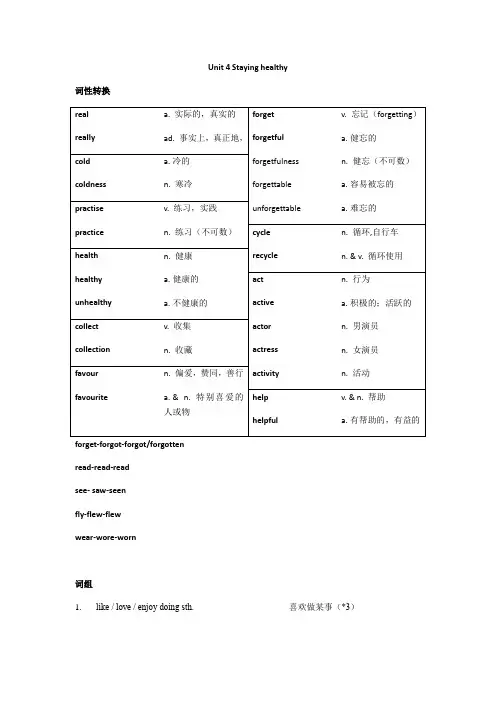
Unit 4 Staying healthy词性转换forget-forgot-forgot/forgottenread-read-readsee- saw-seenfly-flew-flewwear-wore-worn词组1.like / love / enjoy doing sth.喜欢做某事(*3)2.forget doing sth.forget having a meeting 忘记做过某事忘记开过会了3.forget to do sth.forget to do my homework 忘记要去做某事(未做)忘记要写我的作业4.stay healthy = keep healthystay at home 保持健康(*2)呆在家里5.do puzzles at home在家猜谜语6.play football / basketball in the playground在操场踢足球/ 打篮球7.go + V-inggo fishing / cycling / swimming 去做某事区钓鱼/ 骑行/ 游泳8.play the pianoplay computer gamesplay tennis 弹钢琴(play + 乐器)玩电脑游戏打网球(play + 球类游戏)9.make a modelcollect stamps 做一个模型集邮10.fly kiteshave a barbecuego on a picnic 放风筝去烧烤去野餐11.watch television / TVread a booksee a film = go to the cinema = go to the movies 看电视读一本书去看一部电影12.my favourite indoor / outdoor activities我最喜欢的户内/ 户外活动13.draw a bar chart画一幅条形图14.have a headache / stomachache / toothache头疼/ 胃疼/ 牙疼have a cold / fever / sore throat感冒/ 发烧/ 喉咙痛15.watch too much televisionwatch less television 看太多的电视看太少的电视16.wear enough clotheswear more clothes 穿够多的衣服穿更多的衣服17.eat too much spicy food / sweet food (不可数)eat too many rice dumplings (可数复数)吃太多的辛辣食物/ 甜食吃太多的粽子18.give the correct / right answers给出正确答案19.have enough exercises有足够练习(enough名前形后)20.go to bed late晚睡21.practise doing sth.practise swimming 练习做某事练习游泳22.help sb. do sth. = help sb. with sth.help me do the housework= help me with the houseworkhelp me stay healthyhelp oneselfwith the help of sb.帮助某人做某事(*2)帮助我做家务(*2)帮我保持健康自助,自取所需在某人的帮助下(help此处为名词)23.once / twice a month数字≥3 + times a yearfour times a year 一个月一次/ 两次一年四次24.at once = right now = immediately立刻马上(*3)25.make suggestions for sb.给某人提建议26.make a list of your habits列一个你的习惯的清单重点句型和语法27.really真的,确实,的确We really love music. 我们真的喜欢音乐。
牛津英语上海版六年级下册6B Module 1 Unit 4 Staying healthy 4课时教案附反思
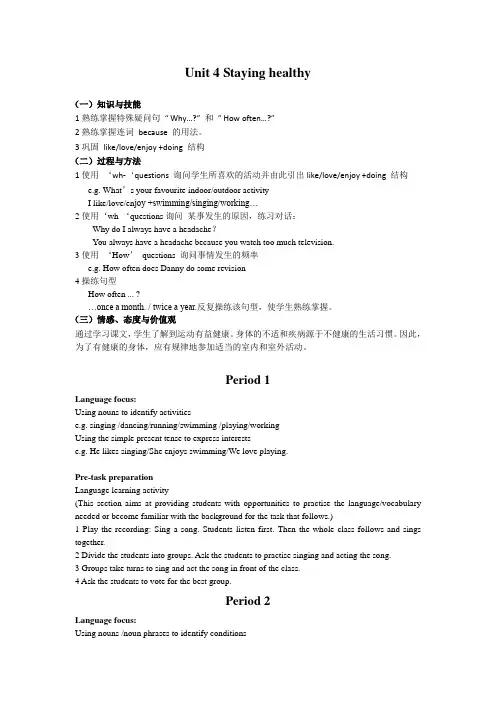
Unit 4 Staying healthy(一)知识与技能1熟练掌握特殊疑问句“ Why…?” 和” How often…?”2熟练掌握连词because 的用法。
3巩固like/love/enjoy +doing 结构(二)过程与方法1使用‘wh-‘questions 询问学生所喜欢的活动并由此引出like/love/enjoy +doing 结构e.g. What’s your favourite indoor/outdoor activityI like/love/en joy +swimming/singing/working…2使用‘wh-‘questions询问某事发生的原因,练习对话:Why do I always have a headache?You always have a headache because you watch too much television.3使用‘How’questions 询问事情发生的频率e.g. How often does Danny do some revision4操练句型How often ... ?…once a month. / twice a year.反复操练该句型,使学生熟练掌握。
(三)情感、态度与价值观通过学习课文,学生了解到运动有益健康。
身体的不适和疾病源于不健康的生活习惯。
因此,为了有健康的身体,应有规律地参加适当的室内和室外活动。
Period 1Language focus:Using nouns to identify activitiese.g. singing /dancing/running/swimming /playing/workingUsing the simple present tense to express interestse.g. He likes singing/She enjoys swimming/We love playing.Pre-task preparationLanguage learning activity(This section aims at providing students with opportunities to practise the language/vocabulary needed or become familiar with the background for the task that follows.)1 Play the recording: Sing a song. Students listen first. Then the whole class follows and sings together.2 Divide the students into groups. Ask the students to practise singing and acting the song.3 Groups take turns to sing and act the song in front of the class.4 Ask the students to vote for the best group.Period 2Language focus:Using nouns /noun phrases to identify conditionse.g. a headache/a stomach-ache/toothache/a cold/a fever/a sore throatAsking ‘wh-‘questions to find out the reasone.g. Why do I always have a headacheUsing connectives to give reasonse.g. You always have a headache because you watch too much television.Using adverbs to express degreee.g. too much/too manyPre-task preparation1 Introduce new vocabulary items: a headache, a stomach-ache, toothache, a cold, a fever, a sore throat. Encourage students to use facial expressions and body language to help convey the meanings.2 Play the recording: Look and learn and Think and say. Students listen and follow in their books.3 Play the recording again. Students listen and repeat.4 Invite students to talk about their experience of suffering from a headache, a stomach-ache, toothache, a cold, a fever or a sore throat.While-task procedure1 Students work in groups of five Distribute a copy of photocopiable page 9 to each group. Four members in the group pretend to feel unwell and one member pretends to be Doctor Chen. Ask students to follow the modeled dialogue and work together to complete the dialogue in the other pictures. Tell them to think about different reasons for not feeling well. Then students practise the dialogue in groups.2 Groups take turns to role-play the dialogue in class. Encourage students to use facial expressions and body language and be as dramatic as possible. Write all the reasons for not feeling well on the board to get students familiar with the target language. Finally, vote for the best group.3 Still in groups, ask students to draw and write down different ways for keeping themselves healthy. Collect students’work and put it on the display board.Post-task activityWorkbook page 7ConsolidationGrammar Practice Book 7A page 12Period 3Language focus:Using adjectives to describe activitiese.g. indoor activities/outdoor activitiesUsing nouns to identify activitiese.g. fishing /cycling/swimmingUsing ‘wh-‘questions to find out various kinds of specific information about a persone.g. What’s your favourite indoor/outdoor activityAsking ‘How’questions to find out quantitye.g. How many of my classmates like watching television bestUsing the simple present tense to express opinionse.g….students like …best.Pre-task preparation1 Differentiate between indoor activities and outdoor activities. Write indoor activities and outdoor activities on the board. Read them aloud. Invite the whole class to repeat the words after you. Explain briefly that indoor activities are activities carried on inside a building and outdoor activities are activities carried on outside a building.2 Invite a student to read the list of indoor and outdoor activities in Read and match aloud. Ask a few more able students to think of more indoor and outdoor activities.3 Give students some time to complete Read and match. Check answers orally.4 Students work in pairs to practise the target language in A survey .Invite some pairs of students to role-play the dialogue in class.While-task procedure1 Students work in groups. Distribute a copy of photocopiable page 10 to each group. Ask students to carry out the survey using the target language. Each group completes one survey form. Write down the other groups’findings on the survey form as well. Each group completes a simple report.2 Invite representatives from the groups to come out to the front and read their reports aloud .Collect students’work and put it on the display board.3 Make sure students know how to tead and draw bar chart .4 Students work in groups. Distribute a copy of photocopiable page 11 to each group. Ask students to carry out the survey using the target language. Each group completes one survey form. Write down the other groups’findings on the survey form as well. Each group completes a simple report and draws a bar chart.5 Invite representatives from the groups to come forward and read their reports aloud. Collect students’work and put it on the display board.ConsolidationGrammar Practice Book 7A page 13Period 4Language focus:Asking ‘How’questions to find out frequencye.g. How often does Danny do some revisionUsing the simple present tense to describe habitual actionse.g. He does some revision once a month.Using adverbs to express frequencye.g. once a month/ twice a yearPre-task preparation1 Remind students about the concept of ‘work and play’and review the song on page 14 again2 Invite a more able student to come out to the front and read Danny’s timetable. Other students keep their books closed and listen carefully3 Ask students some questions to check their understanding. Ask: How often does Danny do some revision How often does Danny watch television How often does Danny practise swimming How often does Danny help do the housework to elicit: He does some revision once a month. He watches television three times a day. He practices swimming twice a year. He never helps do the housework.4 Ask students to give their opinion about Danny’s timetable. Write the list of opinions on the board. In conclusion, students should understand that Danny’s timetable is not very good.While-task procedure1 Ask each student to think of and write a good timetable for himself/herself.3 When the students have finished, ask them to work in pairs and compare their timetables with their classmates’timetables by using the target language. One student starts the conversation by asking: How often do you…They take turns to ask and answer questions about the timetables.ConsolidationGrammar Practice Book 7A pages 14 and 16Photocopiable pages 12, 13, 14 and 15NOTES: (单元教后记)1、通过学习本单元课文,学生了解到运动有益健康。
2019-2020年小学六年级下册英语unit 4 Staying healthy牛津上海版复习特训第九十九篇
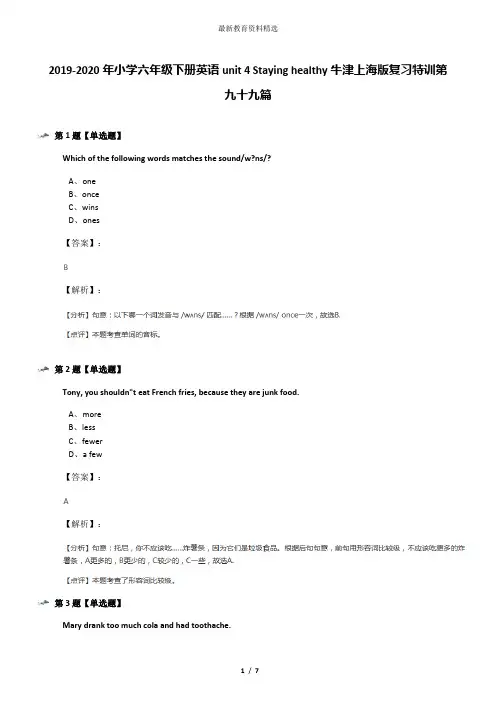
2019-2020年小学六年级下册英语unit 4 Staying healthy牛津上海版复习特训第九十九篇第1题【单选题】Which of the following words matches the sound/w?ns/?A、oneB、onceC、winsD、ones【答案】:【解析】:第2题【单选题】Tony, you shouldn"t eat French fries, because they are junk food.A、moreB、lessC、fewerD、a few【答案】:【解析】:第3题【单选题】Mary drank too much cola and had toothache.A、aB、/C、someD、the【答案】:【解析】:第4题【单选题】It"s outside. I can wear a dress!A、warm enoughB、enough warmC、cold enoughD、enough cold【答案】:【解析】:第5题【单选题】— Do you eat vegetables and fresh fruit? —I eat fruit, but I don"t like vegetables.A、plenty of, a fewB、much, someC、plenty of, someD、much, a few【答案】:第6题【单选题】I often help my mum the housework.A、forB、withC、atD、of【答案】:【解析】:第7题【句型转换】His cousin forgot to invite him to the party. (保持句意基本不变) His cousin____________to invite him to the party.【答案】:【解析】:第8题【句型转换】The food on the plate tastes nicer. (对换线部分提问)____________the food on the plate taste?【解析】:第9题【句型转换】My grandmother does exercise in the park twice a day. (对划线部分提问) ____________does your grandmother do exercisein the park?【答案】:【解析】:第10题【翻译】将下列词组翻译成英语保持健康______户内运动______喜欢工作______喜欢音乐______最喜欢的户外运动______在操场上______弹钢琴______玩拼图______【答案】:无【解析】:第11题【选词填空(词汇运用)】You should try to make______(less/fewer) mistakes in your exam. 【答案】:【解析】:第12题【单词拼写(词汇运用)】You have a sore t______. You can"t speak loudly.【答案】:【解析】:第13题【语法填空】He watches television______a day. (one)【答案】:【解析】:第14题【语法填空】To be a______child,Jack drink eight glasses of water every day. (health)【答案】:【解析】:第15题【语法填空】Please practice______English every day to improve your spoken English. (read) 【答案】:【解析】:。
牛津上海版六年级英语下册unit 4 staying healthy 优秀课件
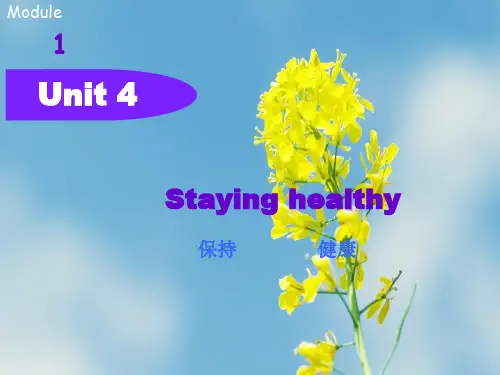
Why do I always have a cold?
PIGGY BANK
GOLD MINE
2-2
It’s because you don’t wear enough clothes, I’m afraid.
What should I do?
12
You should wear more clothes.
3. Alan stayed at home from school because he had a cough and a ______c_o_l_d______.
4. Ben’s head hurt. He has a ____h_e_a_d__a_c_h_e___.
Listen and say
GOLD MINE
Read and write
How did these people feel?
Complete each sentence. 1. Joe’s stomach hurt. He has a __s_t_o_m__a_c_h__a_c_h_e_.
2. Larry didn’t go to the dentist for years. Now he has bad ___t_o_o_t_h_a_c__h_e___.
Read, match and say
Can you give the correct answers?
PIGGY BANK
GOLD MINE
5-1
12345
PIGGY BANK
Why do I always have a stomach ache?
GOLD MINE
5-2
Mr Yang
12345
2019年精选牛津上海版小学英语六年级下册unit 4 Staying healthy拔高训练【含答案解析】第六十四篇
2019年精选牛津上海版小学英语六年级下册unit 4 Staying healthy拔高训练【含答案解析】第六十四篇第1题【单选题】What about a picnic tomorrow?A、go toB、going toC、go onD、going on【答案】:【解析】:第2题【单选题】Your brother, Ken, has had Cola and sweets.A、many, manyB、many, muchC、much, manyD、much, much【答案】:【解析】:第3题【单选题】Is your favourite indoor activity computer games?A、playB、playingC、playsD、played【答案】:【解析】:第4题【单选题】important day it will be tomorrow!A、WhatB、What anC、HowD、How an【答案】:【解析】:第5题【单选题】Elma practices on the playground every day.A、runningB、runsC、runD、to run【答案】:第6题【阅读理解】阅读理解Mr. and Mrs. Smith come from London,England. They work in China now. They teach English in a high school. They like their work very much. They have two children, Sam and Sue. They are both in Shanghai with their parents. Mr. Smith can"t speak Chinese, but his wife can speak it very well.Mr. Smith likes swimming and reading, and Mrs.Smith has the same hobbies (爱好).They often go swimming in the afternoon and read in the evening. Sam and Sue like playing games with Chinese boys and girls after school.Sam"s uncle has a farm near London. He wantsto work in Shanghai, but he can"t speak Chinese. So he is learning Chinese now.He hopes he can come to China one day.Sam and Sue are from .A、CanadaB、AmericaC、EnglandD、AustraliaWhat sport does Mrs. Smith like?A、Swimming.C、Skating.D、Walking.What does Sue like to do after school?A、To swim and read.B、To learn Chinese.C、To watch TV.D、To play games with her Chinese friends.What does Sam\"s uncle do?A、A teacher.B、A singer.C、A farmer.D、A doctor.are in different countries now.A、Mr. and Mrs. SmithB、Mr. Smith and his brotherC、Mrs. Smith and her childrenD、Mr. Smith and his children【答案】:无【解析】:第7题【句型转换】He goes to the park once a week. (对划线部分提问)__________________he______to the park?【答案】:【解析】:第8题【句型转换】My father bought me some discs as my birthday present. (改为一般疑问句) ______your father______you any discs as your birthdaypresent"?【答案】:【解析】:第9题【句型转换】This knife is mine. (改为复数句)____________are mine.【答案】:【解析】:第10题【句型转换】Oliver and his wife look very healthy and happy. (对划线部分提问) ____________Oliver and his wife look?【答案】:【解析】:第11题【语法填空】Ben is______interestedin cartoon films. (real)【答案】:【解析】:第12题【语法填空】These apples______atleast 10 pounds. (weight)【答案】:【解析】:第13题【语法填空】You should eat______(little) meat and______(many) vegetables and fruit.【答案】:【解析】:。
2019年牛津上海版英语(一起)六年级下册Unit 4《Staying healthy》ppt课件

You should wear more clothes.
C
1
2
PIGGY BANK
GOLD MINE
Read, match and say
Can you give the correct answers?
5-1
1
2
3
4
5
C
PIGGY BANK
GOLD MINE
Why do I always have a stomach ache?
C
PIGGY BANK
GOLD MINE
Listen and say
Why do I always have a headache?
2-1
It’s because you watch too much television, I’m afraid.
too much+u.n 太多
What should I do?
PIGGY BANK
GOLD MINE
Read and write
How did these people feel?
Complete each sentence.
stomach ache 1. Joe’s stomach hurt. He has a _______________. 2. Larry didn’t go to the dentist for years. Now he has bad toothache _______________. 3. Alan stayed at home from school because he had a cold cough and a _______________. headache 4. Ben’s head hurt. He has a _______________.
上海牛津英语6B Unit 4 Staying healthy Page 22~23
(favourite 前必须是one’s 或 sb’s)
3. piano n. pianos (p.l)
zoo, bamboo, hero, photo, tomato, potato, radio, studio, memo(备忘录), kilo, hippo, kangaroo, piano
以-s 结尾: zoos, bamboos, photos, radios, studios, memos, pianos, kilos, hippos, kangaroos
• 在操场上 • 弹钢琴 • 骑自行车 • 做一个模型 • 收集邮票 • 进行一次烧烤
in the playground play the piano ride a bicycle make a model collect stamps have a barbecue
1. puzzle n. 智力测试,难题
Unit 4 Staying healthy
Sharon
Two tasks:
• Talk about your favourite indoor and outdoor activities. • Make a dialogue and find out your classmates’ favourite indoor
• 忘记做过某事(做过)
forget doing sth.
• 忘记要去做某事(未做) forget to do sth.
• 记住做过某事(做过)
remember doing sth.
Key phrases:
• 记住要去做某事(未做) • 拼拼图 • 在家 • 那是我最喜欢的室内运动。 • 我也不喜欢拼拼图。 • 踢足球
Unit 4 Staying Healthy 单元分析以及教学设计 牛津上海版英语六年级下册
Unit 4 Staying Healthy一、单元教学内容与目标1. 语言知识● 核心词汇:indoor, outdoor, activity, really, forget, health, model, piano, playground, problem, headache, stomachache, toothache, cold, fever, once, practice, housework拓展词汇:puzzle, sore, throat● 词组:1. stay healthy / keep healthy 保持健康2. like/love singing 喜爱唱歌like/love doing sth. 喜爱做某事3. enjoy running 喜欢跑enjoy doing sth. 喜欢做某事4. forget working 忘记工作forget doing sth. 忘记做某事5. my favourite indoor activity 我最爱的室内活动6. an outdoor activity 户外活动7. playing the piano 弹钢琴8. playing tennis/basketball 打网球/篮球9. watching television 看电视10. seeing a film 看电影11. going on a picnic 进行野餐12. have a headache 患头疼have a stomach ache 患胃疼have a cold 感冒have a fever 发烧have a sore throat 患喉咙疼have toothache 患牙疼(toothache是不可数名词)13. watch too much television 看太多的电视eat too many rice dumplings 吃太多的粽子too much + 不可数名词;too many + 可数名词复数14. not… enough 不够15. watch less television 少看的电视16. wear more /fewer clothes 穿更多/更少的衣服17. how often 每隔多久一次18. once a month 一月一次four times a day 一天四次19. practice swimming 练游泳practice doing sth. 练习做某事20.I’m afraid 恐怕● 词性转换1. really (adv.) 真正地;的确real (adj.) 真的2.fun (u.n) 有趣的事funny (adj.) 有趣的,滑稽可笑的3.health (n.) 健康healthy (adj.) 健康的unhealthy (adj.) 不健康的4.activity (n.) 活动(pl.) activities5. forget (v.) 忘记forgetful (adj.) 健忘的● 知识点:1)询问原因:-- Why do I always have a headache?-- You always have a headache because you watch too much television.2)询问特定信息What’s your favorite indoor/outdoor activity?3)询问频率--How often does Joe practice swimming?--He practices swimming once a month.--He …once a day/twice a week/…times a year.--He never….4)表示数量:not...enough/ too many/ too much; fewer/ less/ more5)一般现在时2. 语言技能1.能运用疑问词Why….?来询问原因。
牛津版上海版六年级下册 Unit 4 Staying healthy 教学设计
牛津版上海版六年级下册 Unit 4 Staying healthy 教学设计一. 教材分析本单元的主题是“Staying healthy”,主要讨论如何保持健康的生活方式。
通过本单元的学习,学生可以了解健康饮食和锻炼的重要性,以及如何养成良好的生活习惯。
教材内容涵盖了食物金字塔、健康饮食、运动等方面的知识。
二. 学情分析六年级的学生已经具备了一定的英语基础,对于一些基本的词汇和句型能够理解和运用。
然而,对于一些专业的健康知识,可能需要通过图片、视频等直观的方式来进行呈现,以便更好地理解和记忆。
三. 教学目标1.能够听懂、说出一系列的关于健康饮食和锻炼的词汇,如vegetables,fruits, milk, meat, exercise, running等。
2.能够理解并运用目标句型“How much…do you eat/drink a day?”和“Iusually…every day.”进行询问和回答。
3.能够通过本单元的学习,了解健康饮食和锻炼的重要性,并能够养成良好的生活习惯。
四. 教学重难点1.词汇的学习和运用,如vegetables, fruits, milk, meat, exercise,running等。
2.目标句型的学习和运用,即“How much…do you eat/drink a day?”和“Iusually…every day.”。
五. 教学方法1.任务型教学法:通过设计各种任务,让学生在实践中学习和运用目标语言。
2.情境教学法:通过创设各种情境,让学生在真实的语境中学习和运用目标语言。
3.合作学习:通过小组合作的方式,让学生共同完成任务,培养学生的团队协作能力。
六. 教学准备1.PPT课件:设计相关的PPT课件,呈现本节课的重点内容和练习。
2.食物金字塔图:准备食物金字塔的图片或海报,以便更好地展示健康饮食的重要性。
3.视频或图片:准备一些关于健康饮食和锻炼的视频或图片,以便更好地吸引学生的注意力。
牛津上海版六下《Unit 4 Staying healthy》ppt课件8
Lisa
a headache
John
a stomach ache
Alice
toothache
Tom
a sore throat
Jane
a cold
Peter
a fever
Jack is Doctor Chen’s patient.
get up late watch television have hamburgers for lunch practise playing football play computer games brush his teeth before sleeping
Revision lesБайду номын сангаасon March 16, 2012
What is the activity?
doing puzzles
playing basketball
playing the piano
watching television
cycling
playing computer games
knitting
I likIen/doloovreac/tievnitjioeys _____O_ ubtedcoaoursaect_iv_i_ti_e_s_.
So _______ is my favourite indoor / outdoor
ac1t,iv3,it4y,.6, 7, 8, 10, 12, 15
2, 5, 9, 11, 13, 14
three times a week four times a week three times a week once a week twice a day never