
Unit1FestivalsaroundtheworldSpeaking[思维导图知识点知识树复习资料]人教高中英语
What
year/date celebrates people do
give and eat
MidAutumn Festival
the beauty of mooncakes;
autumn/fall
the full moon, watch the
harvest, time with family and friends
red packet firecracker
date
food
work
visit
fruit
dumpling
SPRING FESTIV AL
new clothes singing
fun
dancing
memory watching TV
Fill in the following form.
Festival Time of What it
Boat fifth
beloved leaves into water in
Festival/ month in poet Qu memory of Qu
Duanwu lunar Festival calendar
Yuan who Yuan; put herbs on
died in 278 doorways for good
full moon with family and friends
Festival Time of What it
What people
year/date celebrates do
give money in
the end of red envelopes to
winter, arrival children; see
Spring Festival
Fathers ’ Da
May Day
Christmas
FESTIV AL
Mid-Autumn Festival
Teachers ’ Day
Childrens ’ D
Dragon Boat Festival
Mothers ’ Day
谢谢欣赏
T H A N K YO U FO R L IST EN IN G
Festival Time of What it What people do
year/date celebrates
eat zongzi; watch
dragon-boat
the fifth in memory races; throw rice
Dragon day of the of the
wrapped in reed
Festival Time of What it What people do year/date celebrates
the
founding
of the
National October People ’ s
Day
1st
Republic
of China
in1949
visit family or go to other parts of China; go shopping
BC
health
Festival Time of What it What people do year/date celebrates
Tomb 5th Sweeping April Day
honour
the dead sweep the
and satisfy tombs; give
the
flowers
总有一款 PPT 适合您
【最新出品 精心整理 倾情奉献 敬请珍惜】
Unit 1 Festivals around the world
Speaking
Could you tell me ……
1. How did you spend your winter holidays?
2. How did you feel?
ancestors
What do festivals mean?
Festivals are meant to celebrate important events or to honour people at a particular time.
National Day
New Year ’ s Day Army Day
Spring January/ of spring, Festival Februa dances; eat fish, prawns and dumplings;
Year, reunion visit family
with family members
and relatives
Four students in a group. Discuss the time, celebrations and significance of Spring Festival. You can refer to the following questions.
1. When does it usually take place? 2. How do people celebrate? 3. Why?
20版:(步步高) (全国) Unit 1 Festivals around the world
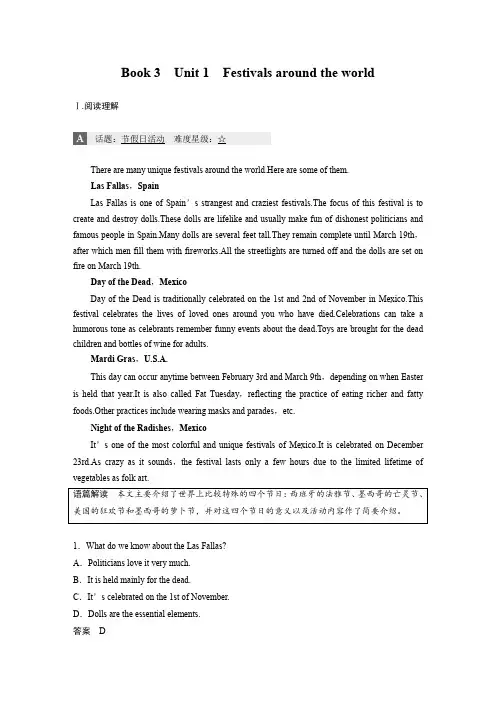
Book 3Unit 1Festivals around the worldⅠ.阅读理解话题:节假日活动难度星级:☆There are many unique festivals around the world.Here are some of them.Las Fallas,SpainLas Fallas is one of Spain’s strangest and craziest festivals.The focus of this festival is to create and destroy dolls.These dolls are lifelike and usually make fun of dishonest politicians and famous people in Spain.Many dolls are several feet tall.They remain complete until March 19th,after which men fill them with fireworks.All the streetlights are turned off and the dolls are set on fire on March 19th.Day of the Dead,MexicoDay of the Dead is traditionally celebrated on the 1st and 2nd of November in Mexico.This festival celebrates the lives of loved ones around you who have died.Celebrations can take a humorous tone as celebrants remember funny events about the dead.Toys are brought for the dead children and bottles of wine for adults.Mardi Gras,U.S.A.This day can occur anytime between February 3rd and March 9th,depending on when Easter is held that year.It is also called Fat Tuesday,reflecting the practice of eating richer and fatty foods.Other practices include wearing masks and parades,etc.Night of the Radishes,MexicoIt’s one of the most colorful and unique festivals of Mexico.It is celebrated on December 23rd.As crazy as it sounds,the festival lasts only a few hours due to the limited lifetime of vegetables as folk art.语篇解读本文主要介绍了世界上比较特殊的四个节日:西班牙的法雅节、墨西哥的亡灵节、美国的狂欢节和墨西哥的萝卜节,并对这四个节日的意义以及活动内容作了简要介绍。
Unit1FestivalsaroundtheWorld(Listeningandspeaking)

Unit1FestivalsaroundtheWorld(Listeningandspeaking)unit 1 festivals around the world(listening and speaking)teaching goals1. to train the students’listening ability through the listening context.2. to learn about the carnival in trinidad and how people celebrate it so as to enable them to learn more about different cultures while learning different language.3. to develop the students’speaking skills, with the help of the sample dialogue.important points1. information grasping of the listening part.2. mastery of the words and phrases concerning festivals in daily expressionteaching aida computerteaching proceduresstep 1 lead-in1. what’s the topic of this unit? festivals around the world.2. what are the festivals we learnt in this unit?show a picture of carnival.can you have a guess? what are they doing in the pictures?ss: they are having carnivals.t: have you ever seen a real carnival?ss: no/yes.t: let’s enjoy a real carnival in the video.(after the video)t: what would people do in a carnival?ss: they would dance.they would go on a parade.step 2 listeningdo you know there is a big and famous carnival in trinidad every february? li mei and wu ping are visiting trinidad and they are getting ready to go to the carnival parade. listen to the tape and find out what the plans for the parade are. then answer the question.part 11. what is wrong with li mei’s clothing and shoes?li mei’s clothing is too thick and her shoes are not comfortable enough to walk in for a long time.2. what advice does carla give li mei?carla suggests that li mei change her shoes to something more comfortable, wear some lighter and cooler clothing and also take a hat. part 23. why is it important for them to have water?it is important for them to have water because it is very hot and they will be doing a lot of walking.4. why is it difficult for them to hear each other?it is difficult for them to hear each other because the music is very loud.5. why do they plan to meet at the parking lot at 8 o’clock?they plan to meet at the parking lot at 8 o’clock because they might get separated in the crowd.listen again and choose the best answer.1. what does carla advise li mei to wear?a. comfortable shoes and a hat,b. light and cool clothes.c. both a and b.2.what do they find when they arrive at the park?a. they meet the boys, big bands, dancers and musicians on trucks共6页,当前第1页123456b. the road is very crowedc. the weather turn cold.3.why is it important for them to have water?a. because they eat enoughb. because the temperature is 35 degree.c. because they will visit the parade.4. why can’t they hear each other?a. because they speak in too low a voice.b. because the loudspeakers make it impossible to hear.c. because it’s too crowded.5. why do they plan to meet at the parking lot?a. in case they may get lost.b. because they want to enjoy the carnival alone.c. because they’re going to park their cars there.6. why shouldn’t li mei wear the dress she chose at first?a. it’s not niceb. it doesn’t go with her shoes.c. it’s too heavy and hot to walk and dance till midnight with such high temperature.step 3 speakingt: now, suppose you are li mei or wu ping.you have visited carla and hari’s home in trinidad and you have returned home to zhejiang.you are phoning their mother to thank her for the visit.the expressions below might help you.t: sample dialogue is given for you.sample dialoguea: hello, xiao feng. it’s calling from jilin. can you hear me?b: oh, hello . how nice to hear from you.a: i want to say thank you very much for the lovely visit in trinidad.b: it was a pleasure having you here. would you please give my best wishes to your parents?a: of course i will. they asked me to send their greetings and thanks also. b: i look forward to meeting them. perhaps we can visit china sometime soon.a: that’d be wonderful. you’re most welcome.b: it was fun having you here ——maybe you can come again for carnival next year.a: i’d love to. say hello to carla and hari for me ——i hope they can come to china with you. and thanks again.b: don’t mention it. i’ll tell them you called. i’m glad you had a good trip home.t: so, now it’s your show time. get your dialogues ready and present it to the whole class.sa…sb …homeworkpreview the reading context a sad love story on page 7 and do therelevant exercises thereafter.unit 1 festivals around the worldextensive reading and writingteaching aims:to introduce a cross-cultural view of lover’s festivals –qiqiaojie and valentine’s day.train the students’reading ability.共6页,当前第2页123456 enable the students to engage imaginatively in the story and to use their own ideas of changing the ending.improve the students’writing ability.teaching proceduresstep 1.lead-int: in the last period, we have learnt many kinds of festivals. some are set in memory of the dead, some are set in honor of some great people and some are set in celebration of harvest. do you know the festivals set for lovers?_______________________________________________________t: you are familiar with them. look at the screen. can you guess who thetwo lovers are?_______________________________________________________ today, we are going to learn a love story.step 2 fast readingthe chinese people believe that the star vega(织女星), east of the milky way, is zhinu and, at the constellation of aquila(天鹰座), on the western side of the milky way, niulang waits for his wife.read fast and get the key words.introduction zhinu, the _______ girl, the most lovely of the daughters, visited the earth and met niulang, the _______ boy.development they f___ ___ _____ , married secretlyand were very happy. climax(高潮)the goddess of heaven got so angry that she forced zhinu back to ________ . niulang tried to f_________ her but was stopped by the milky way. thus, the c_______ were separated.ending the goddess of heaven allowed the couple to meet once a year on the ______ day of the s_______ l_______ month when magpies made a _________ of their wings.t: go through your text quickly and silently. then finish the true or false exercises.1.hu jin failed to meet li fang at 7:00.2.if it is raining on qiqiaojie, it means that zhinu is weeping and the couple will be able to meet.3.because her most lovely daughter got married to a human secretly, the goddess got more than angry.4.li fang thought he could get married to hu jin, just like niu lang and zhi nu.5.when li fang met hu jin, he felt very glad.step 3 careful readingt: read the passage again and answer the following questions one by one.1.what does “this”(l8 para3) mean?_______________________________________________________2.where did li fang and hu jin wait for each other? did they meet on time? _______________________________________________________3.how did li fang feel?_______________________________________________________4.how would he get rid of his sadness then? and what about hu jin?共6页,当前第3页123456_______________________________________________________5.did li fang continue to wait later?_______________________________________________________6.did they meet each other at last?_______________________________________________________7.how did li fang feel?_______________________________________________________s: li fang: made an appointment with hu jin—waited in the coffee shop—not met her—heart-broken; along with…; like a fool—would not hold his breath for her to apologize(wait without much hope); would drown his sadness in coffee (drink coffee in order to forget the sadness/sorrow)—gave up and threw…away—met hu jin without gifts—felt worriedhu jin: made an appointment with li fang—kept her word but waited in the tea shop—not turned up in the coffee shop—waited for him all the time—met li fang with giftsending??step 4 post-readingt: the two love stories happened in two different festivals. what are their similarities and differences? how should we treat chinese traditional festivals and some western festivals?_____________________________________________________________________________________________________________________________________________________________________t: nowadays, some people pay more attention to the valentine’s day than qiqiaojie, which was once one of the most popular festivals in ancient china. anyway, each festival in china has its own tale and meaning. so we should hold on to our own festivals and culture, as well as pass them on from generation to generation. we should never allow some western festivals to take the place of chinese traditional festivals. writingt: li fang met hu jin after he lost heart and threw away the valentine’s gifts. to his surprise, hu jin kept her word and waited for him in the tea shop all the time! what should he do? what would happen to the two lovers? please write a different ending to the story of li fang, beginningwith: as he sadly passed the tea shop on the corner on his way…______________________________________________________________________________________________________________共6页,当前第4页123456_____________________________________________________________________________________________________________________________________________________________________ t: before writing, you’d better read the story again and then think of what hu jin will say when she finds out later that the flowers and chocolates are gone. then think of an ending to the story that will solve li fang’s problem. will he be happy or sad?step 5 language points:1. but she didn’t turn up.1) 来, 出席(某活动)i’m very happy you turned up so early.2) 把(收音机等)音量开大一些, 其反义短语是turn down.turn up the radio a little, i can scarcely hear the program.相关短语:turn down 拒绝turn off 关掉turn on 打开turn out 结果是......turn to sb. for help 向某人求助2. she said she would be there at seven o’clock, and he thought she would keep her word.keep one’s word 意为“守信用”,其反义词是break one’s word, 即“失信”。
Unit-1-Festivals-around-the-world-课文知识点解析1
7....when people should go to clean the graves and light incense in memory of their ancestors.
……这时候,人们去扫墓,点上香火祭祀祖先。
memory[ C usually plura] n. 表示所记住的事情,记忆
starve vt.&vi. 挨饿,饿死
e.g. Thousands of people will starve if food doesn’t reach the stricken city.
假如食物无法到达这座受灾的城市,成千上万的人将会饿死。
5.They lit fire and made music because they thought these festivals would bring a year of plenty.
他们把食物, 鲜花和礼物献给死者。
offer sth. to sb.= offer sb.sth.供应某物给某人
e.g. He offered me 300 dollars for that television.
他出300美元向我买那部电视机。
12.The festival of Halloween had its origin as an event in memory of the dead.
万圣节起源于纪念已逝的人们。
had its origin as an event 起源于某事
have your or its origin=begin 开始
e.g.Many of the problems had their origin in post-war Europe.
英语必修三festivalsaroundtheworld翻译
英语必修三festivalsaroundtheworld翻译编辑整理:尊敬的读者朋友们:这里是精品文档编辑中心,本文档内容是由我和我的同事精心编辑整理后发布的,发布之前我们对文中内容进行仔细校对,但是难免会有疏漏的地方,但是任然希望(英语必修三festivalsaroundtheworld翻译)的内容能够给您的工作和学习带来便利。
同时也真诚的希望收到您的建议和反馈,这将是我们进步的源泉,前进的动力。
本文可编辑可修改,如果觉得对您有帮助请收藏以便随时查阅,最后祝您生活愉快业绩进步,以下为英语必修三festivalsaroundtheworld翻译的全部内容。
unit1Festivals and celebrations Festivals and celebrations of all kinds have been held everywhere since ancient times. Most ancient festivals would celebrate the end of cold weather,planting in spring and harvest in autumn. Sometimes celebrations would be held after hunters had caught animals。
At that time people would starve if food was difficult to find, especially during the cold winter months。
Today's festivals have many origins,some religious, some seasonal, and some for special people or events.Festivals of the Dead Some festivals are held to honour the dead or to satisfy the ancestors,who might return either to help or to do harm。
Unit 1 Festivals around the world (Period 4 Using language Listening and speaking)
Unit 1Festivals around the world (Period 4Using languageListening and speaking)Unit 1銆€Festivals around the worldPeriod 4銆€Using language: Listening and speaking鏁欐潗鍒嗘瀽This is the fourth teaching period of this unit. As usual, the teacher will first get students to review what they learned in the last period, and then lead in the new lesson. We will mainly deal with listening and speaking in this period. At the beginning, students listen to a conversation among young people. Carla and Hari are students in Trinidad. Their Chinese friends Li Mei and Wu Ping, are visiting for the Carnival holiday in February. They are joining in a parade for Carnival in Trinidad. This listening activity is not only to offer students knowledge about how to celebrate Carnival in Trinidad but to encourage students to listen and then use what they have heard to help them answer questions. It is an important exercise because it links skills together and uses them to produce a useful phone call. Make sure students read the questions before they listen to the tape. This is to sharpen their attention and listen for the answers. This will also help them get the gist of the listening text. The teaching procedures may be as follows: First, let students go through the directions, pictures and the questions and guess the listening text may be about. Play the tape for students to listen to and decide whether their guessing is right. Second, ask them to listen again for them to answer the questions. Third, let them listen a third time to check their answers. While they are listening, the teacher should pause and repeat the key sentences to help students understand. When checking the answers, explain some difficult listening points if necessary. In the end, show them the listening text and let them read and retell it. This step can help students understand and grasp the listening material farfurther. Perhaps some students will find it hard to listen to and understand listening materials. Encourage them not to give up. The more they listen to English, the easier it becomes. The speaking exercise is intended to give students the opportunity to practice a phone conversation using the functional items. So they should learn some expressions on how to make phone calls and invitations and express and thanks first. Then they are required to create such a phone conversation. During the course, let them know the polite forms of English are important and should be practiced in a variety of situations. Also encourage them to use vocabulary from the reading and listening passages. This period places emphasis on developing students鈥?listening and speaking ability. We should try our best to encourage students to say something. Don鈥檛always correct the mistakes they have made while they are speaking. Otherwise, they would feel reluctant and not say anything more. 1. Develop students鈥?listening and speaking abilities. 2. Enable students to master different listening skills. 3. Let students learn how to make phone calls and invitations and express thanks. 1. Get students to listen to and understand listening materials with various English accents. 2. Let students make a phone conversation using the functional items requests and thanks. 鐭ヨ瘑1. Get students to learn some useful new words and expressions in the listening passage.2. Let students learn the following expressions: 1)Making phone calls May I speak to. . . ? Can I ring/call back later? Hold/Hang on, please. I鈥檒l ring him/her up again. Just a moment, please. Sorry, he/she isn鈥檛here right now. 2)Invitations I wonder if you are interested in. . . I鈥檇like to invite you to. . . Would you like. . . ? Could/Would you please. . . ? I鈥檓looking forward to. . . I鈥檇love to, but. . . 3)Thanks Thank you so much. Thanks a lot. That鈥檚very kind of you. You 鈥檙e most welcome. Don鈥檛mention it. It鈥檚 a pleasure. 1. Enable students to catch and understand the listening materials. 2. Develop students 鈥?ability to get special information and take notes while listening.3. Get students tolearn and use the expressions of making phone calls, invitations and thanks. 鎯呮劅1. Enable students to know more about festivals and love their life.2. Develop students鈥?sense of group cooperation and teamwork.(涓€) 鈫扴tep 1 Revision 1. Check the homeworkexercises. 2. Ask some students to translate some sentences using modal verbs. 1)鎴, 浣嗘垜浠?0骞村墠涓嶄細鐢ㄣ€?2)鎴?3)浠栧彲鑳芥槸鍔犳嬁澶т汉銆?4)鏈哄櫒涓€瀹氬嚭浜嗘晠闅溿€?5)?Suggested answers:1)Some of us can use the computer now, but we couldn鈥檛ten years ago.2)Can/Could/May/Might I borrow your bike? 3)He may/might be from Canada.4)There must be something wrong with the machine. 5)You should keep your promise. 鈫扴tep 2 Warming up 1. Tell students to turn to Page 6 and we are going to the part Listening and speaking. 2. Ask them to look at the pictures of the Trinidad Carnival and discuss in pairs what kind of activities the Carnival might have. 3. Let them find Trinidad on the map and describe it. 4. Have them to predict what kind of problems someone might have when going to such a carnival. 鈫扴tep 3 Listening 1. Go through the directions and questions to make sure students know what to do. Let them guess what the listening material they will hear may be about. Show the questions on the screen. Part 1: 1)What is wrong with Li Mei鈥檚clothing and shoes? 2)What advice does Carla give Li Mei? Part 2: 3)Why is it important for them to have water? 4)Why is it difficult for them to hear each other? 5)Why do they plan to meet at the parking lot at 8 o鈥檆lock? 2. Play the tape for them to listen to it and decide whether their guessing is right or not. 3. Play the tape again. When listening, they work in pairs: one student writes down the answers to Part 1; the other writes down the answers to Part 2. 4. They exchange the information and listen to the tape again for checking. Let them have the correct answers. 5. Give 2 or 3 minutes to students to ask questions if they have any. 6. Show students the listeningtext and let them read it aloud. Listening text: (Omitted) 鈫扴tep 4 Speaking 1. Show the following form on the screen. Let students read the expressions aloud, and make sure they understand their Chinese meanings. MAKING PHONE CALLS May I speak to. . . ? Can I ring/call back later? Hold/Hang on, please. I鈥檒l ring him/her up again. Just a moment, please. Sorry, he/she isn鈥檛here right now. INVITATIONS I wonder if you are interested in. . . . I鈥檇like to invite you to. . . . Would you like. . . ? Could/Would you please. . . ? I鈥檓looking forward to. . . . I鈥檇love to, but. . . THANKS Thank you so much. Thanks a lot. That鈥檚very kind of you. You鈥檙e most welcome. Don鈥檛mention it. It鈥檚a pleasure.2. Suppose the situation: Imagine you have just visited your friends in Trinidad and seen the Carnival. Make a phone call to invite your friends to a Chinese festival.3. Give several minutes for students to prepare for their phone conversations in pairs.4. Ask as many pairs as possible to present their conversations to the class. 鈫扴tep 5 Listening on Page 41 Turn to Page 41. 1. Ask students to look at the 4 pictures, and in pairs tell as many things as they can from each picture. Then ask them to say what festivals they think these pictures are about. 2. Tell students they will listen to a conversation between Chen Bin and his American friend, Joey. What is the main topic of their conversation? 3. Play the tape for students to listen to and find out the main topic of their conversation. 4. Ask students to look at the chart before they listen to the tape again. Show the chart on the screen. EASTER In which season? Who celebrates? The reason for the festival? On which day of the week? What things represent Easter?5. Play the tape again, and let students listen to it and then fill in the chart.6. Let students share their information in pairs.7. Play the tape a thirdtime for students to check and have the correct answers. 8. Give 2 or 3 minutes for students to ask questions if they have any. 9. Show students the listening text and let them read it. Listening text: (Omitted) 鈫扴tep 6 Listening task on Pages 45-46 1. Talk with students about festivals such as Mother鈥檚Day, Valentine鈥檚Day,Easter, the Cherry Blossom Festival, and so on. 2. Turn to Page 45. Ask them to lookat the pictures and then discuss what festival for each picture is. 3. Have them listen to the tape. Then write the festival name for each picture. 4. Turn to Page 46. Ask them to go through the questions and make sure they know what to do. 5. Play the tape again for them to listen to and get their answers. 6. Two or three minutes for them to discuss and share their answers. 7. Play the tape a third time for them to check and have the correct answers. 8. Show them the listening text and let them read it. Listening text: (Omitted) 鈫扴tep 7 Summary In this period, we mainly focus on the listening and speaking abilities. They are very important. If your listening or speaking is poor, you鈥檇better practice more. The more you listen to or speak English, the better your listening or speaking is. Remember: Practice makes perfect. 鈫扴tep 8 Homework 1. Finish off the Workbook exercises. 2. Preview the passages A Sad Love Story and Winter Carnival in Quebec. (浜? 鈫扴tep 1 Revision 1. Check the homework exercises. 2. Ask some pairs of students to make up short dialogues to review modal verbs. Situations: 1)You want to invite your friend to come to a party on Sunday. 2)You want to ask your mum for permission to go fishing with your friends. 鈫扴tep 2 Listening 1. Talk about Carnival and Trinidad with students. 2. Ask some of students to describe the pictures of the Trinidad Carnival. 3. Discuss with students what kind of activities the Trinidad Carnival might have. 4. Turn to Page 6. Ask students to read through the directions and questions in Exercise 2, predict the main idea of the listening text and then listen to the tape and give their answers. 鈫扴tep 3 Speaking 1. Turn to Page 6. Ask students to read the expressions of making phone calls, invitations and thanks in the box. Try to learn them by heart. 2. Suppose the situation and make a phone conversation in pairs using the expressions.3. Ask as many pairs of students as possible to present their conversations to the class. 鈫扴tep 4 Workbook exercises 1. Listening 1)Ask students to discuss what festival these 4 pictures are about. 2)Have them listen to this conversation and findout the main topic. 3)Let them listen again and take notes to fill in the chart. 2. Talking Ask students to read the directions and questions. Then let them make their role-play dialogues. 3. Listening task 1)Ask students to dictate some festival names to see if they are familiar with them. 2)Let them listen to the tape and write the festival for each picture on Page 45. 3)Have them go through the questions and then listen again to find the answers. 鈫扴tep 5 Homework 1. Finish off the related Workbook exercises. 2. Make up a phone conversation using the expressions of invitations and thanks.Unit 1銆€Festivals around the world Listening and speaking MAKING PHONE CALLS May I speak to. . . ? Can I ring/call back later? Hold/Hang on, please. I鈥檒l ring him/her up again. Just a moment, please. Sorry, he/she isn鈥檛here right now. INVITATIONS I wonder if you are interested in. . . . I鈥檇like to invite you to. . . . Would you like. . . ? Could/Would you please. . . ? I鈥檓looking forward to. . . . I鈥檇love to, but. . . THANKS Thank you so much. Thanks a lot. That鈥檚very kind of you. You鈥檙e most welcome. Don鈥檛mention it. It鈥檚a pleasure. 娲诲姩涓庢帰绌?Imagine you want to invite a foreign friend to join your family鈥檚celebration of the Chinese Spring Festival. In pairs, one as the Chinese student and the other as the foreign friend, make up a phone conversation to give your invitation, ask and answer questions about the holiday. The foreign friend should express his or her thanks for your invitation. Be ready to act out your conversation to the class.。
Unit 1 Festivals around the world(warming up & speaking)

DoubleNinth
Teachers’ Day
Festival Time of What it What people do year/date celebrates the visit family or founding go to other of the parts of China; National October People’s go shopping Day 1st Republic of China in1949
Halloween is celebrated the 31st of October
Carved Pumpkin Lantern
Thanksgiving Day
a time to offer thanks, of family gatherings and holiday meals. A time of turkeys, stuffing馅, and pumpkin pie. A time for Indian corn, holiday parades游行 and giant balloons.Thanksgiving is celebrated on the 4th Thursday of November
Halloween Parade(游行)
the time of Ghosts, Goblins妖精, Gravestones and Graveyards. Of Spooks幽灵 and Spirits and silly-fun tricks. Of Witches巫婆 and Warlocks术士 and Scary Black Cats. And Candy Corn, Jelly果冻 Apples, Pumpkins and Bats蝙蝠.
人教版高中英语必修3课文翻译
人教版高中英语必修3课文翻译(Reading 部分和Using language两部分)导读: 人教版高中英语必修3课文翻译(Reading部分和Usinglanguage两部, 人教版高中英语必修3课文翻译(Reading部分和Usinglanguage两部分)Unit1FestivalsaroundtheworldReading节日和庆典自古以来, 世界各地就有各种各样的节目和庆典。
大多数古老的节日总是庆祝严寒的结束, 春季的种植和秋天的收割。
有时, 在猎人捕获猎物后, 也举行庆祝活动。
在那个人教版高中英语必修3课文翻译(Reading部分和Using language两部分)Unit 1Festivals around the worldReading节日和庆典自古以来, 世界各地就有各种各样的节目和庆典。
大多数古老的节日总是庆祝严寒的结束, 春季的种植和秋天的收割。
有时, 在猎人捕获猎物后, 也举行庆祝活动。
在那个时代, 如果食物难以找到, 特别是在寒冷的冬月, 人们就会挨饿, 现在的节日有很多由来, 一些是宗教上的, 一些是季节性的, 一些是纪念特殊的人和事件的。
亡灵节些节目是为了纪念死者, 或使祖先得到满足, 因为祖先们有可能回到世上(给人们)提供帮助, 也有可能带来危害。
在日本盂兰盆节, 人们要扫墓、烧香, 以缅怀祖先。
人们还点起灯笼, 奏响乐曲, 因为他们一位这样做可以把祖先引到世上。
在墨西哥, 亡灵节是在月初。
在这个重要的节日里, 人们会吃制成颅骨形状的食物, 和装点有“骨头”的蛋糕。
他们向亡者祭献食物、鲜花和礼品。
西方的万圣节也源自人们古老的信念, 以为亡者的灵魂会返回人间。
万圣节如今成了孩子们的节目, 这天他们可以乔装打扮上邻居家要糖吃。
如果邻居什么糖也不给, 那么孩子们就可以捉弄他们了。
纪念名人的节目也有纪念名人的节目。
中国的端午节(龙舟节), 是纪念古代著名诗人屈原的。
全英文说课稿Unit1 Festivals around the world
全英文说课稿Unit1Festivals around the worldUnit1 Festivals around the worldGood morning, everyone. I’m very pleased to have the opportunity to talk about some of my teaching ideas. My topic is the reading text : Festivals and celebrations in unit 1Festivals around the world. It is made up of three parts. Part 1 My understanding of this lesson1. The analysis of the teaching material:This unit talks about many kinds of festivals in different part of the world.The first reading briefly describes four different kinds of festivals. By studying this unit, students can know that festivals exist everywhere, and many of festivals in different countries celebrate similar ideas .An important element in the unit is the opportunity to compare and contrast cultural practices in China and other countries.2. Teaching aims:a. Knowledge aim:Make students know about the holiday all over the world and the details of the holiday, such as origin of the holiday, content of the holiday, and the date of the holiday, etc.b. Ability aim:▲Make students talk about festivals and celebrations in English.c.Emotional aim:▲Make the Ss learn about the significance of festivals.▲Make the Ss know about the foreign festiv als, and respect other countrie s’ custom.3. Teaching important points:How to make the Ss understand the text better.4. Teaching difficult points:Enable the Ss grasp the using of Modal Verbs.Part 2 My teaching theories, methods and aidsa.Teaching theoriesBefore dealing with this lesson, I’ll do my best to carry out the following theories:Make the Ss the real masters in class while the teacher himself acts as director;Combine the language structures with the language functions; Let the students receive some moral education while they are learning the English language.b.Teaching method:According to the modern perception theories(现代认知理论)and social intercourse teaching theories(交际教学理论), I adopts the question-and–answer method, cooperate method and discussion method in my teaching.First, question-and–answer method, to some degree, it can arouse Ss’ inter estand develop their listening and speaking. Second, cooperate method can cultivate the Ss’s communicate skills and in fluence efficiency of the class. Third, discussion can help develop their thinking and communicative ability.c.Teaching aids: 1. a projector 2. a tape recorder 3. a computer 4. the blackboard multimedia Part 3. Teaching proceduresStep 1 Greetings :Greet the whole class as usual.Step 2. Lead-in and preparation for reading :Show them some pictures of many kinds of festivals and let them talk with each other, and then use the pictures about festivals to learn new words, for example, Obon、Halloween, Valentine’s Day and so on.Q1, What kinds of festivals in China do you know about?Q2, What festivals of foreign countries do you know?Purpose:⑴Open the Ss’ mind.⑵Get them to be interested in what is going to learn.Step 3.SkimmingRead the passage as quickly as they can. Then do the Ex .1 in P.3Step 4.. ScanningRead the passage carefully again and answer some detailed questions on the screen.Qs: Which three times of the year did people celebrate in Ancient Times?What kind of things are done to celebrate the Obon Festival?Why does Indian have a national festival on October 2?How do Europeans celebrate Thanksgiving festivals? Name three things people do at Spring Festival.Step 5. Careful readingIt is also called depth reading or study reading. It means reading for detailed information. Purpose: Further understand the text (Train further reading ability)to find out some different sentences and details of the text. Ex.2 in P.3 Step 6. Learning about languageDeal with the language points and the using of the Modal Verbs in the text. In memory of , dress up , look forward to ,……. .Purpose: Train the Ss’ ability of understanding and using laguage.Step 7.Consolidation1. Find out the topic sentences.2. Retell the passage according to the topic sentences.Purpose: I want to know if my students understand the whole text really and if they master what I mean to tell them in this class. What’s more, I want to let them have the ability of introducing and analyzing expression. At the same time, I will write down the topic sentences on the blackboard according to what the students find, so they can retell it easily.Step 8. DiscussionWhat is your favourite festival? Why? When is it?What is the festival about? How long can we have for holiday? What do we usually do in the festival?Step 9. Homework。
Unit1Festivalsaroundtheworld课文知识点解析
Unit 1 Festivals around the world 课文知识点解析Warming up1.Festivals are meant to celebrate important events.人们通过节日来庆祝重要的事情。
此句如果改成主动语态,就很容易翻译了:People mean festivals to celebrate important events.(1)mean vt. mean sb. or sth. to do sth.=intend sb. or sth. todo sth.意欲、打算让某人做某事e.g. I never mean her to read those comments.我没打算让她读那些评论。
The diagram is meant to show the different stages of the process.这个表格是准备用来展示进展的不同阶段的。
(2)event[C] n.重要的事,大事e.g. All of these are the most important events of 1994.所有这些事都是1994年最重要的事。
2.Discuss when they take place...讨论它们何时发生……take place 发生e.g. The next meeting will take place on Tuesday.下一次会议在星期二召开。
Reading:Festivals and Celebration1.Ancient festivals 古代节日ancient adj. 古代的e.g. ancient civilization of Asia亚洲的古代文明ancient Rome 古罗马to study ancient history 研究古代历史2.Festivals and celebrations of all kinds are held everywhere. 世界各地的人们举行各种各样的节日和庆祝活动。
Unit-1-Festivals-around-the-world教案
Unit-1-Festivals-around-the -world教案Unit 1 Festivals around the world I.单元教学目标II.目标语言III. 教材分析与教材重组1. 教材分析本单元以节日为话题,介绍古今中外节日的种类、由来、意义以及人们的活动和习俗,旨在通过本单元的学习使学生不但了解我国的节日,而且对外国的节日也有所了解,进而拓展社会文化背景、增加跨国文化知识;使学生复习和巩固运用请求和感谢的表达法,掌握情态动词的用法;并尝试根据阅读的文章写一个不同的结局,能表达自己的观点和想法。
1.1 Warming Up 旨在通过表格引导学生讨论并列举出五个我国节日的日期、庆祝内容和民俗。
可以刚刚过去的春节为话题导入对节日的讨论;使他们由自己的经历谈起,扩展到别的节日以及外国的重要节日,激发学生的兴趣,激活他们关于节日的背景知识,为本单元的学习做准备。
1.2 Pre-reading是Reading 的热身活动。
主要通过两个问题引导学生思考并讨论自己最喜欢的节日及欢度方式,进而了解学生对节日的认识,以便为阅读作好铺垫。
1.3 Reading 的五篇小短文分别介绍古代节日、亡灵节、纪念名人的节日、丰收节、春天的节日等,使学生了解各种节日的由来及其存在的意义。
此部分载有Festivals的重要信息,还呈现了大量的词汇和主要的语法---情态动词的用法。
处理时应作为重点、整体处理,通过上下文来教词汇、语法,并引导学生分析长句、难句和复杂句。
1.4 Comprehending是考察对阅读内容的进一步理解。
练习一:六个问题让学生对文章内容有浅层理解并考察课文细节,但又不能仅仅拘泥于课文,要引导学生理解课文内容的基础上联系现实生活。
练习二:要求学生讨论哪些节日是最重要的,哪些是最有趣的,以表格的形式检查学生对所读节日的理解,并训练他们举一反三的归纳和推理能力。
练习三:要求学生找出各种节日共有的三件事,然后讨论为什么这些事对各地的人们都很重要。