
Unit4+Where's+my+schoolbag?SectionA 第二课时
/Sorry, I don’t know.
A: Are the… in/ on/ under/…? B:Yes, they are. / No, they aren’t.
A: Are the… in/ on/ under/…? B:Yes, they are. / No, they aren’t.
Oh, it’s a secret(秘密).
二、对划线部分提问:
1. They are under the chair. Where are they? 2. My clock is on the table. Where’s your clock? 3. His keys are in the drawer. Where are his keys? 4. Tommy is at school. Where’s Tommy? 5. Anna’s books are on the bookcase. Anna’s books? Where are
This is my room. It’s very nice.The computer is ___the desk. …… on The baseball is ______ the chair under . My ____ __ are in the bookcase. books _______ my red hat ? Where’s
三、按要求转换句型。
1. The baseball is under the chair. __ ___ ________ under the chair? 2. The keys are on the table. ____ ____ ____ on the table?
Are the keys Is the baseball
用来表示劝说。Come on.Don't be shy(害 羞). ② 鼓励,意为“加油”。“ Come on!” shouted the students. ③ 催促。意为“快点” Come on,Jack!
①
A: Is the pencil on the table? B:Yes, it is
Where is my schoolbag ?
chair
book
bag
desk
clock
table
bed
hat
sofa
bookcase
books
clocks
CDs
hats
tables
bookcases
beds
Try to translate the phrases.
1. 在书柜里面 2. 在椅子底下 3. 在沙发上 in the bookcase ________________ under the chair ________________ on the sofa ________________
in the drawer
under the table
on the chair
Listen and answer the questions
1. Where's the bag? It’s on the sofa.
It’s on Jack’s head.
2.Where’s the map? It’s in Jack’s grandparents’ room.
3.Where's the hat?
This is Mary’s room. Is it nice? Write it down,at least 5 sentences.
You can do it like this: This is my room. My bed is on the floor. My books are…
Let’s go over the prepositions.
Is Jack’s hat on the sofa?
No, it isn’t. It’s on his head.
Is Jack’s bag under the chair?
No, it isn’t. It’s on the sofa.
I think: 我认为。用来表述自己的主观想法
或看法。
Come on:。
8. in your grandparents’room
Mom:Come on,Jack! Jack:Oh,no!Where's my bag? Mom:Hmm…is it on your desk? Jack:No.And it's not under the chair. on the sofa. Mom:Oh! It‘s Jack: Thank you,Mom.Err…where's the map? Mom:I think it‘sin your grandparents' room. on Jack:Yes,it‘s their bed! And my hat? on Mom:It‘s your head!
(改成一般疑问句)Fra bibliotek(改成一般疑问句)
3. Are the pencils in the backpack? (否定回答) ___, ____ _______. No they aren’t 4. The backpack is under the table. (对划线部分提问) ______ ___ the backpack? Where is
4. 在你的课桌上面
________________ on your desk
________________ 在他们的床上 在你的头上 ________________ 在你的外公外婆的房间里 ________________
在书橱上面 5. on the bookcase ______________ 6. on their bed 7. on your head
/ No, it isn’t. It’s on the floor.
It’s under the desk.
A: Is the pencil in the pencil case?
B:Yes, it is.
/No,it isn’t. It’s under the chair.
Are the books in the bookcase? Yes, they are.
/. No, it isn’t. It’s …… /Sorry, I don’t know.
A: Is the pencil on the table? No, it isn’t. It’s under the table.
A:Is the schoolbag on the desk?
B:No, it isn’t.
新人教版七年级上册英语第四单元精选练习题附标准答案

新人教版七年级上册英语第四单元精选练习题附答案Unit 4Where's my schoolbag?第一课时Section A(1a~2d)Ⅰ.根据句意及图片提示填写单词。
(第1题图)(第2题图)(第3题图)(第4题图)(第5题图)1.Anna's ________ is nice.2.Are those books in the ________?3.It is a ________ in English.4.You can see a ________ in her room.5.The red ________ is his sister's.Ⅱ.根据句意及汉语提示填写单词。
6.This is my sister's ________ (房间).It's so nice.7.I ________ (认为) she is Lucy's mother.8.They are my friends.________ (他们的) names are Alice and Kate.9. A hat is on Tom's ________ (头).10.The baseball is ________ (在……下面) the chair.Ⅲ.单项选择。
( )11.Where________Helen and where________her pencils?A.is;is B.is;areC.are;are D.are;is( )12.Tom found a set of keys ________ the school library.A.on B.about C.in D.under( )13.—________ is Kate's map?—It's in her room.A.What B.How C.Where D.Who( )14.—Is the baseball on the bed?—No,________.It's ________ the bed.A.it isn't;in B.it is;inC.it is;under D.it isn't;under ( )15.—________under the desk?—No,they aren't.A.Where are B.What isC.Are your books D.Is this rulerⅣ.根据汉语意思完成句子,每空一词。
七年级上英语 unit4

Unit 4 Where’s my schoolbag?Lesson Plan (Section A 1a-2c)I. Analyzing teaching materialThis unit is from the first book of GO FOR IT for grade 7. In Section A, the text tells the students how to ask the position of things. In Section B, students know how to describe the position of things. I t’s helpful to improve the students’ communicative ability.II.The analysis of studentsThis unit is for the students of Grade 7. It’s important in their daily life. And it is close to their daily life, so students will be certainly interested in it.III.Teaching objectivesa) Students are able to identify words such as tape player, radio, clock, model plane, notebook and so on.b) Students are able to understand listening material which contains new words and phrases in this unit.B. Ability objectivesa) Students are able to describe the position of things.b) Students are able to ask the position of things.C. Moral objectivesStudents are able to be active to make their room tidy.IV.Teaching important pointsa) New words and phrases such as tape player, radio, clock, model plane, notebook and so on.b) Ask others about the position of things.V. Teaching difficult pointsa) Sentence pattern: Where’s…? Where’re…?b) Ask others about the position of things.VI.Teaching aidsBlackboard, chalk, PPT, pictures.VII.Teaching methodsCommunicative approach, Task-based teaching method.VIII.Teaching proceduresStep1: RevisionTeacher shows some school things and practices the conversation with students like this:T: What’s this/that in English?S: It’s a/an…T: What are these/those in English?S: They’re…Step2: Presentation1.Teacher shows the pictures of things on the screen such as: chair, table, bed,bookcase, sofa and so on.2.Teacher leads students read new words for three time.3.Match the words with the things in the picture.4.Teacher shows some pictures so that students can understand the meaning ofin/on/under.Step3: Listen to 1b1.Teacher plays the recording for the first time. Students only listen.2.Teacher plays the recording for the second time. Students number the things in thepicture.3.Check the answers together.4.Listen again and repeat.Step4: Pair Work1.Practice the conversations in 1b in pairs.2. Act out the conversations in pairs in the front of the class.Step5: Listen to 2a and 2b1. Listen and number the things.2. Listen again and check answer together.3. Listen for the third time and finish 2b.4. Make up new conversations like 2b.5. Act out the conversations in pairs in the front of the class.IX.Homework1.Write words for three times from page 19to page 20.Unit 4 Where’s my schoolbag?Lesson Plan (SectionA 2d-3c)I.Teaching objectivesa) Students are able to identify words such as tape player, radio, clock, model plane, notebook and so on.b) Students are able to understand listening material which contains new words and phrases in this unit.B. Ability objectivesa) Students are able to describe the position of things.b) Students are able to ask the position of things.C. Moral objectivesStudents are able to be active to make their room tidy.II.Teaching important pointsa) New words and phrases such as tape player, radio, clock, model plane, notebook and so on.b) Ask others about the position of things.III. Teaching difficult pointsa) Sentence pattern: Where’s…? Where’re…? Is the …? Are the …?b) Ask others about the position of things.IV.Teaching aidsBlackboard, chalk, PPT, pictures.V.Teaching methodsCommunicative approach, Task-based teaching method.VI.Teaching proceduresStep1:Revision1.Speak out words according to pictures.2. Teacher shows some pictures and practices the conversation with students like this:T: Where’s the…?S: It’s…T: What are the…?S: They’re…Step2: Presentation1.T: Look at the picture in 2d. What can you see? But I don’t know the position ofthe things. What should I say?2.Listen to 2d and then underline the difficult sentences in the dialogue.3.Read whole conversation and practice the conversation with partners.4.Act out the conversation in the front of the class.Step3: Work on grammar focus1. Students read sentences.2. Teacher leads students pay attention to the abbreviations.Step4: Finish 3a and 3b1.Look at the pictures and complete the conversations.2.Check the answers together.3.Ask and answer about the things in the pictures with partners.Step5: Finish 3c1.Work in pairs. One student look at the picture on page 19. The other student lookat the picture on page 21. Ask and answer questions to find the differences.2.Act out the conversation in the front of the class.VII.Homework1.Write and translate conversation on page 20.Unit 4 Where’s my schoolbag?Lesson Plan (Section B 1a-1e)I.Teaching objectivesa) Students are able to identify words such as tape player, radio, clock, model plane, notebook and so on.b) Students are able to understand listening material which contains new words and phrases in this unit.B. Ability objectivesa) Students are able to describe the position of things.b) Students are able to ask the position of things.C. Moral objectivesStudents are able to be active to make their room tidy.II.Teaching important pointsa) New words and phrases such as tape player, radio, clock, model plane, notebook and so on.b) Ask others about the position of things.III. Teaching difficult pointsa) Sentence pattern: Where’s…? Where’re…?b) Ask others about the position of things.IV.Teaching aidsBlackboard, chalk, PPT, pictures.V.Teaching methodsCommunicative approach, Task-based teaching method.VI.Teaching proceduresStep1: RevisionT: Where’s the…….?S: It’s ….T: Where are the ……?S: They are…T: Is the …?S: Yes, it is./No, it isn’t.T: Are the …?S: Yes, they are./No, they aren’t.Step2: Finish on 1a1.Learn new words: radio, tape player, clock, model plane and hat.2.Match the words with the things in the picture.3.Check the answers together.4.Read aloud the words together.5.Speak out words according to pictures.Step3: Listen to 1c1.Teacher plays the tape for the first time and students only listen.2.Teacher plays the tape for the second time and students finish 1b.3.Teacher plays the tape for the third time. Check the answers together.Step4: Finish 1d1.Teacher plays the recording again. Students write where Tom’s things are.2.Check out the answers and teacher plays the recording for students to listen andrepeat.Step5: Pair work1.Ask and answer questions about the things in Tom’s room.2.Act out their conversation with partners.VII.Homework1.Listen to 1c for three times.Unit 4 Where’s my schoolbag?Lesson Plan (Section B 2a-2c)I.Teaching objectivesa) Students are able to identify words such as tape player, radio, clock, model plane, notebook and so on.b) Students are able to understand listening material which contains new words and phrases in this unit.B. Ability objectivesa) Students are able to describe the position of things.b) Students are able to ask the position of things.C. Moral objectivesStudents are able to be active to make their room tidy.II.Teaching important pointsa) New words and phrases such as tape player, radio, clock, model plane, notebook and so on.b) Ask others about the position of things.III. Teaching difficult pointsa) Sentence pattern: Where’s…? Where’re…?b) Ask others about the position of things.IV.Teaching aidsBlackboard, chalk, PPT, pictures.V.Teaching methodsCommunicative approach, Task-based teaching method.VI.Teaching proceduresStep1:Brainstorming1. List the things learned before.Stationery: pen, pencil, pencil case, ruler, dictionary, book, notebook, schoolbag. Others: map, cup, baseball, computer game, ring, key, photo.2. Finish 2a and check answer together.Step2: Work on 2b&2c1.Look at two pictures and find out which room is the tidier one.2.Read the passage quickly and answer questions: Is Kate tidy? Is Gina tidy?3.Read the passage careful and complete the chart in 2c.4.Check the answers together.5.Read passage again and answer following questions:(1)Where are Kate’s books and tapes?(2) Where are Kate’s keys?(3) Where is Kate’s clock?(4) Where are Gina’s books?(5) Where is Gina’s model plane?5. Check answers together.6. Read passage together.VII.Homework1.Write and translate passage.Unit 4 Where’s my schoolbag?Lesson Plan (Section B 3a-Self Check)I.Teaching objectivesa) Students are able to identify words such as tape player, radio, clock, model plane, notebook and so on.b) Students are able to understand listening material which contains new words and phrases in this unit.B. Ability objectivesa) Students are able to describe the position of things.b) Students are able to ask the position of things.C. Moral objectivesStudents are able to be active to make their room tidy.II.Teaching important pointsa) New words and phrases such as tape player, radio, clock, model plane, notebook and so on.b) Ask others about the position of things.III. Teaching difficult pointsa) Sentence pattern: Where’s…? Where’re…?b) Ask others about the position of things.IV.Teaching aidsBlackboard, chalk, PPT, pictures.V.Teaching methodsCommunicative approach, Task-based teaching method.VI.Teaching proceduresStep1:Lead-in1. Group workStudents list as many things as they can.2. Classify these things into three groups: furniture, stationery and other.Step2: Presentation1.Make a survey according to the chart in 3a.2.Talk about the room according to the chart in groups.Step3: Finish 3b1. Write about where the things are in the room according to the pictures.2. Use and to combine sentences.3. Check answer together.4. Read sentences together.Step4: Self Check1.Finish Self Check2. Write about the things in the pictures with in, on and under.2.Check the answers together.e and to combine sentences.4.Check the answers together.5.Read conversation in pairs.VII.Homework1.Write about the things in your room with in, on and under.。
人教七年级第四单元讲解及练习
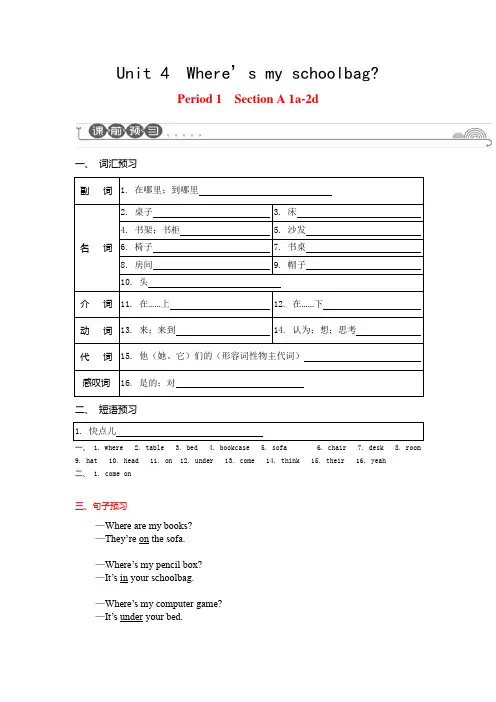
Unit 4 Where’s my schoolbag?Period 1 Section A 1a-2d一、词汇预习二、短语预习9. hat 10. head 11. on 12. under 13. come 14. think 15. their 16. yeah二、 1. come on三、句子预习—Where are my books?—They’re on the sofa.—Where’s my pencil box?—It’s in your schoolbag.—Where’s my computer game?—It’s under your bed.—Where’s the map?—I think it’s in your grandparents’ room.一、请听2d部分的对话,选择正确选项。
() 1. Where is Jack’s bag?A. On the desk.B. Under the chair.C. On the sofa.() 2. Where’s the map?A. Under the chair.B. On Jack’s grandparent’s bed.C. Under the bed.() 3. What’s on Jack’s head?A. A bag.B. A hat.C. A map.一、 1-3 CBB二、考点探究1. Where are my books?我的书在哪里?本句是由where引导的特殊疑问句。
where 为特殊疑问词,用来询问某人/某物“在哪里”,其基本句式为: Where+is/are+主语?当主语为第三人称单数时,谓语动词用is;当主语为复数或you时,谓语动词用are.Where is my notebook? 我的笔记本在哪里?Where are you? 你在哪里?【拓展】where引导的特殊疑问句的答语常用“人称代词It、They等+be动词+表示地点的介词短语.”作答,也可直接用“表示地点的介词短语.”作答。
七年级英语上册(人教版):Unit 4 Where's my school bag 教案
Unit 4Where's my school bag?第一课时Section A(1a-1c)1.重点单词:where,table,bed,bookcase,sofa,chair,on,under2.重点短语:on the sofa,in your bag,under your bed3.重点句型:—Where are my books?—They are on the sofa.—Where's my pencil box?—It's in your schoolbag.—Where's my computer game?—It's under your bed.1.能正确使用where引导的特殊疑问句2.用介词短语描述物品的位置1.能正确使用where引导的特殊疑问句2.用介词短语描述物品的位置一、预习课本P19新单词并背诵,完成下面的汉译英。
1.在哪里____________ 2.桌子____________3.床____________ 4.沙发____________5.椅子____________ 6.在……上________7.在……下__________二、认真预习1a,1b,1c,找出下列短语和句型。
1.在沙发上____________2.在你的书包里____________3.在你的床下____________4.—我的书在哪里?—他们在沙发上。
________________________________________________________________________ 5.—我的铅笔盒在哪里?—它在你的书包里。
________________________________________________________________________ 6.—我的电子游戏在哪里?—在你的床下。
________________________________________________________________________Step 1情景导入Teacher:We often lose our school things,like pens,pencils,erasers and other things.We must find them by ourselves,but sometimes we also ask others for help.Do you know how to ask and answer the location of the things?Let's learn together.环节说明:开门见山地提出本节课的语言知识目标,使学生能够明确学习任务,以最快的速度进入到课堂学习中去。
人教英语七年级上册Unit4Section A(2a-2d) (共28张PPT)
After reading,answer them!
• 1.Where is Jack’s bag? • 2.Is Jack’s hat on the chair?
2d Role-play the conversation.
Mom: Come on, Jack! Jack: Oh, no! Where’s my bag? Mom: Hmm…is it on your desk? Jack: No. And it’s not undet the
A: Are the books on the sofa?
B: Yes, they are.
A: Are the books on the table?
B: No, they aren’t. They’re in the bookcase.
Where’s the eraser?
• Is it on the table? • No, it isn’t.
Conclusion
(总结本课内容)
Where’s the baseball?
• Is it on the table? • No, it isn’t.
• Is it under the table? • Yes, it is.
Where’s the schoolbag?
• Is it under the table? • No, it isn’t.
• Is it under the table? • Yes, it is.
Where’s the schoolbag?
• Is it under the table? • No, it isn’t.
• Is it on the table? •re’s the baseball? Is it under the table?
Unit4Where’smyschoolbag课件-2021-2022学年人教版七年级英语上册

A.Yes,it is
B.No,it isn’t
C.Yes,they aren’t
D.No,they aren’t
( D )4.—______? —It’s in my schoolbag.
A.What’s that
A.think
B.spell
C.know
D.lose
( C )2.(2020楚雄期末) —Where is the library? —Sorry,I ______.
A.not know B.am not know C.don’t know D.not to know ( D )3.(2020禄丰期末)—Are the keys on the table? —______.
— They’re on the sofa.它们在沙发上。
23.— Are the keys on the sofa?钥匙在沙发上吗?
—No, they aren’t .They’re on the table.不,没在。它们在餐桌上。
课堂探究
1.介词 in,on,under的用法 in,on,under都是方位介词,后面跟名词或代词构成介词短语,表示 所处的位置不同,常用来表示“某物在某地”。 (1)on 意为“在……上面”,用来指两个物体相互接触。 ·There is a big clock on the wall.墙上有个大时钟。 (2)in 意为“在……里面”,常用来指某人或某物在某范围里。 ·Those two sisters are in our class.那两姐妹在我们班里。 (3)under 意为“在……下面”,常用来指一物体在另一物体的正下 方,两物体不接触。 ·There is a dog under the tree.树下有一条狗。
遵义专版七年级人教版英语教学课件Unit 4 Where’s my schoolbag
看图填空
This is my room. It’s very nice(漂亮). The
pictures are _o_n_ the wall. The computer is _o_n_ the desk. The baseball is u__n_d_e_rthe chair. My _b_o_o_k_s are in the bookcase. W___h_e_r_e_a__r_emy
1. table __b__ 2. bed _e___ 3. bookcase _h__ 4. sofa _g__
5. chair _d__ 6.schoolbag _a__ 7. books __f _ 8. keys __c__
1b Listen and number the things in the picture[1-4].
Picture 2
Picture (图片)1
(找不同)
Picture 2
In Picture 1, the baseball is behind the sofa. In Picture 2 , it’s … In Picture 1, the CDs are on the table. In Picture 2, they’re …
Yes, they are.
Be + 主语 +介词短语?询问某物或某人在某 处吗? Be动词的变化随主语的单复数而变化。 当某人或某物是单数时, be动词用is; 回答为Yes, it is. No, it isn’t. 当某人或某物是复数时, be动词用are; 回答为Yes, they are. No, they aren’t.
Revision
It’s on the table.
Unit4_SectionA(2a-3c)全英教案
Unit4 SectionA(2a-3c)全英版教案Teaching Aims1. Knowledge Objects(1)Function:Talk about where things are.(2)Key V ocabulary:come, come on, desk, think, room, their, hat, head, know(3)Target Language:—Where’s my schoolbag?—It’s on/in/under the chair.—Are my books on the chair?—Yes, they are. /No, they aren’t.—I don’t know.(4)Structure:Where questions; Yes/No questions and short answers; Prepositions:on, in, under; Subject pronoun:they2. Ability Objects:Enable the students to talk about where things are.3. Moral Objects:Enable the students to like to listen, say, speak and write English.Teaching Key Points and Teaching Difficult PointsHow to talk about where things are.Teaching MethodsIn-class activity method;Ask and answer method;Task based methodTeaching AidsCAI; A tape recorder; Some picturesTeaching ProceduresStep 1 Warming up (About 5 minutes)Chat with the students about the things around the room by showing them some pictures. Ask the students to spell the new words.Step 2 Listen and imitate (About 10 minutes)Section A, 2a:Remember what the things are on page 20,2a. Play the tape for students and let them number them. .Section A, 2b:Play the tape again, let students find the things from 2a and number them ( 1— 6) in the picture.Section A, 2c:Ask and answer questions about the things in the picture in 2be. g. :A:Are the keys on the sofa?B:No, they aren’t. They’re on the table.Step 3 A guessing game (About 5 minutes)Show the students a picture of a room with a few things in it. Have them guess the places of the other things.e. g. :T:There is a bookcase in it. Is the bookcase near the bed?Ss:Yes, it is. /No, it isn’t.Write the general question and the answers on the blackboard.Step 4 Pair work (About 10 minutes)Section A,2d:Role—play the conversation.Section A, 3a:look at the picture and complete the conversations, then work in pairs and act out the conversations.Section A, 3b:Ask and answer questions about the things in 3b.Step 5 Find the difference (About 8 minutes)Student A looks at Picture 1 in la on page 19, student B looks at Picture 2 in 3e on page 21, Ask and answer in pairs and fill in the form.e. g. :SA:Where is the schoolbag? Is it under the table?SB:No, it isn’t. It, s. on the table.In Picture l, the book case isIn Picture 2, the book ease is…In Picture 1, the books are…In Picture 2, the books are…Step 6 Practice the drill “Where is/are ...?” (About 5 minutes)Present short dialogues, using pictures or objects to help.Dialogue 1:A:Where’s my bag?B:I don’t know. Is it on the sofa?A:No, it isn’t.Dialogue 2:A:Where, re my books?B:I don’t know. Are they on the bed?A:Yes, they are.T each “don’t =do not”, “know”.Check the homework in The First Period. Make reports to share the information they got from the friends or teachers, and give their simply assessment.Let the students make similar dialogues according to the pictures in Section A, 3a&3c.Step 7 Homework (About 2 minutes)1. Finish the exercises in the exercise book.2. Act out the dialogues. (Section A, 2a & 2b.)Black board DesignUnit 4 Where’s my schoolbag?The Second Period (Section A 2a—3c)I think it’s in your grandparents’ room.Is/Are it/they on the desk? I don’t know.Yes it/they is/are.No, it/ they isn’t/aren’t.。
初中英语_七年级上 Unit4 SectionA 2d教学设计学情分析教材分析课后反思
Unit4 Section A 2d-3c学情分析1.学习水平不均有的学生对小学英语比较重视,学得很好;但有的学生或学校不重视,学得很不好,还有几个甚至完全没有学过。
有的学生笔试不错,但语音、语调、书写都有待加强。
因此,整个班级的英语水平很不平衡,给日常教学带来诸多的不便,提高了难度。
2.学习习惯不好学生刚刚从小学进入初中,处于一个衔接的阶段,学习任务加重,学习的习惯不是很好,没有形成一定的适合自己的方法,都有待改善。
总之,既要避免好生吃不饱的现象,又要努力把目前英语有欠缺的学生拉上去,激发他们的兴趣和信心,赶上中上的水平学生。
在今后的教学中应该注重培养、激发兴趣,教给学生学习的方法,从学生的学习兴趣、学习能力、生活经验和认知水平出发,倡导体验、实践、参与与交流的学习方式和任务型的教学途径,发展学生的综合语言运用能力,使语言的学习过程成为学生形成积极的情感态度、主动思维和大胆实践、提高跨文化意识和形成学生自主学习能力的过程,这是新课标和新目标英语的要求。
学习兴趣。
通过学习英文歌曲、猜英文谜语、做英式小游戏等加强对同学们英语兴趣的培养,以挖掘同学们学英语的内在动力,变“要我学”为“我要学”。
因此在本节课的教学中,我不是直接把知识教给学生,而是引导学生自主参与学习、交流合作、倡导体验、实践和自主探究的学习方式,注重学生实际课文文题的结合。
激发学生的学习兴趣,是他们自主的寻找信息,获取信息,使用信息,激发学生潜能,使学生在自主与合作的学习过程中获取知识,形成正确的学习方法。
七年级上Unit 4 Section A 2d-3c效果分析本节阅读课教师用书上建议用时1-2课时,但学生英语基础比较好,因此设计用一节课完成。
可这一部分内容对学生来说是相对较容易的一部分,以前接触过这一内容,因此,在整个课堂的学习过程中还算比较顺利,能完成全部的教学任务。
本节课重点的地方在where 和方位,为了让学生充分理解内容,设计了多种多样的练习,包括判断对错,回答问题,以及让学生动手写的根据文章内容填词。
Unit 4 Where’s my schoolbag (Section A 2a-2d)
Are the keys on the sofa?
No, they aren’t. They’re on the table.
版权所有
2c Ask and answer questions about the things in the picture in 2b. A: Are the keys on the sofa? B: No, they aren't. They're on the table.
版权所有
backpackLeabharlann Wordstable
bed
dresser
bookcase
sofa
版权所有
desk
hat
head
版权所有
chair
2a Listen and number the things[1-6].
版权所有
2d Role-play the conversation.
Mom: Come on, Jack! Jack: Oh, no! Where’s my bag? Mom: Hmm…is it on your desk? Jack: No. And it’s not under the chair. Mom: Oh! It’s on the sofa. Jack: Thank you, Mom. Err…where’s the map? Mom: I think it’s in your
=Hurry (up)! (表示催促。)
• • • • on the desk (在桌子上) under the chair (在椅子下面) on the sofa(在沙发上) think(认为;想;思考) think of(记起,想起) think about (考虑,思考) • on the bed (在床上) • on your head (在你的头上) eg. The hat is on your head.