
精选2019-2020学年译林版牛津初中英语总复习(第3课时)七年级下Units1-4
第3课时[七年级下册] Units 1—4●1 invite vt. 邀请[点拨] invite 用作动词,常用于以下结构:(1)invite sb for邀请某人……John invited me for dinner. 约翰请我吃饭。
(2)invite sb to do sth 邀请某人做某事He invited a singer to sing for his friends.他邀请了一位歌手给他的朋友们唱歌。
(3)invite sb to sp 邀请某人到某处Linda invited me to her home.琳达邀请我去她家。
[拓展] invite的名词形式为invitation,意为“邀请;请柬”。
Millie received an invitation to the party.米莉收到了参加聚会的请柬。
●2 broken adj. 损坏了的;破碎的[点拨] broken 用作形容词,在句中作表语或定语。
The TV is broken. I will have it repaired this afternoon. 这台电视机坏了。
今天下午我将让人修理一下它。
[拓展] broken的动词形式为break,意为“打破;打碎”。
Take care not to break the cup.小心别把茶杯打碎了。
She is eager to break the record.她渴望打破那项记录。
[搭配] 与break相关的短语:break down (机器)坏了;(计划、谈判) 失败;(谈话、通讯) 中断break into 破门而入;打断(谈话);占用break off 突然停止;中断(谈判);断绝(关系)break out (战争、瘟疫、火灾等)爆发break up 散会;(学期)结束;驱散(集会);(精神上)垮掉●3 raise vt. 饲养Most students in our school raise pets.我们学校的大多数学生都饲养宠物。
[拓展] (1)raise 还可译为“举起;升起;提起;抬起(某物)”。
常用搭配:raise one's hand 举手He raised his eyes from his work. 他停下工作举目观看。
(2)raise 还有“募集”之意。
常用搭配:raise money for…为……募集资金We'll hold a charity show to raise money for poor children.我们将举行一个慈善义演来为贫困儿童募集资金。
●4 of one's own 属于某人自己的Millie has a new bike of her own.米莉有一辆自己的新自行车。
[拓展] on one's own 意为“单独;独自”,相当于alone/by oneself。
You'd better finish the homework on your own.你最好独自完成家庭作业。
巧辨异同●1 family, house和home(1)family意为“家人;家庭成员”。
family作整体概念的“家庭”讲时,看作单数,作主语时,谓语动词用单数形式;作“家庭成员”讲时,看作复数,作主语时,谓语动词用复数形式。
The whole family are watching TV.全家人都在看电视。
(2)house意为“房屋”,侧重居住的建筑物。
There is a river behind the house.在那座房子的后面有一条河。
(3)home 意为“家”,侧重个人出生、被抚养长大的环境或居住地,含有“家乡;故乡”的意思。
它具有house 所没有的感情色彩(如团聚、思念等)。
Her home is far away. 她的家很远。
●2 elder和older(1)elder表示“年纪较长的”,仅用于同一家庭里的成员的比较;older则不限于此。
My younger son is five and my elder son is nine.我的小儿子5岁,大儿子9岁。
Tom is two years older than me.汤姆比我年长两岁。
(2)elder在句中只作定语,不作表语;older两者皆可。
My elder sister does her homework all by herself.我姐姐独自做作业。
I think his mother is older.我认为他的母亲年龄比较大。
(3)elder只能用来修饰人;older既可修饰人,也可修饰物。
This dog is older than any other dog here.这条狗比这里其他的任何狗都老。
●3 ill和sickill 和sick都有“生病的;有病的”之意,但在用法上有所不同。
(1)ill 表示“生病的;有病的”,在句中一般用作表语,不作定语;而sick 在句中既可以作表语又可以作定语,如:“病人”可以说成a sick man 或the sick, 但不能说成an ill man 或the ill。
She is ill/sick in bed. 她卧病在床。
She is looking after her sick father.她在照顾她生病的父亲。
(2)sick 还可以表示“恶心的;厌倦的”,ill无此义。
The smell makes me sick. 这气味使我感到恶心。
(3)ill 作定语修饰名词时,还可译为“坏的;邪恶的”。
He is an ill man. 他是一个邪恶的人。
●4 hear sb do sth与hear sb doing sth(1)hear sb do sth意为“听到某人做某事”,指动作已经结束或动作经常发生。
I often hear Millie sing in the next room.我经常听到米莉在隔壁房间里唱歌。
(2)hear sb doing sth 意为“听到某人正在做某事”,指动作正在进行。
When I passed the classroom, I heard a girl singing in it.当我经过教室的时候,我听到一个女孩儿正在里面唱歌。
[拓展] 在see, feel, watch, notice 等表示感知的动词后,既可接 v.ing 构成复合宾语,也可用不带to 的动词不定式构成复合宾语。
这两种结构的区别与hear的用法类似。
●5 remember to do sth 与remember doing sth(1)remember to do sth 意为“记得要做某事”,指这个动作在说话时还未做。
Remember to close the door, please.请记着把门关上。
(2)remember doing sth 意为“记得做过某事”,指说话时动作已完成。
I remember closing the door. 我记得把门关上了。
[拓展] forget 意为“忘记”,与remember的用法类似。
●6 cross, across, crossing和through(1)cross 为动词,意为“穿过,横过”,指从一个平面通过,常用于过桥、河、路、街道等。
Look left and right before you cross the street.在你过马路之前要左右看看。
(2)across 为介词,意为“横跨;横穿;穿越”,常与动词walk, run, go, jump等连用,与cross基本同义。
Go across the road, and you will find the post office on your left.穿过这条公路,你会发现邮局就在你的左边。
(3)crossing 为名词,意为“十字路口;交叉处”。
Turn left at the second crossing.在第二个十字路口处向左转。
(4)through 为介词,意为“穿过;通过”,指从物体的内部穿过。
He walked through the forest alone.他独自走过了那片森林。
句型透视●1 Would you like to live in a palace, Eddie? 埃迪,你想住宫殿吗?[点拨] would like常用于委婉地提出请求、建议或某种看法。
根据需要可用不同的表达方式:would like sth 想要某物;would like to do sth 想要做某事; would like sb to do sth 想要某人做某事—Would you like some coffee?—Yes, please./No, thanks.“您想喝一些咖啡吗?”“好的。
/不用了,谢谢。
”—Would you like to go with me?—Yes, I'd like/love to.“你愿意和我一起去吗?”“是的,我愿意。
”●2 —There are twenty restaurants in town. Which is your favourite?—The biggest one in Fifth Street!“镇上有二十家餐馆,你最喜欢哪一家?”“第五大街上最大的那家!”[辨析] one与it(1)one 表示泛指,指代上文出现过的同类事物。
I can't find my hat. I think I must buy a new one.我找不到我的帽子了。
我想我该去买一顶新的。
(2)it 表示特指,指代上文出现过的同一事物。
I can't find my hat. I don't know where I put it.我找不到我的帽子了。
我不知道我把它放在哪儿了。
●3 There's something wrong with my computer. 我的电脑出故障了。
[点拨] 句型“There is something wrong with…”意为“……出故障/有毛病”,相当于“Something is wrong with…”或“…doesn't work.”或“…is broken.”[拓展] 句型“There is nothing wrong with…”意为“……没有毛病”。
●4 Why not visit our local theatre and enjoy Beijing opera? 为什么不去参观我们本地的剧院并欣赏京剧呢?[点拨] 句型“Why not+动词原形?”意为“为什么不……呢?”。
牛津译林版七年级英语下册期末复习课件全册
9.danger n. →da_n_g_e_r_o_u_s___ (adj.) 危险的
10.twelve num. → __t_w_e_l_f_t_h__ (序数词)
词汇 拓展
11.nine num. → ___n_i_n_t_h____ (序数词) 12. own adj.& v. →__o_w_n_e_r____(n.) 物主 13.invite v. → i_n_v_i_t_a_t_i_o_n__ (n.) 邀请
6.wait v.→ w_a_i_t_e_r_/_w_a_i_t_r_e_s_s_ (n.) 服务员
课前自学反馈
中考考点聚焦
当堂效果检测
第3课时┃ Units 1-4 [七年级下册]
类别
课标考点要求
7.leaf n. → _l_e_a_v_e_s___ (复数) 8.above prep. → __c_o_m_p_a_n_i_e_s (反义词)
短语 归纳
23.为……准备…… __p_r_e_p_a_r_e_…__f_o_r_…__ 24.大量,足够 _p_l_e_n_t_y__o_f_______ 25.整天地 ____a_l_l__d_a_y__l_o_n_g_
26.在……脚下 ____a_t__t_h_e__f_o_o_t__of
27.我的一位老朋友 ___a_n__o_l_d__f_r_i_e_n_d_ of mine
8.在……的中心 ___i_n__t_h_e__c_e_n_t_r_e_ of 9.让某人感觉更好 __m_a_k_e__s_b__f_e_e_l__b_etter 10.各种各样的问题 _a_l_l__k_i_n_d_s__o_f__p_r_oblems
课前自学反馈
牛津译林版七年级下册 Unit3 总复习课件 (共30张PPT)
/
theirs
Writing
Useful Expression
How to begin
Hello, I am ... / my name is … I live in Huai’an. It is a beautiful/cool/great city. You can see…(flowers) all over the place. Let me /I’d like to show you around my hometown.
8.钥匙_k_e_y____→__k_e_y_s_____复数
1.没有什么__n_o_th_i_n_g____ 2.稍等片刻__w_a_it_a__m_i_nu_t_e/moment 3.交流生__e_x_c_ha_n_g_e__st_udent 4.新鲜的__fr_e_sh_______ 5.当地的__lo_c_a_l ______ 6.地铁_u_n_d_e_r_g_ro_u_n_d_ 7.不久,很快_s_o_o_n_______ 8.旅馆_h_o_t_e_l ______
around my hometown.
Para 2 ( main body)
1. 淮安有10,072 平方公里大小。 2. 因...而出名/作为... 而出名 3. 名胜古迹 4. 我们可以开车去购物。 5. 超过、大约 6. 一些人爱骑车,另一些人喜欢步行。
• has an area of/be… in size; be famous for/as;
1.邀请某人去某地:i_n_v_it_e__s_b_t_o_s_p 2.邀请某人做某事:i_n_v_it_e__s_b_t_o_d_o sth 3.为什么不做某事:_w_h_y__n_o_t_d_o__sth?
牛津译林版七年级英语下册unit3 复习课件(24张)
根据中文或首字母及句意完成句子
1)We should eat___fr_e_s_h__ (新鲜的)vegetables.
2)Yao Ming is one of __th__e_m__o_s(t 著名的) basketball
Town. 点拨:to do 是动词不定式做定语,表示将来要做的事,
修饰名词things。当动词不定式做定语时,通常放 在被修饰的成分后面。
e.g.I can’t go with you because I have a
letttoer _w_r_it_e_ _____.( 要回) I have a lot of clothes _to___w_as_h____.(要洗)
2.乘地铁只需40分钟。
It takes only 40 minutebsy underground
(1)点拨:by underground “乘地铁”,介词短语, 作方式状语。by+交通工具,不加冠词,且名词用 单数。
by train/plane/bus/car/taxi/bike/ship on foot
go to the park by underground = take the underground to the park go to school by bike = ride to school go to Xuyi by plane = fly to Xuyi
player.
famous
3)Don’t get up late,or you will m_i_s_s____the early bus.
4)Today the baby seems very _q_u_i_e_t_(安静) .
牛津英语译林版七年级下册7下Unit3单元复习(包含答案)
⽜津英语译林版七年级下册7下Unit3单元复习(包含答案)7下Unit 3 单元复习⼀、单项选择I. Mum often has a lol of housework ______ before the Spring Festival.A. to doB. doingC. is doingD. does2. Millie is a good swimmer, and she can swim ______ a fish.A. likesB. likeC. is likeD. /3. It ______ Millie ten minutes ______ go to school every day.A. take; toB.take; /C. takes; toD. takes; /4. —______ is your hometown from here? —About two hours by car.A. How longB. How farC. How manyD. How much5. My ______ home is far from ______.A. grandparent’s; ourB. grandparents’ ourC. grandparents; oursD. grandparents’ ours6. —______ cap is that? —It’s his.A. WhoB. Who’sC. WhoseD. What7. You enjoy ______. Why not______ a song for us at the birthday party?A. singing; singingB. singing; singC. to sing; singingD. to sing; sing8. —Would you like to see the works of art with us? —______A. No, I don't.B. Yes, I do.C. OK.D. Yes, please.9. ―The World Cup is coining. I won't ______ any game! —I'm looking forward to ______ every match of it, too.A. miss; watchingB. miss; watchC. seeing; missingD. see; miss10. Will you go to the zoo ______ your new bicycle?A. fromB. onC. byD. with11. Welcome to my home. Would you like ______ coffee?A. someB.anyC. manyD. much12. —David, you left your English book on the desk. ―It isn't ______. I think it is ______.A. mine; Nick'sB. mine; NickC. my; Nick'sD. my; Nicks’13. —Shall we go for a walk in the park after dinner? —______A. I have no time.B. You are welcome.C. It’s a good idea.D. Yes, I know.14. —Welcome to our restaurant. What can I do for you? —I want to___________a bowl of noodles.A. makeB. cookC. raiseD. order15. —______ your hometown like? —It’s a good place ______.A. How's; to liveB. How does; livingC. What's; to liveD. What does; living⼆.完形填空A driver gets lost (迷路)on his way to Denver. He ___1___ in front of a farmhouse on the side of the road. He gets out and knocks at the door. A very old woman ___2___ the door. The driver asks her how to get to Denver.“Sorry, I don’t know how to get there,”the woman says. The driver feels ___3___. He gets back in his car and ___4___ away. Then he hears ___5___ shouting. He looks in his rearview mirror (后视镜). The woman and ___6___ old man are waving(招⼿) for him to come back.“The old man ___7___ know how to get there!” the driver says to ___8___ . He ___9___ his car around and drives back to them. When the driver gets ___10___ the car again, the old woman says:“This is my husband. He doesn’t know how to get there either.”1. A. comes B. stops C. gets D. walks2. A. closes B. asks C. answers D. knocks3. A. sad B. happy C. surprised D. interested4. A. leaves B. rides C. drives D. runs5. A. anyone B. someone C. everyone D. no one6. A. the B.a C./ D. an7. A. can B. can't C. must D. mustn't8. A. himself B. him C. herself D. her9. A. drives B. looks C. starts D. turns10. A. out B. out of C. into D. on三.阅读理解AI am Peter. I live with my grandparents in a small village (村庄).There are some hills and a river near the village. On the hills, there are many fruit trees and beautiful flowers. I often go walking with my fhends in the hills. The river is shallow, so it is safe (安全的)for us to swim in it. The people here grow wheat and vegetables and they also raise cows and pigs. We live in a small house. There is a pool in front of our house.The people in the village are very friendly and they know each other. They like doing sports very much. The old people like to play t’ai chi ch’uan (太极拳). The young people like to play basketball and table tennis. There is a cinema in the centre of the village. Ifs free to all the villagers (村民),but it opens only at the weekend.I have many friends in the village. I like the quiet and happy life here. I think it's a wonderful place to live.1. Where does Peter live?A. In a small village.B. In a small city.C. In a big city.D. In a small town.2. What does the underlined word “shallow” mean in Chinese?A.浅的B.深的C. 脏的D. 湍急的3. What do the young people like doing?A. Playing t'ai chi ch'uan.B. Playing table tennis and basketball.C. Playing basketball and tennis.D. Playing table tennis and badminton.4. Where is the cinema?A. In the city.B. Near the village.C. In the centre of the village.D. In front of our house.5. Which of the following is true?A. Peter lives with his parents.B. Peter often swims in the pool.C. The cinema ticket is a little expensive.D. The villagers can go to the cinema at the weekend.BSpaceships, dinosaurs and mummies (⽊乃伊)… You usually only see these things in films. But if you visit a museum, you may get to see them for real!A museum is a wonderful place. You can always find something new in different museums. It helps open up your world. For example, how fast can a velociraptor(迅猛龙) run? How do astronauts(宇航员) land when they come back to the Earth? Do you know that Leonardo da Vinci is not only a great artist, but also a great inventor?Many of you may come across something new in a museum. You can go home and look it up online or in books. Has this ever happened to you? Museums help us learn about things outside of school. What’s most interesting is that there are museums for almost everything. There are museums for cats, Teddy bears and even hair! And there’s almost always one close by. Does a trip to a museum sound fun to you?6. This passage describes______.A. dinosaursB. mummiesC. filmsD. museums7. From the second paragraph, we know that______.A. museums have everything you needB. a vclociraptor can run fastC. astronauts can't walk after spending a long time in spaceD. Leonardo da Vinci is an artist and also an inventor8. The underlined phrase "comc across" means "______".A. cross the roadB. findC. listen toD. come to9. Which of the following museums is NOT mentioned in the passage?A. A museum for cats.B. A museum for hair.C. A museum for Teddy bears.D. A museum for balls.10. What can we learn from the last paragraph?A. Museums can help us with our studies.B. Every student should visit museums.C. There are many kinds of museums.D. Museums are better than theatres.四. 填空A) 根据括号中所给汉语写出单词,使句⼦意思完整正确。
【最新】牛津译林版七年级英语下册《Unit3》复习课件.ppt
5. Tom’s family owns
(own) a new car.
6. The fish smells (smell) so nice. I can’t wait to eat!
7.It’s about ten _m___i_n__u_t_e__s_’__ ( minute) walk from here to the playground. 8. Our school is very big, but theirs (their) is small.
2. Pmleinasee give this to Susan. It is
________ pen.
3. hWeerare working hard on ______ project.
The teacher will like it.
our
4. My cousins and I live in the same building. My flat is on the third floor. _T_h_e_i_rs____ is on the tenth floor.
单词背诵2
12. 划船 13. 旅馆 14. 拥有,所有 15. 家乡 16. 友好的 17. 饲养 18. 生长,发育 19. 嗅,闻到 20. 驾驶,开车 21. 等一会儿 22. 盼望,期待 23. 艺术品 24. 钥匙扣 25. 到处,遍及
12. row 13. hotel 14. own 15. hometown 16. friendly 17. raise 18. grow 19. smell 20. drive 21. wait a minute 22. look forward to 23. work of arts 24. key ring 25. all over
牛津译林版2019-2020年七年级英语下册 Unit 3 易错知识点练习(含答案)
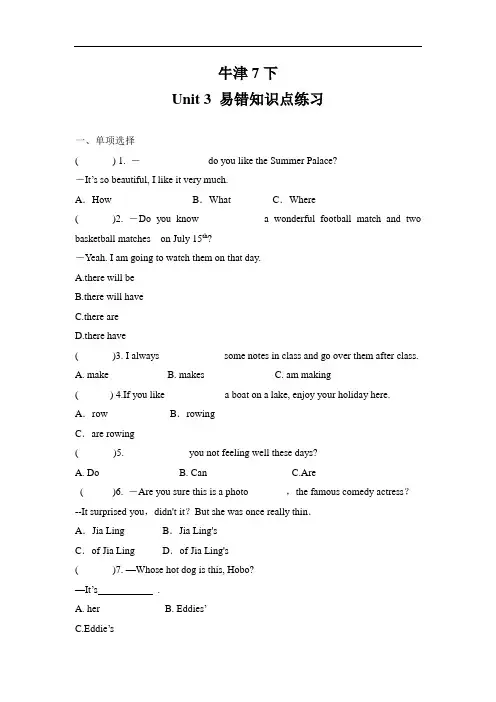
牛津7下Unit 3 易错知识点练习一、单项选择( ) 1. -_____________ do you like the Summer Palace?-It’s so beautiful, I like it very much.A.How B.What C.Where( )2. -Do you know ___________ a wonderful football match and two basketball matches on July 15th?-Yeah. I am going to watch them on that day.A.there will beB.there will haveC.there areD.there have( )3. I always_____________some notes in class and go over them after class.A. makeB. makesC. am making( ) 4.If you like____________a boat on a lake, enjoy your holiday here. A.row B.rowingC.are rowing( )5._____________you not feeling well these days?A. DoB. CanC.Are( )6. -Are you sure this is a photo _______,the famous comedy actress?--It surprised you,didn't it?But she was once really thin.A.Jia Ling B.Jia Ling'sC.of Jia Ling D.of Jia Ling's( )7. —Whose hot dog is this, Hobo?—It’s ____ .A. herB. Eddies’C.Eddie’s( )8. —____ ?—He enjoys watching Evening News.A. What’s your father likeB. What does your father look likeC. What does your father like( )9. —Mr Li enjoys playing golf.—OK, ____ .A. Let’s take him to the library.B. What about taking him to the sports field?C. Why not have a party?( )10. The exchange students from England___________coming to Sunshine Town.A. willB. areC.is二、根据句意及首字母提示填空1. -Is there anything in the fridge?-No, there’s n__________.2. He is a student from the USA, he is an e _______________ student.3. A friend of m _______________ is a doctor.4. Mr. Smith t______________ us maths in Sunshine School.5. I buy many p____________ for my parents when I go home.6. Let’s go to our local t to enjoy Beijing opera.7. You can go to Tian’anmen Square by u because it’s fast and cheap.8. Unluckily, I m the last train to Beijing.9. In the restaurant, you can o any food you like.10. The fish s good.三、用括号内所给单词的适当形式填空1. Miss Yang may go to the library __________(borrow) books.2. Listen carefully. Someone _________(cry) over there.3. Mr Smith enjoys _______(eat) vegetable soup.4. On _________(she) way home, Ann met a friend of hers.5. She wants _________(be) a good teacher when she grows up.四、用方框中所给单词的适当形式填空。
江苏专版牛津译林七年级下册-Unit-3-知识点复习总结
江苏专版牛津译林七年级下册-U n i t-3-知识点复习总结work Information Technology Company.2020YEAR江苏专版译林七下U3知识点总结1.An old friend of mine is coming to see me, Hobo.霍波,我的一个老朋友要来看我。
(1)解析:an old friend of mine意为“我的一位老朋友”。
mine是名词性物主代词,相当于“形容词性物主代词my十名词”。
在英语中,冠词与物主代词不能同时放在同一个被修饰词前,表示“我的一个......”,“他的两个......”用“冠词/数词+名词+of+名词性物主代词”结构。
如:➢ a pen of Jim's 吉姆的一支钢笔a book of hers她的一本书➢ Your cap is black, and mine(= my cap) is blue.你的帽子是黑色的,我的是蓝色的。
(2)解析:be coming是进行时结构,相当于be going to come,表示近期安排的确定将要发生的动作。
在英语中,像come, go, leave等这一类表示位置移动的动词可用进行时表示将来。
如:➢ We are leaving for Hong Kong tomorrow.明天我们将出发前往香港。
➢ They are going to Paris for the summer holiday.他们打算去巴黎度过暑假。
2.Wait a minute... 等一会儿......解析:wait a minute为动词短语,意为“等一会儿”,用于日常交际用语中,同义短语为just a minute/moment。
如:➢ Wait a minute.I'll go with you.等一会儿。
我将和你一起去。
拓展:固定短语: just a minute/ moment等一会儿; in a minute立刻,马上。
牛津译林版7年级下册第三单元知识点复习(25张ppt)
为避免重复使用bag,可写成: My bag is yellow, her bag is red, his bag is blue and your bag is pink. My bag is yellow, hers is red, his is blue and yours is pink.
①'s 所有格的构成方法
(1) 一般情况(包括单数名词和不带词尾-s的复数名词)加 -’s
children's books 儿童图书
today’s paper 今天的报纸
(2) 带词尾-s的复数名词只加省字撇 ’:
girls’ school 女子学校
the Smiths’ car 史密斯家的小汽车
the boss’s plan 老板的计划 actress’s 女演员的
2、Beijing duck is very famous. (第三段)
famous 形容词,意为“著名的,有名的”
其同义词是well-known, 反义词是unknown
例如:Chinese silk is famous around the world. 中国丝绸世界闻名。
【拓展】: 1.be famous for… “因…而著名/出名”。 New York is famous for its skyscrapers. 纽约因它的摩天大厦而闻名。
[拓展]: some… the others…意为“一些……,其他的……”,表示一定范围内除去一部分 后其余的全部。 There are 40 students in my class. Some are Americans, and the others are Chinese. 我们班有40个学生。一些是美国人,其他的是中国人。
牛津译林版英语七年级下 Unit3 知识点梳理
Unit 3 Welcome to Sunshine Town知识点总结1.Welcome to Sunshine Town.欢迎来到阳光镇。
1)“Welcome to +地点”表示“欢迎来到……!”如:欢迎到我们的学校来!2) welcome后面如果接副词,则应省略介词to。
如:欢迎回家/回来。
3)welcome做形容词,意为“受欢迎的”。
如:不用谢。
2. An old friend of mine is coming to visit me, Hobo.is coming是现在进行时,表示将要发生的动作。
在英语中一些位移动词,如come,go,leave等可用现在进行时表示将要发生的动作。
如:一Lingling! Supper is ready.—玲玲,晚饭准备好了。
一I’m coming,Mum. –我就来,妈妈。
an old friend of mine 我的一位老朋友of后用的是名词性物主代词这是双重所有格结构。
双重所有格是指既含有没那个词的所有格或名词性物主代词,又含有of短语的一种表达所有关系的结构。
如:这是我妹妹的一位老师。
在英语中冠词与物主代词不能同时放在同一个修饰词前,要表示“我的一个….”或“他的两个…..”则须用“冠词/数词+名词+of+名词性物主代词”结构。
如:Tim的一个钢笔她的一本书3There’s nothing in the fridge. Nothing=not anything 没有什么Nothing something anything 这些词是不定代词,形容词修饰时要放后面。
如:没有什么重要的Nothing做主语时,谓语动词用单数形式。
Nothing本身含有否定意思,谓语动词不能再用否定式。
如:There is nothing in my bag.==没有什么能阻止西蒙努力学习。
4Let’s go to the supermarket.Let’s是let us 的缩写,后接动词原形,通用用来表示提出建议、请求等。
牛津译林版七年级英语下册Unit3知识点复习资料
牛津译林版七年级英语下册Unit3知识点复习资料一、重点单词1.没有什么2.听,罐3.比萨饼4.安静的5.大气6.新鲜的7.当地的8.慢跑(名)9.地铁10.著名的11.西方的12.歌剧13.剧院14.错过;想念15.向前(副)16.不久17.明信片18.钥匙19.环;戒指20.钥匙扣21.到处22.笔袋23.作品;工作24.艺术品25.绘画;油画26.划---27.旅馆28.拥有;自己的29.家乡30.饲养31.种植;生长32.小麦33.友好的34.闻到;闻起来---35.驾驶36.订购二、重点词组1.我的一个老朋友2.对-----是足够的3.等一会儿4.订购一本书5.一组来自于英国交流的学生6.带某人去某地7.带一把雨伞在你身边8.邀请某人做某事9.邀请某人到某地来10.尝尝一些中餐11.尽力做某事12.为某人准备某物13.想要做某事14.当地的人们15.远离-------16.为某人买某物17.西餐馆18.为什么不做某事19.使某人做某事20.帮助某人做某事21.最好做某事22.期待做某事23.更到地了解-----24.到处,每处25.了解所有关于中国历史的事26.中国画27.在湖上划船28.玩得开心29.一个有四个房间的公寓30.在星期天早上31.听鸟儿唱歌32.在农场上33.带领某人参观某地34.驾车带某人去某地35.一个居住的好地方36.互相了解三、重点句子1.我的一个老朋友要来看望我。
2.在教室里面没有人。
3.这钱对于一听狗食足够了。
4.他又足够的钱去买一辆轿车。
5.他足够的可以上学了。
6.我想要在网上订购一本书。
7.我们带他们到电影院好吗?8.他将邀请我和他们共进晚餐。
9.尝一些中餐怎么样呀?10.我们应该尽力地多了解中国的历史。
11.明天还将有二十棵树要植。
12.瞧,有名老师正在操场上跑步。
13.当地的人们乘地铁去北京只要半个小时。
14.他居住在一个远离镇中心的乡村里。
15.你为什么不买件礼物给你妈妈呢?16.在冬天我们经常生火来保持房间温暖。