
译林版英语八年级下册教学教案 Unit 1 Grammar
8B Unit 1 Past and present
Grammar
Teaching Objectives
1.学习现在完成时的时间副词和时间短语。
2.能在语境中运用现在完成时。
Main points and difficult points:
现在完成时与一般过去时在时间副词用法区别。
Teaching tools: pictures, recorder, tape
Teaching procedures:
Step One: Lead-in
The teacher can have a free talk with the students.
e.g. You have known something about Mr. Chen.
Could you tell me anything about Mr. Chen?
Step Two: Pre-task
Recently we have already known a little about Sunshine Town. I have never been there before. Have you ever been there?
S1: No, I haven’t been there yet.
T: Mr. Chen was born there. He has known it since he was very young. He has known it for a long time.
Step Three: While-task
Task 1: 1) Tell the students that we can use adverbs of time with the present perfect tense, such as already, ever, for, just, never, since and yet.
2) Some more examples:
I have just seen Millie on the playground. Has Millie called yet? No, she hasn’t.
I have not heard from Millie yet. I have done my homework already.
I have never read the novel. …
3)现在完成时与时间副词(on Page16)
for +段时间for two days/three years
since +点时间since last night /1992 since two days ago
since +句子since I came here last week
already 一般用于肯定的陈述句
yet 一般用于否定句和疑问句(否定句中常译为“还”;疑问句中常译为“已经”。
)
just 刚(注意与just now的区别)
recently 近来ever 曾经(常用于问句) never 从不
up to now till now over/in the past 10 years so far before(句尾且不加时间) eg. Have you visited our city before?
4)Exercises A.选择填空
Have you done your homework ______? (for, just, yet)
I have _______ __been to Chengdu. (ever, never, yet)
He has _______ washed the dishes. (already, ever, for)
He has worked there _______ he left school. (already, just, since)
Have you cleaned your room _______? (for, just, yet)
She has known Sam _____ nine years. (for, never, since)
Have you ______ ridden a horse? (ever, for, yet)
They have ______ arrived. (ever, just, yet)
We have not completed the project _______. (already, for, yet)
B. for or since
1. We have lived here ____ 1990.
2. How long have you studied here? ___ 5 years.
3. The boy has had a bad cold _____ last night.
4. Mr. Huang has kept the books ______ a week ago.
5. I have taught in the school _____ I came here.
6. We have been friends ____ a long time.
总结: for +段时间since +点时间(过去时间)
since +句子(一般过去时态的句子)
C.句型转换
1. The boy has already gone home. (一般疑问句)
2. The girl has already given it to me. (否定句)
3.They have ever visited the Hainan Island before .(否定句)总结: 1.(现在完成时)肯定句变为否定句的基本方法:
2.(现在完成时)肯定句变为一般疑问句的基本方法:
3.注意点:just、already、yet之间的关系及各自适应的句型
Step Four当堂反馈,拓展迁移
完成句子
(1) 你曾经到北京旅行过吗?
(2) 我已经看过这部电影了。
(3) 她刚刚完成作业。
(4) --他们已经去看这部电影了吗? --还没有呢。
(5) 我以前从未看过这本书。
Step Five Homework
1.Remember the new words and phrases .
plete the exercises in workbooks.。
牛津译林版八下unit1grammar2课堂教学设计
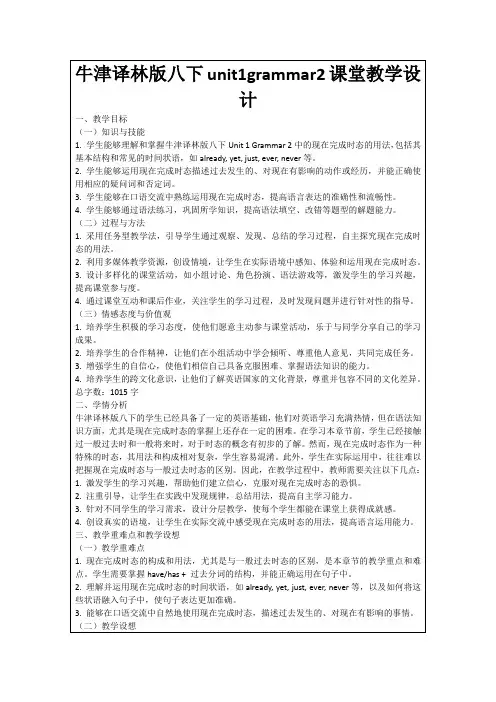
一、教学目标
(一)知识与技能
1.学生能够理解和掌握牛津译林版八下Unit 1 Grammar 2中的现在完成时态的用法,包括其基本结构和常见的时间状语,如already, yet, just, ever, never等。
2.学生能够运用现在完成时态描述过去发生的、对现在有影响的动作或经历,并能正确使用相应的疑问词和否定词。
3.设计多样化的课堂活动,如小组讨论、角色扮演、语法游戏等,激发学生的学习兴趣,提高课堂参与度。
4.通过课堂互动和课后作业,关注学生的学习过程,及时发现问题并进行针对性的指导。
(三)情感态度与价值观
1.培养学生积极的学习态度,使他们愿意主动参与课堂活动,乐于与同学分享自己的学习成果。
2.培养学生的合作精神,让他们在小组活动中学会倾听、尊重他人意见,共同完成任务。
五、作业布置
为了巩固本章节所学内容,确保学生对现在完成时态的理解和应用,我设计了以下作业:
1. **语法练习**:完成课后练习册中关于现在完成时态的练习题,包括填空、改错和完成句子。这些练习旨在帮助学生巩固对现在完成时态结构的掌握,并能够在不同语境中正确运用。
2. **写作任务**:写一篇日记,描述今天发生的三件事情,并使用现在完成时态来表达这些事情对现在的影响。这样的写作任务不仅能够锻炼学生的写作能力,还能加深他们对现在完成时态用于描述过去对现在影响的理解。
(五)总结归纳
在总结归纳环节,我将采取以下措施:
1.对现在完成时态的结构、用法和常见时间状语进行回顾。
2.让学生分享他们在课堂中学到的知识点和遇到的困难。
3.针对本节课的学习内容,布置相关作业,要求学生巩固所学知识。
译林版英语八年级下册第一单元全套教案
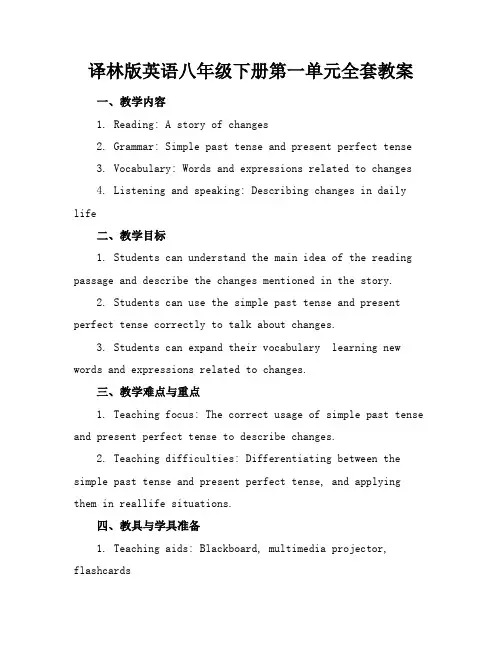
译林版英语八年级下册第一单元全套教案一、教学内容1. Reading: A story of changes2. Grammar: Simple past tense and present perfect tense3. Vocabulary: Words and expressions related to changes4. Listening and speaking: Describing changes in daily life二、教学目标1. Students can understand the main idea of the reading passage and describe the changes mentioned in the story.2. Students can use the simple past tense and present perfect tense correctly to talk about changes.3. Students can expand their vocabulary learning new words and expressions related to changes.三、教学难点与重点1. Teaching focus: The correct usage of simple past tense and present perfect tense to describe changes.2. Teaching difficulties: Differentiating between the simple past tense and present perfect tense, and applying them in reallife situations.四、教具与学具准备1. Teaching aids: Blackboard, multimedia projector, flashcards2. Learning aids: Textbooks, exercise books, dictionaries五、教学过程1. Leadin: Show pictures of a city 10 years ago and now, asking students to observe and describe the changes they see.3. Grammar: Introduce the simple past tense and present perfect tense through examples. Explain the differences and practice using them in sentences.4. Vocabulary: Teach new words and expressions related to changes. Students practice using them in sentences.5. Listening and speaking: Play audio recordings about describing changes in daily life. Students listen and repeat, then practice in pairs.6. Group work: Students work in groups to create a dialogue about changes in their city or school, using the learned grammar and vocabulary.8. Summary: Review the key points of the lesson, emphasizing the usage of simple past tense and presentperfect tense.9. Homework: Assign homework (see section VII).六、板书设计1. Title: Past and Present2. Reading: Main idea and changes in the story3. Grammar: Simple past tense and present perfect tense4. Vocabulary: Key words and expressions related to changes5. Listening and speaking: Key sentences for describing changes七、作业设计1. Homework 1: Complete exercises on simple past tense and present perfect tense (pages 2021).Answers: Provided in the textbookAnswers: To be corrected in the next class八、课后反思及拓展延伸1. Reflection: Assess students' understanding of the lesson, identifying strengths and weaknesses in grammar and vocabulary usage. Make necessary adjustments for future lessons.重点和难点解析1. 教学难点与重点的区分2. 简单过去时和现在完成时的正确使用3. 词汇教学中与变化相关的单词和表达4. 听说练习中描述日常变化的活动设计5. 作业设计中涉及的语言点巩固对于这些重点细节的详细补充和说明如下:一、教学难点与重点的区分教学重点在于让学生掌握如何使用简单过去时和现在完成时来描述变化。
初中英语译林版八年级下册精品教案Unit 1 Grammar
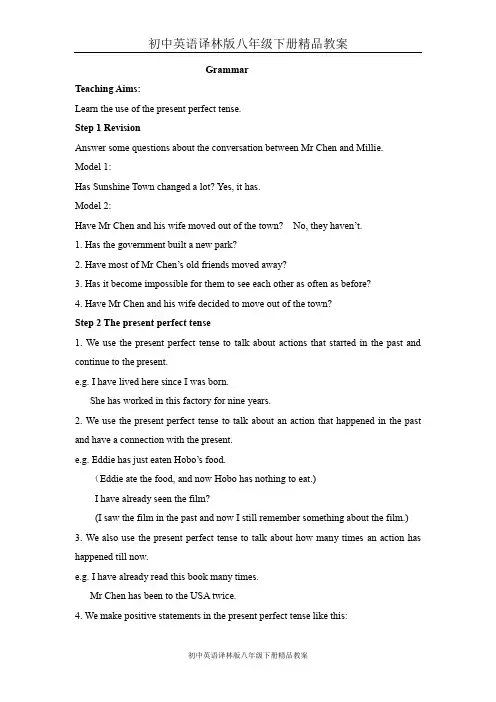
GrammarTeaching Aims:Learn the use of the present perfect tense.Step 1 RevisionAnswer some questions about the conversation between Mr Chen and Millie.Model 1:Has Sunshine Town changed a lot? Yes, it has.Model 2:Have Mr Chen and his wife moved out of the town? No, they haven’t.1. Has the government built a new park?2. Have most of Mr Chen’s old friends moved away?3. Has it become impossible for them to see each other as often as before?4. Have Mr Chen and his wife decided to move out of the town?Step 2 The present perfect tense1. We use the present perfect tense to talk about actions that started in the past and continue to the present.e.g. I have lived here since I was born.She has worked in this factory for nine years.2. We use the present perfect tense to talk about an action that happened in the past and have a connection with the present.e.g. Eddie has just eaten Hobo’s food.(Eddie ate the food, and now Hobo has nothing to eat.)I have already seen the film?(I saw the film in the past and now I still remember something about the film.)3. We also use the present perfect tense to talk about how many times an action has happened till now.e.g. I have already read this book many times.Mr Chen has been to the USA twice.4. We make positive statements in the present perfect tense like this:5. We make negative statements in the present perfect tense like this:6. We ask and answer questions using the present perfect tense like this:7. We form the past participles of some regular verbs by adding –ed, just as what we do to form the simple past tense of these verbs:8. We form the past participle of irregular verbs differently. Here are some examples:Step 3 A short testWrite the past participles of the verbs below.borrow plan sayhope cry growmake send hitget watch enjoyComplete the sentences below using the present perfect tense.1 They ___________ (finish) their homework already.2 John ____ never ______ (visit) China.3 Mr Li ___________ (repair) over ten bicycles since Monday.4 We ____________ (not see) each other for years.5 My parents ___________ (not come) back yet.6 Our teacher __________ (teach) us a lot about the history of China.Complete the conversation. Use the correct form of the verbs in brackets. Millie: ______ you _____ (see) any films recently, Sandy?Sandy: No, I haven't. What about you?Millie: I _____ (see) one last Saturday.Sandy: What's it about?Millie: It’s about the changes in Beijing over the past century. From this film, I ____________ (learn) more about Beijing’s past and present.Sandy: Oh, I think I _________ (hear) about the film. Do you plan to seeit again?Millie: Yes, I’d like to.Step 4 Summary一、现在完成时的构成:1. 现在完成时的肯定句句型:主语+ have /has +过去分词…e. g. He has lived in Beijing for ten years.I have finished my homework.2. 现在完成时的否定句句型:主语+ have/has+ not+过去分词…e.g. I have not seen the movie yet.He hasn’t been to Beijing since then.3. 现在完成时一般疑问句的构成:Have/ Has + 主语+ 过去分词…?Yes, 主语+ have/ has.No, 主语+ haven’t/ hasn’t.e.g. Have you finished your homework yet?Yes, I have. / No, I haven’t.★ haven’t =have not hasn’t = has notI’ve = I have He’s = He has二、用法:以下两种情况应用现在完成时:1. 过去发生的动作或状态一直持续到现在。
译林版英语八年级下册第一单元全套优质教案

译林版英语八年级下册第一单元全套优质教案一、教学内容1. Reading: A visit to the United Kingdom2. Grammar: Present Perfect Tense3. Listening and speaking: Then and now4. Writing: A letter about changes二、教学目标1. 能够理解并运用一般过去时和现在完成时描述过去和现在的变化。
2. 能够通过听力、口语、阅读和写作活动,了解英国的历史和文化。
3. 培养学生的跨文化交际意识,提高他们的英语综合运用能力。
三、教学难点与重点1. 教学难点:现在完成时的构成和用法,以及一般过去时和现在完成时的区别。
2. 教学重点:熟练运用一般过去时和现在完成时进行句子描述,以及了解英国的历史和文化。
四、教具与学具准备1. 教具:PPT、录音机、图片、卡片等。
2. 学具:课本、练习本、字典等。
五、教学过程1. 引入:通过展示英国著名景点的图片,引导学生谈论自己对这些景点的了解,激发学生的学习兴趣。
2. 阅读环节:学生阅读课文,了解英国的历史和文化。
教师针对课文内容提问,检查学生的理解程度。
3. 语法环节:讲解现在完成时的构成和用法,结合例句进行解释,让学生进行随堂练习。
4. 听说环节:学生听录音,完成听力练习。
教师引导学生进行口语交流,运用一般过去时和现在完成时描述过去和现在的变化。
5. 写作环节:教师示范如何写一封关于变化的信,学生根据模板进行仿写。
6. 小组活动:学生分组,讨论并分享彼此的了解,然后向全班展示。
六、板书设计1. Past and Present2. 内容:a. 一般过去时和现在完成时的构成和用法b. 英国历史和文化要点c. 写作模板:关于变化的信七、作业设计1. 作业题目:a. 根据所给图片,运用一般过去时和现在完成时描述变化。
b. 写一封关于自己家乡变化的信。
(最新)牛津译林版八年级英语下册Unit1 Grammar教学案

Unit1 Grammar教学案★课前参与:认真预习12-14页,尝试完成14页上所有内容。
重、难点解析:现在完成时的含义:(1)表示过去发生的动作或事件对现在造成的影响或导致的结果。
完成时的构成:1) 现在完成时的肯定句句型主语+have/has +过去分词例如:We have arrived in Beijing already.He________ __________in Beijing already. (arrive)I ______ just___________ my homework. (finish)They_______ ________the movie already. ( see)2) 现在完成时的否定句句型:主语+have/has+not+过去分词have not= haven’t has not = hasn’t 例如:We have not / haven’t visited Beijing. He has not / hasn’t visited Beijing. (visit) 3) 现在完成时的一般疑问句句型:Have/ Has +主语+过去分词+……?例如:Have you finished your homework yet? Yes, I have . / No, I haven’t.Has he visited Yixing ? Yes, he has. / No, he hasn’t .★课中参与:一. 词汇运用1. I have only started to learn French _____________(近来)2. --Has the train arrived ___________(还,仍)?--Yes, it arrived ten minutes ago.3. No country has made such great progress as China in the ________(过去的)thirty years.4. There have been great ___________(改变)in America since I left there.5. --Is he single or ___________ (结婚)? --He lives alone.6. It is _____________ (不可能)for us to finish the difficult work in such a short time.二. 用所给动词的适当形式填空1. --_________ you ________(have) your lunch ? –Yes, I have.2. They _______________(go) to the shopping center already.3. ---_________ you ________ (enjoy) it? --- Yes, I did.4. Where is my pen? How strange! Who _______ just _________ (take) it away?5. My brother __________________ (visit) England twice.6. I ____________ (know) the boy since 1993,but I ______________ ( not see) him since 2006.7. I ______ (not hear) from my father since two months ago.8. --________ your brother ever __________(write) a letter to his best friend? --Yes, he has.9.We ______ _ (have) another exam sometime next week.10.Lucy ____________ (go) to Shanghai already. She ____ ____ (leave) this morning.11.______ the twins just________ your father ? Yes, they have. They ______him just now. (see)12.John_________________ (work) here since he moved to this city.13.________ you ever ___________(travel) by plane before? Not yet.14.--The woman ________________ (not find) her dog yet. – What a pity!15. –Can I borrow your car this afternoon? --Sorry, I ______already _______(lend) it to a friend.三. 句型转换1. Simon has decided to go to Beijing. (一般疑问句) _______ Simon _________to go to Beijing?2. She’s already finished her homework. (否定句)She_______ _________her homework _____.3. I’ve had a cold since last Friday. (划线部分提问)_____ ______ ______you _______a cold?4. Mary has done the work for twenty minutes. (同义句)Mary ________ ________ _______ the work twenty minutes _________.5. I haven’t watched a film for three months . (同义句)I haven’t watched a film ________ ________ _________ _________.6. The old block has turned into a pretty park.(划线部分提问)________ _______ the old block _________ into?7. I have felt a bit lonely since I moved into that house. (划线部分提问)_________ ________ you ________ since you _________ into that house?8. I have already cooked breakfast. (一般疑问句,肯定和否定回答)________ you _________ breakfast _______ ? _____,I ________. / _____, I _________.四. 单项选择( )1.—Where is Mr Green now ? I haven’t seen him for a few days .—He _____ to Hong Kong .A. goesB. will goC. is goingD. has gone( )2. We have been friends _____.A. for two years agoB. since two yearsC. for two yearsD. in two years ago ( )3. My parents ____ in Nanjing for about twenty years.A. workedB. are workingC. have workedD. work( )4.-Excuse me, does Mr Smith’s son live here?-He _________ be here, but now he has moved.A. has toB. used toC. tried toD. happened to( )5. Kitty has made many friends since she ____________ to China.A.will comeB. comesC. has comeD.came( )6. -Why not go to see the dolphin show with me? -Because I _______ it.A. sawB. will seeC. seeD. have seen( )7. Miss Li has taught in USA 1999.A. atB. onC. sinceD. of( )8.-______ he______ at this school last term? -Yes, I think so.A. Did, studyB. Has, studiedC. Was, studyD. Did, studied( )9.He ________the book back to you if he _____ reading it tomorrow.A.will return / finishesB.will give / finishesC. gives / finishesD. will return/ will finish ( )10.The house is very old. _________, it is comfortable to live in.A.HoweverB.ButC.UntilD.While五.翻译句子1. 最近你看过电影吗?没有。
unit1Grammar2教案2020-2021学年教案牛津译林版八年级英语下册

1.理论介绍:首先,我们要了解现在进行时态的基本概念。现在进行时态是用来描述正在进行的动作或状态的时态。它在日常交流中非常重要,因为它帮助我们清晰地表达正在发生的事情。
2.案例分析:接下来,我们来看一个具体的案例。这个案例展示了现在进行时态在实际中的应用,以及它如何帮助我们更准确地描述动作。
3.成果分享:每个小组将选择一名代表来分享他们的讨论成果。这些成果将被记录在黑板上或投影仪上,以便全班都能看到。
(五)总结回顾(用时5分钟)
今天的学习,我们了解了现在进行时态的基本概念、重要性和应用。同时,我们也通过实践活动和小组讨论加深了对现在进行时态的理解。我希望大家能够掌握这些知识点,并在日常生活中灵活运用。最后,如果有任何疑问或不明白的地方,请随时向我提问。
五、教学反思
今天在教授《Unit 1 Grammar2》这一章节时,我发现学生们对于现在进行时态的理解和应用存在一些问题。在导入环节,通过提问学生们在日常生活中的实际例子,我发现他们对于何时使用现在进行时态还不够明确。因此,在接下来的讲授中,我特别强调了现在进行时态的结构和用法,并通过案例分析来帮助他们理解。
在新课讲授环节,我尝试用简洁明了的语言解释现在进行时态的概念,同时结合具体案例,让学生们看到这个时态在实际交流中的应用。在讲解难点时,我注意到学生们对动词ing形式的变换有些困惑,我通过反复举例和对比,希望他们能够更好地掌握这一知识点。
在实践活动中,分组讨论和角色扮演活动让学生们有了实际操作的机会。我发现他们在讨论和展示过程中,对现在进行时态的应用变得更加自信。然而,我也观察到有些小组在讨论时仍显得拘谨,可能是因为他们对时态的应用还不够熟练。在未来的教学中,我需要更多地鼓励他们开口说英语,增强他们的自信心。
牛津译林版八年级英语下册Unit 1 Grammar示范公开课教案
Period 4Grammar
一、教学内容分析
本节课是一节语法课。主要内容是现在完成时的构成及其意义与功能,用以描述自己周边事物已经发生的变化。
二、学情分析
通过前几课时的学习,学生已经掌握了描述家乡交通、生活、公共设施以及环境等方面的表达,能够运用过去时和一般现在时来描述家乡以前和现在的状态,但对如何使用现在完成时来进行表达还存在一定的困难。
环节三:巩固新知,完成练习,在此基础上进行迁移创新。(15 mins)
教师引导学生完成练习,巩固对现在完成时的相关知识的用法,并联系实际,进行想象和创造活动。
教学活动
11. Studentsread and complete the sentences.
12. Students read and complete the conversation.
3. PreviewIntegrated skills.
活动层次
学习理解之感知与注意
效果评价
观察学生回答问题的表现,了解其对视频内容的理解程度。
环节设计意图:导入话题,激活学生关于现在完成时的相关知识,为本节课的语法知识学习做铺垫。
环节二:识别现在完成时的意义和功能,并归纳总结其功能和句型结构。(27 mins)
学生完成练习和活动,识别现在完成时的意义和功能。通过自主探究的方式,总结、归纳现在完成时的句型结构。
5.Students read and complete the sentences.
6. Students observe and fill in the .
7. Students read and fill in the blanks.
8. Students fill in the blanks and learn.
牛津译林版英语八年级下册Unit1Grammar教学设计
在讲授新知环节,我将用15-20分钟的时间,结合课本实例,详细讲解以下内容:
1.动词时态(一般现在时、一般过去时、一般将来时)的用法和区别;
2.被动语态的构成及其在实际语境中的应用;
3.情态动词的用法及其与其他动词的搭配。
在此过程中,我会采用生动的例子、图表、互动问答等多种教学手段,帮助学生理解和记忆新知识。
3.问题导入:提出与新课相关的问题,如:“Can you tell me the differences between the simple present tense, simple past tense and simple future tense?”、“How do we form the passive voice?”,激发学生的好奇心,引导他们进入新课的学习。
2.价值观目标:结合本章节的教学内容,引导学生关注生活中的英语语法现象,提高他们对英语语法在实际语境中运用的重要性认识。同时,通过学习英语语法,培养学生尊重ቤተ መጻሕፍቲ ባይዱ则、追求严谨的学习态度。
在教学过程中,教师要关注学生的个体差异,因材施教,使每个学生都能在原有基础上得到提高。同时,注重培养学生的跨文化交际意识,使他们能够在实际交流中尊重并理解不同文化背景下的语法表达方式。总之,本章节的教学设计旨在使学生在掌握语法知识的同时,提高英语综合运用能力,为今后的英语学习打下坚实基础。
4.跨文化交际意识的培养:
-结合课本内容,介绍不同文化背景下的语法表达方式,提高学生的跨文化交际能力;
-鼓励学生在课堂上分享自己的文化体验,增进同学们之间的相互了解和尊重。
四、教学内容与过程
(一)导入新课
在新课导入环节,我将利用5-10分钟的时间,通过以下方式激活学生的已有知识,为新课的学习做好铺垫。
2023年牛津译林版八年级英语下册Unit1 Grammar简案
Unit1 Grammar简案Teaching aims1. To learn the structure of the present perfect tense .2. To learn the use of the present perfect tense and time expressions with it.3. To teach the students the regular past participle and irregular past participle4. To teach the students to say “ I have done sth .”教学重点The structure of the presentperfect tense: have/ has +p.p.教学难点To learn the use of the present perfect tense and time expressions with it.教学过程:Step1. Lead in the present perfect tense.1.Ask some questions about the Spring Festival Gala呈现现在完成时(1)We have just heard a song(2) We have already known the song.(3) I have heard the song many times.(4)Have you ever heard the song before?Step2. The structure of the present perfect tenseStep 3. Explain the use of the present perfect tense.一.表示过去发生或已完成的作对现在造成的影响和结果。
We have already known the song二.表示从过去某一时刻开始并一直延Mr Chen has lived in Sunshine Town since he was born.三.表示某事直到现在发生了多少次I have heard the song many timesPractice:CompleteP14,BStep4. Time expressions of the present perfect tense.Practice: Get the students to do some exercises and then CompleteP14,CStep 5. the regular past participle and irregular past participle规则动词:规则动词的过去分词的构成规则与规则动词的过去式的构成规则相同。
Unit1Grammar(A)课时教案2020-2021学年牛津译林版八年级英语下册
举例:Did you go to the movies yesterday? They weren't playing football at that time.
2.教学难点
(1)区分一般过去时和过去进行时的用法。
难点解析:一般过去时用于描述过去发生的具体动作或状态,而过去进行时用于描述在过去某个时刻正在进行的动作。
2.过去进行时态:介绍过去进行时的结构(was/were +动词ing形式),并让学生通过实际例句学会运用。
3.过去时态的疑问句和否定句:学习如何将一般过去时和过去进行时转换为疑问句和否定句,如:Did you work? What were you doing? I didn't go. They weren't playing.
五、教学反思
在今天的教学中,我注意到学生们对一般过去时和过去进行时的掌握程度参差不齐。在导入新课的时候,通过提问的方式,我发现有的学生能够迅速联想到自己生活中的实际例子,而有的学生则显得有些困惑。这让我意识到,对于这些时态的教学,需要从学生的生活经验出发,让他们在实际语境中感受和运用。
在新课讲授环节,我尽量用简明的语言解释了一般过去时和过去进行时的概念,并通过案例分析让学生看到这些时态在句子中的应用。我发现,通过具体的例子,学生们更容易理解和接受抽象的语法知识。同时,我也注意到在讲解难点时,需要重复和强化,以帮助学生克服理解上的障碍。
在教学过程中,教师要针对以上重点和难点内容进行详细讲解和反复练习,确保学生能够透彻理解并正确运用。同时,通过设置真实的语境,帮助学生将所学知识应用于实际交流中,提高他们的英语运用能力。
四、教学流程