
人教新目标八年级上册Unit1Wheredidyougoonvacation?话题作文
because__I__l_e_a_r_n_e_d__s_o_m__e_th__in_g__i_m__p_o_r_t_a_n_t_. For dinner we had _B_e_i_ji_n_g__d_u_c_k___. It was _d_e_l_ic_i_o_u_s__.
In the evening, I felt really __ti_r_e_d__.
ate…,
dinner we had Beijing. It was delicious. In the evening, I felt really tired.
learned…, liked/disliked… ……
Howfdeiedliynogusfeel about it?
Task 3 Fill in the blanks with the words in the box.
Today the weather was hot and
beginning
开头
sunny. At first, I went to the Palace
Museum. It was beautiful, so we
Tip 3
+ 8分 took some photos. I liked this
place because I learned something important. Then, we had Beijing
beautiful
buy something special
interesting
learn something important
August
Wednesday, _A__u_g_u_s_t__ 20th
Today the weather was _h_o_t__a_n_d__s_u_n_n_y____. I
I arrived in Beijing by plane on August 20th with my friend.
the Palace Museum It was sunny and hot.
I went to the Palace Museum. I took quite a few photos. I liked this place because I learned a lot about Chinese history.
Homework
课后将旅行日记发送到微信 (WeChat)上和朋友分享。
爱旅游!爱分享!爱生活!
Love traveling! Love sharing! Love life!
改变语气
It was a sunny day.
1. What a sunny day it was!
(+2)
2. How sunny it was!
Task 45: CPlhaoyoasegtahmeeluacnkdybneuttmerbethrse.passage. 选择数字完成相应的任务,使文章更完美。.
+ 10分 Task 6 Enjoy the travel diary. Wednesday, August 20th Man who travels far knows more. I like travelling. So I arrived in Beijing by plane with my friend. I really had fun tFor dinner, I ate Beijing duck. It was delicious. I bought something special, but the things were kind of expensive.
hotel
In the evening, we went back to the hotel. I felt really tired but happy.
didn’t want to leave.
(+3)
大声朗读美句:
(+3)
1. 读万卷书不如行万里路。
Man who travels far knows more.
2. 我期盼下一次再去。
went to __t_h_e__P_a_l_a_c_e__M__u_s_e_u_m___. It was
___b_e_a_u__ti_f_u_l_a_n__d_i_n_t_e_r_e_s_t_in_g__. We __t_o_o_k__s_o_m__e__p_h_o_t_o_s___. I liked this place
人教新目标八年级上册 Unit1Wheredidyougoo nvacation?话题作文
2020/9/12
Go for it Grade 8A
Unit 1 Where did you go on vacation?
话题作文 A Travel Diary
Step 1 Share my trip to Beijing
(+3)
合并句子:
The buildings were beautiful.
I didn’t want to leave.
1. The buildings were beautiful, so I didn’t
want to leave.
(+2)
2. The buildings were so beautiful that I
What a hot and sunny day today! At first, I went to the Palace Museum. The buildings were so wonderful that we didn’t want to leave. It was beautiful, so we took some photos. I liked this place because I learned something important. Then, we had Beijing duck for dinner. When I saw the delicious food, I couldn’t wait to eat it. At last, we went back to the hotel. I felt tired but happy.
文开正章头文b正需直描o文分奔述dy三主见段题闻
duck for dinner. It was delicious. 结尾抒发情感
At last, we went back to the hotel.
I felt tired but happy.
__I_n__a_w__o_rd__, _it_w__a_s_a__g_re_a_t_t_r_i_p_!____ end I__h_o_p_e_t_o_g_o__to__B_e_i_ji_n_g__a_g_a_in_._______ 结尾
Task 1 Watch a video and answer questions.
(名胜古迹)
1. What places of interest can you see? 2. How do you like Beijing?
Task 2 Share my trip to Beijing.
August, 20th
Wherpeladcide you go? Whatrdaindsypoourtdaoti?on(交通)
partner(同伴)
some photos. I liked this place because I learned
activities saw…,
something important. For
Task 4 Complete the article(补全文章).
Wednesday, August 20th
__I__a_r_r_iv_e_d__in__B_e_i_ji_n_g__b_y_p_l_a_n_e_w__it_h_ m_y__f_ri_e_n_d_.__I_r_e_a_ll_y_h_a_d__f_u_n_t_h_e_r_e_. ___
Task 2 Show your diary.
_______________________________________________________ _______________________________________________________ _______________________________________________________ _______________________________________________________ _______________________________________________________ _______________________________________________________ _______________________________________________________ _______________________________________________________
In a word, it was a great trip! I look forward to going to Beijing again.
Step 3 Keep your travel diary
Task 1 Keep a diary about your trip.
你假期去了有趣的地方吗?你玩得开心吗? 你在那里的所见所闻所做所感是什么? 请写一篇你自己的旅行日记, 80词左右。
评分依据: 1.字迹工整,书写美观 ________________________________________________________ 2.结构完整,信息齐全 ________________________________________________________ 3.语言规范,格式正确 ________________________________________________________ 4. 词汇优美,句式多样 ________________________________________________________
人教新目标版英语八上Unit 1《Where did you go on vacation》(Sec

人教新目标版英语八上Unit 1《Where did you go on vacation》(Section A 1a-2c)教学设计一. 教材分析人教新目标版英语八上Unit 1《Where did you go on vacation》主要介绍了假期旅游的话题。
通过学习本单元,学生能够掌握一般过去时的疑问句和回答,学会描述自己和他人的假期活动。
本单元包括Section A 1a-2c,内容涵盖了假期旅游的照片、一般过去时的疑问句和回答、以及关于旅游活动的词汇和短语。
二. 学情分析学生在学习本单元前,已经掌握了一般过去时的基本知识,具备了一定的听说读写能力。
但部分学生对一些旅游相关词汇和短语可能较为陌生,需要教师在教学中进行引导和拓展。
此外,学生在与他人交流假期活动时,可能存在一定的语言困难,教师需要通过实例和练习,帮助学生提高语言表达能力。
三. 教学目标1.知识目标:学生能够掌握一般过去时的疑问句和回答,学会描述自己和他人的假期活动。
2.能力目标:学生能够运用本课所学知识,与他人交流假期旅游的经历。
3.情感目标:培养学生对旅游活动的兴趣,增进同学之间的友谊。
四. 教学重难点1.重点:一般过去时的疑问句和回答,描述假期活动的词汇和短语。
2.难点:如何运用所学知识,与他人流畅地交流假期旅游的经历。
五. 教学方法1.情境教学法:通过展示旅游照片,引导学生参与课堂活动,激发学习兴趣。
2.交际法:学生进行小组讨论,鼓励学生大胆开口,提高语言表达能力。
3.任务型教学法:设计具有实际意义的任务,让学生在完成任务的过程中,巩固所学知识。
六. 教学准备1.教师准备:备好相关旅游照片,制作PPT,准备教学用具。
2.学生准备:预习课文,了解一般过去时的疑问句和回答。
七. 教学过程1.导入(5分钟)教师展示旅游照片,引导学生谈论假期旅游的经历,激发学生对本课内容的兴趣。
2.呈现(10分钟)教师通过PPT展示课文1a-1c的内容,引导学生跟读,注意语音语调。
八年级英语上册Unit1Wheredidyougoonvacation讲义+习题(新版)人教新目标版

Unit1. Where did you go on vacation程新授授Unit1. Where did you go on vacation?目1.,不的去式。
2.不定代的用法。
学目教3.How , where 引的特别疑句。
学4.一般去1.一般去教课重点2.,不的去式。
一、温(复提)要点默写二、学新(自主研究学)重要短1.go on vacation去度假2.stay at home待在家里3.go to the mountains去登山4.go to the beach去海5.visit museums参博物6.go to summer camp去参夏令7.quite a few相当多8.study for⋯⋯ 而学9.go out 出去10.most of the time大多数11.taste good起来很好吃e up出来 ,生13.of course自然14.feel like⋯⋯的感;感觉到15.go shopping去物16.in the past在去教17.walk around四逛逛18.because of因学19.one bowl of⋯一碗⋯⋯20.the next day次日流21.drink tea品茶22.find out找出;明程23.go on24.take photos照相25.something important重要的事26.up and down上上下下27.have a good time 玩得高 =enjoy oneself=have( great ) fun1.与 seem相关的句式1) seem +形容“看起来⋯ .. ” You seem happy today.2) seem + to do sth.似“乎、仿佛做某事”I seem to have a cold3) It seems / seemed +从句“看起来仿佛⋯;仿佛⋯”.It seems that no one believe you.4) seem like⋯好.“像,仿佛⋯ .. ” It seems like a good idea.2. too many, too much , much too1) too many“太多”,后接可数名复数。
Unit1Wheredidyougoonvacation(SectionA2d)课件(人教新目标八年级上册)
Revisio n
How was your weekend?
It was great / OK /not bad / not very good …
What did you do on the weekend?
Rick: Not really. I just stayed at home most of the time to read and relax.
2d Read the conversation and match the people with the right place.
Rick
Helen
anything special last month? Rick: Not really. I just stayed at home
most of the time to read and relax. 大部分时间
1.好久不见。非常想念。 • 重点句子读记
Long time no see. I miss you very much.
2.你去有趣的地方了吗?
Did you go anywhere interesting ?
3.你看见黄果树瀑布了吗?
Did you see Huangguoshu Waterfall?
4.我们在那里拍了不少照片。
We took quite a few photos there.
5.上个月你做什么特殊的事了吗?
month. Rick: Oh, did you go anywhere interesting? Helen: Yes, I went to Guizhou with my
最新人教版新目标八年级上册英语《Unit 1 Where did you go on vacation》教学设计

Unit1 Where did you go on vacationSection B(1a-1e)一.教学目标知识目标:1.key words: delicious,exciting,terrible,expensive,cheap,boring2.key sentences:(1)Where did Lisa go on vacation?(2)Did she do anything special there?Did she buy anything for her best friend?Did Lisa like her vacation?(3)How was/were...?3.运用be+形容词来评价事物能力目标:1.进行听力训练,提高综合听说能力。
2.能够利用自评和互评的评价标准,提高自己的听说能力。
情感目标:1.让学生学会分享过去发生的事件。
2.通过课堂活动,培养学生的合作精神。
3.向学生提供体验学习成功的多种机会,使其增强自信心。
学习策略:1.听力练习,训练学生学习和使用有选择的听的策略。
2.设计Pairwork, Groupwork等活动,培养和训练他们的合作策略。
3.通过自评和互评活动,使学生不断调整改进自己的学习策略。
文化意识:通过听力内容帮助学生了解香港。
二.教学重难点教学重点:The vocabulary:delicious,exciting,terrible,expensive,cheap,boringTarget language:Where did Lisa go on vacation?Did she do anything special there?Did she buy anything for her best friend?How was/were...?教学难点:1.熟练地谈论过去发生的事件2.运用be+形容词来评价事物三.教学过程Step 1Leading in1.Greetings.2.T:Where did you go on vacation?S:I went to summer camp.T:Did you do anything special there?S:Yes,I...T:Did you buy anything for your parents or friends?S:Yes,I bought...for.../No,I bought nothing.T:How was/were...?S:It was/They were...3.Present the adjectives:delicious,exciting,terrible,expensive,cheap,boring Step 2Pre-taskWork on 1a and 1b.1.Look at the six pictures.2.Match the words with the pictures.4.Check the answers.Step 3While-taskWork on 1c and 1d.1.Make students read the questions in 1c.2.Play the recording for the first time. And say:Listen to the tape. Lisa is talking about her vacation. Complete the four questions.①Where did Lisa go on vacation?She went to Hong Kong.②Did she do anything special there? What was it?__________________________________________________③Did she buy anything for her best friend?__________________________________________________④Did Lisa like her vacation?__________________________________________________3.Play the recording a second time. Students complete the task in 1d.What did Lisa say about ------?her vacation great the people ________the fun park ________ the food ________the stores __________4.Correct the answers.5.Ask the students to listen to the tape and repeat .Then let them read the tape scripts.Step 4Post-taskWork on 1e.1.Pairwork. Get the students to work in pairs about Lisa's vacation. You canbegin your questions with:Where did...?What did...?Did she...?How was...?How were...?2.Ask 3 or 4 students to ask and answer the questions .For example:A: Where did Lisa go on vacation?B: She went to Hong Kong.A: What did she do?B: She went to a fun park.A: Did she go shopping?B: Yes, she did.A: How were the stores?B: They were very expensive.A: How were the people?B: They were really friendly.A: How was the food?B: It was delicious.3.Groupwork. Let the students say about Lisa's vacation . First give the students time to practice it by themselves. Then let them work in groups .At last choose several students to show it individually.For example:Lisa went to Hong Kong with her family on vacation. She went to a fun park. It was really exciting. She bought something for her best friend. The stores were very expensive. The people there were really friendly. Lisa’s parents have some friends there.They had dinner at their friends ’ home. The fo od was delicious. Everything was excellent. And they had a good time.Step 5. Exercises一..根据括号所给单词,句意或首字母完成句子。
初二英语上册(人教新目标)Unit1Wheredidyougoonvacation_知识点总结

初二英语上册〔人教新目标〕Unit 1 Where did you go on vacation?知识点总结一、重点词汇anyone·原文再现Did you go with anyone?有人和你一起去吗?·根本用法pron. anyone 任何人,相当于 anybody,通常用在否认句、疑问句或条件从句中。
如:I won ’ t tell anyone I saw you here.我不会告诉任何人我在这儿见过你。
Why would anyone want that job?为什么会有人想要那份工作呢?·知识拓展 ---同类词some-any-no-every-指人someone 有人anyone 任何人no one 没有人everyone 人人somebody anybody nobody everybody指物something 某物anything 任何事nothing 没有事everything 一切事指地点 somewhere某地anywhere 任何地方nowhere 无处,没有地方 everywhere 到处注意:(1)由 some-, any-, no-, every-构成的符合不定代词作主语时,都作单数看待,其谓语动词用第三人称单数形式。
(2)不定代词假设有定语修饰,该定语要置于其后,作后置定语。
如:I ’ d like something to drink.我想要些喝的。
Is there anything interesting in the book?这本书中有有趣的东西吗?anywhere·原文再现Oh,did you go anywhere interesting?哦,你去过某个有趣的地方吗?·根本用法adv./pron. anywhere 什么地方,任何地方,常用在否认句或疑问句中。
肯定句中常用 somewhere,其修饰词也常常放在其后面。
人教新目标八年级英语上册Unit1Wheredidyougoonvacation知识点讲解
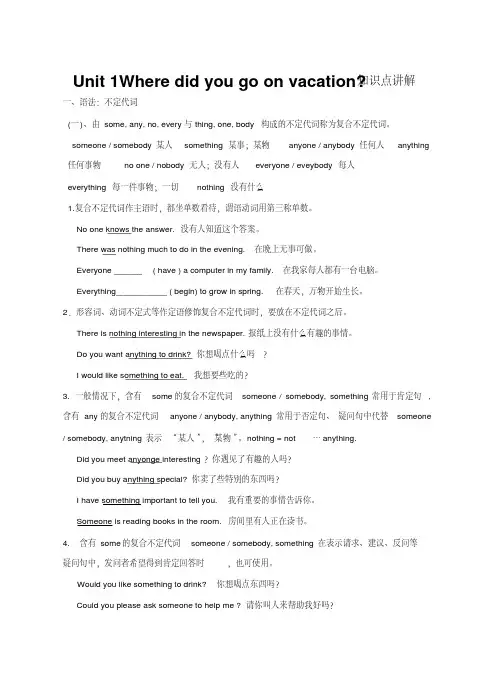
Unit 1Where did you go on vacation?知识点讲解一、语法:不定代词(一)、由some, any, no, every与thing, one, body 构成的不定代词称为复合不定代词。
someone / somebody 某人something 某事;某物anyone / anybody 任何人anything 任何事物no one / nobody 无人;没有人everyone / eveybody 每人everything 每一件事物;一切nothing 没有什么1.复合不定代词作主语时,都坐单数看待,谓语动词用第三称单数。
No one knows the answer. 没有人知道这个答案。
There was nothing much to do in the evening. 在晚上无事可做。
Everyone ______ ( have ) a computer in my family. 在我家每人都有一台电脑。
Everything___________ ( begin) to grow in spring. 在春天,万物开始生长。
2.形容词、动词不定式等作定语修饰复合不定代词时,要放在不定代词之后。
There is nothing interesting in the newspaper.报纸上没有什么有趣的事情。
Do you want anything to drink?你想喝点什么吗?I would like something to eat. 我想要些吃的?3. 一般情况下,含有some的复合不定代词someone / somebody, something常用于肯定句,含有any的复合不定代词anyone / anybody, anything常用于否定句、疑问句中代替someone / somebody, anytning表示“ 某人”,“某物”。
人教新目标版英语八上Unit1《Wheredidyougoonvacation》精美说课稿
人教新目标版英语八上Unit 1《Where did you go on vacation》精美说课稿一. 教材分析《Where did you go on vacation》是人教新目标版英语八上Unit 1的内容。
本节课主要讨论过去发生的事情,通过询问对方度假的地点来展开对话。
教材内容丰富,插图生动,激发学生的学习兴趣。
本节课的主要目的是让学生掌握一般过去时的疑问句和回答,并能够运用所学知识进行实际对话。
二. 学情分析八年级的学生已经掌握了基本的英语语法知识,对于一般过去时有一定的了解。
但在实际运用中,部分学生可能会出现语法错误。
此外,学生的词汇量有限,可能会影响他们对文本的理解。
因此,在教学过程中,需要关注学生的个体差异,因材施教,帮助学生更好地掌握知识。
三. 说教学目标1.知识目标:学生能够掌握一般过去时的疑问句和回答,正确运用动词过去式进行对话。
2.能力目标:学生能够听懂、说出一般过去时的疑问句和回答,提高英语口语表达能力。
3.情感目标:通过讨论度假经历,培养学生热爱生活、分享快乐的感情。
四. 说教学重难点1.重点:学生能够掌握一般过去时的疑问句和回答。
2.难点:学生能够正确运用动词过去式进行实际对话。
五. 说教学方法与手段1.情景教学法:通过设置度假场景,让学生在真实情境中学习一般过去时的疑问句和回答。
2.任务型教学法:学生分组进行角色扮演,完成对话任务,提高口语表达能力。
3.信息技术辅助教学:利用多媒体课件、网络资源等,丰富教学手段,提高学生的学习兴趣。
六. 说教学过程1.导入:教师通过提问“Where did you go on vacation?”引导学生思考并回答,激发学生的学习兴趣。
2.新课呈现:教师展示教材插图,介绍一般过去时的疑问句和回答。
3.课堂活动:学生分组进行角色扮演,完成对话任务,教师巡回指导。
4.巩固练习:学生进行小组竞赛,看哪个小组能够在最短时间内完成一般过去时的疑问句和回答。
人教新目标八年级上册英语《Unit 1 Where did you go on vacation?》
人教新目标八年级上册英语《Unit 1 Where did you go on vacation?》Section A_教学设计3一. 教材分析人教新目标八年级上册英语《Unit 1 Where did you go on vacation?》Section A,主要讲述了假期旅游的话题。
通过本节课的学习,学生能够掌握一般过去时的提问和回答方式,学会使用“Where did you go?”, “What did you do?”等句型来询问别人的假期经历。
教材内容丰富,插图生动,有助于激发学生的学习兴趣。
二. 学情分析八年级的学生已经掌握了基本的英语语法知识,对一般过去时有所了解。
但在实际运用中,可能还存在一定的困难。
学生的词汇量和对英语文化的了解有限,需要通过大量的操练来提高运用所学知识进行交际的能力。
三. 教学目标1.知识目标:学生能够掌握一般过去时的提问和回答方式,学会使用“Where did you go?”, “What did you do?”等句型来询问别人的假期经历。
2.能力目标:学生能够在日常生活中,运用所学知识进行简单的交流。
3.情感目标:通过本节课的学习,学生能够增进与同学之间的友谊,分享彼此的假期经历,培养对英语学习的兴趣。
四. 教学重难点1.重点:学生能够掌握一般过去时的提问和回答方式。
2.难点:学生能够在实际情景中,灵活运用所学知识进行交际。
五. 教学方法采用任务型教学法,通过创设情境,引导学生参与课堂活动,充分调动学生的积极性和主动性。
在教学过程中,注重师生互动,生生互动,让学生在实践中学习,提高语言运用能力。
六. 教学准备1.教师准备:准备好相关的教学材料,如PPT、图片、卡片等。
2.学生准备:学生提前预习教材内容,了解一般过去时的基本用法。
七. 教学过程1.导入(5分钟)通过展示一些假期旅游景点的图片,引导学生谈论自己的假期经历,引出本节课的主题。
2.呈现(5分钟)教师通过PPT展示本节课的主要句型:“Where did you go?”, “What did you do?”等,同时给出相应的回答,让学生感知和理解这些句型的用法。
新版新目标英语八年级上册知识点总结
U n i t1W h e r e d i d y o u g o o n v a c a t i o n1.go on vacation去度假vacation假期、假日=holiday,on vacation = on holiday 度假the long vacation 长假the summer vacation 暑假 the Christmas vacation 圣诞假期goonvacation/tothemountains/tothebeach/tosummercamp 去度假,去爬山,去沙滩,去夏令营2.buy anything special 买特别的东西1buy v买;购买过去式为bought buysb.sth=buysthforsb. 给某人买某物2anything不定代词,某事;某件东西主要用于疑问句或否定句中Do you want to buy anything for meI can’t say anything about it.3)anthing special特别的东西 adj修饰不定代词时后置4 something,anything,nothing,everything是指物的不定代词;somebody,someone,anybody,anyone, nobody,everybody,everyone是指人的不定代词;somewhere,anywhere,nowhere,everywhere是指地点的不定代词;5 这些不定代词做主语时,谓语动词用第三人称单数 Is everybody here 大家都到齐了吗6 something,somebody,someone,somewhere用于肯定句及表示请求或建议的疑问句中,而anything, anybody,anyone,anywhere用于否定句及疑问句中;Did you do anything interesting 你做了有趣的事吗表疑问3. anywhere adv 在任何地方 Did you go anywhere during the summer vacationanywhere 在任何地方常用于否定句和疑问句中I can’t find it anywhere.somewhere 在某处;到某处常用于肯定句中 I lost my key somewhere near here.4.take photos 照相;拍照5. quite a few 很多;不少修饰可数名词复数quite a little 很多;不少修饰不可数名词afew+可数名词复数表肯定 few+可数名词复数表否定alittle+不数名词表肯定 little+不可数名词表否定6.most of the time大部分时间 most为代词,大部分;大多数most of………中的大多数它作主语时,谓语动词取决于most of后所修饰的名词Most of us are going to the park. 我们大多数人要去公园;Most of the food goes bad. 大部分的食物都变质了;7.have a good time = enjoy oneself = have fun 玩得开心 + doingWe had a good time visiting the the Great Wall.= We enjoyed ourselves visiting the the Great Wall.= We had fun visiting the the Great Wall.8.How did you like it 你觉得它怎么样How do/did you like……你觉得……怎么样用来询问对方的观点或看法,=What do you think of……=How do/did you feel about……9. go shopping去购物;去买东西=do some shopping.go+doing 形式表示去做某事,常用于表达从事某一体育活动或休闲活动go skating 去滑冰 go hiking 去徒步旅行 go sightseeing 去观光go fishing去钓鱼 go swimming 去游泳 go boating 去划船10.a friend’s farm是名词所有格形式;一般情况下,表示“有生命的人或物”的名词后面加’s,表示所属关系;The red bike is Alice’s.那辆红色的自行车是爱丽斯的;名词所有格的构成:1单数名词词尾加’s ,复数名词词尾没有s,也要加’sthe girl ‘s pen女孩的钢笔women’s shoes女鞋on Children’s Day2复数名词以s结尾的只加’the students’ reading room学生阅览室Teachers’ Day教师节3如果两个名词并列,并且分别有’s,则表示“分别有”;只后一个名词有一个’s,则表示“共有”:John’s and Kate’s rooms.约翰和凯特各自的房间;Lily and Lucy’s father. 莉莉和露西的爸爸同一个爸爸;4表示无生命的名词一般以...of...构成短语,表示所有关系;a map of China一幅中国地图 the name of the story那个故事的名字11.seem v 好像;似乎;看来1seem+adj. 看起来…… You seem happy today.你今天看起来很高兴;2seem+to do sth. 似乎,好像做某事I seem to have a cold.我似乎感冒了;=It seems that I have a cold.3)It seems/seemed+从句看起来好像…;似乎…It seems that no one believes you.看起来好像没有人相信你4 seem like 好像,似乎12.nothing much to do 没什么事可做nothing...but... 除....之外什么也没有,只有 but+ n/v原形I have nothing to do but watch TV.Thereisnothingmuchtodobutread.除了读书没什么可做的13. bored boringbored 厌烦的;感到无聊的一般在句中修饰人boring 无聊的;令人厌烦的一般在句中修饰事或物beboredwith对…感到无聊interested adj. 感兴趣的 interesting adj. 有趣的 surprised adj. 感到惊奇的surprising adj. 惊奇的tired 累的 tiring 令人疲惫的 excited 兴奋的 exciting 令人兴奋/激动的amazed 惊讶的 amazing 令人惊讶的14.say about 发表对....的看法enjoyable adj 愉快的;快乐的 enjoy doing sth . 喜欢做…乐意做…enjoy oneself =have a good = have fun 过得愉快15.arrive v 到达 arrive in表示到达较大的地方,如国家、省、市等arrive at表示到达较小的地方,如机场、商店、广场、村庄等;地点副词home,here,there前介词省略arrive in+大地点 / arrive at+小地点②get to +地点③reach+地点16.decide v 决定 n decisiondecide to do sth. 决定做某事 decide not to do sth决定不要做某事decide on doing sth. 决定做某事make a decision to do sth.decidetodosth=makeadecisiontodosth决定做某事decide后常跟疑问词+动词不定式做宾语17.try v 其后常接名词、动名词或不定式,尝试;试图,设法;努力1trytodosth努力做…表示想尽一切办法要把事情办成,强调付出努力设法去完成;2trydoingsth尝试做表示一种尝试、做做看的想法,不一定付出很多努力;3try/doone’sbesttodo尽力做4haveatry试一试 try n 尝试18.feel like给……的感觉;感受到其后常接从句;He feels like he is swimming. 他感觉像在游泳一样;feel like 想要……其后可接名词、代词或动名词;feel like sth. 想要某物 feel like doing sth. 想要做某事19. building n 建筑物;楼房build v建造,建筑built,built,The workers built many tall buildings in our school last year.20.wonder v 想知道;琢磨其后常接who, what, why等疑问词引导的宾语从句;I wonder what they were doing here.我想知道他去哪里了;21.walk around 四处走走He’s just walking around the village.他只是在村庄里随便走走;22.difference n 差别,差异 adj different不同的;有差异的What is the difference between this book and that book My schoolbag is different from yours.1tellthedifferencesbe tween..and…说出…与…的区别2makeadifferenceto对…有影响,有意义3 be different from 与……不同 be the same as23. 常用的感叹句的结构:1What +adj.+ 复数名词 / 不可数名词+主语+谓语2What +a/an+adj.+可数名词单数+主语+谓语3How +adj. +a/an+可数名词单数+主语+谓语4How+adj./adv. +主语+谓语What an interesting book it is = How interesting a book is 那本书多么有趣啊24. want to do sth. =想要做某事 start doing sth. 开始做某事=start to do sth.take the train 乘火车”,take乘坐25.a little 一点儿修饰动词、形容词或副词;也可修饰不可数名词;26. wait for等候其后可接人或物Tom was waiting for a bus over there.27. over prep多于;超过=more than;My father is over 40 years old.There are over eight hundred students in our school.28. too many 太多其后接可数名词复数; He always has too many questions to ask me.too many + 可数名词复数太多...too much + 不可数名词太多...much too + 形容词 /副词太...29. becauseof+宾语名词/动名词/代词因为,由于becauseconj.+句子因为引导状语从句I didn’t buy the shirt because it was too expensive.He lost his job because of his age.30. below 表示下方,低于反义词为 above 在......上面under表示在正下方31. bring 带来;拿来指从别处带到说话者所在地take 拿走;带走指从说话者所在地带到别处去bring sth.to +地点,带来其反义词是takePlease bring your book to our school. 请把你的书带到我们学校来;Please take your book to your school. 请把你的书带到你的学校去;32.enough adj 足够的,充分的修饰adj或adv,一般置于被修饰词之后1enough+n足够多的用来修饰名词时放在名词之前2adj/advenoughtodosth足够…We have enough time to do our homework. The box is big enough.33. forget to do sth.与forget doing sth.forget to do sth. 忘记要做某事事情还没做Don’t forget to close the window.forget doing sth. 意为“忘记做过某事事情已经做过了 I forget closing the window.stoptodo停下来去做另外一件事,stopdoing停下来做某事34.why not为什么不呢一般用在疑问句中,表示提建议;why not后面需跟动词原形;Why not + 动词原形 =Why don’t you+ 动词原形Why not go to the party with me =Why don’t you go to the party with me提建议的句子What/ how about +doing sth. Why don’t you + do sth. Why not + do sth.Let’s + do sth. Shall we/ I + do sth.35. with prep 具有;带有with作介词时的其他用法1“和……一起’ I often go to school ______ my friend. 我经常和朋友们一起去上学;2以手段、材料,用工具, Cut the apple with a knife. 用刀切苹果;36.s o … that 如此…以致于引导结果状语从句,so adv+adj/adv. that+从句She was so sad that she couldn’t say a word. 她悲伤得一句话也说不出来;so that 引导目的状语从句以便,为了so…that…/ such…that…如此…以致引导的结果状语从句so+adj./adv.+that…He is ____lovely a boy____we love him very much.The little boy is so young that he can’t go to school.37. tell sb not to do sth. 告诉某人不要做某事keep doing sth. 继续做某事,一直做某事38. jump up and down in excitement. 兴奋地蹦上蹦下up and down 上上下下;来来回回在句中作状语;They looked me ______ ______ ______. 他们上上下下打量我;He walks______ ______ ______ in the room. 他在房间里来回走动;jump into 跳入 jump off 跳离 jump over 跳过 jump out of 跳出39. comeup太阳出来;出现,发生40. 反身代词:myself , ourselves, yourself , yourselves, himself, herself, itself, themselves.作动词或介词的宾语:经常在enjoy, teach, hurt, buy, introduce, dress, kill等动词和by, for, to, of等介词后作宾语;一年主考宾语回自身He is teaching himself English.她在自学英语;talk to oneself自言自语 live by oneself独自住 Help yourself 请随便吃吧/请自己去取吧Make yourself at home 别客气 make yourself heard /understood. 使你的话被人听得见/理解 teach oneself 自学=learn by oneself by oneself 独自for oneself 为自己;替自己 enjoy oneself 玩的愉快 dress oneself 给自己穿衣41. onthetopof在…的上面 takeanumbrellawithsth随身携带一把伞longtimenosee好久不见 inthecountryside在农村keepadiary记日记 enjoydoing享受做… walkuptosp.往上走到某地rideabiketosp.=gotosp.onthebike=gotosp.bybike骑自行车去某地rainhard/heavily雨下得大 abowof一碗42. taste good 尝起来好吃系动词+adjkeep保持stay保持seem好像look看来像smell闻起来sound听起来taste尝起来feel摸起来。
人教版初中英语八年级上册Unit1Wheredidyougoonvacation课件
No, I bought nothing.
How was the food?
Everything tasted really good!
Did everyone have a good time?
Oh, yes. Everything was excellent.
语法重点 :1.复习巩固一般过去时
watch → watched
2. 以e 结尾的动词, 只加d
例: live → lived
close → closed
3. 以辅音字母加y结尾的动词,
改y为i, 再加ed
例: study → studied
carry → carried
4. 末尾只有一个辅音字母的重读闭音节词,
先双写这个辅音字母,再加-ed
例: stop → stopped
e.g. 一些学生发现书架上没有几本书。
A few students find few books in the shelf.
没有时间来完成这一点工作。
Little time is left to finish a little work.