
北师大版(一起)-英语-二年级上册-Unit 5 Welcome 精品教案 (第5课时)
Play the tape and have the children listen for the first time. Then encourage them to hum or clap with the rhythm for the second time.
教学过程
1.Review the first story of this unit.
2.Trace and Match (page 58)
Draw the children’s attention to the picture, have them answer questions: who’s he/she?
Have children follow the tape or you to practice.
作业
Ask the children say the rhyme to their families.
二年级上册第5单元第5用Mocky去Ken的家里做客,认识Ken的家人的情景来进行学习。Ken在介绍家庭成员时所用到的表达方式是前两个单元学习的内容,体现了教材在复习的基础上学习新内容的思路。本单元增加了说明物品归属的句型That’s her car.这个句型是和介绍人物的句型成对出现的,从语用的角度讲,句中的人称代词指代前文出现的人物。这一点要特别注意练习。
课题
Unit5 Welcome
备课人
教
学
目
标
1.通过Trace and Match来练习整体认读能力,为以后的阅读打基础。
2.通过Chant “Visit Uncle”的学习,练习发音,培养语感.。
教学重点
Chant “Visit Uncle”
教学难点
Chant “Visit Uncle”
课前准备
课件和单词卡
Have children read the sentences in the speech bubbles. Ask the children to match the speech bubble and the character.
3.Let’s chant (page59)
Learnthe new word:visit.
二年级上册英语教学设计Unit 5 第一课时_广州版(一起)-经典教学教辅文档

Unit 5 I’m Skating教学反思:鼓励先生大胆参与英语学习当中,加强先生认读句子的能力。
科学睡眠健康成长——在国旗下的发言各位尊敬的老师、各位亲爱的同学:大家上午好!我是来自预备二班的***。
今天,我非常的荣幸,能在3月21日世界睡眠日这一重要节日即将来临的时刻,和大家共同学习、分享《科学睡眠健康成长》这一主题内容。
睡眠是人体的一种主动过程,人的一生几乎有3分之1的时间在睡觉中度过。
睡眠是生命所必需的过程,是健康不可缺少的组成部分。
本届冬奥会的18岁天才少女谷爱凌在赛后回答夺冠秘诀时,她说:“从8 岁到14 岁,我一直都只有周末才滑雪。
而我能比那些年纪更大、更专业的运动员做的更好的秘密武器,就是每天睡十小时,真的每天睡十小时。
”可是据世界卫生组织的调查,竟有27%的人存在着睡眠问题,而其中我国在30%以上,高达50%的学生存在睡眠不足的问题。
而“世界睡眠日”的目的便是要引起人们对睡眠重要性的关注,提醒人们要重视睡眠健康。
如今,随着学习、工作压力的增加,失眠已成为人们常见的健康问题。
失眠不仅会影响人的情绪,甚至能影响人的免疫系统,更重要的是,失眠往往是身体潜在某种疾病的外在表现形式之一。
那么,作为青少年的我们,该如何提高学习效率,留出更多的时间来保障睡眠呢?首先,要明确当天晚上学习的目标。
学习之前,一定要列个清单出来,这样更便于安排时间,不致于手忙脚乱。
其次,减少学习时的干扰。
学习之前不要上网、看电视、玩游戏等;手机要放在不被打扰的地方。
再次,养成规律运动的习惯,建议每天运动半小时。
适当的运动,对调节睡眠有很大的作用,同时让一整天的精力充沛,保持高效学习状态。
最后,我们应当创造一个良好的睡眠环境,周围的温度、湿度和声音,都应保持在恰当的状态。
至少在睡前三十分钟,远离手机和任何发光的屏幕。
亲爱的同学们:睡眠给我们一个清醒的头脑睡眠给我们一个健康的身体睡眠给我们一个幸福的生活睡眠给我们一个精彩的世界让我们做一个聪明的人,养成高效率学习习惯,为充足睡眠保驾护航。
小学英语新北师版(一起)二年级上册Unit5 Welcome 第3课时教案
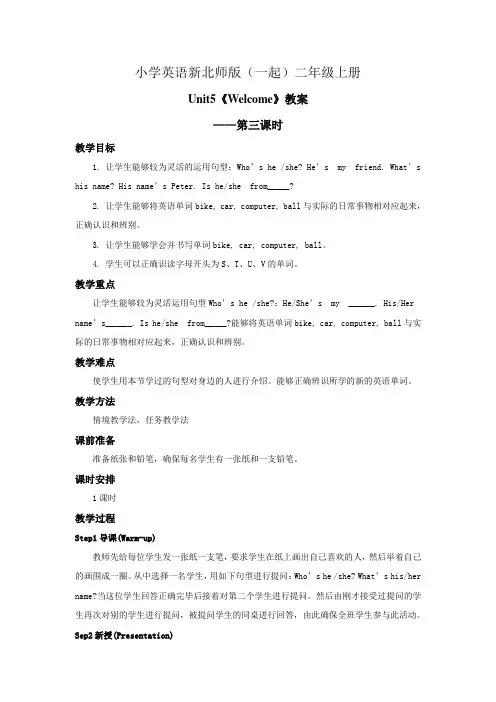
小学英语新北师版(一起)二年级上册Unit5《Welcome》教案——第三课时教学目标1. 让学生能够较为灵活的运用句型:Who’s he /she? He’s my friend. What’s his name? His name’s Peter. Is he/she from_____?2. 让学生能够将英语单词bike, car, computer, ball与实际的日常事物相对应起来,正确认识和辨别。
3. 让学生能够学会并书写单词bike, car, computer, ball。
4. 学生可以正确识读字母开头为S、T、U、V的单词。
教学重点让学生能够较为灵活运用句型Who’s he /she?:He/She’s my ______. His/Her name’s______. Is he/she from_____?能够将英语单词bike, car, computer, ball与实际的日常事物相对应起来,正确认识和辨别。
教学难点使学生用本节学过的句型对身边的人进行介绍。
能够正确辨识所学的新的英语单词。
教学方法情境教学法,任务教学法课前准备准备纸张和铅笔,确保每名学生有一张纸和一支铅笔。
课时安排1课时教学过程Step1导课(Warm-up)教师先给每位学生发一张纸一支笔,要求学生在纸上画出自己喜欢的人,然后举着自己的画围成一圈。
从中选择一名学生,用如下句型进行提问:Who’s he /she? What’s his/her name?当这位学生回答正确完毕后接着对第二个学生进行提问。
然后由刚才接受过提问的学生再次对别的学生进行提问,被提问学生的同桌进行回答,由此确保全班学生参与此活动。
Sep2新授(Presentation)1.教师要求学生将课本翻到54页,看课本54页Cathy手上的图画,引导学生猜想图画上的人物是谁?他来自哪儿?然后要求学生默读课本54页上的课文,要求学生仔细看Cathy 手上的图画,来找出这个男孩是谁。
小学英语新北师版(一起)二年级上册Unit5 Welcome 第1课时教案
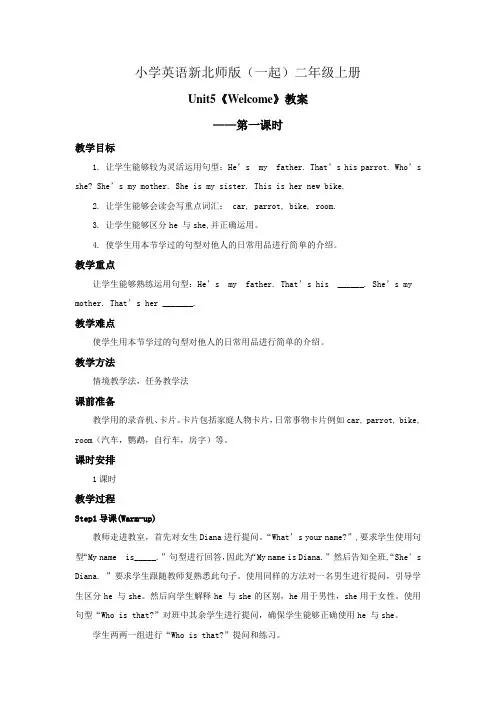
小学英语新北师版(一起)二年级上册Unit5《Welcome》教案——第一课时教学目标1. 让学生能够较为灵活运用句型:He’s my father. That’s his parrot. Who’s she? She’s my mother. She is my sister. This is her new bike.2. 让学生能够会读会写重点词汇: car, parrot, bike, room.3. 让学生能够区分he 与she,并正确运用。
4. 使学生用本节学过的句型对他人的日常用品进行简单的介绍。
教学重点让学生能够熟练运用句型:He’s my father. That’s his ______. She’s my mother. That’s her _______.教学难点使学生用本节学过的句型对他人的日常用品进行简单的介绍。
教学方法情境教学法,任务教学法课前准备教学用的录音机、卡片。
卡片包括家庭人物卡片,日常事物卡片例如car, parrot, bike, room(汽车,鹦鹉,自行车,房字)等。
课时安排1课时教学过程Step1导课(Warm-up)教师走进教室,首先对女生Diana进行提问。
“What’s your name?”,要求学生使用句型“My name is_____.”句型进行回答,因此为“My name is Diana.”然后告知全班,“She’s Diana. ”要求学生跟随教师复熟悉此句子。
使用同样的方法对一名男生进行提问,引导学生区分he 与she。
然后向学生解释he 与she的区别,he用于男性,she用于女性。
使用句型“Who is that?”对班中其余学生进行提问,确保学生能够正确使用he 与she。
学生两两一组进行“Who is that?”提问和练习。
Sep2新授(Presentation)1.教师首先要求一名学生将她的笔递给老师,然后对这支笔进行介绍“This is her pen.”使用相同的方法对一名男同学的铅笔进行介绍,“This is his pencil.”利用这两个句子让学生区分his, her。
北师大版(一起)-英语-二年级上册-Unit 5 Welcome 精品教案 (第1课时)
4.Act out the story
Have the children read the story in roles first, then role-play the story.
作业
Ask the children tell their families about the story.
课题
Unit5 Welcome
备课人
教
学
目
标
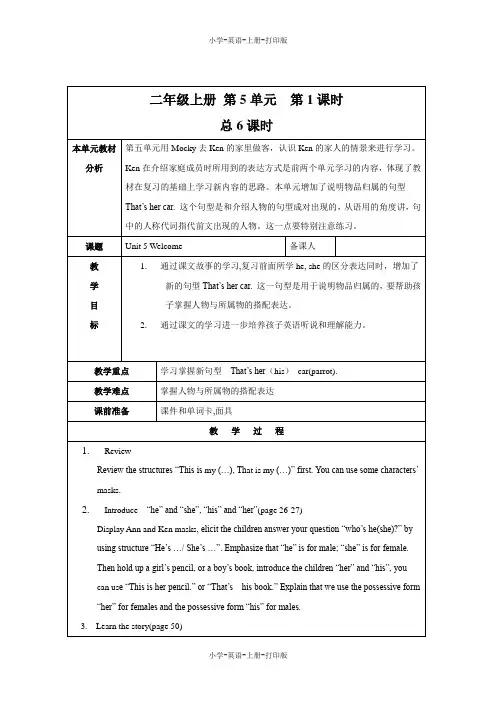
1.通过课文故事的学习,复习前面所学he, she的区分表达同时,增加了新的句型That’s her car.这一句型是用于说明物品归属的,要帮助孩子掌握人物与所属物的搭配表达。
2.通过课文的学习进一步培养孩子英语听说和理解能力。
教学重点
学t).
Then hold up a girl’s pencil, or a boy’s book, introduce the children “her” and “his”, you can use “This is her pencil.” or “That’s his book.” Explain that we use the possessive form “her” for females and the possessive form “his” for males.
二年级上册第5单元第1课时
总6课时
北师大版(一起)-英语-二年级上册-Unit 5 Welcome 精品教案 (第3课时)
作业
Colour the picture and letters for Ss, Tt, Uu, Vv
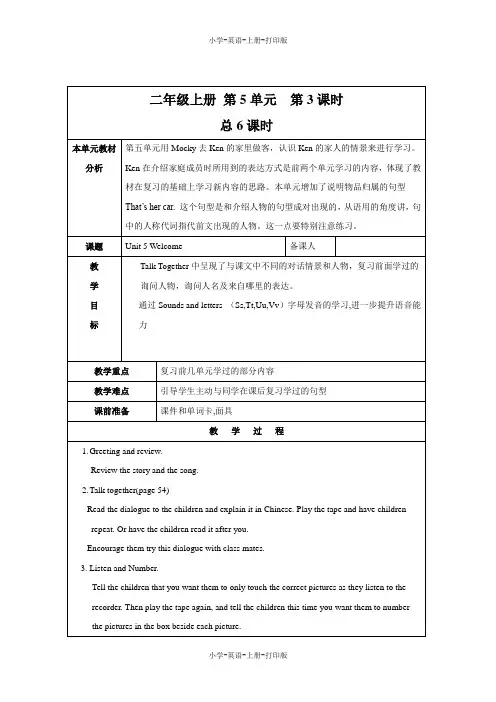
4. Sounds and letters.(page 55)
Display your card of“sun”. Draw the children’s attention to the picture beginning withSs(sun).Play the tape and have the children say the word aloud.And model this for “saቤተ መጻሕፍቲ ባይዱad”.
课题
Unit5 Welcome
备课人
教
学
目
标
Talk Together中呈现了与课文中不同的对话情景和人物,复习前面学过的询问人物,询问人名及来自哪里的表达。
通过Sounds and letters(Ss,Tt,Uu,Vv)字母发音的学习,进一步提升语音能力
教学重点
复习前几单元学过的部分内容
教学难点
二年级上册第5单元第3课时
总6课时
本单元教材分析
第五单元用Mocky去Ken的家里做客,认识Ken的家人的情景来进行学习。Ken在介绍家庭成员时所用到的表达方式是前两个单元学习的内容,体现了教材在复习的基础上学习新内容的思路。本单元增加了说明物品归属的句型That’s her car.这个句型是和介绍人物的句型成对出现的,从语用的角度讲,句中的人称代词指代前文出现的人物。这一点要特别注意练习。
2020年北师大一起二年级上册Unit5 Welcome第2课时教案

Unit5《Welcome》教案——第二课时教学目标1.使学生能区分he/his、she/her的用法。
2.使学生能用That is my …,that’s his/her …句型造句。
3. 使学生能熟练唱课本第53页的歌曲。
教学重点使学生能区分he/his、she/her的用法。
教学难点使学生能用That is my …,that’s his/her …句型造句教学方法任务教学法课前准备学生准备家人的照片、与好朋友的合照、投影仪、录音机。
课时安排1课时教学过程Step1导课(Warm-up)教师请两位学生起立,使其中一名学生做介绍,用上She/He is my…,it’s her/his …句型。
再请一名学生拿出家人的照片放在投影仪上,为全班同学做介绍,同样用上句型:She/He is my…,it’s her/his …。
通过课堂提问的方式,巩固重点句型,特别是区分开he/his、she/her的用法。
强调:he/she表示“他/她”,his/her表示“他的/她的”。
注意区分二者的用法。
Step2新授(Presentation)1.Learn to say。
请同学们翻到课本第52页,这四幅图分别是“我”的什么人?(“我”的爸爸、朋友、姐姐、妈妈)。
他们都拥有什么?(爸爸有鹦鹉、朋友有书包、姐姐有电脑、妈妈有小汽车。
)教师领读一遍例句,让学生跟读,在读的同时请学生用笔划出认为重点的句子。
(例如:This is …/That’s his …)再让学生看到第3、4幅图,用上刚刚标注的重点句子造句。
(This is my sister,that’s her computer./That’s my mother,that’s her car.)强调:想一想,什么时候使用he/she,什么时候使用his/her.2.Listen to this。
请同学们继续看课本第52页,这里有几个人物,并且有几件物品。
二年级英语上册Unit 5 Welcome 教案 北师版一起
(1)学生两人一组完成第一项活动。看图片,帮Ann完成下列句子。
(2)两人一组完成第二项活动。圈出所有学过的字母。
4、Sethomework
Reviewthisunit。
(2)在用较慢的速度读一遍,学生指着词跟读。
(3)学着图中的样子,两人一组,分别拿出自己好朋友的照片,用图中的对话进行练习。展示他们的对话活动。
3、Listenandmatch
(1)让学生看书上的图。教师说单词,学生指出相应的图。
(2)教师指着第一幅图问学生:“Thisishercomputer.YesorNo?”引导学生说No。
3、ListenforS,T,U,V
(1)拿出教学卡片。放第一个词的录音,教师依次指相应的词和它的起始字母。
(2)放录音,学生跟着录音一边指词和起始字母一边朗读。
(3)同样的方法学习其余几个单词和字母的发音。学生临摹图旁的字母。
4、UncleBooky’sblackboard
(1)举起He’s和He is句型卡,She’s和She is句型卡,领学生朗读。告诉学生每组句型卡的意思是一样的。
(2)指着左边的三个名字问学生这些人物的相似之处,引导学生说出他们都是男的,然后,把He写在这三个名字的上面。
(3)用同样的方法把She写在右边三个名字的上面。
(4)教师举起自己家的照片,先介绍家中的女性。让学生也指着自己的照片跟着老师做练习。
(5)同样的方法介绍家中的男性。
(6)学生分组进行练习。一名学生指着另一名学生照片中的一位成员问:“Who’sthat?”另一名学生做出正确的回答。
(7)交换角色进行练习。
2、Learntosay
(1)出示教学挂图。放录音,教师指相应的图。
二年级英语上册 Unit 1 Hello(Lesson5)教案 北师大版
Unit 1 Hello!The 5th periodTeaching Aims:e the dialogues explain the mind.2.The students like to learn English.3.The students can be ask and answer.Teaching Emphasis:1. How can use “What’s your name?” very expertly in live. And answer it.2. E mphasis sentence: what’s your name?my name’s=my name isTeaching Difficulty:How can use “What’s your name?” very expertly in live. And answer it. Teaching Medium:Step 1:Ask the children to read the sentences in the speech bubbles an match them with the characters who have said them. Ask children to draw a line between the speech bubbles and the characters.Ask children to color the characters.Step 2:Review the dialogues for last class.Such as: what’s you name? = What is your name?My name’s = My name isI’m = I amStep 3:Use the pictures or real objects and review the following words: dog, cat, ball and apple.Make sure the children can say these things when given a picture or a real object. Step 4:T: Take some students to roles for dialogues.S: In the one scene, divide the roles make a play for dialogues. Step 5:Black board writes:(Picture) cat (Picture) ball (Picture) apple (Picture) baby (Picture) dogStep 6:Homework:Teach the parents the words.。
北师大版二年级英语上册Unit5Welcome教案2
妈妈教我煎鸡蛋日记600字-范文模板及概述示例1:标题:妈妈教我煎鸡蛋的难忘时光在那个充满阳光的周末早晨,我与妈妈共享了一段温馨且富有生活智慧的教学时光——她手把手地教会了我如何煎出一颗完美的鸡蛋。
这段经历如同烙印一般,深深镌刻在我记忆深处,成为了我生活中一抹亮丽的颜色。
那天,妈妈早早就起床准备早餐,我见状也跃跃欲试,希望能亲手为家人做一份爱心满满的煎蛋。
妈妈看出了我的心思,微笑着答应并开始耐心指导。
她首先让我取来新鲜鸡蛋,一边讲解一边演示,从敲击蛋壳、分离蛋清蛋黄,再到热锅凉油的火候掌握,每个步骤都细致入微,充满了生活的哲学和对食物的敬意。
当油温适中时,妈妈示意我将蛋液缓缓倒入锅中,只见蛋清瞬间凝固成美丽的白色裙边,蛋黄则如宝石般镶嵌其中,慢慢呈现出半熟的诱人状态。
妈妈告诉我,煎鸡蛋看似简单,实则需要细心观察和适度的等待,这就是烹饪的乐趣和挑战。
在她的指导下,我成功地煎出了自己的第一颗鸡蛋,虽然形状略显稚嫩,但那份成就感却无法用言语表达。
通过这次煎鸡蛋的经历,我不仅学会了生活技能,更明白了妈妈平日里操持家务的不易,以及对待生活的那份认真和热爱。
这篇文章虽仅以600字记录,但却承载了妈妈对我无尽的爱与期待,以及我在成长过程中收获的宝贵一课——无论做任何事情,唯有用心去感知,用行动去实践,才能真正领悟其真谛,就像煎一颗看似简单的鸡蛋,背后却是生活的智慧与深情。
示例2:标题:妈妈教我煎鸡蛋的温馨记忆在那个阳光明媚的周末早晨,我与妈妈共同创造了一段难忘的生活小插曲——学习煎鸡蛋。
这不仅是一次烹饪技巧的学习,更是母爱与生活智慧的传承。
那天清晨,厨房里弥漫着诱人的饭香,妈妈正在熟练地翻动着锅中的鸡蛋,金黄的蛋液在热油中欢快地跳跃,散发出令人垂涎欲滴的香气。
我站在一旁,饶有兴趣地看着这一切,心中萌生了亲手尝试的念头。
妈妈似乎看穿了我的心思,微笑着对我说:“来,我教你煎鸡蛋。
”她首先耐心地讲解了煎鸡蛋的步骤和注意事项,从选择新鲜鸡蛋、控制火候到翻转蛋饼的时机,每一个细节都讲解得清晰易懂。
2019年二年级英语上册Unit1HelloLesson5教案北师大版
2019年二年级英语上册Unit1HelloLesson5教案北师大版Teaching Aims:e the dialogues explain the mind.2.The students like to learn English.3.The students can be ask and answer.Teaching Emphasis:1. How can use “What’s your name?” very expertly in live. And answer it.2. Emphasis sentence: what’s your name?my name’s=my name isTeaching Difficulty:How can use “What’s your name?” very expertly in live. And answer it. Teaching Medium:Step 1:Ask the children to read the sentences in the speech bubbles an match them with the characters who have said them. Ask children to draw a line between the speech bubbles and the characters.Ask children to color the characters.Step 2:Review the dialogues for last class.Such as: what’s you name? = What is your name?My name’s = My name isI’m = I amStep 3:Use the pictures or real objects and review the following words: dog, cat, ball and apple.Make sure the children can say these things when given a picture or a real object. Step 4:T: Take some students to roles for dialogues.S: In the one scene, divide the roles make a play for dialogues.Step 5:Black board writes:(Picture) cat (Picture) ball (Picture) apple(Picture) baby (Picture) dogStep 6:Homework:Teach the parents the words.附送:2019年二年级英语上册Unit1HelloLesson5教案北师大版Teaching Aims:e the dialogues explain the mind.2.The students like to learn English.3.The students can be ask and answer.Teaching Emphasis:1. How can use “What’s your name?” very expertly in live. An d answer it.2. Emphasis sentence: what’s your name?my name’s=my name isTeaching Difficulty:How can use “What’s your name?” very expertly in live. And answer it. Teaching Medium:Step 1:Ask the children to read the sentences in the speech bubbles an match them with the characters who have said them. Ask children to draw a line between the speech bubbles and the characters.Ask children to color the characters.Step 2:Review the dialogues for last class.Such as: what’s you name? = W hat is your name?My name’s = My name isI’m = I amStep 3:Use the pictures or real objects and review the following words: dog, cat, ball and apple.Make sure the children can say these things when given a picture or a real object. Step 4:T: Take some students to roles for dialogues.S: In the one scene, divide the roles make a play for dialogues.Step 5:Black board writes:(Picture) cat (Picture) ball (Picture) apple(Picture) baby (Picture) dogStep 6:Homework:Teach the parents the words.小学教育资料好好学习,天天向上!第4 页共4 页。