
仁爱版七年级上册英语教学课件-Unit4Topic2SectionB
Maria ___co_o_k_____ Steve __fl_y_a__ki_te______
Would you like to sing songs with me? Yes, I’d like to. / Yes, I’d love to. / Yes, I’d like that.
How about flying a kite with me?
Learn the invitation: ①—Would you like to sing some songs with me?
—I’m sorry I can’t. I have to cook. ②—Would you like to cook with us?
—Yes, I’d love to. ③—Michael, how about flying a kite with me?
Sally:
This is Sally. 您是谁?
相当于at home。
Maria我’s是Smaollyth。er: Oh, hello, Sally. Maria isn’t in now.
Sally:
Could you ask her to
ask sb. to do sth.
call me back this evening? 要求某人做某事
Listen to 1a and write what the children do. (视频P91-1a)
Jane_s_i_n_g_s_o_n_g_s_ Kangkang __c_o_o_k____
Michael g_e_t_s_o_m_e_w__at_e_r Wang Junfeng _c_o_o_k__
Look, listen and say. (视频P91-1a)
Who sings some songs?
1. What would Jane like to do? She would like to sing some songs.
2. What would other kids like to do? Kangkang, Maria and Wang Junfeng would like to cook. Steve would like to fly a kite. Michael would like to get some water. Bobby would like to fly a kite, too.
A: Hello!
B: Hello! _____5______ A: Sorry. _____2______ Who’s this, please? B: This is Wang Junfeng. ______4______
A: Sure. Does he have your telephone number?
want have to for food fly get
On Sunday, Kangkang goes out __f_o_r_ a picnic with his friends. They take some __fo__o_d_ with them. Jane _w_a_n_t_s_ Kangkang to sing some songs with her, but he has no time. He _h_a_s_t_o_ cook. Wang Junfeng and Maria would like to help Kangkang. Michael _g_e_t_s___ some water for them. And Steve _f_l_ie_s__ a kite with the dog. They are all very happy!
B: _____1_____ My telephone number is 8556-3677. A: 8556-3677. _____3______
B: Thank you. Goodbye.
A: Bye.
Telephone Message
From: _W__a_n_g_J_u_n__fe_n_g_ To: ___L_i_M__in_g_____ Message: C__a_ll_h_i_m__b_a_c_k__th_i_s a__ft_e_rn__o_o_n_, _h_is__t_e_le_p_h_o_n_e_ n__u_m_b_e_r__is__8_5_5_6_-3_6_7_7_.
I’d like that. /
必须, 不得不。后接动词原形。
I’m sorry I can’t. I have to cook. /
I’d like that, but I’m sorry I have no time.
I have to get some water.
很遗憾。常接从句。
没有时间
Complete the passage with the correct form of each word or phrase in the box.
Listen and complete. (视频P92-2a)
Maria’s mother: Hello!
Sally:
Hello!_M_a_y__I _s_p_e_a_k_t_o_M__a_ri_a?
Maria’s mother: Who’s this, please?
Sally:.
_T_h_i_s_i_s_S_a_l_ly_______.
Message: Call Sally back
_th_i_s_e_v_e__n_in_g__.
Mom
Fill in the blanks and then complete the telephone message.
1. No, he doesn’t. 2. He isn’t here now. 3. All right. I’ll tell him about it. 4. Could you ask him to call me back this afternoon? 5. May I speak to Li Ming, please?
Sally:
_T_h_a_n_k__y_o_u_. _G_o_o_d_b_y_e_.
Maria’s mother: Bye.
我可以和玛利亚通话吗?
Maria’s mother: Hello!
Sally:
Hello! May I speak to Maria? 副词。在家,
Maria’s mother: Who’s this, please?
Sing a song.
Let’s sing a song!
kite
fly a kite
A: Can Michael fly a kite with Steve?
B: No, he can’t. He has no time. He has to get some water.
A: How about Bobby?
Maria’s mother: Oh, hello, Sally. Maria isn’t in now.
Sally:
_C_o_u_l_d_y_o_u__a_s_k_h_e_r_t_o____
_c_a_ll_m__e_b_a_c_k__th_i_s_e_v_e_n_in_g_?
Maria’s mother: Sure.
—I’d like that, but I’m sorry I have no time.
Talk about making telephone calls:
①—Hello! May I speak to Maria? —Oh, sorry, She isn’t in now.
②—Who’s this? —This is Sally.
③—Could you ask her to call me back this evening?
—Sure.
1. Make a telephone message. 2. Write a passage about the picnic.
Maria’s mother: Sure.
call sb. back 给
Sally:
Thank you. Goodbye. 某人回个电话
Marcomplete the telephone message.
Telephone Message From: __S_a_l_ly___ To: ___M__a_r_ia___
Would you like to sing songs with me? Yes, I’d like to. / Yes, I’d love to. / Yes, I’d like that.
How about flying a kite with me?
Learn the invitation: ①—Would you like to sing some songs with me?
—I’m sorry I can’t. I have to cook. ②—Would you like to cook with us?
—Yes, I’d love to. ③—Michael, how about flying a kite with me?
Sally:
This is Sally. 您是谁?
相当于at home。
Maria我’s是Smaollyth。er: Oh, hello, Sally. Maria isn’t in now.
Sally:
Could you ask her to
ask sb. to do sth.
call me back this evening? 要求某人做某事
Listen to 1a and write what the children do. (视频P91-1a)
Jane_s_i_n_g_s_o_n_g_s_ Kangkang __c_o_o_k____
Michael g_e_t_s_o_m_e_w__at_e_r Wang Junfeng _c_o_o_k__
Look, listen and say. (视频P91-1a)
Who sings some songs?
1. What would Jane like to do? She would like to sing some songs.
2. What would other kids like to do? Kangkang, Maria and Wang Junfeng would like to cook. Steve would like to fly a kite. Michael would like to get some water. Bobby would like to fly a kite, too.
A: Hello!
B: Hello! _____5______ A: Sorry. _____2______ Who’s this, please? B: This is Wang Junfeng. ______4______
A: Sure. Does he have your telephone number?
want have to for food fly get
On Sunday, Kangkang goes out __f_o_r_ a picnic with his friends. They take some __fo__o_d_ with them. Jane _w_a_n_t_s_ Kangkang to sing some songs with her, but he has no time. He _h_a_s_t_o_ cook. Wang Junfeng and Maria would like to help Kangkang. Michael _g_e_t_s___ some water for them. And Steve _f_l_ie_s__ a kite with the dog. They are all very happy!
B: _____1_____ My telephone number is 8556-3677. A: 8556-3677. _____3______
B: Thank you. Goodbye.
A: Bye.
Telephone Message
From: _W__a_n_g_J_u_n__fe_n_g_ To: ___L_i_M__in_g_____ Message: C__a_ll_h_i_m__b_a_c_k__th_i_s a__ft_e_rn__o_o_n_, _h_is__t_e_le_p_h_o_n_e_ n__u_m_b_e_r__is__8_5_5_6_-3_6_7_7_.
I’d like that. /
必须, 不得不。后接动词原形。
I’m sorry I can’t. I have to cook. /
I’d like that, but I’m sorry I have no time.
I have to get some water.
很遗憾。常接从句。
没有时间
Complete the passage with the correct form of each word or phrase in the box.
Listen and complete. (视频P92-2a)
Maria’s mother: Hello!
Sally:
Hello!_M_a_y__I _s_p_e_a_k_t_o_M__a_ri_a?
Maria’s mother: Who’s this, please?
Sally:.
_T_h_i_s_i_s_S_a_l_ly_______.
Message: Call Sally back
_th_i_s_e_v_e__n_in_g__.
Mom
Fill in the blanks and then complete the telephone message.
1. No, he doesn’t. 2. He isn’t here now. 3. All right. I’ll tell him about it. 4. Could you ask him to call me back this afternoon? 5. May I speak to Li Ming, please?
Sally:
_T_h_a_n_k__y_o_u_. _G_o_o_d_b_y_e_.
Maria’s mother: Bye.
我可以和玛利亚通话吗?
Maria’s mother: Hello!
Sally:
Hello! May I speak to Maria? 副词。在家,
Maria’s mother: Who’s this, please?
Sing a song.
Let’s sing a song!
kite
fly a kite
A: Can Michael fly a kite with Steve?
B: No, he can’t. He has no time. He has to get some water.
A: How about Bobby?
Maria’s mother: Oh, hello, Sally. Maria isn’t in now.
Sally:
_C_o_u_l_d_y_o_u__a_s_k_h_e_r_t_o____
_c_a_ll_m__e_b_a_c_k__th_i_s_e_v_e_n_in_g_?
Maria’s mother: Sure.
—I’d like that, but I’m sorry I have no time.
Talk about making telephone calls:
①—Hello! May I speak to Maria? —Oh, sorry, She isn’t in now.
②—Who’s this? —This is Sally.
③—Could you ask her to call me back this evening?
—Sure.
1. Make a telephone message. 2. Write a passage about the picnic.
Maria’s mother: Sure.
call sb. back 给
Sally:
Thank you. Goodbye. 某人回个电话
Marcomplete the telephone message.
Telephone Message From: __S_a_l_ly___ To: ___M__a_r_ia___
合集下载
仁爱版七年级上册英语优秀教学案例:Unit4Topic2SectionB
四Hale Waihona Puke 教学内容与过程(一)导入新课
本节课的导入我选择了利用图片和歌曲的方式进行。我展示了与一般现在时态疑问句和否定句相关的图片,如学生们在教室里的活动图片,并引导学生用英语描述这些图片。接着,我播放了一首英文歌曲,让学生边听边跟着歌曲一起唱,从而激发他们的学习兴趣,营造轻松愉快的学习氛围。
在导入环节,我注重激发学生的学习兴趣,让他们在轻松愉快的氛围中开始新课的学习。通过图片和歌曲的展示,我引导学生用英语描述现实生活中的情境,激活他们的已有知识,为新课的学习做好铺垫。
三、教学策略
(一)情景创设
1.利用图片、实物等直观手段,创设生动、真实的学习情境。
2.通过多媒体技术,展示与课程内容相关的视频、音频等资料,增强学生的直观感受。
3.运用角色扮演、情景剧等形式,让学生在实际情境中运用英语,提高交际能力。
在教学过程中,我注重情景的创设,让学生在真实的环境中感受、理解和运用英语。我运用图片、实物等直观手段,创设生动、真实的学习情境,激发学生的学习兴趣。同时,我利用多媒体技术,展示与课程内容相关的视频、音频等资料,增强学生的直观感受。此外,我还运用角色扮演、情景剧等形式,让学生在实际情境中运用英语,提高他们的交际能力。
(三)情感态度与价值观
1.学生能够树立正确的学习观念,热爱英语学习。
2.学生能够在学习过程中,培养团队协作精神、自主学习能力和责任感。
3.学生能够认识到学习英语的重要性,提高跨文化交际意识。
在教学过程中,我注重激发学生的学习兴趣,让他们在学习中感受到快乐。我运用人性化的语言,与学生建立良好的师生关系,让他们在轻松愉快的氛围中学习。同时,我还注重培养学生的团队协作精神、自主学习能力和责任感。通过小组讨论、合作完成任务等方式,让学生在实践中培养这些品质。此外,我还引导学生认识到学习英语的重要性,提高他们的跨文化交际意识。
本节课的导入我选择了利用图片和歌曲的方式进行。我展示了与一般现在时态疑问句和否定句相关的图片,如学生们在教室里的活动图片,并引导学生用英语描述这些图片。接着,我播放了一首英文歌曲,让学生边听边跟着歌曲一起唱,从而激发他们的学习兴趣,营造轻松愉快的学习氛围。
在导入环节,我注重激发学生的学习兴趣,让他们在轻松愉快的氛围中开始新课的学习。通过图片和歌曲的展示,我引导学生用英语描述现实生活中的情境,激活他们的已有知识,为新课的学习做好铺垫。
三、教学策略
(一)情景创设
1.利用图片、实物等直观手段,创设生动、真实的学习情境。
2.通过多媒体技术,展示与课程内容相关的视频、音频等资料,增强学生的直观感受。
3.运用角色扮演、情景剧等形式,让学生在实际情境中运用英语,提高交际能力。
在教学过程中,我注重情景的创设,让学生在真实的环境中感受、理解和运用英语。我运用图片、实物等直观手段,创设生动、真实的学习情境,激发学生的学习兴趣。同时,我利用多媒体技术,展示与课程内容相关的视频、音频等资料,增强学生的直观感受。此外,我还运用角色扮演、情景剧等形式,让学生在实际情境中运用英语,提高他们的交际能力。
(三)情感态度与价值观
1.学生能够树立正确的学习观念,热爱英语学习。
2.学生能够在学习过程中,培养团队协作精神、自主学习能力和责任感。
3.学生能够认识到学习英语的重要性,提高跨文化交际意识。
在教学过程中,我注重激发学生的学习兴趣,让他们在学习中感受到快乐。我运用人性化的语言,与学生建立良好的师生关系,让他们在轻松愉快的氛围中学习。同时,我还注重培养学生的团队协作精神、自主学习能力和责任感。通过小组讨论、合作完成任务等方式,让学生在实践中培养这些品质。此外,我还引导学生认识到学习英语的重要性,提高他们的跨文化交际意识。
Unit 4 Topic 1 Section B(课件)七年级英语上册堂(仁爱版)

Shopping List
¥7.00 ¥18.00 ¥25.00 ¥5.00
¥100.00 ¥108.00 ¥139.00 ¥180.00
3
Look at the picture and play this number game under the following rule. The student who breaks the rule will be out.
Unit 4 Having Fun
Topic 1 What can I do for you?
Section B
Teaching Objectives
能在购物的情景对话中就“表达购物愿望、征询他人意见和需求、提建议”和“表
1 达感谢和回谢”等进行交流。
2
能够正确地征询他人对服饰的意见和表达自己的喜好;能根据自己的财力,拟定合 适的购物清单;能编写简单的购物对话,表达连贯准确。
⑤ 为什么不…… __w__h_y_n__o_t___
3.能在购物的情景对话中就“表达购物愿望、征询他人意见和需求、提建议”
和“表达感谢和回谢”等进行交流:
-What do you think of this yellow skirt? -I don’t like it at all.
-How do you like the trousers? -They are too long.
What do you think of the trousers?
1a Listen, look and say.
1a Listen, look and say.
Let’s watch!
1b Listen to 1a and fill in the blanks.
仁爱版英语七年级上册Unit4Topic2SectionB优秀教学案例
在教学实践中,我发现许多学生在学习英语时,往往对时态的掌握感到困惑,特别是在过去时方面。因此,针对这一问题,我设计了本节课的教学案例,旨在通过生动、有趣的教学活动,帮助学生更好地理解和运用过去时,提高他们的英语实际运用能力。
在教学过程中,我注重启发式教学,引导学生运用已学知识进行互动交流,培养他们的合作意识和创新精神。同时,我还注重激发学生的学习兴趣,通过设计丰富的教学活动,使他们在轻松愉快的氛围中学习英语,提高他们的学习积极性。
5.教学内容的层次性:本节课的教学内容由浅入深,循序渐进。从导入新课到讲授新知,再到学生小组讨论、总结归纳和作业小结,每个环节都紧密结合,使得学生能够系统地学习和掌握一般过去时。教学内容的层次性有助于培养学生扎实的英语基础和综合运用能力。
3.每个小组选择几个有趣的句子,用多媒体展示给全班同学,并简要解释为什么使用一般过去时。
(四)总结归纳
1.教师引导学生总结一般过去时的构成规则和用法,强调过去时态用于描述过去发生的动作或状态。
2.教师通过一些典型的例句,如"He visited the Great Wall last year.","They watched a movie together last night.",帮助学生巩固对过去时的理解和运用。
仁爱版英语七年级上册Unit4Topic2SectionB优秀教学案例
一、案例背景
本案例背景以仁爱版英语七年级上册Unit4Topic2SectionB为主题,该章节主要围绕询问时间、日期以及表达过去发生的动作等知识点展开。通过本节课的学习,学生能够掌握一般过去时的构成和用法,学会正确询问过去发生的事情,并能够用英语进行简单的交流。
4.教师引导学生进行一些简单的练习,如填空、造句等,以巩固他们对一般过去时的理解和运用。
在教学过程中,我注重启发式教学,引导学生运用已学知识进行互动交流,培养他们的合作意识和创新精神。同时,我还注重激发学生的学习兴趣,通过设计丰富的教学活动,使他们在轻松愉快的氛围中学习英语,提高他们的学习积极性。
5.教学内容的层次性:本节课的教学内容由浅入深,循序渐进。从导入新课到讲授新知,再到学生小组讨论、总结归纳和作业小结,每个环节都紧密结合,使得学生能够系统地学习和掌握一般过去时。教学内容的层次性有助于培养学生扎实的英语基础和综合运用能力。
3.每个小组选择几个有趣的句子,用多媒体展示给全班同学,并简要解释为什么使用一般过去时。
(四)总结归纳
1.教师引导学生总结一般过去时的构成规则和用法,强调过去时态用于描述过去发生的动作或状态。
2.教师通过一些典型的例句,如"He visited the Great Wall last year.","They watched a movie together last night.",帮助学生巩固对过去时的理解和运用。
仁爱版英语七年级上册Unit4Topic2SectionB优秀教学案例
一、案例背景
本案例背景以仁爱版英语七年级上册Unit4Topic2SectionB为主题,该章节主要围绕询问时间、日期以及表达过去发生的动作等知识点展开。通过本节课的学习,学生能够掌握一般过去时的构成和用法,学会正确询问过去发生的事情,并能够用英语进行简单的交流。
4.教师引导学生进行一些简单的练习,如填空、造句等,以巩固他们对一般过去时的理解和运用。
仁爱版七年级上册 Unit4 Topic 2 Section B教学课件共16张PPT
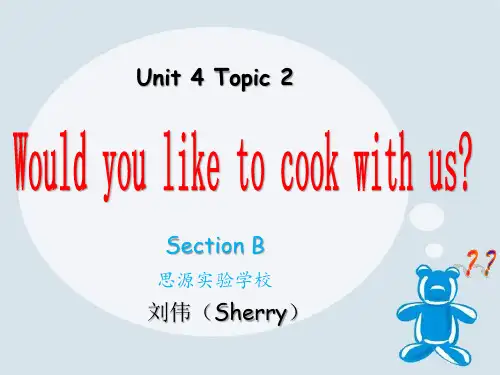
have a picnic
What would Jane like to do?
Jane
Kangkang
Jane: Would you like to sing some songs with me? (How about singing some songs with me?)
Kangkang: I’m sorry I can’t. I have to cook.
( C)1. Would Kangkang like to sing some songs with Jane ?
A.Yes,he would like to. B. No, he doesn’t. C. No, he has to cook.
(C)2. What would Michael like to do?
A. sing some songs B.fly a kite C. get some water
( A )3. What are they doing now?
A. Having a picnic.
B. Doing homework.
C. Going to work.
Part II
Jane
Say : What would they like to do ?
Part V
Homework
1. Write a passage about the picnic. 2. Write an invitation card to invite ccmore friends.
没有时间 很遗憾。常接从句。
Part III
Work alone: Complete the passage
cook to sing happy get sad drink for hamburger too mother eat
What would Jane like to do?
Jane
Kangkang
Jane: Would you like to sing some songs with me? (How about singing some songs with me?)
Kangkang: I’m sorry I can’t. I have to cook.
( C)1. Would Kangkang like to sing some songs with Jane ?
A.Yes,he would like to. B. No, he doesn’t. C. No, he has to cook.
(C)2. What would Michael like to do?
A. sing some songs B.fly a kite C. get some water
( A )3. What are they doing now?
A. Having a picnic.
B. Doing homework.
C. Going to work.
Part II
Jane
Say : What would they like to do ?
Part V
Homework
1. Write a passage about the picnic. 2. Write an invitation card to invite ccmore friends.
没有时间 很遗憾。常接从句。
Part III
Work alone: Complete the passage
cook to sing happy get sad drink for hamburger too mother eat
最新仁爱版 七年级上册英语 第四单元Unit4__Topic2 教学课件PPT
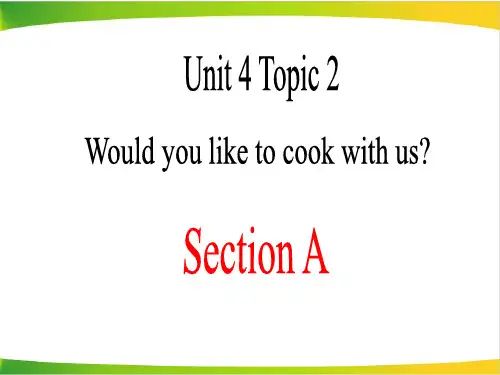
_t_o_e_at_…____________
(1)—Hello! —Hello, Jane! This is Kangkang.
(2)—Are you free this Sunday? —Yes. What’s up?
(3)—Would you like to go to West Hill for a picnic? —Oh, I’d love to.
Make Kangkang’s picnic plan according to 1a.
When: _th_i_s_S_un_d_a_y_ Where: _th_e_W_e_s_t _H_ill_ Who: _K_an_g_k_an_g_,_J_a_n_e_,_M_a_ri_a…__ Things: _t_o_t_ak_e_…___________
(4)—Please tell Maria about it. —Sure. I’ll call her.
(5)—See you then. —See you.
Example: (Ring …) S1: Hello! S2: Hello, S1. This is S2. S1: Hi, S2. S2: Are you free on Sunday afternoon? S1: Yes. What’s up? S2: Would you like to go to … for a picnic with me? S1: Yes, I’d like to. S2: Please tell S3 about it. S1: Sure. I’ll call her. S2: See you then. S1: See you.
1. Lucy and Linda are free tomorrow. __T_ 2. Lucy doesn’t want to go shopping with Linda.__F_ 3. Linda wants to buy a toy car for her cousin. _F__ 4. Linda and Lucy are good friend. _T__
(1)—Hello! —Hello, Jane! This is Kangkang.
(2)—Are you free this Sunday? —Yes. What’s up?
(3)—Would you like to go to West Hill for a picnic? —Oh, I’d love to.
Make Kangkang’s picnic plan according to 1a.
When: _th_i_s_S_un_d_a_y_ Where: _th_e_W_e_s_t _H_ill_ Who: _K_an_g_k_an_g_,_J_a_n_e_,_M_a_ri_a…__ Things: _t_o_t_ak_e_…___________
(4)—Please tell Maria about it. —Sure. I’ll call her.
(5)—See you then. —See you.
Example: (Ring …) S1: Hello! S2: Hello, S1. This is S2. S1: Hi, S2. S2: Are you free on Sunday afternoon? S1: Yes. What’s up? S2: Would you like to go to … for a picnic with me? S1: Yes, I’d like to. S2: Please tell S3 about it. S1: Sure. I’ll call her. S2: See you then. S1: See you.
1. Lucy and Linda are free tomorrow. __T_ 2. Lucy doesn’t want to go shopping with Linda.__F_ 3. Linda wants to buy a toy car for her cousin. _F__ 4. Linda and Lucy are good friend. _T__
Unit+4Exploring+the+Topic课件2024-2025学年仁爱科普版英语七年级上册
Write a passage about this picture.
Here are 2 short passage about this picture. Which is better ? Why ?
The girl is playing Chinese yo-yo.
weather time It's sunny in the morning.
___________ ___________
Weather:
___________ ___________
From the setting, we know some basic information about the passage.
The setting of _p_l_a_y_in_g__b_a_s_e_b_all
Place:
o__u_t_d_o_o__rs__o_r i_n_d__o_o_r_s____
Time:
a__ll_y_e__a_r____ l_o_n__g_______
Weather:
_s_u__n_n_y__o_r__ _c_l_o_u__d_y____ _r_a_i_n_y______
Time:
___________ ___________
Weather:
___________ ___________
➢ Activity 2
Read the text and complete the setting chart.
Many Americans love playing baseball. They play baseball all year long. On sunny or cloudy days, they play it outdoors. On rainy days, they play it indoors.
Here are 2 short passage about this picture. Which is better ? Why ?
The girl is playing Chinese yo-yo.
weather time It's sunny in the morning.
___________ ___________
Weather:
___________ ___________
From the setting, we know some basic information about the passage.
The setting of _p_l_a_y_in_g__b_a_s_e_b_all
Place:
o__u_t_d_o_o__rs__o_r i_n_d__o_o_r_s____
Time:
a__ll_y_e__a_r____ l_o_n__g_______
Weather:
_s_u__n_n_y__o_r__ _c_l_o_u__d_y____ _r_a_i_n_y______
Time:
___________ ___________
Weather:
___________ ___________
➢ Activity 2
Read the text and complete the setting chart.
Many Americans love playing baseball. They play baseball all year long. On sunny or cloudy days, they play it outdoors. On rainy days, they play it indoors.
仁爱版七年级英语上册 Unit 4 Topic 2 Section D 课件(共16张PPT)
② What about __D__? I’d like that, thanks.
A. have a picnic with old Tom
B. to have a picnic with old Tom
C. has a picnic with old Tom
D. having a picnic with old Tom
③ Would you like to go shopping with us? __C___.
A. Yes, I would. B. No, I wouldn’t. C. Yes, I’d like to. D. No, no.
④ Could you ask her __A__ the guitar tomorrow?
组学环节
go out for a picnic, take … with, go fishing, get water, cook food, fly a kite, sing some songs, be happy…
1. Who likes bananas very much? 2. What does Kangkang like to eat? 3. What does Kangkang’s mother cook? 4. Is Dingding Kangkang’s brother?
—I’d like that, thanks. 2. 打电话 (1)—Hello!
—Hello, Jane! This ito Maria?
—Oh, sorry. She isn’t in now. (3)—Could you ask her to call me back this evening?
B: Thank you. Goodbye. A: Bye.
仁爱版七年级英语上册 Unit 4 Topic 2 Section A 课件
Jane:
Hi, Kangkang! be free 有空的,空闲的
Kangkang: Are you free this Sunday?
Jane:
Yes. What’s up? 什么事?怎么了?
Kangkang: Would you like to go to the West Hill for a picnic?
A. How are you? B. Is that all? C. What’s up?
4. Would you like to go to the West Hill for a picnic?
Would you like to do sth…?你愿意去做某事吗?” 是询问对方意见,邀请或 请求某人做某事的一种委婉表达法, 例如: Would you like to have dinner with me? (你愿意和我一起吃晚饭吗?) 肯定回答通常是:Yes, I’d like /love to我愿意./
向别人发出邀请之前,一般先询问对方到时是否有空,经常用到这个句型:
Are you free …? 你… 有空吗? 如: Are you free tomorrow? 明天你有空吗?
Are you free this Sunday afternoon? 本周日下午你有空吗?
邀请别人常用到的句型是:Would you like to …? 此时would like 表示“愿意,想 要”,后接to+动词原形,常用于有礼貌地提出邀请、请求 。例如: Would you like to have dinner with me? (你愿意和我一起吃晚饭吗?) 肯定回答通常是:Yes, I’d like /love to我愿意./
仁爱版七年级英语上册unit1-topic2-sectionBPPT课件
He is from Japan.
.
4
Is she from Canada?
She is Jane.
Is he Li Ming?
He is from Japan.
.
5
He is Li Ming.
他是李明。
Is he Li Ming?
他是李明吗?
She is from Canada. 她来自加拿大。
.
6
Is she from Canada?
Yes, she is. Is he Li Ming?
No, he isn’t. He is Yukio.
.
7
一般疑问句的回答 你知道吗?
— Is she from Canada? — _________.
Yes, she is
是的,她是。
— Is he Li Ming?
Байду номын сангаас
She is from Cuba.
Where is she from?
No, she isn’t. She is Maria.
.
10
2a Look at the pictures.Then practice with your partner.
Deng Yaping/China
Stephen Hawking/ England
1a Look, listen and say.
Look! who is she?
She is Jane.
Is she from Canada?
Yes, she is.
.
3
Look,Kangkang! Is he Li Ming?
Where is he from ?
.
4
Is she from Canada?
She is Jane.
Is he Li Ming?
He is from Japan.
.
5
He is Li Ming.
他是李明。
Is he Li Ming?
他是李明吗?
She is from Canada. 她来自加拿大。
.
6
Is she from Canada?
Yes, she is. Is he Li Ming?
No, he isn’t. He is Yukio.
.
7
一般疑问句的回答 你知道吗?
— Is she from Canada? — _________.
Yes, she is
是的,她是。
— Is he Li Ming?
Байду номын сангаас
She is from Cuba.
Where is she from?
No, she isn’t. She is Maria.
.
10
2a Look at the pictures.Then practice with your partner.
Deng Yaping/China
Stephen Hawking/ England
1a Look, listen and say.
Look! who is she?
She is Jane.
Is she from Canada?
Yes, she is.
.
3
Look,Kangkang! Is he Li Ming?
Where is he from ?
仁爱版七年级英语上册优质课件 unit4_topic2_sectionb_
Listen to 1a and write what the children do.
Jane_s_i_n_g_s_o_n_g_s_ Kangkang __c_o_o_k____ Michael g_e_t_s_o_m_e_w__at_e_r Wang Junfengc_o_o_k___ Maria ___co_o_k_____ Steve __fl_y_a__ki_te______ Bobby _f_ly__a_k_it_e__
Listen and complete. 动画2a
Maria’s mother: Hello!
Sally:
Hello!_M_a_y__I _s_p_e_a_k_t_o_M__a_ri_a?
Maria’s mother: Who’s this, please?
Sally:.
_T_h_i_s_i_s_S_a_l_ly_______.
Sally:
This is Sally. Could you ask her to 您是谁?
我是Sally。 call me back this evening?
Maria’s mother: Sure.
call sb. back 给 某人回个电话
ask sb. to do sth. 要求某人做某事
Learn the invitation: ①—Would you like to sing some songs with me?
—I’m sorry I can’t. I have to cook. ②—Would Байду номын сангаасou like to cook with us?
—Yes, I’d love to. ③—Michael, how about flying a kite with me?