
动词过去式变化规则及其读音规则)
动词过去式变化规则及其读音规则规则动词的过去式变化如下:copy---copied cry---cried carry---carriedstop ---stoppedmade get – got buy - bought come - came fly-flew不规则动词的过去式的构成1.把动词原形中的i改为a,变成过去式。
如:begin—began,drink—drank,give—gave,ring—rang,sing—sang,sit—sat,swim—swam2.把重读开音节中的i改为o,变成过去式。
如: drive—drove,ride—rode,write—wrote3.改动词原形中的aw /ow为ew,变成过去式。
如:draw—drew,grow—grew,know—knew,throw—threw(动词show除外,show—showed)4.动词原形中的e改为o,变成过去式。
如: get—got,forget—forgot5.动词原形中的ee改为e,变成过去式。
如: feed—fed,meet—met6.动词原形中的eep改为ept,变成过去式。
如: keep—kept,sleep—slept,sweep—swept7.动词原形中的eak改为oke,变成过去式。
如: break—broke,speak—spoke8.动词原形中的ell改为old,变成过去式。
如: sell—sold,tell—told9.动词原形中的an改为oo,变成过去式。
如: stand—stood,understand—understood10.以ought和aught结尾,且读音是的过去式。
如: bring—brought,buy—bought,think—thought,catch—caught,teach—taught11.以ould结尾且读音为〔ud〕的情态动词过去式。
如: can—could,shall—should,will—would12.把动词原形中的o改为a,变成过去式。
如: come—came,become—became13.在动词原形后加d或t变成过去式,并且发生音变。
如:hear—heard, say—said,mean—meant14.动词的过去式与动词原形一样。
如: let—let,must—must,put—put,read—read〔red〕15.不符合上述规律的动词过去式。
如:am,is—was,are—were,build—built,do—did,eat—ate,fall—fell,feel—felt,find—found,fly—flew,go—went,have /has— had,hold—held,leave—left,make—made,may—might,run—ran,see—saw,take—tookwant →wanted (要)、need →needed (需要)kiss →kissed (吻)、wash →washed (洗)、watch →watched (注视)call →called (叫)、stay→stayed (停留)、cry→cried (哭)构成表示一般过去式的动词通常用动词的过去式形式来表示,而动词的过去式是在动词原形的基础上变化的。
动词的过去式可分为规则动词和不规则动词。
规则动词的过去式变化如下:一般情况下,动词词尾加 -ed ,如:worked played wanted acted以不发音的 -e 结尾动词,动词词尾加 -d,如:lived moved decided declined hoped judged raised wiped以辅音字母 + y结尾的动词,把-y变为-i 再加-ed,如:studied tried copied justified cried carried embodied emptied以一个辅音字母结尾的重读闭音节动词,双写词尾辅音字母,再加 -ed,如:stopped begged fretted dragged dropped planned dotted dripped注:不规则动词的过去式变化规律性不强,须多加记忆。
go - went make - made get - got buy - bought come - came fly-flew is/am-was are-were see-saw bring-brough用法:(1)表示过去某一时刻或某一段时间内所发生的动作或情况,通常一般过去式带有表示动作时间状语的词,词组或从句,如 yesterday, the day before last, last week, two days ago 等,上下文清楚时可以不带时间状语。
I worked in that factory last year. 去年我在那一家工厂工作。
I went to the Tian Long Mountain yesterday. 昨天我们去了天龙山。
规则动词过去式的变化规则(2010-12-18 10:59:44)转载▼分类:基础知识标签:杂谈1.规则动词过去式的变化规则1)一般在动词词尾加ed。
work—worked,rain—rained,watch—watched2)如果动词以字母e结尾,变过去式时直接在词尾加d。
love—loved,live—lived,change—changed3)如果动词是以一个元音字母加上一个辅音字母结尾的重读闭音节单词,变过去式时,要双写这个辅音字母,再加ed。
stop—stopped,plan—planned,drop—dropped4)如果动词是以辅音字母加y结尾,变过去式时要变y为i再加ed。
study—studied,carry—carried,try—tried一般过去式构成:表示一般过去式的动词通常用动词的过去式形式来表示,而动词的过去式是在动词原形的基础上变化的。
动词的过去式可分为规则动词和不规则动词。
规则动词的过去式变化如下:一般情况下,动词词尾加-ed,如:worked played wanted acted以不发音的-e结尾动词,动词词尾加-d,如:lived moved decided declined hoped judged raised wiped以辅音字母+ y结尾的动词,把-y变为-i再加-ed,如:studied tried copied justified cried carried embodied emptied以一个辅音字母结尾的重读闭音节动词,双写词尾辅音字母,再加-ed,如:stopped begged fretted dragged dropped planned dotted dripped注:不规则动词的过去式变化规律性不强,须多加记忆。
go - went make - made get - got buy - bought come - came fly-flew构成表示一般过去式的动词通常用动词的过去式形式来表示,而动词的过去式是在动词原形的基础上变化的。
动词的过去式可分为规则动词和不规则动词。
规则动词的过去式变化如下:一般情况下,动词词尾加 -ed ,如:worked played wanted acted以不发音的 -e 结尾动词,动词词尾加 -d,如:lived moved decided declined hoped judged raised wiped以辅音字母 + y结尾的动词,把-y变为-i 再加-ed,如:studied tried copied justified cried carried embodied emptied以一个辅音字母结尾的重读闭音节动词,双写词尾辅音字母,再加 -ed,如:stopped begged fretted dragged dropped planned dotted dripped注:不规则动词的过去式变化规律性不强,须多加记忆。
go - went make - made get - got buy - bought come - came fly-flew is/am-was are-were see-saw bring-brough用法:(1)表示过去某一时刻或某一段时间内所发生的动作或情况,通常一般过去式带有表示动作时间状语的词,词组或从句,如 yesterday, the day before last, last week, two days ago 等,上下文清楚时可以不带时间状语。
I worked in that factory last year. 去年我在那一家工厂工作。
I went to the Tian Long Mountain yesterday. 昨天我们去了天龙山。
(2)一般过去时态:表示过去某一时间所发生的动作或存在的状态。
谓语动词要用一般过去式。
时间标志:yesterday(昨天), last week(上周), last month(上个月), last year(去年), two months ago (两个月前), the day before yesterday(前天),in 1990 (在1990年), in those days (在那些日子里)等表示过去的时间状语。
如:I was born in 1990. (我出生在1990年)。
When did you go to the park? (你是什么时候去的公园)。
I went to the park last week. (我是上周去的公园)在上面的句子中第一句属于be动词的一般过去时态;第二句和第三句属于实义动词的一般过去时态。
1. Be 动词的一般过去时态在没有实义动词的句子中使用be动词, am is 的过去式为was; are的过去式为were.构成:肯定句:主语+was (were) +宾语如:I was late yesterday. (昨天我迟到了。
)否定句:主语+was (were) +not+宾语如:We weren't late yesterday. (我们昨天没迟到)疑问句:Was (Were) +主语+宾语如: Were you ill yesterday? (你昨天病了吗?)肯定回答: Yes, I was. (是的,我病了。
)否定句: No, I wasn't. (不,我没病。
)特殊疑问句:特殊疑问词+was (were) +主语+宾语如:When were you born? 你是什么时候出生的?读法:规则动词词尾加-ed有三种读音:1. 在清辅音后读作[t]。
动词过去式变化发音技巧
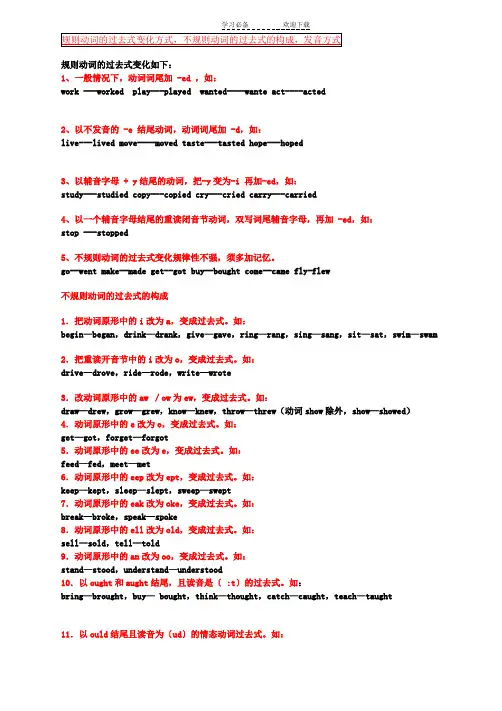
规则动词的过去式变化如下:1、一般情况下,动词词尾加 -ed ,如:work ---worked play---played wanted----wante act----acted2、以不发音的 -e 结尾动词,动词词尾加 -d,如:live---lived move----moved taste---tasted hope---hoped3、以辅音字母 + y结尾的动词,把-y变为-i 再加-ed,如:study---studied copy---copied cry---cried carry---carried4、以一个辅音字母结尾的重读闭音节动词,双写词尾辅音字母,再加 -ed,如:stop ---stopped5、不规则动词的过去式变化规律性不强,须多加记忆。
go--went make--made get--got buy--bought come--came fly-flew不规则动词的过去式的构成1.把动词原形中的i改为a,变成过去式。
如:begin—began,drink—drank,give—gave,ring—rang,sing—sang,sit—sat,swim—swam2.把重读开音节中的i改为o,变成过去式。
如:drive—drove,ride—rode,write—wrote3.改动词原形中的aw /ow为ew,变成过去式。
如:draw—drew,grow—grew,know—knew,throw—threw(动词show除外,show—showed)4.动词原形中的e改为o,变成过去式。
如:get—got,forget—forgot5.动词原形中的ee改为e,变成过去式。
如:feed—fed,meet—met6.动词原形中的eep改为ept,变成过去式。
如:keep—kept,sleep—slept,sweep—swept7.动词原形中的eak改为oke,变成过去式。
动词过去式变化规则及其读音规则
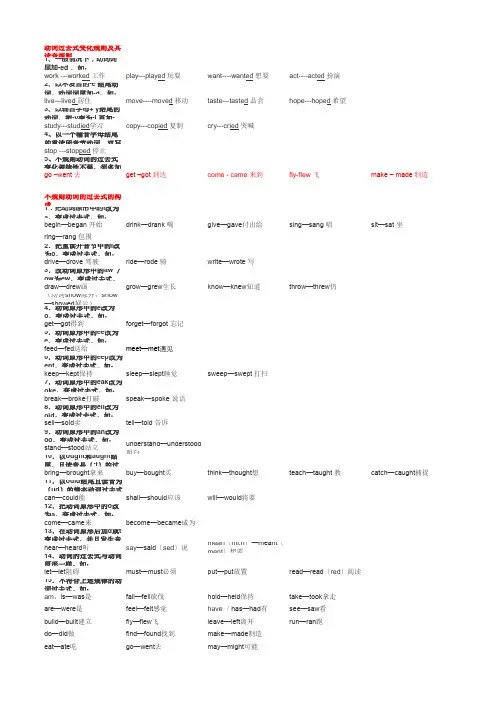
help →helped (帮助) laugh →laughed (笑) look →looked (看)
watch →watched (注
视 ()3)动词词尾为t,d以
外之浊辅音或元音时,发/
call →called (叫)
stay→stayed (停留) cry→cried (哭)
kiss →kissed (吻)
14.动词的过去式与动词
原形一样。如:
let—let阻碍
must—must必须
15.不符合上述规律的动
词过去式。如:
am,is—was是
fall—fell砍伐
write—wrote 写 know—knew知道
sweep—swept 打扫
think—thought想 will—would将要 mean〔mi:n〕—meant〔 ment〕想要 put—put放置 hold—held保持
make—made制造
eat—ate吃
go—went去
may—might可能
sit—sat 坐 catch—caught捕捉
过去式“-ed”的发音规则
(1)动词词尾为“t,d”
时,发/ id /音,
want →wanted (要) need →needed (需要)
(2)动词词尾为清辅音
时,发/ t / 音。
8.动词原形中的ell改为
old,变成过去式。如:
sell—sold卖
tell—told 告诉
9.动词原形中的an改为
oo,变成过去式。如: stand—stood站立 10.以ought和aught结
understand—understood 明白
动词过去式和过去分词的变化及发音规则
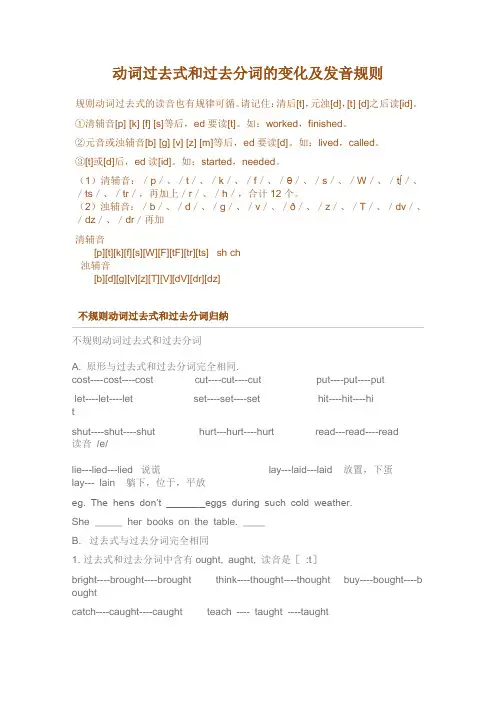
动词过去式和过去分词的变化及发音规则规则动词过去式的读音也有规律可循。
请记住:清后[t],元浊[d],[t] [d]之后读[id]。
①清辅音[p] [k] [f] [s]等后,ed要读[t]。
如:worked,finished。
②元音或浊辅音[b] [g] [v] [z] [m]等后,ed要读[d]。
如:lived,called。
③[t]或[d]后,ed读[id]。
如:started,needed。
(1)清辅音:/p/、/t/、/k/、/f/、/θ/、/s/、/W/、/t∫/、/ts/、/tr/,再加上/r/、/h/,合计12个。
(2)浊辅音:/b/、/d/、/g/、/v/、/ð/、/z/、/T/、/dv/、/dz/、/dr/再加清辅音[p][t][k][f][s][W][F][tF][tr][ts] sh ch浊辅音[b][d][g][v][z][T][V][dV][dr][dz]不规则动词过去式和过去分词归纳不规则动词过去式和过去分词A. 原形与过去式和过去分词完全相同.cost----cost----cost cut----cut----cut put----put----putlet----let----let set----set----set hit----hit----hitshut----shut----shut hurt---hurt----hurt read---read----read读音/e/lie---lied---lied 说谎lay---laid---laid 放置,下蛋lay--- lain 躺下,位于,平放eg. The hens don’t _______eggs during such cold weather.She _____ her books on the table. ____B. 过去式与过去分词完全相同1. 过去式和过去分词中含有ought, aught, 读音是[:t]bright----brought----brought think----thought----thought buy----bought----b oughtcatch----caught----caught teach ---- taught ----taught2. 动词原形中的e为o,变成过去式和过去分词。
动词过去式变化及ed的发音规则

2021/6/30
1
动词过去式变化规则
一、规则变化
1、 一般情况下,动词词尾加-ed, 如:
work—worked play—played want—wanted
ask—asked
2、 以不发音的-e结尾动词,动词词尾加-d,
如:live—lived move—moved taste—
go—went sit—sat sing—sang drink—drank give— gave • write—wrote ride—rode drive—drove • draw—drew grow—grew know—knew • get—got forget—forgot • keep—kept sleep—slept • can—could shall—should will—would • 过去式与动词原形一样:let—let must—must put—put read—read
2021//30
3
1.辅音包括清辅音和浊辅音两大类。发音时声带 不震动、送气的叫清辅音, p/p/、t/t/、k/k/、f/f/、th /θ/、 s/s/、sh/∫/、ch/t∫/、c/ts/、tr/tr/, 再加上h/h/ ,合计12个。; 2.发音时声带震动、不送气的叫浊辅音,b/b/、 d/d/、g/g/、v/v/、the/ð/、z/z/、 ds/dz/、dr/dr/r/ r /再加 鼻音m/m/、n/n / ing边音l/l/ 半元音j/j/、w/w/合计16个。
什么是清辅音和浊辅音??
2021/6/30
4
动词过去式构成读音
1、 清辅音后读清辅音ed[t] (清读清)
如:jumped liked
英语过去式规则及发音
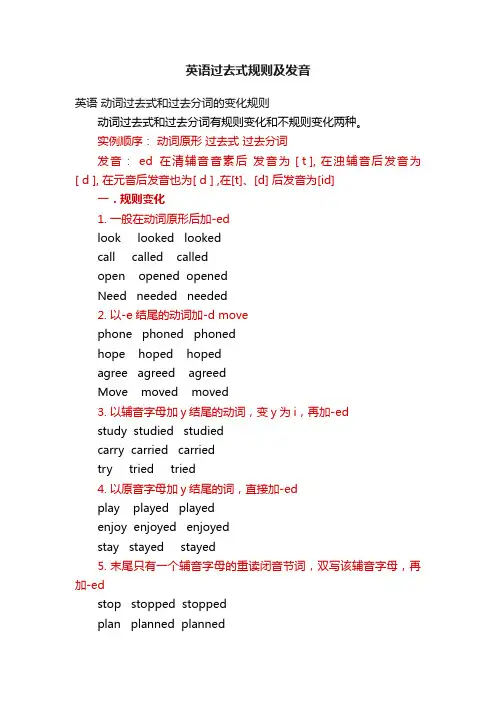
英语过去式规则及发音英语动词过去式和过去分词的变化规则动词过去式和过去分词有规则变化和不规则变化两种。
实例顺序:动词原形过去式过去分词发音: ed在清辅音音素后发音为 [ t ], 在浊辅音后发音为[ d ], 在元音后发音也为[ d ] ,在[t]、[d] 后发音为[id]一.规则变化1. 一般在动词原形后加-edlook looked lookedcall called calledopen opened openedNeed needed needed2. 以-e结尾的动词加-d movephone phoned phonedhope hoped hopedagree agreed agreedMove moved moved3. 以辅音字母加y结尾的动词,变y为i,再加-edstudy studied studiedcarry carried carriedtry tried tried4. 以原音字母加y结尾的词,直接加-edplay played playedenjoy enjoyed enjoyedstay stayed stayed5. 末尾只有一个辅音字母的重读闭音节词,双写该辅音字母,再加-edstop stopped stoppedplan planned plannedfit fitted fitted6. 以-r音节结尾的词,双写r字母,再加-edprefer preferred preferredrefer referred referred二.不规则变化:英语中有些动词的过去式和过去分词形式变化不规则,可分为五种情况。
1.动词原形、过去式和过去分词完全同形。
cut(切) cut cuthit(打) hit hitcast(扔) cast casthurt(伤害) hurt hurtput(放) put putlet(让) let letshut(关) shut shutcost(花费) cost costset(放) set setrid(清除) rid rid2.过去式与过去分词完全同形。
动词过去式的变化规则及发音

动词过去式的变化规则及发音1. 一般动词过去式的变化规则是在动词词尾加上-ed。
例如,work变为worked,dream变为dreamed。
2.以不发音的e结尾的动词,在过去式中只需要加上-d。
例如,live变为lived,move变为moved。
3. 以重读闭音节结尾、末尾只有一个辅音字母的动词,双写这个辅音字母,然后再加上-ed。
例如,stop变为stopped,plan变为planned。
4. 以辅音+y结尾的动词,将y变为i,然后再加上-ed。
例如,study变为studied,carry变为carried。
5. 不规则动词的过去式变化规则各不相同,需要通过背诵来记忆。
例如,go变为went,give变为gave,eat变为ate。
对于发音,动词过去式的发音规则如下:1. 当动词以清辅音音素结尾时(/p/,/t/,/k/,/f/,/θ/,/s/,/ʃ/),过去式的发音为/t/音素。
例如,looked,washed。
2. 当动词以浊辅音音素结尾时(/b/,/d/,/g/,/v/,/ð/,/z/,/ʒ/),过去式的发音为/d/音素。
例如,grabbed,closed。
3. 当动词以元音音素结尾时 (/aɪ/,/aʊ/,/ɔɪ/,/iː/,/aː/),过去式的发音为/d/音素。
例如,cried,played。
4. 当动词以浊辅音音素+t结尾时 (/d/,/z/,/ʒ/),过去式的发音为/ɪd/音素。
例如,wanted,raised。
需要注意的是,这些规则并不是适用于所以动词过去式的情况,有些动词的过去式发音需要根据各自的规则来判定。
动词过去式的变化和发音规1
动词过去式的变化和发音规则①一般情况下,在动词原形后直接加ed。
如:wanted,played。
②以不发音的字母e结尾的动词,直接加d。
如:hoped,lived, tasted;moved③重读闭音节单词需双写最后一个辅音字母,再加ed。
如:stopped,jogged, shopped,planned④以辅音字母+y结尾的动词变y为i,再加ed。
如:studied,worried, carry—carried, hurry—hurried, try--tried。
⑤有些动词不符合上面的规则,需要特殊记忆。
不规则动词的过去式大体上归纳有以下8条:1. 过去式与原形相同。
如:put—put, let—let, cut—cut, read--read2. 把d变成t。
如:build—built, spend—spent,bend-bent;spell-spelt3. 部分以n结尾的词,在词后加t。
如:mean—meant, learn—learnt4. 部分以ow / aw结尾的词,把ow / aw变成ew。
如:blow—blew, draw—drew, know—knew, grow—grew,throw-threw5. 含有双写字母的词,将双写改为单写,在词尾加t。
如:keep—kept, sleep—slept, feel—felt, smell—smelt,sweep-swept6. 含有元音字母o / i的词,将o / i变成a。
如:sing—sang, give—gave, sit—sat, drink—drank, ring-rang ,swim-swam, come-came,7. 将i改成o 如:ride-rode, drive-drove, write-wrote,8. 非常不规则的:am(is)-was,are-were, go-went,eat-ate,buy-bought, catch-caught teach-taught think-thoughtsee-saw, meet-met stand-stood, tell-told,take-took fly-flew, get-got do-didspeak-spoke, find-found, shall-should run- ran,say-said, can-could, have-had, make-madehear-heard lie-lay规则动词过去式加“ed”后的发音规则在浊辅音和元音后面[d]clean—cleaned call—called live—lived play—played pull—pulled open —opened climb—climbed listen—listened water—watered stay—stayed answer—answered在清辅音后面 [t]like—liked dance—danced help—helped pick—picked watch—watched touch—touched look—looked jump—jumped work—worked ask—asked walk —walked milk—milked pass—passed wash—washed在[t], [d]音后面 [id]want—wanted start—started wait—waited plant—planted collect—collected taste—tasted point—pointed visit—visited用所给动词的适当形式填空。
动词过去式变化规则
动词过去式变化规则及其读音规则2011-01-21 10:15:30 来自: VIPABC(真人在线,实时互动)规则动词的过去式变化如下:1、一般情况下,动词词尾加-ed ,如:work ---worked play---played wanted----wanted act----acted2、以不发音的-e 结尾动词,动词词尾加-d,如:live---lived move----moved taste---tasted hope---hoped3、以辅音字母+ y结尾的动词,把-y变为-i 再加-ed,如:study---studied copy---copied cry---cried carry---carried4、以一个辅音字母结尾的重读闭音节动词,双写词尾辅音字母,再加-ed,如:stop ---stopped5、不规则动词的过去式变化规律性不强,须多加记忆。
go – went make – made get – got buy - bought come - came fly-flew不规则动词的过去式的构成1.把动词原形中的i改为a,变成过去式。
如:begin—began,drink—drank,give—gave,ring—rang,sing—sang,sit—sat,swim—swam 2.把重读开音节中的i改为o,变成过去式。
如:drive—drove,ride—rode,write—wrote3.改动词原形中的aw /ow为ew,变成过去式。
如:draw—drew,grow—grew,know—knew,throw—threw(动词show除外,show—showed)4.动词原形中的e改为o,变成过去式。
如:get—got,forget—forgot5.动词原形中的ee改为e,变成过去式。
如:feed—fed,meet—met6.动词原形中的eep改为ept,变成过去式。
动词过去式变化规则及其读音规则(Thechangerulesofthepasttenseo..
动词过去式变化规则及其读音规则(The change rules of the past tense of verbs and their pronunciation rules)The change rules of the past tense of verbs and their pronunciation rules1, in general, the verb suffix -ed, such as:Work ---worked work, play---played play, 5----wanted wants act----acted to play2, to the end of -e pronunciation verb, verb suffix -d, such as:Live---lived live move----moved mobile taste---tasted tasting hope---hoped hope3, the consonant + y end of the verb, the -y into -i, plus -ed, such as:Study---studied learning, copy---copied replication,cry---cried, crying, carry---carried, carrying4, to the end of a consonant of the stressed syllable verbs, double consonant consonant, plus -ed, such as: stop ---stopped5, the irregular verb past tense change regularity is not strong, must remember.Go – went goes to make - made to build get - got, arrives at buy - bought, buys come - came, and flies to fly-flewThe composition of the past of an irregular verb1. change the I in the verb prototype to a and change it into the past tense. Such as:Begin - began begins, drink - drank drinks, give - gave pays, ring - rang surrounds, sing - sang sings, sit - sat sits, swim - swam swims2. change the I in the stressed syllable to O and turn it into the past tense. Such as:Drive - drove driving, ride - rode riding, write - wrote writing3. change the verb in the prototype of AW / ow for EW, into the past tense. Such as:Draw - drew painting, grow - grew growth, know - knew know, throw - threw is still (verb show except, show - showed show)4., the verb prototype in the e instead of O, into the past tense. Such as:Get - got gets, forget - forgot forgets5., the verb prototype in the EE instead of E, into the past tense. Such as: feed - fed sent to, meet - met met6., the verb prototype in the EEP instead of EPT, into the past tense. Such as:Keep - kept keeps, sleep - slept sleeps, sweep - swept cleans7., the verb prototype in the eak instead of oke, into the past tense. Such as:Break - broke breaks, speak - spoke speaks8., the verb prototype in the ell instead of old, into the past tense. Such as:Sell - sold sells, tell - told tells9., the verb prototype in the an instead of OO, into the past tense. Such as:Stand - stood stands, understand - understood knows10. ends with ought and aught, and the pronunciation is the past of [t]. Such as:Bring - brought brings, buy - bought buys, think - thought thinks, catch - caught captures, teach - taught teaches11. the past tense of modal verbs that ends with ould and the pronunciation is [UD]. Such as:Can - could can, shall - should should, will - would will12. change the o in the verb prototype to a and change it into the past tense. Such as:Come - came, become - became becomesIn 13. after the verb plus D or T into the past, and change. Such as:Hear [hi] - heard [H: D] Listen, say [SEI] - said [sed] says, "mean [mi:n] - meant [ment] wants."The past of the 14. verb is the same as the original form of the verb. Such as:Let - let block, must - must must, put - put put, read - read [red] read15. past verbs that do not conform to the above rules. Such as:Am, is - was is, are - were is, build - built build, do - did do, eat - ate eat, fall - fell felling, feel - felt feeling,Find - found find, fly - flew fly, go - went go, have / has - had have, hold - held keep, leave - left leave, make-Made manufacturing,May - might may, run - ran run, see - saw look, take - took take awayThe pronunciation rules of the past "-ed"(1) verb suffix "t, D", the / ID / sound,Want = wanted (to) need = needed (need)(2) for the verb suffix consonants, the / T / sound.Help = helped (help) laugh = laughed (laugh) look = looked (see) Kiss = kissed (kiss) wash = washed (wash) watch = watched (gaze)(3) verb suffix T, other than D voiced consonants or vowels, the / D / sound.Call = called (call) stay = stayed (stay) cry = cried (cry) Work - workingSleep - sleepingCook - CookingThe present participle of a verb forms a ruleI. add -ing directly to the verb1. do-doing do2. stand-standing stations,3. sleep-sleeping sleep,4. eat-eating eat5. sing-singing sing6. drink-drinking, drink7. read-reading, read8. look-looking9. walk-walking walk 10. watch-watching look 11. Draw-Drawingdraw 12. fly-flying fly13. open-opening open 14. jump-jumping jump 15. do-doing do 16. paint-painting painting17. pick-picking pick up 18. play-playing play 19.garden-gardening do gardening work20. talk-talking speak, 21. cook-cooking cook, 22. see-seeing see 23. learn-earning learn24. catch-catching grab 25. climb-climbing, climb 26.count-counting count 27. clean-cleaning sweep28. fish-fishing fishingTwo. Verbs change the present participleGo to the E plus -ing with the silent e ending1. come - coming to2. Dance - dancing dance,3. close - closing pass,4. make - making manufacturing5. ride - Riding ride6. write - writing write7. take - taking, take8. phone - phoning call9.dance-dancing dance 9. move - moving move, move 10. have - having, have 11.leave-leaving 12.wake-wakingThree. Verbs change the present participleRepeat the closed syllable, double the last consonant, and add -ing1. sit- sitting2. hop hopping3. swim- swimming - hop swimming for4. run - running run5. cut -cutting cut6. put - putting put7.get-getting to get8.shop-shopping shopping9.skip-skipping jump rope, 10.begin-beginning start,11.forget-forgetting forget, 12.stop-stopping stop13.travel-travelling travelThe verb prototype changes the third person singular rule1, most of the verb in the suffix "S" in the Qing Dynasty and after a consonant pronunciation is [s] in voiced consonants and vowel pronunciation after [z]. Such as:The Stopstops [s] stop; Makemakes [s] manufacturingThe Readreads [z] reading; Playplays [z] play2, with consonant letters with "Y" ending, we should first "Y" into "I", and then add "es" to read [iz], such as:Flyflies [z] fly; Carrycarries carrying [z]Studystudies [z] learning; Worryworries worry3, with "s, x, CH, SH" in the end, plus suffix "es", pronounced [iz]:Teachteaches [iz] taught Watchwatches [iz] watch;4, with "O" end of the verb, plus "es", read [z], such as:去去-[Z]去做-确实[Z]做下面几个动词变为单数时,原词的元音部分的发音发生了较大的变化,请注意记忆。
英语动词变化规则表(附音标)
sold[səuld]
卖
tell[tel]
told[təuld]
told[təuld]
告诉
retell[,ri:'tel]
retold[,ri:'təuld]
retold[,ri:'təuld]
重讲,重复,复述
5.ABC(1)原形→过去式→原形+(e)n
动词原形
过去式
过去分词
blow[bləu]
动词过去式、过去分词变化规则
一、规则变化:
1.一般在动词原形后加-ed look -> looked; need -> needed
2.以-e结尾的动词加-d move -> moved
3.以辅音字母加y结尾的动词,变y为i,再加-ed carry -> carried; study -> studied
got/gotten['ɡɔtən]
得到
hide[haid]
hid[hid]
hidden['hidən]
隐藏
forget[fə'ɡet]
forgot[fə'ɡɔt]
forgotten[fə'ɡɔtn]
忘记
freeze[fri:z]
froze[frəuz]
frozen['frəuzn]
冷冻,结冰,感到严寒
flown[fləun]
飞
go[ɡəu]
went[went]
gone[ɡɔn]
去
lie[lai]
lay[lei]
lain[lein]
躺
wear[wεə]
wore[wɔ:]