
Unit 7 Will people have robotsSection A (Grammar Focus – 3c )
Unit 7 Will people have robots?
Section A (Grammar Focus – 3c )
一、学习目标:
1.学会下列词汇:
名词:peace sea sky
短语: in the future ; in the sea ; world peace ; fresh air ; on computers
2.系统学习there be 句型的一般将来时态.
3.会用一般将来时态预测未来。
二、重点、难点:
重点:学会词汇和there be 句型的一般将来时态。
难点:用一般将来时态预测未来。
难点:如何正确运用一般将来时态预测未来。
三、落实目标:
预习题:
1.认真阅读(Grammar Focus – 3c)找出下列词汇并识记。
(汇报2分)
世界和平___________ 清新的空气___________
更多的污染___________ 在家通过电脑学习__________
将来___________ 在海里___________
2.句型转换:对学1分;群学2分;汇报2分
(1)T here will be a concert in our school in 10 days.
①_______________________________________(改为否定句)
②______________________________________(改为一般疑问句并做肯定及否定回答)
_____________________ ___________________
问题一,自学2分;对学2分;群学2分;汇报3分
(各组3号准备汇报)
there be句型的一般将来时态: 将会有……, 其结构为如下:
(1) 肯定句:There will be +主语+其他.
(2)否定句:There will not be +主语+其他. will not= won’t
(3)一般疑问句:Will there be +主语+其他?
肯定回答:Yes, there will.
否定回答:No, there won’t.
例如:肯定句: There will be more cars in the cities.
否定句:There will not be more cars in the cities.
一般疑问句:Will there be more cars in the cities?
肯定回答:Yes, there will.
否定回答:No, there won’t.
四、巩固拓展:
1.熟读Grammar Focus里的句子。
( 自学2分;汇报1分)
(各组3号汇报)
2.完成3a。
(自学2分;对学2分;群学2分;汇报2分)
(各组4号汇报)
3.完成3b. (自学3分;汇报3分)
(各组1号汇报)
拓展延伸二:
自学2分;对学2分;群学2分;汇报2分(各组4号汇报)
选词填空
more / less / fewer
(1) Don’t pour waste water into the river. Or there will be ______
pollution.
(2) There will be _______ people here, because many people are going to
the cities to find jobs.
(3) We should plant trees. The ________ , the better.
(4) There are 25 boys and 20 girls in my class. So there are ____ girls
than boys.
五、课后反思。
Unit 7 Will people have robots_ Section A 1a—2d教案
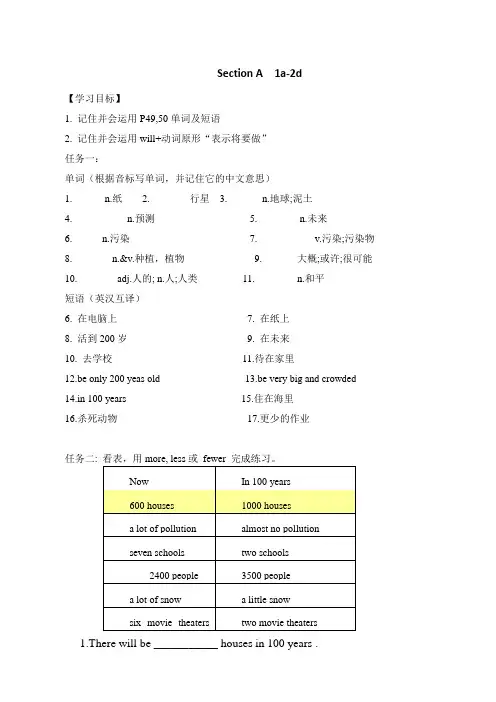
Section A 1a-2d【学习目标】1. 记住并会运用P49,50单词及短语2. 记住并会运用will+动词原形“表示将要做”任务一:单词(根据音标写单词,并记住它的中文意思)1. ______n.纸2.________行星3._______n.地球;泥土4.___________n.预测5. ________n.未来6.______n.污染7.___________ v.污染;污染物8.________n.&v.种植,植物9.______ 大概;或许;很可能10. _______ adj.人的; n.人;人类11. ________n.和平短语(英汉互译)6. 在电脑上________________7. 在纸上____________________8. 活到200岁________________ 9. 在未来_____________________10. 去学校________________ 11.待在家里______________________12.be only 200 yeas old___________ 13.be very big and crowded_______________ 14.in 100 years______________ 15.住在海里_____________________16.杀死动物________________ 17.更少的作业_____________________任务二: 看表,用more, less或fewer 完成练习。
1.There will be ___________ houses in 100 years .2.There will be ___________ pollution in 100 years.3 .There will be ___________ schools in 100 years.4.There will be ___________ people in 100 years.5.There will be ___________ snow in 100 years.6.There will be __________ movie theaters in 100 years.more, fewer 和less的用法注意:fewer 和less都表示“较少的”的意思,more 较多的不同点:1. fewer是few 的比较级,fewer+可数名词复数。
人教版英语八年级上册Unit 7听力原文及翻译
Unit 7 Will people have robots?Section A, 1bBoy 1:Do you think people will have robots in their homes in 100 years?你认为百年内人们家中都会有机器人吗?Boy 2:Yes, I do. I saw a robot on TV, and it cleaned the kitchen.是的,我在电视上看到一个机器人清扫厨房。
Boy 1:Well, I don’t think people will use money.哦,我认为人们将不会使用钱币。
Boy 2:Do you think everything will be free?你认为一切都将会是免费的吗?Boy 1:Yeah, probably.是,很可能。
Boy 2:I think there will be only one country.我认为将只会有一个国家。
Boy 1:Only one country in the world? Will there be world peace?世界上只有一个国家?那将会有世界和平吗?Boy 2:I hope so.我希望如此。
Boy 1:I think kids won’t go to school. They’ll study at home on computers.我认为孩子将不会去学校。
他们将会在家通过电脑学习。
Boy 2:Oh, I disagree.哦,我不同意。
Boy 1:You do?是吗?Boy 2:Yeah, there will always be schools.是的,学校将会一直存在。
Section A, 2a, 2bMs. Steen:OK, now I want to hear everyone’s predictions about the future.好,现在我想听听大家对未来的预测。
八年级英语上册-Unit-7-Will-people-have-robots-Section-B(3
应对措施和思路
教学重点
教学重点:
1) 能运用所学的知识及提示来阅读相关个人未来生活预测, 并能完成相关任务。
2)能运用所学的知识与句型表达方式来描绘一下自己未来的生活。
3) 复习要单元所学的重点知识点, 并完成相关复习任务。
(含教法学法、媒体应用等)
教学难点
教学难点:
能运用所学的知识与句型表达方式来描绘一下自己未来的生活。
(9)许多;大量__________
3.Talkin.abou.th.robots:
(1) What can a robot do now?
(2)What will the robots do in the future?
Ⅱ. Lea.i.
1.As.som.S.wha.thei.lif.wil.b.i.th.future.
Will people have robots
一、教材分析
复习用will表达一般将来时态的用法。结合机器人这一话题表达自己的想法。
3) 能够综合运用所掌握的知识来描述自己未来生活的情况
二、学情分析
1.八年级处于思维活跃期, 对学习本单元有好处, 可以进一步开阔学生视野。
3.本单元总体知识结构比较单一, 内容相对比较简单。
(1)在工厂__________(2)帮助做某事________
(3)感到乏味_________________
(4)在将来______________
(5)试着做某事___________________
(6)能够________________
(7)倒塌_______________
(8)似乎能/不可能_____________
unit_7_Will_people_have_robots_section_A

will happen.
1.Kids study at school now. In 100 years, ________________________ 2. I sometimes see blue skies in my city, but in the future_____________ 3. People now usually live to be about 7080 years old, but in the future__________ 4. Families usually spend time together on weekends, but maybe in 200 years _____________
Section A
Grammar Focus
To learn to use will + do To learn to use there will be To be able to predict city in the future with the words more, fewer, less
特殊疑问句: A: What will the future be like? B: Cities will be more crowded and polluted. A: What will your life be like in ten years? B: I think I’ll be an astronaut. A: Where will you live? B: I’ll live on a space station. A: When will she live for London? B: She’ll leave next Sunday.
Unit 7 Will people have robots Section B 2a —2e教案

本课是一节阅读课。
文本话题是机器人。
通过设置读前预热、读中理解、读后检测和拓展等活动,让学生了解机器人的由来、发展过程、对人类生活产生重大影响等,并把所读信息转化成对话信息,关注语言的使用。
引导学生关注生活,展望和相信未来,崇尚科学,探索和创造未来,从而对学生进行适当的情感态度的教育。
帮助学生树立远大的理想,增强科学探索精神。
知识目标:(1)熟练掌握四会单词和短语。
(2)学习谈论未来,并预测在未来机器人将像什么样和机器人将可以做什么等。
能力目标:(1) 提高学生的阅读技巧,如浏览扫描,特别是确定每一段的主要思想,并考虑每一段所回答的问题。
(2)学会描述未来的机器人将如何帮助人类。
情感目标:引导学生崇尚科学,相信未来,探索和创造美好未来。
使学生的理想观和价值观更为科学,更具发展价值。
1) 掌握本课时出现的生词及表达方式。
2) 阅读短文,获得相关信息,提高学生们的综合阅读能力。
1) 阅读2b 部分的短文并完成相关要求。
2) 能掌握一定的阅读方法。
本节阅读课,以robots 展开话题,在语言输入环节是通过丰富多彩的听、读等任务情境调动学生学习的积极性,使他们主动地投入英语学习之中;在语言输出环节是通过写、说等任务进一步提高学生们的综合语言运用能力,真正让学生“动”起来,让英语教学“活”起来。
经过前面听说以及语法教学,学生对本单元的目标已经有了较好的掌握,能够较好的运用目标语言进行一系列的听说活动,表达自己的思想,这为接下来的阅读课打下来良好的基础。
另外,文本的话题是机器人,时代感很强,大部分学生会比较感兴趣。
但是,我们团场的学生阅读量不是很大,视野也不够宽阔,同时学生在阅读策略和效率上还有待提高,需要老师设置Step2.While-reading让学生知道我们本课的话题就是 robots ,同时用思维导图的方式给学生留有想象的空间。
一系列的教学环节进行有效地指导。
1) 任务型教学法:整个教学过程都是通过学习和阅读的任务进行的。
Unit 7sectionB阅读
[辨析] seem与look的区别: 两者后面都可接形容词、名词或介 词短语。但seem指说话人内心的主观判 断,而look则强调从所述事物外表上看 得出的视觉印象。在下面两种情况下只 能用seem,而不能用look。
1. seem 后面接动词不定式时。如: My father seemed to know the news. 我父亲好 像知道这个消息。
我强烈反对他的见解。
I disagree completely with Jack.
我完全不同意杰克的意见。
7.If buildings fall down with people inside, these snake robots can help look for people under the buildings. 如果建筑物倒塌,人还在里面,这些蛇形 机器人可以帮助在坍塌的建筑物里搜救伤者。 fall down 的意思如下: 1)掉下,落下,跌倒: The old lady fell down in the street and broke her leg. 老妇跌倒在大街上,摔坏了腿。
4. Some scientists believe that there will be more robots in the future. However, they agree it may take hundreds of years. These new robots will have many different shapes. Some will look like humans, and others might look like animals. In India, for example, scientists made robots that
Unit7Willpeoplehaverobots_SectionA(1a-2d)教学设计人教版英语
八上Unit 7 Will people have robots?Section A(1a2d)I.Teaching objectivesAt the end of this class, students will be able to:e the words and phrases to express their future predictions.2.Make predictions about future life.3.Identify the use of more, less, fewer.4.Improve listening skills and strategies.5.Write a passage to describe future life.II. Teaching key and difficult points:Teaching key points:1.Identify some new words and phrases.2.Listen for the key words and sentences.3.Make predictions about future life.Teaching difficult points:1.Listen for key words and sentences.2.Make predictions about future life.III.Teaching methods and aidsTBLT, CLTPictures, PPT, blackboardIV. Teaching procedures(1) Warmup&LeadinWarmup: Greet students as usualLeadin: Play a short video about future life, then ask students what can they see in this short video.(2)Prelistening1.Discussion: What do you think our life will be like in the future? Ask students to discuss in groups first , then invite two students to share their opinions. Teacher will show a picture to aid students.Examples: I think there will be more cars.People won’t drive cars, because cars will be automatic.2.Play a gameThere is a big magic castle in an island, and there are some students too. They are talking about the far future. If you want to enter the castle, you need to figure out these questions and finish some tasks.3.Read&check.You made some predictions about future just now. Do you want to know what they say in the castle? Let’s read together ! Do you agree what they said?(3)Whilelistening1.Listen&circleLet’s move on to the second step, wow, in this step you have the chance to listen to what students in Mr Steen’s class said. Let’s listen carefully what they talk about.2.Which one?The third step is to choose the words you hear. Before we listening, can you guess which one tochoose?Okay, let’s listen to check your guessing. Can you read these sentences for them? They want to hear your beautiful voice.3.Right or wrong?In this step, you need to listen and check which prediction is right. You only have one chance, after listening please speak out loudly your answer.(4)Postlistening1.PracticeIn this step, you need to choose the right word to plete the sentences. Pay attention to the noun. You just have three minutes to finish them. Then the teacher invite five students to share their answers.2.Make conversationsIn this step, students need to make conversations with partners to share their ideas about future. They can use the information in 1a and 2a. Then invite two pairs to give presentations.3.AccidentThere appears a mysterious cat who can bring you to the castle, but you need to answer her questions first.1)What will the future be like according to the book about the future?2)What can people do to save the earth?Firstly, answer the two questions according to your imagination, then read the conversations to answer the questions.4.RoleplayWow, you arrive at the door of castle, but you can’t enter. You need to finish another task. Let’s role play the conversation with your partner. Then, the teacher divide students into two groups to role play the conversation.Congratulations! You succeed!(5)SummaryThe game is over, let’s summarize what we learned today!1)Words & phraseswill, won’t, robot, be free, on paper, live to be, predictions2)Sentences:1.People will have robots in their homes.2.Kids won’t go to school.3.I think there will be...3)Grammar focus:will/won’tless, fewer, more(6)HomeworkWritingWhat’s your prediction about the future?Please write a passage no less than 70 words to introduced your dream future.。
Unit 7 Will people have robots课文翻译
Section A, 2d尼克:你在读什么书,吉尔?吉尔:一本关于未来的书。
尼克:听起来好酷。
那么未来会是什么样子呢?吉尔:嗯,城市将更加拥挤,污染将更加严重。
树木将会更少,环境将极其危险。
尼克:听起来真糟糕!那我们得搬到其他行星上去吗?吉尔:或许吧。
但是我想住在地球上。
尼克:我也是。
那么我们能做些什么呢?吉尔:我们可以节约用水,还可以种更多的树。
每一个人都应当尽一份力来拯救地球。
Section B,2b你认为你将会拥有自己的机器人吗?在观看关于未来的电影时,我们有时会看见机器人。
通常它们像人类的佣人。
它们帮忙做家务,或者在肮脏或危险的地方干活。
现在已经有机器人在工厂里干活了。
有些机器人能帮我们制造汽车,并且它们反复地干着简单的工作。
将来做这样的工作的人会更少,因为它们很枯燥,但是机器人永远不会感到厌烦。
科学家们正在努力使得机器人看上去像人,并且与我们做同样的事情。
在日本,有些机器人会走路、跳舞。
这种机器人观看起来很有趣。
但是,一些科学家认为,尽管我们能够让机器人像人一样活动,却很难让它们真的像人类那样思考。
例如,科学家詹姆斯·怀特认为,机器人永远不可能(像人一样)醒来后知道自己在哪里。
但是,很多科学家们不同意怀特先生的观点。
他们认为在25到50年之后,机器人甚至能够像人类那样说话。
一些科学家相信,未来会有更多的机器人。
然而,他们认为这可能需要数百年的时间。
这些新型机器人将会有很多不同的形状,有的会看起来像真人,其他的可能看起来像动物。
比如,在印度,科学家们已经制造出像蛇一样的机器人。
如果建筑物倒塌了,并且还有人在里面,这些蛇形机器人能够帮助搜寻埋在建筑物下面的人。
这在20年前还是不可能的事,不过在100年以前,电脑、火箭看上去似乎也是不可能的。
我们永远不知道未来会发生什么事!。
unit7Will people have robots sectionB课本作业解析
3a Read Jill’s answer to the question” what will your life be like in the future?” Fill in the blanks with the following words.
meet wear work more live less look fewer keep take
Unit 7 Will people have robots?
2c Read the article again quickly. complete the
sentences about what robots can do now. 1.Robots can build cars in factories.
2.They can do simple jobs many times and not get bored. 3.Some can
walk and dance .
4. Some can help look forpeople under
the buildings.
2d Fill in the blanks in this paragraph with words from the article.
free time attend a dancing party, activities travel neighborhood A famous singer
3c Write about your life 20 years from now. Use 3a and 3b to help you.
In 20years ,I think I'll be a
work in
designer .I' ll designer,I'll design a
人教版八年级上册Unit7WillpeoplehaverobotsSectionB2b教学设计教案
4.教师展示与本节课相关的词汇和短语,如“robots”, “take over”, “perform”, “require”, “be necessary for”等,让学生初步了解并感知这些词汇的用法。
3.学生能够运用目标词汇和句型,描述未来机器人的功能、工作场景及对未来社会的影响。
4.学生能够理解并运用阅读策略,如预测、扫描、细读等,提高阅读理解能力。
(二)过程与方法
1.通过小组合作、讨论、分享等方式,培养学生合作学习和解决问题的能力。
2.通过阅读课文,引导学生运用预测、扫描、细读等阅读策略,提高阅读效率和理解能力。
2.教师对学生的练习成果进行现场批改和指导,帮助学生发现并改正错误。
(五)总结归纳
1.教师引导学生回顾本节课所学内容,总结一般将来时态和目标词汇的用法。
2.学生分享本节课的收获和感悟,以及在学习过程中遇到的困难和解决方法。
3.教师对学生的总结进行补充和归纳,强调重点,提醒学生加强课后复习。
4.教师布置课后作业,巩固本节课所学知识,为下一节课的学习做好准备。
提示:可以从以下几个方面展开:
a.机器人在未来的功能和应用领域。
b.机器人对人类社会的影响。
c.人们对机器人的态度和看法。
3.预习下一节课的内容,提前了解与未来科技相关的词汇和句型,为课堂学习做好准备。
4.搜集与未来科技相关的新闻或资料,下节课分享给同学们,共同探讨未来科技的发展趋势。
作业布置要求:
1.学生在完成作业时,注意语法和词汇的准确性,提高语言表达的流畅性和连贯性。
2.家长协助督促孩子完成作业,关注学习进度,鼓励孩子积极思考,发想象力。