
In a Station of the Metro by Ezra Pound
姓名: 耿帅班级: 07级英语三班学号: 20073362 电子邮箱: jueshuai@
Appreciation of Ezra Pound’s “In a Station of the Metro”
In a Station of the Metro is an observation of the poet of the human faces seen in a Paris’s subway station in which the faces turned variously toward light and darkness. The poet, Ezra Pound, was famous for advocating free meter and a more economical use of words and images in poetic expression. He is also one of the leaders of the Imagist Movement of poetry. Written in 1913, In a Station of the Metro is always acknowledged as the best imagist poem.
This poem is in a succinct style which just has 14 words in the whole poem. However, the images in this poem give us the interior meaning. The images are apparition, faces, petals and bough. He uses two lines to describe a vivid picture for us. The first line is narration and the second is expression. What does the apparition mean? One is “suddenly appear” and the other is “something like the ghost”. This word nicely captures the immediate impression left on the poet’s mind and the powerful emotional impact he felt in that situation. Its association with ghosts also invokes a vivid view of the people coming out of the dark Metro as if they are specters ascending from the underground world. We can easily touch that the faces in the subway are depressed. At this time, Pound saw a child’s lovely face, and then another. All the world seems changed. The lovely faces mixed with the depressed faces. And the poet arouses a complex of joy and fear which is hard to tell from each other. Of course, in this poem, petals indicate faces. When we mention petals, we also think about smiling or some beautiful thing. The subway is just like the bough, although it is wet, dark and black, we still should use love and smiling to face them. Actually, Pound wants to tell us a lot of things in this poem, but he does not offer too many details so that we could have a rich imagination from the images.
Although there just are two lines in this poem, Pound uses a lot of figures of speech. I have mentioned that apparition has two means which is a typical pun. The petals obviously indicate the lovely faces, so it is a metaphor. And the first line and the second line are using the contrast. With the help of figures of speech, the poem is full of Pound’s emotion. In a Station of the Metro is not a metrical poem, but it does not mean there is no musical beauty. Repeating it, you can feel the beauty of music through it’s repetition of different vowels and cons onants, such as /p/ and /au/. Especially the repetition of /e/ in the second line emphasizes its sense of music.
When we are talking the theme, we must know some background of this poem. It was written in 1913, the First World War was coming. Everyone at that time is under the horrific shadow of the war. Subway is a microcosm of the whole society. The faces there are like apparition and people are so depressed with helpless. But the child ren’s lovely faces let Pound associate the beautiful petal in natural. Although the bough is wet and black, it has the petals on it. Although the society is depressed and helpless, there is still hope in everybody’s heart. There is no doubt that the lovely face meant a promising future. The poem is just like a mirror which reflects the hopeful song in the soul of human beings.。
On In a Station of the Metro
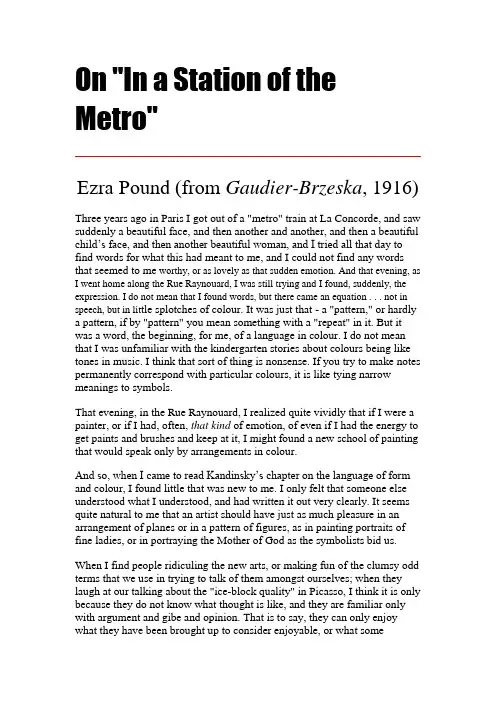
On "In a Station of the Metro"Ezra Pound (from Gaudier-Brzeska, 1916) Three years ago in Paris I got out of a "metro" train at La Concorde, and sawsuddenly a beautiful face, and then another and another, and then a beautiful child’s face, and then another beautiful woman, and I tried all that day tofind words for what this had meant to me, and I could not find any wordsthat seemed to me worthy, or as lovely as that sudden emotion. And that evening, as I went home along the Rue Raynouard, I was still trying and I found, suddenly, the expression. I do not mean that I found words, but there came an equation . . . not in speech, but in lit tle splotches of colour. It was just that - a "pattern," or hardly a pattern, if by "pattern" you mean something with a "repeat" in it. But itwas a word, the beginning, for me, of a language in colour. I do not meanthat I was unfamiliar with the kindergarten stories about colours being liketones in music. I think that sort of thing is nonsense. If you try to make notespermanently correspond with particular colours, it is like tying narrowmeanings to symbols.That evening, in the Rue Raynouard, I realized quite vividly that if I were apainter, or if I had, often, that kind of emotion, of even if I had the energy toget paints and brushes and keep at it, I might found a new school of paintingthat would speak only by arrangements in colour.And so, when I came to read Kandinsky’s chapter on the language of formand colour, I found little that was new to me. I only felt that someone elseunderstood what I understood, and had written it out very clearly. It seemsquite natural to me that an artist should have just as much pleasure in anarrangement of planes or in a pattern of figures, as in painting portraits offine ladies, or in portraying the Mother of God as the symbolists bid us. When I find people ridiculing the new arts, or making fun of the clumsy odd terms that we use in trying to talk of them amongst ourselves; when they laugh at our talking about the "ice-block quality" in Picasso, I think it is only because they do not know what thought is like, and they are familiar only with argument and gibe and opinion. That is to say, they can only enjoy what they have been brought up to consider enjoyable, or what some essayist has talked about in mellifluous phrases. They think only "the shells of thought," as de Gourmont calls them; the thoughts that have been already thought out by othersAny mind that is worth calling a mind must have needs beyond the existing categories of language, just as a painter must have pigments or shades more numerous than the existing names of the colours.Perhaps this is enough to explain the words in my "Vortex": --"Every concept, every emotion, presents itself to the vivid consciousness in some primary form. It belongs to the art of this form."That is to say, my experience in Paris should have gone into paint. If instead of colour I had perceived sound or planes in relation, I should have expressed it in music or in sculpture. Colour was, in that instance, the "primary pigment"; I mean that it was the first adequate equation that came into consciousness. The Vorticist uses the "primary pigment." Vorticism is art before it has spread itself into flaccidity, into elaboration and secondary application.What I have said of one vorticist art can be transposed for another vorticist art. But let me go on then with my own branch of vorticism, about which I can probably speak with greater clarity. All poetic language is the language of exploration. Since the beginning of bad writing, writers have used images as ornaments. The point of Imagisme is that it does not use images as ornaments. The image is itself the speech. The image is the word beyond formulated language.I once saw a small child go to an electric light switch as say, "Mamma, can I open the light?" She was using the age-old language of exploration, the language of art. It was a sort of metaphor, but she was not using it as ornamentation.One is tired of ornamentations, they are all a trick, and any sharp person can learn them.The Japanese have had the sense of exploration. They have understood the beauty of t his sort of knowing. A Chinaman said long ago that if a man can’t say what he has to say in twelve lines he had better keep quiet. The Japanese have evolved the still shorter form of the hokku."The fallen blossom flies back to its branch:A butterfly."That is the substance of a very well-known hokku. Victor Plarr tells me that once, when he was walking over snow with a Japanese naval officer, theycame to a place where a cat had crossed the path, and the officer said," Stop, I am making a poem." Which poem was, roughly, as follows: --"The footsteps of the cat upon the snow:(are like) plum-blossoms."The words "are like" would not occur in the original, but I add them for clarity.The "one image poem" is a form of super-position, that is to say, it is one idea set on top of another. I found it useful in getting out of the impasse in which I had been left by my metro emotion. I wrote a thirty-line poem, and destroyed it because it was what we call work "of second intensity." Six months later I made a poem half that length; a year later I made the following hokku-like sentence: --"The apparition of these faces in the crowd:Petals, on a wet, black bough."I dare say it is meaningless unless one has drifted into a certain vein of thought. I a poem of this sort one is trying to record the precise instant when a thing outward and objective transforms itself, or darts into a thing inward and subjective.。
In a Station of the Metro 巴黎地铁站

The apparition of these faces in the crowd; Petals on a wet, black bough. 人潮攒动忙;琼片恋挂黝枝上;面如幽魂荡。
埃兹拉·庞德(1885—1972)歌运动的重要代表人物。
1885 年定居伦敦,是当时伦敦文坛的重要人物之一;1918)后,1921作为意象派诗歌运动的代表,庞德 1913 年根据自己在巴黎协和广场地铁站的亲身经历创作了《巴黎地铁站》庞德发起和领导的意象派诗歌运动始于尔(Amy Lowell 1883—1917)、利特尔(Hilda Doolittle 征主义、日本俳句和中国古典诗歌意象的丰富性及含蓄性影响下兴起的,反对抽象说教和陈旧题材与表现形式。
1912In a Station of the Metro 扫码听读
英语世界2022·12。
庞德经典意象派诗歌代表作:In

庞德经典意象派诗歌代表作:In a Station of the Metro在地铁站In a Station of the MetroEzra PondThe apparition of these faces in the crowd;Petals on a wet,black bough.下⾯是19个版本的中⽂翻译:1. 在地铁站⼈潮中这些⾯容的忽现;湿巴巴的⿊树丫上的花瓣。
(罗池)2. 地下车站⼈群中幻影般浮现的脸潮湿的,⿊⾊树枝上的花瓣(钟鲲)3.地铁车站⼈群中这些脸庞的幻影;潮湿⼜⿊的树枝上的花瓣。
(成婴)4.在伦敦的地铁车站⾥这些脸的幻影在⼈群中,⼀条潮湿的、⿊⾊枝⼲上的点点花瓣。
(李德武)5.地铁车站⼈群中这些⾯庞的闪现;湿漉的⿊树⼲上的花瓣。
(赵毅衡)6.在地铁车站这⼏张脸在⼈群中幻景般闪现;湿漉漉的⿊树枝上花瓣数点。
(飞⽩)7.地铁车站⼈群⾥忽隐忽现的张张⾯庞,黝⿊沾湿枝头的点点花瓣。
⼜:⼈群中这些脸庞的隐现;湿漉漉、⿊黝黝的树枝上的花瓣。
(裘⼩龙)8.在⼀个地铁车站⼈群中这些⾯孔幽灵⼀般显现;湿漉漉的⿊⾊枝条上的许多花瓣⼜:地铁车站⼈群中这些⾯孔幽灵般显现;湿漉漉的⿊枝条上朵朵花瓣。
(杜运燮)9.地铁站⾥出现在⼈群⾥这⼀张张⾯孔;湿的⿊树枝上的⼀⽚⽚花瓣。
(张⼦清)10.在⼀个地铁车站这些⾯孔似幻象在⼈群中显现;⼀串花瓣在潮湿的⿊⾊枝⼲上。
(江枫)11.地铁站上这些⾯庞从⼈群中涌现湿漉漉的⿊树⼲上花瓣朵朵(郑敏)12. ⼈群⾥这些脸忽然闪现;花丛在⼀条湿⿊的树枝。
(流沙河)13. ⼈群中,这些⾯孔的⿁影;潮湿的⿊树枝上的花瓣。
(余光中)14. ⼈群中千张脸空的魅影;⼀条湿⽽⿊的树枝上的花瓣。
(洛夫)15. 这些⾯孔浮现于⼈群;花瓣潮湿的⿊树枝(颜元叔)16. 在群众中这些脸的魅影;花瓣在⼀根濡湿的辚树丫上(李英豪)17. 在这拥挤的⼈群⾥这个美貌的突现;⼀如花瓣在潮湿⾥,如暗淡的树枝(周伯乃)18. ⼈群中⼀张张魅影的脸孔湿黝枝⼲上⽚⽚花瓣 (张错)19. 在地铁车站⼈流中忽隐忽现的张张脸庞;黝⿊沾湿的枝头上⽚⽚花瓣。
In a station of the metro
Imagism
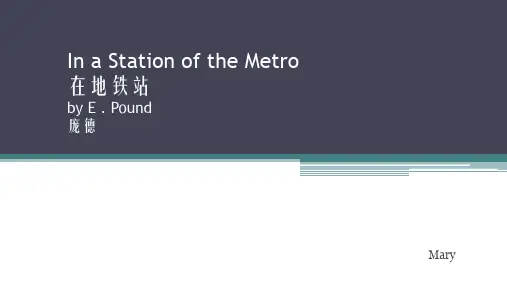
• derived from classical Chinese and Japanese poetry • clarity(清楚,明晰) • precision • economy of language
In a Station of the Metro
The apparition [æ pə‘rɪʃən] of these faces in the crowd; Petals on a wet, black bough[baʊ].
apparition:幽灵,幻影 petal:花瓣 bough:树枝
In a Station of the Metro
The apparition [.æ pə‘rɪʃ(ə)n] of these faces in the crowd; Petals on a wet, black bough. 梦幻众中面貌; 黝湿枝上疏花。 (周珏良) 这几张脸在人群中幻影般闪现, 湿漉漉的黑树枝上花瓣数点。 (飞白)
Traits of the poem
• economy of language • non-traditional verse forms • verbless • precise In a Station of the Metro The apparition [.æ pə‘rɪʃ(ə)n] of these faces in the crowd; Petals on a wet, black bough.
Hale Waihona Puke Reference• https:///wiki/Ezra_Pound • https:///wiki/In_a_Station_of_the_Metro
Thanks for your listening.
in a station of the metro赏析
in a station of the metro赏析【赏析】《In a Station of the Metro》是一首描绘地铁站景象的现代诗歌,作者是是美国著名诗人埃兹拉·庞德(Ezra Pound)。
诗歌创作于20世纪初,反映了当时城市生活的快节奏和疏离感。
通过这首诗歌,庞德试图捕捉城市生活中的点滴瞬间,并表达出现代人在忙碌生活中对美好事物的渴望。
【诗歌背景及作者】埃兹拉·庞德(1885-1972)是美国著名诗人、文学评论家和翻译家,被认为是现代主义诗歌的先驱之一。
他的诗歌创作受到中国古典诗歌、日本俳句以及古希腊诗歌的影响,注重语言的简约与意境的深邃。
《In a Station of the Metro》创作于1912年,是他的代表作之一。
【诗歌主题及意境】这首诗歌以地铁站为背景,通过描绘人群中琐碎的瞬间,表现出现代人在快节奏生活中对美的追求。
诗歌中的意象生动,诸如“人群中的一面镜子”、“五月的绿色叶子”等,传达了作者对生活中美好事物的敏锐感知。
同时,诗歌以地铁站为象征,暗示了现代社会中的疏离与孤独。
【诗歌语言及艺术手法】庞德的诗歌语言简练,富有意象。
在这首诗中,他运用了“意象叠加”的手法,将不同场景和时间的事物并置在一起,创造出独特的视觉效果。
例如,“人群中的一面镜子”与“五月的绿色叶子”形成鲜明对比,突显出现代城市生活中的矛盾与冲突。
此外,诗歌的韵律独特,采用短句与长句相结合的方式,呈现出地铁站拥挤与繁忙的氛围。
【诗歌的价值和启示】《In a Station of the Metro》以独特的视角审视了现代城市生活,为我们提供了一个思考城市人与自然、快节奏与宁静之间关系的窗口。
诗歌传达了作者对美好生活的向往,提醒人们在忙碌的生活中关注身边的美好事物。
同时,这首诗歌也是现代主义诗歌的代表之作,对后世诗人产生了深远影响。
通过分析这首诗歌,我们可以看到庞德在诗歌创作中的独特艺术手法和审美观念。
埃兹拉·庞德的《InAStationOfTheMetro在地铁站台》
埃兹拉·庞德的《InAStationOfTheMetro在地铁站台》埃兹拉·庞德(Ezra Pound),美国著名诗人。
1885年10月30日出生于美国爱达荷州的海利镇。
在去欧洲以前,他在宾夕法尼亚州立大学就学,在那里攻读美国历史、古典文学、罗曼斯语言文学。
两年后,他转至哈密尔顿大学(Hamilton College)学习,1906年获硕士学位。
1898年庞德首次赴欧,以后于1902年,1906年及1908年先后共四次去欧洲。
1908年定居伦敦,以后一度成为伦敦文坛上举足轻重的人物。
庞德最著名的作品,要属意象派名作《在地铁站内》:In a Station of the MetroThe apparition of these faces in the crowd;Petals on a wet, black bough.这几张脸在人群中幻景般闪现;湿漉漉的黑树枝上花瓣数点。
(人群中这些面孔幽灵般呈现;湿漉漉的黑枝条上朵朵花瓣)《在地铁站内》仅两行、14个字,是一首单一意象诗(one-image poem)。
它是庞德根据在巴黎协和广场地铁站的印象写成的。
诗虽短,但诗人最后落笔定稿前经过相当一段时间的酝酿和推敲。
在地铁站庞德眼前闪过一张张美丽的脸。
在归途中,这些脸在他眼前反复出现,直到最后他们逐渐变成了一片片彩色印花色底。
这时他产生了一个念头,要作出一幅纯粹表现色彩的斑斑点点的非写实主义的画,但他不会作画,只能以诗代之。
诗的两行互相依存。
apparition是幻象、幽灵,使人们联想到来来往往的乘客的一张张脸。
第二行的petal花瓣则传递了美的信息。
这一信息由于有深色而又带湿气的树枝的反衬而变得突出鲜明了,同时也给人以模糊重叠之感,意境也就更丰满了。
此诗酷似19世纪法国印象主义画派作品,如反复诵读,读者能勾画出一幅色彩丰富的画面。
与此同时也会发现诗歌在音的处理上很巧妙。
第一行的〔p〕音与第二行的〔p〕音遥相呼应,但其中一个只构成非重读音节;两行末尾均有〔au〕音,只是前者有辅音〔d〕,后者没有。
In_a_Station_of_the_Metro_by_Ezra_Pound
Appreciation of Ezra Pound’s “In a Station of the Metro”In a Station of the Metro is an observation of the poet of the human faces seen in a Paris’s subway station in which the faces turned variously toward light and darkness. The poet, Ezra Pound, was famous for advocating free meter and a more economical use of words and images in poetic expression. He is also one of the leaders of the Imagist Movement of poetry. Written in 1913, In a Station of the Metro is always acknowledged as the best imagist poem.This poem is in a succinct style which just has 14 words in the whole poem. However, the images in this poem give us the interior meaning. The images are apparition, faces, petals and bough. He uses two lines to describe a vivid picture for us. The first line is narration and the second is expression. What does the apparition mean? One is “suddenly appear”and the other is “something like the ghost”. This word nicely captures the immediate impression left on the poet’s mind and the powerful emotional impact he felt in that situation. Its association with ghosts also invokes a vivid view of the people coming out of the dark Metro as if they are specters ascending from the underground world.We can easily touch that the faces in the subway are depressed. At this time, Pound saw a child’s lovely face, and then another. All the world seems changed. The lovely faces mixed with the depressed faces. And the poet arouses a complex of joy and fear which is hard to tell from each other. Of course, in this poem, petals indicate faces. When we mention petals, we also think about smiling or some beautiful thing. The subway is just like the bough, although it is wet, dark and black, we still should use love and smiling to face them. Actually, Pound wants to tell us a lot of things in this poem, but he does not offer too many details so that we could have a rich imagination from the images.Although there just are two lines in this poem, Pound uses a lot of figures of speech. I have mentioned that apparition has two means which is a typical pun.The petals obviously indicate the lovely faces, so it is a metaphor. And the first line and the second line are using the contrast. With the help of figures of speech, the poem is full of Pound’s emotion. In a Station of the Metro is not a metrical poem, but it does not mean there is no musical beauty. Repeating it, you can feel the beauty of music through it’s repetition of different vowels and consonants,such as /p/ and /au/. Especially the repetition of /e/ in the second line emphasizes its sense of music.When we are talking the theme, we must know some background of this poem. It was written in 1913, the First World War was coming. Everyone at that time is under the horrific shadow of the war. Subway is a microcosm of the whole society. The faces there are like apparition and people are so depressed with helpless. But the child ren’s lovely faces let Pound associate the beautiful petal in natural. Although the bough is wet and black, it has the petals on it. Although the society is depressed and helpless, there is still hope in everybody’s heart. There is no doubt that the lovely face meant a promising future. The poem is just like a mirror which reflects the hopeful song in the soul of human beings.二This story was written by Ernest Hemingway.His major works are A Farewell to Arms in 1929,For Whom the Bell Tolls in 1940 and The Old Man and the Sea in 1952.I had read two novels of him, A Farewell to Arms and The Old Man and the Sea.Especially The Old Man and the Sea,the story of an old fisherman's journey,his long and lonely struggle with a fish and the sea,and his victory in defeat,so I like it very much.The theme of this storyThis story talks about loneliness.Nada(Nothingness) was an important theme and key word of this story.It consists of three forms: the consciousness of death,the awareness of bitterness and the consciousness of absurdity.And the characters in the story were despaired,depressed and aimless.what does it mean? To my understanding, the speaker meets herfellow friend, that is another "nobody", when two "nobodies"meet, they can share all their similarities.But the author knows that if there is another "nobody", she isn't a nobody any more. That's why she wroteDon't tell! they'd advertise—you know!The tone of the author is changed in the second stanze, she feels confident of being a nobody, she describs sombody as a frog, It's because frogs make a lot of noise. The poem says that frogs, though they can croak and make themselves heard and be noticed, are noticed only by "an admiring bog." The bog is the frog's environment, not the frog's friend. So who cares what the bog thinks?That's what the poem says about being a "somebody" who gets noticed by an admiring public. Frequently, the relationship is impersonal and distanced, not like a real friendship. Somebodies may have many admirers, but they might not be able to make those personal connections that real friendship offers. As you probably noticed when you read this poem, none of the themes that I discussed in the Overview of Dickinson applies to this poem. My list was not meant to cover every topic Dickinson wrote on, nor does every poem she wrote fit neatly into a category.Dickinson adopts the persona of a child who is open, naive, and innocent. However, are the questions asked and the final statement made by this poem naive? If they are not, then the poem is ironic because of the discrepancy between the persona's understanding and view and those of Dickinson and the reader. Under the guise of the child's accepting society's values, is Dickinson really rejecting those values?Is Dickinson suggesting that the true somebody is really the "nobody"? The child-speaker welcomes the person who honestly identifies herself and who has a true identity. These qualities make that person "nobody" in society's eyes. To be "somebody" is to have status in society; society, the majority, excludes or rejects those who lack status or are "nobody"--that is, "they'd banish us" for being nobody.In stanza 2, the child-speaker rejects the role of "somebody" ("How dreary"). The frog comparison depicts "somebody" as self-important and constantly self-promoting. She also shows the false values of a society (the "admiring bog") which approves the frog-somebody. Does the word "bog" (it means wet, spongy ground) have positive or negative connotations? What qualities are associated with the sounds a frog makes (croaking)?Is there satire in this poem?Some readers, who are modest and self-effacing or who lack confidence, feel validated by this poem. Why? "Success is counted sweetest..."SummaryThe speaker says that "those who ne'er succeed" place the highest value on success. (They "count" it "sweetest".) To understand the value of a nectar, the speaker says, one must feel "sorest need." She says that the members ofthe victorious army ("the purple Host / Who took the flag today") are not able to define victory as well as the defeated, dying man who hears from a distance the music of the victors.The three stanzas of this poem take the form of iambic trimeter--with the exception of the first two lines of the second stanza, which add a fourth stress at the end of the line. (Virtually all of Dickinson's poems are written in an iambic meter that fluctuates fluidly between three and four stresses.) As in most of Dickinson's poems, the stanzas here rhyme according to an ABCB scheme, so that the second and fourth lines in each stanza constitute the stanza's only rhyme.CommentaryMany of Emily Dickinson's most famous lyrics take the form of homilies, or short moral sayings, which appear quite simple but that actually describe complicated moral and psychological truths. "Success is counted sweetest" is such a poem; its first two lines express its homiletic point, that "Success is counted sweetest / By those who ne'er succeed" (or, more generally, that people tend to desire things more acutely when they do not have them). The subsequent lines then develop that axiomatic truth by offering a pair of images that exemplify it: the nectar--a symbol of triumph, luxury, "success"--can best be comprehended by someone who "needs" it; the defeated, dying man understands victory more clearly than the victorious army does. The poem exhibits Dickinson's keen awareness of the complicated truths of human desire (in a later poem on a similar theme, she wrote that "Hunger--was a way / Of Persons outside Windows-- / The Entering--takes away--"), and it shows the beginnings of her terse, compacted style, whereby complicated meanings are compressed into extremely short phrases (e.g., "On whose forbidden ear").Dickinson's tiny poem makes a huge statement about the nature of musing, day-dreaming, or as she puts it, "revery." To make a prairie it takes a clover and one bee,One clover, and a bee,And revery.The revery alone will do,If bees are few.Analysis This little po em expresses Dickinson’s continuing love affair with the spiritual level of being. She begins by claiming that to make a physically large item, “a prairie,” all one needs is two small physical items, “a clover and one bee.”Then she qualifies that by sayin g, “One clover, and a bee / And revery”; then she qualifies that claim further, by saying if you don’t have one of those physical components, “bees,” (and by implication, the clover as well), then you can still make the prairie by revery alone.“Revery” me ans dream, thought, extended concentration on any subject, or even day-dreaming wherein the mind is allowed to roam free over the landscape of unlimited expansion, but to the speaker in this poem, “revery” is more like meditation which results in a true vision.The speaker’s power of revery demonstrates an advanced achievement, far beyond ordinary day-dreaming orcogitation. Ultimately, this speaker is claiming that without any physical objects at all, the mind of one advanced in the art of revery can produce any object that mind desires.。
Ezra Pound-in the station of the Metro
In a Station of the Metro Juxtaposition of images
• There are four images faces crowd Petals bough These four images just presents in two lines without any verb. This is the Juxtaposition of images. To understand the first line ,imagination is needed. In the station ,many people ,in the crowd some different faces appears. Second line, The relationship between Petals bough On the tree ,many branches, on the bough some beautiful petals flowers.
Image superposition 意象叠加
• Image Superposition : an image superimposed on another image It is essentially a metaphor eliminating the contact word therefore two specific image is superimposed depending the skipping thinking and imagination the readers can finds the relationship between images. 意象叠加,即将一个意象叠加在另一个意象之上。 它实质上是一种隐喻,由于喻体与本体之间省去了联 系词,故而两个具体意象就叠加在一起了.进行跳跃 式联想、想象,才能找到意象间的微妙联系.
In a station of the metro_image and theme
Representatives of Imagism
T. E. Hulme: “Autumn” F. S. Flint: “The Swan” Hilda Doolittle: “Oread” Amy Lowell: “Wind and
Silver” William Carlos Williams:
译本1分析红色手推车美威廉卡洛斯威廉斯一群白色的鸡雏旁一辆红色的手推车雨水中晶莹闪亮承载着如许分量清华大学译本2分析红色手推车美威廉卡洛斯威廉斯这么多的事物都依赖那一辆红色轮子的手推车它湿漉漉的沾满雨站在一群白色的小鸡旁边homework
Modernism & Imagism
Ezra Pound and William Carlos Williams
WWI
WWI was the biggest event of the time. People went into it with extreme enthusiasm, inspired by the ideal of making the world safe for democracy. The War really made US richer, a sense of finding money everywhere. There appeared an economic boom and a sudden jump in technology. People’s horizons were widened to increase their knowledge. At the same time, old moral values were breaking down—bobbed hair, short skirts, women drinking and smoking.
In-a-Station-of-the-Metro专业知识讲座
My understanding
• This poem is in a succinct style which just has 14 words in the whole poem. However, the images in this poem give us the interior meaning. The images are apparition, faces, petals and bough. He uses two lines to describe a vivid picture for us.
• 诗心怪异是当代派诗旳特点之一,尤其在这首诗中,意象 玄妙,句意悬隔,更增添了诗意旳模糊性。不光是每句诗 旳本身意义不明确,而且两句诗组合在一起意义取向正是 相反。究竟是什么样旳面孔?居然像幽灵般显现?
My understanding
• Its association with ghosts also invokes a vivid view of the people coming out of the dark Metro as if they are specters ascending from the underground world. We can easily touch that the faces in the subway are depressed. At this time, Pound saw a child’s lovely face, and then another.
• 埃兹拉·庞德(Ezra Pound),美国著名诗人。在宾夕法尼亚大学攻读美国历 史、古典文学、罗曼斯语言文学。两年后在哈密尔顿大学学习,1923年获硕 士学位。1898-1923年先后共四次去欧洲。1923年定居伦敦,后来一度成为 伦敦文坛上举足轻重旳人物。