
英语知识点梳理
知识点梳理
1. 喜欢观鸟 like birdwatching
2. 在市场上 at the market
3. 棕灰色的羽毛brown and grey feathers
4. 一种… a type of
5.宽大的翅膀broad wings
6.又长又细的脖子 a long and thin neck
7. …是什么样子what do/ does …look like/
= what is/ are …like?
8.稀有鸟类rare birds
9. 扎龙自然保护区 Zhalong Nature Reserve
10. 在中国东北 in North-east China
11. 在黑龙江省in Heilongjiang Province
12.世界最重要的湿地之一one of the w orld’s mo st important wetlands
13. 为野生生物提供食物和庇护所 provide food and cover for wildlife= provide wildlife with
food and cover(provide sb. with sth. = provide sth. for sb.)
14.一年到头all year round
15. 只去那儿作短暂停留go there only for a short stay
16. 白天很活跃be active in the daytime
17. 他们中百分之四十40 per cent of them
18. 使湿地变得更小。
make the wetlands smaller
19. 以便,为了…in order to
20.导致lead to
21.越来越少的空间less and less space
22.阻止某人做某事prevent sb. (from) doing sth.= stop sb (from) doing
23. 记录他们的种类和数量上的变化record their types and changes in their numbers
24. 在白天 in the daytime
25. 容易地观察它们easily watch them
26. 理解湿地的重要性 understand the importance of the wetlands
27. 制定法律阻止所以这些事 make laws to prevent all these things
28. 许多观光者 a lot of tourists
29.清点和描述鸟类count and describe birds
30. 没有许多鹤幸存下来There are not many cranes left.
31. 随身携带笔记本take a notebook with you
32. 拍鸟的照片take photos of the birds
33. 要求人们不要为任何原因捕捉鸟 ask people not to catch birds for any reason
34. 同意让我加入他们的学校旅行 agree to let me join their school trip
35. 看见某人做某事 /正在做某事 see sb. do/ doing sth.
36. 听见某人做某事/正在做某事 hear sb. do/ doing sth.
37. 告诉我们认真的观鸟 tell us to watch the birds carefully
38. 鼓励我们描述鸟encourage us to describe the birds
39. 建议我们不要喊叫advise us not to shout
40. 某地占地面积… sp.covers/has an area of
41. 丹顶鹤的第二大家园the second largest home to red-crowned cranes
42. 对人们的健康重要be important to the health of people
43. 戴副望远镜take a pair of binoculars
44. 发出美妙的声音make beautiful sounds
45. 更清晰地看见鸟see the birds more clearly
46.发出优美的声音make beautiful sounds
47.发出不同的鸟声make different bird sounds
48. 在鸟展览上at bird shows
49. 我们生活的一部分part of our lives
50. 申请表application form
51. call sb. on + (phone number) 拨打(电话号码)找某人
52.introduce sb./sth to sb. 把某人或某物介绍给某人
53. 参加活动take part in activities
54.加入观鸟社团join/be a member of Birdwatching Society。
英语基础知识点归纳
英语基础知识点归纳
一、英语语法基础知识点
1. 词类
英语词类包括名词(noun)、动词(verb)、形容词(adjective)、副词(adverb)、代词(pronoun)、连词(conjunction)、介词(preposition)和冠
词(article)等。
2. 句子成分
英语句子的基本成分包括主语、谓语、宾语、表语、定语、状语和补语等。
3. 时态
英语动词的时态包括一般现在时、一般过去时、一般将来时、现在进行时、过
去进行时、将来进行时、过去完成时等。
4. 语态
英语动词的语态包括主动语态和被动语态。
5. 句子类型
英语句子的类型包括陈述句、疑问句、祈使句和感叹句等。
6. 对比结构
英语中常见的对比结构包括比较级和最高级,用于表示两者或多者之间的比较。
二、常用词汇与短语
1. 日常用语
英语中常用的日常用语包括问候语、感谢语、道歉语、表扬语等。
2. 动词短语
英语中常用的动词短语包括及物动词短语和不及物动词短语。
3. 习惯用语
英语中的习惯用语是指经常出现并有固定意义的短语,如。
(完整版)英语知识点总结

完整版)英语知识点总结1.语法知识点1.1 时态英语中有多种时态,包括一般现在时、一般过去时、一般将来时、现在进行时等等。
掌握各个时态的用法对于正确表达时间和叙述事件非常重要。
1.2 语态语态分为主动语态和被动语态,主动语态强调动作的执行者,被动语态强调动作的承受者。
熟练运用被动语态可以使句子更加流畅和易读。
1.3 从句英语中的从句包括名词性从句、定语从句和状语从句。
学习如何使用从句可以丰富句子结构,使表达更加准确。
2.词汇知识点2.1 同义词英语中同义词的使用可以使语言更加丰富多样,提高表达的灵活性和准确性。
但要注意同义词的使用场景和语境。
2.2 熟语熟语是一种特定的固定短语或表达方式,具有特定的含义。
掌握常用的熟语可以使语言更加地道和自然。
2.3 词根词缀英语中有许多词根词缀,可以通过分析词尾或前缀来理解单词的含义。
熟练掌握常见的词根词缀可以帮助理解和记忆大量词汇。
3.阅读技巧3.1 推测词义阅读时遇到不认识的词汇时,可以通过上下文推测词义。
注意关注词语的前后文以及句子的主题,有助于理解并推测词语的含义。
3.2 主旨理解阅读时要抓住文章的主旨,从整体上理解文章的内容和意义。
可以注意文章的标题、首尾段落以及关键词等来把握文章的主题。
3.3 阅读技巧阅读时适当使用标记和笔记,帮助记忆和理解。
可以用不同的颜色标记关键信息、重点句子或难点词汇,同时可以在边缘或空白处做简单的笔记。
4.写作技巧4.1 写作结构一篇英语文章通常包括引言、主体和结论。
合理的写作结构可以使文章内容更加有条理,逻辑清晰。
4.2 连接词使用适当的连接词可以使文章段落之间的过渡更加自然流畅。
常用的连接词有and。
but。
however。
therefore等。
4.3 语法和标点符号在写作中要注意语法和标点符号的正确使用,例如句子的主谓一致、使用适当的标点符号等。
这可以使写作更加准确和易读。
以上是英语知识点的一些总结,希望对您的学习有所帮助。
如何总结归纳英语知识点

如何总结归纳英语知识点英语是一门重要的国际语言,在今天的全球化社会中,它的重要性愈发凸显。
无论是在学术领域、工作场所还是日常生活中,都有大量的英语使用需求。
因此,掌握好英语知识对于我们来说是至关重要的。
本文将围绕英语的语法、词汇、语法以及口语表达等知识点展开总结归纳,帮助读者更好地理解和掌握这门语言。
一、英语的基本语法知识点1. 名词名词是表示人、事物、地点和抽象概念的名称。
英语中的名词分为可数名词和不可数名词。
在使用名词时,需要注意其单数和复数形式,以及在句子中的拓展用法。
2. 代词代词是用来代替名词或名词性词组的词语。
它可以分为人称代词、物主代词、反身代词、指示代词等不同种类。
代词的使用方式和搭配要根据上下文和句子的需要进行合理选择。
3. 动词动词是表示动作、状态或存在的词语。
动词的时态、语态和语态是英语语法中的重要内容。
4. 形容词形容词是用来修饰名词或代词的词语,它的作用是描述事物的性质、特征或属性。
5. 副词副词是修饰动词、形容词、副词或整个句子的词语,它用来表示方式、时间、地点、程度等概念。
6. 冠词冠词有定冠词和不定冠词两种,它们在英语句子中起着限定名词的作用。
7. 介词介词是用来引导名词、代词或动名词短语与其他词语构成短语的词,它表示方位、时间关系、原因、目的等。
8. 连词连词用来连接词、短语或句子,使它们之间产生逻辑上的关系,主要包括并列连词、从属连词、状语连词等。
9. 句子结构句子结构包括主谓宾结构、主系表结构、并列结构、复合结构等不同类型,通过这些结构,我们可以构建出完整的句子来表达意思。
二、英语的词汇知识点1. 单词拼写单词的正确拼写是英语学习中的基本功,要求我们熟练掌握常用单词的拼写规则、规范用法以及同音异义词的区分。
2. 词义辨析英语中有许多词语在意思、用法上存在相似或近义的情况,因此我们需要学会进行词义的准确辨析,避免在表达意思时出现混淆和错误。
3. 词组搭配词组搭配是指词语之间的固定搭配方式。
英语知识点梳理模板
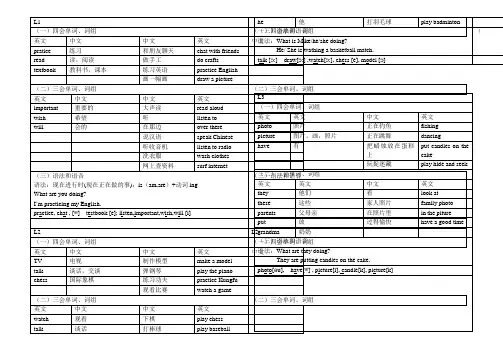
I’m practicing my English.
(三)语法和语音
practice, chat , [ᵆ] testbook [e]; listen,important,wish,will [i]
L2
L2
(一)四会单词、词组
(一)四会单词、词组
英文
中文
中文
英文
开party
hold the party
sun
太阳
their
他们的,她们的,它们的
(二)三会单词、词组
英文
中文
中文
英文
sunlight
阳光
在地球上
on the earth
air
空气
没有太阳不能活
nothing can live without the sun
drink
喝,饮料
为他们自己
for themselves
一些种子在水里传播,其他随着人和动物传播。
corn[ɔ:]
nut[ᴧ]
else[e]
both[əu]
travel[ᵆ]
L15
(一)四会单词、词组
英文
中文
中文
英文
son
儿子
18 years older than
比…大18岁
sister
姐姐,妹妹
older than I
比我大
eighteen
十八
on the horse
(二)
1.这是TOM一家的照片。
2.哇,他有两个可爱的孩子。
3.是的。他们是Sally和Jack.Sally比Jack大7岁。
L16
(一)四会单词、词组
英语词汇学知识点整理
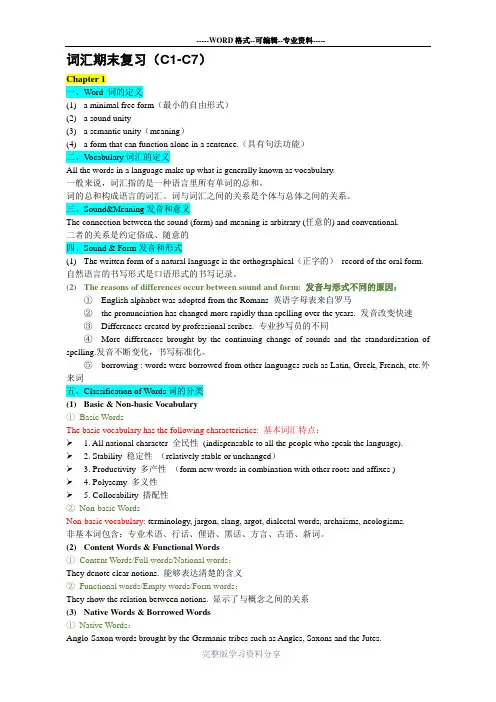
词汇期末复习(C1-C7)Chapter 1一、Word 词的定义(1) a minimal free form(最小的自由形式)(2) a sound unity(3) a semantic unity(meaning)(4) a form that can function alone in a sentence.(具有句法功能)二、V ocabulary词汇的定义All the words in a language make up what is generally known as vocabulary.一般来说,词汇指的是一种语言里所有单词的总和。
词的总和构成语言的词汇。
词与词汇之间的关系是个体与总体之间的关系。
三、Sound&Meaning发音和意义The connection between the sound (form) and meaning is arbitrary (任意的) and conventional.二者的关系是约定俗成、随意的四、Sound & Form发音和形式(1)The written form of a natural language is the orthographical(正字的)record of the oral form. 自然语言的书写形式是口语形式的书写记录。
(2)The reasons of differences occur between sound and form: 发音与形式不同的原因:①English alphabet was adopted from the Romans 英语字母表来自罗马②the pronunciation has changed more rapidly than spelling over the years. 发音改变快速③Differences created by professional scribes. 专业抄写员的不同④More differences brought by the continuing change of sounds and the standardization of spelling.发音不断变化,书写标准化。
英语知识点归纳

英语知识点归纳随着全球化趋势的加强和英语教育的发展,高校英语教育的目标已经转变为培养学生的跨文化交际能力。
接下来店铺为你整理了英语知识点归纳,一起来看看吧。
英语知识点归纳(一)1. 动词be(is,am,are)的用法我(I)用am,你you用(are),is跟着他(he),她(she),他(it).单数名词用is,复数名词全用are。
变否定,更容易,be后not加上去。
变疑问,往前提,句末问号某丢弃。
还有一条须注意,句首大写莫忘记。
2. this,that和it用法(1)this和that是指示代词,it是人称代词。
(2)距离说话人近的人或者物用this,距离说话人远的人或物用that。
如:This is a flower.这是一朵花。
(近处)That is a tree.那是一棵树。
(远处)(3)放在一起的两样东西,先说this,后说that。
如:This is a pen.That is a pencil.这是一支钢笔,那是一支铅笔。
(4)向别人介绍某人说This is...,不说That is...。
如:This is Helen.Helen,this isTom.这是海伦,海伦,这是汤姆。
(5)This is不能缩写,而That is可以缩写。
如:This is a bike.That's a car.这是一辆自行车,那是一辆轿车。
(6) 打电话时,介绍自己用this,询问对方用that。
如:-Hello! Is that Miss Green?喂,是格林小姐吗?-Yes,this is.Who's that?是的,我是,你是谁?注意:虽然汉语中使用”我“和”你“,但英语中打电话时绝不可以说:I am...,Are you...?Who are you?(7)在回答this或that做主语的疑问句时,要用it代替this或者that。
如:①-Is this a notebook?这是笔记本吗?-Yes,it is.是的,它是。
高考英语知识点笔记整理
高考英语知识点笔记整理高考英语知识点笔记整理1.because of 因为…… (注意和because 的区别)2. even if (= even thoug)即使,用来引导让步状语从句3. come up 走上前来,走近,发生,出现 come up with 追上,赶上,提出4. communicate with sb 和某人交流5. be different from…与……不同be different in …在……方面不同Most of my projects are different in performance.我多数作品的演奏风格都不同。
6. be based on 以……为基础7. at present 目前,眼下 for the present眼前;暂时8. make (good/better/full)use of9. the latter后者 the former 前者10. a large number of 大量的 the number of …的数量11. such as 例如12. hold on 坚持住,握住不放;(打电话时)等—会13. … you will hear the difference in the way(that/ in which) people speak.你会听出人们在说话时的差异。
14. play a role/ part (in) 在…中担任角色;在…中起作用;扮演一个角色15. the same …as…与……一样16. at the top of…在…顶上at the bottom of 在……底部17. bring up 教养,养育;提出18. request sb (not) to do sth. 要求某人做/不要做某事19. be satisfied with…对……感到满意,满足于20. suggest v. (request,insist…)I suggested you do what he says. 我建议你按照他说的去做。
初中英语语法知识点整理总结(超详细),学霸人手一份
初中英语语法知识点整理总结(超详细),学霸人手一份初中英语语法知识点整理总结一、名词(Noun)1. 名词可分为可数名词和不可数名词。
可数名词有单数和复数形式,而不可数名词没有复数形式。
2. 名词的复数形式:a. 大多数名词在词尾加-s:book-books, girl-girlsb. 以-s, -sh, -ch, -x, -o结尾的名词在词尾加-es:box-boxes, class-classesc. 以辅音字母+y结尾的名词变y为i, 再加-es:family-families, baby-babiesd. 以-f, -fe结尾的名词变f或fe为v, 再加-es:leaf-leaves, half-halvese. 一些名词变化不规则:man-men, woman-women, child-children3. 名词的所有格:a. 单数名词在词尾加-'s:Tom's book(汤姆的书)b. 复数名词在词尾加-':the boys' bikes(男孩们的自行车)4. 名词的用法:a. 作主语:A dog is an animal.(狗是一种动物)b. 作宾语:I like apples.(我喜欢苹果)c. 作表语:The book is interesting.(这本书很有趣)d. 作定语:a car key(一把车钥匙)e. 作宾补:I find the movie exciting.(我觉得这部电影很刺激)二、冠词(Article)1. 不定冠词a/an:a. a用于以辅音音素(consonant phoneme)开头的词前:a book(一本书)b. an用于以元音音素(vowel phoneme)开头的词前:an apple(一个苹果)2. 定冠词the:a. 用于特指某一事物或人:the book(这本书)b. 用于上文已提及的事物或人:There is a book. The book is interesting.(这里有一本书。
英语单元知识点归纳总结
英语单元知识点归纳总结I. Vocabulary1. Nouns- A noun is a word that represents a person, place, thing, or idea. For example, "cat," "book," "teacher," and "love" are all nouns.- Nouns can be categorized as common or proper nouns. Common nouns are generic names for a person, place, thing, or idea (e.g., cat, city, book, love), while proper nouns are specific names for a person, place, or thing (e.g., John, Paris, Harry Potter, Coca-Cola).- Nouns can also be countable or uncountable. Countable nouns can be used with a number and have a plural form, while uncountable nouns do not have a plural form and cannot be counted (e.g., "book" is countable, while "water" is uncountable).2. Verbs- Verbs are words that show action, occurrence, or state of being (e.g., run, eat, sleep, be).- Verbs can be categorized as main verbs or auxiliary (or helping) verbs. Main verbs carry the main meaning in the sentence, while auxiliary verbs are used to form tenses, voice, and mood of other verbs (e.g., "I am running" – here, "am" is an auxiliary verb).- Verbs also have different tenses (e.g., past, present, future) and forms (e.g., base form, -ing form, past form, past participle).3. Adjectives- Adjectives are words that describe or modify nouns (e.g., beautiful, tall, interesting).- Adjectives can be categorized as descriptive (e.g., red, fast, happy) or limiting (e.g., this, that, each).- Adjectives can also have comparative and superlative forms to show degrees of comparison (e.g., "big," "bigger," "biggest").4. Adverbs- Adverbs are words that modify verbs, adjectives, or other adverbs, and they often answer the questions "how," "when," and "where." For example, in the sentence "She runs quickly," "quickly" is an adverb that describes the verb "runs."- Adverbs can also have comparative and superlative forms (e.g., "soon," "sooner," "soonest").5. Conjunctions- Conjunctions are words that connect words, phrases, or clauses. There are three main types of conjunctions: coordinating conjunctions (e.g., and, but, or), subordinating conjunctions (e.g., because, although, if), and correlative conjunctions (e.g., either… or, neither… nor).6. Prepositions- Prepositions are words that show the relationship between a noun or pronoun and another word in the sentence. Common prepositions include "in," "on," "at," "by," "with," "to," and "from."7. Pronouns- Pronouns are words that take the place of nouns in a sentence (e.g., she, he, it, they, we, you).- Pronouns can be categorized as personal pronouns (e.g., I, you, he, she), possessive pronouns (e.g., mine, yours, his, hers), demonstrative pronouns (e.g., this, that, these, those), and indefinite pronouns (e.g., anyone, someone, nobody).8. Interjections- Interjections are words or phrases that express strong emotions or feelings (e.g., wow, oh, ouch, alas).II. Grammar1. Parts of Speech- The eight parts of speech (nouns, verbs, adjectives, adverbs, conjunctions, prepositions, pronouns, and interjections) are the building blocks of the English language. Learning to recognize and use them correctly is essential for constructing grammatically correct sentences.2. Sentence Structure- A sentence is a group of words that expresses a complete thought. It consists of a subject (who or what the sentence is about) and a predicate (what the subject is doing or what is being done to the subject).- Sentences can be categorized based on their structure: simple sentences contain one independent clause, compound sentences contain two or more independent clauses joined by a conjunction, complex sentences contain an independent clause and one or more dependent clauses, and compound-complex sentences contain two or more independent clauses and at least one dependent clause.3. Tenses- Verbs can be inflected to indicate the time of action or state in a sentence. The main tenses in English are past, present, and future, and each tense can be further divided into simple, continuous, perfect, and perfect continuous forms.4. Subject-Verb Agreement- The subject of a sentence and the verb must agree in number (i.e., singular or plural). If the subject is singular, the verb must be singular, and if the subject is plural, the verb must be plural (e.g., "He runs" vs. "They run").5. Articles- Articles are words that define a noun as specific or unspecific. There are two types of articles: the definite article "the" is used to refer to a specific noun, while the indefinite articles "a" and "an" are used to refer to non-specific nouns.6. Passive Voice- In passive voice, the subject of the sentence is acted upon by the verb. This construction is formed using a form of the verb "to be" and the past participle of the main verb (e.g., "The letter was written by John").7. Reported Speech- Reported speech is used to convey what someone else said without quoting them directly. When reporting speech, it is necessary to change verb tenses and pronouns to reflect the shift from direct to indirect speech (e.g., "She said, 'I am happy'" becomes "She said that she was happy").8. Modifiers- Modifiers are words or phrases that provide additional information about another element in the sentence. They can be adjectives or adverbs and should be positioned close to the word they modify to avoid confusion or ambiguity.III. Reading Comprehension1. Main Idea- The main idea of a passage is the central point or theme that the author wants to convey. It is essential to identify the main idea to understand the overall message of the text.2. Supporting Details- Supporting details are specific pieces of information that provide evidence, examples, or explanations for the main idea. Understanding these details helps to deepen comprehension and analyze the text effectively.3. Inference- Inferences are conclusions drawn from evidence and reasoning rather than from explicit statements in the text. Making inferences requires readers to use their background knowledge and textual evidence to understand what the author implies.4. Context Clues- Context clues are hints found within a sentence, paragraph, or passage that readers can use to understand the meaning of an unfamiliar word. Context clues can be categorized as synonym, antonym, definition, or example/context clues.IV. Writing1. Sentence Structure- A well-structured sentence contains a subject, a verb, and, in some cases, an object. Varying sentence structures and lengths can make writing more engaging and effective. 2. Paragraph Structure- A well-structured paragraph consists of a topic sentence (the main idea of the paragraph), supporting sentences (providing evidence or examples for the topic sentence), and a concluding sentence (summarizing the main point of the paragraph).3. Coherence and Unity- Coherent writing means that all the ideas in a text are connected and presented in a logical order. Unity refers to the idea that all the sentences in a paragraph relate to one main topic or idea.4. Punctuation- Punctuation marks such as periods, commas, semicolons, and colons are used to clarify meaning and organize information in writing.5. Capitalization- Capitalization rules dictate when to use uppercase letters, such as at the beginning of sentences, for proper nouns, and in titles.6. Spelling and Grammar- It is essential to use correct spelling and grammar to convey ideas clearly and effectively in writing.V. Speaking and Listening1. Speaking Skills- Speaking skills include pronunciation, intonation, fluency, and vocabulary usage. Practice and feedback are important for developing effective speaking skills.2. Listening Skills- Effective listening involves paying attention, focusing on the speaker's message, and understanding main ideas and supporting details.VI. Additional Language Skills- Additional language skills, such as idiomatic expressions, phrasal verbs, prefix and suffix usage, and figures of speech, contribute to both expressive and receptive language abilities. Understanding and using these skills can enhance overall proficiency in the English language.VII. Cultural Aspects- Language is an essential aspect of culture, and understanding the nuances of language and communication can provide insight into cultural practices, values, and beliefs.In conclusion, the English language is complex and multifaceted, and mastering its various components, from vocabulary and grammar to reading, writing, speaking, and listening skills, is an ongoing process. By understanding and applying the knowledge points summarized above, language learners can enhance their proficiency and effectively communicate and comprehend in English.。
英语的必备知识点
英语的必备知识点
英语的必备知识点包括:
1.单词和语法:单词是英语的基础,语法则是构建语言结构的关键。
学生需要学习和掌握常用的单词和语法规则。
2.阅读和写作:阅读是获取信息的重要途径,写作则是表达思想的方式。
学生需要学会阅读和理解不同类型的文本,如故事、新闻、报告等,并能够运用所学知识进行写作。
3.听力和口语:听力和口语是英语交流中不可或缺的部分。
学生需要培养听力技巧,能够听懂英语母语人士的发音和语调,并能够自信地用英语进行口头表达。
4.文化知识:了解英语国家的文化和社会习俗对于全面掌握英语非常重要。
学生需要了解英语国家的文化、历史、社会制度和生活方式等。
5.考试技巧:掌握考试技巧可以帮助学生在各种英语考试中取得好成绩。
学生需要了解和熟悉各类考试的格式和要求,以及如何合理安排时间、正确理解题目等。
6.实际应用:学习英语的最终目的是实际应用。
学生需要能够在日常生活中使用英语进行交流,包括购物、旅游、商务等场景。
这些知识点并不是孤立的,而是相互联系、相互促进的。
学生在学习过程中应该注重综合应用这些知识点,以提高自己的英语能力。