
【课件】仁爱版七年级上册英语 Unit3 Topic3 SectionD 课件
What would you like to drink?
Section D
Group A: Countable nouns • some eggs • some cakes • some apples • some hamburgers • some vegetables
she
write
to?
Jack.
③ Does she have many friends here?Yes, she does.
④ Do they often have dinner together?Yes, they do.
⑤ Does she like Fujian food? No, she doesn’t.
PPT素材:/sucai/ PPT图表:/tubiao/ PPT教程: /powerpoint/ 范文下载:/fanwen/ 教案下载:/jiaoan/ PPT课件:/kejian/ 数学课件:/kejian/shu xue/ 美术课件:/kejian/me ishu/ 物理课件:/kejian/wul i/ 生物课件:/kejian/she ngwu/ 历史课件:/kejian/lish i/
(some+可数名词) some cakes
eggs vegetables 不可数名词: fish meat rice chicken
milk water tea
(some+不可数名词)
some
fish
meat
milk
① Who writes the letter? Jane.
②
Who
does PPT模板:/moban/ PPT背景:/beijing/ PPT下载:/xiazai/ 资料下载:/ziliao/ 试卷下载:/shiti/ PPT论坛: 语文课件:/kejian/yuw en/ 英语课件:/kejian/ying yu/ 科学课件:/kejian/kexu e/ 化学课件:/kejian/huaxue/ 地理课件:/kejian/dili/
1) Would you like something to…? 2) What would you like to…? 3) Why not…? 4) What do you usually have for…? 5) Help yourself/yourselves to…?
这个单元,你学到了什么? 1. 词汇: 2. 语法: 3. 重点句子:
Group B: Uncountable nouns
• some fish • some rice • some bread • some milk • some chicken • some juice
名词
可数名词
不可数名词
可数名词: cake egg apple banana
vegetable noodle源自pencil carSurvey the students about their favorite food, and then have a party. One student acts as the host, and the others act as the guests.
Make up a conversation.
Jane
kind
China
nice
英文书信的基本格式: (1)称呼:常用Dear…开头,顶格起写,
后用逗号。 (2)正文:主体部分。 (3)结束语:结尾客套话,末尾用逗号,
常用Yours/Sincerely yours/Love。 (4)签名:在结束语下面。
Sharing Favorite Food
七年级英语仁爱版上册Unit3_Topic2_SectionD_教学设计

Unit3 Topic2 SectionD 教学设计I. Material analysis本课是话题二的最后一个课时,主要活动是Grammar和Functions。
引导学生复习构词法、实义动词一般现在时的特殊疑问句及其回答,以及通过对话、听力训练、阅读训练、综合探究等活动复习和巩固Sections A~C学习的打招呼、询问职业、家庭成员、工作场所等信息的表达方式。
另外,学生将在学完本话题后,学会自行总结和归纳构词法的规律以及实义动词一般现在时的特殊疑问句及其回答,学会在实际的句子中发现语法错误并改正错误,同时还将锻炼他们听并判断、听再填空、读前猜测、读后总结的能力,提高他们用所学的词汇、句型、功能、话题进行综合探究活动的能力。
此外,在project的综合探究活动中,借助全家福,让学生以实践体验等方式来综合运用本话题所学知识,学会用英语做事情。
II. Teaching aims1. Knowledge aims能根据已学语音、音标及发音规则,正确朗读下列词汇并在实际的对话操练中加以应用:cute, play, its, love能根据本话题已学知识,自行总结和归纳构词法、实义动词一般现在时的特殊疑问句及其回答:teach—teach er, act—act or在教师的帮助与指引下,通过对话操练、听力训练、阅读训练、综合探究等活动复习和巩固有关打招呼、询问职业、家庭成员、工作场所等信息的表达方式,如:(1)—Glad to meet you.—Glad to meet you, too.(2)—What does your father do?—He is a doctor.(3)—Where does he work?—He works in a hospital.(4)—Who is the man in yellow?—He is my uncle.2. Skill aims能听懂有关询问职业、家庭成员等简单对话或叙述并完成相应的任务;能根据图文就职业、工作场所、家庭成员等基本情况的话题进行交流;能够在图片的帮助下进行阅读,理解大意、细节等,并按要求进行语言活动;能根据提示书面介绍自己或同伴的家庭成员的工作情况。
仁爱版七年级英语上册 Unit 3 Topic 3 Section D 课件
• 很高兴做某事:be___g_l_a_d__t_o___d_o
•
在s这th里b:e _h_e_r__e________
2 Write a letter to your friend, paying attention to
its form. The letter in 1 may help you.
和…一起
all kind to me .I often have dinner with them. I usually
have many vegetables. I like Sichuan food and Guangdong
很高兴做… 在这里
food very much. They are nice.
Unit 3 Getting together
Topic 3 Section D
Warming-up
Enjoy a soLeabharlann g:Presentatio n
Look and learn: be kind to sb.
= be friendly to sb.对…友好
Look, This is Lucy. These are
• 2. They are all kind to me他._们__都__对___我__很__友__好______。
• 对某人友好___b_e__k__i_n_d__t_o_____
•
s三b.者a或ll三:_者___以__上__都____
•
bo两th者: 都____________
• 3.I am very glad to be her我e.很___高__兴__在__这__里______ 。
F very much.
Unit 3 Topic 1-Section D课件 仁爱版七年级英语上册
4.Zhang Ming can speak a l ittle English. 5.Many people wants to l ive in big cities(城市)now.
Practices
用括号中所给单词的适当形式填空。 1.Jane morning. 2. —Could you tell (tell) me your ID number? —Sure. 3.I meet a lot of people (people) every day. 4.Jim has many friends. Some of them (they)can speak Chinese very well. 5.Susan is a teacher. She often visits (visit) some different schools.
Warm up
Name: Alan From: Canada Language: English Wish: visit China
Where is Alan from? Does Alan speak English? What does Alan want to do?
Warm up
Name: Li Lin From: China Language: Chinese Wish: visit Australia
仁爱版七年级上册英语笔记Unit3Topic3-Unit4Topic1知识点总结
仁爱版七年级上册英语笔记Unit3Topic3-Unit4Topic1知识点总结U 3 T3—U4 T11.1)would like = wantwould like没有人称和数的变化I would like an egg.=I want an egg.He would like an egg.= He wants an egg.(would like不能加s)2)would like to do = want to doa. He would like to drink some water.(drink)=He wants to drink some water.b. She would like (visit) the Great Wall.=She the Great Wall.3)I would like=I’d like He would like=He’d like4)a. I’d like an egg.(一般疑问句) Would you like an egg?Yes,please./ No,thanks.b. He’d like a hamburger.he a hamburger?. / .5)Would you like some chicken?(用some 加强语气,表示强调)6)I’d like an egg.What would you like?He’d like some fish.he ?2.1)you—yourself(反身代词)2)yoursel f---yoursel ves(pl.)3.help yourself/yourselves to +n.:随便吃……a. Help yourself (you) to some chicken, Tom.b. Help yourselves (you) to some chicken, kids.4.1)可数名词[C]:有单数和复数的形式.2)不可数名词[UC]:一般没有复数的形式.3)常见的不可数名词有:milk,rice,fish(鱼肉),chicken(鸡肉),(apple/orange) juice,water,bread5.fish:1)作为“鱼” , 是可数名词.fish—fish(pl.)2)作为“鱼肉”, 是不可数名词.some fish6.chicken:1)作为“鸡” , 是可数名词.a chicken2)作为“鸡肉”, 是不可数名词.some chicken7.some + n.(pl.),some+ [UC]some eggssome fish/chicken/milk/apple juice/rice8.---Help yourselves.---Thank you.9.---Would you like…? ---Yes, please. /No, thanks.10.What/How about +sb(宾格)/sth?What about him/her/some milk?11.All right.行,好吧(表示对别人的建议表示赞同)---I’d like some rice and chicken.---All right./doc/6e6981861.html,k for me.13.Me,too.14.表示建议:---What about …? ---Good idea.15.an ideaa good ideaHomework:1.I’d like a hamburger.(一般疑问句) a hamburger?(肯否回答) ./ .2.She’d like some orange juice.she ?3. , boys and girls.(随便吃些鸡肉吧)4.She likes it very much.(否)She it .5..(我想喝些牛奶).6.他们怎么样?Unit 3 T 3 Section B—D1.1)usually:70-80%,often:50-60%2)usually,often放在be之后,行为动词之前.I usually have breakfast at home.2.have…for breakfast/lunch/supper/dinner1)He usually has an egg and some milk for breakfast.2)We usually have some rice and chicken for supper.3.一日三餐前不加a/an/the,后不加s.What do you usually have for/ breakfast?4.1)He usually has some bread for lunch.What does he usually have for lunch?2)We usually have some juice and fish for dinner. usuallyfor dinner?5.have:1)有2)吃,喝:have milk/bread6.[UC]前面不加a/an/the,后不加s.He has / milk and/ bread for breakfast.7.What/How about +sb(宾格)/sth?8.with带着/有,(表示伴随关系)have chicken/fish with vegetables9.some rice10.three meals(餐):breakfast,lunch,supper/dinner11.food:[UC],食物的总称,作主语,谓语用单数.My favorite food is (be) chicken and fish.12.Chinese /English food13.wait(v.)—waiter(指人)(男服务员)---waitress(女服务员)14.take one’s orderMay I take your order?15.something to drink/eat1)修饰词如不定式(to do) ,形容词修饰something时,放在something之后.2)something:某事(肯定句)anything:任何事(否/疑问)nothing:没有什么事(表否定意思的陈述句)3)Would you like +something?Would you likesomething to eat ?16.[UC]表示数量的表达法:1)a glass of apple juice/watera bag of rice /milk2)a glass of apple juice---two/some glasses of apple juice3) a bag of milk---five bags of milk17.wait/just a moment18.Let me see.让我想一想.I see. 我明白了.19.1)Would you like some vegetables?2)some vegetables/rice20.something to drink21.banana juice----Section C1.eat out2.eat---eating(现在分词)3.would like to doWould you like to have (have) dinner with me?4.have / breakfast/lunch/supper/dinner5.with sb(宾格)6.Would you like to have lunch with him?7.Yes, I’d like/love to.(to不能省略)8.1)May/can I help you?=What can I do for you?2)情态动词may/can/could+动原May I help (help) you?9.sir—madam(对应词)10.What would you liketo eat (eat)?11.Why not+动原? =Why don’t you +动原?Why not study (study) with me? = Why don’t you study with me?12.表示建议:1)What about…? 2)Why not…?肯定回答:Good idea.13.Here you are.14.---Would you like sth to drink?---Yes,please./No,thanks.Section D1.in+地点: in China2.many+n(pl.)many friends3.1)all,bothall指三者或三者以上“都”both指两者“都”2)all,both放在be之后,行为动词之前They are all students.We all like school.4.be kind to sbThe teacher is kind to us.5.have dinner with them6.such as +若干例子7.Sichuan food8.be glad to do sthObama is glad to visit (visit) the Great Wall.9.1)here,there是介词,前不加介词.2)be here/thereI’m glad to be (be) here.10.let sb do sthLet me (I) see (see).Homework:1.他晚饭通常吃什么?he usually2.你可以点菜了吗?3.Tom,为什么不随便吃些汉堡包呢,?,Tom?4.你想喝些什么东西吗?来两杯香蕉汁. Would you like.5.She’s glad (be) there.6.I’d like (work) with you.7.Would you like something (say)?8.Why not (tell) him about it.= him about it.9.他对我很友善.He .10.I usually have some rice for lunch. usually for lunch?1.---Do you like…?---Yes, I like …very much/a lot/a little. (No, I don’t like …at all.)Section D1.at / homeHe has a dog at home.2.it’s, its(它是)(它的)a cat. name’s Mimi.3.Tommy =T om4.Zhou Lan likes it a lot.= Zhou Lan likes it very much. (否)Zhou Lan doesn’t li ke it at all.5.some,anyShe has some pets.(否)She doesn’t have any pets.(疑问)Does she have any pets?6.1)人称代词:主格---宾格I—me,you-you,he-him,she-her,it-itwe-us,they-them2)形物代—名物代my-mine,your-yours,his-his,her-hers,its-its,our-ours,their-theirsThis is a girl. name is Lily. is twelve. We like .(Her,She,her) Unit 4 T1 Section A1.What can I do for you?=Can/May I help you?2.madam---sir(对应词)3.want to do = would like to do1)She wants to have milk and bread.=She would like to have milk and bread.2)Would you like a glass of apple juice?=Do you want a glass of apple juice?3)Would she like some vegetables?=Does she want any vegetables?4.clothes:衣服的总称,复数名词,作主语时,谓语用复数形式。
仁爱版英语七年级上册Unit 1 Topic 3 How old are you (Section ABCD)教学课件
QQ number
What’s your QQ number?
one
eleven
你 two
twelve
发 three
thirteen
现 four + teen = fourteen
规 five
fifteen
律 six + teen = sixteen
了 seven + te say.
Excuse me, what’s this in English?
(视频P19-1a)
map
eraser
It’s an eraser.
pen pencil desk
A: What’s this in English? B: It’s a pen. A: How do you spell it? B: P-E-N, pen. A: Thank you. B: That’s OK.
(录音P18-3)
Hello, Maria! What grade are you in?
I’m in _G__ra_d_e_ _S_e_v_e_n_.
Are you in Grade Seven, too?
Yes, I am.
Who’s that?
That’s Nancy.
How old is she? What class is she in?
A: What’s that in English? B: It’s a toy. A: Can you spell it, please? B: Yes. T-O-Y, toy. A: Thanks. B: You’re welcome.
It’s __a__b_o_o_k_.
What’s that in English?
Unit3Topic3SectionD导学案英语七年级上册
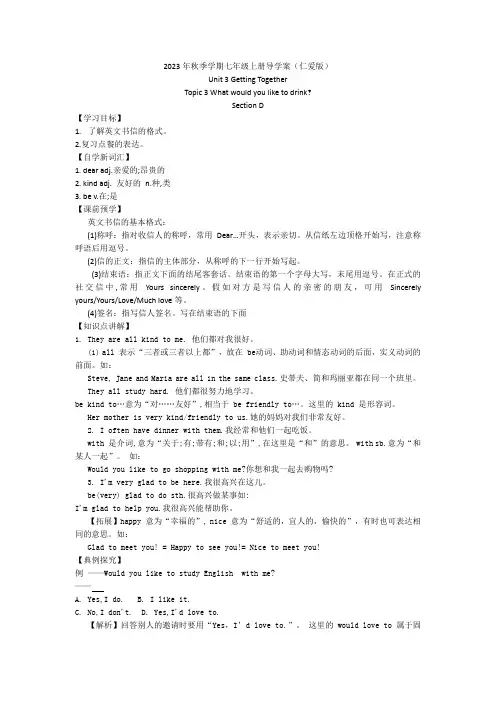
2023年秋季学期七年级上册导学案(仁爱版)Unit 3 Getting TogetherTopic 3 What would you like to drink?Section D【学习目标】1.了解英文书信的格式。
2.复习点餐的表达。
【自学新词汇】1. dear adj.亲爱的;昂贵的2. kind adj. 友好的n.种,类3. be v.在;是【课前预学】英文书信的基本格式:(1)称呼:指对收信人的称呼,常用Dear…开头,表示亲切。
从信纸左边顶格开始写,注意称呼语后用逗号。
(2)信的正文:指信的主体部分,从称呼的下一行开始写起。
(3)结束语:指正文下面的结尾客套话。
结束语的第一个字母大写,末尾用逗号。
在正式的社交信中,常用Yours sincerely。
假如对方是写信人的亲密的朋友,可用Sincerely yours/Yours/Love/Much love等。
(4)签名:指写信人签名。
写在结束语的下面【知识点讲解】1. They are all kind to me. 他们都对我很好。
(1) all 表示“三者或三者以上都”,放在 be动词、助动词和情态动词的后面,实义动词的前面。
如:Steve, Jane and Maria are all in the same class.史蒂夫、简和玛丽亚都在同一个班里。
They all study hard. 他们都很努力地学习。
be kind to…意为“对……友好”,相当于be friendly to…。
这里的 kind 是形容词。
Her mother is very kind/friendly to us.她的妈妈对我们非常友好。
2. I often have dinner with them.我经常和他们一起吃饭。
with 是介词,意为“关于;有;带有;和;以;用”,在这里是“和”的意思。
with sb.意为“和某人一起”。
如:Would you like to go shopping with me?你想和我一起去购物吗?3. I'm very glad to be here.我很高兴在这儿。
仁爱版英语七年级上册Unit3 Topic1 SectionA精品课件
从方框选择单词的正确形式填空 look have, be want, help is 1. The girl ______ in a blue dress. looks like her mom very much. 2. Mary ______ 3. He _____ has three photos. wants to help me with my English. 4.My sister _____ help Jane with her Chinese. 5.I often ______
1c- Make up a new conversation. T: Excuse me, could you please tell me his name? S: Sure. He is Kangkang. T: Does he come from China? S: Yes, he does. T: Can he speak English? S: Yes. But his English is not very good. T: Could you help him with it? S: No problem.
(影片2)
tell I have a friend. I’d like to ____you something about her. She is Jane. She is from Canada. She often speaks _____ English. She likes Chinese, but her Chinese is not wants pal to good. He _______to find a pen _____ Could with _____ ______you please help her ______it. help her?
初中英语仁爱科普版七年级上 Unit 3 Topic 3 Section D 课件 (共24张PPT)
你能区分哪些是可数名词,哪些是不可数名词吗
可数名词
2020/8/27
tomato oebrrbwgamieagcnaaenitgldekaerna
不可数名词
你能区分哪些是可数名词,哪些是不可数名词吗
可数名词
2020/8/27
havfdaphebijrsmpuagoihnliexberckteuajurbgilceer
2020/8/27
egg milk rice water bread apple chicken orange vegetable
hamburger fish food dinner lunch20 Nhomakorabea0/8/27
可数名词: _e_g_g________h_a_m__b_u_rg_e_r_______v_e_g_e_t_a_b_le__________ __l_u_n_c_h_______o_ra_n_g_e_______d_in_n_e_r____a_p_p_le________ 不可数名词: __m_i_lk_______r_ic_e______w__a_te_r_______b_r_e_a_d_________ __ch__ic_k_e_n_____f_is_h_____f_o_o_d_____________________
meals and making suggestions. 4. Learn how to write an English letter.
rs x z v l u n c h ba b u e f o o d o ia e g g i p l y r ap p l e s u e w a cg h j t h w g a n hb r e a s a s t g ir u i b o s i e e ce m i l k j r r l ka n k e d f i i c ed i n n e r c c u nh a m b u r g e r
仁爱版七年级上册英语笔记 Unit3 Topic3-Unit4 Topic1知识点总结
U 3 T3—U4 T11.1)would like = wantwould like没有人称和数的变化I would like an egg.=I want an egg.He would like an egg.= He wants an egg.(would like不能加s)2)would like to do = want to doa. He would like to drink some water.(drink)=He wants to drink some water.b. She would like (visit) the Great Wall.=She the Great Wall.3)I would like=I’d like He would like=He’d like4)a. I’d like an egg.(一般疑问句) Would you like an egg?Yes,please./ No,thanks.b. He’d like a hamburger.he a hamburger?. / .5)Would you like some chicken?(用some 加强语气,表示强调)6)I’d like an egg.What would you like?He’d like some fish.he ?2.1)you—yourself(反身代词)2)yoursel f---yoursel ves(pl.)3.help yourself/yourselves to +n.:随便吃……a. Help yourself (you) to some chicken, Tom.b. Help yourselves (you) to some chicken, kids.4.1)可数名词[C]:有单数和复数的形式.2)不可数名词[UC]:一般没有复数的形式.3)常见的不可数名词有:milk,rice,fish(鱼肉),chicken(鸡肉),(apple/orange) juice,water,bread5.fish:1)作为“鱼” , 是可数名词.fish—fish(pl.)2)作为“鱼肉”, 是不可数名词.some fish6.chicken:1)作为“鸡” , 是可数名词.a chicken2)作为“鸡肉”, 是不可数名词.some chicken7.some + n.(pl.),some+ [UC]some eggssome fish/chicken/milk/apple juice/rice8.---Help yourselves.---Thank you.9.---Would you like…? ---Yes, please. /No, thanks.10.What/How about +sb(宾格)/sth?What about him/her/some milk?11.All right.行,好吧(表示对别人的建议表示赞同)---I’d like some rice and chicken.---All right.k for me.13.Me,too.14.表示建议:---What about …? ---Good idea.15.an ideaa good ideaHomework:1.I’d like a hamburger.(一般疑问句) a hamburger?(肯否回答) ./ .2.She’d like some orange juice.she ?3. , boys and girls.(随便吃些鸡肉吧)4.She likes it very much.(否)She it .5..(我想喝些牛奶).6.他们怎么样??Unit 3 T 3 Section B—D1.1)usually:70-80%,often:50-60%2)usually,often放在be之后,行为动词之前.I usually have breakfast at home.2.have…for breakfast/lunch/supper/dinner1)He usually has an egg and some milk for breakfast.2)We usually have some rice and chicken for supper.3.一日三餐前不加a/an/the,后不加s.What do you usually have for/ breakfast?4.1)He usually has some bread for lunch.What does he usually have for lunch?2)We usually have some juice and fish for dinner.usuallyfor dinner?5.have:1)有2)吃,喝:have milk/bread6.[UC]前面不加a/an/the,后不加s.He has / milk and/ bread for breakfast.7.What/How about +sb(宾格)/sth?8.with带着/有,(表示伴随关系)have chicken/fish with vegetables9.some rice10.three meals(餐):breakfast,lunch,supper/dinner11.food:[UC],食物的总称,作主语,谓语用单数.My favorite food is (be) chicken and fish.12.Chinese /English food13.wait(v.)—waiter(指人)(男服务员)---waitress(女服务员)14.take one’s orderMay I take your order?15.something to drink/eat1)修饰词如不定式(to do) ,形容词修饰something时,放在something之后.2)something:某事(肯定句)anything:任何事(否/疑问)nothing:没有什么事(表否定意思的陈述句)3)Would you like +something?Would you likesomething to eat ?16.[UC]表示数量的表达法:1)a glass of apple juice/watera bag of rice /milk2)a glass of apple juice---two/some glasses of apple juice3) a bag of milk---five bags of milk17.wait/just a moment18.Let me see.让我想一想.I see. 我明白了.19.1)Would you like some vegetables?2)some vegetables/rice20.something to drink21.banana juice----Section C1.eat out2.eat---eating(现在分词)3.would like to doWould you like to have (have) dinner with me?4.have / breakfast/lunch/supper/dinner5.with sb(宾格)6.Would you like to have lunch with him?7.Yes, I’d like/love to.(to不能省略)8.1)May/can I help you?=What can I do for you?2)情态动词may/can/could+动原May I help (help) you?9.sir—madam(对应词)10.What would you liketo eat (eat)?11.Why not+动原? =Why don’t you +动原?Why not study (study) with me? = Why don’t you study with me?12.表示建议:1)What about…? 2)Why not…?肯定回答:Good idea.13.Here you are.14.---Would you like sth to drink?---Yes,please./No,thanks.Section D1.in+地点: in China2.many+n(pl.)many friends3.1)all,bothall指三者或三者以上“都”both指两者“都”2)all,both放在be之后,行为动词之前They are all students.We all like school.4.be kind to sbThe teacher is kind to us.5.have dinner with them6.such as +若干例子7.Sichuan food8.be glad to do sthObama is glad to visit (visit) the Great Wall.9.1)here,there是介词,前不加介词.2)be here/thereI’m glad to be (be) here.10.let sb do sthLet me (I) see (see).Homework:1.他晚饭通常吃什么?he usually?2.你可以点菜了吗??3.Tom,为什么不随便吃些汉堡包呢,?,Tom?4.你想喝些什么东西吗?来两杯香蕉汁.Would you like?.5.She’s glad (be) there.6.I’d like (work) with you.7.Would you like something(say)?8.Why not (tell) him about it.= him about it.9.他对我很友善.He .10.I usually have some rice for lunch.usually for lunch?1.---Do you like…?---Yes, I like …very much/a lot/a little.(No, I don’t like …at all.)Section D1.at / homeHe has a dog at home.2.it’s, its(它是)(它的)a cat. name’s Mimi.3.Tommy =Tom4.Zhou Lan likes it a lot.= Zhou Lan likes it very much.(否)Zhou Lan doesn’t like it at all.5.some,anyShe has some pets.(否)She doesn’t have any pets.(疑问)Does she have any pets?6.1)人称代词:主格---宾格I—me,you-you,he-him,she-her,it-itwe-us,they-them2)形物代—名物代my-mine,your-yours,his-his,her-hers,its-its,our-ours,their-theirsThis is a girl. name is Lily. is twelve. We like .(Her,She,her)Unit 4 T1 Section A1.What can I do for you?=Can/May I help you?2.madam---sir(对应词)3.want to do = would like to do1)She wants to have milk and bread.=She would like to have milk and bread.2)Would you like a glass of apple juice?=Do you want a glass of apple juice?3)Would she like some vegetables?=Does she want any vegetables?4.clothes:衣服的总称,复数名词,作主语时,谓语用复数形式。
仁爱版七年级英语上册Unit3Topic3WhatwouldyouliketodrinkC优质教案(2)
课题:Topic3Whatwouldyouliketodrink?SectionC第1课时一、导学目标1、复习SectionB的重要句型2、学习重要句型1)Wouldyouliketohavedinnerwithme?2)Whatwouldyouliketodrink?3)Helpyourse4)Whynotdo…?句型【阅读质疑合作探究】一)课前预习本课新单词,并自我检测:吃__________在外面___________下馆子__________吃正餐__________随便吃些鱼___________为什么不_______________一些喝的东西___________让我想想_______________在餐馆_______________二)走入新课1、熟读1a对话.注意文中MayIhelpyou,sir?这句话的使用情景2、自主完成课本P75页1b和P76页2、3、4a/4b.二、精讲点拨①letsb.dosth..让某人做某事。
e.g.Letmehelpyou.②Whynot+动词原形…….?用来提出建议或表示责备。
也可以变成Whydon’tyou+动词原形…….?e.g.Whydon’tyouhavesomejuice?注意:在whynotdosth.?=whydon’tyoudosth.?这两个句型中,因都表示建议、请求等委婉语气,故含有some时不能换成any.【多元互动合作探究】1、Heworkson a farm.(对划线部分提问)he ?2、I’dlikesome apples.(同上)like?3、Wouldyouliketodrinksomewater.(做否定回答)No,4、I’dlikesomecakes.(改为一般疑问句)you cakes?5、Whydon’tyouhavesomefish?(改为同义句)Why havesomefish?6、Janelikesapples.(对划线部分提问)_____________Jane_______?【训练检测目标探究】A.根据句意及首字母提示填词。