
2018~2019学年冀教版五年级下册英语 Lesson 21 Look at the Photos!课件
Sum-up
be动词变过去式
am is are was was were
Homework
Warm-up/Revision
将下列一般现在时改为一般过去式(昨天)
I go shopping every day. I went shopping yesterday.
Danny calls his mother on Fridays.
Danny called his mother yesterday.
Jenny: Danny was at the Palace Museum. Steven: What happened? Jenny: He hurt his tail. He was sad.
Jenny: We were on the Great Wall. Steven: Wow, it's so great! Jenny: We were very happy.
Practice
看照片,讲故事
Look at this photo. We played football on the playground. The weather was sunny. We had fun.
Test
选词填空。
is, was, are, were
was 1. Danny ________ short when he was 4 years old.
Let’s do it!
1.Read and write “am”,”is”,”are”,”was” or “were”.
I _____ was a baby in 2002. were They _____ eggs on June 1. was Li Ming ____ short in 2003. The trees were small _____ last year. am I _____ a boy now. They _____ are baby chicken now. is He _____ tall now. are They _____ big now.
Homework
掌握be动词的一般过去式变化。 NhomakorabeaPresentation
(名词)照片
【同义词】 picture
【例句】 This is a photo of my mother. 这是一张我妈妈的照片。
(动词)发生
What happened? 发生了什么?
(形容词)快乐的,高兴的 【副词】 happily
We were very happy. 我们非常高兴。
游戏时间
同学们说出单词的意思,帮 小蝌蚪找到妈妈吧!
photo
happen
happy
fun
Danny’s story
Jenny: Look at this photo. We were on the train to Beijing. Danny: We played with the baby. It was fun.
Is and was
He is eight years old this year.
I am happy today. He was seven years old last year.
I was sad yesterday. We were in China last week.
We are in Canada this week.
Unit 4 Did You Have a Nice Trip?
冀教版(三年级起点)五年级下册
Lesson 21 Look at the Photos!
Warm-up/Revision
● Danny’s
story ● Is and was ● Let's do it!
Presentation
Practice Test Sum-up
2.Talk and write.
Look at this photo. We were at the Palace Museum. We went there by bus. We had fun.
My Photo
______________________________ ______________________________ ______________________________ ______________________________ ______________________________
冀教版五年级英语下册基本功训练19~21课练习题
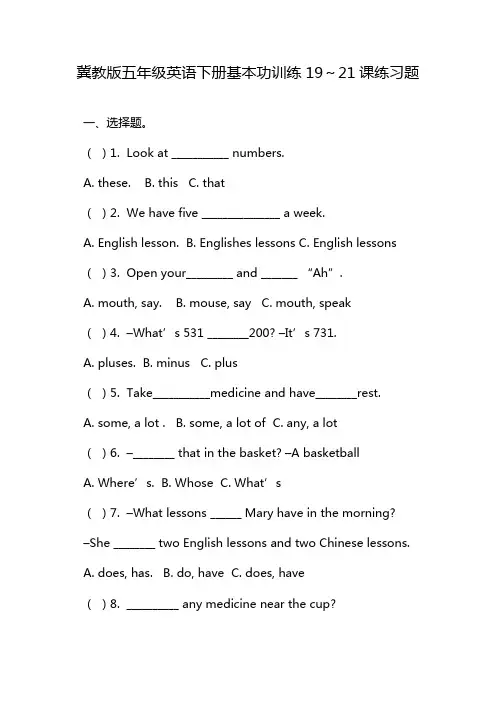
冀教版五年级英语下册基本功训练19~21课练习题一、选择题。
()1. Look at ___________ numbers.A. these.B. thisC. that()2. We have five _______________ a week.A. English lesson.B. Englishes lessonsC. English lessons ()3. Open your_________ and _______ “Ah”.A. mouth, say.B. mouse, sayC. mouth, speak()4. –What’s 531 ________200? –It’s 731.A. pluses.B. minusC. plus()5. Take___________medicine and have________rest.A. some, a lot .B. some, a lot ofC. any, a lot()6. –________ that in the basket? –A basketballA. Where’s.B. WhoseC. What’s()7. –What lessons ______ Mary have in the morning?–She ________ two English lessons and two Chinese lessons.A. does, has.B. do, haveC. does, have()8. __________ any medicine near the cup?A. There are.B. Are thereC. Is there二、情景交际。
()1. 当你想询问别人想喝什么,你会问:A. What would you like to eat?B. What would you like to drink?()2. 去商店买东西时,服务员会对你说:A. Can I help you?B. Can you help me?()3. 当你想表达“没问题”时,你会说:A.Wonderful!B. No problem.()4. 你想知道别人是否会做饭时,你会问:A. Can you do any cook?B. Can you cook?()5. 你想称赞别人的房间很漂亮时,你会说:A. My room is really nice.B.Your room is really nice.。
五年级下册英语21课
五年级下册英语21课21. My DayUnit 6: Healthy eatingIn the 21st lesson of the fifth grade English textbook, students will learn about healthy eating habits and how to talk about food and meals in English. This lesson aims to enhance students' vocabulary, reading, and speaking skills while also promoting the importance of a balanced diet.The lesson begins with a warm-up activity where the teacher introduces the topic by asking students about their favorite foods and meals. Students can take turns sharing their answers, allowing for class participation and engagement.Next, the teacher presents new vocabulary words related to healthy eating such as fruits, vegetables, grains, proteins, and dairy products. Handouts or flashcards with pictures and words can be used to facilitate understanding and memory retention.To introduce the concept of a balanced diet, the teacher can show visuals or use real food items to categorize different food groups. Students can be askedto identify which food groups each item belongs to and explain why they are important for our health.Once the vocabulary and concepts are introduced, the teacher can proceed to the reading activity. The textbook provides a passage titled "My Day" where a fictional character named Lily describes her daily routine, including her eating habits. The passage should be read aloud by the teacher, with proper intonation and emphasis on key vocabulary words.After the reading, the teacher can ask comprehension questions to check students' understanding of the passage. For example, "What does Lily have for breakfast?" or "What does she eat for lunch?" This encourages students to recall information from the text and practice their reading comprehension skills. Following the reading and comprehension questions, students can be divided into pairs or small groups to discuss their own daily routines and eating habits. They can take turns asking and answering questions using the target vocabulary words. For example, "What do you eat for dinner?" or "Do you like to eat fruits and vegetables?"To further reinforce the lesson, a group activity can be conducted where students have to create a healthy meal plan for a day. They can use magazines or online resources to find pictures of different foods and categorize them into food groups. Each group can then present their meal plan to the class and explain why their choices are healthy.Finally, to conclude the lesson, students can create posters or collages showcasing the importance of healthy eating. They can use pictures, drawings, and key vocabulary words to illustrate the concept of a balanced diet. The posters can be displayed in the classroom as a reminder for students to make healthy food choices.In summary, the 21st lesson of the fifth grade English textbook focuses on healthy eating habits. Through various activities such as vocabulary introduction, reading comprehension, speaking practice, and group activities, students learn about the importance of a balanced diet and how to talk about food and meals in English. By actively engaging students in the learning process, this lesson aims to promote healthier eatinghabits and improve English language skills simultaneously.。
新冀教版五年级英语下册《Unit 4 Did You Have a Nice Trip. Lesson 21 Look at the Photos.》教案_18
Lesson 21 Look at the photos!教材分析:本单元以“Did you have a nice trip ?”为话题,讲述了Li Ming、Danny、Jenny 回到家中,向他们的亲戚朋友讲述了这次的旅行经历。
在讲述时主要用到一般过去时描述过去发生的事情。
而本节课是第四单元的第三课,Danny 和Jenny给朋友Steven展示旅行时的照片并讲述他们这次的旅行经历,讲述时同样运用了过去时来描述过去旅行时发生的事情。
同时本课第二部分通过一般现在时和一般过去时的对比学习,使学生能更深刻的理解一般现在时和一般过去时。
学情分析:五年级学生已经有一定的词汇基础,接触了一些简单的词汇和句型,课堂上能够在老师的指导下顺利学习和参加一些教学活动,这个年龄段的学生对动画比较感兴趣,并且愿意和同伴交流,乐于分享。
所以本节课运用生动的课堂视频调动学生的学习积极性。
同时,让学生和同伴分享自己以前的照片,提高课堂参与度。
教学基本策略及设计思路:本课题是根据本学段学生学习语言的认知规律和《课标》提出的学习目标来设计的,以学生熟悉的生活情境和经验为基础,通过听、说、读、chant等活动让学生在情境中学,在学中学习语言、运用语言。
教学目标:一、语言技能目标:1、能根据录音模仿说英语;2、听懂课堂上的常用指令,并根据课堂上的简单提问和要求做出适当的反应;3、能在具体的情境中交流,巩固所学的词汇、句型;4、能根据照片写出简短的描述。
二、语言知识目标:1、学生能听懂、会说、认读并书写以下词汇:photo、was、were、happy;2、学生能继续加深对现在时和过去时概念的理解。
三、情感态度目标:1、体会英语学习的乐趣,乐于学英语,用英语交流,在各种活动中培养学生学习的兴趣;2、通过小组合作,培养学生的合作精神和竞争意识。
四、学习策略:培养学生的合作意识,遇到问题主动向同学或老师请教,在课堂交流中注意倾听,积极思考,提高学习效率,增强学习效果。
五年级下册英语教案-21 Look at the Photos |冀教版(三起)
Lesson 21 Look at the Photos一、教学目标1.知识目标:(1)能听懂、会说、会读、书写词汇:was, were,photo,happy。
(A,B,C)(2)初步感知含有be 动词的句子在过去时态表达中的用法,尝试在情境中灵活运用。
(A,B,C)2.学习策略目标:通过独立阅读发现新知,在不同时态的语句对比中发现规律,形成自主学习能力。
(A,B,C)3.情感与态度目标:(1)通过丰富的图片资源激发学习兴趣。
(A,B)(2在观察描述照片的描述中体会摄影作品带给人们视觉和心灵的冲击,引导学生心中有爱,崇尚亲情。
(A,B)(3)采取小组活动和评价的形式,培养学生竞争合作意识。
(A,B)二、重要单词: was,were,photo,happy。
三、重点句型:I am happy today. I was sad yesterday.He is 8 years old this year. He was 7 years old last year.We are in Canada this week. We were in China last week.四、教学重点:感知be动词的过去式形式,巩固和扩充学生动词过去式的词汇,学习使用过去时态。
五、教学难点:正确使用一般过去时,并有意识地运用过去时态描述照片。
六、课前准备:ppt、自己的照片七、教学过程:Step I Class Opening教师与学生互致问候。
师:Hello, boys and girls.What did you do yesterday ?生:I watched TV . I walked to the park.I did my homework .…(由B组学生先回答,再由C组学生回答,A 组学生做补充或评价。
)师:What do you do on Sundays ?生:I watch TV on Sundays. I walk to the park on Sundays.I do my homework on Sundays.…(由B组学生先回答,再由C 组学生回答,A组学生做补充或评价。
Unit4 Lesson21 Look at the Photos(教学设计)冀教版(三起)英语五年
Unit4 Lesson21 Look at the Photos(教学设计)一、教学背景本教学设计适用于冀教版(三起)英语五年级下册 Unit4 Lesson21 Look at the Photos。
二、教学目标1.了解表示人物、食物、动物和地点的英文单词。
2.掌握描述图片的句子,如“Look at the…”和“There is/are…”。
3.能够用英文描述自己或他人的照片。
4.培养孩子们观察、描述事物的能力。
三、课前准备1.教师准备课件、图片和学生练习册。
2.确保学生已经学习了表示人物、食物、动物和地点的英文单词。
四、教学过程步骤一:引入新单词1.教师出示人物、食物、动物和地点的图片,让学生尝试用英文说出图片中的物品。
2.介绍新单词及其拼写。
步骤二:观看图片1.教师出示照片,让学生欣赏照片并尝试描述。
2.教师设计问题引导学生,如“Look at the photo. What can you see?”和“What is in the photo?”。
3.引导学生使用“There is/are…”描述照片中的物品,如“There is a cat in the photo.”或“There are three children in the photo.”步骤三:活动练习1.教师将学生分成小组,给每个小组发放几张照片。
2.学生自己或合作伙伴使用英文描述自己的照片。
3.学生轮流上台,将自己的照片展示给全班,其他学生则用英文描述。
步骤四:练习册教师分发练习册,让学生独立完成练习册上的相关练习。
五、课后作业1.复习本节课所学单词和句型。
2.查找并记忆新单词。
3.设计类似步骤三的活动,邀请家长或朋友来展示自己的照片,并用英文进行描述。
六、小结本课教学通过引入新单词、观看图片、活动练习和练习册的方式,让学生通过视觉、听觉、口语和笔头等方式全方位掌握本节课的内容。
通过本课的学习,孩子们不仅扩展了词汇量,还进一步培养了观察能力和描述能力,从而驱动感性认知和形成美好的语言习惯。
2019年三年级英语上册 Lesson 21 Look at Your Hair教案 冀教版
2019年三年级英语上册 Lesson 21 Look at Your Hair教案冀教版一、教材分析:本课学习有关头发形状的单词,还有一个头发的颜色的单词,和大小的描述,以单词教学为主,句子教学为拓展。
要求学生能根据实际用本课所学描述不同人的头发,同时让学生能将所学的内容与生活联系起来,真正的运用到生活中去。
二、学生分析:班内许多学生都已经熟练掌握前面课时所学的有关身体各部分的名称。
且经过了一段时间英语方面的的培养和训练,学生熟悉教师的课堂用语,他们喜欢上英语课,特别是游戏以及在一定的真实的语境中学习英语更受他们的欢迎。
三、教学目标:1、知识方面:听说读词组 long hair, short hair, straight hair , curly hair2、能力方面:能用本课所学描述不同人的头发。
3、情感态度方面:关注学生的情感,营造宽松民主和谐的课堂气氛,通过多样性的活动和教学评价,激发学生学习英语的兴趣和积极性四、教学重点:听说读词组 long hair, short hair, straight hair , curly hair五、教学难点:学会描述不同类的头发,如何在实际生活中运用本课所学知识。
六、教学准备:1、教师:(1)有关身体部位的单词图片。
(2)不同头发的图画。
(3)本课录音带。
2、学生:单词小卡片,彩笔。
七、设计理念:1、创设学习英语的氛围,发挥学生的主动性和创造性。
2、学生是学习活动的主体,教师是教学活动的组织者和引导者,本课的教学活动通过演一演、画一画等多种形式展开,其目的就是为了激发学生学习英语的兴趣。
3、采用合作的学习方式,利用学生间的信息差,通过小组间的合作,大家互相帮助,一起努力,更好的巩固本课的内容。
4、设计任务,让学生在真实操练中运用新知,发挥学生的想象力和创造力。
八、教学过程:Step1:Greetings and review(问候和复习)1 Sing <<how are you>>song2 复习表示颜色的单词师问:What color is it?3、Chant: Head、 head 动一动,head、 head; Hand、hand谣一摇,hand、hand;arm 、arm 晃一晃,arm、arm;leg 、leg抬一抬,leg、leg;foot、foot 跺一跺,foot、foot;身体body锻炼好,妈妈夸我好宝宝。
冀教版小学英语五年级下每课练习
冀教版小学英语五年级下每课练习Lesson17---lesson 18一、写单词信明信片电脑纸电子邮件寄左右顶部下部角邮票地址二、词组写一封信在纸上在左边在电脑上明信片的上部在右边多少钱明信片的下部把寄给一张故宫的图画一张我旅馆的图片右上角三、单选题1. We can write an e-mail on________.A. a paperB.a computerC. a postcard2. I want to _________ this postcard to my mum and dad.A. takeB. makeC. send3. How much _________ this postcard?A. forB. withC. to4. I’ll ________ nine postcards.A. takeB. makeC. lake5. Look _______ my letter.A. toB. toC. on6. This is the top ______ the postcard.A.ofB.inC. on7. Li Ming’s hotel is _______ the Wangfujing Street.A. nearB. farC. under8. We are _________ fun in Beijing now.A. haveB. hasC. having.9. Don’t _______ the stamp and the address.A. rememberB. haveC. forget10. Let’s _______ a postcard.A.writeB. writesC. writing四、连词成句Some, I , postcard , to , want , buy _________________________________________________ . This , panda , it , has , postcard , a , on ____________________________________________________. Want , to , send , this , letter , to , my , mum________________________________________________. The , the , of , in , right , corner , postcard , top _______________________________________________.五、简答Where do you write an e-mail? ________________________________________________Where do you write a letter? ________________________________________________Where do you write on a postcard? _______________________________________________Where do you put the address on a postcard? _________________________________________Where do you put the stamp on a postcard? _________________________________________1.写出中文e-mail letter postcard paper computer write send top bottom left right corner stamp miss address forget2.翻译成中文This is an e-mail.You write an e-mail on a computer.A postcard has a picture on it.This postcard has a picture of the Palace Museum.I want to send this postcard to my mum and dad.How much for this postcard? One yuan.I’ll take nine, please.This is the top of the postcard.the bottomWhere do you write on a postcard? On the left.Where do you put the address? On the right.Where do you put the stamp? In the top, right corner.Wangfujing Street has many shops.We are having fun in Beijing.Our hotel is near Wangfujing Street.I miss you.Don’t forget the stamp and the addres s.Lesson 19----Lesson 20一、按要求写词baby的复数top反义词young反义词send第三人称单数left反义词stamp复数need现在分词二、短语英汉互译buy stamp your letter nine postcardssend a letter 在邮局直着走左拐弯右拐弯打扰了写一封信in the top, right corner write…to..at the bottom, left corner send…to…buy…for…三、单选题1. I need a ______ for my letter.A.stampB. stampsC.envelope2.How much ______ the apples?A.isB.areC.am3. I am sending _____ postcards to Nanjing.A.areB.thisC.these4. I ______ a friend in China. He ________ a friend in China,too.A. have, haveB. have, hasC.has, has5.Now I am putting the letter _______ an envelope.A.inB.onC.at6. Can you point _____ the bottom ______ the envelope?A. to,ofB. at,toC.to,at7. I am writing a letter _______ my father.A.atB.toC.for8. Go straight ______ the street.A.toB. downC.in9. Turn left ______ the traffic lights.A. atB.inC.on10. Beijing is ______ than Shijiazhuang.A. bigB. bigerC.bigger四、用下列六词填空to, in, on, with, at, downWhere do I write the address _______ this postcard? _______ the right.Where do I put the stamp? ______ the top, right corner.Danny lives _______ his mother.Turn left _______ the traffic lights.Go straight ________ this street.He is sending these postcards _______ Canada.五、英汉互译句子1. Don’t forget the stamp and the address. _______________________________________________2. 我在把信放进信封里。
冀教版小学五年级英语必备词组短语
小升初英语必备短语(1-50)1. a bit (of) 有一点儿2. a few 一些;少量;几个a little一些;少量3.a group of 一群4. a kind of 一种;一类5. a lot of (lots of)=a number of 许多a number of 一些;许多6. a pair of 一双;一副7. a piece of "一(块,张,片,件)"8. according to 按照;根据9. after class 课后after all "终究, 毕竟"10. after school 放学后11. agree with sb/ to+V. 同意某人的意见/某事12. again and again 反复地;在三地13. all over 到处;遍及;结束14. all right 行了;好吧;(病)好了15. all the best 一切顺利;all the same 还是, 仍然16. all the time 一直17. all the way 一路上18. and so on 等等19. apologize to sb. for sth. 为某事向某人道歉20. arrive at / in a place 到达某地21. as well 也;又22. ask for 请求;寻求23.at breakfast /lunch /supper 早/午/晚餐时24. at first / last 起先;开始的时候/ 最后;终于25. at home 在家(里)26. at least / most 至少/ 至多27. at once 立刻;马上28. at present "现在, 目前"29. at school 在学校;在上课30. at the moment "此刻,目前;那时,当时31. at the same time 同时32. at work 在工作33. at the / on weekends 在周末34. be able to 能够(有能力)35. be afraid of 害怕36. be angry with sb. 生某人的气37. be bad for 有害于38. be born 出生于39. be busy with / doing sth. 忙于做某事40. be careful with 小心41. be covered with 被……覆盖42. be different from 与……不同43. be familiar to 对……熟悉44. be famous for 以……而著名45. be fond of 爱好46. be full of 充满47. be good / poor at 善长于/ 对……比较差48. be interested in 对……感兴趣49. be keen on 喜爱;喜欢;热衷于50. be late for …...迟到小升初英语必备短语(51-100)51. be located (in/on/at) 位于52. be made of 由……制成53. be made up of 由……组成54. be on "上演, 上映"55. be pleased with 对……满意56. be proud of 为……而感到自豪57. be/get ready for 为……作准备58. be surprised at 对…...感到惊奇59. be thankful to sb. 对某人很感激60. be/get used to+v-ing 习惯于61. be worried/serious about 为……而担心62. because of=thanks to 由于63. belong to 属于64. break out 爆发break into "闯入, 破门而入"65. by air mail 寄航空邮件66. by bus 乘公共汽车67. by oneself 亲自68. by phone 打电话69. by the way 顺便说;顺便问一下70. call on 拜访71. care for 照顾;喜欢72. carry out 执行73. catch (a) cold 着凉;伤风;catch up with 赶上(或超过)74. change one's mind 改变主意75. check in 办理登机76. come across 被理解;遇见;come back 回来;想起来77. come from 出生于;来自78. come on 快;走吧;跟我来;come out 出来;(书等)出版,发行79. come to an end 结束80. come to know 知道81. come to life 显得逼真;苏醒82. come true 实现come up with追上;赶上;想出(主意);找出(答案)83. communicate with 与……交流84. compare with 与……比较;congratulate …on…祝贺……85. cover an area of 占地面积86. cut down 砍倒87. deal with 处理88. depend on "依靠,依赖"89. die of 因…病而死different from 与…不同90. do one's best 尽最大努力91. do sb. a favour 帮某人忙92. do some shopping 买东西(cleaning)93. do with 处置, 处理94. dream of 梦见95. dress up 穿着打扮96. each other 互相97. eat up 吃光, 吞噬;earn one’s life 谋生;either…or…或者……或者……98. enjoy oneself 过得愉快99. enter for 报名参加;even if / thought 即使;尽管100. fall off 从…...跌落小升初英语必备短语(101-150)101. far away (from) (离)遥远;far from远离;feel like doing 想要……;感觉要……102. fill in "填充, 填写" fill …with …用…填充103. find out 找出;查明;了解104. finish off 吃完;喝完first of all 首先105. for ever 永远106. for example 例如107. for the first time 第一次108. for the time being "暂时,眼下";from …to…从……到……109. from door to door 挨家挨户110. from now on 从此以后;今后111. from time to time 不时;有时112. get along / on (with) 进展;与…….相处;go away 逃离113. get back 返回114. get in 进入;收集115. get in the way 挡道116. get off 下车117. get on 上车get on with与…….相处118. get ready for 为……作准备119. get rid of 摆脱120. get tired of 对……感到厌倦121. get to 到达get together 相聚;联欢122. get up 起床123. give back 归还;送回124. give out 分发125. give sb. a hand 助某人一臂之力126. give up 放弃127. go ahead 先走;向前走;去吧;干吧;go away 走开;离去128. go shopping / bowling 去购物/ 打保龄球129. go for a swim 去游泳go for a walk 散步130. go home 回家131. go in for 参加;从事于;酷爱132. go on 继续133. go on a diet 实行节食134. go on a picnic 去野餐135. go on with / doing sth. 继续做某事136. go out 熄灭137. go over 复习;仔细地再读一遍138. go sightseeing 去观光139. go to (the) hospital 去医院(看病)140. go to bed 就寝141. go to college 上大学142. go to school 上学143. go to sleep 入睡144. go to the cinema / movie(s) 去看电影145. go up 走上前去146. go wrong 出错147. grow up 成年;长大148. had better 最好还是;还是……好149. hand in 上交hand out 分发150. happen to do 碰巧做小升初英语必备短语(151-200)151. happen to sb. 发生到某人身上;have fun with玩得高兴;have fun doing…玩得高兴152. have (got) to 不得不153. have a class / lesson 上课154. have a good time 玩得很愉快;过得很愉快155. have breakfast 吃早餐156. have no idea 不清楚157. have pity on sb. 怜悯某人158. have sports 进行体育活动159. hear from 收到……来信160. hear of 听说161. help sb. with sth. 帮助某人做某事;help oneself to …请随便吃点……162. here and there 到处163. hold a meeting 举行会议164. hold on 等一等(别挂电话)165. hold one's breath 屏住呼吸166. hold up 举起167. huge amounts of 大量的;hundreds of 几百;成百上千168. hurry off 匆忙离开hurry up 赶快;快点169. in a hurry 匆忙;很快地170. in a minute 一会儿in a word简言之;总之171. in addition 另外172. in all 总共173. in charge of "主管,负责";in danger 处于危险状态174. in English 用英语175. in fact 事实上;实际上176. in front of 在……前面177. in hospital 住院178. in line 成一排;成一直线179. in no time 立刻180. in one's fifties 在某人五十多岁时181. in one's opinion 根据某人看法182. in order 按顺序;in order to 为了;in other words 换句话说183. in return 作为回报184. in surprise 惊奇地;in public 当众;公开;in surprise 吃惊;惊讶185. in the end 最后;终于186. in the future 在将来187. in the middle of 在……中间188. in the years to come 在即将来临的几年里189. in this way 这样190. in time 及时instead of 代替;而不是191. in trouble 处于困境中192. instead of 代替;而不是193. join in 参加;加入194. just a minute 等一下195. just now 现在;刚才196. keep doing sth. 继续做某事197. keep fit 保持健康keep one’s word 守信198. keep... from 使……不做199. keep in touch (with) (与……)保持联系200. keep off 阻挡;不让……接近小升初必备短语(201-250)201. keep quiet 保持安静202. keep sb. busy 让某人忙个不停203. knock over 撞倒;撞翻204. later on 过后;后来205. laugh at 嘲笑206. lay the table (饭前)摆好餐具207. learn…from 向……学习208. leave (secondary) school (中学)毕业209. leave a message 留个口信210. leave for 动身去211. less / more than 少于/ 多于212. let out 放出213. line up 整队;排成行214. listen to 听……(讲话)215. live on 靠……为生216. look after 照料;照顾;look down upon 看不起;轻视217. look at 看;观看218. look for 寻找219. look forward to+V-ing 期待着220. look like 看上去象;显得221. look out of 从……朝外看222. look up 查寻;抬头看223. lose one's way 迷路224. lose weight 减肥225. make a face 做鬼脸;做苦脸;make a film 拍电影226. make a fire 生火227. make a living 谋生228. make a mistake 出差错;犯错误229. make a noise 弄出声230. make friends with 与……交朋友231. make fun of 拿…...开玩笑232. make money 挣钱;赚钱233. make the/one's bed 整理床铺234. make out 辨认出235. make progress 取得进步236. make up one's mind 下决心237. meet the needs of 迎合……的需要238. meet with 遭遇239. more or less 或多或少;neither…nor…既不……也不……;next to 紧挨着;紧靠着240. no longer / not …any more/longer 不再241. not…at all "(用来加强语气)一点也不,根本不"not only …but also…不仅……而且……not so…as 不像……;不如……not till / until …直到……才……242. now and then /again 时而;偶而243. of course 当然244. of one's own 属于某人自己的245. on business "有事, 出差" 246. on duty 值日;值班on foot 步行;走路247. on holiday 在休假248. on one's side 在某人一边249. on show 在展出250. on the other hand 另一方面小升初英语必备短语(251-335)251. on the phone 在听电话252. on the right 在右边253. on the/one's way (to) 在去……的路上254. on time 准时255. on weekdays 在工作日256. once a day 每天一次once again 在一次257. once every four years 每四年一次258. once more 再次259. once upon a time 从前;很久以前one after another "一个接一个,连续地" 260. one another 互相261. operate on sb. 为某人动手术262. out of 从……里出来;缺乏263. out of work 失业out of date 过时264. over and over 再三;一遍又一遍265. over there 在那边266. pass by 经过pay for 付…...钱;买267. pick out 挑选出268. pick up 拾起269. play a trick on 捉弄270. play with 玩弄271. plenty of 许多272. point at 指向;指着273. point out 指出274. praise sb. for sth. 为某事表扬某人275. prefer…to (比起……来)更喜欢276. prepare for 准备277. protect…from 保护……免受prevent …from…妨碍;防止;预防278. pull down 推倒279. put down 记下put off 延期;推迟280. put on 穿;戴上;上演281. put out 伸出;扑灭282. put up 举起;挂起283. rely on 依靠284. right now "立刻,马上"285. ring up 打电话给……run after 追捕;追踪286. run away 逃跑run out of 用完287. save one's life 挽救某人生命288. search for 搜寻;搜查289. see…off 为……送行290. sell out 售完291. send for 派人去叫……292. separate …from 分开293. set free 释放;解放293. set off 动身;启程;使爆发294. set out 出发;开始295. show off 炫耀296. so far 到目前为止297. so…that 太……以至于……298. sooner or later 迟早;早晚299. speed up 加快速度300. spend …on 在……花钱301. stand for 代表302. stop doing sth. 停止做某事(不再做……)303. stop to do sth. 停下来做某事(开始做……) 304. such as 例如305. take away 拿走306. take it easy 别着急;别紧张307. take off 脱下;起飞308. take one’s time 从容;别紧张309. take out 取出310. take place 发生311. talk about 谈论;议论312. the day after tomorrow 后天313. the day before yesterday 前天314. the more…the more 越……就越……315. the other day 前几天;某日316. think about 考虑(是否去做)317. think of 想起;考虑;认为;看法318. thousands of 成千上万;几千319. throw away 扔掉320. too…to…太……以至于不……321. try on 试穿;试试看322. try out 试验323. turn down 关小;调低324. turn off 关掉(水、电视、收音机等) 325. turn on 打开(水、电视、收音机等) 326. turn over 翻动;梨翻(土地) 327. turn up 到达;来到;开大(声音等) 328. up and down 上下,来回329. used to do sth. 过去常常330. wait for 等候,等待331. wake up 醒来332. work out 算出,解决333. worry about 担心,烦恼334. write down 写下,记下335. write to 写信给…。
九年义务教育2020年编五年级英语下册Unit4DidYouHaveaNiceTripLesson21LookatthePhotos作业冀教版三起
Lesson 21 Look at the Photos!一、读一读,判断单词是(T)否(F)同类。
二、单项选择。
( ) 1. ______ you _____ your nose yesterday?A. Did; hurtsB. Do; hurtC. Did; hurt ( ) 2. I often _____ books on weekends.A. readB. readsC. reading ( ) 3. I bought a T-shirt _____ you.A. toB. onC. for( ) 4. It is ____ small for you.A. tooB. toC. just三、按要求完成下列各题。
1. there, by, we, bus, went (.) (连词成句)____________________________2. I had fun in Beijing. (改为否定句)____________________________3. I am happy today. (用yesterday改写句子)______________________________答案:一、1. T 2. F 3. F 4. T 5. T二、1. C 2. A 3. C 4. A三、1. We went there by bus.2. I didn't have fun in Beijing.3. I was happy yesterday.赠送试卷五年级Module2T,不同F。
( )1.She danced in a lot of _____.A.cityB.citysC.cities( )2.Did she learn any ____?A.foreign languagesB.foreign languageC.foreign English ( )3.She is a ____ .A.danceB.dancerC.teach( )4.He ____ English last year.A.is learningB.learnC.learnt( )5.Ten years _____ , I was a child.A.agoB.beforeter( )6.Ms Smart learnt ___ .A.danceB.to danceC.dancing( )7.-- _______are they? --They’re my grandparents.A.WhoB.WhatC.Whose( )8. --What she yesterday? --She made a cake.A.do, didB.did, didC.did, do( )9.He ______English now.A.learningB.is learningC.learnt( ) 10.Five years ago, he _____ to school. Now he to school by bus.A.Walked, wentB.walks, goesC.walked, goes三、选答语。
英语说课题目(小初高)
小学英语说课题目(五选一)1、义务教育教科书英语五年级下册unit1: 河北教育出版社Lesson 2 What Are You Doing ?………………………………………P4-52、义务教育教科书英语五年级下册unit4: 河北教育出版社Lesson 21 Look at the Photos!……………………………………P60-613、义务教育教科书英语六年级下册unit2: 河北教育出版社Lesson 9 Eat More Vegetables and Fruit!…………………………P24-254、义务教育教科书英语六年级下册unit3: 河北教育出版社Lesson 16 Li Ming’s Summer Holiday……………………………P44-455、义务教育教科书英语六年级下册unit4: 河北教育出版社Lesson 21 A Party for Li Ming……………………………………P60-61初中英语说课题目(五选一)1、义务教育教科书英语八年级下册unit 7: 人民教育出版社Section A What’s the highest mountain in the world ?……P49-502、义务教育教科书英语八年级下册unit 10: 人民教育出版社Section A I’ve had this bike for three years .………………P73-743、义务教育教科书英语九年级全一册unit 2: 人民教育出版社Section A Full Moon, Full Feeling………………………………P114、义务教育教科书英语九年级全一册unit 6:人民教育出版社Section B Do You Know When Basketball Was Invented?…………P46-475、义务教育教科书英语九年级全一册unit 13:人民教育出版社Section B Rethink , Reuse, Recycle !…………………………P102-103高中英语说课题目(五选一)1、普通高中课程标准实验教科书英语必修4 UNIT 4: 人民教育出版社GRAMMAR: THE -ING FORM AS THE ATTRIBUTE AND ADVERBIAL………P29 2、普通高中课程标准实验教科书英语必修4 UNIT 2: 人民教育出版社READING : PIONEER FOR ALL PEOPLE………………………………P10-11 3、普通高中课程标准实验教科书英语必修4 UNIT 1: 人民教育出版社SPEAKING AND WRITING :………………………………………………P7-84、普通高中课程标准实验教科书英语必修5 UNIT 2: 人民教育出版社READING : SIGHTSEEING IN LONDON…………………………………P14-155、普通高中课程标准实验教科书英语必修5 UNIT 5: 人民教育出版社READING : FIRST AID FOR BURNS……………………………………P33-352。